French Republic Justice Palace in Paris, France

How to Apply For French Citizenship Part IV, Part 1: Decision

To see a video discussion of the information in this article click here.

So on February 25th, roughly three months after my citizenship interview, I got an electronic notice that I should re-apply in two years because of “insufficient professional integration.” I appealed that decision, because it would be silly for me not to, since even if I accepted the decision I would have to start the process all over again in two years.

The way the appeals process works is that if you receive no reply within four months, that is considered an implicit rejection, and you have to sue in Nantes as your final recourse. That meant June 25th would be a final decision, of sorts.

I had no intention of suing, as I knew (and had suspected) that my income might have been an issue.

Some of you reading this have not been on this immigration journey with me for the last decade so I’ll give you the quick version.

In 2013 I moved to France on a visitor visa which I renewed in 2014. In 2015, armed with proper information thanks to people like Jean Taquet (not intolerable Karens in FB groups), I applied for a PL visa which would allow me to work in France, give me a longer renewal window (4 years), and open the possibility of citizenship. My plans of “apply for citizenship the moment I am eligible” faded into the rear-view mirror, along with annual visits to the prefecture to renew my visa.

It’s important to remember here that the income bar necessary to renew your carte de sejour is very different from the bar necessary to obtain a ten-year card or citizenship.

The SMIC, a fixed national minimum wage, is really all you need to obtain a visitor visa, and SMIC + 20% is all you need to obtain and maintain a 4-year card (no, that’s not in writing anywhere: the French government isn’t in a habit of providing clear instructions on immigration requirements).

This is where my being an American, and being an American business owner for twenty years, really influenced my actions.

Most Americans have an aversion to taxes in general, as our country was (ostensibly) founded on a tax revolt. Most people in our country feel like we already pay too much in taxes, and aren’t interested in paying more, no matter what the consequences are to the country as a result.

Furthermore, the US tax code is built around small businesses. The expense deductions that businesses can take allow small businesses to grow and thrive. I know because I’ve seen it myself, having built multiple companies from scratch, including the one I sold that allowed me to move to France in the first place.

So, as I stood up my new French profession libérale business, I created a US equivalent (and later one in the country of Georgia as well) that would allow me to have options on how and in which tax jurisdiction I billed my clients. France has no moral or legal right to require me to do all my business in France, and besides, the PL comes with an income cap of around 85k anyway, so even if I abided by the “keep all my income in France” thinking that France would like me to consider, at some point I would have to bill elsewhere to stay under the cap.

But it never got that far, because I was very unhappy with my first business tax return in France. I was unpleasantly surprised to find out that many of the deductions I had been used to as a US business owner had no equivalent in France, and that what was a much smaller portion of my expenses in America, namely social charges + income tax, were roughly doubled in France, but for no additional benefits to my business.

Let’s clarify a couple of things. There’s no “free education” in France; there’s just education that is paid for by heavy taxation put on everyone. There’s no “free healthcare” either. Not only do all of us pay into a fund that pays for health care, but even at the point of service it’s 70% paid. You have to pay for the rest yourself or via a private insurance plan you pay for. Life in France for me is not beautiful because of the welfare state, it’s beautiful because of the wonderful people in it and the culture they create and uphold.

So, France delivered, and continues to deliver, an incredible lifestyle, one that I love. And yet, I was unwilling to opt for double taxation for it. I was willing to meet the minimum necessary to keep my carte de sejour, not more.

To put this in terms of euros and cents, had I billed more of my clients to my French business over the last five years, which would have been the perfect showcase for my citizenship dossier, I would have paid north of an additional 50,000€ in taxes and social charges, at minimum.

Many would argue, in a world in which citizenships go for millions of dollars (Cyprus, New Zealand, Singapore), why not just pay the 50k? The short answer is, I don’t have that extra money. That 50k I saved paid for trips to every single European country save three (Belarus, Ukraine, and Russia). It paid for trips to Singapore and the US to see my family. It paid for not one but three trips to New Zealand and three to Australia.

Was I willing to give all that up to have a citizenship that would allow me to live in France forever? My actions spoke for me: no.

The Consequences

I have always told everyone, for years, that France is the most anti-business country in Europe and that I only started a business there to have a path to citizenship, and the minute I got that citizenship, I would close the business down.

The logic still holds. Because I didn’t get citizenship, and I’m unwilling to pay more in taxes because of fundamental beliefs and practical reasons, I am going to close my French business. I’ll document that, as I have so many other things, to make sure others have help if and when they have to close their businesses. But that also means that I’ll lose my current immigration status and will have to change it or leave France when my carte de sejour expires in January 2026.

I have an incredible life in France, but I traveled a lot in 2022 and 2023 for personal and professional reasons, and the reason I put in for citizenship in the first place, despite having been eligible for five years already, was that I was considering leaving France for an extended period. It seems now is the right time to do that.

Starting Over

I’m certain many of you might be asking, “Aren’t you afraid of having to start all over?” The answer is no, because it’s not clear to me that my future is in France. This beautiful country has every right to restrict who becomes a citizen and I accept France’s decision.

There’s a big beautiful world out there, and I’m going to see more of it. I’m incredibly grateful for my dozen years in my beloved France. It very much changed my life.

It’s important to always maintain the prerogative in your life to not be bound to scripts or patterns of behavior. Always reserve the right to do what makes the most sense in your life, even if it’s difficult or challenging.

And I still have much I want to share about French life and adapting to it, so I’ll still be writing here at TAIP and appearing with Molli on our YouTube channel, taip on tape.

Thanks for joining me on the French segment of my journey, and I will continue to assist others who wish to come here.

I delayed posting this article for a few months because this decision interrupts our series, which still needs to be finished. I continue to solicit among Americans I know who have completed the process par decret. If you know anyone who fits that bill who would like to write, we only need these two final parts: decision (which we will label Part 2) + ceremony. Use the contact us form to recommend a friend. 

Photo by Nathan Cima on Unsplash

Did you enjoy this article? TAIP is 100% reader-supported through tipping. If you want to leave us a tip of any amount it would be highly appreciated. These tips help support our efforts to keep TAIP an ad-free environment. Just as at a cafe, the tips are split evenly among the team.

How to Apply for French Citizenship, Part I: Documents

I suppose ever since I began this blog in 2013, this article was in the works. But in my early days of life in France, I always thought I would apply for citizenship on the very day I became eligible. But that day passed more than four years ago. Why did I only just recently apply and what did I need to do in order to make that happen? Get comfortable; I’ll tell you all about it.

Why Didn’t I Apply Sooner?

When I first moved to France, I, like many fellow immigrants, felt great instability in my new home. I had no sense of my rights as a legal resident of France and I lived with an (irrational, unfounded) fear that I could be deported at any time for any reason. I truly feared that I might not get my visa renewed the first time because I might be missing a key piece of paperwork I would not be told about.

But then, with help, I figured out French bureaucracy and lost my fear. Once I got my first four-year card, I wasn’t dreaming of doing more paperwork (which is what applying for citizenship meant). I was enjoying my freedom! No trips to the prefecture for FOUR YEARS. 

Further, as I tell people often, if you are a French resident and you have a Class A passport, like my dark blue American one, French citizenship only really gives you the right to vote. It doesn’t really give you significantly more in the way of visa-free travel and it doesn’t convey any additional rights for your life in France. “I’ll get to that later,” I thought. Indeed, Covid had shown me that French residency was good enough to get me in and out of France in the middle of a worldwide crisis. Who needed to rush the citizenship process?

Yet, after some extensive travels outside France in the last two years doing research for a book, I decided it was high time to address this issue and I started the process (I alluded to some preliminary steps in a previous article). Citizenship would give me the option to be gone from France for an extended time — years, even — if I needed to work on a project. It also would mean I would never have to go to the prefecture for a visa issue again.

First, Get Your Papers

As you progress in your French residence and citizenship journey, you’ll need papers for renewals and new statuses that you didn’t need at the beginning.

For example, when it came time to renew my visitor visa the first time, they asked for a translated birth certificate. My story behind that is related here.

As I progressed in my Profession Liberale journey, they would ask for invoices and tax returns, the latter of which you couldn’t possibly have at the first application, because your business wasn’t yet open.

When you get to a ten-year card, you’ll need to show language competency at the A2 level, minimum.

Citizenship is all that paperwork, plus.

The plus is information about your family.

“Have a Folder”

There are many great lessons I take from my parents. One that I’ve very much adhered to over the years was my mother’s admonition to always “have a folder” with my key documents: birth certificate, baptism, confirmation, passport copies, etc. Not only do I have digital copies of all these items in a secure place in the cloud, accessible anytime around the world, but I have paper copies in a folder that is entrusted to one of my sisters.

So when it came time to get three necessary documents for my citizenship application, I thought it would be a breeze. Surely, I thought, my mom will have her birth certificate, my father’s birth certificate, and their marriage certificate, all in one folder, just like she always taught me.

She did not.

First, let me give you some context. My father passed away in 2018, and those who have gone through the bereavement of a loved one know that after the initial flurry of dealing with banks and credit cards and the government, you don’t necessarily think about nor keep track of the vital documents of your deceased loved one.

Further, my mom, for various reasons, did not have a need for official documents. Those of us who live outside our countries of citizenship always know where these documents are. For the rest of the world, life is much more simple. My mom currently lives a simpler life.

So, once I realized that not only did my mom not have a “folder,” but that she didn’t immediately have a solution to my needs, I realized I would need to work my own angles while she worked hers.

Look Online

My father was born in Los Angeles and a basic search led me to VitalChek, a website that looked like it had been designed about ten years ago, but had fairly decent reviews online.

I opted for a copy from the LA County Registrar ($32) + UPS Next Day Air Saver ($18.50) + VitalChek fee ($9) for a total of $59.50 USD

Once you place your order you will immediately be told your order is on hold pending a notarized document from you. I went the very next day to get the document notarized, and then I scanned and uploaded it.

Ten days passed, and they told me that they needed to verify the mother’s maiden name. I called in and verified it.

For some unknown reason, the case remained stuck for two more weeks until I called again to find out the status. The person I spoke to escalated the case, and less than a week later, I had a certified copy of my father’s birth certificate at a US address I had specified.

Keep in mind that this was only the first part of this process. The French would also need to see a translated version of this, because the French bureaucracy doesn’t “understand” English. It’s the same with countries worldwide, so it’s totally understandable.

Ask Other Family

My mom’s youngest sister, for her part, did adhere to the “keep a folder” routine, and she had a laminated copy of my mom’s birth certificate in a folder she had compiled when her mother, my maternal grandmother, had passed away some years ago. I wired her money and she sent that original to me by mail. It took a few days to arrive from Singapore to the States (I wanted all the documents going to a single location, and I would happen to be in the States when they arrived).

Hope Among the Boxes

In the meantime, my mother, who had responded originally with, “tell the French your mother doesn’t have a copy of the marriage certificate,” had started looking through boxes. A couple days later she found a certified true copy of their marriage. The part of me that pauses when looking at documents that are fundamental to my existence — this document was witnessed by people, including my parents, who at the time couldn’t know me or my part in their story — took a moment to look at the document lovingly. The practical side of me wanted an additional document in case the French didn’t like this one.

The Singapore government, efficient as always, got me a Certificate of Marriage (with a QR code, even!) within a couple weeks of requesting it.

Now with all these documents in my hand, the translator could move forward. But interestingly enough, Fields Granville, who has been my trusted translator for some time, didn’t need the originals to do their work. In fact, the entire process is digitized now, so I didn’t even need to send these originals to the prefecture (at least not right now). 

Within ten days they had all the documents translated and the one part of my application that wasn’t dependent solely on me was complete. The cost of translation varies based on your specific documents (it’s literally charged by the word) but you can expect costs to be anywhere between 200-400€. More if you are rushing. But why would you rush a citizenship application?

Moral: keep hope alive. In the meantime, do the work.

FBI Paperwork

If you have lived in France for fewer than ten years, you’ll need a fingerprint-based criminal background check from your home country. At the time I started the process I had been in France nine years and two months and I didn’t want to wait another ten months just so I could skip this process.

While some countries around the world now accept electronic fingerprints, at the time I went through the process, the FBI required traditional on-paper fingerprints for the background check. Thankfully, Eve Humrich of Fingerprints Paris was there for me, and I stopped by her office and got it done. Please follow her directions regarding your hands, i.e. unless your skin is very moist, try to use hand cream as much as possible before the appointment. Thinking that I had “no dry skin problems” I didn’t think I needed the cream, but the reality is that most problems with illegible fingerprints are due to dry skin. She had some lotion for me there and my skin was just moist enough for us to pull the prints necessary, but it would have been easier for us if I had just used lotion in the days before as she had directed me to.

You then send these fingerprint cards to the FBI (if you’re an American — to the equivalent agency if you’re not an American) along with your order (which has a barcode). Two weeks later I received an email saying that I had no criminal history. I printed out this email (no formal letter was mailed) and added this to the documents I needed Fields Granville to translate.

Next, Start the Process

Now, had I started this process four years ago when I first became eligible for citizenship, I most certainly would not have been able to go to an Etrangers site that has a specific button “Je demande la nationalité française.” But not only does that exist now, but you can periodically save and exit your application so that you don’t have to do everything all at once.

It’s hilarious that I’ve only been on this immigration journey for a decade and I can already say, “You people don’t know how easy you have it these days.”

If you do happen to have everything with you, even then the process shouldn’t take you more than an hour.

Your Information

You are going to need to provide the following:

  • Passport
  • Birth certificate (you will likely already have a translated version if you’ve been in France for this many years, but you will also need it to be apostilled).
  • Current CDS
  • Background/criminal check
  • Photo (after years of going to Photomaton machines in France for my official photos, imagine my surprise when they effectively allowed me to upload a selfie against a white wall).

Now, regarding the passport, don’t fall into the habit of your experience in France for all these years. This is the first and only time they want more than the identity pages. They want a photocopy of the entire passport. They want to know where a future citizen of France has been the last few years (e.g. have I been going to North Korea a lot?).

You might also be asking, what’s an apostille? Great question, and not something you would ever have to know, normally. An apostille certifies that the document you are handing to another authority has been certified as authentic by the issuing authority. In my particular case the apostille on my birth certificate was one of the earliest pieces of paperwork I prepared; I got the apostille at the end of 2022.

Your Family

I already mentioned the information I needed from my parents, but they also wanted to know some vital information about my siblings. They don’t require birth certificates or marriage certificates, thankfully.

If I were married and/or had children, that information would be needed too, but I got to skip this section, since I have never been married or had children.

Your Living Situation

This will again be familiar to anyone who has renewed visas in France. They want:

  • Your lease
  • An EDF
  • The identity card of your landlord
  • The last three quittance de loyers

All these documents are familiar to all who have lived in France for enough time to apply for citizenship.

Your Employment Situation

So here again, things are familiar. You need:

  • Proof of your employment situation (a CDI for those who have jobs or in my case, as a profession liberale, my certificate of inscription, the story of obtaining I detailed here)
  • A P237, which is a form you can request from the Impots site, which simply says you have paid your taxes the last three years and there are no problems. Because I had lived in Moret for two of those years I actually had to get two different P237s for the different tax jurisdictions, then scan them into one single document (the site can be very particular at times about only accepting one digital file). Each time I requested these documents I would receive them electronically within 24 hours. 
  • Your last three Avis d’Impots, which is the certificate you get every year after the Ministry of Finance reconciles your tax return around September.

Payment

You need to pay 55€ for your application. You can get the fiscal stamp you need here. Once again, it’s funny how much has changed since when I first came to France, when all this paperwork was done in person (you had to make an appointment to turn it in, even) and I would have bought fiscal stamps from a tabac in order to pay.

A Few More Things

Something I had prepared for some years was my “why” document: Why did I want to become a French citizen? I had also gotten letters of recommendation from two dear friends who were French citizens, as well as an essay on my integration into France.

I was not asked for any of those items in this part of the process, which leads me to believe that when I am called in for my interview not only will I be asked to turn in all the paper documents that up until now I have been scanning in, but I can also submit anything else I think would be helpful for my application. In the weeks to come I will find a way to get these documents added to my application (and tell you about it).

That was it. I hit submit and two months later (about a week ago) I received this:

Confirmation de dépôt

Bonjour STEPHEN HEINER,

Vous êtes informé-e qu’après avoir pris connaissance des pièces justificatives jointes à votre demande de naturalisation, la plateforme d’accès à la nationalité française atteste de son dépôt et va procéder à son examen afin d’en vérifier la complétude.

N.B. : dès lors que cet examen attestera du caractère complet de votre dossier, vous serez rendu-e destinataire d’un récépissé conformément à l’article 21-25-1 du code civil. À défaut, la plateforme d’accès à la nationalité française vous contactera afin de vous demander de compléter votre demande.

Dès lors qu’il sera considéré comme complet, votre dossier sera instruit par la Préfecture, siège de la plateforme d’accès à la nationalité française dont relève votre domicile. C’est dans ce cadre que vous serez reçu(e), au siège de la plateforme, pour un entretien d’assimilation.

Cordialement,

L’agent Instructeur

Ministère de l’Intérieur et des Outre-Mer

So now my file is in the hands of the Prefecture. Once they are satisfied with all the documents, they will send me a date for an in-person interview. If they are not happy with the documents they will ask for corrections/updates, and I’ll normally be given up to 60 days to file those amendments.

So that’s it my friends. I’ve started what might be potentially my last bureaucratic journey in France. It’s hard to believe it’s happening after that first blog entry back in 2013 when I authored one of the world’s first publicly-findable articles on how to get a French long-stay visitor visa. I’m glad to have you all with me on this last part of the journey as well.

There are no guarantees I will be awarded citizenship, and I do not take anything for granted in this process. But I will keep you posted every step of the way.

The next article in this series will be how I have been preparing for my in-person interview.

At current speed, based on what I’ve been hearing through the citizenship grapevine, I expect to receive communication from the prefecture within 2-3 months, and if all is satisfactory with my dossier, an interview date 2-3 months beyond that, meaning I could have a decision from the French government by early 2025, or at the very latest, by current Paris prefecture standards, the end of 2025.

You can find the next part in this series here.

The photo is from a visit I made to Vaux-le-Vicomte in July 2023. Like my citizenship application, that visit was long overdue.

Did you enjoy this article? TAIP is 100% reader-supported through tipping. If you want to leave us a tip of any amount it would be highly appreciated. These tips help support our efforts to keep TAIP an ad-free environment. Just as at a cafe, the tips are split evenly among the team.

Christmas Sale

Podcast Appearance and a 12 Days of Christmas Sale on Moving to France!

I recently appeared on Meet the Expats to talk about my ten years of living in France and my reflections on the journey. You can find it wherever you like to listen to your podcasts or via the direct player below. One of the themes that has been most on my mind recently is the question of citizenship vs. residency and there’s a segment of the episode devoted to that topic.

Earlier last month I also offered the Nomadic Matt community a webinar on moving to France which featured some ideas I outlined in 29 Days to France. The webinar was around 80 minutes long and is now available for purchase as a stand-alone item here. On that page you can watch a free 15-minute preview of the webinar I did.

This webinar is now available as free bonus content for those who are students of my Profession Liberale and Visitor Visa video courses. Next week we are also going to be sending free passes for the webinar to all those who have already bought the paperback edition of the book in gratitude for them supporting us. We also don’t want them to miss out on this offer just because they already bought the book!

In the meantime, to celebrate the end of the year and the festive season, starting on Christmas Day, also known as the First Day of Christmas, we will be offering that webinar ($20 value) for free for anyone who buys a paperback edition of our book. The offer will continue until Twelfth Night, the Epiphany, also known as the Twelfth Day of Christmas.

Use the content I share to springboard you into a New Year’s resolution: 2023 is the year that you plan your move to France!

Photo by Markus Spiske on Unsplash

Did you enjoy this article? TAIP is 100% reader-supported through tipping. If you want to leave us a tip of any amount it would be highly appreciated. These tips help support our efforts to keep TAIP an ad-free environment. Just as at a cafe, the tips are split evenly among the team.

prof lib visa renewal

How to Renew a Four Year Profession Libérale Visa

I always tell readers of the blog that getting a visa is usually much more challenging than renewing one, for the simple reason that for the former you are trying to prove to the French that something is at least plausible (this business will work, I am enrolled in this school, I am in a relationship with this person).  For the latter you are simply offering evidence that their original judgment was correct.

I remember how I felt in 2017 when I got a four-year card for the first time.  After three years of building my entire travel schedule for each year around a renewal, the idea of not seeing the immigration office for four years was a dream.  I said so at the time.

I’d like to say this article was four years in the making, but that isn’t true.  This is just the soonest I could write to tell you about a renewal.  And there’s not too much to say.

Below are a few key facts you should know about renewing your Profession Libérale Visa.

One Year Probation

All of us, when originally applying, are given a one-year visa (what attracts a lot of people to Passeport Talent is that it gives you the possibility of a four-year card to start).  With Prof Lib the French are using the “trust but verify” mentality: can you actually do what you said you could do in your original business plan?

Now, there’s nothing published on the internet from the French government about this (one of the many reasons this blog exists in the first place, to fill a gap of information), but if you don’t have a good first year, you are only going to get a one-year renewal, and are effectively on a sort of probation.  What does a “good first year” mean?

The French expectation is that your Prof Lib business does at least the SMIC, which at the time of this article is 1269€/month, or 15,228€/year.  For those who don’t know, SMIC is the nationally-established minimum wage.  The thinking in the French bureaucracy is, if you’re going to bother to start your own business, you should at least make the minimum wage.

Now, this doesn’t mean that if you have a “bad” first year you’ll lose your visa status.  If it’s very bad, you may.  Meaning, if you only bring in something like 2,000€ for the whole year, the French will consider this essentially a scammy method for you to stay in France, and without a wonderful explanation about how new clients are just around the corner or that you have had a major personal/professional issue, you will not get a renewal and will have to leave the country in 60 days.

But if it’s anything north of say, 12,000 € for the year, you have a decent chance of at least getting a one-year card, with the expectation that you make it above the SMIC the following year.  If it’s significantly above the SMIC, let’s say at 22,000 €/year or more, you have a good chance of getting a four-year card on your first renewal, as I did.

Renewing the Four-Year Card

Renewing the Four-Year Card follows the exact same process as obtaining it in the first place.  Your main evidence, apart from the usual proof of address, renter’s insurance, etc. will be your tax forms* and invoices.  The tax forms will be a shorthand for the health of your business and the person looking over your dossier can see in an instant your topline revenue and your take-home profit.

Many small businesses in France had an off year in 2020 (understandably) and it seems the authorities have been willing to give a pass on that year to pretty much everyone, as long as in 2021 there was an increase in revenues compared to 2020 and that there’s a through-line narrative from your previous years as well.

One reason I have seen people not get a four-year card for a few years was a lack of diversity of clients.  If you only have one whale client and no others, the French consider your business very fragile.  This doesn’t mean you need to have dozens, you just can’t have only one or two and expect them to necessarily sign off on a four-year card.

The big difference for me this time from 2017 was that instead of going to the big Paris prefecture I had come to know through two different visa classifications and three renewals, I would be going to Melun because of my recent move to the Seine-et-Marne department (77).  It would be a completely new experience for me, but that experience turned out to only differ in Covid-19 restrictions pushing a security guard out front to forbid entry to any people not already cleared on a list.

Two Complications (That Weren’t Really Complications)

I went for my appointment in September 2021 with the thought that surely I would get a new card before my planned three-month visit to the United States which would begin in January 2022.  That didn’t end up happening.

Yet, I wasn’t worried insofar as I had traveled without my residence card during the pandemic (because the card had been stolen and I didn’t want to pay to replace it) and the US authorities, which guarded the border I was focused on crossing next, didn’t care about my status in another country.

The récépissé I was given had a six-month validity, which was double the length I had been used to in the past, but I didn’t actually expect them to use that entire time. I thought to mitigate this by getting a new récépissé before leaving, but since you cannot apply for a new récépissé unless it’s 60 days from expiration, with a 17 March expiry that meant I couldn’t apply for a new one until 17 January, when I would already have been in America two weeks.  I found this out the hard way when they cancelled my appointment to get a new récépissé the morning of that appointment with an “ineligible” note in the cancellation.

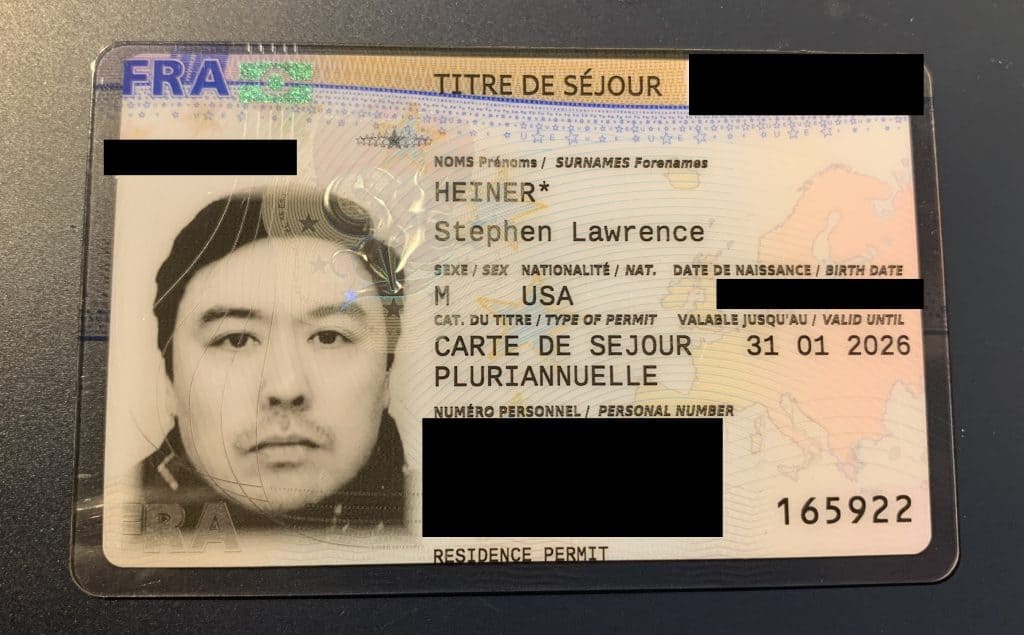
As you can see from the featured image for this article, the date of my new card is from 31 January of this year, but it wasn’t until 23 February that I received the text message from the government that I was welcome to pick up my new card and could I please bring a fiscal stamp to cover the 225 € it cost them to make it (you can purchase said stamp here; what a world of difference from 2014 when I bought a bunch of stamps at the tabac!).  You still need to make an appointment to pick up the residence card, and while I’ve heard that’s been hard to do lately in Paris, in Melun they had plenty of slots for me to book.  So from start to finish, it was six months from when I showed up for my renewal to when I could pick up a new card.

So the complications were:

  1. I didn’t have my residence permit: all I had was a police report which stated that my residence permit had been stolen.  I had carried that around while traveling for the last couple of years.  As I’ve shared elsewhere, I’ve come to realize that you need your residence card for exactly zero things in France and carrying it around only risks adding one more headache if your wallet is lost or stolen.  Keep it at home.  If and when you do need to show “ID” your passport will always win and if you want you can always store a picture of the front and back of the card in the cloud.  And as I told someone recently who worried that having her passport with her new visa sticker inside stolen invalidated her visa: your right to live in France lives inside the French bureaucracy, on a computer, not in your passport/residence card.
  2. My récépissé would expire on 17 March, but I wasn’t due to land in France until 1 April.  I knew the system well enough to know that I could flash my expired récépissé, with the text message, with the convocation that I had printed out to pick up the CDS, IF I was asked.  What happened at the French border?  Was I asked for my vaccination status?  No.  Was I asked for a PCR test?  No.  He asked me to remove my mask and stamp, I was in, just like old times.  As I often say: be prepared for the French to ask for everything, but realize they may not ask for anything.

So, like I said, there were two complications that weren’t really complications.

Today I picked up the card and voila, here’s the article explaining what you need to do to renew the card.

Now some of you may be thinking…wait, Stephen didn’t you take the A2 test last year so that you could get your ten-year card?  Yes.  But I also realized then that this was the last piece of the Prof Lib story I hadn’t told.  That if you had gotten a Prof Lib, renewed it, and gotten a four-year card, you would need to renew one more time before you were eligible to apply for a ten-year card (at least five years of fiscal residency)  Part of why I started this blog in the first place was to give information that isn’t out there, and I don’t think there’s an article on renewing a four-year card, so here it is, as brief as it might be.  I figured I could wait a bit before moving on with my own next step to put together an article with this info.

Related to a willingness to wait to apply for my next big status upgrade in France is that I’m no longer in a rush.  The pandemic has proven to me that residence gives you 99% of the privileges of citizenship, at least in France, as I was able to come and go as I pleased, and was even eligible for personal and business aid from the government.

When I first moved here, I was in a hurry to get citizenship, as I was under the delusion that the French were looking for any excuse to deport me at any moment, whether I mispronounced a word or forgot a piece of paper in my dossier.  Ten years have shown me the naïveté that that was and I try to pass on a sense of calm to people who hire me to consult with them or who take my courses**.  Citizenship is no guarantee that you won’t lose your rights (ask the Americans of Japanese descent what their citizenship meant in America after Dec 7, 1941, or what happened to people of a certain race in France the following year, in 1942) and the term “permanent resident” is a misnomer for the vast majority of resident visas worldwide: almost all require some kind of residence over some period of time, and then need to be renewed…not exactly “permanent” by any definition.

Just realize you’re going to be a foreigner in France for at least a while, and get comfortable with the “odd” feeling of being a long-term guest.  You may be kicked out at any time, but rest assured, it’s not going to be because you forgot a piece of paper in your dossier, and in fact, it’s not likely to happen at all.

What’s next for me, of course, is citizenship and/or a ten-year card.  Stay tuned; I’ll keep you in the loop and try to provide a template you can follow, as always.

I am certainly happier than the photo would indicate, but as you may know, you are not permitted to smile in official French photos. 🙂

*I don’t know how many times I have to say this: you MUST FILE TAXES if you live in France, even if you don’t earn any income in France!  I know it’s not told to any of us when we get here by the French government (I only learned, as I’ve learned so many important bits of information over the last decade, due to the newsletters of Jean Taquet), but your proof of filing taxes every year are the most important documents you must have if you ever want to apply for a ten-year carte de resident or for citizenship.

**Anyone who charges more than 1000 € to help you get a profession libérale status is probably running a scam.

Did you enjoy this article?  TAIP is 100% reader-supported through tipping.  If you want to leave us a tip of any amount it would be highly appreciated.  These tips help support our efforts to keep TAIP an ad-free environment.  Just as at a cafe, the tips are split evenly among the team.

The Path to French Citizenship Begins, or “Visitor No More”

Note from the editor: In light of new guidance on remote working in France as shared by the official French tax office in June 2025, we have also officially changed our stance on remote working for a US company while living in France under the visitor visa. Read more here, and contact us with any questions or concerns. We’re here to help! — MS

I saw her place the green and white paper on top of my file.  It was the paper used to print a récipissé (the temporary document one uses for identification while waiting to get a permanent identity card).  Externally I remained stoic.  Internally my jaw dropped and I wanted to shout out.  That enormous dossier that I had handed over 15 minutes earlier had worked.  Not only had I successfully jumped the track from the hamster-wheel of visitorhood to the track to an EU and French citizenship, but this had been the shortest prefecture visit since I moved to France in 2013.  From start to finish it had been thirty minutes.  I had felt supremely confident in my dossier but this was France, after all.  There could always be something objectionable.

Still dumbstruck, I silently handed over my photos.  As the big printer hummed, she clipped out one of them, handed the rest back to me, then dutifully affixed it to my récipissé.  She then gave it all the stamps and signatures it needed after I had verified all the information and signed it myself.

Today is eight days after I successfully changed to a Profession Libérale visa.  As long as I earn a certain income over the next five years and pay the requisite taxes, I’ll be eligible to apply for French citizenship (note: that does not mean I’ll get it).  I’m officially allowed to work in France, now.  I had to go to URSSAF yesterday to do more paperwork, and I need to come back in 90 days to give the prefecture that paperwork, but that’s literally paper pushing, rather than the complex compilation of a dossier.

Could I have taken this path immediately in 2013 instead of taking the visitor route?  Yes.  Indeed, if there are any of you out there interested in taking this path, I can help consult you through this process as someone who has successfully completed it and has a winning template.

And yet, the answer for me is also No.  I could not have taken this route myself, knowing as little as I did about France in 2013.  I didn’t even know what I didn’t know, and my plans and ideas about my time in France were so inchoate when I landed here.  Yes, eight days ago I took a bulletproof dossier to the Prefecture…but I knew it was bulletproof because of my last two visits there and what I had learned about the French and their expectations in the last three years.

It’s also been marvelous to hear from people I’ve met because of this blog not just those who needed help regarding the visitor visa but those who have started to meet with me to strategize about what I’ve just successfully done: a transition to the citizenship route.  A few of their testimonials are here.

Thanks for continuing this journey with me.  Last Thursday was the end of the beginning.


Did you enjoy this article? TAIP is 100% reader-supported through tipping. If you want to leave us a tip of any amount it would be highly appreciated. These tips help support our efforts to keep TAIP an ad-free environment. Just as at a cafe, the tips are split evenly among the team.