overhead: rows of french books

If You Want to Learn French Before Moving to France, Start Here

Moving to France requires a certain level of organization, determination, and a willingness to embrace the piles of paperwork you’re required to show at the prefecture once a year (or less, if you’re lucky). But, one thing a lot of hopeful expats forget to do is something that has the power to improve your entire France experience: learn the language. Or at least try to.

It’s the exact opposite of what I did when I moved to France, and I’ve made it somewhat of my mission to encourage others not to be like me. 

Listen, you don’t need to be fluent. You don’t need to know how to conjugate the plus-que-parfait, or even know what that is (spoiler, I do not). But you will have a much better chance of actually interacting with and becoming friends with French people if you can carry on a simple conversation.

Not being able to order a coffee, ask a question in a grocery store, or communicate easily with your doctor will make your life difficult. Yes, it is manageable, and plenty of expats (in Paris in particular) get by without speaking much French. But learning the language will give you a much more fulfilling — and actually French — life.

So, as I embark on my mission of yes-you-should-learn-French-before-moving-to-France, I was thrilled to sit down with Manon, a French YouTuber and language teacher who recently interviewed Stephen and I for her channel.

Manon is the founder of Ohlala French Course and a fluent English speaker who understands the struggle of learning a second language from scratch. One of her programs, French Coffee, is one of the most helpful resources I’ve come across for people who are planning to move to France. Or, those who just want to feel more confident speaking French before they arrive for a trip.

It’s exactly what I wish I had done before I moved to Paris.

The Real Secret to Learning French

Is to speak it. Often. With native French speakers. 

Workbooks, podcasts, grammar guides, and apps like Duolingo can be helpful, but if you’re not speaking French with other people who speak French, you miss the most important piece of the puzzle. If you haven’t noticed it yet, it will become very obvious the moment you get to France. When you aren’t used to practicing, you’ll likely freeze up, forget vocabulary, and may not understand all of the “familiarity” native French speakers use that they don’t teach you in school.

Not knowing the language — or relying too heavily on English — can cause anxiety over phone calls, appointments, going shopping, or even running into your neighbor. I can’t tell you the number of times I have cried over a phone call that went badly because I couldn’t communicate.

On the flip side, when you do take the time to learn and practice, you’ll be able to have wonderful conversations, make new friends, and gain access to a side of France that doesn’t exist when you’re stuck behind a language barrier.

As we say often here at TAIP, it’s all about being curious and willing to try.

French Coffee for Real Conversations and Progress

But Molli, I don’t live in France yet, so how am I supposed to find people to practice French with?

This is exactly where French Coffee comes in. Manon created this weekly (!!) program to give French learners a chance actually to speak. It’s structured like a small, friendly coffee chat, except you get to hone your French skills with peers of the same level, with a native French-speaking teacher there to guide the conversation if needed.

When I asked Manon how she would describe it, she told me it’s “perfect for those who already understand French well, but can’t yet speak with confidence. It’s a warm, well-structured space, and really helps with oral expression.

Each session is held online and is organized by level, so you’ll never feel like you can’t keep up. You can talk about real-life topics with people who have the same level of French as you do in a format that feels casual, cozy, and… dare I say… fun? The groups are small enough that you’ll get plenty of time to speak too.

French coffee isn’t like sitting through a lecture at school, or awkwardly repeating vocab into an app (been there). It’s real conversation practice that will help build your confidence so you feel comfortable enough to speak up once you’re out in the real, French-speaking world.

Manon’s entire platform Ohlala French Course is full of thoughtful resources that range in time commitment and price. French Coffee is a great place to start if you’re moving to France anytime soon.

If you can’t communicate with the people around you, you’ll likely feel isolated and lonely. Moving abroad is already an isolating and lonely experience, so if you can do something to make it feel a little less lonesome, wouldn’t you?

Photo by The Now Time on Unsplash

Did you enjoy this article? TAIP is 100% reader-supported through tipping. If you want to leave us a tip of any amount it would be highly appreciated.  These tips help support our efforts to keep TAIP an ad-free environment. Just like at a cafe, the tips are split evenly among the team.

an old book with the words 'a french course for schools' written on it

The Mindset Shifts That Helped Me Learn French Faster

Way back in 2014, I moved to France with little more than a couple of suitcases, a dream of living in Europe, and about three words of French. When I first stepped foot off the plane, I had no idea how hard — and how rewarding — learning the language would be. The rewarding piece is important. Learning and then mastering French as an adult is truly one of my life’s greatest accomplishments.

As I went along, something I quickly realized was that my success wouldn’t just come from memorizing vocabulary or drilling myself with grammar quizzes.

It would come from changing how I approached the entire process. 

Here are the mindset shifts that actually improved and then accelerated my French that I hope can help you too.

1. I Embraced Embarrassment Instead of Fearing It

If you’re not new here, you’ve heard me say this about a million times: I’m shy! Even in English, my native language, I tend to lean more towards the reserved side of the spectrum. I used to fight against it, but now I embrace it. Just like I embraced being embarrassed by my French level instead of being afraid to even try. 

When I first arrived, almost every conversation ended in confusion or blank stares — mostly on my end. I got used to pretending to listen and then making an educated guess based on the person in front of me’s body language to determine whether I should respond with a half-hearted oui or non. It worked out about half the time.

Something that really helped me was the French as a foreign language program I took at Nanterre. It was enough coursework to qualify for the student visa, and I was able to learn French with peers at the same level as me. This opened up a whole new world of possibilities because I was no longer ashamed to try and practice — two crucial aspects of learning a new language.

I was always so embarrassed by my accent, but the truth is most French speakers find it charmant and I’ve also started leaning into that, 10+ years on.

2. I Prioritized Progress over Perfection

This is another aspect of learning French that was very difficult for me. I’m a self-proclaimed perfectionist, and honestly? You just can’t hold on to that when learning a new language, skill, or anything else you’ve never done before. If you wait for perfection, you’ll be waiting forever.

So, the next mindset shift involved me pushing perfectionism out of the way so I could keep trying — and be okay with making mistakes as I went along. One of my first big wins in France wasn’t making a flawless speech in front of a room of French speakers. It was being able to order a meal without stumbling over my words, accent or not. It didn’t matter that I may have gotten a verb tense wrong. What mattered was that I was actually communicating in French.

I started telling myself that as long as the person in front of me understood the gist of what I was trying to say, I was making progress. I have to laugh when I think back to some of the very kind people who just let me go on and on, even if I was using the wrong words or conjugations. This shift kept me moving forward even when my French was nowhere near “perfect.”

3. I Leaned into Feeling Uncomfortable

This mindset shift can really apply to the entire experience of moving to a foreign country where I knew no one and didn’t speak the language. And while yes, being uncomfortable most of the time wasn’t always great, the feeling I got on the other side of that was incredible.

My belief is that putting yourself in places outside of your comfort zone will only help you grow. The first time I ever left the US to do my semester abroad was a little scary at first, but the experience went on to change my entire life — something that would have never happened if I stayed in my hometown.

In those early days, every time I spoke French with actual French speakers, I felt super uncomfortable. Is everyone staring at me? Did I use the right verb there? Is my accent so heinous that everyone is trying not to laugh? Of course, thoughts like those crossed my mind, but I had to ignore them to improve.

Straining to pay attention to a conversation is uncomfortable. Making mental notes to remember what to respond is uncomfortable. Not being able to find the word you’re looking for is uncomfortable. Sitting there as everyone easily converses around you while you’re still stuck on something that was said 10 minutes ago… is uncomfortable.

But, I had to go through these moments to learn French. And the good news? I did it. I started feeling much more comfortable after that intensive year of French courses at Nanterre, which, when all said and done, at the end of that, I had already been in France for 3.5 years.

So, yes, it can take time. But, I went over knowing nothing and my first few years were spent in an English-speaking bubble. As soon as I made the commitment to myself to actually study, I saw improvement within just a few months.

And today, 10+ years after touching down to live in France, I can confidently say that I am a French speaker. My husband and I only communicate in French, same with all of my in-laws. Most of my French friends like to try out their English with me, so we end up speaking in a funny franglish or franglais when we’re together, but I get plenty of practice with them too.

I’m able to navigate different accents, converse on a variety of topics, read a French novel, and take care of all of my paperwork myself. Some of that is thanks to years of practice and effort, but a lot of it is also due to the mindset shifts that had to happen in order to improve.

Listen. If I can learn French, anyone can — prove me wrong.

Photo by Erik Mclean on Unsplash

Did you enjoy this article? TAIP is 100% reader-supported through tipping. If you want to leave us a tip of any amount it would be highly appreciated.  These tips help support our efforts to keep TAIP an ad-free environment. Just like at a cafe, the tips are split evenly among the team.

a bookshelf of english and french books

Raising Children — Bilingually? Part 2

Note from the editor: If you haven’t already, be sure to read Raising Children — Bilingually? Part 1 before jumping into Part 2. — MS

Bilingual Native-Language Acquisition

Children who are brought up bilingually will acquire two native languages according to the same processes as children who acquire language in a monolingual environment. 

All children, whether they are brought up in monolingual or bilingual situations acquire language passing through the one-word and two-word stages as they build up language proficiency. However, bilinguals must learn to distinguish between two different streams of language and then develop their language accordingly. 

Whether due to early non-discrimination or to the difficulty of acquiring first words, children in the early one-word sentence stage in a bilingual situation will use either language without differentiation according to whom they are speaking. This is comparable to monolingual language acquisition, where children do not acquire synonyms immediately, sometimes hypothesized as a measure of efficiency in the language acquisition process.  At about the same time as when monolinguals start using synonyms, the bilingually-raised child then begins to use equivalents separately. This means that there should be no fear of a child’s ultimately “mixing” languages as long as caretakers specifically take heed not to mix languages themselves. What children hear, they imitate. 

Brain Studies and Cognition

Studies of brain functioning in bilinguals have been and are still being carried out extensively. After much research into language competence, it is generally accepted that bilinguals have a single, integrated language system. 

Also, “language and cognition may not be processed separately in the brain; instead they interact with and facilitate each other… Bilingualism appears to be associated with more effective cognitive control, particularly with executive control and executive function (EF) abilities.” (Higby et al.)

Experience with two languages tends to lead to greater cognitive efficiency. Bain has carried out a longitudinal study comparing two bilingual children and two monolingual children using cognitive testing as set up by Piaget and Vygotsky, He concludes that the bilingual brain is a better tool for learning. 

Children learning two languages from infancy are not impaired cognitively or academically. It may even be possible to conclude that bilinguals have superior language skills as well as other cognitive abilities as compared to those of monolinguals. For example, it seems the tendency for bilinguals to be better in mathematics than monolinguals might be due to their having learned to handle abstraction from an early age. For a monolingual, the object “bed” and the word /bed/ are bound together such that the word is the thing. Piaget once asked five-year-olds to give him a long word, and many of them answered “train.” On the other hand, a bilingual has learned that the object can be called either /bed/ or /li/; words, which are abstractions, are thus separate from the objects they designate. 

Code-Switching and Interference

That a bilingual’s two languages co-mingle in a single language system where both languages remain continually activated implies possible alternation between the two languages. One language needs to be inhibited when speaking in a context where the other language is being used. This imperfect separation leads to code-switching when bilinguals speak among themselves or to interference when speaking in a monolingual situation. The former refers to using elements of a different language within the speech stream of the language in which an exchange is taking place. In this case, these elements are not affected by the host language. “Interference” is the transference of elements of one language to another at various levels, namely phonological, grammatical, lexical, and orthographical. In this case, the foreign elements are modified to fit the host language (Amenorvi). Alternation in the case of code-switching is considered to be positive as it often refers to language choice; however, interference is viewed as negative as it is often involuntary.

The abundant code-switching observed in conversation between and among bilinguals has led to the recently developed concept of “translanguaging” whereby bilinguals express themselves across languages to best communicate nuances that may not exist in both languages. 

Bilingual communication may lead to what is referred to as “negotiation of language” whereby each participant tends to pull exchanges toward their preferred language. This can often be observed between children preferring to speak in the majority language as they converse with a parent or grandparent whose preference is the minority language. Often when my son came home from French public school, totally immersed in French, he immediately began telling me about his day in French. Pulled in this direction I found myself responding in French until at some point I had difficulty making my ideas clear in this language and wondered why I was even trying to do so. I then switched to English, pulling him in that linguistic direction.

Life-long Bilingualism

As bilinguals grow older their language experiences modify their language use. Language dominance may change over time, as they use one language more than another. They may learn other languages, or they may lose some ability in one of their languages, known as language attrition. Language dominance and attrition are dependent on language exposure and can evolve: more exposure at a given time will improve language ability, reduced exposure can lead to more or less attrition. Losing some vocabulary, for example, in a native language that is not being used, is not unusual and not to be worried about. Increased exposure would bring renewed competence. 

More and more research is being carried out on the relationship between bilingualism and dementia. It would seem that “actively using two languages seems to have a protective effect against age-related dementia.” The lifelong usage of two languages contributes to neuroplasticity and has been shown to delay cognitive decline “with a delayed age at onset of dementia” (Kamenetz). Furthermore, older bilingual adults are better able to cope with the pathology of neurodegeneration. One study shows that should bilinguals with dementia present greater neurodegeneration, their cognitive performance remains comparable to monolinguals with dementia. The hypothesis is that “Bilingualism recruits alternative brain networks to compensate for those that become damaged during aging and dementia (Marian and Shook, 2012). There would then exist a greater cognitive reserve to enhance brain functioning during aging. 

Some Anecdotes

I was very strict in my use of English until my son became much older and we fell into code-switching modes. When visiting friends, I even read French-language children’s books to him in English, at least until the simultaneous translation became too difficult. Once, friends remarked, “We didn’t know we had English books in the house.”

When bicycling in Finland with my two-year-old, and not keeping very regular meal hours, one day my son called out, “Mommy. Eat, mange.” Clearly, he was using every linguistic tool in his possession to cry out his hunger. It was definitely time for lunch. 

Once, when chatting with my neighbors, my three-year-old turned to me and asked, “Can I go to Maryse’s?” I said, “Ask Maryse.” He then turned to her and asked, “Je peux venir chez toi?” After her responding, “Oui,” he turned back to me saying, “She said ‘yes’.” 

When coming home from kindergarten with my son one day, we stopped at a Chinese take-out to get lunch. As the server prepared our dishes, she complimented my son on his bilingualism. I immediately asked her what language she spoke with her own little boy I had seen behind the counter. Looking down and hiding her face she responded, “Mandarin,” as if she were ashamed. I immediately launched into compliments on how wonderful she was to speak to him in Mandarin and the fantastic effects on the brain of being brought up in two such different languages. By the time our food was ready, she was standing much straighter and smiling broadly.   

If any of a child’s caretakers speak a native language other than French in this country, I implore you to speak with them and play with them in your own native language. It can only serve them well.

Photo of our bilingual bookshelf.

Did you enjoy this article? TAIP is 100% reader-supported through tipping. If you want to leave us a tip of any amount it would be highly appreciated. These tips help support our efforts to keep TAIP an ad-free environment. Just as at a cafe, the tips are split evenly among the team.

two wedges of cheese and scrabble pieces spelling out cheese and fromage

Raising Children — Bilingually? Part 1

Language choices in a mixed native-language family or one whose native language(s) is not that of the majority culture surrounding them


New country, new language, and maybe new family? Language, then, becomes an important issue. When two people get together they fall into what is a comfortable language of communication. However, when children come along, linguistic decisions, what is referred to now as Family Language Policy, need to be made as to their all-important language acquisition.

Some of the important questions to help plan for children’s linguistic upbringing include:

  • What language(s) do the parents speak together where French is the majority language of this relatively monolingual country?
  • What are their native languages?
  • Does one of them speak their native language when they are together?
  • Or do they speak a language of communication that is the native language of neither of them?
  • How well do they speak the majority language?
  • How important is it that the children learn each of the parents’ own native language?
  • And thus, what language(s) will the children be brought up with, and how? 

If at least one of the parents, or grandparents does not speak the majority language as a native speaker, the question of raising children bilingually is brought to the fore. 

Having carried out my thesis on child bilingualism and raising my son to be bilingual such that he has two native languages, this article is a continuation of my decades-long crusade to raise children bilingually in France because bilingualism matters.

Bilingualism as a Native Language

Long before Ronjat’s (the grandfather of child bilingualism) 1913 publication of Le Developpement du Langage Observé chez un Enfant Bilingue he had asked his own professor how to raise a child bilingually. The answer, which was “one person, one language,” has been the recommendation for parents ever since.

“Never switch roles. In this manner they will begin to speak two languages without noticing it and without having to put forth any special effort in learning them” (In: Bain Bruce 1996, p. 177). 

Although there has been some controversy on the subject, it remains that children need to anchor, in some way, a separation of the languages they are learning. Obviously, this differentiation will be inherent in their linguistic environment. For example, one caretaker might speak the majority language (the language of the community outside the home) and the other the minority language (a language different from that of the outside community). There should be no mixing in the caretakers’ language(s) so that the child will learn to keep the languages separate, even though language itself is learned as a whole. 

Raising Children Bilingually in a Monolingual Environment

Until recently, and somewhat even still, the typical attitude in France toward bilingualism (in spite of Ronjat) has been “Against.”

As of 30 years ago and much further in the past at least in the 70’s, when I was writing my thesis, how often was it said that children being brought up bilingually never learn their two languages well, that a second language would negatively affect the child’s French?

Of course, this was all hearsay in a language-political context where the French were defending their language against English as the language of communication. I remember when a very respected researcher in language acquisition, a friend of mine and a direct student of Piaget’s, said when my son was born, “Bilingualism doesn’t really exist.” I did not rise to the argument, but then what will we call it when people speak more than one language fluently? Obviously, she was thinking in terms of perfection; but then, how many monolinguals speak their (only!) language ‘perfectly’? The most widely used definition for bilingualism is Grosjean’s: “bilingualism is the use of two or more languages… in everyday life.” 

In fact, globally, there are more bilingual situations than monolingual ones, typically where in a country more than one language is spoken. This means that France is an exception rather than a rule. And then, when we think of France’s colonization in Africa, it was never asked whether it was good for children to learn French in addition to their heritage language. It was taken for granted that learning French could only be good for them. As Bain suggests, the results of research concerning whether bilingualism is positive or negative can be politically and ideologically motivated.

Language Ability

The question of children’s ability in their two languages is more complex than what has been suggested above.  Bilinguals are not just two monolinguals put together. Their ability in the two languages is rarely equal. Only exceptionally are children what I have heard called “perfectly bilingual,” sometimes called “balanced bilinguals” and which is what Valdes calls “mythical bilinguals.” Typically we will speak of a dominant language, the language the child is most proficient in, and the non-dominant, or weaker language. And even in this case, a bilingual can be more proficient in one context in one language and another context in the other language. 

Bilingualism is not just a question of Linguistics; Sociology and Psychology are also important factors in its development. From a sociological point of view, it is easier to raise a child bilingually French-English in France than, let’s say French-Arabic or French-Swahili. English is considered an “important” language and is encouraged in discrete ways. For example, I have had people stop me in the street with my three-year-old and say how wonderful it was that he would be bilingual.

On the other hand, I have never seen (nor have my students when I asked) people stopping in the street to compliment a mother speaking Arabic, Bambara, or Hindu. On the one hand, the child is receptive to compliments on their language ability, and on the other, parents are discouraged by school teachers to speak a language other than French to their children, especially when it is non-occidental European. And even for English, I was sometimes told to speak French to my child. No way would I listen; furthermore, I would give the person a half-hour lecture on child bilingualism. No one ever made the same suggestion twice. 

Sometimes children, however, refuse the minority language. Typically they are influenced by those around them and do not want to feel “different” from others, or rejected for the home language they might speak. In this case, the recommended course is to stubbornly continue to speak the minority language with the child even when they refuse to answer in that language. This creates what is called “passive bilingualism,” where the child understands but cannot/does not speak the language. The best way to improve competence in the minority language,  and to help the child to become an active speaker, is to take the child to a country where the minority language is spoken as the majority language. What typically happens then, is that the child will pick up the language very quickly, in fact in as little as a few weeks. 

Otherwise, it is important to try to bring the child in contact with people other than the parent who speaks the minority language. Reading to the child in the minority language is very important for language learning. Videos, too, help the child to advance their minority-language learning.

Stay tuned for Part 2, in which doli will cover how age, the brain, and cognition play a role in raising children bilingually.

Photo taken of arguably one of the most important words in French and English.

Did you enjoy this article? TAIP is 100% reader-supported through tipping. If you want to leave us a tip of any amount it would be highly appreciated. These tips help support our efforts to keep TAIP an ad-free environment. Just as at a cafe, the tips are split evenly among the team.

taking the delf test

How to Take a French B1 DELF Test

If you don’t know what the DELF system is, I explained it in my article on my first DELF experience, taking the A2 exam in Annecy. Gracie wrote an article about taking the B2, and now I’m filling in the gap by writing about B1.

Why Does B1 Matter?

One of the first questions that a student asked when our instructor was finished giving us our B1 exam briefing on test day was whether the official diploma was necessary for proof of B1 competency. The instructor had heard this question many times before and told all of us that for purposes of French administration, the test results were equivalent to the diploma. This was important because we could expect the results in 6-8 weeks but wouldn’t get the diploma for 2-3 months.

The room gave a sigh of relief as I was certain the overwhelming majority of my fellow testers were there for the same reason I was: certifying that we were at this level for our citizenship application. There are some French jobs that would require a B1 level of proficiency, but those employers are just as likely to informally assess you during an in-person interview than insist on a DELF certification, which would take some added time and small expense.

Taking My Own Advice

In the aforementioned article I mentioned that I chose the testing center I did last time because I wanted to see Annecy (awesome place) but also because that testing center had a very smooth registration process, including (gasp!) online payment. However, in April when I was looking for a summer test date, there didn’t seem to be any centers available with such an easy process. So I sent a check and printed registration form by postal mail to Prosodia, in the 20th in Paris.

I got an email about a week later telling me that the July date I had picked had already completely filled out but would I like the August date? No, I wanted the July date and was already planning travel around it.

But did I want to go through the hassle of finding a new testing center? And trying to register and getting the same potential result? No and no. So I accepted the date and adapted my travel plans. It turned out that in between a trip to Portugal and returning from the Baltics I’d stop in France for 48 hours to come home, sleep, take the test, and then fly out again.

Hiring a Tutor

I’ve never been as comfortable with my French as I am now, and I no longer get tired just from speaking it for hours, but I knew I wanted a refresher, not just because it had been a while since my last DELF, but because I wanted to do well. I met with a tutor once a week in July and focused on precisely what I’d be tested on.

Every DELF exam is the same, insofar as there’s an oral comprehension portion, followed by reading comprehension, and written production. After a break you will then be individually tested orally. At my test in Annecy that break was only ten minutes, as my slot for the oral examination had come right after the written, while others had to wait a couple of hours.

The difference between A2 and B1 are a few more tenses and a level of complexity in all these sections that indicate you’ve made progress beyond the basics of the A-levels, which are all about basic survival in France. At the B-levels you are expressing yourself more thoughtfully, sometimes running into conflict, and using more variety in your expressions.

What I found really valuable about this tutoring-for-the-test was the simple practice of doing the sections with my tutor. He had many copies of previously-administered exams and we were able to target where I was really strong and where I needed some polishing.

The oral and reading comprehension, comprised of short answer and true/false questions, were a breeze. We didn’t spend any more time after a first try of them and some homework.

The written production needed some work, for sure. Some of my expressions betrayed anglicisms, ways of saying, and thinking that we just wouldn’t use in France. The rubric used in the written production is “choix des temps et des modes” with a maximum of 2 out of 25 points, for “fait prevue d’un bon contrôle malgré de nettes influences de la langue maternelle.” Other parts of the 25 comprised use of vocabulary, proper orthography (punctuation, etc.), and coherence and cohesion of ideas.

After some diligent corrections (and some discursive discussions as I drilled into why the French would say something a particular way) we moved on to the last part, the oral exam.

There are three parts. The first is a simple presentation, i.e. my name is Stephen, I’m an American, etc. There’s no prep for that, as you should know who you are. 🙂

The second is a prepared presentation of an idea. Prior to walking into the room you are asked to pull two slips from a table and from those two slips to pick one topic that you wished to speak about. The topic is presented in 5-7 sentences. You’ll have seven minutes to prepare a presentation and when you go into the room you’ll be asked to present on this topic.

In between your personal presentation and this prepared presentation is an “unprepared” interaction. Once again you’ll pick two slips, and from those two pick one, and you’ll immediately begin the interaction. In my A2 test these interactions were quite simple, i.e. you’re going to a store and you wish to buy some souvenirs for a friend or family member.

What was universal about all the B1 scenarios was conflict. Something went wrong and you had to “negotiate” with your interlocutor to get to a result you want. Part of this was funny to me as I would have to effectively pretend to be upset, and then try to argue with a French person, who I am already convinced wouldn’t care and would be ready to shrug his/her shoulders and tell me it’s “not their problem.”

While I had some laughs with my tutor as we worked through different scenarios, he just kept reminding me to pretend and that the instructors were not looking to trip me up but would give me time and space. If I hesitated or took a little longer to articulate an idea or sentence, they would wait with me, not start writing down on the exam sheet, “responds too slowly.”

Game Day

The exam at Prosodia was at 10h00 on a Thursday and I showed up about two minutes before testing time, knowing that they would be registering people and we probably wouldn’t start until 10h30. I was right and I had plenty of time to sit at my desk and even review some notes while waiting.

The first three sections flew by: oral and reading comprehension and then the written production. My topic was ways that someone who was leaving the workforce to go back to school could earn some extra income.

My individual oral exam was scheduled for 14h00 and I was done with my test by 11h50 or so, so I took the opportunity to go to a favorite nearby place for lunch (The Hood) and was back in time for my slot.

I smiled as one of the two slips I picked up was on the Marie Kondo phenomenon, her book, and whether decluttering was a successful idea. I happen to love Marie Kondo (and her book) and my pen flew over the page. If these people didn’t love Marie Kondo before my presentation, they would know all about her after I was done.

I walked in, still slightly nervous as all people are in testing situations, and was asked to introduce myself. There was some follow-up from the instructors about some of what I did for a living and my clients before they asked me to pick my slip for the interaction.

The scenario was arriving at a rental car location and finding out that they did not have the rental car I needed. Remembering my tutor’s advice I gamed out a “pretend” scenario and remembered that the instructor had as little preparation for this as I did, given that I was going to be leading the interaction anyway.

My scenario was that I was renting an SUV to do some moving and he responded that all they had was a Twingo. I lost my bearing a bit at this and laughed because a Twingo is possibly the smallest car that Renault makes. Think of the Mr. Bean car, but slightly bigger.

The other instructor laughed at my laughter and I gathered myself and kept going, asking if there were other size possibilities before settling on asking if any of the other locations would have one. The instructor played along, pretending to search on a computer and saying that there was one vehicle that would work for me at a certain location, but it wouldn’t be ready before a particular time. I said that was fine, and asked for directions, etc. and the interaction played out.

Finally, it was time for me to share Marie Kondo with these people and they had their notebooks out. One would be grading my expression, the other would be noting questions to follow up with. Just from reading facial expressions I felt that one of my instructors was definitely going to check out the book sometime given my enthusiasm. But the best part was when I finished, they looked at each other to ask if there were any follow-up questions, and there were none. “The exam is finished,” they told me.

I felt great, as it meant I had expressed everything well and they didn’t need to give me any chances to redeem myself via follow-up questions.

That feeling when you really ace a test, that you might remember from your school days? I felt that walking out, and looked forward to getting my results in a few weeks. A few weeks after that, I’d be submitting my citizenship application.

Oh, and if you need a tutor to prep for your DELF, drop your email in the comments and I’ll connect you with mine. He’s strongly recommended!

Photo by Skylar Kang.

Did you enjoy this article? TAIP is 100% reader-supported through tipping. If you want to leave us a tip of any amount it would be highly appreciated. These tips help support our efforts to keep TAIP an ad-free environment. Just as at a cafe, the tips are split evenly among the team.

How to Get a Long-Stay Visa for France Through French Lessons

While it would be nice if Americans were able to live in Europe visa-free, it’s not the case (one can dream that it will be someday, right?). If you’re from the US and want to live in a country like France for more than 90 days, you’ll need to apply for a long-stay visa (known as the VLS-TS) first.

If you don’t have family or a French spouse, there are (to really simplify things) two ways you can live in France legally as a non-European: through work or school. 

I’ve already touched on how to obtain a student visa for France, but this “hack” is for those of you who are more interested in improving your French skills rather than going to a university.

What Kind of French Classes Get You a Long-Stay Visa for France?

If you’re like me, you cringe at the thought of going back to school. Maybe you finished your undergraduate degree and thought to yourself “Never again!” Or, maybe you’ve gotten as far as your master’s or doctorate and there isn’t much university-level schooling out there for you. Or, hey, maybe after high school you decided to go straight to work.

As someone who never thought she would ever go back to school after my undergrad, I eventually did get my master’s degree here in France. But, that’s another story for another day. In between being an au pair and enrolling in my master’s program, I did one year of intensive French classes. And, those classes enabled me to get a long-stay visa for France.

For a bit of background, once I did ultimately decide to go for my master’s degree, I knew I needed to improve my French for a few different reasons. First of all, I wanted to be able to intelligently engage in a conversation with a French person. I also knew that in whatever master’s program I enrolled in, I would be required to understand, speak, and write at least basic French (a level I had not yet reached after living here as a nanny). Plus, if you want to go to a public French university as a foreigner, you need to prove that you have at least “B2” level French. 

B2 refers to a level in the “Common European Framework of Reference” (CEFR) scale for languages. It is used to assess people’s language levels and ranges from A1-C2. Here is a breakdown of the different levels for French:

  • A1: Beginner
  • A2: Elementary 
  • B1: Intermediate
  • B2: Fluent
  • C1: Advanced
  • C2: Bilingual

To be honest, whether or not you want to continue on to a master’s or doctorate program if you plan on living in France for an extended period of time, you should try to obtain at least a B2 level. 

The good news is, an intensive French language program will get you that student visa you’re after whatever level you’re at! Here is what is required:

Once you’ve found your dream program, you’ll have to go through the steps of applying for a student visa for French. I’ve mapped out everything you need to know here.

If you’re in Paris, I did the FETE program at Université Nanterre (yup, that Nanterre. Any other 20th-century history buffs out there?). It’s located just outside of the city to the west. I recommend it to anyone who is interested in improving their French. The classes are a mix of speaking and writing as well as cultural classes. Fieldtrips include visits to Parisian museums and landmarks, how cool is that? There is also a similar option at La Sorbonne

If you’re not in Paris, simply take a look at the list of FLE-accredited schools I linked above!

Some Things to Remember if You Want to Renew

If you plan on spending just one year in France and know that you won’t need to renew your visa, you can skip the next section.

If you already know that you’ll want to extend your time in France after one year, there are a few things to keep in mind:

  • You need to pass the school year in order to renew. That means you’ll have to take school seriously. Attend all of your classes and study for your tests. Stay on good terms with your professors as well.
  • Make sure you have a plan for what you want to do next. Do you want to continue with intensive French courses until you’ve achieved C2? Do you want to enroll in university? Remember, for the latter, you’ll need at least a B2 level.
  • Start gathering the paperwork you need to renew 4-5 months before the end of the school year. You’ll need to schedule your renewal appointment at least 3 months before your visa expires.
  • As a general note concerning all French visas: keep everything. That means bank statements, cell phone bills, copies of your lease, or a letter from the person who is housing you saying that they are housing you. You’ll need all of this plus proof that you passed the school year. 

Disclaimer: I’m not giving you permission to slack off or stop going to school if you don’t plan to renew your visa. My advice? Take advantage of the fact that you’re in France learning French. It’s the best way to learn a new language, and you’ll have the opportunity to speak French with actual French people. Don’t throw away an opportunity like that.

Molli offers private consultation services which range from help with visas and adjusting to life abroad to Paris travel itineraries. Fill out the contact form to learn more.

Photo by Faisal Waheed on Unsplash

Did you enjoy this article? TAIP is 100% reader-supported through tipping. If you want to leave us a tip of any amount it would be highly appreciated. These tips help support our efforts to keep TAIP an ad-free environment. Just as at a cafe, the tips are split evenly among the team.

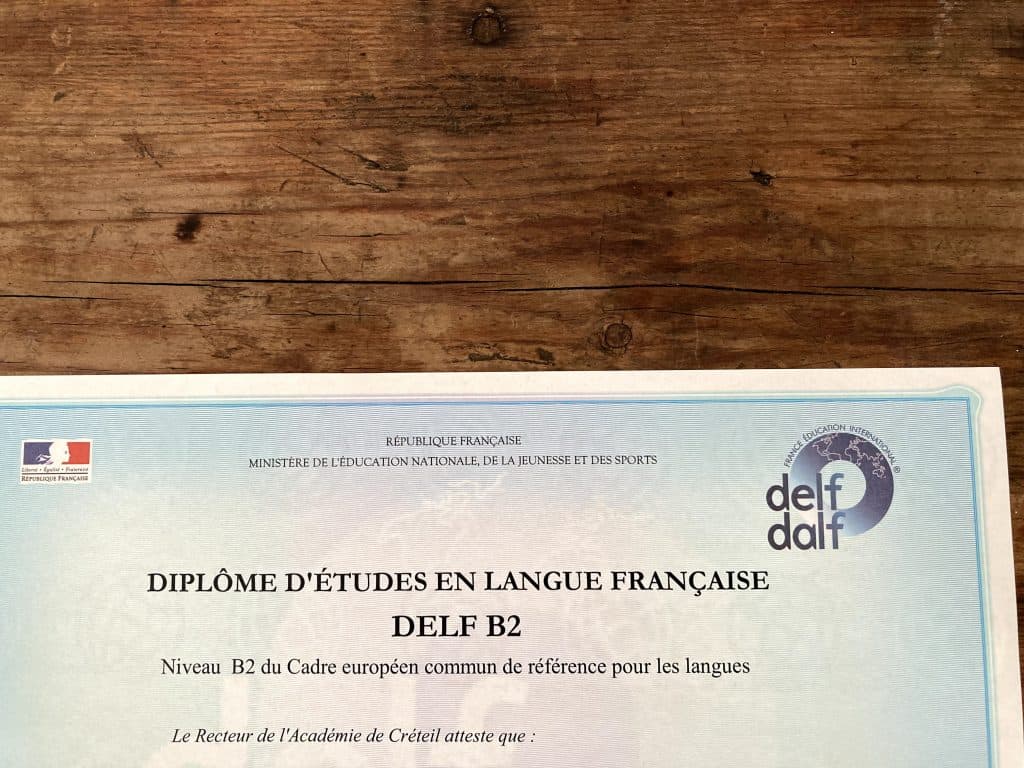
How To Take a French B2 DELF Test

As Stephen mentioned in his article about the DELF A2, the DELF is an internationally recognized competency exam, and one that I hadn’t heard of until 2020. When I was at the appointment for my first vié privée et familiale visa, the prefecture employee mentioned that if I had a French diploma or a DELF certificate, it would allow me to apply for a multi-year visa. Since taking a French exam was less time-consuming than going to university, I decided to sign up for the DELF. I’d already been studying French since age thirteen, so it felt like another strange, slightly-fun step on my immigration path.

Signing Up

Like all many things French, signing up for the DELF was not as easy as I assumed it would be. Depending on the test you’re taking (there are levels A1 to C2), the exam is only given a few times per year. While there is a list of official test centers, each center has different registration dates, requirements, and turnaround times for their results.

After doing a bit of research in January and then dropping the project without setting myself any calendar reminders (mistake), I found myself scrambling in early April to sign up for a May test. The only other B2 offered was in October, which would be after my visa renewal. The centers had limited capacity due to Covid, and all the ones I found in Paris were already full. This left me mailing my application to a center in Ivry (a southern banlieue). As an American who is used to everything happening via the internet, it constantly amazes me how many official letters and registrations I’ve had to send via mail since moving to France. It is truly a step backward in terms of convenience and efficiency.

You Will be Convoked

I have also never received so many “convocations” or summons since moving abroad. These official notices are used by the prefecture, as well as in other formal capacities to tell you what time you have to be somewhere without you having any say in it. Although I had called the exam center and confirmed the two testing dates, I ended up receiving a convocation for the written part on Thursday and the oral part on Friday. In other words not the dates they’d told me. Since the exam was full, and the slots were pre-assigned there was no way to change my time to one that worked with my schedule. On top of this, the exam took place in Juvisy-sur-Orge not at the company’s mailing address which was much closer to Paris.

Lesson Learned: Make sure your schedule is clear all day on testing days (the exam sites often list three separate days) and be prepared to be summoned at any given time. Also, determine where the test center is before signing up. As someone who bikes everywhere, I ultimately decided that 26 km ride through Paris’ industrial zones Juvisy-sur-Orge was not the way I wanted to arrive so I took the RER even though two-round trip tickets ended up adding another 15 € to my test costs.

Preparing

Since the DELF is a standardized test, it’s easy to find practice tests and other resources online. My spoken French is fluent, and I had to write essays in French in college so I wasn’t concerned about my proficiency. Regardless, I decided to take two practice tests simply to know what I was getting into and to be prepared for the process on test day.

One practice test later, I decided that was enough. The oral comprehension was fairly straightforward, the reading comprehension was even easier, and although my partner found plenty of errors in my written response, he deemed it at least a 20/25. Since all I needed was 50/100 to pass the test, I decided not to worry about getting a perfect score.

Exam Day

I arrived early and the exam started late which made the wait feel long. The proctor checked our convocations along with our IDs before we went into an upstairs classroom. It had been over ten years since I’d taken any form of test, so sitting at a desk and waiting for instructions was quite surreal.

Written Exam

They had changed the format of the exam since I’d taken the practice version, and the listening section of the exam had more questions per recording, moved faster than I remembered, and was more challenging than the one I’d taken at home. I would recommend practicing this section at least twice (and in the most current format) to familiarize yourself with the number of questions as well as the recording speed.

Once we got past that, the reading comprehension and writing were straightforward. I finished with forty minutes to spare and wasn’t allowed to leave. This was both strange and frustrating, as the best part about finishing a test is being able to go home. The proctors also collected our scrap paper, which was mildly upsetting since I’d written a poem on mine.

Oral Exam

Inconveniently, the next day I made the trip back to Juvisy-sur-Orge back for the oral exam. In this section of the test, you pull two topics at random and then choose one to present. I knew I’d be given twenty minutes to prepare, which felt unnecessarily long, especially given my confidence in speaking French.

But once I’d chosen the topic of online versus in-person tutoring and sat down with scrap paper, I realized I had no idea what I was supposed to do with this paragraph of information. In a moment of unprepared panic, I stopped the proctor as she was leaving the room, and asked her to clarify. She explained that I was supposed to present this topic and then be prepared to debate it with the examiners. I ended up using the full twenty minutes to make sure was absolutely clear on what the text was saying and write out arguments for different methods of learning.

The preparation time and idea of having to debate the topic made me nervous but as soon as I started talking, that all fell away. One woman asked me questions while the other took notes and occasionally interjected. Their questions were easy to understand in the context of our conversation, and I talked through the different arguments.

Near the end of the exam, my interviewers asked where I learned French and how long I’d been studying. I explained that I started in middle school and had more or less continued ever since. Only when they complimented my French did I realize that the oral part was over, and they’d been impressed by my language skills. It was an affirming moment after two days of RER rides and fussy testing requirements.

Lessons Learned

My main lesson was to give myself more time to find a test center that was easy to access and easy to work with. In retrospect, following Stephen’s lead and applying via the internet would’ve saved me many headaches. Also, confirm that the registration address is the same address as the test center. I’d also recommend taking two practice tests that are current, and having a clear understanding of all the instructions before showing up. Other than that, the process was quite straightforward, and I’m happy to have proof of my French proficiency to add to my resumé.

Photo is of my certificate: one more for the wall!

Did you enjoy this article?  TAIP is 100% reader-supported through tipping.  If you want to leave us a tip of any amount it would be highly appreciated.  These tips help support our efforts to keep TAIP an ad-free environment.  Just like at a cafe, the tips are split evenly among the team.
take A2 DELF test in French

How to Take a French A2 DELF Test

One of the misconceptions many have before moving to France is that living here will make us “fluent” in the language in a short time: 2-3 years at the very longest. Not only have I come to appreciate that fluency in any language, including your native tongue, comes after 15-20 years, but that fluency in French will take at least that long for me, if not longer. But that doesn’t mean I can’t get around or have conversations with strangers on a variety of topics. It just means I won’t be able to speak at great speed, have cultural landmarks and references readily at my command, and will sometimes lack the ability to speak about a complex idea. But that’s okay: those are not necessary parts of daily life in France.

There Will Be a Test

What I didn’t know before moving here is the high number of English speakers who do not speak French at even a basic level. This takes effort: you have to not take any classes to improve and you have to not speak French on a daily or even weekly basis. Naturally, the French expect you to speak French in their country and so they have two bars set in place to make life more inconvenient for those who choose not to develop basic competency in this language:

For those who aren’t familiar, these number and letter combinations refer to a classification system called DELF (Diplôme d’Etudes en Langue Française). The lowest level is A1 and the highest level is B2. From there it is taken up by DALF (Diplôme approfondi en Langue Française) which has levels C1 and C2. While B1 and B2 are often acceptable not just for citizenship but for many jobs in multilingual (but French-dominant) workplaces, C1 and C2 are part of the path to studying at the Master’s level without having to take additional language classes or for more technical jobs that require greater French proficiency. This isn’t the only type of test that is acceptable, but it is the most popular.

First, Getting to A1

My journey of learning French has had many way stations. I was 17 the first time I bought a “how to learn French” course on cassette. It wasn’t very advanced but it got me going on some basics. I also took a couple of courses at community college and made three weekend trips to Montreal to give some of that French a trot. In the last year before I moved here I was meeting with a private tutor at least twice a month. When I arrived in 2013 I registered for a class at Alliance Francaise, down in the 12th, and they gave me an assessment that placed me somewhere in A1. All of my previous studies led to my being classified as basically a beginner. But you have to start somewhere, right?

I was attracted to the pricing of the larger classes at Alliance Francaise, but the commute to the 12th took its toll, as did the fact that you could only move as fast as the slowest person in the class. But before too long our A1 class finished and we took a simulated DELF and I passed. A1 competency is normally achieved by roughly 80-100 hours of study time. I spent a few more classes at the A2 level but didn’t choose to continue on, as I was at a better level than when I had arrived, and that made me more comfortable interacting with the French in general.

How to Register for a DELF Test

Well even though I was in Paris, where we have a lot of DELF testing centers, I needed to find a date that worked for my schedule. I found a pretty comprehensive list of DELF testing sites in France and after some checking with dates that I expected to be traveling I found the best fit was a testing center in Annecy, snug up against the Alps, and just half an hour from the Swiss border. I had wanted to visit for some time, so why not for an exam?

The second reason I chose this testing center was because it was quite “advanced” in terms of registration for the test. A number of exam sites allowed you to “register” online for the test, but then they required you mail them documents and payment. No ability to pay online! So, I didn’t want to fuss with this: I wanted to register for the test and be done. I would still need to book a train and accommodations after that. So, if you would like that one-step online registration and payment convenience as well, and don’t “mind” trucking out to the Alps, I can recommend CILFA for DELF testing. Costs vary, but should not be much more than 100€ for A2 registration.

How to Study for the A2 DELF Test

I’m flabbergasted to say this, but the official government website has some absolutely fantastic resources. Not only do they essentially provide you with a practice test that has answers you can check, but that practice test is almost exactly like the actual exam you will take. You can get all the information you need right on their site.

The A2 level presumes another 100-120 hours of study, bringing your total hours to 180-200. Some of the things you’ll be expected to know include:

  • demonstrative adjectives (this, that, these, etc.)
  • personal pronouns (I, you, we, etc.)
  • possessive adjectives (mine, yours, hers, etc.)
  • relative and interrogative pronouns (who, where, etc.)
  • the imperfect tense (I routinely did something in the past)
  • the passé composé tense (I did something in the past that has been completed)
  • the future simple tense (I will do something)
  • the conditional present (I “have to” or would “like to” do something)
  • the imperative
  • variations of asking questions

If you can competently deal with all these issues, and you have the vocabulary to match that knowledge, the A2 level will be an absolute breeze.

How to Take the A2 DELF Test

It’s fascinating to watch the crowd milling around outside of the exam site because you know that every single one of you have the same thing in common: you are not native speakers of French and for some reason, need to formally prove your competency. Maybe it’s for a job, maybe, as it was for me, for a longer-term residency, or maybe just as a milestone in your journey forward in the language. I can genuinely say I saw every age group represented and overheard at least six different native languages.

You will be required to PRINT your convocation, in part because that’s the French being the French, but also because you will need it as part of identity certification at numerous stages of the exam.

After you’ve all made it into the waiting room you will be called into various classrooms (or, if your test site is big enough, one large classroom) for the first part of the exam. As you enter the classroom you have to present your convocation and your form of ID. You will then sign next to your name on a sheet of paper and be asked to sit at a desk which has your name and DELF ID on it. Once everyone has checked in and the proctor has read the instructions, the first part of the exam will begin.

The Oral Comprehension Portion

You are given four scenarios. The audio will play for you twice, with a thirty-second gap between playings. The example I will give was given in my practice materials and was also the one for my exam: Air France announces a delay for a certain flight number. The reason for the delay is given. A boarding gate is given. Certain classes of people are allowed to board first. People needing assistance will need to go to a certain location. You have 5-6 questions in front of you. Some of them are multiple choice with multiple correct answers (or a single correct answer) or have a space for you to write the answer. One of the questions might be, “What was the reason given for the delay?” or “Who will be allowed to board first?”

Three of the scenarios are in this format, in which the audio plays for anywhere between 30-60 seconds in total. The speakers are speaking at a natural pace, at the speed you are used to hearing at train stations and airports.

The final part of the oral comprehension involves four very short exchanges, of three sentences or phrases at the very most. One example featured two roommates talking about who was going to clean the kitchen. You then match these exchanges to four different possibilities, like “asking for information” or “making a decision,” etc.

The time is sufficient for you to answer everything, especially with the second playing of the audio.

The Written Comprehension Portion

Once this is done, the entire testing cohort continues on with the written portion, which has various documents and pieces of information in written French, with the same number of comprehension questions following. Once again you have four different portions and the 30 minutes you are given here is only slightly longer than the 25 you are given for the oral section, but here you aren’t constrained by waiting for an audio recording. You can go as quickly or slowly as you please.

Once again, the time is sufficient for you to answer everything.

The Composition Portion

You will now be given 45 minutes to produce two texts of at least 60 words for certain scenarios. The first one I had involved sending an email to a friend to tell him all about a “culinary journey through France” day. I felt very comfortable with this and ended up having to cut out a few regional cuisines I wanted to discuss just because of time and space constraints. The second involved an invitation to a picnic and I had to respond with appropriate questions and the proper etiquette.

Again, if you don’t overthink these sections, they will be pretty straightforward.

Break

Once you’ve completed all these sections, the proctor will pick up your exams as well as a piece of scratch paper each of you has been given to use. You’re then free to pick up your belongings which you will have stowed somewhere in the classroom. They are quite strict about electronics, even including smartwatches and mobility trackers, so the less you bring that day, the better.

Oral Examination Portion

You will have been given a time slot for your oral exam in advance and mine was ten minutes after the written portion ended so I had almost no waiting period. Others would have at least another hour before their slot. Just after exiting the written portion my name was called and I was ushered into a prep room where I was briefed on what was going to happen. There would be three portions:

  • A brief dialogue, in which I answered basic questions about myself and my life (1-2 mins)
  • A monologue, in which I spoke about a subject that I picked blindly from a pile of 12 choices and had 5 minutes to prepare (2-3 mins)
  • A role-play, again chosen blindly from a dozen possibilities and also had 5 minutes to prepare (4-5 mins)

My monologue was about a place I had visited recently and what I like to see when I travel, and my role-play was with a fictional French merchant (my examiner would play the part) about gifts I might buy for friends and family. Again, things went well, and while there’s always some level of nervousness whenever you’re in a formalized test setting, if you know this material it will be a breeze. My identity and convocation were again demanded, and I had to sign next to my name to certify that it was indeed me.

During this portion of the test you are being graded for pronunciation, vocabulary, and proper use of appropriate tenses: things you have done in the past, things you will do in the future, and things you do in the present. One examiner is watching and writing observations down the entire time, the other examiner is interacting with you.

Results!

You will get your pass/fail notification within four weeks, but the formal diploma that you’ll want to have on hand for your prefecture appointment will take a little longer, usually another four weeks after that. This is due in part to the fact that each exam is checked by two different examiners for the highest level of accuracy and fairness. The tests are also graded anonymously: the reason you have a DELF ID number is so that they can’t see your name while grading: you’re just a number.

It is a wonderful feeling to pass the exam. Yes, A2 isn’t a be-all-end-all, but it’s enough of a bar to keep thousands of English speakers from getting a ten-year card. For whatever reason, these English-speaking French residents have given up on making progress in French and are content to do annual renewals of their CDS, perhaps forever. I can only encourage you to put in the effort to get to at least this level. You won’t get long-term residence without it, to say nothing of citizenship, which requires an even higher level: B1.

Image by F1 Digitals from Pixabay

This article also appeared on Medium and on Dispatches Europe (in two parts)

TAIP is 100% reader-supported through tipping. If you want to leave us a tip of any amount it would be highly appreciated. These tips help support our efforts to keep TAIP an ad-free environment. Just as at a cafe, the tips are split evenly among the team.
After a Month of Immersive French at the Alpine French School

There have been plenty of adventures since I moved back to Paris after living in Morzine for the month of February, but before I tell you about those, I should put a bookend on my time there and tell you why I think you could benefit greatly from doing a similar full-time immersion program be in the mountains or at the seashore.

What I Expected

I was expecting to learn a lot of French and to personally immerse myself outside of classroom hours with French apps, podcasts, and videos.

I was also expecting to improve, in some way, in my skiing.

In the back of my mind I also thought it would be a nice “reset” or getaway at the beginning of 2018 to orient the rest of my year.  The French Alps for a month?  “Why not,” as the French say. 🙂

That was all.

What Actually Happened

My confidence and progress in French grew leaps and bounds.  While I entered into the program on the edge of A2/B1, by the end of the month, with 80 classroom hours under my belt, I was much closer to really starting into B2 work.  For those of you unfamiliar with the DELF system, progress starts at A1, then A2, then B1, and so on and C2 is the final level.  For context, C2 means you could be hired by pretty much any French company, though many of my friends have been hired at as low as B1 competence (since many younger French enjoy speaking English at work, and at many tech companies, English is ironically the linguafranca in this country).

It turns out when you spend four hours in a classroom per day (two hours in the morning, and two hours in the late afternoon, with weekends off), your progress is cumulative and exponential.  My halting descriptions in my first week were night and day from my confident (albeit short) explanations of the fourth week, when all fear about speaking French for extended periods of time with complete strangers had vaporized.

My skiing also improved.  I was a level 5 skier coming into my time in Morzine and confidently left a level 6.  I left to ski right after the morning class each day and would come back a bit before the afternoon class and change and have a quick snack, and get the homework from the previous day done…most of the time.

As for the podcasts and videos?  Well that lasted about a week, if that.  I was getting plenty of material in class as well as homework and there is such a thing as burnout.  You have to make sure that you’re giving yourself enough time to absorb and retain material, as well as reflect on it.

The reset?  That definitely happened.  You can’t be surrounded by views like this, this, that, and that, without relaxing and reflecting on your life and how fortunate you are to be in such a situation.

What I Didn’t Expect (And Loved)

I didn’t expect to have to really explain myself and be open in class.  One of the key things to master in the B levels is the correct time to use the imparfait vs passé composé tenses.  I won’t get into all of the differences right now, but one very basic difference is that the imparfait describes past habitual actions, whereas the passé composé describes an action that occurred at a specific time (think, “I used to walk to school when I was younger” vs “one day in school a tornado appeared in the school yard”).

But using these tenses in supervised conversation with my classmates (we would pair off and our teacher would stroll around, eavesdropping and spot-correcting either our pronunciation or formation of the tense, but in a kind manner, not an annoying one. 🙂 ) meant I had to describe things like, “my earliest memory” or “my favorite vacation” or “my closest friends.”  It was a double vulnerability firstly, sharing intimate details of my life with near-strangers (who would eventually become friends), but secondly, being okay with mispronouncing and misforming my French.  This was the “safe, supervised” environment that I knew would help develop my French quickly.

I really didn’t expect the social aspect of the course.  I lived in a giant apartment with about seven others.  There was an Irish couple whose oldest child was my age in their own room, an 18-year-old English girl on her gap year in her own room, a 21-year-old English guy on his study abroad year (he’s studying German in Stuttgart) in his own room, and three other guys in my room, which had bunk beds: an Australian and two Swiss (from the German part of Switzerland).  We would occasionally gain and lose people as the weeks wore on, as some people were only there for a week.  One night after dinner, I marveled at the fact that we had spent all day working on French, had dinner together in English, and then some of us chatted in our own native tongues the Irish couple chatted in Gaelic (which they’ve spent a fair amount of time studying), the Swiss happily chatted in Swiss-German, which is a happier, bouncier version of the Schmetterling-variety High German that you think of when you hear the word Deutschland, and the Brits and the Aussie and myself would deconstruct idioms that we all used that were usually never used in each others’ cultures (e.g. the British use the word trousers whereas Americans use pants.  The Brits laugh at that as pants mean underwear to them.  The Aussies just shorten everything, so that’s always fun to talk about).

As the “uncle” of the group I was a couple of decades older than most of my roommates I organized “family dinners” on Saturday nights in which we would sample the Haute Savoie cuisine of our region: raclettes, fondue, tartiflette, etc.  It was a great time to unwind and just get to know each other even better.  It also gave us some buffer I, for example, had told all my friends that I had no intention of speaking with them in February so that I could give all my energy and attention to this.  But, I hadn’t calculated that I would still need human interaction (surprise!), and my fellow classmates were a great help in this way.

I started with a new French tutor here in Paris the week after I got back.  I wasn’t about to lose all the progress I had made.  It was wonderful to sit down with him and work through tenses and grammatical constructions still fresh in my mind.  The reaction from some in Morzine (and, I imagine from some of my newer readers who have not been on this journey with me from the beginning) was: “Five years in Paris?  But surely your French is fine!”  I’ve written about this here and here but I often explained that it’s not a problem to learn a basic “subsistence” level of French to get through daily life, the prefecture, and short conversations with friends.  It’s the longer conversations with friends and the lectures at museums that were more of a challenge, and that was what I was here to improve.  But to be fair, you can’t live here for five years and not pick up on the proper pronunciation, and I was complimented on my pronunciation by several of my teachers.  I smile to think about how scared and hesitant I was in my very first year in France.  It’s that fear that keeps so many people from progressing.

I overcame a lot of that fear, and I got so much more out of the experience than I expected.  I want to pay special compliments to my teachers Emilie, Justine, Celine, as well as Christelle, and all the AFS team that worked hard on every aspect of our time in Morzine.  It was amazing and unforgettable.

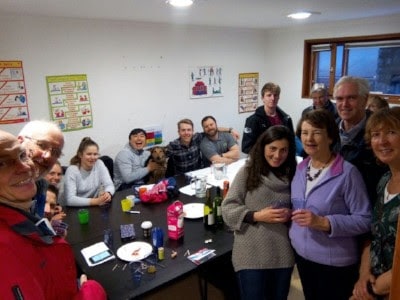
Photo is courtesy of Alpine French School and was taken the night of our “going-away” party.  I’m in the middle with our school dog Mani.  Several of us who had been there for some weeks were leaving the next day and they feted us before our departure.  To learn more about the school and how I learned about it (and about a discount for TAIP readers), click here.

TAIP is 100% reader-supported through tipping. If you want to leave us a tip of any amount it would be highly appreciated. These tips help support our efforts to keep TAIP an ad-free environment. Just as at a cafe, the tips are split evenly among the team.
In the Mountains…to Learn French at Alpine French School

I write this on my second day of classes at Alpine French School, a school I first became aware of because of TAIP reader, Matt Kern.  I was telling Matt over coffee that I wasn’t particularly happy with the classes I had taken while in Paris, and that perhaps getting away for a few weeks would help me get to a higher level of ability in the language, as I knew “fluency” was some years away.  In Paris I was in the thick of my life with friends, social activities, and the city itself.  Somewhere else…perhaps I would be able to put in 4-5 hours a day of study and make a serious move forward from where I was (B1).

Matt told me of this particular school in Morzine, nestled in the French Alps but just a stone’s throw from the Swiss border, where I could be isolated, learn French, and if I wanted to, ski in between classes.  My reaction was the same as those of most when I tell them about it: “Really?”  Yet, it was perfect in a number of ways.

I would be isolated.  It’s at least an hour’s winding drive through the Alps to get to Geneva from Morzine, and I wouldn’t have a rental car and would have to pay for a shuttle to get into town, if I even wanted to go (I’m much more a Zurich than Geneva person in Switzerland, anyway).  No temptations for weekend getaways.  I’d also be in a small town, away from my Paris life, so my options would be limited.  Studying and skiing could be everything!

So, around last October, I began planning.  I set aside four weeks, bought the 4-hour-per-day learning French package (Super Intensive), bought a season ski pass (it’s around 30-40% off when you buy prior to the end of October), and train tickets to and from Geneva.  The school assisted me with finding accommodations and with getting to and from Geneva.

It being day 2, both mental and actual muscles are a bit sore.  Four hours in class yesterday from 09h00-11h00, then 16h00-18h00, with a break in between, which I and my roommates used for skiing, of course.  I also took an additional hour and a half in the evening for studying, and have been listening to Pimsleur lessons to and from school (about a 15-minute walk each way).

I’ll be updating you on progress throughout the month, and I also hope to shoot some videos for the Alpine French School Facebook page, which you can follow here.  If you ever decide to come (it has been three years since Matt and I had that conversation about this place, so understandably it may be a while) the school will waive enrollment fees for anyone who mentions “The American in Paris blog” as how they heard about the school.  Remember, the school is open year-round, so if skiing’s not your thing, perhaps hiking in the summer?  The town is lovely and Montblanc is visible on good weather days from the top of the highest ski runs.  More to come…

I took the photo on my first day here.  Conditions were great.

TAIP is 100% reader-supported through tipping. If you want to leave us a tip of any amount it would be highly appreciated. These tips help support our efforts to keep TAIP an ad-free environment. Just as at a cafe, the tips are split evenly among the team.