French Tax Office Rules Against Remote Work

In the United States, when there is ambiguity about a tax law, if enough accountants and people ask about, the IRS will give guidance which then means people will have to, at least from that time forward, act accordingly. For example, when crypto came into its own some years ago, the IRS gave guidance for how to deal with it. That guidance is publicly listed on an official government website so everyone knows.

Just a few days ago, Emma Pearson of The Local wrote a very helpful article sharing new guidance on remote working in France. While I am unclear as to why the French Tax office would choose to “exclusively clarify to The Local” a rather important tax rule, instead of publishing and publicizing it themselves on a government website, we are grateful for Emma’s work regardless, as the guidance is clear.

This is the key quote:

“The French tax authorities (DGFiP) consider that work is carried out in France when it is physically performed from French territory, regardless of the employer or location of the clients. So if you’re an employee or freelancer working for a company based abroad, but physically carrying out your tasks from France, this constitutes work carried out in France for tax purposes.”

Our position at TAIP for many years has been that since we have guided many people through successful visa applications in which a letter from employers stating that the applicant was remote working, that as far as immigration authorities are concerned, remote work in France is legal. That is still our position. The ruling of the tax authorities cannot overrule another equivalent (or possibly higher) department of the government: immigration. A ruling or clarification would still need to come from there.

However, this clarification from the tax authorities makes such visa applications now impractical, as once you get here, the tax authorities play an oversized role in your ability to stay in France. Various attestations, including the P-237 which I had to submit for my French citizenship application, all need to come from them and you want to be in their good graces. You couldn’t be in their good graces in the face of this new clarification.

Practical Effects

What does this mean for you? Here are some scenarios we have considered as of today, when we are officially amending our advice on visitor visa applications:

Current Visitor Working Remotely

Our advice is for you to transition to a Profession Libérale visa, freelancing in the field you already work in. This may be straightforward in some fields. For example, if you are a bookkeeper, you could simply set up a French bookkeeping practice with this visa, and your now-employer could then transition to using a foreign contractor. On the American side, this will be relatively painless, as they don’t have to enter the French labor market. They are simply hiring a foreign freelancer. The tax implications are on the freelancer. You can start working on the paperwork now (we have courses and consultations to assist), and then when renewal comes, you can simply apply for a “change of status” and present your application then.

Hopeful Visitor Who Wanted to Work Remotely

As we noted above, this door is now officially barred so you’ll have to consider Passeport Talent or Profession Libérale as alternatives, and our website is full of advice on both.

Person Who Decides to “Risk It For the Biscuit”

Okay, so you’ve done your own French taxes for years, and you’ve correctly reported your foreign-sourced income. There’s no real way for the tax authorities to know you work remotely, as we’ve always noted (there are no tax authority digital police roaming around, no matter what the Karens say…or believe!). But your long-term future in France doesn’t offer solid possibilities. To get a ten-year card you will need to prove financial anchorage in France, which you can’t do with mostly (or entirely) foreign-sourced income (N.B.: we have seen exceptions to this principle made for retirees). The bar is even higher for citizenship. So, you can potentially get away with this indefinitely, but you’ll be stuck with only ever getting one-year cards forever. Not a pleasant prospect.

Reflections

Other nations like Croatia and Spain have created much more progressive visas in which immigration and the tax authorities work together, so there could never have been any ambiguity about visas because one department considered remote working legal and the other illegal. That’s neither good nor bad, as every country has a right to run itself as it sees fit, but it’s unfortunate for those who would like to live in France but don’t wish to start a business, get into a relationship with a French person, or have the particular set of skills that would lead a French company to pay a one-time bounty + a percentage of every paycheck indefinitely just to hire you when they could hire a European. This ruling from the tax authorities excludes many people from France who would otherwise have come to the country, paid into the economy, possibly learned French, and made friends (and maybe found a spouse).

In a time of global uncertainty, such a stance cannot be considered welcoming from a country that prides itself on hospitality and showcasing its treasures. And why the tax authorities have chosen to effectively speak for French immigration, I’ll never know. However, it’s not our duty to like official rulings, but to comply with them and advise our clients to do so, as we always have here on TAIP.

Photo courtesy of Wikimedia Commons.

Did you enjoy this article? TAIP is 100% reader-supported through tipping. If you want to leave us a tip of any amount it would be highly appreciated. These tips help support our efforts to keep TAIP an ad-free environment. Just as at a cafe, the tips are split evenly among the team.

URSSAF’s Summer Robbery (and Autumn Reimbursement)

Back in 2016 I wrote my very first article about French taxes. I noted that I had to send two written corrections to the Ministry of Finance by registered mail, asserting (with my French accountant gently nudging me forward) that I, in fact, did not owe taxes to the French on my foreign income. It was only after the second letter (they had tried to get away with simply a reduction in the first reply) that they removed all liability.

Reflecting on that incident now, I remember being surprised that it could have happened. I had only been living in France for about three years at that point. I had the idea that tax returns go into a machine, and that the machine double-checks your own calculations, and then voila, you get your September attestation. This situation turned me on to the idea that sometimes, the machines can screw up, even with something so banal as number-crunching.

Summer 2024 marked a new milestone for me. As is the case for most of my summers in France since 2015, I was away from Paris for the majority of the time. That also meant if “administrative issues” occurred, I probably wouldn’t be able to deal with it until after the rentrée, for various reasons. In this particular case, URSSAF suddenly started pulling out seven times my normal monthly social contribution out of my business bank account.

I say “suddenly” but the truth is that URSSAF sends a “regularization” notice for your social contributions (just as the Ministry of Finance sends one for your personal taxes). The latter normally comes in September but with the new integration of URSSAF with your tax filings, the former came as part of a regular email notice that I ignored. Revenue for my French business had been more or less the same in relation to the previous year so I thought my contributions would remain the same.

Wrong.

For whatever reason, URSSAF had taken my foreign earnings amount, which I have to declare on my French personal return, and decided that all of it was taxable French business income. I only learned that because I sent an email to my personal and business accountants (in September, when I knew everyone would be back) asking what could have happened, and did I miss some new major tax that had been levied on small businesses?

The same accountant who all those years ago helped me stand up to the Ministry of Finance wrote back:

The XXX€ amount represents US source earnings for which you paid social charges in the US. URSSAF should not be using this amount in their calculation.

This happened to one other client and after correspondence with URSSAF by the client’s French accountant, he was able to correct his calculation.

The explanation should be that this is US source income and per the social security tax agreement (Totalization agreement) it is taxed in the US thus exempt from French social charges. 

She helpfully enclosed the link for me to share with URSSAF in correspondence.

I duly forwarded my objection to URSSAF and a couple of weeks later I got a new regularization and a large portion of the overcharge refunded to my bank account for the 2023 number. Now that I’ve gotten clarity on what happened, I’m going to restate estimated numbers for 2024 to URSSAF (quite easy since it’s almost the end of 2024), and once they process that, I will probably get the remaining amount of the overcharge refunded.

Two key takeaways:

  • As doli recently noted in her dogged pursuit of the French to pay her back for the locks they broke, it’s about persistence. Most people, even the French, often cave on personal administrative injustices, as confrontation with the authorities is emotionally draining, and life is hard enough. Stay dogged.
  • The French bureaucracy is going to make mistakes, even nonsensical ones sometimes. Stay patient and make sure you have good help.

Speaking of good help, for years we have been dogged by the question, “Do you know any good accountants?” My accountant (the one referred to in this story) stopped taking new clients in 2018 so I’ve not been very helpful in recent years other than to send links to some accountants we had found online but had not gotten to know. But thankfully, we now have a resource. You’ll see short interviews done with these firms in the weeks ahead to give you a bit more context. When you reach out to them, let them know The American in Paris sent you. It’s one more way you can support our work. 🙂

If you’d like a laugh from a fellow immigrant, Tatty Macleod, who understands the pain of URSSAF, click here.

Photo by George Becker.

Did you enjoy this article? TAIP is 100% reader-supported through tipping. If you want to leave us a tip of any amount it would be highly appreciated. These tips help support our efforts to keep TAIP an ad-free environment. Just as at a cafe, the tips are split evenly among the team.

This story also appeared on Medium.

mini american and french flags in a cup on a wooden table

US Taxes for Americans Living in France

Note from the editor: One of our most asked questions here at TAIP is: how do I file my taxes as an American expat in France? Do you have any accountant recommendations? As such, I’ve made it a goal to come into contact with some reputable CPAs. Universal Tax Professionals specializes in US taxes for Americans living abroad. Josh Katz, CPA and Founder of UTP shared this very helpful overview of everything you need to know about filing as an expat in France, as well as ways UTP may be able to help. — MS

For Americans living in France, the issue of taxes can seem complex, as they need to address both French and US tax obligations. While living abroad provides many opportunities, it does not absolve US citizens from filing and paying US taxes. The US operates on a citizenship-based taxation system, meaning Americans must file a tax return annually, no matter where they live. 

Who Needs to File US Taxes?

All US citizens and Green Card holders living abroad must file a US tax return if they meet the below income thresholds:

  • $13,850 for single filers
  • $27,700 for married filing jointly
  • $5 for married filing separately
  • $20,800 for head of household
  • $400 for self-employed

This means if your worldwide income, including earnings from French sources, exceeds these amounts, you must file a US tax return, regardless of where you live.

Foreign Earned Income Exclusion (FEIE)

To reduce the burden of double taxation, the Foreign Earned Income Exclusion (FEIE) allows Americans living abroad to exclude a certain amount of their foreign-earned income from US taxation. For the 2023 tax year, this amount is $120,000. To qualify for this exclusion, you must pass either the Bona Fide Residence Test or the Physical Presence Test.

  • Bona Fide Residence Test: You must reside in a foreign country for an uninterrupted period that includes a full tax year
  • Physical Presence Test: You need to be physically present in a foreign country for at least 330 full days in any consecutive 12-month period

Foreign Tax Credit (FTC)

In addition to FEIE, US expats in France can also claim the Foreign Tax Credit (FTC). This credit allows you to offset taxes paid to the French government against your US tax liability. If you pay taxes in France, you may be able to avoid double taxation on the same income by claiming the FTC.

For instance, if you’re employed in France and pay French income taxes, the amount of tax you pay to the French government can be credited against the US taxes you owe. This credit applies to income, dividend, and interest taxes but not to social security contributions.

Reporting Foreign Bank Accounts: FBAR

If you have a foreign bank account, including accounts held at French banks, you may need to report this to the US government. The Foreign Bank Account Report (FBAR) is required if the total value of all your foreign financial accounts exceeds $10,000 at any point during the year. The FBAR must be filed electronically with the Financial Crimes Enforcement Network (FinCEN) by April 15 each year, though an automatic extension to October 15 is available.

FATCA Reporting

The Foreign Account Tax Compliance Act (FATCA) requires US expats to report their foreign assets if they exceed certain thresholds. For US taxpayers living abroad, the threshold is $200,000 for single filers and $400,000 for joint filers at the end of the year. This includes bank accounts, investment accounts, and other financial assets held in France.

FATCA reporting is done through Form 8938, which must be included with your US tax return.

Self-Employment Taxes

If you’re self-employed in France, you must pay US self-employment taxes, which cover Social Security and Medicare. The US self-employment tax rate is 15.3% of your net income. However, if you’re covered by the French social security system, the US-France Totalization Agreement can help you avoid paying social security taxes in both countries.

Under this agreement, if you contribute to the French social security system, you won’t be required to pay US self-employment taxes. However, you’ll still need to file your US tax return and report your income.

Double Taxation and the US-France Tax Treaty

The US-France Tax Treaty helps avoid double taxation by providing rules for which country has the right to tax specific types of income. For example, the treaty outlines how pensions, investment income, and wages should be taxed to prevent them from being taxed by both the US and France.

Understanding how the treaty applies to your situation is crucial, as it can affect your tax liability in both countries. 

Deadlines and Extensions

For Americans living abroad, the US tax filing deadline is June 15 — an automatic two-month extension beyond the standard April 15 deadline. However, if you owe any taxes, interest will still accrue from the April deadline. If you need more time, you can request an extension until October 15, but you must submit Form 4868 to do so.

Streamlined Filing Compliance Procedures

If you’ve fallen behind on your US tax filings while living in France, you may be able to catch up without facing penalties through the Streamlined Filing Compliance Procedures. This program is designed for expats who have not filed their tax returns due to non-willful neglect. To use the program, you must file three years of back taxes and six years of FBARs, along with a statement explaining your non-compliance.

How a Tax Professional Can Help with Your US Taxes

Handling US taxes while living in France can be challenging, especially with the complexity of filing requirements, credits, and exclusions available to expats. Working with a tax professional means you won’t have to worry about missing deadlines, filling out complicated forms, or determining whether you qualify for certain credits. They can help simplify the process and reduce the risk of penalties or overpayment.

Universal Tax Professionals has been offering tailored tax services to American expats in France for over ten years. Our experienced team specializes in US expat tax preparation, ensuring that you comply with US tax laws and maximize the credits and exclusions available to you. Whether you need help filing back taxes, claiming the right deductions, or understanding complex reporting requirements, UTP provides personalized support. Reach out to schedule a consultation today and let our team take the stress out of your US tax filing while living in France.

Photo by The Now Time on Unsplash

Did you enjoy this article? TAIP is 100% reader-supported through tipping. If you want to leave us a tip of any amount it would be highly appreciated. These tips help support our efforts to keep TAIP an ad-free environment. Just as at a cafe, the tips are split evenly among the team.

piggy bank next to gavel

Bank Accounts, Taxes, and New Legislation: a Quick Guide for the American Expat in France

Note from the editor: In this special guest post, Robert Levitt, a French licensed investment advisor at Levitt Capital Management, a tax and investment advisory firm established to work with US citizens in France and throughout Europe, shares news of two pieces of legislation that could have an impact on American expats in France. Follow the link above if you’re interested in working with Robert or his firm – MS

Americans who live in France may already know they are unique in the world of expats — they fall under two different tax regimes: the United States and France, and both tax you on your worldwide income.

You may also know that the US and France have some of the most favorable tax treaties in the world, especially when it comes to investment portfolio strategy. These treaties not only reduce double taxation but also allow you to take full advantage of the best of both countries’ tax rules.

So for most Americans in France, changes in US legislation can often be a huge setback, not an advance. At our investment and tax advisory firm, Levitt Capital Management, we closely follow the legislative activity in Washington that can impact expat Americans. Two proposals on the horizon are worth discussing.

New Legislation in DC Most Likely Won’t Impact Americans in France

A new bill, called the Overseas Americans Financial Access Act, is intended to provide relief for Americans who have trouble opening basic bank accounts in the country of their residence.  

I had the opportunity to catch up with Congresswoman Titus, the person who introduced the bill, and I’m impressed with her efforts. However, in my opinion, the bill will not be very helpful for a myriad of reasons.

Its basic premise, sometimes called the “Same Country Exemption,” proposes that Americans who live in a foreign country would not be subject to FATCA on their basic checking accounts open in the country where they live. 

Bills that provide relief for Americans abroad are a good thing and, again, I applaud Congresswoman Titus. But I don’t believe this particular bill will be helpful. Legislation in the United States famously doesn’t impact banks in Europe, and nobody involved seems to have asked the banks if it would change their view on Americans.  

I decided to do the research myself and have discussed the potential of a bill like this with banks throughout the UK and Europe. The answer? No, a bill of this type wouldn’t have any impact on what they do, because if they tried to determine who lived where it would just add to the bank’s burden. 

Most of the people I spoke with also mentioned there are logistical problems with the legislation as well. Each country has signed a specific agreement or treaty with the United States regarding FATCA. Meaning, that even if the bill were passed into law, it would not change the treaty agreement. 

It’s also an idea whose time has come and gone. Thankfully, opening a basic bank account is no longer an issue in Europe (particularly in France). Most banks have purchased the software needed to conform with the FATCA regulations. So, if a particular bank refuses an American, there are plenty of alternatives out there.

Better Legislation on the Horizon?

Far more interesting is legislation soon to be introduced called the Americans Abroad Tax Bill. It’s set to:

  • Combine tax and foreign bank and financial account reporting (FBAR and FATCA) 
  • Study and report on the simplification of currency exchange rates 
  • Increase the threshold for simplified foreign tax credit rules and reporting 
  • Give a time extension for persons outside the United States to request abatements of math errors 
  • Reduce the burden for lower-income dual citizens expatriates and more.  

Some of these issues are probably non-starters because combining the FBAR with the FATCA filings would be opposed by both the IRS and FinCEN, the financial crimes unit of the U.S. Treasury, so I’m not sure that portion will pass.

It’s complicated, but still, this is a bill that I can support and will advocate for in an upcoming trip to Washington — although it has a far better chance of passing in 2025 than in 2024.

There is far more involved in the bill, and if you’re interested in seeing the text, I’d be happy to discuss it with you. While tax and financial issues can seem overwhelming, more and more providers understand these issues and offer straightforward solutions. We are one of those providers, and would be happy to work with you!

In any case, whether these bills are passed or not, I applaud the efforts of all legislators who are trying to provide relief to Americans who live in France. It is needed and appreciated.

Photo by Sasun Bughdaryan on Unsplash

Did you enjoy this article? TAIP is 100% reader-supported through tipping. If you want to leave us a tip of any amount it would be highly appreciated. These tips help support our efforts to keep TAIP an ad-free environment. Just as at a cafe, the tips are split evenly among the team.

french taxes

French Tax Season Concludes

It’s that time of year when French accountants have closed their offices, put do-not-disturb autoresponders in their email inboxes, and have fled town to relax.  Tax season is over.  I never expected to write so much about taxes on this site, but enough people ask me about them that I have to pretty consistently write about the topic, as I did in 2015, 2016, 2018, 2020 (twice) and this article adds 2021 to the list.

Yesterday was the last day this year that personal income taxes could be filed in France.  The Fifth Republic gives paper filers the least amount of time.  This year that date was May 20th.  After that only online filing was possible.  May 26th was the deadline for departments 01-19 and non-residents of France (if you have real estate or a business that earns income in France you have to file even if you don’t live here).  June 1st was the date for departments 20-54, and yesterday, June 8th, was the deadline for all the rest of the departments, from 55 to 976 (Mayotte), including those of us here in Paris (75).

I’ve not filed my own taxes in any country since my early 20s, before I started to own businesses and learned how favorable the US tax code was to them.  Even then, I always took cues from paid accountants who spent their entire working lives learning about the tax code and were always up on the latest regulations.  I carried that same attitude over when I moved to France.  I hired my French personal accountant in 2014 and she’s taken care of me every year since and works in concert with my US firm that handles my business and personal US returns and specializes in location-independent businesses.  My French accountant sends her engagement letters out to her existing clients early each year and that guarantees you a spot for the year’s filings.  If you’re not a pre-existing client, you’re going to pay much more to file a return if you reach out to her or her colleagues even in mid-season.  You’ll pay progressively more each week closer to filing time, and double or triple what I pay if you contacted her last week, if she was even willing to pick up the phone then.

Hence, when I get panicked emails from Americans in April and May asking if I know anyone who can help them, I often say, “I don’t know.”  There are a very limited number of firms that work with Americans filing taxes here in France and because of that, the rates are significantly higher.  Then the immediate retort to the price I quote, which is usually from someone on visitor status is, “But I don’t even PAY taxes here.”  But the problem with that statement is its lack of anchorage in reality: you don’t pay your accountant based on how much tax you pay.  The accountants don’t work for the French government.  You pay based on how complicated your return is.  While Americans who are tax residents in France don’t have to file particularly complicated returns, no one would classify those returns as simple.  They get additionally complex when you add in French income from rentals and/or businesses (as I have had to over the years).

Americans forget that there isn’t some equivalent of H&R Block here offering tax returns at cut-price rates done by people who went to a clinic for eight weeks.  Hence they have unreasonable expectations.

One way to adjust your expectations appropriately is to educate yourself.  I recently came across a book written by someone I met in Bangkok at the end of 2019.  He runs an international accounting firm and the book is called US Taxes for Americans Abroad.  It’s not an exciting page-turner (no financial book is) but it’s very helpful for understanding just how complicated life for a US citizen abroad is.  I suspect the estimated nine million of us who live outside the US have no idea how complicated it is, even if, like me, they have been filing in their country of residence for years.

Just a few helpful concepts Vincenzo (himself a non-resident American) includes in his book:

  • how renting a home abroad can lower your US tax burden
  • the ins and outs of the Foreign Earned Income Exclusion (FEIE)
  • how to avoid paying state taxes if you are no longer resident stateside
  • the tax implications of marrying a non-US citizen
  • retirement and investment challenges

And the topic du jour among Americans abroad in recent years: renouncing US citizenship, and all the costs that come with it.

The moral of the story, as always: living outside the United States comes with some amazing opportunities and benefits.  It also comes with at least double the paperwork of a regular life in the US.  Stop your complaining and get to work.  At least one benefit for those of us filing in France this year?  No need to report any of the aid we received for our businesses due to Covid.  One more thing to be grateful for as the weather turns warmer, ever so slightly, day by day.

TAIP is 100% reader-supported through tipping. If you want to leave us a tip of any amount it would be highly appreciated. These tips help support our efforts to keep TAIP an ad-free environment. Just as at a cafe, the tips are split evenly among the team.
french taxes

Normalizing Your Tax Contributions in France

I’ve written about taxes numerous times over the years but I don’t think I’ve ever talked about what happens after you file them here in France.  As 2020 winds to an end, it’s as good a time as any to explain.

Année Blanche

One of the numerous campaign promises that President Macron made years ago was a simplification of the tax and pension systems, and one of those reforms meant moving to a “present year” form of taxation instead of the trailing year system we have in the US (we pay taxes on income we earned the previous year).  On January 1st, 2019, many people who were in salaried positions began being taxed for their income each time they received a paycheck.  The idea was that since you were paying each month, you wouldn’t need to “save up” to pay taxes the following year.  This meant that for many, 2018 would be considered as a “no tax” year, an “année blanche,” since the government would theoretically only be looking at your 2019 earnings for your 2019 taxes.  In practice, it’s pretty much the same as before, but with monthly deductions instead of a lump sum annual payment.

But that still means that your tax charges for any given year are based on what you earned in the previous year.  If nothing changes for you financially, your taxation will always remain the same, unless legislation changes the tax code.

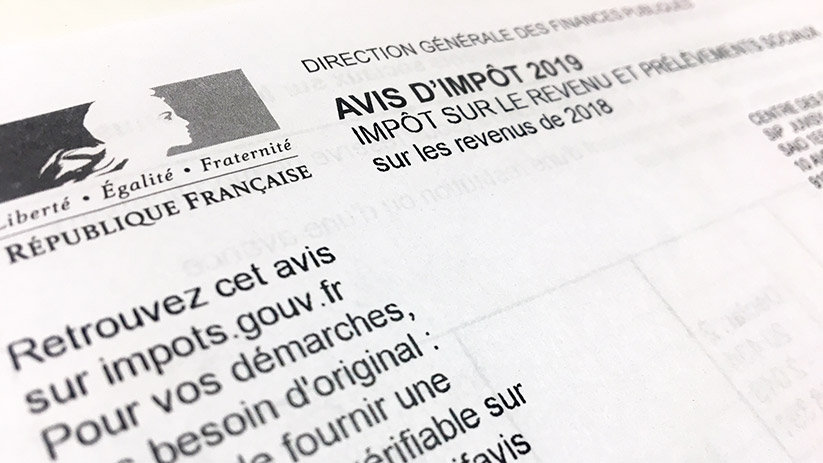
Avis d’Impot

Taxes in France are due at the end of May usually.  This gives the Ministry of Finance all summer to process your returns and by September you will receive an important document for those who are on a citizenship journey: your “Avis d’impot sur les revenus et prelevements sociaux.”  You’ll need at least five of these in which you are paying taxes (and making a sustainable income) as part of your citizenship dossier.  These used to be mailed but now they are available as downloadable PDFs, which makes the normally scary “document à conserver” label pointless.  No worry about having to keep a document on file that you can print on command.

This report verifies the return that you have made, though the Ministry of Finance is not bound to it.  They can come back for you up to 3 years after a tax year for any errors or omissions that they find.  So, if they have problems with your current return they will tell you.  Otherwise they’ll accept it and tell you what remains to be paid for the current year.

So, let’s say that based on your 2019 return, the government estimated that if nothing changed in 2020, you would need to pay 100 € per month, or 1200 € for the year.  However, 2020 was good to you (maybe you had stock in Zoom) and you made more money. As a result, when you get your Avis back in September, the government says that instead of the 1200 € that you were going to pay this year (which they smoothed into 100€/month), you now owe 1600 €.  As such, your automatic deductions for September-December will double to 200 € to get you to 1600 € total by the end of the year, and your 2021 contributions will now probably be 133.33 € per month, unless you make more money in 2021, in which case you can expect those contributions to go up, or if you make less money, in which case the contributions go down.

Keep in mind that this is simply for your personal tax return.  File a personal tax return in May, get an end-of-year regularization of your personal tax contributions in September.

Déclaration Sociales des Indépendents

So, when you file your French personal taxes the Ministry of Finance makes the calculations and auto-adjusts your contributions.  But it doesn’t work that way for filing your French business taxes.  Once you’ve filed your business return, you’ll need to enter certain values from your return into a website, in this case, it’s a website called net-entreprises.fr.

Now, I’m not your accountant, and that’s who you should be speaking with regarding these various boxes, as your business may have certain revenues and contributions that I have not made and vice versa, but the two most important numbers are going to be XA, which is your total profit, and XD, which is your total revenues (turnover).  You’ll also need to report if you received certain benefits or have certain obligatory contributions, but at the end of all this you are going to push “submit.”  This has to be done no later than the end of June normally, so unlike your personal taxes, which give you your new amounts owed in September, your revised business contributions to URSSAF will immediately display.

To follow the previous example, if you were paying 200 € a month in contributions to URSSAF (if you don’t know, this is your social security and health care contribution as a business) based on your previous year’s revenues, and this year was better, they will increase your charges in September-December in order to make you current for the year, then create a new schedule of payments for you for the following year based on your new “normalized” revenues.

The corresponding document you will get from URSSAF will come much sooner than September, probably sometime in early August, and this year would look like: “Régularisation des Cotisations 2019 et Appel de Cotisations 2020.”  URSSAF hasn’t yet caught up technology-wise with the Ministry of Finance so they are still sending these by mail, but I expect them to go paperless pretty soon.  President Macron has been pushing the dematerialization agenda pretty hard across all government agencies and that’s a good thing: more digital documents + less paper = fewer things to lose.

In this same document they will give you an estimate for your monthly contributions for the following year but it’s only “provisional” as things can change.  For example, this year URSSAF stopped taking our contributions beginning in March which didn’t mean our charges were forgiven, but that September-December of this year took up all the burden of the contributions that were not deducted from March-August.  URSSAF did tell us that we could continue to manually make payments during this time, but they made it sufficiently complicated that the majority of us opted to take the “free rent” from the government and just wait until later in the year when the charges would catch up.

Digital Has Its Benefits

So I hope that you now have a better understanding of how taxes work in France and the fact that what you file in the spring has consequences in the autumn, for better or worse.  An increasingly interconnected digital system across all the government agencies is reducing error and making managing your accounts easier, though of course this risks leaving behind the elderly, who are less comfortable with technology, or the poor, who don’t have ready access to the internet or computers.  Thankfully there are agencies and associations trying to help these and other groups keep up with change in France.

TAIP is 100% reader-supported through tipping. If you want to leave us a tip of any amount it would be highly appreciated. These tips help support our efforts to keep TAIP an ad-free environment. Just as at a cafe, the tips are split evenly among the team.

Firing Société Générale

One of the earliest articles for this blog was about my experience getting my first French bank account at Société Générale.  The process was relatively painless, but that was before FATCA came into force and made life more challenging for US citizens living abroad.  Still, possession of any form of long-term visa will allow you to get a bank account here, as I shared some years later.  When it came time for me to open a bank account for my French business, I decided to hedge my bets and audition another company, BNP Paribas.  Time has shown them to be the better bank for me, and armed with additional European bank accounts at N26 and Wise, I fired Société Générale from my life in February.

Mais pourquoi?

Given how challenging it can be to open accounts these days, why would I get rid of one I had?  Well, firstly, bank accounts in France are rarely free.  There’s a monthly service fee (in this case, 17 euros a month for a very basic account) whether you have any activity or not.  Secondly, I had already had exceptional service from BNP that Société Générale couldn’t match.  When I moved from the 2nd to the 19th, I was able to change my “home agency” using the BNP Paribas app.  With Société Générale, it was a nine-month saga, with multiple trips to my original agence in the 17th.  But the last straw was a denial of a loan.

Americans are used to having a “credit score” which tells lending institutions how worthy we are of being loaned money, and at what rate of interest.  There’s no such thing in France.  Indeed, there’s not even a centralized place for banks to know you have loans at other banks.  I found all this out when BNP Paribas sent me a flyer some years ago offering a 2% loan for my business account.  I didn’t need any funds at that time, but I was intrigued by an opportunity to build my relationship and profile with the bank and thought it might make for a good future article.  The truth was that the process was so speedy, there wasn’t enough meat for the article.  I made an appointment (online, using the app), showed up, and after 15 minutes of us getting to know each other and how we ended up in Paris, he asked what the loan was for.  I told him I actually didn’t need a loan, but was more interested in seeing how the process worked.  He nodded and said, “Okay, how about for working capital?”  I nodded and asked if there was any early repayment penalty.  He shook his head.  Ten minutes after that I was out the door, and 48 hours after that, the funds were in my account.  BNP had once again shown me that they were forward-looking, easy to work with, and fast.

As I audited my expenses for 2019 I wondered about Société Générale and my personal account there, which is what I paid my French taxes out of and was an account I deposited some sources of income into.  Should I really be paying 17 € a month for my personal account there when my account at BNP cost 7 € a month?  But I wanted to give them one final test to confirm my gut instinct: asking for a loan.

There’s no way to make an appointment with your counselor online with SG, so I had to go into my agence.  That’s fine.  I made an appointment in January.  The day of the appointment, he cancelled on me.  Okay, I rescheduled for the next available time, which was two weeks later.  When that day arrived, I brought all the paperwork I might be expected of to get a loan, which includes the “Avis d’impot” (the government document that verifies the veracity of your last filed return) of the last three years, my business tax returns, my business bank accounts, and the usual ID, lease, etc.  Two hours later, he “didn’t have enough information” and told me he would email me for more info.

Of course he didn’t email me.  I had to follow up with him over a two-week period and he kept asking for more info before finally saying flatly, “Non.”  I was appalled.  “Tu rigoles,” I began, and told him that BNP had had the exact same info (actually, BNP had asked for less info) and gave me a decision in five minutes, and I had only been banking with them since 2016, whereas I had been with Société Générale since 2014.  He shrugged and told me that different banks have different practices.

Okay, then I need to close my account,” I replied.  He was nonplussed.  We made an appointment for the following week.  You can guess what happened next.  I arrived only to find out that he was too busy to keep the appointment he had made and I was traveling the following week and he was in conferences the week after, so yes, I had to delay closing my account by three weeks, giving them another month of bank fees.

It took nearly an hour to actually close the account.  I was forced to sign several papers closing both my Livret A (savings account) and the checking account as well as ending the agreements that went with them.  The final action was to transfer the remaining funds at SG into my newly opened additional bank account at BNP (which took all of ten minutes to open, since they just copied all my information over from my existing account). Ridiculous to the end, offering no apology or regret for losing me as a customer, both my counselor and the bank vindicated my decision to fire them.  I’m literally now doubly happy as a BNP client, having two accounts with them and a solid and respectful relationship with my counselor.

Why don’t more French people fire their banks?  That’s part of a larger administrative issue that I’ll address in a future article.

TAIP is 100% reader-supported through tipping. If you want to leave us a tip of any amount it would be highly appreciated. These tips help support our efforts to keep TAIP an ad-free environment. Just as at a cafe, the tips are split evenly among the team.

Yes, You Should Get a French Bank Account

A friend recently wrote an account of her experience getting a bank account in France and it reminded me to do an update of my various thoughts on this topic beyond my first time getting a personal account, a business account, and the legislation which is the reason for difficulties Americans face on this front: FATCA.  The most important reason to get a French account is that it’s the only way you may hit a snag on your renewal.  Not having a French account signals a lack of integration into society.  You may be able to squeak by with something else, which readers have received inconsistent results with, so the advice I give is to do what definitely works, not “let’s try this.”  Hope is not a strategy, and certainly a poor idea when it comes to renewing visas in France.

While major French banks are understandably reluctant to give a US citizen a bank account because of the high cost of compliance with FATCA, if you hold a residence card (whether a sticker in your passport or the hard card in your wallet), you can, respectfully and calmly, demand a bank account as a right.  Yes, there are low-cost online banks that have no branches, like Boursorama, that will eject you from the application process the minute they find out you are a US citizen (trust me, I tried).

My recommendations, based on personal experience, are BNP Paribas and Société Générale, in that order.  They both have excellent online banking in the form of web access and brilliant native apps for your smartphones.  My counselors have always been available when I’ve needed help and my cards consistently work in countries all over the world, often offering an extra layer of security by needing me to verify purchases over a certain amount via entering my password on the app on my phone.

What I’ve been told secondhand by readers is that both LCL and HSBC are also willing to grant accounts to US citizens, and feel free to pitch your bank of choice in the comments below.

When you stop in at a bank you’ll almost always be making an appointment for a future date, as the bankers are often booked some time in advance.  If you don’t feel comfortable speaking the entire time in French, make sure to ask for someone who does speak English, and many of the staff do.  They will often provide you with a list of what to bring, which will include, but not be limited to:

  • Passport
  • Carte de Séjour (1st-year visa holders this is the sticker in your passport, everyone else it’s the hard card)
  • EDF or ADH and/or lease
  • Proof of income
  • Most Recent Tax Filings both US and French

and expect to pay around 15-20 € a month for even a basic checking account.  It’s part of the deal.

They also won’t let you pick your PIN, but I’ve found this to be a smart policy, because it doesn’t allow a thief who correctly guesses one pin access to all your cards, which Americas tend to use the same PIN for.

An intermediate step in the right direction, if you want to be able to easily transfer in Euros, pay your rent, etc., is a free Borderless Account from Wise that allows you to hold multiple currencies with no monthly rate and even includes a free contactless debit card.  But it is not clear to me that statements from a Borderless Account will pass muster with French immigration and no reader has yet let me know that such a strategy works.  The euro-denominated account in the Borderless Account is based in Belgium.  I absolutely love Transferwise and use it for other transactions outside of my personal and business ones, which I use my French accounts for.

TAIP is 100% reader-supported through tipping. If you want to leave us a tip of any amount it would be highly appreciated. These tips help support our efforts to keep TAIP an ad-free environment. Just as at a cafe, the tips are split evenly among the team.

French and US Taxes

This was the year I finally found my rhythm filing in two countries.  I did my US business taxes in March, my US personal taxes in April (though I needed some French income estimates to complete them), my French business taxes in May, and my French personal taxes right before June.  Yes, Americans, from the country ostensibly founded on a tax revolt, always get to file taxes, no matter where they live in the world.

Everyone has different strategies and situations and how much you actually pay in taxes is down to how well-constructed those strategies are.  What I have been reminding people in previous articles over the years (here and here) is that the moment you pass 183 days in a calendar year of living in France, you transform from being a regular resident to a fiscal resident, and as such, are required to file taxes, even if you are here on a visitor visa and have earned no French income.  As I often say, the French love documentation and paperwork, and the Ministry of Finance doesn’t share records with OFII in this regard and even if they did, they wouldn’t care.  They want their own proof of your fiscal liabilities (or lack thereof) during your stay here.

If you aren’t an accountant who speaks French and also knows French accounting law, I would strongly advise against self-filing.  If you need the recommendation of someone reliable, my accountant has been filing for me since my first fiscal year in Paris and now handles my file which includes French income and tax liability.

I’ve also found new French business accountants, who have been a dream to work with and delivered the kind of customer service that I had hoped for when I signed up with the last firm I used (who I have severed ties with).

I often hear from people who mention in their emails that “no one ever told me about this” and while I fully understand that sentiment, as I had to be told about this issue myself, you can’t have that attitude when emigrating to a new country, or even staying there just a few years.  Do not wait “to be told” about anything.  You are not a customer in a store.  You are a visitor and/or future possible citizen.  Read everything you can and continuously educate yourself.

Further, be assured that as cryptocurrency begins making greater inroads and banks continue to become more rigorous in their compliance, taxes will follow you, wherever you might be domiciled.  You won’t get to skate out of a tax system simply because you aren’t living in your country of nationality and/or because you’re a legal resident of a country in which you’re a foreigner.  Be proactive.  It will go a long way to preventing unpleasant messages in long white envelopes from either the IRS or the Ministry of Finance.

TAIP is 100% reader-supported through tipping. If you want to leave us a tip of any amount it would be highly appreciated. These tips help support our efforts to keep TAIP an ad-free environment. Just as at a cafe, the tips are split evenly among the team.

Troubleshooting: Branchless Bank Accounts

Article updated July 2022 for accuracy.

Some time ago I was sitting with some friends and the conversation turned to banks and bank fees.  Both of my friends shared how much they hated “establishment” banks and described with relish how they had recently “fired” them.  They had chosen to move on to the “internet only” banks.  One banked at Fortuneo, the other recommended Boursorama.  I was happy with Société Générale and had long ago written off bank fees in France as “part of the deal.”  Turns out, as an American citizen, I don’t really have a choice.

I went through the process of applying for a basic checking account at both Fortuneo and Boursorama, banks that leveraged technology and virtual offices to offer low-to-no fee banking.  At the end of both applications I was rejected, in no uncertain terms.  Not because of my credit score (because there’s no such thing in Europe), but because unlike my friends, who possessed German and Czech citizenship, respectively, I was considered a “US person” for legal purposes, and was subject to FATCA.

FATCA (Foreign Account Tax Compliance Act) became law in 2010 in the US but came into force officially in France this year.  It places an enormous regulatory reporting burden on French banks servicing US citizens.  The “budget banks” mentioned above do not have the means or the staff to comply with this reporting requirement so they rejected me.  I was told by one person in the know that it costs French banks up to 10,000€/year to service someone like me (a “US person”).  This is all because the US government is determined to get its grubby hands on every last shred of our income, even if it was not earned in the USA.

Now, even if that number of 10,000 €/year is wildly exaggerated, something like 2,500 €/year is still a lot just to comply with US reporting requirements.  When you keep that in mind, you can smile your way through the two-hour process of opening a new checking account, as I had to do a few months ago for my new French business.  It’s not enough to sign a few forms and give the bank your money, as we often do in America.  The French want to know what kind of business you are operating, how much money you think you will make, the name of your most recently deceased pet, etc.

Part of this is simply a “get to know you” policy that French banks are encouraging these days.  But part of it is both French governmental compliance and now US regulatory compliance.  My poor counselor told me that I was his first “US” account and he called in backup from his colleagues no fewer than three times as unexpected screens kept popping up during my registration.

All in all, I was happy with the process and BNP Paribas offers the same level of service and convenience that I’ve become accustomed to with French banks but is (to my knowledge) not widespread in the US.

  1. RIB (relevé d’identité bancaire) This is an upgrade over traditional “online bill pay” as there is never a paper check issued.  The money leaves your account and 48 business hours later it is in another account, whether it’s the account of a friend or that of a regular payee of your household.  When you add a new payee you must key in a pin and every time you issue a RIB payment to someone you must key in a pin.
  2. App-based verification for online purchases.  When you make a credit card purchase on the web you will receive a push notification on your phone.  You must key in a pin in order to approve the purchase.  Then, and only then, is your purchase approved.
  3. No ATM fees.  By French law, you cannot be charged fees for withdrawing your own money, even if it’s from the ATM of another bank.  So you can use any ATM anywhere, anytime. Unfortunately, this is no longer the case, as of 2021.

It’s a lot of trouble to set up a French bank account as an American these days, but once you have that account, it’s a great thing, and it makes your life here that much easier.

Did you enjoy this article? TAIP is 100% reader-supported through tipping. If you want to leave us a tip of any amount it would be highly appreciated. These tips help support our efforts to keep TAIP an ad-free environment. Just as at a cafe, the tips are split evenly among the team.