prof lib visa renewal

How to Renew a Four Year Profession Libérale Visa

I always tell readers of the blog that getting a visa is usually much more challenging than renewing one, for the simple reason that for the former you are trying to prove to the French that something is at least plausible (this business will work, I am enrolled in this school, I am in a relationship with this person).  For the latter you are simply offering evidence that their original judgment was correct.

I remember how I felt in 2017 when I got a four-year card for the first time.  After three years of building my entire travel schedule for each year around a renewal, the idea of not seeing the immigration office for four years was a dream.  I said so at the time.

I’d like to say this article was four years in the making, but that isn’t true.  This is just the soonest I could write to tell you about a renewal.  And there’s not too much to say.

Below are a few key facts you should know about renewing your Profession Libérale Visa.

One Year Probation

All of us, when originally applying, are given a one-year visa (what attracts a lot of people to Passeport Talent is that it gives you the possibility of a four-year card to start).  With Prof Lib the French are using the “trust but verify” mentality: can you actually do what you said you could do in your original business plan?

Now, there’s nothing published on the internet from the French government about this (one of the many reasons this blog exists in the first place, to fill a gap of information), but if you don’t have a good first year, you are only going to get a one-year renewal, and are effectively on a sort of probation.  What does a “good first year” mean?

The French expectation is that your Prof Lib business does at least the SMIC, which at the time of this article is 1269€/month, or 15,228€/year.  For those who don’t know, SMIC is the nationally-established minimum wage.  The thinking in the French bureaucracy is, if you’re going to bother to start your own business, you should at least make the minimum wage.

Now, this doesn’t mean that if you have a “bad” first year you’ll lose your visa status.  If it’s very bad, you may.  Meaning, if you only bring in something like 2,000€ for the whole year, the French will consider this essentially a scammy method for you to stay in France, and without a wonderful explanation about how new clients are just around the corner or that you have had a major personal/professional issue, you will not get a renewal and will have to leave the country in 60 days.

But if it’s anything north of say, 12,000 € for the year, you have a decent chance of at least getting a one-year card, with the expectation that you make it above the SMIC the following year.  If it’s significantly above the SMIC, let’s say at 22,000 €/year or more, you have a good chance of getting a four-year card on your first renewal, as I did.

Renewing the Four-Year Card

Renewing the Four-Year Card follows the exact same process as obtaining it in the first place.  Your main evidence, apart from the usual proof of address, renter’s insurance, etc. will be your tax forms* and invoices.  The tax forms will be a shorthand for the health of your business and the person looking over your dossier can see in an instant your topline revenue and your take-home profit.

Many small businesses in France had an off year in 2020 (understandably) and it seems the authorities have been willing to give a pass on that year to pretty much everyone, as long as in 2021 there was an increase in revenues compared to 2020 and that there’s a through-line narrative from your previous years as well.

One reason I have seen people not get a four-year card for a few years was a lack of diversity of clients.  If you only have one whale client and no others, the French consider your business very fragile.  This doesn’t mean you need to have dozens, you just can’t have only one or two and expect them to necessarily sign off on a four-year card.

The big difference for me this time from 2017 was that instead of going to the big Paris prefecture I had come to know through two different visa classifications and three renewals, I would be going to Melun because of my recent move to the Seine-et-Marne department (77).  It would be a completely new experience for me, but that experience turned out to only differ in Covid-19 restrictions pushing a security guard out front to forbid entry to any people not already cleared on a list.

Two Complications (That Weren’t Really Complications)

I went for my appointment in September 2021 with the thought that surely I would get a new card before my planned three-month visit to the United States which would begin in January 2022.  That didn’t end up happening.

Yet, I wasn’t worried insofar as I had traveled without my residence card during the pandemic (because the card had been stolen and I didn’t want to pay to replace it) and the US authorities, which guarded the border I was focused on crossing next, didn’t care about my status in another country.

The récépissé I was given had a six-month validity, which was double the length I had been used to in the past, but I didn’t actually expect them to use that entire time. I thought to mitigate this by getting a new récépissé before leaving, but since you cannot apply for a new récépissé unless it’s 60 days from expiration, with a 17 March expiry that meant I couldn’t apply for a new one until 17 January, when I would already have been in America two weeks.  I found this out the hard way when they cancelled my appointment to get a new récépissé the morning of that appointment with an “ineligible” note in the cancellation.

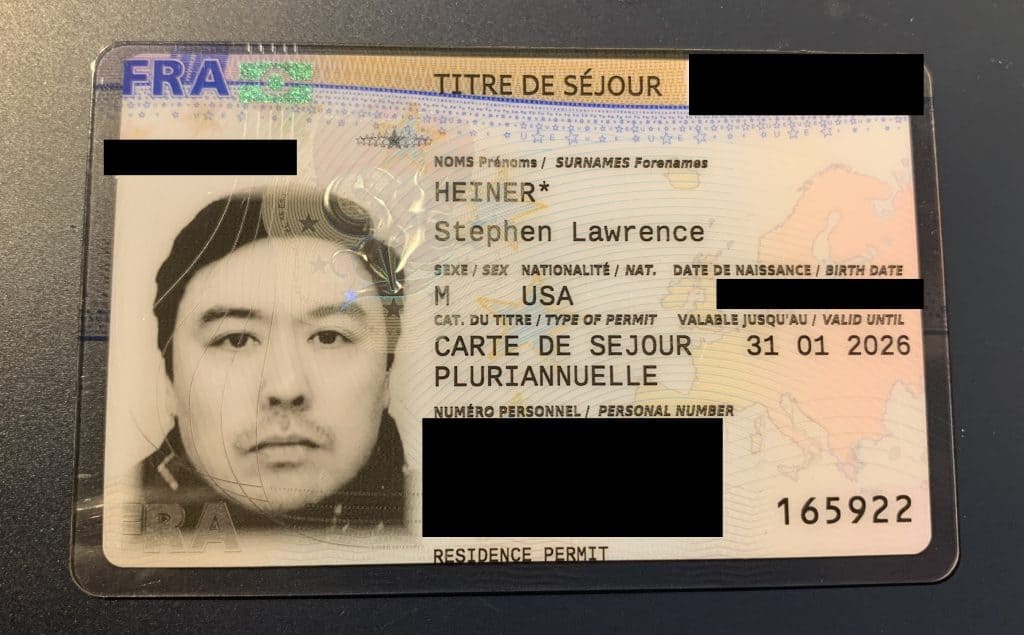
As you can see from the featured image for this article, the date of my new card is from 31 January of this year, but it wasn’t until 23 February that I received the text message from the government that I was welcome to pick up my new card and could I please bring a fiscal stamp to cover the 225 € it cost them to make it (you can purchase said stamp here; what a world of difference from 2014 when I bought a bunch of stamps at the tabac!).  You still need to make an appointment to pick up the residence card, and while I’ve heard that’s been hard to do lately in Paris, in Melun they had plenty of slots for me to book.  So from start to finish, it was six months from when I showed up for my renewal to when I could pick up a new card.

So the complications were:

  1. I didn’t have my residence permit: all I had was a police report which stated that my residence permit had been stolen.  I had carried that around while traveling for the last couple of years.  As I’ve shared elsewhere, I’ve come to realize that you need your residence card for exactly zero things in France and carrying it around only risks adding one more headache if your wallet is lost or stolen.  Keep it at home.  If and when you do need to show “ID” your passport will always win and if you want you can always store a picture of the front and back of the card in the cloud.  And as I told someone recently who worried that having her passport with her new visa sticker inside stolen invalidated her visa: your right to live in France lives inside the French bureaucracy, on a computer, not in your passport/residence card.
  2. My récépissé would expire on 17 March, but I wasn’t due to land in France until 1 April.  I knew the system well enough to know that I could flash my expired récépissé, with the text message, with the convocation that I had printed out to pick up the CDS, IF I was asked.  What happened at the French border?  Was I asked for my vaccination status?  No.  Was I asked for a PCR test?  No.  He asked me to remove my mask and stamp, I was in, just like old times.  As I often say: be prepared for the French to ask for everything, but realize they may not ask for anything.

So, like I said, there were two complications that weren’t really complications.

Today I picked up the card and voila, here’s the article explaining what you need to do to renew the card.

Now some of you may be thinking…wait, Stephen didn’t you take the A2 test last year so that you could get your ten-year card?  Yes.  But I also realized then that this was the last piece of the Prof Lib story I hadn’t told.  That if you had gotten a Prof Lib, renewed it, and gotten a four-year card, you would need to renew one more time before you were eligible to apply for a ten-year card (at least five years of fiscal residency)  Part of why I started this blog in the first place was to give information that isn’t out there, and I don’t think there’s an article on renewing a four-year card, so here it is, as brief as it might be.  I figured I could wait a bit before moving on with my own next step to put together an article with this info.

Related to a willingness to wait to apply for my next big status upgrade in France is that I’m no longer in a rush.  The pandemic has proven to me that residence gives you 99% of the privileges of citizenship, at least in France, as I was able to come and go as I pleased, and was even eligible for personal and business aid from the government.

When I first moved here, I was in a hurry to get citizenship, as I was under the delusion that the French were looking for any excuse to deport me at any moment, whether I mispronounced a word or forgot a piece of paper in my dossier.  Ten years have shown me the naïveté that that was and I try to pass on a sense of calm to people who hire me to consult with them or who take my courses**.  Citizenship is no guarantee that you won’t lose your rights (ask the Americans of Japanese descent what their citizenship meant in America after Dec 7, 1941, or what happened to people of a certain race in France the following year, in 1942) and the term “permanent resident” is a misnomer for the vast majority of resident visas worldwide: almost all require some kind of residence over some period of time, and then need to be renewed…not exactly “permanent” by any definition.

Just realize you’re going to be a foreigner in France for at least a while, and get comfortable with the “odd” feeling of being a long-term guest.  You may be kicked out at any time, but rest assured, it’s not going to be because you forgot a piece of paper in your dossier, and in fact, it’s not likely to happen at all.

What’s next for me, of course, is citizenship and/or a ten-year card.  Stay tuned; I’ll keep you in the loop and try to provide a template you can follow, as always.

I am certainly happier than the photo would indicate, but as you may know, you are not permitted to smile in official French photos. 🙂

*I don’t know how many times I have to say this: you MUST FILE TAXES if you live in France, even if you don’t earn any income in France!  I know it’s not told to any of us when we get here by the French government (I only learned, as I’ve learned so many important bits of information over the last decade, due to the newsletters of Jean Taquet), but your proof of filing taxes every year are the most important documents you must have if you ever want to apply for a ten-year carte de resident or for citizenship.

**Anyone who charges more than 1000 € to help you get a profession libérale status is probably running a scam.

Did you enjoy this article?  TAIP is 100% reader-supported through tipping.  If you want to leave us a tip of any amount it would be highly appreciated.  These tips help support our efforts to keep TAIP an ad-free environment.  Just as at a cafe, the tips are split evenly among the team.
Getting Pickpocketed

So I’ve been pickpocketed three times in the seven years that I’ve been in Paris.  Once in 2015 and twice in the last quarter of 2019, when pickpocketing was at an all-time high in the city.  Nothing irreplaceable was taken; it was more a chance to learn weaknesses and correct behavior.

The Wallet

I was helping a friend get to Gare du Nord to catch a train.  We got onto line 4 at the Cité métro stop and just before the door closed we felt a crush of people get onto the carriage.  I felt a strong hand at my back as we felt people try to squeeze in, which was probably all that was necessary to distract me from a hand reaching into the inside left pocket of my overcoat, where my wallet was.  I didn’t notice until Gare du Nord, which of course was far too late to do anything about it.

My pulse quickened; chemicals swam into my bloodstream to “help” my body cope with panic.  I tried to clear my head and quickly used my phone to cancel credit cards that I remembered were inside (including one that wasn’t inside!).  I didn’t think there was anything that could really be done so many wallets get lifted in any given day in a big city, not just in Paris but there was one crucial card in that wallet whose loss I would have to document for the French authorities: my four-year carte de séjour.

I had learned this some years back when I had left my wallet on an airplane, again, with a carte de séjour inside.  You have to file a police report to certify the “missing” status of the card.  Having that report allows you to get a new card.  You can’t start the process of replacing a missing carte de séjour unless you’ve filed a police report.  The sooner the better.

I was already in Gare du Nord, so I made my way down to the lower level branch police station that I knew was inside the station.  I briefly explained to the cop at the front desk what had happened.  He told me to take a seat and that it would probably be an hour (which in French bureaucratic speak means at least one hour).  The effects of the “panic chemicals,” cortisol and adrenaline, were ebbing away, and I smiled, nodded, sat down, and pulled a book out of my bag (always have a book to read when you’re walking around in Paris).

I had started to feel a bit sorry for myself when a girl in her early 20s came into the station escorted by a couple of officers.  One of them walked up to the front desk clerk and quietly said a few words.  The front desk clerk grimly nodded and the other officer walked the girl over towards me and put her into the seat next to me. He then said they would take her statement shortly.

The girl was shaken, and had either just been crying or was holding back tears.  I realized that however “poorly” my day was going, that others were having worse days, and I abruptly stopped feeling sorry for myself.

About an hour later, I was asked to come into the office and explain what had been lost.  The officer was very efficient and in about 15 minutes I was out of there with two crucial documents: the one-page police report with an inventory of all that had been in my wallet, signed by me and sealed by the attending officer, and a recipisse that the declaration had been filed, again signed by me and sealed by the attending officer.

I could have used this to go in and get a récépissé, which would have given me a “legal ID.”  But something had changed in the years since I had first started getting those coveted thick plastic ID cards: I had realized I didn’t really need them for daily life in France.  If I needed to rent a car, I would give the rental agency my US driver’s license.  If I needed to travel, I would use my US passport.  I might occasionally present the carte de séjour (CDS) if I needed to pick up a package, but I could just as easily bring my passport as well.  The cost of a replacement card is the exact same as the cost of the original card, and a part of my personality which has served me very well in past years, a character I call “frugal Stephen,” objected to the idea of paying for a new card with fewer than 24 months left.  “Why not just try to get by without one?”

Why not indeed?  I hadn’t foreseen that there might have been some sort of global crisis that would make the actual hard plastic card very important indeed.  More on that another time.

The iPhone

I am not the guy who gets the new flashy gadget.  I’ll gently use something until it gives up on me.  Case in point, Apple was offering double trade-in value on what was then my four-year-old iPhone 6 Plus.  Because of software upgrades (which would lead to a class action lawsuit some years later, which would lead to me also getting a payout) the phone simply couldn’t perform anymore and crashed all the time.  I took the double trade-in value and got a shiny new iPhone XS.  The phone was dreamy in comparison to my faithful old 6 Plus.  Until it got stolen a couple of months later.

I’ve mentally tracked down the 60 likeliest seconds in which it happened.  I have a habit of keeping my hand in my coat pockets during the winter season, and usually have my phone in one of those pockets.  The last time I remember using the phone was to show a friend of mine a funny meme.  We were on Line 2 and changed at Jaurès for the line in my neighborhood, 7bis.  Somewhere between changing from those lines is when I got pickpocketed.

The thing is I offer ready advice all the time to friends and travelers about how to stand in the métro and on buses to be more protected against such a thing (have your back to at least one area/part so that no one can stand behind you, don’t leave zippers or pockets exposed, etc.).  Predictably, as I had in 2015, I got mad and turned on “find my iPhone” to once again turn into the angry vigilante to track down my phone.  I shut down all the Apple Pay rights and started quickly changing various passwords when I got a note that my Facebook password had been changed!  These guys were good.

I used a combination of the location features offered by my local carrier, SFR, and Apple itself to triangulate where the phone was last seen, in the Barbès neighborhood, thirty minutes earlier.  Who did I think I was to go wander there?  Was I just going to approach anyone who I thought might have it and kindly ask that they return it to me?  Silly as it was, I went anyway, and found the street mostly deserted, with an empty kabob shop nearby.  At some point the foolishness of the endeavor caught up to me and I headed home.

The next day I bought a replacement at SFR and the kid helping me commiserated, telling me this happens pretty regularly and asked why I didn’t have insurance.  After explaining that after some time the insurance costs as much as a new phone he reasoned with me to carry it for two years and then dump the insurance.  I saw his point and agreed.  This particular insurance would allow for two full-price replacements in any given year.  Later that afternoon I got a taunting text from a number telling me in French, “thanks for the phone.”  I blocked the number and all the subsequent spoofed emails that clearly showed this was a group of professionals who regularly grabbed phones on the Métro and looked to spin the grief/anger/desire of the victim to get the phone back into even more “profit.”

Adjustments

So, what happened as a result?  I bought an even thinner wallet than the minimalist one that I had stolen, one small enough that it could fit in my front pocket (good luck with that, thieves!).  I also created a new habit of always putting my phone in my back pocket when traveling on the métro, usually with my messenger bag additionally slid over that pocket (you’re going to have to work harder if you want it!).  I can’t say I became ever more alert, because like anything in life, your guard goes down after a while.  But I was reminded that yes, unfortunate things can happen at times, but never forget someone may be having a worse day than you, so keep everything in context, and keep smiling.

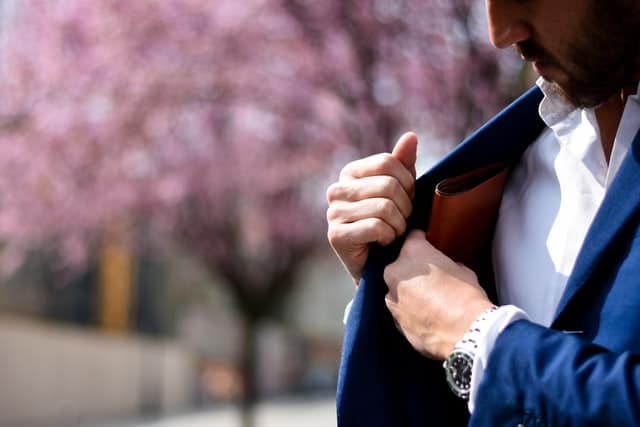
Photo by Andrea Natali on Unsplash

Troubleshooting: Récépissé for Visa Renewal

***Please note that practices have changed since Covid-19.  You may be able to get an electronic récépissé.  Check with your local prefectures.***

One of the things that keeps me really up-to-date in my immigration journey is the monthly newsletter of Jean Taquet.  If you don’t already get it, and you are planning to emigrate here, you’re doing it wrong.  In fact, if you haven’t subscribed to his newsletter, stop reading this article, click here, and subscribe (it’s on the right-hand side).  Then come back and finish this.  I’ll wait.

So one of the things that I got from Jean’s newsletter was that appointment times were going from their normal 2-3 month lead time to something like 5-6 months.  Sure enough, as I applied for the renewal of my visa which would expire on the 20th of April, the first date listed in the system was the 27th of June!  Keep in mind the date that I made this appointment was the 12th of January.  So the soonest I got an appointment was a little over 5 months from the date of request.

What that meant was I needed “legal coverage” from the date of the expiration of my visa (the 20th of April) until the date of my appointment (the 27th of June).  Otherwise I would be showing up to my appointment with an expired visa, which wouldn’t qualify me for a renewal, but would rather mean I would get to start the whole process all over again.  It also would mean I could be stopped and given a very hard time when coming in and out of Schengen during that time if I were asked for my CDS.

So, for those of us on the right bank, we have to head to the police station in the 17th, which specifically deals with issuing récépissés, among other things.  The address is 19-21 Rue Truffaut.

I just now returned from receiving the récépissé, and I blame myself for the two hours I waited from 14h00-16h00.  The reason being that my visa expires sometime next week, when I’ll be in Malta, where I obviously can’t get a récépissé, so I had to go today, which was the first day I had free to head over to the 17th to wait in line.  However, this next Monday is a public holiday, so that meant the line was extra special this Friday.

As you face the police station, you’ll want to go around to the left-hand side, where the entrance is for récépissés.  Most of the people seemed to know that the line would be bad and were pretty quiet about the wait, but even I was not prepared for the fact that the line effectively did not move for 90 minutes.  Then, bizarrely, at 15h30, they took almost all of us who were in line (about 30) and assigned us numbers.  Fifteen minutes after that, my number was called and I headed up to Guichet #8, where a nice gentleman speaking Russian-accented French helped me.

The problem was, as I mounted the stairs, I realized something dreadful.  I had forgotten my passport.  I had even laid it on my desk intentionally to bring with me, but I had that moment of realization even as I began to reach for my bag to search frantically that I had, indeed, forgotten it.

Cool.  Calm.  Collected.

I said these words to myself and kept walking up the stairs.

The gentleman greeted me and I returned the greeting.  The rest of the conversation proceeded in French:

I would like to obtain a récépissé for my visa appointment, please.”

No problem.”

I slid over my convocation, which showed the date of my appointment, as well as my Carte de Sejour.  He looked at both and started typing.  A minute later:

Your passport, please.”

Cool as a cucumber, I reach in to grab my passport card.  I had obtained that passport card last year during the process of getting a new passport early.  The passport card is a handy driver’s license size card that can fit in your wallet which is valid for travel to Canada, Mexico, and many of the Caribbean Islands.  I figured, just pretend like I planned it this way.

The gentleman squinted at my card.

They are making American passports like this now?

No, sir, this is just a passport card,” and I said it like everyone knows what a passport card is.

He continued typing, but at a certain point he came to a place where it asked for the number of the passport and the number on my passport card does not correspond to that number.  He got up.

I knew he was going to see his supervisor.

While waiting, I opened up a browser in my smartphone and went into my online cloud vault in which I keep images of all my important documents and found a digital scan of my passport and had it ready to show the gentleman when he inevitably would come back with a frowning supervisor.

They were back in two minutes.

What is the purpose of this card, sir?” she asked kindly.

Ah, it’s for travel in Canada, Mexico, and the Caribbean.”  I said it just like a helpful librarian would.

Yes, but your regular passport.”

I’m so very sorry, I seem to have forgotten it,” tapping on my bag for effect.

She paused one moment, then said, “We can make a single exception this time, but if you go to your appointment like that, you’ll get kicked out!

I smiled, nodded vigorously, made all the necessary groveling noises to indicate gratitude for this kindness, while asking myself how I could have been so silly to forget my passport.  This must be my seventh or eighth time in a French immigration office.

The Russian-accented gentleman made a few more key taps under the watchful eye of the supervisor, who then departed, smiling at me.

A photo, please,” he asked, betraying none of the fatigue that a full day of this, nonstop, must beset those in his line of work.

I handed him one of those terribly serious unsmiling photos we take for all our official documents in France.

Thank you.”

Tap, tap, tap.

Heavy old printer starts printing.  I walk out the door at just after 16h00.

So, three lessons today.

One, subscribe to Jean’s newsletter.  It’s fascinating and bailed me out of having had a very, very delayed renewal.

Two, do not be insouciant about any gap between the expiration of your visa and your date of renewal.

Three, please don’t forget your passport.

Oh, and bring a book.  I finished a short one while waiting in line, in the lovely sunshine.

The photo is by Ashley Batz, via CC-Attribution.

Did you enjoy this article? TAIP is 100% reader-supported through tipping. If you want to leave us a tip of any amount it would be highly appreciated. These tips help support our efforts to keep TAIP an ad-free environment. Just as at a cafe, the tips are split evenly among the team.