Making Friends With The French

Making Friends With The French

One of the things that I was happiest to leave behind in the US is the idea that there’s something wrong with you if you’re not an outgoing extrovert. Throughout my childhood, teenage years, and even into young adulthood I was constantly called shy. My closest friends always laughed at comments like that because I’m a very talkative person once you get to know me. That’s the difference between being reserved and shy, and so you can imagine my frustration at being falsely labeled for most of my life.

Then I showed up in France and, spoiler alert, I’ve never been called shy here. France is the place where being discreet is the penultimate. Consider this: have you ever been on the métro in Paris? Have you noticed that most of the time, you could hear a pin drop? Take a moment to really think about it. 

Now, have you ever been on the subway in New York City? I’ll admit that there’s an energy there that you’ll never find in Paris, but one thing that sticks out the most in my mind is the noise. Once, I landed at JFK and had to take the subway out to Brooklyn to meet the friend I was staying with. The shock of just how loud the subway was hit me like a ton of bricks. My jetlag probably didn’t help, but I think you get the idea. 

So in France I feel more at home than I ever have because the fact that I’m reserved is not only accepted here but sought after. When I first got here, I lived with a Franco-American family out in the Parisian suburbs. Almost immediately after I arrived, I got on Meetup and Facebook and got out there to meet people. I was lucky in that I was an au pair, and similarly to international students, au pairs flock together. Just two weeks after stepping foot on French territory, I had found a group of girls with whom I really bonded.

But (le sigh), we were all American. I started meeting more people and they were, second spoiler alert, more English speakers. Australian, Irish, English, and even some German people, but all Anglophones. In some way, it felt good to be surrounded by this comfort of a shared language because I was so far from home. But I couldn’t shake the feeling that this wasn’t what I came here to do. I came here to learn new things, meet new (French) people, and, to be honest, I was struggling to do so.

Fast forward to my second year as an au pair. At this point, my group of friends had dwindled down to a solid six people, all English speakers. Once you start living the life of an expat, you realize that other foreigners come and go and you have to be ready to adapt and make new friends at all times. The group that I became close with was also interested in sticking around for the long haul, which is why we gravitated toward each other. And, we were all frustrated that we hadn’t made any solid French friends yet.

After 2.5 years as an au pair, I was ready to make a change and yet not at all ready to go back to the United States. I still couldn’t speak French at this point and so I decided to take the plunge and go back to school — in French. Before I could do that I needed to seriously step my French skills up, so I enrolled in an intensive year-long program that promised to get me to the level that I would need to go on and apply for a master’s program. 

So, I moved into my apartment in the sky, otherwise known as an under 100-square-foot shoebox on the seventh floor of a Parisian apartment building, and started trading English lessons for free rent (another story for another day!) so that I could focus all of my attention on finally learning French and hopefully making French friends. The learning French thing happened fairly quickly, as it turned out I just needed a little encouragement, a lot of practice, and to be in a classroom where I was the only English speaker. The French friends took much longer.

As it turns out, there aren’t many French people who take intensive French classes (read: none). So while I was happy to have new friends that I could practice my French with, I still ached to truly integrate into French life, and for me, that meant a shiny new group of French friends. I finally got my chance through my best friend here, who is English. She started dating a guy and a few months in, wanted me to meet his group of (French!) friends. 

And so I got ready to meet a bunch of new people, took a deep breath, walked down my seven flights of stairs, and started to walk to the club we were supposed to meet at. I had a great night, was finally able to meet a group of Parisians with whom I could connect and speak in French, and no one called me shy. It was also the first time I met my now-husband

The French are notorious for being hard to connect with and well, I used to agree. But, I also think of it like this: when you’re out with your friends, are you on the lookout to meet new people? Probably not. You’re probably just enjoying being with your people and this was a realization that I came to the hard way. I’m also grateful for my experience because it served as another helpful reminder that the world doesn’t revolve around me or my needs. 

Don’t feel discouraged if you’re a fellow expat reading this article. You don’t need to wait three years to learn French and meet French friends. I will say it’s a lot easier if you have an in with at least one French person. If you hit it off, they’ll likely introduce you to the rest of their friends. Once you do have that in, the French are kind and welcoming, and will most likely cook you delicious meals as well as teach you how to pick out a good bottle of wine. And, when you think about it, finding just one French friend is a lot less intimidating than finding a whole group of them, isn’t it?

Molli offers private consultation services which range from help with visas and adjusting to life abroad to Paris travel itineraries. Fill out the contact form to learn more.

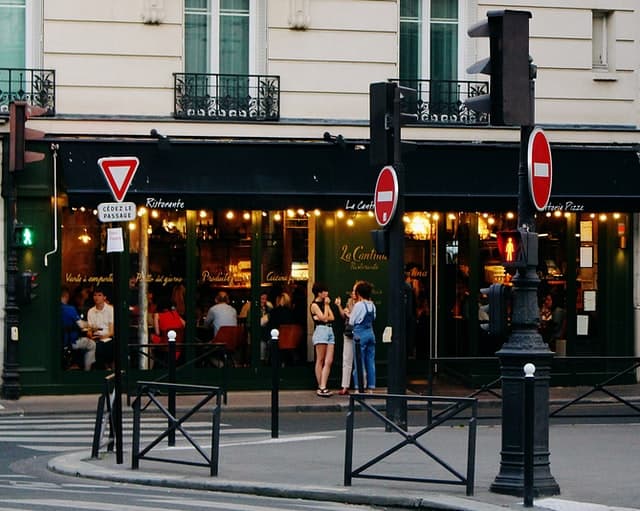
Photo by Steven Lasry on Unsplash

Did you enjoy this article?  TAIP is 100% reader-supported through tipping.  If you want to leave us a tip of any amount it would be highly appreciated.  These tips help support our efforts to keep TAIP an ad-free environment.  Just like at a cafe, the tips are split evenly among the team. 
Three Years On, Part I: Penseés for Those Planning to Move to France

Next month I begin my fourth year in Paris.  I wanted to use the milestone to share some reflections on how I have changed and ongoing tips on how to make the move yourself.  This is the first in a series of four.

I’ve successfully obtained two different classes of visa, long-term visitor (part one and two, and renewal) and indépendant, also known as profession libérale (part one and two).  It’s been really gratifying to get mail from readers who simply printed out those articles, followed them to the letter, and got visas. Indeed, I spent so much time researching and documenting the process that I now offer paid consulting services (in person and via Skype) to those seeking these visas, and refer those seeking other types of visas to professionals I have grown to know and trust.  Today I want to share, in broad strokes, just a few of the points I touch on when speaking to readers who use my consulting services.

What is a Scouting Trip?

This is the chance for you to take off your tourist hat and visit Paris as a possible resident.  You go to visit apartments that are in your price range to rent, even if you aren’t going to be in town for a while.  You meet with people who work in your industry (if you have a job) or meet with business owners in your field (if you’re an entrepreneur).  You go to Meetups and Coworking spaces to build a network and get to know the city a bit.  If you need a bit of assistance here, use Shapr.  And yeah, take a day trip and/or a trip to a nearby country to remind yourself of what’s at your doorstep when you live in this gem of a city.

What Is the Number One Mistake Made by Those Coming to Paris For the First Time?

Not having your housing situation locked down.  In fact a friend of an acquaintance showed up and was living in hostels and Airbnbs, and was completely clueless as to just how tight this market was (and is), and after 45 days of searching and applying to over 2 dozen places, gave up and went back to her country.  To be fair, I think she came for a job, not for the city, so she wasn’t committed to persevering, financially or emotionally, but I’m shocked to see even graduate students not take a very serious stance on this.  I recently coached a friend through this process who is enrolled in a two-year graduate program but only had arranged for a four-month Airbnb stay with no backup plan.  An agency found her a great place but witnessing her anxiety reminded me of my heady early days when I was in an Airbnb for 90 days before moving to my first apartment in Paris, a little shoebox in the sky, on the 8th floor of a centuries-old building in the 17th.

What is One Ongoing Nuisance?

Bank accounts.  I’ve written about it here and here and it seems at the moment that unless you are a fiscal resident of France, US citizens are being granted French bank accounts only with a lot of difficulty and documentation.  (Two readers of this blog who are not fiscal residents did manage to get an account at Crédit Agricole, after being turned down at Société Générale and BNP Paribas, among other places.)

There are a few workarounds.  You could, like my friend Patty, use your American credit card to pay for everything (maybe even earning points and miles), and then settle that bill every month from your American bank account, withdrawing petty cash as needed from that account.  This is not a solution for those who wish to live here long-term, however.

Alternatively, if your only major French-focused transaction each month is your rent payment, Wise will also allow you to pay a French bank account directly from your US bank account, with a bare minimum of fees, which is a lot more fun than withdrawing hundreds of euros from an ATM and then handing that to your landlord.

If you want a complement to the Transferwise solution you can use Revolut, which issues you a chip and pin card which you can load up in the currency of your choice from the bank account of your choice, all manageable from an app.  Did I mention it’s all totally free? 🙂

What is One Thing You Cannot Do Too Much of Before Arriving?

Conversational French.  You can take all the classes you want and know 6 different tenses and a lot of vocabulary, but if you haven’t practiced speaking French, you will be in for a rude awakening when you arrive.  In a way, I parse it as the difference between “studying” French and “learning” it.  You can “study” all you want, but your “learning” will commence when you arrive and get to speak this lovely language every day, and hear the pace, cadence, and the distinct Parisian pronunciation.  Get a private tutor, join a local meetup language group, use an app, and maybe, as a last resort, take classes (they are time-consuming and move only as quickly as the slowest person in the class).  As I post this article I am spending a month in the States and to keep my French up I’m attending a local French conversational meetup.

What Did You Fail to Do Adequately?

Budget.  There’s always “one more expense” I could not have foreseen.  If I could go back and do it again I would have taken my planned-down-to-the-centime budget and multiplied it by 1.5, thereby giving myself just an extra bit of fat.  As it turned out, the squeeze on my budget in the 11th month of my stay caused me to start another small business to generate more cash flow.  So, in my case the squeeze created a great new thing, but that doesn’t mean I couldn’t have benefited from the “1.5” strategy myself.

Last Thing…

Find and develop French friends.  Severely limit your reliance and/or attendance at “expat” bars or events, which ironically use English as the linguafranca.  I’ve found there is no faster way to the heart, stomach, and soul of France than my French friends.  They will help you with your French, ask for help with their English, and give you genuine local reactions to news, politics, and new places you want to try.

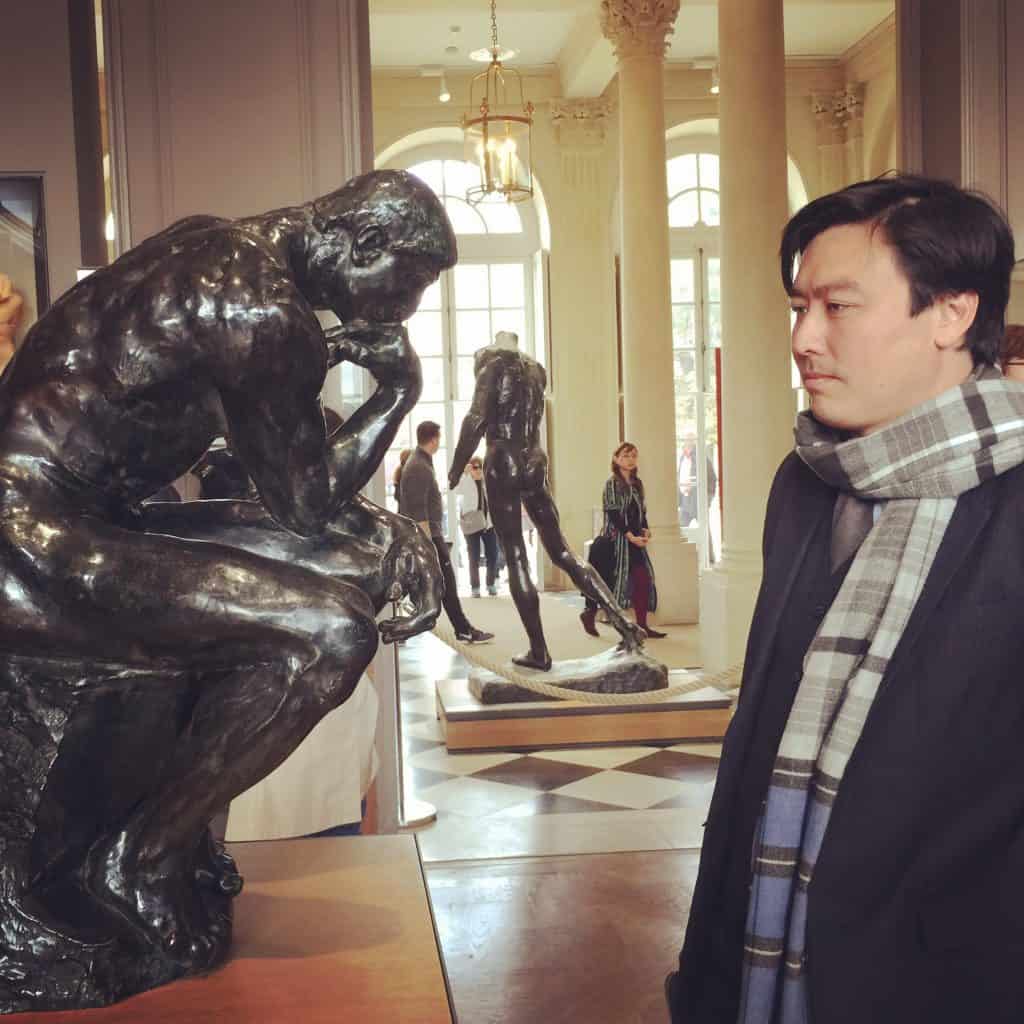
The photo was taken by my friend Domo on a recent visit to the Rodin Museum.  On almost every first Sunday when many museums are free, a group of us go out for brunch and a museum visit.  To date we have seen 22 museums together.

Did you enjoy this article? TAIP is 100% reader-supported through tipping. If you want to leave us a tip of any amount it would be highly appreciated. These tips help support our efforts to keep TAIP an ad-free environment. Just as at a cafe, the tips are split evenly among the team.
Meetup: a Great Way to Build a Core of Diverse Friends

This summer I went to the Fête de la Musique with a large group of friends.  Though it originally started in France it’s now a worldwide annual event.  As the evening closed out at our fourth musical venue out of hundreds we could have chosen, I took a moment to be thankful for a platform that has connected me with so many wonderful people.

Meetup is a company that started in NYC in mid-2001, but really gained traction after 9/11 as New Yorkers tried to connect with people who wanted to talk and process the disaster that had befallen their city, their nation, and the world.  It has grown quickly in the US, and as a result it can cost north of $100USD/year to start a group.

For those who aren’t familiar with the concept, Meetup is a “just add internet” for any type of group.  Want to “jog on Wednesdays” or “knit on Tuesdays” or “club on Saturdays”?  There’s a group for you to join.  Can’t find the group you want?  Start your own.

For the casual browser it’s a dazzling arena of fun activities with strangers who might become friends.  For the organizer type (comme moi) at only 12€/year to start up to three groups, it’s a bargain that pays back massive dividends.

I created a group called Paris Culture Lovers as a way to find people like me who love art, film, books, conversation, food, and day trips.  We are closing in on our first year as a group and have done almost 90 events, some of which were among my most treasured memories of 2015.

So what’s the bad news?

  1. Many groups are ephemeral.  People get enthusiastic, start a group, never do an event or do one and give up.  That’s okay.  It happens.
  2. Because Meetup has created a “buffet” culture, and because society worldwide becoming less accountable about events and invitations, many people feel they can no-call and no-show an event they have RSVPed for, or cancel hours or minutes before an event, for frivolous reasons or for no reasons whatsoever.  You might not do that to friends but you may be inclined to do that to strangers (At PCL we have invented a ranking system that measures and ranks you by the number of events attended and gives senior members priority for events).

But neither of these things are dealbreakers and as this year ends, a group of the core of Paris Culture Lovers has become good friends and strong acquaintances, which means a lot to a stranger in a strange land even more so to the type like me, who isn’t seeking to surround himself with expats to build an anglo island in France.  There are meetup groups for that…if that’s what you want.  But when I want to feel like America or be with Americans…I visit that country.

* * *

P.S. I should note that I had two Meetups fail due to lack of interest a casual kick-around soccer group and a chess players group.  But you have to try in order to see what works 🙂

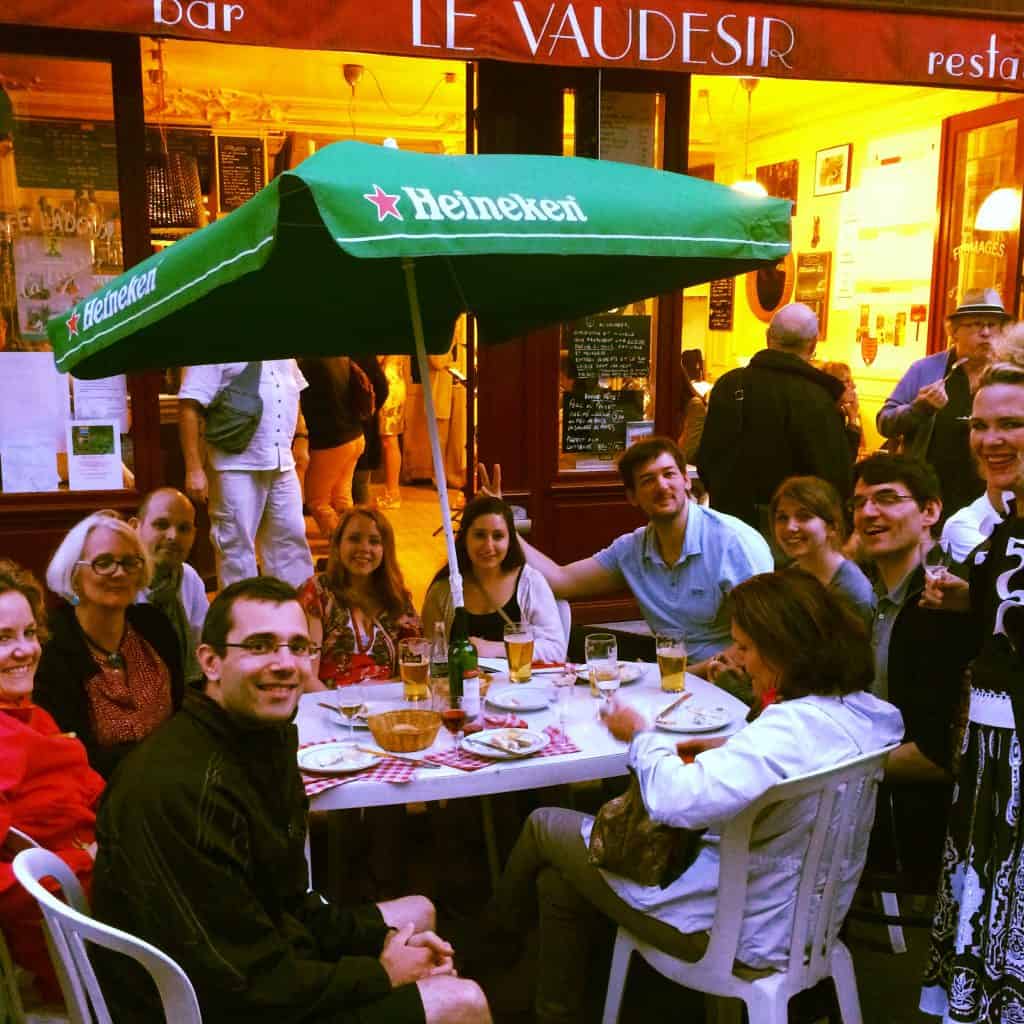
Photo was a crew of friends at the end of a fun and rambling Fête de la Musique.

Did you enjoy this article? TAIP is 100% reader-supported through tipping. If you want to leave us a tip of any amount it would be highly appreciated. These tips help support our efforts to keep TAIP an ad-free environment. Just as at a cafe, the tips are split evenly among the team.
Death in the Afternoon, or Sunday Chess in the Jardin du Luxembourg

Meetup is a great website.  If you don’t know it, it is a site that allows you to create a group based around a particular love or passion.  Want to play bridge?  Or go hiking?  How about practicing your English and French?  All you want, and then some.

The burden is on the organizer.  He/she pay$ to start the group and is responsible for its ups and downs.  The better the organizer, the better the group.  I’ve started two groups here.  One for soccer inside the city (there are a couple of excellent groups that play in the big parks just outside the city…I can play soccer in a big field anywhere in the world.  But in front of Les Invalides?  Not too often.).  The other one is for chess, and has been pretty successful in its early days.  Our first get-together found 8 strangers from all over the world drawn together by a common love for the game of black and white squares, and the pieces that inhabit them.

That first meeting was at Anti-Cafe, a “co-working” space.  More on that another time.  A great time was had by all and we played timed and untimed games.  We also took time to school a novice on the rules and some basic strategy.

Chess is fascinating on many levels, and during the year I lived in Saint Louis I was a member of the Saint Louis Chess Club, which hosts the US Championship every year and where you can get tutored by grandmasters.

Basic principles beyond the names and movement of pieces are manifold, but here are three that I share with any fellow novice:

1.  Try to capture/attack the center of the board

2.  Try to develop your pieces (move back-rank players forward)

3.  Try to consider each move through the two-fold criteria of what is this piece attacking and how is it attacked

These principles were on my mind last Sunday, during our latest meetup our first outdoors at the Jardin du Luxembourg.  After three successful meetups, where we had built up a strong core, I thought a fun tournament, with some euros on the line, might be fun.  5 euro buy-in.  We would see who would show up.

As a group becomes more carefully curated over time (again, depending on the organizer), the percentage of who signs up for an event vs who shows up may improve; my basic rule was 50%.  That is, if eight people said they were coming, then four people, at best, would be actually coming.

Today was a bit better.  Ten committed, including myself.  We had five plus myself actually show up.  There was an alleged “beginner” but as we played a quick game it became obvious he was just being modest.  I drew up a quick series of brackets that ensured everyone would play at least three games before we got to the final “money” matches.  It was imperfect for sure.  I had always played in well-organized round robins but as the sole organizer unsure of the number of attendees I hadn’t troubled too much with an elaborate schedule of matches.

Indeed, my focus (perhaps wrongly!) had been on bringing terrine, crackers, oranges, and vin rouge.  Who can play chess without drinking, surely?  But that is the least of the tournament transgressions we committed.

No one else had brought clocks so I loaned out my iPad and iPhone, both of which had chess clock apps.  The iPhone sadly gave up the ghost midway through the 3rd match, though the iPad lasted longer.  Some couldn’t play a timed match due to the paucity of clocks.

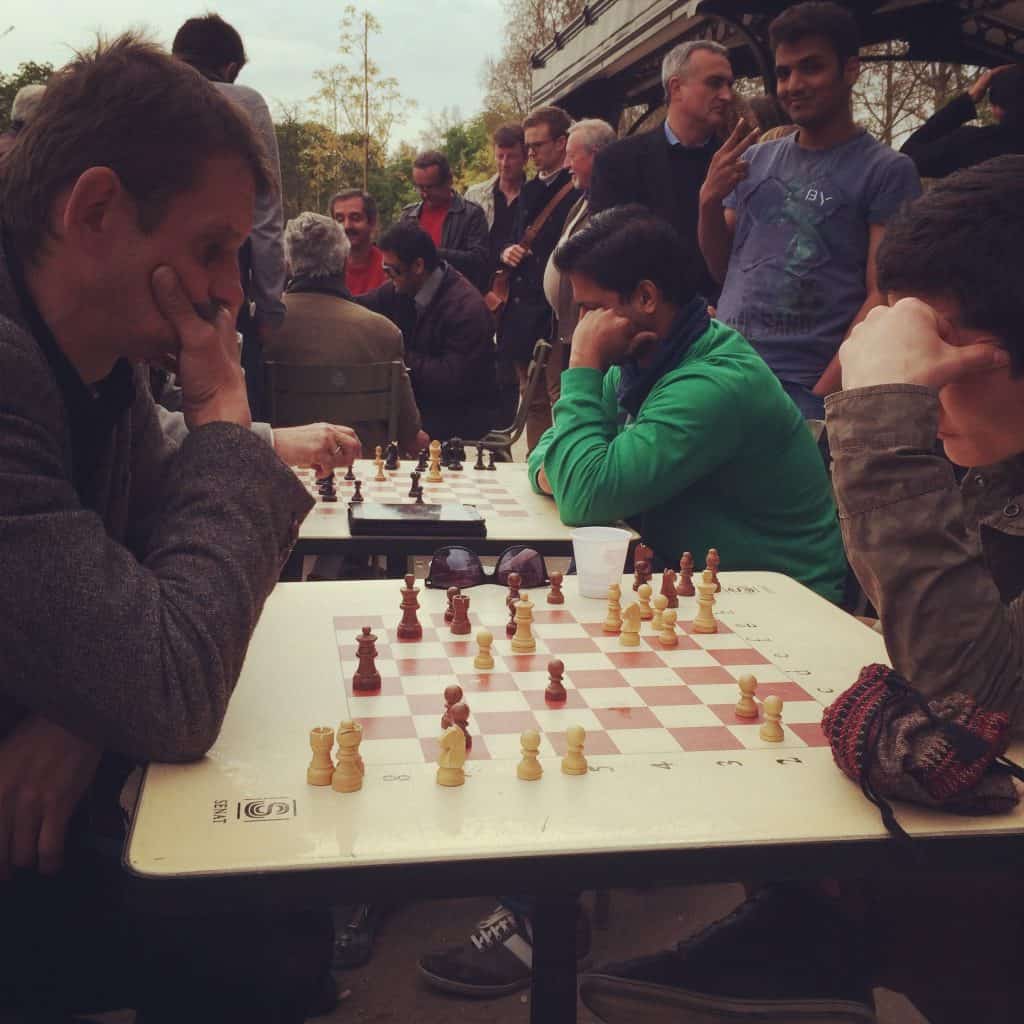
You also shouldn’t talk during tournaments, but the French are quite disposed to comment on everything, whether they know you or not, much less chess.  We were just a few feet away from the most popular players in the Jardin.  One of them was an old man with a grizzled salt-and-pepper beard.  The other was a man with palsy.

They played 3-5 minute blitz games, where moves were almost instinctive.  Winner stayed, loser walked.  Occasionally bets would be taken.  A group of 15 always surrounded whomever was playing a variation on a nerd cage-fight.

Everyone was commenting on the game: some jeering, some offering officious (or kind) advice.  Players got into it also: “Allez, putain!”  I laughed heartily and leaned across to my adversary, “Les français sont très polis, non?”  He laughed also.

Tourists, taking in what had started as a beautiful day, continued to mill by even as it got overcast and slightly chilly.  I heard the snap and click of cameras and I wondered how my horrible losing positions might look on someone’s Facebook, captioned, as, “what a moron: mate in 7!”

I had placed four of the six players in “advanced” brackets.  Yves, the self-proclaimed beginner, and I, occupied the “knockout” brackets, where we would play each other and the losers of the upper brackets (As an aside, I love names like Yves and Ombeline that we just don’t have in English).

Some played faster than others and in between Yves and I’s second matches, some parents cooed their precocious children our way.  The children looked reluctant and somewhat embarrassés about their French “tiger mom” who would take them to the tables of the Jardin to make them play chess with adults.

We looked friendly enough, as usual my goofy American smile was the “over here” beacon that allowed a French parent to come over and ask, “peut-il jouer avec vous?

Oui.”  Chess keeps you humble, I thought to myself as I reached out to sake the paw of the (I guessed) 10-year-old, also remembering to switch all my you-singulars to the familiar.  Children and animals get the “tu” treatment automatically.  “Tu” though he might be I figured that no kid who was going to come play with adults was a slouch.  I expected to lose.  I’m only in the mid-hundreds in USCF ratings, after returning to the game in 2011 after a nearly 2-decade absence.

“He’s terribly aggressive,” I thought to myself as he brought out his Queen in move 8.  Yes, I had people asking me questions, people wanted to know who played next, my own vin to pour, bien sûr, but all credit to the kid, he beat me handily, in fewer than 20 moves (I wasn’t notating, but that’s a fair guess).  I was a bit distracted but he beat me fair and square!

His sister was playing a slower, less aggressive game against Prem.  “Be careful, ah?” I said with a smile.  “He beat you?” Prem asked, almost astonished.  “Oui.”

An English father came up and asked in halting French if his kid who looked 8 could play.  After a bit of discussion, I let the battle of les enfants terribles commence and I chatted with the parents.

From London, and Arsenal fans, even better!  The kid was rated 1700, with the father in the 2000s.  Even mom was an 1100.

“We don’t have anything like this in London.”  “Yes, it’s wonderful, isn’t it?  Put some beautiful boards down and people will come.”

There was a bocce ball “field” right by a park in my arrondissement at the Square de Batignolles.  It was often occupied by Italian expats who took their native game quite seriously, grazie mille.  Angry Italian spewed out whenever a teammate was supposed to have made a poor throw.  No angry Italian, or angry any language here, really.

We laughed and looked back at the game at hand.  “Your son’s quite deliberative.”  “Yes, well, I blame his coach.”  “You, no doubt,” I surmised.  He didn’t say anything.  He was analyzing his son’s current position.  The mother was being indulgent.  She wanted to move on after the first game but we encouraged them to play one more.

To keep her amused I switched into tour guide mode and told her a bit about the garden itself, its founding, and recent history.  “You love this place,” she remarked.  “It’s my favorite big park in the city, yes,” I replied.

The kids wrapped up, I wished them well, and I notified all my players of the final matchups, collecting the euros and placing them under the clocks of the respective games: 15 euros for the top winner, 10 euros for the next bracket, and 5 euros for the final bracket.

Aranya (giving the peace sign here) actually won the final between him and an elderly gentleman who went by the Meetup handle of “Whynot.”  Instead of taking the money and running, they went for 2 out of 3 and Aranya conceded the next two matches, and the 15 euros.  Why not stop? 🙂

Erkhem, who had only been knocked into the second bracket by one loss, took a bit longer to take out Prem.  They too played at least one more game, but Erkhem had the sense to confirm his winning after the first game.

Much of the food and drink I brought was uneaten (note for next time: food not so important for chess nerds) and as we shook hands almost four hours after we started, I promised more meetings for the months ahead.

Did you enjoy this article? TAIP is 100% reader-supported through tipping. If you want to leave us a tip of any amount it would be highly appreciated. These tips help support our efforts to keep TAIP an ad-free environment. Just as at a cafe, the tips are split evenly among the team.