Coming down Mont Boron in Nice

Living in France as a Retiree: Part 2: Health Insurance, Medical Care, and Nursing Homes

Don’t miss Part 1 of this series on Living in France as a Retiree

Health Insurance

When you first apply for your long-stay visa for your first year in France, you are required to prove that you have health insurance. The less expensive way of getting it, for me, was via the visa website; it cost about $500 for the entire year, but it was not comprehensive, i.e., not for preventive healthcare, but rather for emergency situations.

Be aware that basic Medicare covers nothing outside of the United States. Some supplemental plans may cover expenses in other countries after a deductible is met.

After you have been residing in France for three months, you can apply for a numéro de sécurité sociale (social security number, which is not the same as Social Security in the United States). You’ll need proof of residence, a birth certificate, and your passport/visa. Usually the application is mailed to the local CPAM office. CPAM (Caisse Primaire d’Assurance Maladie: national health insurance) will probably request additional information by mail or have you fill in a questionnaire. 

The process can be quite daunting and appear illogical. You may be asked for the same document again and again, and then suddenly discover that you’ve been covered for a year! (You can request reimbursement for expenses incurred in the meantime.)

To apply:

  • Your name must be the same on your birth certificate and your passport. If not, you will need to prove that you are the same person through your consulate, and if there’s no consulate only an embassy.
  • If you live with someone without being married or “PACS‘ed” (officially partnered) you may be considered a concubine. It doesn’t have the same connotations as in English, or at least it’s not limited to those connotations. 
  • The CPAM agents usually answer any questions you may have on the phone, and while they are very polite they have little time to speak at length. Telephone number: 3646 (within France). You can request an English speaking agent when you call.
  • You’ll need a French RIB (Relevé d’Identité Bancaire, or bank identity) in order to be reimbursed.
  • To find your local branch, use the Adresses et Contacts (addresses and contacts) section on the Ameli website.
  • More information on French healthcare in English.

Once you have your French social security number, you must request the carte vitale, the health insurance card, which will then be mailed to you. The card is used by medical providers to enter your information, when you fill a prescription or visit a doctor.

Some areas of France are medical deserts, with few medical facilities. In larger towns, you’ll find many hospitals and medical practices, but wait times for specialists can be long and some don’t accept new patients. In Nice, where I live, it’s hard to find a dermatologist — they are often busy with cosmetic procedures!

There are different tiers of medical practices; for some, you don’t need to pay anything over the basic reimbursement offered by health insurance; for others, you’ll pay more. For tier 1 medical practices, you will often pay nothing out of pocket; the national health insurance will handle it.

You can also buy supplemental insurance, through a mutuelle, in a dizzying array of levels. A basic mutuelle subscription might cost €40 a month, and help pay for hospital stays, which can be very expensive. Higher premiums will help pay for hearing aids, glasses, higher-tier medical practice fees… the second year, I used a broker to help me choose.

Nursing Homes and Assistance for the Elderly

In the US, nursing homes often cost much more than many of us can afford, especially in larger cities on the coasts. In France, they are not inexpensive, but appear to be more affordable. There are a variety of systems.

There are senior living facilities for seniors who are well enough not to need assistance, mainly for people who would like to have a community, and in-house facilities.

EHPADs (Établissements d’Hébergement pour Personnes Âgées Dépendantes) are like our medicalized nursing homes. They are meant for people over 60 who need daily assistance. As far as I know, in 2025 they cost about €4,000 a month, but it varies. If you don’t have enough income, you may be able to stay at a lower cost, but when you pass, the difference will be taken out of your estate.

  • Public (government-run) homes cost less than privately-owned homes (nonprofit or for profit).
  • For more information (in French)
  • For a list of locations separated by area: Assistance Retraite (in French)

There are also agencies offering in-house care for a fee. I’m not sure, but if your income is below a certain level, and you are disabled or recovering from a hospital stay, you may be eligible for help paying for a nurse or a cleaning person.

In general, France is a good country to age in, once you have surmounted the bureaucratic hurdles! In my personal view, single-payer insurance is much better than the US system of many disparate for-profit insurance companies, especially as so many get left behind.

Some additional informational websites:

Photo of Mont Boron in Nice

Did you enjoy this article? TAIP is 100% reader-supported through tipping. If you want to leave us a tip of any amount it would be highly appreciated.  These tips help support our efforts to keep TAIP an ad-free environment. Just like at a cafe, the tips are split evenly among the team.


An Expat Discussion of CSS vs Mutuelle

A note from the authors: In these articles, we (Molli — MS and Gracie — GB) have a conversation about a topic that’s familiar to both of us. In addition to providing information, our aim is to explore it from two different angles and give you a more in-depth view of the complexities of French life and the expat experience.  To get the most benefit, make sure you read our previous articles explaining CSS and mutuelles.

GB: Since moving to France, I’ve been both impressed and mystified by the French healthcare system. For a long time, I assumed everyone’s carte vitale was a magical debit card that paid all their medical expenses. Eventually, I learned that this isn’t the case and that many French people also have a mutuelle which acts as additional health insurance. My American perspective is to assume health care plans are linked to employers, so I figured a mutuelle had to come from a full-time job at a French company, and since I arrived in France on a specifically non-working visa, none of these options felt accessible to me. What were your first impressions of the French healthcare system, Molli? Did you have someone to help you avoid my misconceptions?

MS: I had a similar perspective as you! I think that in the U.S. there’s this big narrative around the fact that yes, health care is free in most other countries, but that it means low-quality care, long wait times, and old-fashioned hospitals and healthcare centers. I was also shocked to find out that the “free” health care so bragged about here isn’t actually free.

The first time I had to go to the doctor or hospital was when I was still an au pair. I cut my thumb on some broken glass and when the cut got infected my host dad took me to the hospital. I was pleasantly surprised at the normal wait times, friendly doctor, and standard hospital equipment that I was used to seeing in the US Yet another stereotype bit the dust that day. 

That said, one stereotype did come true that day, and it was the fact that health care here is extremely affordable albeit not free. You definitely don’t have to worry about going bankrupt if you end up in the emergency room and you don’t have a carte vitale, which I didn’t at the time. I was on some special au pair insurance that my host family had set me up with. If you’re wondering what a carte vitale is, think of it as a healthcare card similar to the insurance cards in the US. You use it at the doctor’s office, pharmacy when you pick up prescription drugs, and at the hospital. It also has your French social security number on it, as well as your name and picture.

I actually didn’t get my first carte vitale until I opened my auto-entreprise three years after I had been living in France. Interestingly enough, I should have been given one automatically when I began the intensive French language program I began after I decided to stop nannying, as all students are part of France’s social security system (which includes the carte vitale). But, in true French bureaucratic fashion, halfway into the school year I still wasn’t issued one. Luckily, I decided to start my auto-entreprise while I was still a student. 

I also had never heard of the concept of a mutuelle, and naively thought that I could go to any sort of doctor or specialist for free. I have since learned that if you have to go to the dentist, eye doctor, or physical therapist and you don’t have this extra coverage, things can get really expensive. Gracie, do you have extra coverage now that you understand the system better? And, speaking of which, when and how did you start to wrap your head around how everything works?

GB: Yes, I have extra coverage through complementaire sante sociale (CSS) in addition to a carte vitale. Having both of those together means the French government pays for most of my healthcare which makes me feel amazing and lucky. That said, it did take about a year and a half of filing paperwork and waiting to get the whole thing in place. And to qualify for a CSS, you have to be making very little money so I’m not sure if it will be a permanent solution, especially since you have to reapply each year. As with all French bureaucracy, they don’t make it easy. 

I started to wrap my head around how everything works after being in France for about two years.  I’d always assumed that I had to be a French citizen or have a more permanent visa (at the time all I had was a long-term visitor visa), but that wasn’t correct. France is actually fairly lenient about including immigrants in its healthcare system, and all you have to do is prove that you’re living in France in a “stable and regular manner.” This means you do not have to be born in France, married in France, or even working in France to register. It does mean you do have to have spent at least three months in the country and have a valid titre de séjour

This was one of those classic –– why didn’t anyone tell me this –– revelations. From there, I learned more from the assurance maladie office which told me I could apply for a permanent number and a carte vitale after I was PACSed and had a VPF visa. My primary care physician was also extremely helpful and advised me to apply for the CSS in the first place.

What about you — were there any specific moments or people who illuminated this process for you? And once you were in the French system, what made you decide to get additional coverage?

MS: It seems like I’ve had to just figure out everything as I go ever since I arrived in France. In all seriousness, when I was an au pair, my host family was very helpful, but almost too helpful because my host parents took care of almost everything for me, including a lot of paperwork. Once I became a student and was no longer living under their wing, a lot of things came as a shock and there was a massive learning curve!

I was really hesitant to get a mutuelle because up until very recently I had the mentality of “I’m healthy, I’m young, I’ll never have to go to the hospital, and I don’t want to spend the money on something I’ll never use.” And, until I was 26 and still under my parent’s insurance back in the States, I saved my yearly dentist and eye doctor appointments for when I went home to visit. 

My French mother-in-law actually pushed me to finally get a mutuelle. Since I’m turning 30 this year, it was about time, and ultimately I’m happy I took the plunge into the world of paying for my own healthcare. I pay around 30 € per month, and most of my prescription drugs are covered as well as the dentist and the ophthalmologist (I wear glasses and contacts). I have to admit, there’s something so sweet about going to the pharmacy and picking up medicine for free!

My last question for you about the CSS is, do you have the same coverage as someone like me who has a mutuelle? Or, are there things that I have access to and you don’t? 

GB: I’m pretty sure my CSS has the same coverage as a mutuelle, if not more. Although I haven’t taken it to every possible doctor, the documentation says it reimburses most glasses, prosthetics, and hearing aids, as well as all visits to the doctor, dentist, and hospital. I wear insoles and have been meaning to see my podiatrist about those, and I’m assuming that’s covered as well. I also have lofty ambitions to work with a kinesiologist and would love it if that was reimbursed since I know it’s only partially covered by the normal medical system. 

My admittedly American approach is to show up to any doctor, assume it will cost hundreds of euros, and be pleasantly surprised that it’s significantly cheaper than in the US. That said, the medical system here is much more transparent about costs –– all doctors post their fees on their website and in their offices, and they will explicitly tell you how much a procedure is and if you’ll be covered when discussing it with you. My dentist wanted to x-ray my teeth and told me it would only be partially reimbursed –– the x-rays cost 50 € and I’d get back 60%. The total cost was laughably small, especially since I used to pay $300 to have my teeth cleaned. That said, I’m grateful she had the conversation with me and wish the American medical system had the same transparency.

We hope this has been a helpful discussion of our experience with the French medical system. Feel free to comment with any questions or health insurance adventures of your own.

Photo by Marcelo Leal on Unsplash

Did you enjoy this article? TAIP is 100% reader-supported through tipping. If you want to leave us a tip of any amount it would be highly appreciated. These tips help support our efforts to keep TAIP an ad-free environment. Just as at a cafe, the tips are split evenly among the team.

How to Get a Mutuelle in France

When I first decided to start my life in France after years of being an au pair and a student, I started to hear talk of something called a mutuelle. I had already been enjoying the benefits of seriously discounted health care for years at this point, and I often relished the fact that my monthly prescriptions were only a few euros instead of upwards of $40 per month back in the states.

You may be thinking, “Huh? But I thought going to the doctor was free in France and so was all medicine.” Health care is much, much less expensive here than in the United States, but as they say, nothing in life is free. 

Why You Should Get a Mutuelle in France

If you’re a permanent resident of France, you’re eligible to receive government-provided health insurance within the first three months of being here. It works like a co-payment system, and much of your medical costs are reimbursed up front by the standard, public health insurance. For example, if you go to the doctor and you’re uninsured, you’ll pay around 25 € (still a steal, if you ask me). If you sign up for public health insurance, you’ll pay around seven euros. If you get a mutuelle (some call it “top-up” coverage in English) in France, you’ll pay nothing.

Having that extra coverage ensures that you don’t pay anything at the doctor’s office and most prescriptions are covered too. If you have to stay overnight at the hospital, depending on the plan that you choose, you won’t have to pay for that either. 

If you wear glasses or contacts or enjoy having clean teeth, you’ll want to sign up for one as well. I wear both glasses and contacts (and like keeping my pearly whites, well, white) and so my mutuelle is a lifesaver. I went from paying hundreds of dollars every year for my eyes to paying nothing.

I haven’t even begun to mention all of the other perks you could be enjoying if you sign up for your own mutuelle. Specialists such as dermatologists, chiropractors, and osteopaths are also covered (again, depending on your plan). Furthermore, you can sign up no matter your medical history and without fear that a preexisting condition will make the monthly free skyrocket. Oh, and if you’re pregnant or plan to be, a mutuelle is also really helpful.

Shout out to my French mother-in-law for pushing me to finally sign up. I think for me, seven euros to go to the doctor just seemed so sweet that I couldn’t imagine paying even less. My American mentality prevented me from signing up for a mutuelle for several years when in reality I could have started benefitting from one all the way back in 2012.

How to Know Which Plan to Choose

Not all mutuelles are created equal, but neither are everyone’s health care needs.  Stephen, for example, almost never goes to the doctor, so a mutuelle for him would be a waste of money. Furthermore, if you don’t have terrible eyesight as I do, you don’t need a plan that will help you save on glasses and contacts. 

When you begin shopping around for a plan, you’ll notice that coverage is determined in percentages. I recommend opting for coverage that is over 100%. Start with at least 150%. And if you have problems with your teeth or need to visit the eye doctor, consider going up to 175-200% coverage. I know that asking for over 100% coverage may sound a bit much, but some doctors charge more than the standard fee set out by the government. You’re going to want that extra coverage just in case you find yourself at a specialist (like the dentist, ophthalmologist, or chiropractor) that naturally charges more than your primary care physician. 

You’ll be charged a monthly fee in order to benefit from your mutuelle. The cost is nominal, especially when compared to the ever-climbing costs of private health insurance in the US. For example, my mutuelle is one step above the “basic” plan, and I pay around 30 € per month. There are several different providers to choose from:

Once you sign up, you’ll receive your mutuelle card. It’s not a plasticized card like your carte vitale (the card you use to benefit from the standard public health care), but rather a small piece of paper you’ll have to be careful not to lose.

My advice? Take your time when comparing plans, ask your French friends for advice, and don’t get too hung up on finding “expat” specific plans. If you are a resident of France, you have all of the rights of a French person. These so-called expat-specific plans tend to be much more expensive for no real reason that I can see. And, if you don’t earn a lot of money, you could be eligible for a state-run mutuelle program called the CSS, so, if you can, don’t forget to look into that option, either.

There are plenty of mutuelle comparison sites that can help you decide as well. This one by Le Comparateur Assurance (The Insurance Comparer — a great resource for comparing any type of insurance in France) is my favorite. However, I will say this again, your French friends will be your best asset here. They’ve had this type of insurance their whole lives and are the best place to start for some advice!

Photo by National Cancer Institute on Unsplash

Molli offers private consultation services which range from help with visas and adjusting to life abroad to Paris travel itineraries. Fill out the contact form to learn more.

Did you enjoy this article?  TAIP is 100% reader-supported through tipping.  If you want to leave us a tip of any amount it would be highly appreciated.  These tips help support our efforts to keep TAIP an ad-free environment.  Just as at a cafe, the tips are split evenly among the team.

How to Get a Complémentaire Santé Solidaire (CSS)

After I successfully enrolled in France’s health insurance system and got my temporary social security number or numéro provisoire, I went to see many doctors. At the beginning of the appointment, they would look at my certificate of registration and ask if I had a complementaire. I’d say no, because I didn’t, and I also had no idea what that term meant.

Then they’d ask if I had a mutuelle, and I would say no again. I knew that was additional health insurance offered by French businesses, but I didn’t have a French job. I didn’t even have a working visa. I was already thrilled to be enrolled in government health care, wasn’t that enough?

But they were asking because it wasn’t. Assurance maladie works in tiers of reimbursement, and only fully reimburses its users for a select few medical visits. For other expenses, they might cover a small percentage of the cost, which is why most French people have a mutuelle as well. After six months of being disappointed by the meager refunds trickling into my bank account, my general practitioner kindly explained all this to me. She also told me I could get a mutuelle without being employed by a French company, but advised that I apply for a complémentaire santé solidaire or CSS. And so my health insurance journey continued.

What Is a Complémentaire Santé Solidaire?

A complémentaire santé solidaire or CSS is an additional insurance that covers your medical costs at the doctor, dentist, and hospital. It also covers most glasses, prosthetics, and hearing aids.

Who Qualifies?

In order to qualify for a CSS, you must have already enrolled in the health care system and be a regular resident of France. In my reading, this means you must have a long-term visa as well as other documents tying you to a fixed address here.
Note: Even if you have a temporary social security number, numéro provisoire, you can still apply for a CSS.

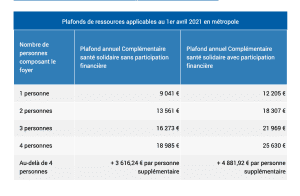
Beyond residency, you qualify based on your income or resources, which include salary, government aid and donations, commercial sales of objects, and gambling gains. Depending on your annual total, you can either qualify for full government aid or you’ll pay less than 1 € per person per day. I was given full aid so I’m not sure what the annual payment would be. It seems safe to assume it’d be under 365 € annually or 30 € monthly, which is equivalent to the cheapest monthly mutuelle.

As you can see below, your income must be quite small in order to qualify:

How Do You Apply?

To apply you fill out a form with your personal and financial information, as well as information about the rest of your household and any dependents. Since Fred and I are PACSed, he’s considered part of my foyer, and his income was included in the calculations.

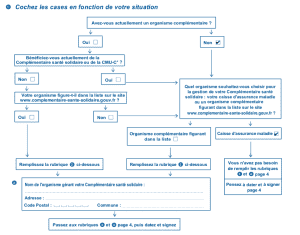
As I mentioned in the list of requirements, you’re also asked to declare any additional government aid you’re receiving such as unemployment or pension. After quite a few boxes pertaining to income sources, there is a deeply puzzling flowchart.

In a very convoluted way, all it’s asking is if you want to have your CSS directly with assurance maladie or through a mutuelle company.

Note: You also need to include your titre de séjour with the application, as this is proof that you’re a current French resident.

How Long Does It Take?

Great question. The assurance maladie website says the application will be processed in two months, which I rounded up to three.

How Long Is It Valid For?

Since the complémentaire is contingent on your income and “need” you must renew your request each year by sending proof of income, as well as your tax documents.

What Happens Next?

  • The short answer: Go to the doctor and get reimbursed.
  • The long answer: Now I can go back to the dentist and not have to worry about how much she’s charging to take X-rays of my teeth. Actually, doctors in France are always upfront about costs, and they must be listed on the doctor’s website so you usually know exactly how much you’re paying before you walk in. In the case of my dentist, she explained that assurance maladie would only cover eighty percent of the cost of the 50 € x-rays, and wanted to make sure I was okay with that. The bill was laughably small compared to my dentist back in New York where I paid $300 for a cleaning.

Photo was taken in the tastefully appointed waiting room of my knee doctor.

Did you enjoy this article?  TAIP is 100% reader-supported through tipping.  If you want to leave us a tip of any amount it would be highly appreciated.  These tips help support our efforts to keep TAIP an ad-free environment.  Just as at a cafe, the tips are split evenly among the team.

carte vitale

How to Get a Numéro Provisoire or How to Sign up for Assurance Maladie

For the first year after I arrived in France, every time I went to the pharmacy or doctor, they’d ask for my carte vitale. This is the health insurance card every French person has which allows them to be reimbursed for medical expenses, and each time I politely explained I didn’t have one, the person checking me out would be shocked. To be paying out of pocket for my medical costs was unheard of, even though they were fractions of what I was used to in the U.S.

It took me longer than it could’ve to realize I also qualified for medical insurance or assurance maladie. After going through the process, the first document I received was a temporary social security number or numéro provisoire. If you’re in France on a carte de séjour visiteur, this is the only number you’ll be assigned. However, if you are here on a talent visa or vie privée visa, you’ll be eligible for a permanent social security number, as well as a carte vitale.

Who Qualifies?

Anyone living in France in a “stable and regular manner” qualifies to be covered by France’s healthcare system. This means you do not have to be born in France, married in France, or even working in France to register. However, it means you do have to have spent at least three months in the country and have a valid titre de séjour.

How do I Register?

To register you need to send copies of the following documents to the closest health insurance office. You can look up which one here.

Required Documents:

  • National Identity Card or passport or residence permit, as well as any documentation of your civil status.
  • Extract of birth certificate with filiation or full copy of your birth certificate
  • Completed “Demande d’ouverture des droits d’assurance maladie.” (The second page of the form also lists the necessary documents to include.)

In my case, I sent copies of my passport and current titre de séjour, as well as the récépissé of my PACS — all documents which showed I was a ‘permanent’ resident in France. I also included a long-form copy of my birth certificate which had an apostille and had been translated into French, as well as a letter d’hébergement saying I lived with Fred. Luckily, I was doing this process soon after being PACSed and had all these documents on hand. Proving you live in France usually all boils down to the same set.

Why is it Taking so Long?

  • The Short Answer: Assurance Maladie is a single government health agency that serves the entire country of France. Unsurprisingly, it can take them a long time to process documents, especially since you’re required to mail in your application.
  • The Long Answer: There are many reasons why an application can be deemed incomplete –– perhaps you sent an abbreviated version of your birth certificate, perhaps you forgot to sign a certain form, perhaps your dossier is inexplicably missing. This was the case for my first attempt, and after waiting three months and without a word from the health insurance office, I went back and discovered they had no record of my ever having filed for a numéro provisoire. Whenever possible, try to keep track of who you’re speaking to, their name and contact info, and any trace that could be helpful in tracking down your file. In my case, I simply resubmitted everything and waited a few more months. As you can see, it’s always worth it to follow up and be on top of these processes.

Bonus Question: What’s the difference between a temporary and permanent number?

Your temporary number allows you to be reimbursed for expenses, assuming to keep the form the doctor or pharmacy fills out, as well as any prescriptions, and mail them to assurance maladie. The reimbursement is done directly to your French bank account on file, though the entire process can take up to a month.

With a permanent number, you qualify for a carte vitale which acts as a debit card and means the French government is paying the upfront costs, or at least the percentage of costs covered by the health care system.  You can create an online account on Ameli (the French government’s healthcare site) which means you no longer have to mail completed forms and proof of doctor visits to be reimbursed. That said, as I’ll talk about in a future article, being reimbursed doesn’t mean that one hundred percent of the costs are covered.

If, like me, and you’ve assumed that you don’t qualify for healthcare because you’re not French, I hope this article is helpful. As you can see, the process of applying is relatively straightforward and worth it from a financial sense and for the mental relief of being “covered.”

Photo is of my new card when it finally arrived!

Did you enjoy this article?  TAIP is 100% reader-supported through tipping.  If you want to leave us a tip of any amount it would be highly appreciated.  These tips help support our efforts to keep TAIP an ad-free environment.  Just like at a cafe, the tips are split evenly among the team.

French Customer Service

Another Take on “French for ‘Customer Service'”

Unlike Stephen’s article on French customer service, my experiences have not been nearly as rosy. It’s interesting that one or two specific events can stick out in our minds as indicative of an entire system. There are enough tales and tropes about French waiters and service in restaurants that I’m not going to address that genre of customer service here. Rather, I thought it’d be helpful to share some of my experiences of French customer service via the telephone, as I’ve had the joy of sorting through various appointments, banking mishaps, and healthcare struggles.

Be Prepared

One of my most memorable customer service experiences was with assurance maladie. I’d called to check on the status of my carte vitale – my application had already been rejected twice for reasons unclear, and I wanted to confirm that it was finally being processed.

In order to verify my identity, they asked for the last four digits of my IBAN. This is not something I have as a handy PDF on my computer, and it took me a while to access my account. While I explained to the woman that I was in the process of finding the number, she coldly told me that she would hang up if I had to keep looking. I managed to keep her on the line, and we worked through my request despite her hostility. Clearly in France, it’s the agent not the customer who’s always right.

Practice Patience

The answer to many of my customer service questions has simply been to wait. After months of waiting, I’ve called assurance maladie about the status of my CSS only to receive an update in the mail later that week. Generally speaking, it takes several months for the French government to do anything.

At the same time, follow up on important appointments. At my visa appointment in October, I was told I’d be convoked to sign a contrat d’integration and never received that notice. When I was emailed about my titre de séjour being ready (in March) I mentioned this, and was immediately emailed a convocation. Although this all seems like it should be automated, my sense was that if I hadn’t said anything, I never would’ve received a summons, and I would have been French toast at my next visa appointment.

Your French Will Never Be Good Enough

At one point I asked my partner to call the office of immigration for me, and he succeeded in having a conversation (what a concept) with a secretary who had previously told me to send an email, then repeated this as the answer to every question I asked. She understood my French, and I was being polite, but somehow a native speaker got further. Or maybe Fred is just more charming than I am.

Pick up the Phone (Or Your Pen)

As I will mention in an upcoming post about the DELF B2, in my four years since arriving in France, I’ve sent more official mail than in my entire American life. The technology of virtual chatting or even filling out customer service forms is still being implemented in France. In general, the easiest way to get an answer is to call. Even with my fluent French, this usually means explaining myself multiple times and hacking my way to an answer. Often, this also means sending a letter –– it took six months of calls until I sent a letter to my phone company demanding they change the address on my bill. (An address change which I needed as proof of residence for my visa). And I’ve even had to send letters to get concert tickets refunded.

My advice when it comes to French customer service is also useful advice for the world at large: be polite, prepared, and persistent. It may take that (and more) to get what you want.

Photo by Icons8 Team on Unsplash

Did you enjoy this article?  TAIP is 100% reader-supported through tipping.  If you want to leave us a tip of any amount it would be highly appreciated.  These tips help support our efforts to keep TAIP an ad-free environment.  Just like at a cafe, the tips are split evenly among the team.