The Museum Passes for the Louvre and the Orsay

One of the oldest articles for this blog is one I wrote on the Paris Museum Pass and whether you should get it when visiting as a tourist. My answer then and now is: only get it if you’re really into art.

That idea of being “really into art” segues nicely into today’s topic, which will cover the two museum annual passes that I have held at different times, the Amis du Louvres and the Orsay’s Carte Blanche. You used to have to go in person to get the cards the first time, but the Orsay has since introduced digital membership and renewal, and the Louvre is in the process of doing both, I think.

Some of the marketing behind such passes is that you will have “broken even” on the cost for these annual passes on the 2nd or 3rd visit. But I think that marketing misses the point entirely. Do not get these passes if you are only going to go to the Louvre or the Orsay a few times in a year. I recommend these cards for those who are going to go a minimum of 12 times in a year. Hear me out.

People save money and wait years so that they can come to these museums sometimes once in their lives. As a resident of the city, and someone who loves art, and has easy access to go during times that are not crowded for a bargain basement price, you’d be silly to pass up on these cards. Let me share a few reasons why you should consider getting them.

You Get to See the Whole Place

While the Orsay can be seen, from start to finish, in one long day, it will take you weeks to accomplish the same thing in the Louvre. Why stress yourself out when you can see both museums at your own pace, dividing your visits into floors and wings, spending an hour or so seeing what you want to see, and then getting out? While you could see the entire Orsay over 2-3 leisurely visits, it took me 10 well-planned visits to see all of the Louvre.

You’ll never do this without a plan, so before you buy these, designate a day you’ll go (e.g. 3rd Thursdays, 2nd Saturdays) and just block that out for the rest of the year. People who just say, “Oh, I’ll go sometime” never end up using these cards.

Exhibitions are Free

Those special rotating temporary exhibitions that everyone else has to pay for? Those are included in your subscriptions. Just flash your card and get your ticket. You’re never confined only to the permanent exhibitions. Even better, with the Amis du Louvre card you get discounts at other museums and with the Carte Blanche you get free access to the Orangerie anytime. The Carte Blanche also offers a discount at the bookstore, while the Amis du Louvre gives a 10% discount in the Carrousel, the mall built under the Louvre.

You Can Bring a Friend

The Orsay used to allow you to bring a friend for free on Wednesday nights. They seem to have removed that benefit but added a new ongoing benefit of entry 30 minutes early (that’s a treat!) as well as “duo” cards which always allow you to bring an additional person with you anytime. The Amis du Louvre card has always allowed free entry on Friday nights (a fantastic time to go, I’ve taken many a friend during this time slot when the weary tourists have given up and have cleared out) even if you only have a solo card. Indeed, if you have a “duo” Amis du Louvre card you’re probably allowed to bring two friends with you.

You Will Sink Into the Art

When you become as familiar with these museums as the layout of your own home, you get to enter into the art in a way that so few can. How many times have I sat and simply people-watched in front of David’s Coronation of Napoleon, one of the largest paintings in the Louvre, and one which is a spectacular accomplishment of memory (and propaganda), and simply enjoyed watching people encounter this canvas for the first time? More than I can remember.

Something else I really enjoyed doing was engaging my friends in conversation to purposely distract them while we were coming up on the staircase that houses Winged Victory. When I knew it was about to come into view, I’d casually say, “Oh, what’s that?” and bask in the pleasure of seeing people take in their breaths as they see a piece of art presented in a stunning manner. We’d then be able to talk more about it as we got closer and I’d quiz them about which wing on the statue is original and which had been reconstructed (you can tell…just take your time looking).

Just as when you revisit great books or films, you’ll find something new, so it is with great art. I’ve gained so many insights just sitting with paintings, sculptures, and objets d’art in an unhurried manner.

You’ll notice that I don’t list “save money” as one of the reasons to get these because that’s not why you’re buying them. You’re buying them for the kind of access that people around the world dream of, and people in Paris take for granted, but you have decided to invest in, on your own behalf (and of your friends), to get serious about the treasures in these museums. You may not renew after a year of access (indeed, I only held both of these cards for one year) but that year that you hold them is going to be a special one.

Photos of my cards.

Did you enjoy this article? TAIP is 100% reader-supported through tipping. If you want to leave us a tip of any amount it would be highly appreciated. These tips help support our efforts to keep TAIP an ad-free environment. Just as at a cafe, the tips are split evenly among the team.

photography gallery in Paris

Seeing Fine Art Photography in Paris

Photography is the process of making pictures by means of the action of light.” Clearly defined as a technique, how then should it be typecast: reporting, remembrancer, art … ? 

While her work may be exhibited implicitly as art, the photographer,  Tina Modotti, explicitly rejects the designation as an artist, and is “considerably affected” should the words “art” and “artistic” be applied to her work:  “I consider myself a photographer, nothing more. If my photographs differ from that which is usually done in this field, it is precisely because I try to produce not art but honest photographs…” (1929). On the other hand, the impact of documentary photography is dependent upon its aesthetic value. 

So when does photography become art? And if photography is to be considered an art, where then does it stand in a classification of the arts? 

In the 19th century, Hegel defined five arts: architecture as the first, sculpture as the second, painting as the third, music as the fourth, and poetry as the fifth. By the 20th century in the European-centered art world, it was considered that there were ten arts:

  • Architecture
  • Sculpture
  • Painting/Visual Arts
  • Music
  • Literature
  • Performing Arts
  • Film and Cinema
  • Media
  • Comics
  • Digital art forms in general

This is open to debate and there is still no consensus on the possibility of more classes to include culinary art, fashion … Interestingly, at a meeting of photography aficionados, no one knew which ordinal had been applied to photography. And this is for a very good reason: in fact, while cinema/film-making gets its own ordinal as the seventh art (as defined by the French Ministry of Culture), photography might be subsumed under media or visual arts, depending. Under United States copyright law, photography is specifically included as a work of visual art.

In fact with so much that can be done with photographs today — they can be painted or embroidered on, be multiply exposed, colored, incorporated into mixed media artworks, lens-based or not — it would seem that photography merits an ordinal of its own.

Lydia Melamed Johnson, Executive Director of the 2023 Photography Show in New York “believes the best days of photography have yet to come.” And Anna Planas, artistic director of ParisPhoto considers that “Whether a reflection of reality or a product of imagination, photography has certainly established itself as one of the most opened (sic) medium onto the world, in direct and frontal contact with the author’s environment, be it true or staged…It is the material element that enables communication between its different actors: namely, the subject, the photographer, and the beholder. It is through this trio that the image fundamentally exists.”

The French, as a group, have always been particularly interested in photography well in advance of other cultural groups. In fact, the French Ministry of Culture takes photography very much to heart by promoting photographic creation and its dissemination through its support of photo fairs and institutions that sustain photographic art collections. It even has a specific delegué assigned to photography. Curiously it has not assigned a specific ordinal to photography. Might it be because photography would be forced too far down the list?

Museums

Today, “the art gallery context [for photography] looms larger and larger as the site where image-making is taken seriously and can take on serious value.” (Ben Davis 2024)

Maison Européene de la Photographie & Jeu de Paume

The Maison Européene de la Photographie (MEP) and the Jeu de Paume are the two main photography museums in Paris offering temporary exhibits. The MEP was the first institution in France to be fully devoted to photography and features contemporary, usually living, artists. On the other hand, the Jeu de Paume will show any important photographic art ranging from the nineteenth century to the present day.

Centre Pompidou

The Centre Pompidou devotes a room on its lower floor to small temporary photo exhibits which are free to the public at all times. It has also had a few large photography exhibitions on its main temporary exhibition sixth floor requiring an entrance fee.

Le Bal

Le Bal is a nonprofit organization that focuses on the eighth art of media and spotlights documentary photography, video, and film.

Henri Cartier-Bresson Foundation & Maison Doisneau

There exist two private museums within Paris devoted to specific artists: the Henri Cartier-Bresson Foundation and the Maison Doisneau. Both museums showcase their eponymous photographers but also present exhibitions of contemporary photographers. The HCB Foundation offers an exceptional type of book event more or less monthly called “feuilletage,” roughly translated as “leafing” in the sense of leafing through a book. This is a presentation by a contemporary photographer of his or her book whereby they leaf through a book of theirs commenting on the context of the photographs therein. The audience is shown each picture directly through the use of an overhead projector. And if you are willing to go just a little farther afield, there is the la Maison Doisneau in Gentilly, just outside Paris which can be reached by the RER B (a suburban subway line).

La FAB

La FAB (Fondation Agnès B),  displays works from Agnes B’s personal art collection of which photographs comprise 60%. Thus, at any time there are always photographs on show, and oftentimes an exhibit devoted to photography, such as the extraordinary “histoire” de la photographie that I had the chance to see.

Albert Kahn Museum

The Albert Kahn Museum is free every first Sunday of the month (reservation recommended). Its “Archives of the Planet” presents “a kind of photographic inventory of the surface of the globe, occupied and organized by man, such as it presents itself at the beginning of the 20th century.” Come to see what photographs are on view; stay to wander through the extensive botanic gardens, and maybe find an art exhibition therein.

Photo Fairs

In November the Paris art world goes all out for photography. It’s the Month of Photography in France with the photography trade fair, ParisPhoto, as its heart. As one of the most important photography art fairs in the world, it endeavors to present a broad spectrum of the most significant photography to be had. Its innumerable participating galleries offer an array of photographic art ranging from that by the foremost classic photographers ever, to today’s emerging artists working in all forms of the medium using all types of supports. Here can be found traditional gelatin silver prints and digitally printed photos, photographic works with or without a camera, reworked numeric photography, and video art. In fact, so much is on offer here that it can be overwhelming.

Its free satellite fair, Photo Discovery, in a smaller space with table-top stands, puts the visitor in more convivial contact with its dealers who are happy to discuss the photos on offer.

During this time, many galleries, not necessarily specialized in photography, give way to photography exhibits. Photo St Germain is a walking, free photography festival where many of the galleries throughout the area opt into the art flavor of the month. The Photo St Germain organization puts up a daily program online, and during the month offers free guided tours of chosen galleries exhibiting photography in the area. Often, when such a group arrives, the gallerist will take a moment to present the photography on view. Probably the highlight of this open-air fair is a visit to the hotel, La Louisiane, which reserves its third-floor rooms for photographers to show their work, one photographer per room. Beds might be removed to create a gallery-type space, remain as a horizontal showcase, or even be used as part of an installation. It is as much fun to visit the exhibition for the photography as to meet with the artists or just to see the rooms of this famous hotel.

Auction houses, too, may have a special photography sale during this month. 

As the name implies, Biennale de la Photographie du 13e is a photography fair that is hosted by the town hall of the 13th arrondissement of Paris every two years. It aims to exhibit together photographs by well-known photographers, those by young professionals at the beginning of their careers, and others by amateurs all following a given theme. In their program, they offer guided tours of the exhibit and various workshops in photography. 

Galleries

Paris, where photography was born, boasts more and more galleries specializing in photography scattered throughout the city. As photography becomes more and more prevalent as collectors’ art, such galleries have become fixtures of the art scene with some located in the heart of the gallery districts and others independent of of Paris’ art nexus.

Camera Makers

The makers of photographic materials have gallery spaces featuring photographers using their material — of course. These include Leica in the chic rue Boissy d’Anglas, Nikon Plaza on the Boulevard Raspail, and Pentax in the 10th arrondissement with its photo galleries. There can be found Les Douches la Galerie, created above a former public shower. The exhibitions are of top quality and worth the visit and you can count on being seriously ignored if you are not there as a purchaser. So enjoy the photography! Smaller but much more friendly is the stimulating Miranda gallery. 

Magnum

The renowned Magnum photographer collective and agency, founded in Paris and New York in 1947 on the heels of the horrors of World War II, has opened a gallery in the 11th arrondissement of Paris. There it hosts four to five temporary exhibits of vintage prints and/or photographs of younger members in a modular, industrial décor.  In a well-lit corner visitors can comfortably read or browse the books, and then buy some should they so desire. Thus we might say here can be found a library/librairie. Once a year it holds a square-print sale of moderately-priced, 6 x 6” original, signed prints readily available for purchase. Although somewhat off the beaten path of art galleries (as are most specialist photo galleries), it is still located in the heart of Paris and a must for any photography enthusiast.

Galérie l’Embrasser & Galérie Clémentine de la Ferronnière

Very centrally located on the Ile St Louis and situated on the same street, St Louis en Ile, are Galérie l’Embrasser and the Galérie Clémentine de la Ferronnière.  The former, whose exhibitions are mostly of young emerging photographers is easily accessible to walk in. It also doubles as a tea shop. The latter, supporting its photographers on a long-term basis, is well worth the effort to find and visit. To enter, go through the porte-cochère where on the right is the intercom. Scroll to the “gallery,” ring and you will be let in. The gallery is all the way through to the second courtyard (an interesting site in itself), where the photographs on display can already be seen through the large bay windows. Feel free to go ahead in and look around. 

Roger-Viollet

The Roger-Viollet agency, situated on the rue de Seine, almost in front of the river itself, has existed in its present premises since 1936. The walls are lined with labeled green boxes from floor to ceiling. Signs are posted asking visitors to please not open the boxes. Temporary exhibits according to given themes follow one after another. Reprints of the exhibited photographs, or for that matter of any of the six million photographs that make up its archives (i.e. what is in the green boxes), are available for purchase for a nominal sum on request. 

Polka

Polka Gallery, well-known by the eponymous photography magazine, is mainly devoted to traditional photography by well-known photographers. There, crowds descend on opening night for the art, the animated exchanges among photographers, and the beer. 

Speaking of magazines, it’s important to mention the free magazine The Classic. As the name implies, it runs particularly interesting articles on classic photography, exhibiting galleries, museums, and fairs, and comes out twice a year. It is published by Bruno Tartarin of Photo Discovery, The Place, a space located in the 2nd arrondissement and where hard copies can be picked up. 

Galérie Thomas Zander & GalleryC

The small Zander Gallery in the 6th arrondissement always has a photography-related exhibit on show that is worth the detour. GalleryC which has a number of contemporary artistic photographers on its roster is well worth a visit where Tom will be glad to discuss the works being shown and the artists behind it.

Galérie 291

The tiny but exceptional Galérie 291 in the 14th district specializes in pictorialist photographs. At a time when photography was in its infancy photographers were dabbling in all kinds of chemical processes to develop their photographs. The aesthetic philosophy of this school of photography which had its heyday from the 19th to the beginning of the 20th century,  was based on the idea that a photograph should incite an emotional reaction. The gallerist will kindly explain and present the beautiful photos of this period that he has in this tiny shop.

Fluctuart Urban Art Gallery

The Fluctuart urban art gallery which is located on a riverboat near the Invalides now has a sister ship with a photography gallery up the Seine from the Austerlitz train station, Quai de la photo – Centre d’art photographique. While upstairs can be found a café where you can contemplate the boats going by,  downstairs is where the temporary photography exhibitions will be found. 

PhotoHouseParis

And a very confidential photography space is PhotoHouseParis located in a beautiful house in a courtyard in the sixth arrondissement of Paris. A space well worth the visit if you can get an invitation there.

Street Exhibitions

In recent years the various protective railings surrounding monuments of Paris have become the support of street exhibitions, there for the unexpected pleasure of unwary passers-by or for intentional visits. The first ever of these monumental outdoor photography exhibits was Arthus’ “Earth from Above,” where photographs of 2×3 meters were mounted on the railing around the Luxembourg Park from the St. Michel gate to the Odéon gate. This exhibit created an enormous buzz, and many exhibits have followed. The powers that be in charge of other monuments then followed suit including the Hotel de Ville which hangs exhibitions on its fence along the rue de Rivoli.  Among other important “railing exhibitions”  is Unesco’s which can be found along the rue Suffren up to its visitors’ entrance. 

It is also a welcome surprise to come upon the photography exhibitions to be found on the walls along the metro platform at Hotel de Ville on Line One of the métro. Sometimes they concern an important exhibition taking place in a Paris museum, such as the Vivien Maier exhibition that took place in the Luxembourg museum. Other times, galleries arrange such exhibitions for their artists, as was the case for the amazing exhibition of Patty Carroll’s satirical photographic works of women overwhelmed.

So take a metro ride, take a walk, and discover why the French are considered the photo aficionados of the world.

Photo taken by me while admiring photography in Paris.

Did you enjoy this article? TAIP is 100% reader-supported through tipping. If you want to leave us a tip of any amount it would be highly appreciated. These tips help support our efforts to keep TAIP an ad-free environment. Just as at a cafe, the tips are split evenly among the team.

Sotheby April 2024 evening sale

Art Fairs and Auctions to Explore in Paris

If you are thinking of collecting art, much thought should go into your choices before purchasing. First, you need to know what you like, what moves you. Visit galleries, go to art exhibitions and fairs. Discuss art with friends; define your tastes. Then you can follow artists that interest you. 

Trade Fairs

Fairs are a concentrated marketplace for art. The visitor can see much of what is currently occurring internationally within a given time and place. 

Paris hosts a number of art trade fairs during the year where booths are set up for galleries to display their wares.  The major fairs typically occupy the Grand Palais during their short tenure, although between 2021 and April 2024, while the Grand Palais underwent massive renovations, they relocated to the Grand Palais Ephémère. Other regular fair sites include the Carreau du Temple and the Carrousel du Louvre

As a rule, many fairs will take place at the same time, organized as satellites around a renowned central fair, thus creating an “art week” with its overwhelming offer of fairs, exhibitions, and events throughout the city. If you are lucky enough to find a way to beg, borrow, or steal a VIP pass to the main fair, you will also be invited to free museum entrances, private visits to artists’ studios, museum exhibitions, and various openings. Even without the coveted pass, art weeks can become quite an overwhelming whirlwind of art with all that is happening during the same short week.

There are two major art weeks in Paris: the first built around Paris+ by Art Basel which takes place in October, and the second around ArtParis which occurs at the beginning of April. 

Of the two, Paris+ is THE major art fair in France with the world’s most high-flying galleries participating. While this very exclusive fair is particularly parsimonious with its invitations (even a reporter friend was not let in free of charge), there are enough satellite events to keep the most hyperactive of art lovers sufficiently busy.

For example, in 2023 satellite fairs (some of which are free) included Moderne Art Fair, AsiaNow (at the Monnaie museum), Paris Internationale (free), AKAA (Also Known as Africa), Offscreen (free — mainly showing video art and situated interestingly in a garage with the advantage of having no stairs but ramps up to the various floors of the “showroom”), and Art Shopping (free with invitation on its internet site). Traditionally during the Paris+ art week Palais d’Iena (free) offers an exhibition of renowned artists, the Tuilleries (free, outdoor) is turned into a contemporary sculpture park and galleries show off the best of their blue-chip artists.

Art fairs covering specific art media are Salon du Dessin and ParisPhoto, each with their satellite exhibitions, some free some for a fee. Salon de Dessin is the central exhibition with Drawing Now as the secondary one. During drawing week (La semaine du dessin), free visits are offered for the general public in various museums and institutions if you sign up quickly enough after they are announced. Orbiting around ParisPhoto is the gallery fair, Photo St. Germain where many galleries give their space over to photo exhibitions. Another is the Urban Art Fair, with no satellites (to my knowledge) although many galleries will give themselves over to urban art at the time of the fair.

The historical Salon de Paris and the Salon des Independants seem to have receded into a more general contemporary art fair known as Art Capital, which is subdivided into four constituent art fairs. For the most part at each of these fairs’ works are arranged according to various themes, and only a few pieces of any given artist will be found. Such an agglomeration of so many little-related artists can be quite mind-boggling.

While most fairs are more often than not an aggregate of galleries, the atmosphere at a fair is generally more hard-sell than at the galleries’ premises. Prices are rarely posted, but there is always a sheet nearby with a price list or the gallery’s representatives have a crib sheet of prices on hand. And whether you are a purchaser or not, it is a great pleasure to see all the art concentrated in a single, limited space. Of all the thousands of works on view, see what styles, palettes, strokes, forms, lines, and movements grab you — and which do not. They are a great place to clarify your personal taste.

Auctions

Auctions are the number crunchers of the art world. They are the reference point of the value of an artist’s work which is calculated according to the latest prices paid for pieces created by that artist. Auctions are the kings of the secondary art market, i.e. when works are not sold directly by an artist or their gallery, but by previous owners of the work in question whether they had bought it at a gallery or through auction.

Visit a pre-exhibition of an auction and the plate describing the work will typically offer an estimation of its value in the form of a price bracket. This valuation is typically set on the suggestion of the auction house’s expert as compared to other works by the same artist previously sold at auction.  Bidders, then, are the final decision-makers concerning the value of an artwork.

There are a number of auction houses in Paris. The big names include Sotheby’s, Cristie’s, Artcurial, Piasa, Tajan, Bonhams, and Aguttes. All of these have their own premises to exhibit and auction off art. These auction houses will announce the type of art they will be selling, e.g. Modern and Contemporary, Works on paper, Urban art, and 17th-19th-century art. Often a sale may consist of a given individual’s complete collection. Depending on your interests, these exhibits are well worth visiting for your viewing pleasure.

Of particular interest to everyone, whether a potential purchaser or not, there are times when an auction house hosts the sale of a single artist’s work. The exhibit before this type of sale can be especially enticing as it is equivalent to a museum’s temporary exhibition of the artist. I will never forget Artcurial’s sale of Utrillo — three floors of nothing but this artist’s works, none of which I could afford, but a wonderful exhibit all the same.

And just like for trade fairs, if you can get on to a big auction house’s VIP list, there are invitations to openings of a sale’s exhibit, whereby a pleasant visit of the works can be enjoyed, full champagne glass in hand. 

Hotel Drouot, often considered a monolithic auction house, is in fact a building consisting of 16 rooms where 70 independent auction firms affiliated with the Hotel Drouot exhibit and hold their auctions. They maintain offices elsewhere, for the most part, nearby. Thus there is a large turnover as to who will be occupying the various rooms in the building on any given day. One might pop in to see particular works that have been advertised, or just to take a look around at whatever might be on sale. I once went for just a look around and ended up bidding on and winning a beautiful Christian Lacroix set of dishes for twelve, which I set out every Thanksgiving and for other special occasions. 

Auctions are not the place to start collecting. Once you have an idea of those artists you would like to collect you can register on the Drouot site and ask to be alerted to sales of those artists. A myriad of auction houses throughout Europe have enrolled with Drouot and register their upcoming catalogs with them. The site scans all the artwork for sale and sends out alerts when the work of an artist or category of art you have subscribed to comes up for sale. 

Bidding at auction can be done in person, by phone, or online. Concerning auctions, it is recommended to see the work before it goes up for bidding. Check for flaws — ask to pick up a piece or to see the back of a work which will often have information about galleries from which it was sold, or even other auction sales. Think ahead on your ceiling price keeping in mind the added fees which will include tax and commission, typically 30% above the hammer price. During the auction, you will need to make up your mind very quickly, within seconds, as concerns the price — raise or drop out? It is hard to resist the temptation from within and from the auctioneer to go higher than the maximum you have set. On the other hand, I have mourned years for some works I have let get away.  

And of course, be careful. I have just heard from a friend who was watching an auction online at Christie’s, and it seems that just as he was cleaning his touch-screen, he found himself the top bidder for a work he did not particularly want. He is now figuring out what he wants to do with the work. Personally, I like it, and he got it (albeit unwillingly) under the low estimate. He might have made the right purchase for the wrong reason, but that waits to be seen.

Sometimes the lower estimate acts as the reserve price, the price below which the consignor will not sell. While sometimes the reserve is even less than this estimate, the reserve cannot, by law, be higher. 

One interesting possibility, on the other hand, is not to take part in the auction at all, but to wait to see if the work sells. If it does not reach its reserve price, it is considered unsold. In this case, you can contact the auction house and make an offer within a few days; this is called an after-sale offer. The auction house will contact the consignor to see if they accept. One reasonable offer is the low estimate commission included, which means 30% lower than if you’d taken part in the bidding war. A friend often offers 50% of the lower estimate, plus commission. It’s for you to decide on an acceptable price for you and for the consignor to accept or not.

When considering the secondary market, some ask, “Which is better, buying at auction or from galleries?” As a friend once said, “In an auction, the price only goes up; in galleries, you can negotiate down.” True, but… galleries sometimes put prices up higher than an auction estimate. On the other hand, galleries sometimes let you pay over time, or even trade from your collection to offset the price of a work. Also, you can take time to think. Auction houses demand full payment within a few weeks, as they need to pay the consignor. Obviously, this all depends on how much you want a work, and how much you can afford.

Investing in art is a bit like the stock market: works can go up or down in price. But contrary to cold numbers you get the pleasure of living with a work that speaks to you. 

And remember, too, should you be stirred by art (purchaser or not) and thirsty to learn more, art fairs and auctions, while they exist for selling, are also great places to see art that will soon be outside the public domain. Take advantage of these possibilities, and enjoy!

Photo taken at Sotheby’s April 2024 evening sale.

Did you enjoy this article? TAIP is 100% reader-supported through tipping. If you want to leave us a tip of any amount it would be highly appreciated. These tips help support our efforts to keep TAIP an ad-free environment. Just as at a cafe, the tips are split evenly among the team.

Contemporary Art in Paris: Galleries

The association of art and Paris is well deserved. Beyond its exceptional art museums, Paris is teeming with a plethora of galleries. 

Any type of art can be seen in Paris’ galleries, from ancient Greek statues through renaissance works to the latest contemporary performances and installations.

Contemporary art galleries serve a double function in the art world. Art dealers scout young talent whose work they feel is worthy. If they decide to represent an artist they will take on all kinds of responsibilities to help the artist grow in the art market. They will incubate these artists, support them in many ways, promote them and get their work shown and out into the public eye. They act as a middle figure between artist and collector. This approach is referred to as the primary art market, i.e. the purchaser of such a piece is the first ever owner of that piece. Often, promising artists owe their coming out thanks to some gallery. Galleries are considered to be the “primary market,” where work that is on sale comes directly from the artist. It has been said that when buying a work on the primary market the purchaser creates a relationship with artist. When buying on the secondary market (i.e. from a previous purchaser,  someone other that the artist or their gallery) the purchaser acquires an object.

Galleries are open to the public, to purchasers and visitors alike.  While, of course, catering to collectors, they also welcome visitors who are interested in taking the pulse of the status quo of art and trying to snuff out the direction the art world is headed without necessarily looking to purchase. 

It has been said that Paris’ galleries might be intimidating. Many are uncomfortable opening the door. One gallery owner on the rue Quincampoix that I spoke with after I dropped in by chance informed me that his American customers complained about (un)welcoming gallery personnel. He, of course, was the opposite: as soon as I stepped in he came over to ask me what I knew about the art and the artist, and as I knew nothing, he immediately offered to explain her technique. This is obviously a best case scenario, and in fact the most pleasant stop on my route that day. 

Some galleries cannot even be seen from the street; they might be in a courtyard such as Perrotin, Templon, Mitterand, Aline Reche … or even upstairs like Putnam. Most visitors either know what particular big-league gallery is behind what door or they have read recommendations to see the artwork and learned the address. You may even have to ring a bell to have the gallerist ring you in to the gallery or to get into a building and find your way to the gallery. Obviously it does take some art world self-assurance to ring that bell if you are not really on a buying trip, knowing that the gallerist will be paying special attention to your presence.

So what can happen when you open the door of a gallery? Dealers know that most of those who come in are not purchasers but art enthusiasts. Clearly not many people can or are willing to pay, 50 000€ (or more) for a painting, 10 000€ for a small sculpture in plastic or even 2500€ for a small work.  The basic assumption is that if you have entered, you are interested in the art and might simply be curious. Therefore, they leave you alone unless you open the conversation with a comment or a question. While all galleries exist to sell the art, they are well aware of their role to make the art they show available to be appreciated by the general public. The bigger, more important and international the gallery, the less they will notice who enters. So do step in. 

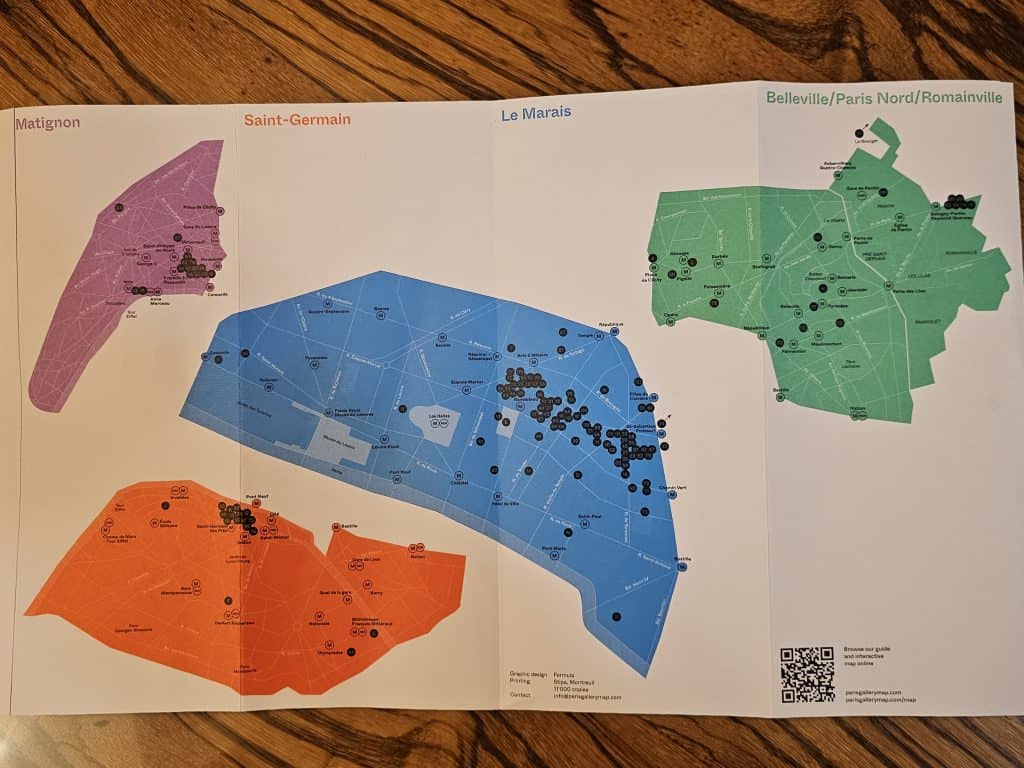
While one can always find a gallery or two in any area of the city, there are three main areas in Paris where galleries are concentrated and a fourth on the rise: the Marais (and the new Haut-Marais near the Place de la République), St Germain, Avenue Matignon and surrounding streets the east of Paris is slowly evolving. This loosely bound zone includes the Belleville area and extends beyond the ring road to Romainville and Pantin. Around Belleville the galleries are young and recently set up, showing emerging artists. Romainville presents a sort of art campus in a quadrangle with four galleries along one side, the FRAC reserve on another. The area is earmarked to become an art center. In nearby Pantin a few galleries have opened, spearheaded by the internationally famous Ropac Gallery. 

While some galleries have closed their physical space to go digital, such as the urban art gallery Sakura, and the iconic Galerie Denise Renée where kinetic art got its lift into art history, others are moving in. And, as City Hall makes parking and driving in the Marais more and more difficult, some of the largest, international galleries originally established in the Marais have opened a (or another) site around Matignon catering to collectors who want to drive to their art spree expedition and park nearby. 

Also, since Brexit, London is gradually yielding its position as the art center of Europe to Paris. Many internationally known galleries who have heretofore had bases in London, are now also opening shop in Paris. And besides these, new, emerging galleries are blooming in the city. 

It is always a pleasure to stroll in any one of these areas and to pop into the galleries to feel invigorated by communicating with the art of the day. Slash is the perfect site to help plan such a walk. The home page will offer suggestions of galleries to visit and if something strikes your fancy, check out what else there is to visit in the area and go take a turn there. Even better, look up the openings that will take place. These are typically held on Thursday evening and sometimes on Saturday afternoon. Thursday evenings can range from a crowded celebration with drinks and even sometimes nibbles, to a quiet display undistinguished from any other day.

The traditional art nexus of the Marais, near the Centre Pompidou is particularly lively where crowds throng to its cafés, restaurants, trendy shops and, of course, its eclectic mix of galleries that can be large or small,  unrenowned or prominent, French or international.  Almost all the artwork being shown is by living, sometimes well-established (or not) artists using a multitude of techniques, with highly diverse materials and in wide-ranging styles. 

The crescent-shaped Rue Debellyme has a particularly high number of galleries in a short distance including the particularly friendly Galerie Pierre-Alain Challier, the international Thaddeus Ropac and Galerie Karston Grève which has two separate spaces side by side. The small Rue Chapon is lined with many small galleries.   On the Rue de Turenne are situated some of the largest international galleries such as Perrotin and Almine Rech with David Zwirner just off on the rue Vielle du Temple. 

The international Galerie Continua, decorated in modern industrial style on Rue du Temple, is a bit of a labyrinthine affair with rooms going round and back on the ground floor and upper floor and sometimes the basement. It has a number of highly visible, internationally known artists on its roster.  Strangely, and singularly, it even boasts a small café and ice cream parlor (an easy place on your itinerary to take a pit stop) which from the front windows overshadows the fact that this is indeed an art gallery.  And the gallery continues and greatly expands its show space way out in the French countryside on two different former industrial sites in Les Moulins and Sainte-Marie. Unique in its business plan, once a year it offers a free bus excursion for an opening out to its two provincial galleries. Of a Sunday morning art enthusiasts are bussed out to Les Moulins, then around lunch time bussed from there to the Sainte-Marie site where they are served a picnic lunch. After lunch they have a couple of hours to visit the artwork and then get on a bus back to Paris. Follow the gallery on eventbrite to know of future events of this type.

Further north is what is now called the Upper Marais, a much trendier designation than “République area”, allowing galleries to psychologically annexe their location to the more fashionable Marais district. Here, an increasing number of emerging galleries are setting up shop where they can have more space at a lower rent with the advantage of a shopfront right at street level. The main streets for art exploration are the rue Béranger and rue Notre Dame de Nazareth. Also in this area, just behind the 3rd district town hall is the exhibition hall, Carreau du Temple, a complete transformation from what was once a leather goods market.  

The galleries in the St Germain area tend to be small each with its own speciality: antiques, modern, contemporary, primary … Rue de Seine has become virtually generic to refer to this gallery area. The other most gallery-laden streets of this quarter are rue des Beaux Arts, rue Guénégaud and rue Mazarine. 

Off the beaten path, and surprisingly so, but still in the sixth district, is the high-end, luxury department store, Bon Marché, which invites renowned artists to create works filling the height of its atrium space above and beyond the central escalators. The windows will also display works of the chosen artist. Artists who have exhibited in situ in this unusual space include, Ai Weiwei, Joanna Vasconcelos  Suboth Gupta, Daniel Buren… These temporary exhibits are well worth the visit to the department store, where you can also shop for (expensive) items to take back home.

The highest end of the gallery quarters is on and around the Avenue Matignon, a short walk or even just across from the Elysées Palace where the president resides. Get off the metro at Miromesnil and start down Rue Déclassé and you nave entered the golden triangle of art galleries of Paris. Galleries line the street on the left side as you head toward the Champs Elysées. One of the first is Galerie Slato-Parra which specializes in Latin American artists and is run by a very knowledgeable Venezuelan. Don’t miss her openings with the pleasure of drinks in the back courtyard on a lovely summer’s evening. The side-streets toward the left: rue Mirosmenil,  rue Penthievre, also boast numerous galleries. Most important is the Rue Faubourg St Honoré, on which is located the entrance to the Elysées Palace, with Sotheby’s right across from it. But if you are not side-tracked,  Rue Déclassé turns into Avenue Matignon with some of the  most prestigious international galleries coming to Perrotin’s three-floor gallery as you almost reach the Champs Elysées. And just before the Rond-Point is Strouk, which, although not a heavy-weight internationally, has some wonderful exhibitions. Immediately on the other side of the street is Christie’s auction house and Gagosian just around the corner on rue Ponthieu. 

The galleries in the east are far-between, and more suitable to a hike than to a short walk. But when you reach Pantin, there is a nice stroll to take along the canal on a lovely, summer day.

Most galleries have,  lying around somewhere (e.g. window-sill, floor, shelf, desk …), a free Paris Gallery Guide, which comes out four times a year and lists virtually every gallery in the main gallery areas, the artists on view, openings that are coming up and a relatively clear, colorful, coded map to find them.

So choose a gallery and an area, pick up a Gallery Guide, and enjoy  “a pleasant walk, a pleasant talk” into Paris’ gallery culture.

Photo of a Gallery Guide.

Did you enjoy this article? TAIP is 100% reader-supported through tipping. If you want to leave us a tip of any amount it would be highly appreciated. These tips help support our efforts to keep TAIP an ad-free environment. Just as at a cafe, the tips are split evenly among the team.

Contemporary Art in Paris: Institutions

Once, when I had been asked to pick up the artist wife of a film-maker for “Festival America” (a biennial fair in American literature where numerous writers are invited to present their books and literary subjects in general), she asked me about where to see contemporary art. At the time I had to think a bit and did not get back to her until a few days later. Unfortunately she no longer had time to visit. Today, some years later, I have a plethora of recommendations, because, on the one hand I have been thinking about and following contemporary art, and on the other, because there are now so many venues that cater to contemporary art today. Beginning with Paris’ contemporary art museum, Palais de Tokyo and the regional contemporary art museum, Mac/Val, there are also a number of fondations, privately owned museums and museum-like galleries as well as various structures set up to encourage talented young artists.

Palais de Tokyo, Europe’s Largest Center for Contemporary Art Today

One of the three 1937 Universal Exhibition edifices built for posterity, the Palais de Tokyo is so called because it was constructed on the then “Quai de Tokyo.” While the street is now called “Avenue de New York,” the edifice has kept its original name. 

Originally slated to become a national art museum, the Palais has, during its turbulent history, also served as the Nazi’s collection point for looted art to be stored and inventoried before its transfer to Germany. 

After the war, it finally came into its own as a national museum of modern art until 1976 at which time the art it held was removed to the new Centre National d’Art et de Culture Georges-Pompidou. Employed for various purposes then, it fell into neglect until it became earmarked in 1999 as a contemporary art museum. The architects, Anne Lacaton and Jean-Philippe Vassal gutted the site down to its bare-bones cement structure, which is how we encounter the institution today.

Palais de Tokyo is devoted to exhibiting established contemporary artists, or those who are on the cusp of becoming so. Contemporary art being what it is today, I have seen extraordinary exhibitions of artists such as Le Parc, and Saraceno, Theaster Gates…a number of forgettables, and controversial others such as Miriam Cahn’s recent exhibition with her painting, Fuck Abstraction. Typically a number of artists will be exhibited at any one time and in the basement there is an area dedicated to video art. The museum also boasts a restaurant and a bookshop. 

The museum has also been used as a discotheque and for rave parties. Thus, locked under normal conditions, can be found walls and staircases covered with fantastic spontaneously-created art. These areas can only be visited on a specially organized guided tour.

A good place to go after other museums have closed, it can be visited until late at night (22h) and even later for evenings when an exhibition first opens. An added bonus for vernissage nights is that museum entry is free and therefore should be watched for.

Another important contemporary art museum, this one outside Paris, is MAC/VAL located in Vitry-sur-Seine. While a bit way out (approximately an hour by public transportation), this relatively new building houses a very good collection of specifically French contemporary art and presents two temporary exhibits per year. If time is not of a premium, this museum (free to the public), of very high caliber, is well worth a visit.

Establishments Exhibiting Contemporary Art

There exist both public and private organizations whose objective is to exhibit the work of living artists. 

In 1982 Jack Lang, the then-Minister of Culture, set up a network of institutions, named FRAC (Fonds Régionaux d’Art Contemporain) to encourage the collection and showing of contemporary art in all of France’s regions.  The FRAC of Ile de France is located at 22 rue des Alouettes, 75019.  Admission is free and it typically offers exhibits of living, contemporary artists, both French and international. It has a second location in the new, contemporary art center in Romainville. This extension is known as “Les réserves.” Although slightly outside Paris, it can be reached by metro line 5. 

The Cent-quatre-Paris is a multipurpose art space offering contemporary art exhibits (ticket fees apply) as one of many other activities. The center includes an auditorium for lectures and performances, various restaurants, a book exchange, activities for children…and a large central space where visitors can see various groups practicing their hip-hop dance moves and sequences. 

The beautiful 13th century College des Bernardins often provides a venue for artists to create and set up installations adapting and highlighting its Cistercian architecture. Whatever the exhibition, the sheer beauty of its rows of stone pillars and gothic arches offer the visitor a moment of tranquillity and spirituality. 

To create a marketable aura and gain a reputation as a patron of the arts, various private corporations have created exhibition spaces which can be as grand as a quasi museum. The largest and most famous of these have been created by France’s art-collecting billionaires: Bernard Arnaud who heads LVMH and François Pinault.  

The former had the architect, Frank Gehry, build an architecturally fantastic structure in the likeness of a ship in Neuilly, a near-western suburb of Paris. Visiting exhibits at the Fondation Louis Vuitton means following a bit of a labyrinthine course, but the tour offers artistic and architectural wonders around every corner. When there is no special temporary exhibit on show, the walls will be hung with Arnaud’s own collection of modern and contemporary art. This Fondation is also known for its blockbuster temporary exhibits, which are a must for any art lover.

The latter renovated the former Bourse de Commerce (Paris’ old stock market building) to create a center for exhibiting contemporary art, much of which is from his personal collection. Temporary exhibits may change every quarter or semester. Here can be seen the most well-known artists of today’s contemporary art scene. Constructed in a circle around a central atrium, this building is also well worth a visit for its architecture as well as for the art. For those on a tight art budget (and who isn’t?), it is important to note that the museum is free the first Saturday evening of every month where explainers are available to offer (sometimes very necessary) insights into the exhibitions. Be sure to reserve a time slot as early as possible for these tickets go quickly.

The Cartier Foundation for Contemporary Art hosts temporary exhibits of contemporary art both on the ground floor of Jean Nouvel’s modern, light-filled, high-ceilinged rooms on its ground floor and in a more muted locale in the basement. Artists are typically already well-known internationally, such as Damien Hirst, Ron Mueck, Fabrice Hyber … Out back, there is also a lovely garden with a cafe which is a great place to spend some time on a sunny afternoon and discuss the current exhibition with friends.

Galéries Lafayette has taken over a building in the Marais to produce ever-changing temporary exhibitions in its contemporary art space, Lafayette Anticipations. Each exhibit is typically devoted to a single artist. No reservations are needed, except for their guided tours every day (except Tuesday when it is closed) at five in the afternoon; these are well-worth signing up for. 

Fondation Pernod-Ricard has moved its small art quarters near the Concorde to a spacious new building just behind the Gare St Lazare. Here they offer free entrance to temporary exhibitions of hand-picked contemporary artists. Vernissages, which are always of particular interest, are indeed open to all where Ricard cocktails flow free and freely to celebrate the event.

With an aim to promote their culture, a number of countries have reserved a space for art exhibitions in their embassies or cultural centers. Thus without leaving the city, any art enthusiast can feel the pulse of artistic creation in various nations around the world. Countries particularly engaged in presenting their contemporary art include ItalyCzech Republic, Canada, Australia, Korea

Artists’ Compounds

Then there are artists’ residences, where young artists are given a studio to work in and create. They also offer venues for these young artists to exhibit. 

In the center of Paris right on the Seine is the Cité des Arts, a complex where promising young artists have won a residency. Every Wednesday is open house from 6pm to 9pm when the general public can visit artists in their studios and see their work in progress. Every so often exhibitions are staged to display the residents’ works. In the lower level, there is a small auditorium, which offers conferences and concerts. Attached to this residence is a second compound of studios overlooking gardens located way up on Montmartre.

And far off the beaten track, in Clichy, as part of Greater Paris, an industrial site has recently been repurposed into a new artists’ residence.  Entitled Poush, it also offers visits and exhibitions to the general public, promoting the artists who are living and working there.

Les Frigos (the refrigerators) was once just that, a refrigerating edifice on the left bank of the Seine to store perishable foodstuffs until they were brought to Paris’ central market, Les Halles. Each distributor had its own refrigerator in the building. When the market was moved out of Paris to Rungis the building was abandoned no longer serving a purpose. It was then that the artists moved in, created windows, dismantled the refrigerator doors, installed plumbing and in a word, undertook all the installations necessary to make the various rooms viable and to set up work studios.  Once or twice a year Les Frigos are opened to the public to visit the studios housed behind each disabled refrigerator door.  A curious and totally unconventional art scene not to be missed.

Then there are the various open house days set up independently in different sectors of Paris and its suburbs where artists might have studios. These include, among others, areas such as Belleville, Père Lachaise, Ménilmontant, Montmartre, Glacière … most of the districts of Paris and suburbs such as Montreuil. Each neighborhood is free to decide on the dates for this type of event although typically they occur during the Spring months.

While what has become a plethora of institutions and venues offering exhibits of contemporary art, the above-mentioned list, as daunting as it might seem, is certainly not exhaustive.  It is only the beginning for a foray into the present day’s contemporary art, both French and international.

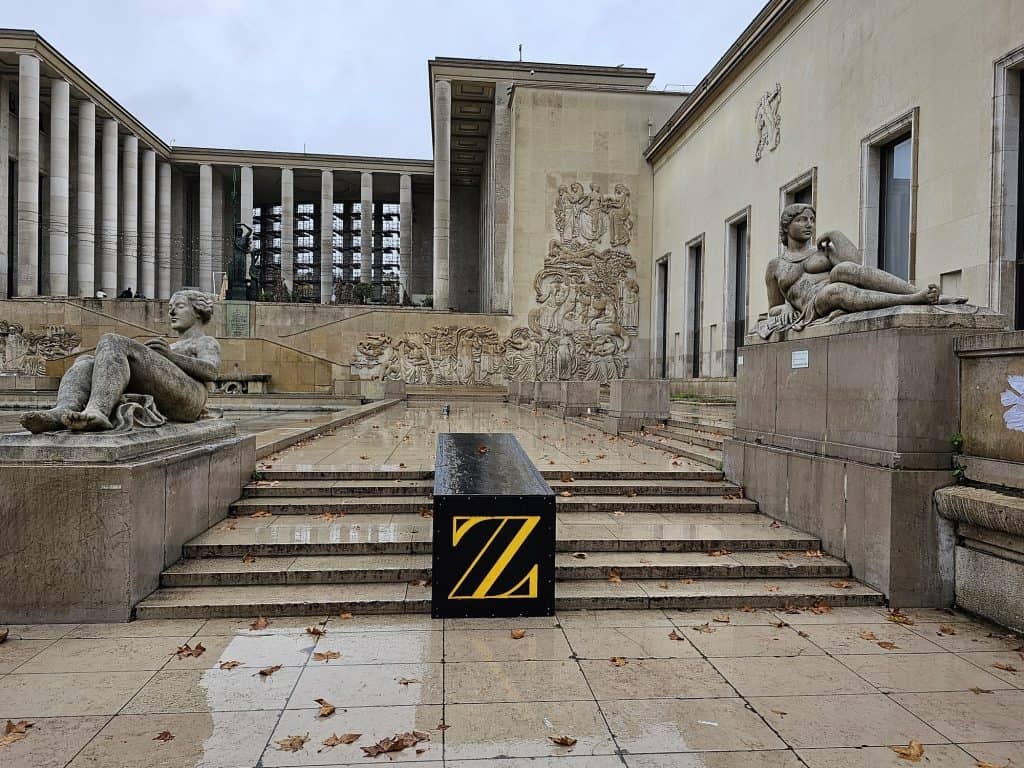
Photo taken outside the Palais de Tokyo/ Modern Art Museum in Paris.

Did you enjoy this article? TAIP is 100% reader-supported through tipping. If you want to leave us a tip of any amount it would be highly appreciated. These tips help support our efforts to keep TAIP an ad-free environment. Just as at a cafe, the tips are split evenly among the team.
arc de triomphe paris

The Paris Museum Pass: Worth it?

One of the things I’ve come to appreciate about working with accountants and lawyers over the years is their most frequent response to what a layman would consider a fairly innocent and straightforward question: “It depends.”

That “it depends” has many possible follow-ups.  “It depends on what you want your tax exposure to be,” or “It depends what your long terms goals are,” etc.  The “it depends” for the Paris Museum Pass isn’t dependent on how much you like art, but rather on how quickly you like to see your art.

For those who want to see their art “efficiently” (which was me once upon a time), read on for why the Paris Museum Pass is for you.  For those who prefer to see their art slowly, don’t worry, I’ve still got some helpful suggestions for you.

You Get to Skip the Line

For some of the museums there is a special entrance just for pass holders the one at the Louvre is particularly skip-tacular.  If there’s one thing no traveler really enjoys, it’s standing in long lines to get into places.  Often this is down to poor planning as today so many places offer online booking and so many internet reviews tell people exactly when the lines get ridiculous.

It Covers Monuments and Museums that Are Short Visits

When people hear the word “Museum Pass” they may think of museums, but they don’t think of National Monuments be they the Arc de Triomphe or Sainte-Chapelle.  Both of those are excellent short visits (your Museum Pass gets you to the top of the Arc, one of the best views of the city) and can be accomplished in under 30 minutes, if you time your entrance well.  Separate admission to these two places alone goes a long way to covering the value of your Pass.

Then there’s a museum like the Orangerie, which has a decent permanent collection but a spectacular “custom-designed” collection of Monets, which you can fully appreciate within half an hour.  There’s also Petit Palais, which does have a magnificent permanent collection, and can be comfortably seen in 2-3 hours, and that’s even with a break in its lovely inner courtyard.

You Save $$$/€€€/£££

The Museum Pass allows you to get into the “biggies” (think Louvre + Orsay + Invalides) but also gets you into dozens of lovely and under-appreciated museums as well.  This is a testament to Paris itself, as a city like New York doesn’t have anything like it, despite having many wonderful museums.  The existence of such a pass in a city known for its territorial curators is almost unbelievable.  Someone herded all the art cats into a room and got them to agree on this idea, to the benefit of all of us.

For locals, the next best thing to the Museum Pass is Free Museum Sunday (the first Sunday of the month).  That’s when we get into almost all the museums for free (the Louvre is seasonally on that list).  Serious value seekers have been known to time their Museum Passes to expire the day before that Sunday and add one more day onto their museum binge.  However, it’s a very crowded day so consider using Free Museum Sunday as a day to circle back to places you might have already seen, or luxuriously use it as a way to go into a place, see one or two things, then leave.

It Doesn’t Commit or Obligate You

When you buy tickets ahead of time for particular days and times at specific museums, you sometimes feel trapped should you feel ill or like doing something else on the appointed day(s).  If you realize the true value of the Paris Museum Pass, plan the three or four visits upon which you will immediately recoup the cost: you will see each additional visit as extra gravy for your Parisian “meal” of culture.

But It Doesn’t Cover Every Place Worth Visiting

Three favorites of mine that are not covered by the Museum Pass are the Musee Marmottan Monet, on the edge of the 16th, the Caillebotte Estates in Yerres, and Monet’s place in Giverny.  This is to say nothing of the Museum of the Liberation of Paris, the newly opened Bourse de Commerce, or the (finally) re-opened Carnavalet Museum in the Marais, one of the very best museums in the city.  And, just like the best things in life, all three of those are free.

Photo by Marcos Pena Jr on Unsplash

Did you enjoy this article? TAIP is 100% reader-supported through tipping. If you want to leave us a tip of any amount it would be highly appreciated. These tips help support our efforts to keep TAIP an ad-free environment. Just as at a cafe, the tips are split evenly among the team.