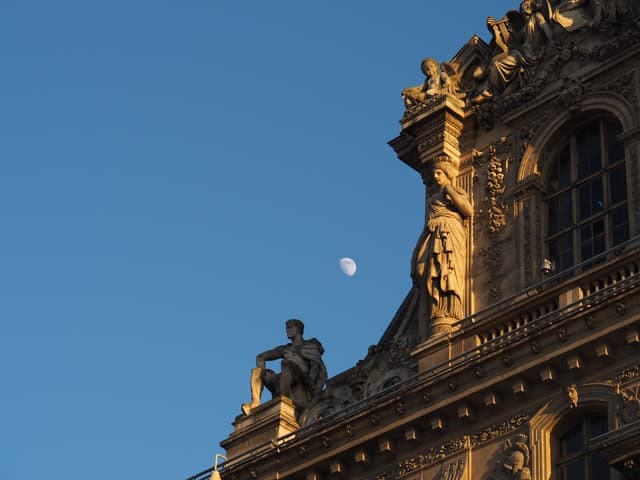
moon

Book Club: Paris to the Moon, by Adam Gopnik

My favorite book written about Paris from the expat perspective is the series of essays written for The New Yorker by Adam Gopnik that was later compiled into a book called Paris to the Moon.  As the book’s magical title promises, it is a thoughtful and earnest look at a city Gopnik never intended to permanently live in, but experienced more deeply in six years than some people do in a lifetime. 

Gopnik has gifted me with some ways to express feelings and sentiments I have in my new country, from saying that we “breathe in our native language, but swim in our second,” to his chapter on “Distant Errors” in which he deconstructs, albeit kindly, the French tendency to look at problems or errors as distant as something external rather than related to their own thinking and behaving, to his explanation of “white helicopter” thinking among the French (in contrast to the American “black helicopter” idiom, which is a meme for conspiracy theories) that there is always the possibility that a future government will offer a higher pension and a lower retirement age.

Adam’s approach to life in France is certainly one I wish to emulate, though my French needs to improve in order to do so.  He is at home as the American he will always be, while truly attempting to live life as the French do, day in and day out, in dealing with strikes, protesting the takeover of a favorite restaurant, by enjoying holidays enthusiastically (I wonder sometimes if the French love the planning and anticipation more than the holiday itself), and even in the ceremony of childbirth, which both he and his wife participate in.

I’ll leave you with a quote from the book particularly germane to the subjects covered in this blog: “Everything about moving to Paris has been wonderful, and everything about emigrating to France, difficult.”

As it perhaps, should be.  This life should only be available to those who truly want it.

Photo by Rafael Garcin on Unsplash

Did you enjoy this article? TAIP is 100% reader-supported through tipping. If you want to leave us a tip of any amount it would be highly appreciated. These tips help support our efforts to keep TAIP an ad-free environment. Just as at a cafe, the tips are split evenly among the team.
jill jonnes

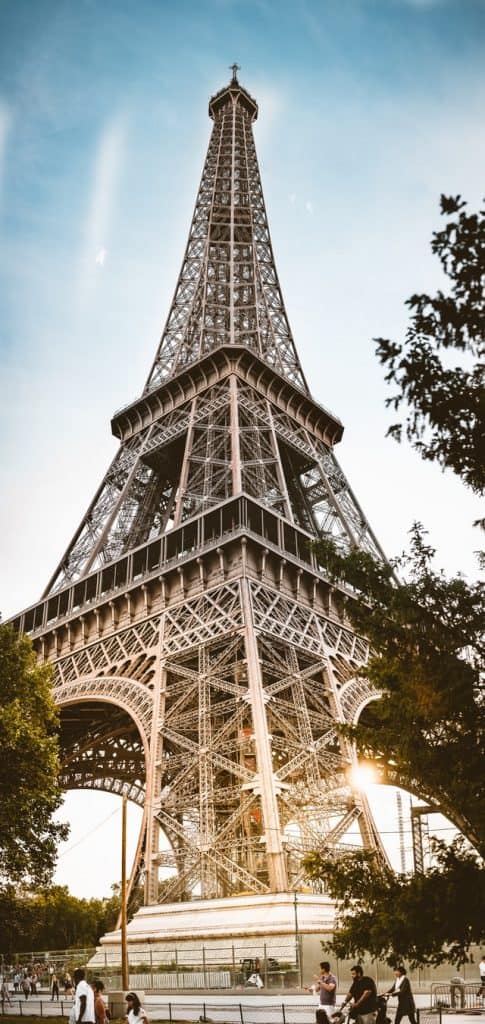
Book Club: Eiffel’s Tower, by Jill Jonnes

“But there’s no such thing as Paris without the Eiffel Tower,” said my friend Florence the other day.  Locals have complicated views about the tower of iron, but perhaps she is right.  But the beginning of pondering that question should
start with Jill Jonnes’ fascinating book, Eiffel’s Tower: The Thrilling Story Behind Paris’ Beloved Monument and the Extraordinary World’s Fair That Introduced It.

In this book you learn just how much it took for Eiffel to overcome in order to build this true architectural achievement of its time.  It stood as the world’s tallest building for 30 years, and took only 2.5 years to complete (perhaps one of the few French building projects ever completed on time).  In contrast the previous “tallest building” in the world was the Washington Monument in Washington D.C., which was half the height of the Eiffel Tower and took 40 years to complete.  Mind you, there was a little thing called the War Between the States during that 1848-1888 period of construction, but still, you can imagine many Americans, including Thomas Edison, felt a bit of envy to have the French claim a technological achievement before America did.

Edison was feted when he visited the Tower he was the great man of innovation and ideas and Eiffel toasted him with champagne at the summit of the Eiffel Tower.  But he emptily boasted that for the upcoming Chicago World’s Fair that they would build something twice as tall at half the price.  The French raised their eyebrows, understandably so when what ended up being invented for that event was not some tall tower, but the Ferris Wheel.

Jonnes writes a compelling narrative, bringing all the characters together in a cohesive story that is, oddly, suspenseful, especially given that we already know how events turned out.  I shared this book with some local Parisians and they told me it forever changed how they saw and understood the Tower, which is just the sort of antidote you need, especially when you’re walking past the Selfie Nation on the Champs de Mars.

But perhaps you will be most edified to learn how well Eiffel bore up under the most vile and vicious attacks, before, during, and well after the construction of the Tower.  It is his entrepreneurial genius something the French could allow to flourish a bit more these days that is the true story behind this great little book.

Photo by Mika Baumeister on Unsplash

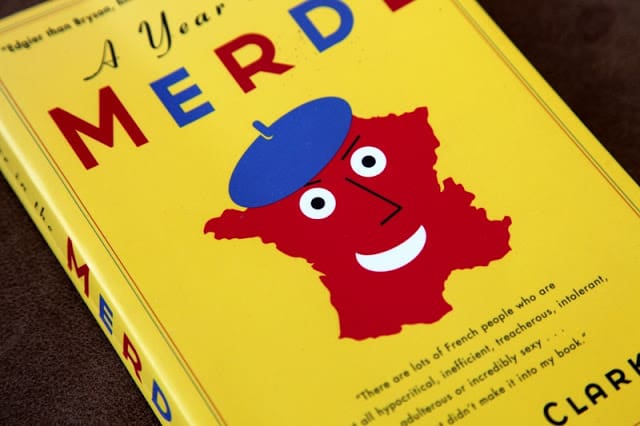
Book Club: A Year in the Merde, by Stephen Clarke

I read a lot of books about Paris and France before moving here and I’ve only recently realized I might do well to share them with you.  So, I’ll start with an old favorite.

It was the second week I was in Paris.  I had just gone to an Asterix exposition at the ugly BNF (Bibliotheque Francois Mitterand), with my friend Julien, who I had met in Adelaide, Australia, a year earlier (a story for another time).

“Stefan,” (this is how the French pronounce my name), “Stefan, do you know zis booke, ah, a year in dee Merde?”  I nodded that I had vaguely heard of it, but not much more.

He started laughing.  “Oh, you must read it!  It is soooo funny!  And it’s true!”  Julien is a great guy a real Anglophile to boot though he insists that when we go on ski trips I only speak French so I gave his recommendation its due importance and in time purchased and read the book.

It was, as he had warned me, absolutely hilarious.  One time I almost choked on my tongue while reading in the metro because I was laughing so hard.  Another time, while I was buying groceries at Franprix, I noticed that the checkout guy started to giggle quietly because he saw the book under my arm.  “C’est vrai?” I asked him, left eyebrow raised.  “Oui tout!” he responded.

So, Stephen Clarke, the author, invented this fictional Paul West character who comes to Paris for a job and gets caught in the life of apartments, work, and love.  It’s told from an Anglo perspective, and it’s particularly funny if you’ve lived in Paris for any period of time because the jokes hit on the realities of everyday life.  Some memorable lines from the book include:

Jean-Marie did the hugest shrug I’d ever seen, even outdoing the man in the electric shop.  His shoulders, arms, his whole rib cage, took off vertically in a gesture of infinite indifference.

and this

The Paris police are the best in the world at one thing sitting in buses.”

and this

Red lights are like queues,” he said scornfully, “They are for people who have time to waste.”

It’s not a perfect book, by any means, but it’s very revealing in its takedown of the French.

Clarke was a bit taken aback, I’m sure, by his success, and has gone on to write at least two other books on this theme, which I have, unfortunately, also read.  I say unfortunately because these books go beyond the playful fictional satirical conceit of the first book and just linger in stereotype that is, over time, increasingly unfunny.

Yes, it was funny that first time but if you want to keep going you’re going to have to go deeper.  In comedy, the analogue would be the first Austin Powers movie the first one was funny in so many ways the others were horrible.  Same with the sleeper Liam Neeson hit film Taken.  I love that movie.  Which is probably precisely why I hate the sequels so.

Perhaps we as moderns don’t understand that success can be solitary (witness Harper Lee being huckstered into releasing an inferior and revisionist novel in her dotage).  Success doesn’t mean having to repackage your great idea as something only slightly different.  Indeed, success is sometimes leaving well enough alone.

So, read this first one.  Skip the rest of Clarke’s catalogue.

Did you enjoy this article? TAIP is 100% reader-supported through tipping. If you want to leave us a tip of any amount it would be highly appreciated. These tips help support our efforts to keep TAIP an ad-free environment. Just as at a cafe, the tips are split evenly among the team.
Little Entrepreneurs and a Sunday Stroll

I’ve often said that Paris is built for walkers.  The subtext there is that it’s a dream for wanderers.  Have some free time and nothing on your agenda?  Just take a stroll.  If it’s a particularly cold day, you might hit a string of Passages.  Historically these were just places where the bourgeois could shop, free from the threat of the elements.  Now tourists (and locals) mug in, enjoying the ongoing “show” that is the endless corridors of glass shop windows.  Today my target was a string of them, starting in my neighborhood, the 2nd, at the Cadet Metro station and working my way south towards Bourse.

Because my French is still a work in progress, I will often buy used children’s books as a means of improving (so I read like a French 10-year-old, so what? 🙂 ).  If they are used and on offer for 1 or 2 euros, that’s ideal.  These young entrepreneurs had set up in front of a beautiful art store that was conveniently closed.  People might crowd around looking into the store at curios and hey there are some kids selling books right here let’s take a look.

Where had these children (they couldn’t have been older than 10) gotten these books?  Had maman insisted on a cleanout of the rooms?  Had they found them by the trash somewhere and decided to be enterprising?  I stopped asking myself questions and started looking for my friends Babar, Madeleine, Tintin, and Asterix.

I spotted what I wanted a picture book on St. Bernadette, and inquired of one of the young ones “how much?” in French.  She told me to wait one moment and she asked her brother.  He told her, “Whatever you think.”  She paused, hand firmly under chin, mulled it over, and said “deux cinquante.”  I shrugged and nodded and reached into my pocket and pulled out a grip of coins.  Seeing my “riches” she quickly amended: “Trois.”  I laughed.  How do you say no to a kid selling books on the sidewalk on a Sunday?

I happily paid the spontaneous 20% upcharge and walked away with my new treasure, grateful to witness yet another facet of life in this amazing city.  Entrepreneur might be a French word, after all 🙂

Photo of said entrepreneurs in the Galerie des Panoramas.

Did you enjoy this article? TAIP is 100% reader-supported through tipping. If you want to leave us a tip of any amount it would be highly appreciated. These tips help support our efforts to keep TAIP an ad-free environment. Just as at a cafe, the tips are split evenly among the team.