How to Find a Certified French Translator

My search for a certified French translator began when I decided to trade in my American driver’s license for a French permit. I am still in the middle of that process, thanks to a few mistakes I made in the documents I submitted as part of my dossier (French for file). However, that’s a reflection for another day. For now I want to share my journey of attaining a certified translation of my English documents from the United States for my numerous French bureaucratic ventures. 

My first bit of research led me to a company that created certified translations based in Dallas, Texas. The price was $62 for two pages, which felt reasonable. Great, I thought. As I already alluded to, I thought wrong. Yes, it’s true, I went on to purchase a certified translation; however, that certification was in the eyes of the US government — and not the French. I thought I was ahead of the game to try to start this process before I left the States, but I was mistaken. A certified French translator will most likely offer their services in French. I made the blunder of searching the internet in English. 

It was not until many months later that I realized my error on receiving a notification from ANTS (l’Agence Nationale des Titres Sécurisés) that my file was on hold due to “uncertified translation.” They informed me that I needed a “Traduction Assermentée,” a translation certified by a court-certified translator. Cue deep sigh. Their reply pointed me down a rabbit hole that ended in a PDF list of certified translators in France —a 356-page document with translators of every language imaginable. From the extensive list, I chose to reach out to two who were certified to translate from English to French. From one, I received no response. The other quoted me 66 € per page of translation. I had two pages, so this was going to be a 132 € expense for a translation I technically already had.

Solving the Problem

In the midst of my regret and indecision, I decided to search “traduction assermentée” on the internet to see what I could find, this time in French. Sure enough, I found plenty of translation services, with promises to have a quoted price before the end of the day. The first quoted me 66 € total, 39 € for my rights as a driver in the state of Texas, and 27 € to translate my driver’s license from English to French. Their reviews were fine and the price was right, so I used their services. Five days later I received an email with the translations attached. I added them to my driver’s permit request and reactivated the online request.

Recently in need of translation for documents concerning my upcoming marriage in France, the stakes felt much higher. Instead of using the company I had used previously, or even searching on Google, I searched on Trustpilot. I found companies with high reviews, quick turnarounds, and reasonable prices. I ended up going with ML Traduction. Though they claim a 48-hour turnaround, I received a digital copy of the translation I needed in less than 24 hours.

Additionally, in search of a full-time teaching position, it became apparent that I would need a translation of my university diploma. This process of approval for foreign studies requires a certified translation of the diploma and the corresponding transcript; however, the submission portal specifies that the certification can be made in the eyes of France or the issuing country. If this had also been the case for my driver’s license application, my original translation would have been as good as gold, but I digress. 

Takeaways

This may seem obvious — it certainly does to me in hindsight — but if you’re looking for a “traduction assermentée,” you’ll most likely be navigating a website originally in French and be charged in euros. Average prices run from 25-70 € a page, depending on the word count and complexity of the document in question. When seeking out a translation for a legal process, ensure that your document can be a digital copy, or find a service that will send you the original signed version by post. This additional service could cost somewhere between 3 and 15 €. For an American in Paris, or any part of France for that matter, you’ll likely find yourself in need of certified translation sooner or later. Finding a provider you trust is one less reason to stress as you navigate the kinds of legal procedures that require them. 

Have you acquired a certified translation while in France? Would you recommend your translator to our community? We would love to hear about your experience. 

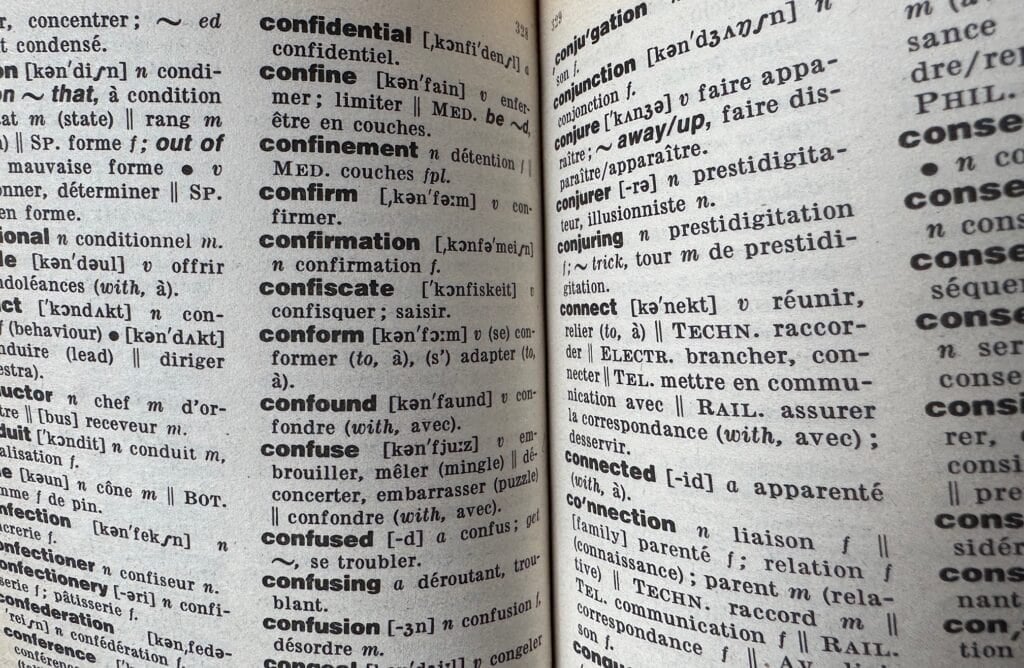
Photo taken of an English to French dictionary by your truly. 

Did you enjoy this article? TAIP is 100% reader-supported through tipping. If you want to leave us a tip of any amount it would be highly appreciated.  These tips help support our efforts to keep TAIP an ad-free environment. Just like at a cafe, the tips are split evenly among the team.

Building in Nice

Living in France as a Retiree: Part 3: Taxes and Succession

Don’t miss Part 1 and Part 2 of this series on Living in France as a Retiree

France has rather rigid laws, especially when it comes to taxation and succession. They are also quite unclear. Disclaimer: I am not an attorney, nor an accountant. However, I can inform any prospective retirees on issues to look out for. I used some of my own experience, but also that of other immigrants from the US to France with different financial and family situations.

Note of caution: French attorneys and tax accountants who deal with Americans tend to ask for a lot of money, and their advice is not always crystal clear. I don’t want to make a sweeping assumption, but this has been our experience.

Another note of caution: Laws change.

No Double Taxation

Who is a French tax resident? The French government uses several factors to determine whether or not you are a resident for tax purposes. A rough rule of thumb is that if you intend to spend more than 6 months of the year in France, you will probably be considered resident for tax purposes.

The good news is that there is a treaty between the US and France, and retirement income, at the very least, is not double-taxed.

Trusts

Many Americans have trusts. France does not recognize US revocable trusts as “transparent” for tax purposes, so every time you change or take a distribution of funds held in a trust, you will have to declare it to the tax authorities within 30 days. The penalties for not doing so are steep.

The current default position is that distributions are automatically treated as income and hence taxable. The onus is on you to prove that distributions are not income and thus not taxable, which means you will need a full accounting trail of the funds. If you have a revocable trust, you should consider removing any financial assets from the trust prior to moving to France.

Joint Ownership of Property

If you are buying property jointly (e.g., you and your spouse or partner), there are three ownership options:

1. En Indivision (Standard Joint Ownership)

This is the default and most common method. Each person owns a specific share (e.g., 50/50 or 60/40) based on their financial contribution.

  • Pros: Simple and flexible; reflects actual financial input.
  • Cons: If one (legal) partner dies, their share is subject to French inheritance laws. This means children (including those from previous relationships) automatically inherit a portion of that share, potentially making the surviving partner a co-owner with their children or stepchildren.
  • Best for couples with no children, or those who are comfortable with their children becoming immediate co-owners when one of the partners passes.

2. En Tontine (Survivorship Clause)

A specific clause is added to the sale deed stating that the survivor is deemed to have owned the entire property from the start. This needs to happen when the property purchase occurs.

  • Pros: The surviving partner becomes the sole owner automatically, bypassing “forced heirship” for that specific property. The children cannot claim their share until both partners have passed away.
  • Cons: It can be difficult to undo if the couple splits up, as both must agree to cancel it. There may also be higher tax implications if the property value is high and the couple is not married or in a PACS (official civil partnership)
  • Recommended for unmarried couples or those with children from previous marriages who want to ensure the survivor stays in the immediate family

3. SCI (Société Civile Immobilière) (Limited Liability Company)

You set up a French LLC to buy the property. The couple (and their children) then owns shares in the company rather than the real estate itself.

  • Pros: Offers the most flexibility for succession planning. Shares can be transferred more easily than real estate, and they can help non-residents manage French inheritance taxes.
  • Cons: Higher setup costs and ongoing administrative requirements (annual accounts). The shares must also be declared to the IRS every year.
  • Recommended for high-value properties or complex family situations where you want to avoid certain French succession rules.

Comparison of Couple Status & Protections

Status: Married

  • Inheritance Tax: Exempt (0%)
  • Automatic Rights: Strongest; can use a Communauté Universelle contract to protect the survivor

Status: PACS (Civil Union)

  • Inheritance Tax: Exempt (0%)
  • Automatic Rights: No automatic inheritance. You must write a French will, or the partner gets nothing

Status: Cohabiting

  • Inheritance Tax: 60% (yes, you read that correctly!)
  • Automatic Rights: None; the surviving partner is treated as a “stranger” for tax purposes

Inheritance Tax on Worldwide Income

When a French tax resident dies, their entire worldwide assets will be taxed by the French authorities. French inheritance tax rates and allowances depend entirely on the familial relationship between the deceased and the beneficiary.

  • Spouse/Civil partner: Fully exempt from inheritance taxes
  • Children/parents: biological, adopted: €100,000 tax-free allowance; above that threshold, a sliding scale: 5% to 45% (progressive)
  • Siblings: €15,932 tax-free allowance; above that threshold, a sliding scale: 35% to 45%
  • Nephews/Nieces: €7,967 tax-free allowance; above that threshold, 55%
  • Unrelated/Friends: €1,594 tax-free allowance; above that threshold, 60%. This category includes unofficial life partners, as well as stepchildren you may have raised, but are not officially your children

More notes of caution:

  • It is important to verify that adopted children will indeed inherit just like biological children; it isn’t always the case, especially if they were adopted as adults.
  • If you have a joint bank account, the wording in the title can determine what happens upon the death of one account holder. It is best to verify this when you open an account.
  • In France you cannot “disinherit” your children. If a couple jointly owns a property and one partner dies, the children of the deceased partner have automatic ownership rights on a portion of the assets and property of the deceased. This cannot be overridden by a legal contract.

The above is not a comprehensive account of all the details. However, at least this article can help retirees avoid some pitfalls and be prepared.

Photo of a building in Nice

Did you enjoy this article? TAIP is 100% reader-supported through tipping. If you want to leave us a tip of any amount it would be highly appreciated.  These tips help support our efforts to keep TAIP an ad-free environment. Just like at a cafe, the tips are split evenly among the team.

Coming down Mont Boron in Nice

Living in France as a Retiree: Part 2: Health Insurance, Medical Care, and Nursing Homes

Don’t miss Part 1 of this series on Living in France as a Retiree

Health Insurance

When you first apply for your long-stay visa for your first year in France, you are required to prove that you have health insurance. The less expensive way of getting it, for me, was via the visa website; it cost about $500 for the entire year, but it was not comprehensive, i.e., not for preventive healthcare, but rather for emergency situations.

Be aware that basic Medicare covers nothing outside of the United States. Some supplemental plans may cover expenses in other countries after a deductible is met.

After you have been residing in France for three months, you can apply for a numéro de sécurité sociale (social security number, which is not the same as Social Security in the United States). You’ll need proof of residence, a birth certificate, and your passport/visa. Usually the application is mailed to the local CPAM office. CPAM (Caisse Primaire d’Assurance Maladie: national health insurance) will probably request additional information by mail or have you fill in a questionnaire. 

The process can be quite daunting and appear illogical. You may be asked for the same document again and again, and then suddenly discover that you’ve been covered for a year! (You can request reimbursement for expenses incurred in the meantime.)

To apply:

  • Your name must be the same on your birth certificate and your passport. If not, you will need to prove that you are the same person through your consulate, and if there’s no consulate only an embassy.
  • If you live with someone without being married or “PACS‘ed” (officially partnered) you may be considered a concubine. It doesn’t have the same connotations as in English, or at least it’s not limited to those connotations. 
  • The CPAM agents usually answer any questions you may have on the phone, and while they are very polite they have little time to speak at length. Telephone number: 3646 (within France). You can request an English speaking agent when you call.
  • You’ll need a French RIB (Relevé d’Identité Bancaire, or bank identity) in order to be reimbursed.
  • To find your local branch, use the Adresses et Contacts (addresses and contacts) section on the Ameli website.
  • More information on French healthcare in English.

Once you have your French social security number, you must request the carte vitale, the health insurance card, which will then be mailed to you. The card is used by medical providers to enter your information, when you fill a prescription or visit a doctor.

Some areas of France are medical deserts, with few medical facilities. In larger towns, you’ll find many hospitals and medical practices, but wait times for specialists can be long and some don’t accept new patients. In Nice, where I live, it’s hard to find a dermatologist — they are often busy with cosmetic procedures!

There are different tiers of medical practices; for some, you don’t need to pay anything over the basic reimbursement offered by health insurance; for others, you’ll pay more. For tier 1 medical practices, you will often pay nothing out of pocket; the national health insurance will handle it.

You can also buy supplemental insurance, through a mutuelle, in a dizzying array of levels. A basic mutuelle subscription might cost €40 a month, and help pay for hospital stays, which can be very expensive. Higher premiums will help pay for hearing aids, glasses, higher-tier medical practice fees… the second year, I used a broker to help me choose.

Nursing Homes and Assistance for the Elderly

In the US, nursing homes often cost much more than many of us can afford, especially in larger cities on the coasts. In France, they are not inexpensive, but appear to be more affordable. There are a variety of systems.

There are senior living facilities for seniors who are well enough not to need assistance, mainly for people who would like to have a community, and in-house facilities.

EHPADs (Établissements d’Hébergement pour Personnes Âgées Dépendantes) are like our medicalized nursing homes. They are meant for people over 60 who need daily assistance. As far as I know, in 2025 they cost about €4,000 a month, but it varies. If you don’t have enough income, you may be able to stay at a lower cost, but when you pass, the difference will be taken out of your estate.

  • Public (government-run) homes cost less than privately-owned homes (nonprofit or for profit).
  • For more information (in French)
  • For a list of locations separated by area: Assistance Retraite (in French)

There are also agencies offering in-house care for a fee. I’m not sure, but if your income is below a certain level, and you are disabled or recovering from a hospital stay, you may be eligible for help paying for a nurse or a cleaning person.

In general, France is a good country to age in, once you have surmounted the bureaucratic hurdles! In my personal view, single-payer insurance is much better than the US system of many disparate for-profit insurance companies, especially as so many get left behind.

Some additional informational websites:

Photo of Mont Boron in Nice

Did you enjoy this article? TAIP is 100% reader-supported through tipping. If you want to leave us a tip of any amount it would be highly appreciated.  These tips help support our efforts to keep TAIP an ad-free environment. Just like at a cafe, the tips are split evenly among the team.

french flag

How to Renew the Passeport Talent

Bonjour tout le monde! I’m excited to share with you a brief guide to the beloved (read dreaded) passeport talent renewal process for first timers. I’m new around here, so I’ll share a bit of backstory.

Initially, my passeport talent was approved for 12 months; this time frame is different for everyone. Some people receive two to four years their first time; it’s mainly dependent on what subcategory you fall into and your work experience.

My renewable visa was approved for 18 months, which is less than I had hoped, but reasonable as they wanted to give me more time to grow my business.

When your renewal application is being processed, several factors are taken into consideration, not only how much income was earned and if it met the minimum 70% of the French minimum wage. But also, what type of work did you do? For example, if you are a musician and the majority of your declared work was as a barista, then that income might not count towards your renewal. Your visa will clearly stipulate what kind of work you’re allowed to do. If it states you can only receive income as a musical performer, then you’d be hindering yourself by accepting work as a barista.

My particular visa was passeport talent artistique et culturelle. As a producer, I could do photography, video, writing, and consulting as long as it fell within the scope of a production entertainment agency. I drafted a business plan explaining the breadth of what I could accomplish in France along with a track record of what I had already done in the US. I made this intentionally because I wanted to have more options on how to earn an income. As a producer, I knew I could get the projects done, but I needed the flexibility to show that on paper.

When the time for renewal came, I provided proof of all my work and it was successful. So, let’s dive in, step by step, into how I obtained the renewal for myself and my husband.

Step 1: Know Your Timeline! 

You are eligible to apply for your visa renewal up to four months before its expiration BUT NO LESS THAN two months before its expiration. Confusing? Welcome to France!

If you submit your renewal application within 60 days of its expiration, you are now in a penalty period and will be charged a late fee for the now late processing of your application. Ask me how I know…

So, familiarize yourself and understand your active dates so that you aren’t paying extra fees and so that you give yourself enough time to collect and produce all your documents appropriately. 

Step 2: Read the Directions and Then Double It

Review the application rules thoroughly, but use it as a guide, not a bible. In my experience, the more proof provided, the more perceived readiness your dossier has. When applying for my first visa, I submitted a business plan, but this was not requested in the application. During my appointment with the consulate, they reviewed it and asked for an additional copy, which I gleefully provided; thankful for the tedious research I had done beforehand, making copies of everything. When renewing, you want to show how well you did during your first season in France; sometimes that is difficult to do as an artist or performer, or in a non-traditional career. But nothing is impossible! 

I know, how dare I bring that attitude around here, but it’s true. I provided printed screenshots of Instagram DM’s with potential and locked clients, reaching out asking for services and availability. I included written letters explaining my work and expertise and hyperlinked to videos produced, photoshoots, etc, so that if my documents were reviewed on a computer, the agent could click the hyperlink and view my work. Did they do this? Who knows! But I wanted to ensure that if there was a way to prove myself, they could see it in every medium.

Additional documents in my dossier were letters from former, current, and future clients. This was important because it showcases that I made a footprint in Paris and garnered interest in my work.

When reviewing the application guidelines, you’ll see that they simply request proof of work, which could have been sufficient with a copy of an invoice and a bank statement showing payment received.

My intention was to provide as much as possible from the beginning to reduce requests for additional paperwork. Essentially, if you deem it relevant to your work or portfolio, make a copy and send it in. You have everything to gain.

Step 3: Don’t Worry About the Trees

Since you’re renewing your visa, you should already know this, but here is your reminder. The French LOVE paperwork, now is not the time to conserve and submit only what’s necessary. Ensure that you make at least one copy of every document you are submitting and print everything in a simple font, one-sided, and in the correct size. For example, when you submit a photocopy of your carte de séjour, it must not be thumbprint size, nor should it be two pages wide. Keep it looking clean, smart, and orderly. Ideally the true size, or half page, usually is a good rule of thumb for image copies.

Step 4: Print the RIGHT Photo

How naïve I was in the early years. I assumed the metro photo booths provided passport photos exclusively. Now we all know that you have several options alongside the fun vertical keepsake.

When selecting the required passport-sized photos for your application, ensure that you select the option for visa renewal for foreigners. I had to redo this because I got too confident and subsequently lost 10 euros’ worth of metro rides to the photobooth.

Step 5: Submit Certified Mail

When you’ve finally collected all your documents and are standing in the never-ending La Poste line, know that everything should be sent via certified mail. This is your French life at stake! Keep a track of it and rest easy at night knowing that if something gets lost, it’s not on you, and you have a copy.

Step 6: Be Patient, All Good Things Come to Those Who Wait!

Is this the hardest part? Maybe you’ll hear back in one month; maybe in 4, maybe your current visa will expire, and they’ll give you an extension while they review your case, and you’ll be floating in a nervous limbo. This is when you laugh and eat your croissant and take a deep breath. Tout va bien, it’s all good!  You’ll know when you know, and hopefully, that beloved email notifying you of a new message in your account will be the light to illuminate your next chapter. The one where you get to stay and keep living where you want to be.

Photo by Amin Zabardast on Unsplash

Did you enjoy this article? TAIP is 100% reader-supported through tipping. If you want to leave us a tip of any amount it would be highly appreciated.  These tips help support our efforts to keep TAIP an ad-free environment. Just like at a cafe, the tips are split evenly among the team.

Building in Nice on Mont Boron: probably Villa Marie Leocadie

Moving to France as a Retiree: The Journey (Part 2)

In Part 1, I described how I applied for a long-stay visa to France as an American retiree, without any EU citizenship or job.

I hadn’t mentioned two items in the visa application process:

  • You will be asked to write and sign a letter promising not to work in France.
  • You need to prove an income of at least the French minimum wage. I provided my pension 1099s, and the Embassy requested a few months of bank account statements to boot.

As you may have already read in the TAIP blog, receiving some work-related income in the US is frowned upon by the French tax authorities. France and the US have a tax agreement and last year I did not have to pay any income tax in France (I had already paid in the US).

Settling Down

With a few months’ respite until the next round of residence applications, it was time to figure out where to live on a long-term basis.

The first few weeks, I was in a series of home exchange apartments in several neighborhoods. I moved on to an Airbnb, then to a studio rented previously from friends of a friend, while looking for a longer-term rental. In Nice, my chosen city, it was just the wrong time: students were moving out of their nine-month rentals, and the apartments were being quickly rented out for the tourist season.

I paid a fee to a rental agency: money down the drain. I went to see a longer-term rental, but there was no kitchen equipment (often the case in some European countries), and I didn’t want to buy an oven and a refrigerator for just a few months, for an apartment I didn’t even like. Finally, the decision was made to buy an apartment, as my partner and I were going to stay in Nice anyway. We found by sheer good luck a wonderful realtor who patiently took us to a variety of places in our chosen neighborhoods (close to public transportation but not too close to tourist and second-home areas) until we found a place that checked many boxes.

Another warning: do your homework about the different ways to own property. In France, a notaire (notary) handles many legal issues that in the US would be handled by an attorney. Ours did not lay out the options for us.

Applying for a Carte de Séjour (Residence Card)

Two months before my visa expired, I went online on the immigration website — the same one where I validated my visa. Now I was in the system, but the site wouldn’t accept my password, and I made the terrible mistake of (in desperation) using my email as a user name. That took me down a rabbit hole, and I found out two months later that I had applied for refugee status! Warning: only log in with the numéro d’étranger!

The login area is on the upper right-hand side. Once you’re “in” you’ll see your history. I was asked for a list of documents, including an e-photo (there are specialized photography studios that will take your photo and provide you with a number.) When you enter the number, your photo pops up. That is a really nice digital feature.

Unfortunately, not everything is as polished. As it turns out, it is almost impossible to ask a question. There is a question area, but it feels like a bot is answering. If you attach the wrong item, you wait about a month before being able to modify it. If you try going to the Préfecture (regional administrative headquarters) without an appointment, you’ll stand in line for 2 hours for nothing, as they instruct you to go online. 15 months went by before I received my residence approval. In the meantime, sometimes I’d get a three-month document to prove that I was allowed to be on French territory. It was nerve-wracking every time I needed to travel outside the EU.

Things may go faster in other regions, where there are fewer foreigners. Southern France apparently is notorious for delays, even for other immigration matters.
There are consultants, but in my humble opinion, I am not convinced they can help things go faster. If you don’t speak/understand French, though, it may be worth it to get precise information. Avoid paying anyone you don’t know large amounts of money.

At the end, the system worked. Next year, I’ll start over for the next carte de séjour! I hope it will be easier, but immigration laws may change and I can’t take anything for granted.

Photo of a building in Nice on Mont Boron

Did you enjoy this article? TAIP is 100% reader-supported through tipping. If you want to leave us a tip of any amount it would be highly appreciated. These tips help support our efforts to keep TAIP an ad-free environment. Just as at a cafe, the tips are split evenly among the team.

URSSAF’s Summer Robbery (and Autumn Reimbursement)

Back in 2016 I wrote my very first article about French taxes. I noted that I had to send two written corrections to the Ministry of Finance by registered mail, asserting (with my French accountant gently nudging me forward) that I, in fact, did not owe taxes to the French on my foreign income. It was only after the second letter (they had tried to get away with simply a reduction in the first reply) that they removed all liability.

Reflecting on that incident now, I remember being surprised that it could have happened. I had only been living in France for about three years at that point. I had the idea that tax returns go into a machine, and that the machine double-checks your own calculations, and then voila, you get your September attestation. This situation turned me on to the idea that sometimes, the machines can screw up, even with something so banal as number-crunching.

Summer 2024 marked a new milestone for me. As is the case for most of my summers in France since 2015, I was away from Paris for the majority of the time. That also meant if “administrative issues” occurred, I probably wouldn’t be able to deal with it until after the rentrée, for various reasons. In this particular case, URSSAF suddenly started pulling out seven times my normal monthly social contribution out of my business bank account.

I say “suddenly” but the truth is that URSSAF sends a “regularization” notice for your social contributions (just as the Ministry of Finance sends one for your personal taxes). The latter normally comes in September but with the new integration of URSSAF with your tax filings, the former came as part of a regular email notice that I ignored. Revenue for my French business had been more or less the same in relation to the previous year so I thought my contributions would remain the same.

Wrong.

For whatever reason, URSSAF had taken my foreign earnings amount, which I have to declare on my French personal return, and decided that all of it was taxable French business income. I only learned that because I sent an email to my personal and business accountants (in September, when I knew everyone would be back) asking what could have happened, and did I miss some new major tax that had been levied on small businesses?

The same accountant who all those years ago helped me stand up to the Ministry of Finance wrote back:

The XXX€ amount represents US source earnings for which you paid social charges in the US. URSSAF should not be using this amount in their calculation.

This happened to one other client and after correspondence with URSSAF by the client’s French accountant, he was able to correct his calculation.

The explanation should be that this is US source income and per the social security tax agreement (Totalization agreement) it is taxed in the US thus exempt from French social charges. 

She helpfully enclosed the link for me to share with URSSAF in correspondence.

I duly forwarded my objection to URSSAF and a couple of weeks later I got a new regularization and a large portion of the overcharge refunded to my bank account for the 2023 number. Now that I’ve gotten clarity on what happened, I’m going to restate estimated numbers for 2024 to URSSAF (quite easy since it’s almost the end of 2024), and once they process that, I will probably get the remaining amount of the overcharge refunded.

Two key takeaways:

  • As doli recently noted in her dogged pursuit of the French to pay her back for the locks they broke, it’s about persistence. Most people, even the French, often cave on personal administrative injustices, as confrontation with the authorities is emotionally draining, and life is hard enough. Stay dogged.
  • The French bureaucracy is going to make mistakes, even nonsensical ones sometimes. Stay patient and make sure you have good help.

Speaking of good help, for years we have been dogged by the question, “Do you know any good accountants?” My accountant (the one referred to in this story) stopped taking new clients in 2018 so I’ve not been very helpful in recent years other than to send links to some accountants we had found online but had not gotten to know. But thankfully, we now have a resource. You’ll see short interviews done with these firms in the weeks ahead to give you a bit more context. When you reach out to them, let them know The American in Paris sent you. It’s one more way you can support our work. 🙂

If you’d like a laugh from a fellow immigrant, Tatty Macleod, who understands the pain of URSSAF, click here.

Photo by George Becker.

Did you enjoy this article? TAIP is 100% reader-supported through tipping. If you want to leave us a tip of any amount it would be highly appreciated. These tips help support our efforts to keep TAIP an ad-free environment. Just as at a cafe, the tips are split evenly among the team.

This story also appeared on Medium.

One Last Step Before Applying for Citizenship

I’ve been following forums and Facebook groups more closely in the last few years, knowing I was going to be applying for citizenship soon. There are some areas of the country that have notorious reputations for that process. Montpellier, for example, has been known to have a five-year average waiting period from depositing your dossier to your interview. For some years Paris had a 18-24 month reputation, which all things considered, wasn’t too bad, and since I had spent the majority of my French life in Paris, I had set that expectation in my head for years.

But that changed with Covid and the dematerialization of the citizenship process.

Now, with the possibility of submitting everything online (you used to have to make an appointment and deliver everything in a folder in person, and if there was anything not satisfactory you were sent back to get it and had to make a new appointment), Paris was, by all reports, consistently tracking at 6-8 months, whereas the Department where I was living, Seine et Marne (77) was tracking at 18 months. Save a year by moving back to Paris? No brainer.

Except I didn’t end up saving that year, for what should have been the simplest of changes, but ended up being a nightmare instead.

For context, I’ve been dealing with the French authorities for more than a decade now, and have become so comfortable that I charge money for consultations and have written a book about how to move to France. But France always finds a way to humble those who think they have it all figured out.

Turns out, the nine-month delay (cutting into the 12-month savings I thought I was going to get by making the change to Paris) I ended up experiencing in turning in my citizenship dossier was held up by a dual address change, one for me, one for my business. Let’s start with the simpler one first.

Personal Address Change

Now I’m not talking about the regular “civilian” logistics of changing your address which include notifying your bank, etc. That’s covered in this article. This about an administrative address change, which is different from a simple postal address change.

So what’s the good news? There’s a dreamy new website that, while not perfect, makes the whole process of living in France as a foreigner so much easier. The Etrangers en France website allows you to:

  • Apply to renew your visa
  • Apply for French citizenship
  • Ask for a work permit
  • Apply for a new card because
    • You lost your old one
    • You changed your address
    • You’ve gotten married (or divorced)
  • You need a travel document (this is for people with special statuses, like refugees (TVE) or minor foreigners (DCEM)

So I put in for the address change and it took under five minutes to submit the form. My experience with the French told me it should take 2-3 weeks for them to process this.

Wrong.

I submitted in March 2023, hoping to pick up my card in May. Instead, in late April, six weeks after my initial submission, I messaged them, asking (with typical French politesse) if perhaps this had gotten stuck in the system somewhere. Within 48 hours, I was told that the change would be made. Just like I had done many years ago when I stuck a post-it note to a letter to the Carte Vitale folks, a simple short follow-up nudged my request out of the gears of bureaucracy into which it had fallen.

Sometimes it’s that easy.

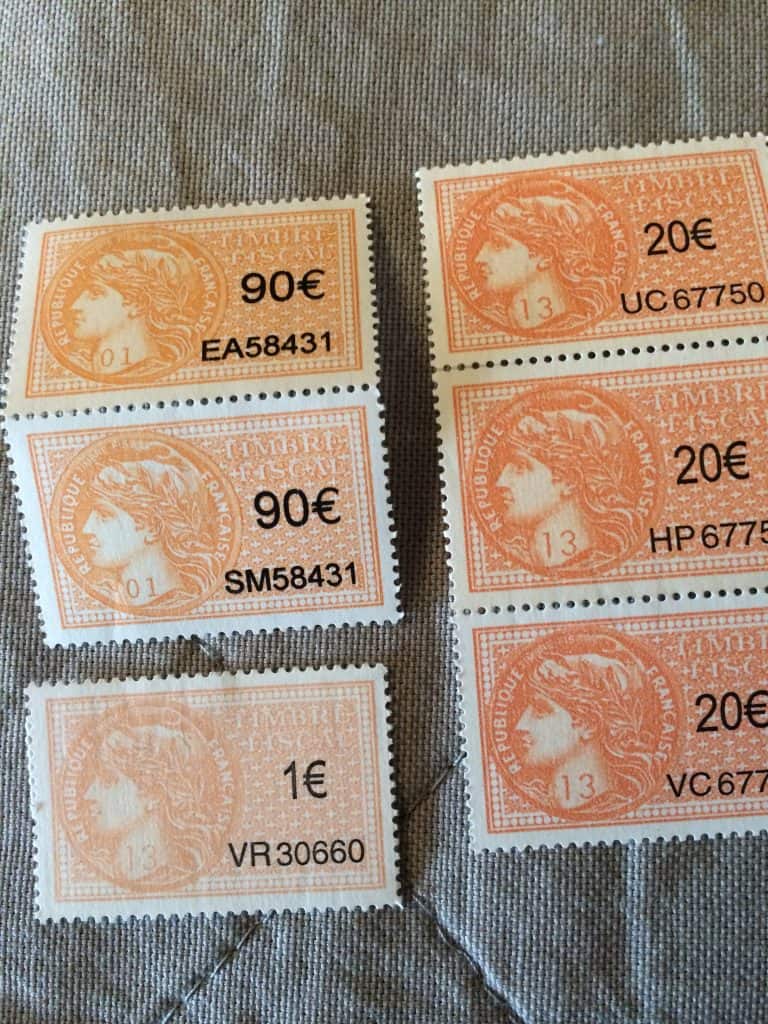
So what followed was another four weeks or so before I got a text message saying that my card was ready to be picked up in early July. It would cost 25€, to be paid by fiscal stamp (also, now available online). But the problem was that I had to make an appointment the old-fashioned Hunger Games way: by waiting with a bunch of other people here when new appointments were released, and then hoping I snagged one before they disappeared within four minutes or the system crashed, whichever came first.

I spent weeks trying to get an appointment before I landed one in mid-September (this was, of course, influenced by the aoutiens in the administration, who I can’t blame for their preference, since I’m of the same persuasion), in which I was able to come in and get the card. 

Make sure to get the right kind of stamp! We were witness to someone who had bought a stamp for a French citizen to get an identity card, which is not the type of stamp you need as a foreigner getting an identity card. People looked on as he haplessly held his phone on high, trying to get a cell phone signal so he could buy the stamp online, a signal which is elusive inside the Police Prefecture on Ile de la Cite. Select “titre pour etrangers” in step 1 to avoid this dilemma.

So, that problem was solved, six months after the initial request. 

Why did this matter in the first place? Because part of your citizenship dossier requires a current CDS, and since I wanted to apply for citizenship in Paris, my new Paris address, in the 12th, needed to be on my CDS.

As this was going on, another struggle was happening concurrently, that of my business address change.

Business Address Change

As I explain to my Profession Liberale clients who ask, when you move from one residence to another inside France, the authorities consider that your business has “closed” and “moved” to a new location too. Since you’re a sole proprietor/trader, that makes a certain amount of sense.

But this means that you will be issued a new SIRET, because the old SIRET was tied to the now “closed” location, which has implications for your invoices and tax returns.

But that’s okay. I’d actually changed my business address twice before, when I moved from the 2nd to the 19th, and when I moved from the 19th to Moret-sur-Loing, where I lived until March 2023. There was a fairly straightforward paper form known as a P2. You submitted it, the wheels of bureaucracy turned, and about a month later you would receive an all-important Certificat d’Inscription, with your new SIRET. You can take a look at it here, if you’d like, but it’s no use filling it out as it’s a now-defunct form.

A current Certificat d’Inscription is necessary for your citizenship application if you hold a PL visa, as I do.

The problem was that the dematerialization scheme which had created the new website I alluded to above had created one for small businesses as well. Welcome to INPI Connect.

The website is not intuitive, but with some trial and error I found the section that related to changing my business address. It took me about twenty minutes to figure out the forms, and then I attempted to submit my form but the website kept refusing to accept what I thought was a legitimately “signed” document.

Enter the QES.

Qualified Electronic Signature (QES)

So in the past, the P2 form worked like most administrative changes. I filled it out, signed it, and mailed it in. The idea that someone else would want to change my business address for nefarious reasons was as ridiculous then as it is now.

But that didn’t stop the French from requiring a level of security on an electronic signature that, unless you work in law, you have probably never heard of. If you want to get nerdy, you can read more here.

As I kept trying to upload the address change document that I had hand-signed, the website kept rejecting it (I thought this was like Docusign, like most e-signature systems that I had grown accustomed to.). I dug a bit deeper and saw that they tried to offer some helpful advice, along the lines of, “if you don’t have access to a QES, simply use FranceConnect+, which allows you to do this easily.”

FranceConnect+

So, FranceConnect is an awesome system that allows you to use some other user name/password to a website of French bureaucracy to login. It cuts down on having to maintain multiple passwords and gives the French confidence that it’s the same person. 

For example, for my login to the Etrangers en France website, I consistently use FranceConnect and my login and password for the Department of Finance (taxes). 

FranceConnect+ is heralded as an even more secure, even safer version of FranceConnect. The only problem? To use it, a foreigner needs a CDS that has more than 5 years validity. Well there’s only one such card, the golden 10-year Carte de Resident. Despite having lived in France ten years at that point, I didn’t qualify for this service though I was reminded once again that I should have gotten my ten year card years ago.

Which meant that I had to find a private service that would give me QES access. Enter ZealID.

Now I should pause for a moment. These discoveries did not all happen in one day. As with any project in life, you run into a frustrating wall and then you can pick up your task again when you have time and emotional stamina to try to overcome that wall. So this period of trying to make an address change, finding out that each of the changes had to be certified by a system that the French government had deemed I couldn’t have access to, then having to find such a system on my own, then finding out the address change had to be done in a certain order, was not something that occurred over a period of days, but over weeks which stretched into months.

And remember, I had thought I was going to save all this time by applying in Paris. 🙂

Anyway, I have nothing but wonderful things to say about the ZealID folks. They only charge something like 40€ for five signatures (when I bought it it was 25€ for three signatures) and their software is intuitive and easy to use. There may have been a fist pump (or three) when the INPI Connect at long last recognized that I had uploaded a document with a valid QES and queued it for processing.

Now I ran into my second problem.

I had mistakenly thought that I could change my personal address and my business address in the same form. I was told, in typical pedantic French bureaucro-speak that I was obviously too much of an idiot to realize that I needed first to change my personal address with one form, then submit a second form closing my old location and opening my new one, related to my new personal address.

How I could have found that out when no instructions existed on the site didn’t matter. And what mattered was that I had an answer, so I could move forward.

I had to wait some weeks for that first form to be processed before submitting the second form. Which also took some time to be processed.

Here’s where the digitalization came back into my my favor. They no longer mail a Certificat d’Inscription to you. You simply need to go to this site, enter your new SIRET and download the document that is generated. It’s not a Certificat d’Inscription but it is accepted as an equivalent. It is an “Extrait des inscription.” This is analogous to US state websites where you can print out certain forms that are equivalent to articles of incorporation, which you may need to open a bank account. 

About ten days after that final form was submitted, my new SIRET was active and I printed my form. It was the 19th of December. I had started the address change process for both my personal and business addresses in March of that year.

Now I was ready to apply for citizenship, humbly reminded that even ten years of experience doesn’t prevent papers from getting caught in the gears of bureaucracy. But the citizenship application process is a story for an upcoming article.

The photo is of the stamps that I first bought when I moved to France in 2013. They, like the Paris metro tickets, are history now.

An Expat Discussion of CSS vs Mutuelle

A note from the authors: In these articles, we (Molli — MS and Gracie — GB) have a conversation about a topic that’s familiar to both of us. In addition to providing information, our aim is to explore it from two different angles and give you a more in-depth view of the complexities of French life and the expat experience.  To get the most benefit, make sure you read our previous articles explaining CSS and mutuelles.

GB: Since moving to France, I’ve been both impressed and mystified by the French healthcare system. For a long time, I assumed everyone’s carte vitale was a magical debit card that paid all their medical expenses. Eventually, I learned that this isn’t the case and that many French people also have a mutuelle which acts as additional health insurance. My American perspective is to assume health care plans are linked to employers, so I figured a mutuelle had to come from a full-time job at a French company, and since I arrived in France on a specifically non-working visa, none of these options felt accessible to me. What were your first impressions of the French healthcare system, Molli? Did you have someone to help you avoid my misconceptions?

MS: I had a similar perspective as you! I think that in the U.S. there’s this big narrative around the fact that yes, health care is free in most other countries, but that it means low-quality care, long wait times, and old-fashioned hospitals and healthcare centers. I was also shocked to find out that the “free” health care so bragged about here isn’t actually free.

The first time I had to go to the doctor or hospital was when I was still an au pair. I cut my thumb on some broken glass and when the cut got infected my host dad took me to the hospital. I was pleasantly surprised at the normal wait times, friendly doctor, and standard hospital equipment that I was used to seeing in the US Yet another stereotype bit the dust that day. 

That said, one stereotype did come true that day, and it was the fact that health care here is extremely affordable albeit not free. You definitely don’t have to worry about going bankrupt if you end up in the emergency room and you don’t have a carte vitale, which I didn’t at the time. I was on some special au pair insurance that my host family had set me up with. If you’re wondering what a carte vitale is, think of it as a healthcare card similar to the insurance cards in the US. You use it at the doctor’s office, pharmacy when you pick up prescription drugs, and at the hospital. It also has your French social security number on it, as well as your name and picture.

I actually didn’t get my first carte vitale until I opened my auto-entreprise three years after I had been living in France. Interestingly enough, I should have been given one automatically when I began the intensive French language program I began after I decided to stop nannying, as all students are part of France’s social security system (which includes the carte vitale). But, in true French bureaucratic fashion, halfway into the school year I still wasn’t issued one. Luckily, I decided to start my auto-entreprise while I was still a student. 

I also had never heard of the concept of a mutuelle, and naively thought that I could go to any sort of doctor or specialist for free. I have since learned that if you have to go to the dentist, eye doctor, or physical therapist and you don’t have this extra coverage, things can get really expensive. Gracie, do you have extra coverage now that you understand the system better? And, speaking of which, when and how did you start to wrap your head around how everything works?

GB: Yes, I have extra coverage through complementaire sante sociale (CSS) in addition to a carte vitale. Having both of those together means the French government pays for most of my healthcare which makes me feel amazing and lucky. That said, it did take about a year and a half of filing paperwork and waiting to get the whole thing in place. And to qualify for a CSS, you have to be making very little money so I’m not sure if it will be a permanent solution, especially since you have to reapply each year. As with all French bureaucracy, they don’t make it easy. 

I started to wrap my head around how everything works after being in France for about two years.  I’d always assumed that I had to be a French citizen or have a more permanent visa (at the time all I had was a long-term visitor visa), but that wasn’t correct. France is actually fairly lenient about including immigrants in its healthcare system, and all you have to do is prove that you’re living in France in a “stable and regular manner.” This means you do not have to be born in France, married in France, or even working in France to register. It does mean you do have to have spent at least three months in the country and have a valid titre de séjour

This was one of those classic –– why didn’t anyone tell me this –– revelations. From there, I learned more from the assurance maladie office which told me I could apply for a permanent number and a carte vitale after I was PACSed and had a VPF visa. My primary care physician was also extremely helpful and advised me to apply for the CSS in the first place.

What about you — were there any specific moments or people who illuminated this process for you? And once you were in the French system, what made you decide to get additional coverage?

MS: It seems like I’ve had to just figure out everything as I go ever since I arrived in France. In all seriousness, when I was an au pair, my host family was very helpful, but almost too helpful because my host parents took care of almost everything for me, including a lot of paperwork. Once I became a student and was no longer living under their wing, a lot of things came as a shock and there was a massive learning curve!

I was really hesitant to get a mutuelle because up until very recently I had the mentality of “I’m healthy, I’m young, I’ll never have to go to the hospital, and I don’t want to spend the money on something I’ll never use.” And, until I was 26 and still under my parent’s insurance back in the States, I saved my yearly dentist and eye doctor appointments for when I went home to visit. 

My French mother-in-law actually pushed me to finally get a mutuelle. Since I’m turning 30 this year, it was about time, and ultimately I’m happy I took the plunge into the world of paying for my own healthcare. I pay around 30 € per month, and most of my prescription drugs are covered as well as the dentist and the ophthalmologist (I wear glasses and contacts). I have to admit, there’s something so sweet about going to the pharmacy and picking up medicine for free!

My last question for you about the CSS is, do you have the same coverage as someone like me who has a mutuelle? Or, are there things that I have access to and you don’t? 

GB: I’m pretty sure my CSS has the same coverage as a mutuelle, if not more. Although I haven’t taken it to every possible doctor, the documentation says it reimburses most glasses, prosthetics, and hearing aids, as well as all visits to the doctor, dentist, and hospital. I wear insoles and have been meaning to see my podiatrist about those, and I’m assuming that’s covered as well. I also have lofty ambitions to work with a kinesiologist and would love it if that was reimbursed since I know it’s only partially covered by the normal medical system. 

My admittedly American approach is to show up to any doctor, assume it will cost hundreds of euros, and be pleasantly surprised that it’s significantly cheaper than in the US. That said, the medical system here is much more transparent about costs –– all doctors post their fees on their website and in their offices, and they will explicitly tell you how much a procedure is and if you’ll be covered when discussing it with you. My dentist wanted to x-ray my teeth and told me it would only be partially reimbursed –– the x-rays cost 50 € and I’d get back 60%. The total cost was laughably small, especially since I used to pay $300 to have my teeth cleaned. That said, I’m grateful she had the conversation with me and wish the American medical system had the same transparency.

We hope this has been a helpful discussion of our experience with the French medical system. Feel free to comment with any questions or health insurance adventures of your own.

Photo by Marcelo Leal on Unsplash

Did you enjoy this article? TAIP is 100% reader-supported through tipping. If you want to leave us a tip of any amount it would be highly appreciated. These tips help support our efforts to keep TAIP an ad-free environment. Just as at a cafe, the tips are split evenly among the team.

How to Get a Mutuelle in France

When I first decided to start my life in France after years of being an au pair and a student, I started to hear talk of something called a mutuelle. I had already been enjoying the benefits of seriously discounted health care for years at this point, and I often relished the fact that my monthly prescriptions were only a few euros instead of upwards of $40 per month back in the states.

You may be thinking, “Huh? But I thought going to the doctor was free in France and so was all medicine.” Health care is much, much less expensive here than in the United States, but as they say, nothing in life is free. 

Why You Should Get a Mutuelle in France

If you’re a permanent resident of France, you’re eligible to receive government-provided health insurance within the first three months of being here. It works like a co-payment system, and much of your medical costs are reimbursed up front by the standard, public health insurance. For example, if you go to the doctor and you’re uninsured, you’ll pay around 25 € (still a steal, if you ask me). If you sign up for public health insurance, you’ll pay around seven euros. If you get a mutuelle (some call it “top-up” coverage in English) in France, you’ll pay nothing.

Having that extra coverage ensures that you don’t pay anything at the doctor’s office and most prescriptions are covered too. If you have to stay overnight at the hospital, depending on the plan that you choose, you won’t have to pay for that either. 

If you wear glasses or contacts or enjoy having clean teeth, you’ll want to sign up for one as well. I wear both glasses and contacts (and like keeping my pearly whites, well, white) and so my mutuelle is a lifesaver. I went from paying hundreds of dollars every year for my eyes to paying nothing.

I haven’t even begun to mention all of the other perks you could be enjoying if you sign up for your own mutuelle. Specialists such as dermatologists, chiropractors, and osteopaths are also covered (again, depending on your plan). Furthermore, you can sign up no matter your medical history and without fear that a preexisting condition will make the monthly free skyrocket. Oh, and if you’re pregnant or plan to be, a mutuelle is also really helpful.

Shout out to my French mother-in-law for pushing me to finally sign up. I think for me, seven euros to go to the doctor just seemed so sweet that I couldn’t imagine paying even less. My American mentality prevented me from signing up for a mutuelle for several years when in reality I could have started benefitting from one all the way back in 2012.

How to Know Which Plan to Choose

Not all mutuelles are created equal, but neither are everyone’s health care needs.  Stephen, for example, almost never goes to the doctor, so a mutuelle for him would be a waste of money. Furthermore, if you don’t have terrible eyesight as I do, you don’t need a plan that will help you save on glasses and contacts. 

When you begin shopping around for a plan, you’ll notice that coverage is determined in percentages. I recommend opting for coverage that is over 100%. Start with at least 150%. And if you have problems with your teeth or need to visit the eye doctor, consider going up to 175-200% coverage. I know that asking for over 100% coverage may sound a bit much, but some doctors charge more than the standard fee set out by the government. You’re going to want that extra coverage just in case you find yourself at a specialist (like the dentist, ophthalmologist, or chiropractor) that naturally charges more than your primary care physician. 

You’ll be charged a monthly fee in order to benefit from your mutuelle. The cost is nominal, especially when compared to the ever-climbing costs of private health insurance in the US. For example, my mutuelle is one step above the “basic” plan, and I pay around 30 € per month. There are several different providers to choose from:

Once you sign up, you’ll receive your mutuelle card. It’s not a plasticized card like your carte vitale (the card you use to benefit from the standard public health care), but rather a small piece of paper you’ll have to be careful not to lose.

My advice? Take your time when comparing plans, ask your French friends for advice, and don’t get too hung up on finding “expat” specific plans. If you are a resident of France, you have all of the rights of a French person. These so-called expat-specific plans tend to be much more expensive for no real reason that I can see. And, if you don’t earn a lot of money, you could be eligible for a state-run mutuelle program called the CSS, so, if you can, don’t forget to look into that option, either.

There are plenty of mutuelle comparison sites that can help you decide as well. This one by Le Comparateur Assurance (The Insurance Comparer — a great resource for comparing any type of insurance in France) is my favorite. However, I will say this again, your French friends will be your best asset here. They’ve had this type of insurance their whole lives and are the best place to start for some advice!

Photo by National Cancer Institute on Unsplash

Molli offers private consultation services which range from help with visas and adjusting to life abroad to Paris travel itineraries. Fill out the contact form to learn more.

Did you enjoy this article?  TAIP is 100% reader-supported through tipping.  If you want to leave us a tip of any amount it would be highly appreciated.  These tips help support our efforts to keep TAIP an ad-free environment.  Just as at a cafe, the tips are split evenly among the team.

How to Get a Complémentaire Santé Solidaire (CSS)

After I successfully enrolled in France’s health insurance system and got my temporary social security number or numéro provisoire, I went to see many doctors. At the beginning of the appointment, they would look at my certificate of registration and ask if I had a complementaire. I’d say no, because I didn’t, and I also had no idea what that term meant.

Then they’d ask if I had a mutuelle, and I would say no again. I knew that was additional health insurance offered by French businesses, but I didn’t have a French job. I didn’t even have a working visa. I was already thrilled to be enrolled in government health care, wasn’t that enough?

But they were asking because it wasn’t. Assurance maladie works in tiers of reimbursement, and only fully reimburses its users for a select few medical visits. For other expenses, they might cover a small percentage of the cost, which is why most French people have a mutuelle as well. After six months of being disappointed by the meager refunds trickling into my bank account, my general practitioner kindly explained all this to me. She also told me I could get a mutuelle without being employed by a French company, but advised that I apply for a complémentaire santé solidaire or CSS. And so my health insurance journey continued.

What Is a Complémentaire Santé Solidaire?

A complémentaire santé solidaire or CSS is an additional insurance that covers your medical costs at the doctor, dentist, and hospital. It also covers most glasses, prosthetics, and hearing aids.

Who Qualifies?

In order to qualify for a CSS, you must have already enrolled in the health care system and be a regular resident of France. In my reading, this means you must have a long-term visa as well as other documents tying you to a fixed address here.
Note: Even if you have a temporary social security number, numéro provisoire, you can still apply for a CSS.

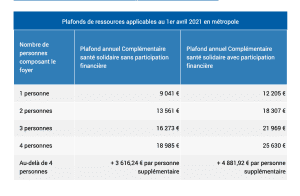
Beyond residency, you qualify based on your income or resources, which include salary, government aid and donations, commercial sales of objects, and gambling gains. Depending on your annual total, you can either qualify for full government aid or you’ll pay less than 1 € per person per day. I was given full aid so I’m not sure what the annual payment would be. It seems safe to assume it’d be under 365 € annually or 30 € monthly, which is equivalent to the cheapest monthly mutuelle.

As you can see below, your income must be quite small in order to qualify:

How Do You Apply?

To apply you fill out a form with your personal and financial information, as well as information about the rest of your household and any dependents. Since Fred and I are PACSed, he’s considered part of my foyer, and his income was included in the calculations.

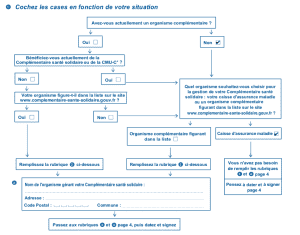
As I mentioned in the list of requirements, you’re also asked to declare any additional government aid you’re receiving such as unemployment or pension. After quite a few boxes pertaining to income sources, there is a deeply puzzling flowchart.

In a very convoluted way, all it’s asking is if you want to have your CSS directly with assurance maladie or through a mutuelle company.

Note: You also need to include your titre de séjour with the application, as this is proof that you’re a current French resident.

How Long Does It Take?

Great question. The assurance maladie website says the application will be processed in two months, which I rounded up to three.

How Long Is It Valid For?

Since the complémentaire is contingent on your income and “need” you must renew your request each year by sending proof of income, as well as your tax documents.

What Happens Next?

  • The short answer: Go to the doctor and get reimbursed.
  • The long answer: Now I can go back to the dentist and not have to worry about how much she’s charging to take X-rays of my teeth. Actually, doctors in France are always upfront about costs, and they must be listed on the doctor’s website so you usually know exactly how much you’re paying before you walk in. In the case of my dentist, she explained that assurance maladie would only cover eighty percent of the cost of the 50 € x-rays, and wanted to make sure I was okay with that. The bill was laughably small compared to my dentist back in New York where I paid $300 for a cleaning.

Photo was taken in the tastefully appointed waiting room of my knee doctor.

Did you enjoy this article?  TAIP is 100% reader-supported through tipping.  If you want to leave us a tip of any amount it would be highly appreciated.  These tips help support our efforts to keep TAIP an ad-free environment.  Just as at a cafe, the tips are split evenly among the team.