Earful Tower Book Club Reboot

For those who don’t know about it, the Earful Tower podcast is one of the most popular, if not the most popular podcast about Paris in English. It has hundreds of audio and video episodes covering everything about life in Paris and France (just the sort of stuff we love).

For some years the host, Oliver Gee, had also run a book club side-by-side with the pod. But it’s been on hold for a number of years while he had a couple of children and released three children’s books, which can keep anyone busy! 🙂

That’s where I come in. As someone who has hosted hundreds of book club meetings in Paris over the years (two of which I have handed off to successors, Great Books and Shakespeare) I wanted to see a book club dedicated to books about Paris and France thrive. I’ve had a chance to catch up with Oliver over the years (the children’s books have been great gifts for my nieces and nephews) and he’s given me the chance to reboot the club.

I’ve got a clear vision for the types of books I want us to read and where I’d like to take us so it’s an honor to be able to work with an audience that has already read dozens of books with Oliver in years past. While this won’t be a book club hosted in Paris cafes and coworking spaces, as my previous book clubs were, the fact that it will be on Zoom means that anyone in the world can join (if they are time-zone compatible).

Our first meeting is on Paris Lost and Found by Scott Dominic Carpenter and the author will join us for the second half of the discussion. There’s still (not much!) time to get the book, read it, and join us for the discussion on October 23rd at 8pm US Eastern time. You can sign up here.

To see future book selections and sign up for the discussions, you’ll need to join the (free) Facebook group, though recordings of all these discussions will be available free to Earful Patreon members.


Book Club: My Life in France, by Julia Child

Julia Child is best and rightly known as the woman who brought French cooking to America in an accessible and sensible way. You may know her through her recipes and her famous TV show, but this book, My Life in France, is all about the woman herself her life in Paris and Marseille, and other places throughout Europe as WWII ended and the Cold War began. You would hardly guess that she worked for the OSS, which was the forerunner of today’s CIA but in a way that’s believable as she really did “infiltrate” into an American kitchen that was focused on frozen foods and items you could make out of a box or tin.

It was also fascinating to hear her describe the French and their ways it reads like it could have been written today, even though Julia is describing post-war France, almost 60 years ago!

Here’s a story she recounts about her sister Dort and struggles with French:

“Monsieur; voulez-vous couper mes chevaux avant ou après le champignon?” The hairdresser looked at her quizzically while the ladies under the hairdryers broke into laughter. What Dort had been trying to so earnestly ask was: “Sir would you like to cut my hair before or after the shampoo?” But it came out as: “Sir, would you like to cut my horses before or after the mushroom?”

She also reflects on the reason why she felt so at home in this country:

“I looked out the window. I had come to the conclusion that I must really be French, only no one had ever informed me of this fact. I loved the people, the food, the lay of the land, the civilized atmosphere, and the generous pace of life.”

On the French attitude towards “modernizing,” which I laughed out loud reading:

“The individualistic, artisanal quality of the French baffled the men Paul called the “Marshall Plan hustlers” from the USA. When American experts began making “helpful” suggestions about how the French could “increase productivity and profits,” the average Frenchman would shrug, as if to say: “These notions of yours are all very fascinating, no doubt, but we have a nice little business here just as it is. Everybody makes a decent living. Nobody has ulcers. I have time to work on my monograph about Balzac, and my foreman enjoys his espaliered pear trees. I think, as a matter of fact, we do not wish to make these changes you suggest.”

Indeed it is this contrarian view against the rush of globalization and frenetic intemperance combined with a balanced attitude of “enough” that attracts so many of us to France.

Of course, this is a book by Julia Child and you will find yourself, if you have even the slightest inclination towards cooking, jotting down recipes or tips she casually sprinkles throughout the book.

It’s a great read, with quite a few photos, many of which were taken by her loving and devoted husband Paul Child.

A version of this article originally appeared on my Goodreads page

Did you enjoy this article? TAIP is 100% reader-supported through tipping. If you want to leave us a tip of any amount it would be highly appreciated. These tips help support our efforts to keep TAIP an ad-free environment. Just as at a cafe, the tips are split evenly among the team.

homeless in Paris

Book Club: Down and Out in Paris and London, by George Orwell

George Orwell is perhaps best known for his seminal works 1984 and Animal Farm.  One of his lesser-known works that I’ve come to appreciate is Down and Out in Paris and London.  The book is an examination of working-class poverty in 1929 Paris and London.  It is true that George Orwell had a safety net.  Just as Thoreau lived on Emerson’s property for free and often went back into Concord to either dine or do laundry while he toiled away writing Walden, Orwell always had the ability to contact his middle-class family for help if he did get into real trouble.  Knowing that does, in a way, vitiate some of the desperation we read about.

That being said, the short chronicle, weighing in at just past 200 pages, is worth the read, if only to appreciate just how “first-world” our problems these days really are when so many of us have running water, indoor plumbing, and a bed to call our own.

For, when you are approaching poverty, you make one discovery which outweighs some of the others.  You discover boredom and mean complications and the beginnings of hunger, but you also discover the great redeeming feature of poverty: the fact that it annihilates the future. (from Chapter III)

Obviously, there is a stoic positivity to this who needs to worry about tomorrow?  Focus on the daily.  And yet, that annihilation of the future also implies a destruction of dreams and goals.

There’s a humorous moment in the book when I realized that immigration problems don’t just belong to our century.  Orwell recounts a visit to the pawnshop:

And then, after all our trouble, the receiver at the pawnshop again refused the overcoats.  He told me (one could see his French soul revelling in the pedantry of it) that I had not sufficient papers of identification; my carte d’identité was not enough, and I must show a passport or addressed envelopes.  Boris had addressed envelopes by the score, but his carte d’identité was out of order (he never renewed it, so as to avoid the tax), so we could not pawn the overcoats in his name. (from Chapter VII, emphasis mine)

There’s also an unexpected insight into the life of waiters and service staff in Parisian hotels and restaurants, where Orwell has to turn for work as his money dwindles away to nothing.  One would hope that hygiene and other practices recounted in the book have improved…but perhaps they are simply toned down rather than gone.

A good 65% of the book is dedicated to Paris the rest to London.  Perhaps the biggest surprise was how prepared the English were to accommodate the homeless through a series of government shelters.  They were dreadful, but still offered room and board for a night.

In one of the final chapters Orwell reflects that: “The evil of poverty is not so much that it makes a man suffer as that it rots him physically and spiritually.”  If the book inspires you to do anything, it may be to help people out of poverty, and the first world does have real and practical tools to do that, starting with sites like Kiva, which allows you to loan as little as $25 to people looking to improve their lives around the world through various endeavors and projects.

But perhaps the lasting lesson for me is that today, as in Orwell’s time, it is possible to live meanly, or even well, for not a lot of money.  Reading about the darkness Orwell experienced makes you appreciate the City of Light that much more.

Photo by Lizgrin F on Unsplash

Did you enjoy this article? TAIP is 100% reader-supported through tipping. If you want to leave us a tip of any amount it would be highly appreciated. These tips help support our efforts to keep TAIP an ad-free environment. Just as at a cafe, the tips are split evenly among the team.

Book Club: A Moveable Feast, by Ernest Hemingway

After the November attacks of last year many French begin reading this book as an act of defiance.  It was left among some of the tributes at République and other places.  More than one French friend told me that it was a chance to look at Paris through a foreigner’s eyes, and its sudden resurgence made it okay to read something that is often seen as too “cliché” for the French to read.

For those of us who write in Paris, it’s impossible to avoid Hemingway’s shadow.  Whether we are browsing the stacks at Shakespeare and Company, or walking near the Place Contrescarpe, or even when writing in a café, we might imagine Hemingway himself toiling away in a corner over a notebook near empty glasses of rum.  He’s writing, and he glances up to see a girl sitting by herself waiting for someone.  She has a face “fresh as a newly minted coin if they minted coins in smooth flesh with rain-freshened skin, and her hair black as a crow’s wing and cut sharply and diagonally across her cheek.”  If the description of her strikes you, you can imagine the effect she had on Hemingway as he tried to refocus and concentrate on the story at hand.

“I’ve seen you, beauty, and you belong to me now, whoever you are waiting for and if I never see you again, I thought.  You belong to me and all Paris belongs to me and I belong to this notebook and this pencil.”

And what was that writing process like?  “So finally I would write one true sentence, and then go on from there” and “Write the best story that you can and write it as straight as you can.”

While Hemingway describes some measure of poverty during his time here, it’s nowhere near the harrowing account that George Orwell gives in Down and Out in Paris and London, a book I will cover in a future installment of this series.  Yet, almost 100 years later, I think this is still very true: “In Paris, then, you could live very well on almost nothing and by skipping meals occasionally and never buying any new clothes, you could save and have luxuries.

More than anything, A Moveable Feast is a snapshot of life in Paris, amidst writers and artists, between 1921 and 1926.  We see all the usual suspects Sylvia Beach, Gertrude Stein, Ford Madox Ford, Ezra Pound, James Joyce, F. Scott Fitzgerald (and Zelda), as well as so many landmarks that are still around like Le Deux Magots and Brasserie Lipp.  And of course, there is his wife, whom he manages to lose in the course of the writing, due to his own self-admitted infidelity.  She’s not an integral enough part of the work for you to really feel the loss, but she does provide bookends to the story and to his time there.

Read it because you’re an American or because you’re not but want to get the quintessential “American in Paris” viewpoint.  Or because you want to see just how little the city has changed in a century.

The featured image is of Hemingway in his Left Bank apartment in 1924.

Did you enjoy this article? TAIP is 100% reader-supported through tipping. If you want to leave us a tip of any amount it would be highly appreciated. These tips help support our efforts to keep TAIP an ad-free environment. Just as at a cafe, the tips are split evenly among the team.

moon

Book Club: Paris to the Moon, by Adam Gopnik

My favorite book written about Paris from the expat perspective is the series of essays written for The New Yorker by Adam Gopnik that was later compiled into a book called Paris to the Moon.  As the book’s magical title promises, it is a thoughtful and earnest look at a city Gopnik never intended to permanently live in, but experienced more deeply in six years than some people do in a lifetime. 

Gopnik has gifted me with some ways to express feelings and sentiments I have in my new country, from saying that we “breathe in our native language, but swim in our second,” to his chapter on “Distant Errors” in which he deconstructs, albeit kindly, the French tendency to look at problems or errors as distant as something external rather than related to their own thinking and behaving, to his explanation of “white helicopter” thinking among the French (in contrast to the American “black helicopter” idiom, which is a meme for conspiracy theories) that there is always the possibility that a future government will offer a higher pension and a lower retirement age.

Adam’s approach to life in France is certainly one I wish to emulate, though my French needs to improve in order to do so.  He is at home as the American he will always be, while truly attempting to live life as the French do, day in and day out, in dealing with strikes, protesting the takeover of a favorite restaurant, by enjoying holidays enthusiastically (I wonder sometimes if the French love the planning and anticipation more than the holiday itself), and even in the ceremony of childbirth, which both he and his wife participate in.

I’ll leave you with a quote from the book particularly germane to the subjects covered in this blog: “Everything about moving to Paris has been wonderful, and everything about emigrating to France, difficult.”

As it perhaps, should be.  This life should only be available to those who truly want it.

Photo by Rafael Garcin on Unsplash

Did you enjoy this article? TAIP is 100% reader-supported through tipping. If you want to leave us a tip of any amount it would be highly appreciated. These tips help support our efforts to keep TAIP an ad-free environment. Just as at a cafe, the tips are split evenly among the team.

jill jonnes

Book Club: Eiffel’s Tower, by Jill Jonnes

“But there’s no such thing as Paris without the Eiffel Tower,” said my friend Florence the other day.  Locals have complicated views about the tower of iron, but perhaps she is right.  But the beginning of pondering that question should
start with Jill Jonnes’ fascinating book, Eiffel’s Tower: The Thrilling Story Behind Paris’ Beloved Monument and the Extraordinary World’s Fair That Introduced It.

In this book you learn just how much it took for Eiffel to overcome in order to build this true architectural achievement of its time.  It stood as the world’s tallest building for 30 years, and took only 2.5 years to complete (perhaps one of the few French building projects ever completed on time).  In contrast the previous “tallest building” in the world was the Washington Monument in Washington D.C., which was half the height of the Eiffel Tower and took 40 years to complete.  Mind you, there was a little thing called the War Between the States during that 1848-1888 period of construction, but still, you can imagine many Americans, including Thomas Edison, felt a bit of envy to have the French claim a technological achievement before America did.

Edison was feted when he visited the Tower he was the great man of innovation and ideas and Eiffel toasted him with champagne at the summit of the Eiffel Tower.  But he emptily boasted that for the upcoming Chicago World’s Fair that they would build something twice as tall at half the price.  The French raised their eyebrows, understandably so when what ended up being invented for that event was not some tall tower, but the Ferris Wheel.

Jonnes writes a compelling narrative, bringing all the characters together in a cohesive story that is, oddly, suspenseful, especially given that we already know how events turned out.  I shared this book with some local Parisians and they told me it forever changed how they saw and understood the Tower, which is just the sort of antidote you need, especially when you’re walking past the Selfie Nation on the Champs de Mars.

But perhaps you will be most edified to learn how well Eiffel bore up under the most vile and vicious attacks, before, during, and well after the construction of the Tower.  It is his entrepreneurial genius something the French could allow to flourish a bit more these days that is the true story behind this great little book.

Photo by Mika Baumeister on Unsplash

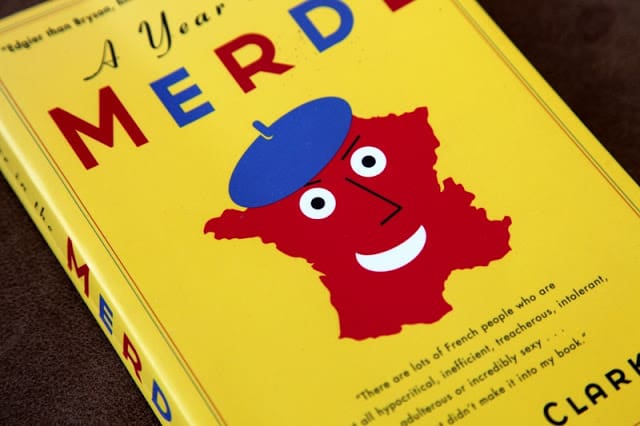
Book Club: A Year in the Merde, by Stephen Clarke

I read a lot of books about Paris and France before moving here and I’ve only recently realized I might do well to share them with you.  So, I’ll start with an old favorite.

It was the second week I was in Paris.  I had just gone to an Asterix exposition at the ugly BNF (Bibliotheque Francois Mitterand), with my friend Julien, who I had met in Adelaide, Australia, a year earlier (a story for another time).

“Stefan,” (this is how the French pronounce my name), “Stefan, do you know zis booke, ah, a year in dee Merde?”  I nodded that I had vaguely heard of it, but not much more.

He started laughing.  “Oh, you must read it!  It is soooo funny!  And it’s true!”  Julien is a great guy a real Anglophile to boot though he insists that when we go on ski trips I only speak French so I gave his recommendation its due importance and in time purchased and read the book.

It was, as he had warned me, absolutely hilarious.  One time I almost choked on my tongue while reading in the metro because I was laughing so hard.  Another time, while I was buying groceries at Franprix, I noticed that the checkout guy started to giggle quietly because he saw the book under my arm.  “C’est vrai?” I asked him, left eyebrow raised.  “Oui tout!” he responded.

So, Stephen Clarke, the author, invented this fictional Paul West character who comes to Paris for a job and gets caught in the life of apartments, work, and love.  It’s told from an Anglo perspective, and it’s particularly funny if you’ve lived in Paris for any period of time because the jokes hit on the realities of everyday life.  Some memorable lines from the book include:

Jean-Marie did the hugest shrug I’d ever seen, even outdoing the man in the electric shop.  His shoulders, arms, his whole rib cage, took off vertically in a gesture of infinite indifference.

and this

The Paris police are the best in the world at one thing sitting in buses.”

and this

Red lights are like queues,” he said scornfully, “They are for people who have time to waste.”

It’s not a perfect book, by any means, but it’s very revealing in its takedown of the French.

Clarke was a bit taken aback, I’m sure, by his success, and has gone on to write at least two other books on this theme, which I have, unfortunately, also read.  I say unfortunately because these books go beyond the playful fictional satirical conceit of the first book and just linger in stereotype that is, over time, increasingly unfunny.

Yes, it was funny that first time but if you want to keep going you’re going to have to go deeper.  In comedy, the analogue would be the first Austin Powers movie the first one was funny in so many ways the others were horrible.  Same with the sleeper Liam Neeson hit film Taken.  I love that movie.  Which is probably precisely why I hate the sequels so.

Perhaps we as moderns don’t understand that success can be solitary (witness Harper Lee being huckstered into releasing an inferior and revisionist novel in her dotage).  Success doesn’t mean having to repackage your great idea as something only slightly different.  Indeed, success is sometimes leaving well enough alone.

So, read this first one.  Skip the rest of Clarke’s catalogue.

Did you enjoy this article? TAIP is 100% reader-supported through tipping. If you want to leave us a tip of any amount it would be highly appreciated. These tips help support our efforts to keep TAIP an ad-free environment. Just as at a cafe, the tips are split evenly among the team.