I’ve been following forums and Facebook groups more closely in the last few years, knowing I was going to be applying for citizenship soon. There are some areas of the country that have notorious reputations for that process. Montpellier, for example, has been known to have a five-year average waiting period from depositing your dossier to your interview. For some years Paris had a 18-24 month reputation, which all things considered, wasn’t too bad, and since I had spent the majority of my French life in Paris, I had set that expectation in my head for years.
But that changed with Covid and the dematerialization of the citizenship process.
Now, with the possibility of submitting everything online (you used to have to make an appointment and deliver everything in a folder in person, and if there was anything not satisfactory you were sent back to get it and had to make a new appointment), Paris was, by all reports, consistently tracking at 6-8 months, whereas the Department where I was living, Seine et Marne (77) was tracking at 18 months. Save a year by moving back to Paris? No brainer.
Except I didn’t end up saving that year, for what should have been the simplest of changes, but ended up being a nightmare instead.
For context, I’ve been dealing with the French authorities for more than a decade now, and have become so comfortable that I charge money for consultations and have written a book about how to move to France. But France always finds a way to humble those who think they have it all figured out.
Turns out, the nine-month delay (cutting into the 12-month savings I thought I was going to get by making the change to Paris) I ended up experiencing in turning in my citizenship dossier was held up by a dual address change, one for me, one for my business. Let’s start with the simpler one first.
Personal Address Change
Now I’m not talking about the regular “civilian” logistics of changing your address which include notifying your bank, etc. That’s covered in this article. This about an administrative address change, which is different from a simple postal address change.
So what’s the good news? There’s a dreamy new website that, while not perfect, makes the whole process of living in France as a foreigner so much easier. The Etrangers en France website allows you to:
- Apply to renew your visa
- Apply for French citizenship
- Ask for a work permit
- Apply for a new card because
- You lost your old one
- You changed your address
- You’ve gotten married (or divorced)
- You need a travel document (this is for people with special statuses, like refugees (TVE) or minor foreigners (DCEM)
So I put in for the address change and it took under five minutes to submit the form. My experience with the French told me it should take 2-3 weeks for them to process this.
Wrong.
I submitted in March 2023, hoping to pick up my card in May. Instead, in late April, six weeks after my initial submission, I messaged them, asking (with typical French politesse) if perhaps this had gotten stuck in the system somewhere. Within 48 hours, I was told that the change would be made. Just like I had done many years ago when I stuck a post-it note to a letter to the Carte Vitale folks, a simple short follow-up nudged my request out of the gears of bureaucracy into which it had fallen.
Sometimes it’s that easy.
So what followed was another four weeks or so before I got a text message saying that my card was ready to be picked up in early July. It would cost 25€, to be paid by fiscal stamp (also, now available online). But the problem was that I had to make an appointment the old-fashioned Hunger Games way: by waiting with a bunch of other people here when new appointments were released, and then hoping I snagged one before they disappeared within four minutes or the system crashed, whichever came first.
I spent weeks trying to get an appointment before I landed one in mid-September (this was, of course, influenced by the aoutiens in the administration, who I can’t blame for their preference, since I’m of the same persuasion), in which I was able to come in and get the card.
Make sure to get the right kind of stamp! We were witness to someone who had bought a stamp for a French citizen to get an identity card, which is not the type of stamp you need as a foreigner getting an identity card. People looked on as he haplessly held his phone on high, trying to get a cell phone signal so he could buy the stamp online, a signal which is elusive inside the Police Prefecture on Ile de la Cite. Select “titre pour etrangers” in step 1 to avoid this dilemma.
So, that problem was solved, six months after the initial request.
Why did this matter in the first place? Because part of your citizenship dossier requires a current CDS, and since I wanted to apply for citizenship in Paris, my new Paris address, in the 12th, needed to be on my CDS.
As this was going on, another struggle was happening concurrently, that of my business address change.
Business Address Change
As I explain to my Profession Liberale clients who ask, when you move from one residence to another inside France, the authorities consider that your business has “closed” and “moved” to a new location too. Since you’re a sole proprietor/trader, that makes a certain amount of sense.
But this means that you will be issued a new SIRET, because the old SIRET was tied to the now “closed” location, which has implications for your invoices and tax returns.
But that’s okay. I’d actually changed my business address twice before, when I moved from the 2nd to the 19th, and when I moved from the 19th to Moret-sur-Loing, where I lived until March 2023. There was a fairly straightforward paper form known as a P2. You submitted it, the wheels of bureaucracy turned, and about a month later you would receive an all-important Certificat d’Inscription, with your new SIRET. You can take a look at it here, if you’d like, but it’s no use filling it out as it’s a now-defunct form.
A current Certificat d’Inscription is necessary for your citizenship application if you hold a PL visa, as I do.
The problem was that the dematerialization scheme which had created the new website I alluded to above had created one for small businesses as well. Welcome to INPI Connect.
The website is not intuitive, but with some trial and error I found the section that related to changing my business address. It took me about twenty minutes to figure out the forms, and then I attempted to submit my form but the website kept refusing to accept what I thought was a legitimately “signed” document.
Enter the QES.
Qualified Electronic Signature (QES)
So in the past, the P2 form worked like most administrative changes. I filled it out, signed it, and mailed it in. The idea that someone else would want to change my business address for nefarious reasons was as ridiculous then as it is now.
But that didn’t stop the French from requiring a level of security on an electronic signature that, unless you work in law, you have probably never heard of. If you want to get nerdy, you can read more here.
As I kept trying to upload the address change document that I had hand-signed, the website kept rejecting it (I thought this was like Docusign, like most e-signature systems that I had grown accustomed to.). I dug a bit deeper and saw that they tried to offer some helpful advice, along the lines of, “if you don’t have access to a QES, simply use FranceConnect+, which allows you to do this easily.”
FranceConnect+
So, FranceConnect is an awesome system that allows you to use some other user name/password to a website of French bureaucracy to login. It cuts down on having to maintain multiple passwords and gives the French confidence that it’s the same person.
For example, for my login to the Etrangers en France website, I consistently use FranceConnect and my login and password for the Department of Finance (taxes).
FranceConnect+ is heralded as an even more secure, even safer version of FranceConnect. The only problem? To use it, a foreigner needs a CDS that has more than 5 years validity. Well there’s only one such card, the golden 10-year Carte de Resident. Despite having lived in France ten years at that point, I didn’t qualify for this service though I was reminded once again that I should have gotten my ten year card years ago.
Which meant that I had to find a private service that would give me QES access. Enter ZealID.
Now I should pause for a moment. These discoveries did not all happen in one day. As with any project in life, you run into a frustrating wall and then you can pick up your task again when you have time and emotional stamina to try to overcome that wall. So this period of trying to make an address change, finding out that each of the changes had to be certified by a system that the French government had deemed I couldn’t have access to, then having to find such a system on my own, then finding out the address change had to be done in a certain order, was not something that occurred over a period of days, but over weeks which stretched into months.
And remember, I had thought I was going to save all this time by applying in Paris. 🙂
Anyway, I have nothing but wonderful things to say about the ZealID folks. They only charge something like 40€ for five signatures (when I bought it it was 25€ for three signatures) and their software is intuitive and easy to use. There may have been a fist pump (or three) when the INPI Connect at long last recognized that I had uploaded a document with a valid QES and queued it for processing.
Now I ran into my second problem.
I had mistakenly thought that I could change my personal address and my business address in the same form. I was told, in typical pedantic French bureaucro-speak that I was obviously too much of an idiot to realize that I needed first to change my personal address with one form, then submit a second form closing my old location and opening my new one, related to my new personal address.
How I could have found that out when no instructions existed on the site didn’t matter. And what mattered was that I had an answer, so I could move forward.
I had to wait some weeks for that first form to be processed before submitting the second form. Which also took some time to be processed.
Here’s where the digitalization came back into my my favor. They no longer mail a Certificat d’Inscription to you. You simply need to go to this site, enter your new SIRET and download the document that is generated. It’s not a Certificat d’Inscription but it is accepted as an equivalent. It is an “Extrait des inscription.” This is analogous to US state websites where you can print out certain forms that are equivalent to articles of incorporation, which you may need to open a bank account.
About ten days after that final form was submitted, my new SIRET was active and I printed my form. It was the 19th of December. I had started the address change process for both my personal and business addresses in March of that year.
Now I was ready to apply for citizenship, humbly reminded that even ten years of experience doesn’t prevent papers from getting caught in the gears of bureaucracy. But the citizenship application process is a story for an upcoming article.
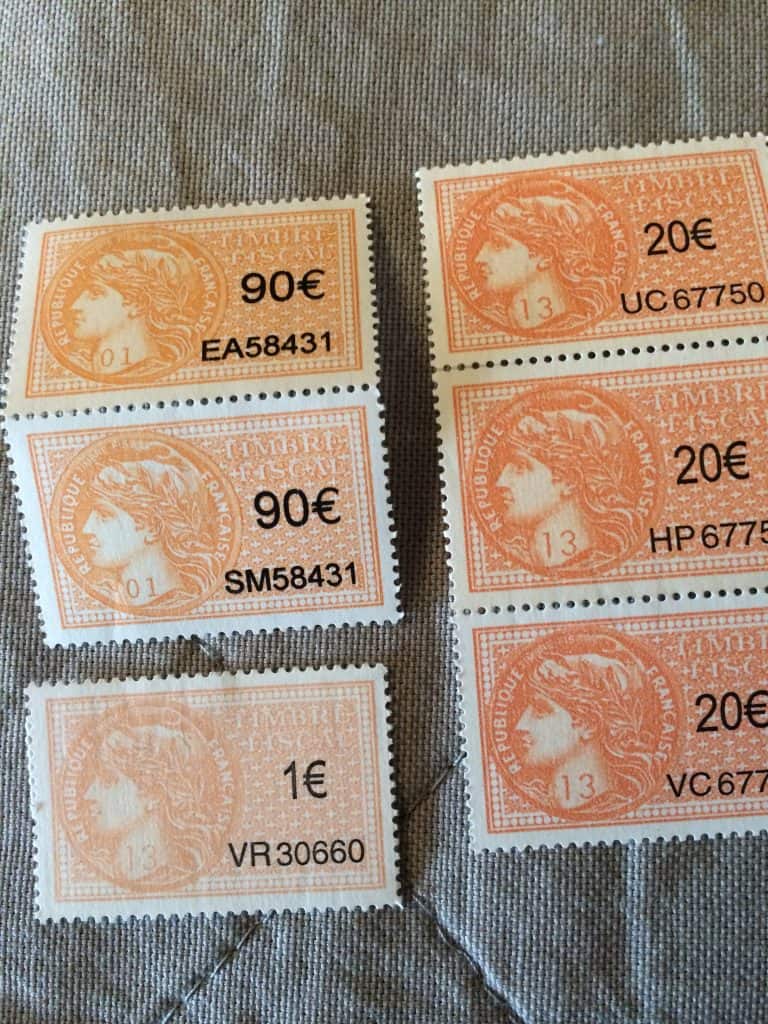
The photo is of the stamps that I first bought when I moved to France in 2013. They, like the Paris metro tickets, are history now.