OFII Visit for Long Stay Visitor Visa (2022 Update)

Note from the editor: In light of new guidance on remote working in France as shared by the official French tax office in June 2025, we have also officially changed our stance on remote working for a US company while living in France under the visitor visa. Read more here, and contact us with any questions or concerns. We’re here to help! — MS

So you have made it through the France-Visas & VFS Global maze, obtained your long-stay visiteur visa (in the form of a sticker pasted into your passport), and moved yourself to France. Congrats! But we are not quite finished with the intake process just yet, there remain a few steps to be completed in France to make ourselves official residents. Thankfully they are not at all difficult.

Stephen already wrote about his experiences and the two basic assignments remain the same now as when he went through them almost a decade ago we need to register our visa with OFII, and we need to complete a medical exam. The biggest change since Stephen’s time is that the registration portion is now done entirely online, and if that wasn’t great enough news, the process also involves fewer steps and requirements. It is completely painless (except for the 200 € fee) and can be completed in a few minutes.

The medical portion is also very straightforward, the only thing that requires forethought is that you will be asked to provide your vaccination records. Those will obviously be much easier to obtain when you are still in America so add that to your list of things to do before you leave.

OFII Registration

Registration with OFII (l’Office Français de l’Immigration et de l’Intégration) must be done within the first three months of your arrival in France. Since the process only takes a few minutes there’s no reason to put it off.

To start go to: https://administration-etrangers-en-france.interieur.gouv.fr/

If you prefer there is an option to set the website language to English though it might still leave you with some French phrases just to keep you on your toes! Several options are presented, we want of course: Je valide mon VLS-TS (Validate your VLS-TS long-stay visa).

You will be asked to enter various pieces of information that are shown on your visa sticker, including the “from” date (de), the “until” date (au), and the “on” or issue date (le). Remember that dates are entered with the day first, then the month and year.

Under remarques (remarks) we will specify our visa type, for us this will be Visiteur. You will also be asked to select a Référence réglementaire (regulatory reference) number from a drop-down list. I found this number in small print on my visa, but we have heard this may no longer always be the case.  Since sometime around the year 2022 the code for Visiteur visas is CESEDA R431-16 16°. “CESEDA” stands for “Code de l’entrée et du séjour des étrangers” or in other words “entry and residence code for foreigners.” The specific number refers to the paragraph in the legal code that references the given visa type; as this law is occasionally updated, the numbers are subsequently changed (prior to 2022 the Visiteur visa code was R311-3 5°).

You will need to provide various pieces of personal information; all of it is straightforward and self-explanatory. Finally you will need to pay a fee that will cover the expense of your upcoming medical appointment. The payment can be made online with a credit card, but it wouldn’t be France if the process weren’t slightly convoluted.

First you will be sent to a site to purchase a timbre fiscal électronique (electronic tax stamp), and then you will need to return to enter the 16-digit timbre code given on your receipt as proof of payment. But at least you did not have to wait in line at the tabac to buy your stamp! At the time of writing the fee was 200 €.

Having provided proof of payment you are now done. Your visa is now registered and you will be assigned an identifiant (personal ID number) and password which you can use to access your personal account. We will use this same website and account a year later if we wish to extend our stay, and this ID number we are told is our official ID as a foreign national residing in France and “will be used in all administrative procedures while you are in France.” So probably best not to misplace it.

OFII Medical Visit

At the time your visa is registered you will be informed about the upcoming medical requirement, but this is just to forewarn you. There is nothing to do until they assign you an appointment time and place, in my case it was a further five weeks before I received my Convocation Visite Médicale (medical visit summons) by email.

This summons informed me of the date and location of my OFII medical appointment. I was additionally instructed to get a radio pulmonaire (chest x-ray) at a separate medical office of their recommendation. I needed to make the x-ray appointment myself, and it had to be performed before my OFII medical visit, as I would need to bring the results with me.

I walked down to the indicated radiology center and was glad I brought a printed copy of my convocation letter because they wanted to see it. (Buying a printer has been the best purchase I’ve made so far in France and saved me countless hours of walking to, and dealing with, the print shop.) Although the radiology lab was not affiliated with OFII they were used to having OFII immigrants come through so they knew exactly what I needed. Of course this visit was not to have the x-ray performed, it was simply to make the appointment. As they were apparently quite booked, the soonest they could schedule me for the x-ray was the day before my OFII visit! This seemed like cutting it a bit close for comfort but it all worked out.

It is entirely likely that in the larger cities these two steps (the x-ray and the OFII medical) are combined into a single visit, the way it was for Stephen in Paris. But if you find yourself in my situation, I definitely recommend not delaying at all to schedule the x-ray appointment.

Day of the X-Ray

I arrived at the radiology center at the appointed hour (for some reason these things are always at the crack of dawn). Along with my passport, I had once again, and as instructed, brought my convocation letter. Even though the convocation is not for the x-ray, it lets them know why you’re there to get one. After being checked in I was sent to a waiting room. A few minutes later I was summoned by a nurse into a small changing room where I needed to remove all clothes from the waist up. I was led to the x-ray machine which looked basically like a wall of glass. I stood on a little pedestal and was instructed to stand with my chest firmly pressed against the glass. At her command I was to take a deep breath and hold it (inspirez et retenez votre soufflé) while the x-ray was performed.

This done I redonned my clothes and returned to the waiting room. Barely ten minutes later I was handed an envelope with the x-ray image as well as a letter with their official conclusion: image thoracique normale. It was signed by Docteur Cockenpot, which I’m pretty sure is a name I hadn’t seen in America.

I was free to go, and there was no charge for this visit. I had spent less than one hour from the time I left my apartment to the time I walked back in my own front door. There are advantages to living in a small town!

Day of the OFII Visit

These are the list of items I was asked to bring to the OFII medical exam:

– Passport
– Printout of my OFII Convocation (the summons letter I was emailed)
Radiologies pulmonaires récentes (chest x-ray and letter)
Carnet de vaccination (vaccination records)
Comptes rendus d’hospitalisation (hospitalization records)
Lunettes de vue (prescription eyeglasses)
Carnet de maternité le cas échéant (maternity booklet, if applicable)

This appointment was held at my local OFII facility and also went quickly. After verifying my identity I was brought in to see the doctor. He posed a variety of questions such as my age, existing health conditions and whether I took any medications, marital and work status, and whether my teeth were in good condition (he took my word for it). He took my weight and height which was the extent of any physical “examination.”

I wore my glasses and even also brought my current eyeglass prescription, however I was not asked to show these. I had no hospitalizations to report.

He asked for the results of the x-ray which I had just taken, which I handed over. He then asked about my vaccination records. Of course the vaccine most on everyone’s mind today is the Covid vaccine. The question was asked if I had received it, and if you have by all means bring the documentation for it. However at the time of writing (February 2022) it is not obligatory to have received the Covid vaccine for purposes of your long-stay visa. Now if you want to drink a coffee outside a café, that’s a different story. 🙂

As for “regular” vaccines which is what they really want to know about, I had searched in vain for a list of requirements. As of 2018 France requires a total of 11 vaccines for children to enroll in school, but nowhere did I see what the requirements were for adult immigrants and of course most of us were born long before 2018. Although childhood vaccines in America are largely similar to the ones given in France, actual policies vary by state as well by which decade you were born.

My parents incredibly still had my little booklet from childhood in which was scribbled by half a dozen doctors the multitude of vaccines I had been given as an infant. I brought this with me to the appointment but I had a feeling it might not be considered the best possible record.

In anticipation that a more official (and legible) transcript might be appreciated, I had contacted my state health department before leaving the US. Practices no doubt vary from state to state, but in Kansas I was told that records are destroyed after 10 years. Being quite a bit older than that I found their policy to be somewhat inconvenient. No problem, they said, you can easily obtain a copy of your vaccination records from your old high school. Who knew the American public education establishment was the true repository of our nation’s vaccine records! Not me, as I had been educated outside of formal public institutions, but I list it here as another avenue you can pursue if you are looking for your own records.

There is yet another option, and that is to take what is called an “antibody titer test.” I was able to get one at my doctor’s office in America without trouble. It is a simple blood draw, and afterwards they provided me a nice printout showing my antibody levels for measles, mumps, rubella, varicella (chicken pox), and hepatitis B. I’d received quite a few other vaccines as a child but my doctor told me these were the main ones they tested for and I accepted his word for it.

I was right that the French doctor at my OFII visit didn’t seem too interested in looking at my tattered childhood vaccine booklet, but he had no problem with my titer results and proclaimed them satisfactory. I still can not claim to know what official list they are looking for specifically, but I suppose in the worst case they could ask you to retake some.

This ended the “examination.” I was returned to the waiting room and after a few minutes an attendant brought me two copies of a short letter titled Certificat de Controle Medical (Certificate of Medical Inspection). Along with my information was the following simple statement followed by the doctor’s signature: Remplit les conditions sanitaires pour être autorisé à résider en France, or, “Meets the health requirements to be allowed to reside in France.”

The attendant explained to me that one copy was for my own records and the second would need to be given to the prefecture at the end of my first year in France, if I chose to extend my stay beyond that point. If so, I would need to start the renewal process between 4 and 2 months prior to the end of my visa validity, using the same website listed above.

I was asked if I had any questions, the only one I could think of was, “Is there anything else I need to do?” The answer was no — I was free to live my life as a legal French resident for the next year.

Once again this whole process went very quickly, I was in and out in less than an hour. My interview with the doctor was conducted in French but I suspect he could have spoken English if necessary, and the attendant who dealt with me before and after spoke English.

A Note About Visas and “Titres”

The type of long-stay visitor visa we have obtained, and which was pasted into our passports by the French embassy before we left America, is called VLS-TS, which stands for Visa de Long Séjour – valant Titre de Séjour.

Translated that means a “long-stay visa that is valid as a residence permit.”

Technically speaking it is not itself a residence permit (titre de séjour), it is a visa that is valid as a residence permit. With this visa we can reside in France for one year without needing to do anything at the Prefecture. If we want to stay beyond the one-year validity period of our visa, then between 4 and 2 months prior to its expiry we need to apply to the Prefecture to renew our immigration status. It is then that we will finally be asking for a titre de séjour and if granted they will give us a physical carte de séjour visiteur (visitor residence permit card). This card will from thenceforth replace the sticker in our passport as our official identification.

I mention this in the event, that like me, you found yourself early in your research with a great deal of confusion about cards and permits and visas and stickers and their French translations, as many of these terms are used interchangeably by various people on the internet, and of course the process has changed over time and some information becomes obsolete. When Stephen went through the OFII process he received an additional sticker in his passport at the conclusion of the process. That no longer occurs. For our first year in France we will get nothing in addition to that, though as described in this article, we do need to register this visa with OFII in order to make it official.

Did you enjoy this article?  TAIP is 100% reader-supported through tipping.  If you want to leave us a tip of any amount it would be highly appreciated.  These tips help support our efforts to keep TAIP an ad-free environment.  Just as at a cafe, the tips are split evenly among the team.

What Is a Contrat d’intégration Républicaine (or CIR)?

As with many things involving French bureaucracy, when I received my vie privée et familial visa, the process was not truly over. In addition to coming back to pick up my titre de séjour, the administrator told me that I’d be summoned by OFII to sign a contrat d’intégration républicaine, have a language proficiency interview, and take four days of civic training.

What is a contrat d’intégration républicaine (CIR) you ask? I wondered the same thing even as I was waiting to sign it. A CIR is an agreement between any non-European foreigners who wish to live in France permanently and the French government –– you’re agreeing to attend the courses on French government, society, and culture, as well as attain an A1 proficiency (the lowest level) while they’re agreeing to provide you with language classes, as well as employment and other integration services. The concept of such an arrangement is very foreign to me, and I’m not sure if any such thing exists in the US.

The Process

The process of my CIR technically begin in October 2020 when I received my VPF visa, however, I wasn’t summoned by OFII until March 2021. Five months after the appointment, when I was in contact with the prefecture to pick up my new carte de séjour, I mentioned that I hadn’t received a date and they immediately sent one. Never trust French bureaucracy to function as they say it will — it’s always best to follow up since you’ll still be required to have the paperwork, even if they never sent it.

Once I had the interview scheduled with OFII, I knew there would also be four days of civic training where I learned about France.

There is also an exit interview which no one mentioned to me throughout the process, and I only discovered it when doing research for this article. Since the civic classes are typically scheduled a month apart, and the exit interview is done within three months of completing those, it’s best to assume the entire process will take 6-8 months.

OFII Visit

The OFII visit took place at their office in the 13ème, a different location from where I’d gone to have my medical exam for my first long-stay visa. No one gave us an official explanation of the afternoon’s agenda or why we’d been summoned, which made the experience even more Kafka-esque. After waiting for what felt like a long time, we were given a basic French proficiency exam which, along with the spoken interview, would assess if we were at least A1 French.

I couldn’t remember the last time I’d taken a written exam, so while it was very easy, it was also surreal. My French is fluent thanks to French classes from middle school through college, a study abroad semester, and my French friends and partner. That said, I don’t have any degrees to prove this (in France or the US) so the proficiency exam was both required and necessary for my visa. In fact, in order to have French citizenship, you must have passed a level B1.

After the test was over, we were called one by one for our language interviews. In a moment of foolhardy optimism, I’d left the apartment without a book. Thankfully, I still had a notebook and pen — the wait was so long I wrote my friend back home a letter. When the man who was interviewing me asked what I did, I told him about my writing and he pulled up my website. We talked about literature for quite a while, and he was clearly pleased to be having a fluent, interesting conversation. Before leaving, we scheduled my first two civic courses at OFII and he printed me convocations for two Fridays in May.

Day One

I arrived at the OFII office of the twentieth arrondissement. It was across the péripherique which I’d always thought meant the address would be outside of Paris and the arrondissement numbering. Enough of us were puzzled by this that we asked the teacher who explained that this street managed to make it “into” Paris while the next block hadn’t. Like French grammar, there are the rules and there are the exceptions.

The classroom was fluorescent, unpleasant, and had tightly sealed windows. None of the twenty-or-so other immigrants looked particularly thrilled to be there either. I’d been intrigued by what they’d serve us for lunch but it was a sandwich, apple sauce, and bottled water. I’m not sure why I thought it would be something more interesting.

The day’s lessons were divided into the following sections:

  • The Nation: General information about geography, population, economic standing, and government structure
  • Health: Emergency phone numbers, health insurance, mutuelles
  • Employment: Searching for jobs, national employment agency or pôle emploi, CVs and letter de motivation, starting your own business
  • Parenthood: Parental rights, protecting children, types of childcare
  • Housing: Types of housing, finding housing, requesting government housing

Since I’ve lived in France for over three years, most of this information was a review to me, though in each section, there was at least something I didn’t know. For example, I never learned any of the emergency numbers here. And whenever I saw the phrase “France mêtropole” I’d translate it to “French metropolitan” in my head without knowing its second definition as “parent state of a colony.”

Reflections

As tedious as these days of slideshows and infographics were, I’m grateful the French government offered them. Or rather, required them. Maybe I’m still used to the United States form of capitalism where nothing is free, especially in terms of services. The cynical part of me thinks these courses wouldn’t exist in the US because they focused in large part on government services, and we don’t have many of those.

Featured photo is of my contract: I can’t say I ever expected to have to sign a contract with France… 🙂

Did you enjoy this article?  TAIP is 100% reader-supported through tipping.  If you want to leave us a tip of any amount it would be highly appreciated.  These tips help support our efforts to keep TAIP an ad-free environment.  Just like at a cafe, the tips are split evenly among the team. 

OFII Checkboxes: Two Classes Done

In my last post chronicling a visit to OFII since getting on the path to citizenship, I attended the two classes which were mandated as part of my immigration classes: “Living and Working in France” and “Civic Formation.”

Both of these classes were unexciting eight-hour affairs, punctuated by lunch.  The lunch was provided for us and the training itself was completed by an agency known as SJT which was responsible for certifying that we were the persons we claimed to be, that we knew our stuff, and that we weren’t sleeping in class.

In both classes an English translator was provided to give a delayed translation to the English speakers in the room.  In both classes the English speakers comprised more than 35% of the class, and no doubt it could easily have been a half-day if the classes were separated into the languages that were easiest for the students to understand, but that would have ironically undermined the fact that these classes were to welcome immigrants to FRANCE where they speak FRENCH. 🙂

The classes themselves provided some interesting information and were deeper dives into themes discussed at our first briefing at OFII.  In the Civic Formation class we took a closer look at French history, from the time of the Romans and then Clovis all the way to present day and the French Republic.  We explored the themes of liberté, égalité, fratérnité, and laïcite.

The “living and working in France” class also included some 16 and 17-year-olds as the law only recently changed to exempt those who had emigrated to France at an early age from these classes.  And, indeed, it felt like a high school class, in some ways.  In the “getting a job” section we were instructed in granular ways on how to create a CV (that’s “curriculum vitae” and in Europe is often what they say when they mean “resumé.”  It’s not to be confused with the academic CV that’s often submitted when you apply to graduate programs in America.) as well as how to dress and act in an interview.  I was once again astonished at the amount of social help available to the French in terms of nursery schools, job finding, housing, and subsidies.

Social housing was a subject of a prolonged digression in our class, as one woman, an Ivorian, shared (thankfully, in quite deliberate and paced French) her travails in social housing with her three children in a 20-square-meter apartment.  The French State does guarantee very low rent for those who get social housing, but it can’t guarantee spacious accommodations.  Our instructor told us that the wait inside the périphérique (the 20 arrondissements) was roughly 8-10 years, and that you had to renew your place in line each year or you had to start over.  If you were willing to live in the suburbs you could get a place within 18 months or even sooner.

At the end of each class we were given a multiple choice quiz which was graded on completion, not accuracy, and we went over the answers as a class and noted whether we had known this information prior to taking the class.

So, all is now clear for me to pick up my actual carte de séjour, over 6 months since I obtained legal rights to work and live in France beyond my previous visitor status.  Apart from keeping up on my regular payments to the various social and governmental agencies I needed to as a French business owner, I wouldn’t need to start thinking about my next visit to the Préfecture for at least another…3 months. 🙂

Did you enjoy this article? TAIP is 100% reader-supported through tipping. If you want to leave us a tip of any amount it would be highly appreciated. These tips help support our efforts to keep TAIP an ad-free environment. Just as at a cafe, the tips are split evenly among the team.

OFII for Prof Lib

It was 07h40.  “I’m early,” I thought, and decided to stop in for a quick breakfast.  It was a patisserie on rue de la roquette, halfway between Bastille and my 08h00 appointment that morning.  My thoughts flashed back to my first visit to OFII, back in 2014.  What a greenhorn I was back then worried that my French wouldn’t be good enough, or that I wouldn’t have the necessary documents.  How times change.

I took my last sip of coffee after finishing off a strawberry beignet and at 07h55 casually sauntered towards OFII (L’Office Francais de l’immigration and de l’integration).  There were two lines.  The one on the left was for asylum-seekers.  My eyes involuntarily flicked up to the 6-8 souls in line, who looked forlorn.  I couldn’t imagine their individual situations and stories.  Then my gaze fell on the line on the right, my line, which was already 20 deep.  I wondered to myself why they had felt the need to get there early.  But then I realized that some of these people may have just arrived in France, and like me in those early days, didn’t want to take a false step: cue arriving 15-20 minutes early for your appointment.  Good on them!  I, on the other hand, wasn’t going to get there until right about 08h00.  I love my sleep and I knew this wasn’t really going to be that stressful.

I’ve written before about the dread that one might feel about entering a prefecture.  How many dreams and plans have foundered and died on the shoals of French bureaucratic requirements and the moodiness of civil servants!  And yet, I’ve always maintained that the antidote to that dread is to be overprepared.

But the Prefecture is the “scary” part: you are getting authorization from the French government to be here, legally.  OFII, by comparison, would be giving me the bise, and welcoming me to France, which is why I wasn’t carrying a thick sheaf of papers, but rather a book to read while waiting.

Promptly at 08h00 we started shuffling forward.  One guard checked the nature of our appointment to verify we were at the right place at the right time.  The second guard verified by ID (I brought my passport and récipisse).  We then went upstairs and got into another line, to check us in for our orientation.

The lady at the desk verified our names, checked us off her list, and verified which language we would be interviewed in after the orientation.  We then shuffled in, one by one, into this room.

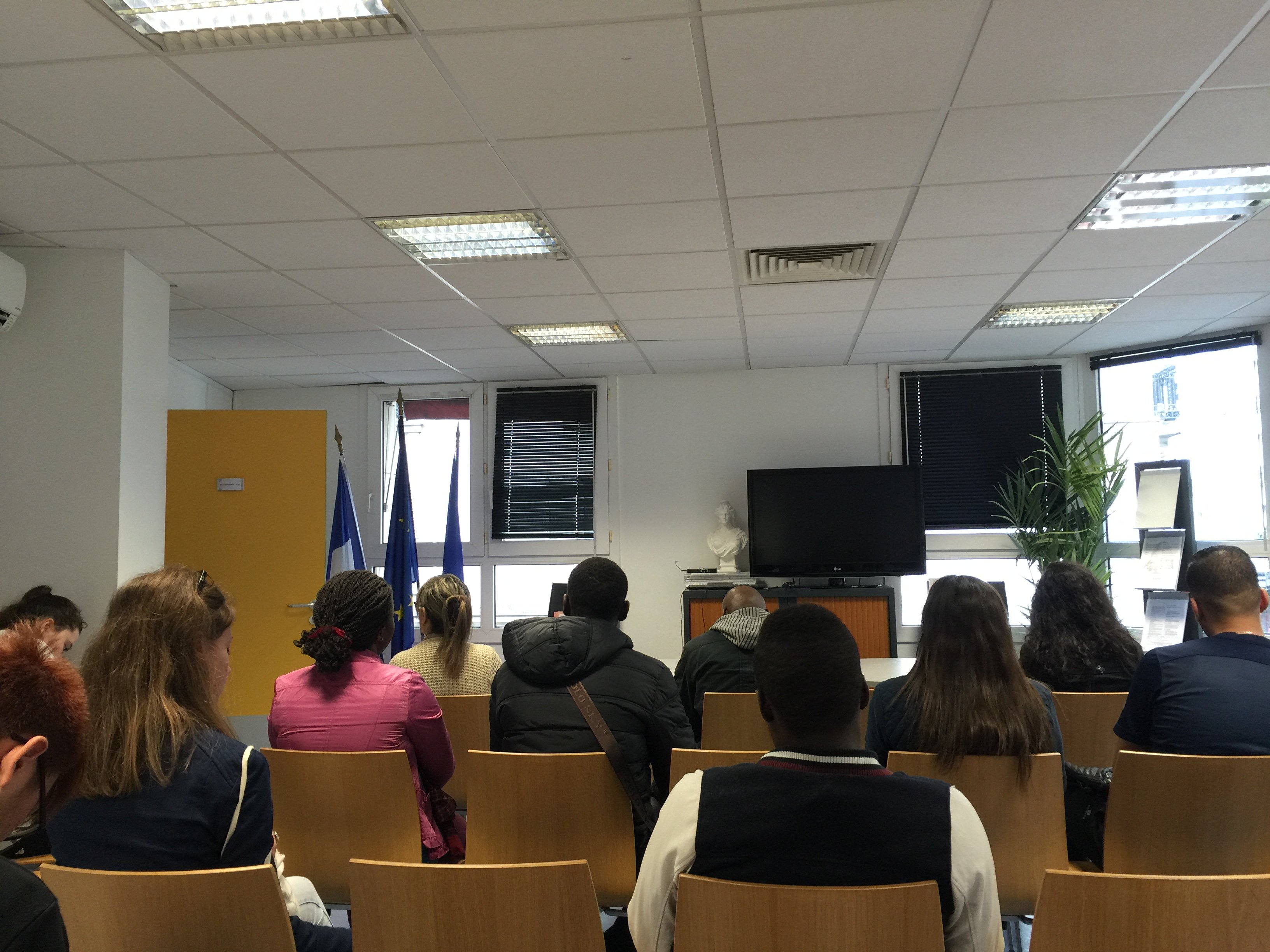
IMG_1900

At about 08h20 or so we were all assembled, roughly 25 of us, and our orienter came to tell us what would be happening today.  She spoke entirely in French, but not with the typically hurried Parisian cadence, but the slower measured cadence of the south, knowing she was dealing with many novices of the language.

She said there would be three parts of our day: a video, an interview, and a physical.  The video also worked with individual audioguides you could hold up to your ear which would allow you to follow along in real-time in the language of your preference.  One of our class requested Arabic, and another Kenyan.  If you’re uncertain, be brave and ask for Anglais, svp.  No one cares about your French level at this point, I promise.

The video was quite good, as orientation videos go (not too many cheesy situations or fake drama).  Obviously, as a royalist, I smirked a bit as the narrator spoke about the French “values of the Revolution,” considering that France was built upon superior values that predated that revolution by centuries, if not a millennium, but today was a day for quiet learning, not for a disquisition from Stephen on the murders, excesses, and poor logic of that revolt.  The video concluded with an explanation of the necessary steps of integration we would all need to go through now, namely:

  1. Attendance at a one-day class in French civics, with a translator supplied if requested.  This class purports to teach you about liberté, égalité, fraternité, laïcité, solidarité, and any other és that I may have missed.  They will also teach you the mechanisms of the French state, for example, that the President of the Republic still wields the ancient power of the Kings of France, i.e. the ability to pass a decree without legislative consent.  The class is one day, goes from 09h00-17h00, is obligatory, and is scheduled during your interview.  Mine was scheduled for the 30th of June, about 6 weeks from the visit I made to OFII yesterday.
  2. Attendance at a one-day class in “living and gaining employment in France.”  As with the aforementioned civics class, this one is obligatory, is one day only, and requires you to bring your ID.
  3. Attendance at free French language classes to obtain a basic level of competence as determined by the French state.  The course runs a minimum of 50 hours, and a maximum of 100.  You simply ask to test whenever you are ready.  This condition is in force unless, when you do your interview at OFII, your French is competent and clear.  Then you get an attestation that you don’t have to take the class.
  4. Your signature on a contract which commits you to do all of these tasks within one year, and that you will integrate into French life and the French way of thinking “avec assiduité.”

I was pleased to be exempted from the French courses via my interview.  If you are required to take the classes I believe they occur on either Mondays or Saturdays in your arrondissement.

She then asked if I had kept my medical exam from OFII from my 2014 visit.  I laughed and told her that I kept ALL THE PAPERS, gesturing to simulate a large stack.  She laughed and asked if my visa renewals were continuous, with no gaps.  I replied in the affirmative.  She then told me I was done for the day, as I didn’t need a new physical (which I ostensibly would have if I didn’t have that record or hadn’t kept a continuous immigration record).

She printed out my appointments, had me sign the contract, and gave me a lovely folder to put it all in.

It was 09h30 and I was done for the day!

Three things to note:

  • I was the first person called after we watched the video and our orienter briefly recapitulated the important points and answered some stray questions.  My being called first may only have been because they knew I didn’t need a physical and wanted to see me first.  But I don’t think you need to schedule more than a half day for this appointment, even for a worst-case scenario.
  • You will get the convocation to go to OFII after your second Profession Liberale appointment.  If you can’t make the date they give you, reschedule as soon as possible so as not to hold up this end of the process.
  • If you bypass my two-years-as-a-visitor route and go straight to Profession Libérale, you’ll be doing this appointment 90 days after you first officially move to France.

* * *

I slowly walked to Bastille after the appointment.  I was in the official “immigrant” stream.  The appointment went well, and I felt welcomed to my beloved France.  That, after all these years of hard work, felt good.

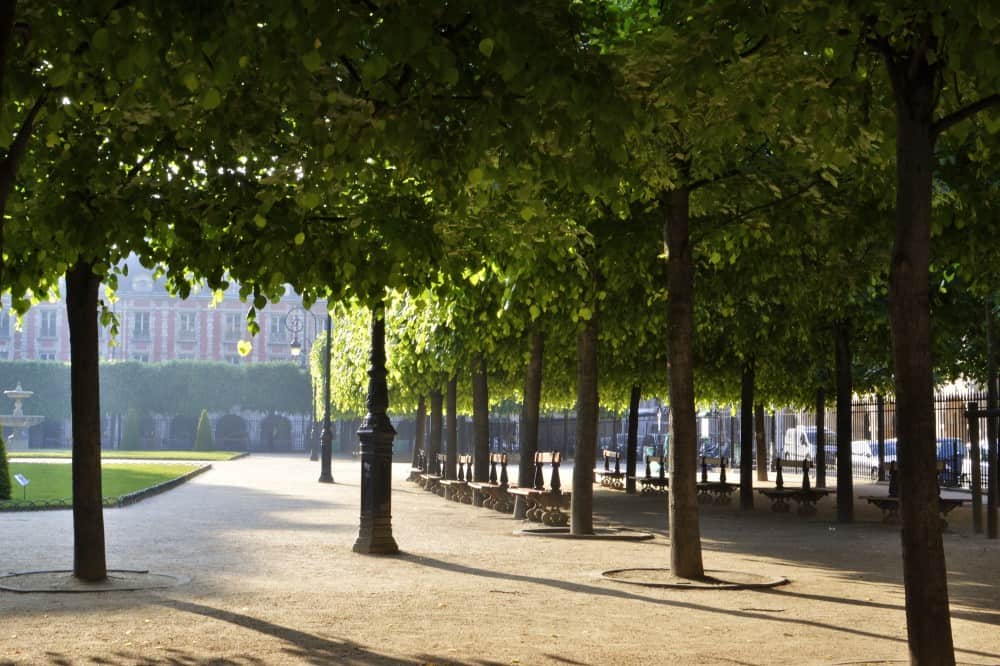
Featured image of an early morning Place des Vosges, not far from OFII, originally appeared here.  Follow the photographer here, who gave permission for this photo to be used.

Did you enjoy this article? TAIP is 100% reader-supported through tipping. If you want to leave us a tip of any amount it would be highly appreciated. These tips help support our efforts to keep TAIP an ad-free environment. Just as at a cafe, the tips are split evenly among the team.
Long Term Stay Visitor Visa, Part 2

Note from the editor: In light of new guidance on remote working in France as shared by the official French tax office in June 2025, we have also officially changed our stance on remote working for a US company while living in France under the visitor visa. Read more here, and contact us with any questions or concerns. We’re here to help! — MS

Despite the work it took to obtain my visa in the first place, my paperwork was not completed.  This is what happens when you get here.

I will admit, I was planning for a full-day affair on March 12th.  That was the 90-day mark of my arrival and OFII (Office Français de l’Immigration et de l’Intégration) wanted my bright shining face in the 10th arrondissement at 09h00.

I needed to bring the following with me:

1.  The letter which had been mailed (and emailed) to me providing proof of my appointment.  Easy enough.

2.  My passport.  Of course.

3.  My quittance de loyer or attestation d’hébergement.  Asked my landlord, piece of cake.

4.  A photo.  They have photomatons all over the city where you can step into a booth and knock this out.  5 euros for five pictures.  You can use them for all sorts of things.  Notice how happy I look!  But in all seriousness, you’re not allowed to smile.

5.  Fiscal stamps.  This was hilarious.  I needed to go to a Tabac a store that sells tobacco which is often a café and buy these.  You use them for all sorts of taxes and fees.  There were two and then soon ten anxious smokers behind me in line, as the lady kindly counted out 241 euros in fiscal stamps.  To be fair you can now, mirabile dictu, buy these online!

6.  A vaccination card. This was proof that I had gotten all the basic stuff.  The kind folks at Sunflower Medical Group faxed that to me the same day I requested it.

So I had a bit of work I had to do in the days leading up to my appointment.  Day of, I packed snacks, sandwiches, a book, my journal, etc.  I was ready to be there all day.  Boy was I wrong.

Perhaps it is the repetitive nature of what they do, but this group of French civil servants are among the most efficient I have seen in any country, ever.

I was checked in downstairs by a security guard, who sent me upstairs to my first waiting area.  I had arrived at 08h50, about 10 minutes before my appointment window.  I was seated for about three minutes before I was moved to another area.  Instead of the first room, which had 30 seats and only six people seated, this oval room had 40 seats and all but three were taken.  These were immediately taken by myself and the other two aliens/immigrants who had been walked down the hall from Room #1.

I got comfortable, got out my book (Msgr. Robert Hugh Benson’s Lord of the World, an excellent read, by the way, and free on your Kindle or Kindle app) and got ready to be there for a while.

After 20 minutes of reading I looked up to get used to the flow of traffic.  Immediately to my left there were nurse practitioners or equivalents calling out names.  After going into that room, you are a little later called into another room, then another, then you leave to go back to the front.

One of the interesting aspects of the morning was hearing the French try to pronounce non-French names.  “Stephen Heiner” comes out as “Steve-fen Eye-Nehr.”  I’ve often thought of creating a “stage name” during my time in France something like “Etienne Henry.”  Etienne is French for Stephen and Henry would just be an elision of Heiner.  Oh well, next time perhaps.  When I didn’t have to show documentation that I was someone else 🙂

I heard my name amid the buzzing French conversations and stood up and went into the first room.  I was asked to take off my coat and scarf and was weighed, measured, and given an eye test.  There didn’t seem to be any problems, and as a bonus I found I had dropped 5 kg, about 12 pounds, since I had been in France.  I could keep this up and be at my ideal weight after nine more months! 🙂

I should note here that I’ve very much taken on French rhythms and customs of eating, with a paleo twist.  I don’t snack in between meals, my portion sizes are sensible (read: not American), and I cook my own food most of the time.  My paleo twists are frequent use of butter and meats, and a reversal of my age-old practice of increasing meal size as the day goes on.  I now have a huge breakfast (when it isn’t Lent, of course), a medium-sized lunch, and a modest dinner, with the dinner taken before 19h00.  Of course, when I go out with friends for meals we usually don’t even get to the restaurant until 20h00.  But most days this is the regimen and that, combined with my having to walk and bike everywhere an average of 3 miles per day was probably the main reason I lost that winter weight that had been storing up during my car-dependent life in America.

I sat down after this felicitous weigh-in and dug back into my book.  09h45.

The next station was the radiologist.  There were three changing rooms we lined up outside of.  We would step in and lock the door, which would activate a light on the other side to let the radiologist know there was a new “customer” waiting.

We were to strip above the waist and wait patiently.  After a few minutes my door opened and I was walked to an x-ray machine.  The radiologist said “Breathe-in” in French and I took a deep breath and held it.

At around 10h30 I was called for my last stop in the oval room: the doctor.

She asked if I spoke French and I said that if she spoke slowly, please, I would be able to keep up.  Fluents, by nature, speak quickly.  I do so unconsciously in English all the time.

She laughed and obliged.  She looked over my files, asked for my vaccination card, and ticked off some other questions like was I taking any medications, etc.

She stamped and signed a sheet one for my records and one to hand to my final stop.

I was back in the room I started in.  I sat down just in time to watch the exchange between the woman in charge and another person, like me, getting ready to check out.

(In French)

“Your papers, please”

(girl hands them over)

“Photo, proof of residence, and fiscal stamps, please”

(girl hands them over)

Woman takes everything, then frowns and hands back a piece of paper.

“This is not sufficient.”

Now, the girl had handed her an SFR cell phone bill, which everyone knows isn’t good enough for anything.  The woman asked for a quittance de loyer or attestation d’hébergement, or the single most important piece of paper for your administrative life in France, an EDF (Électricité de France) bill.

(girl stammers back in halting French that she doesn’t have it)

Bien, revenir, alors,” the woman said, annoyed.

The girl stammered, in English, “I come back?”

Oui, oui, cet après-midi, demain, ce n’est pas grave.”  She was more annoyed now.

The girl made it into a statement, “I come back.”

The woman stared her into going away.

That girl left without the one thing we all were there for today: the sticker in the passport saying we were “legal.”  I was scared.  I triple-checked all my stuff.  But I had everything.  She smiled and handled my papers, put this all-important sticker in my passport, and stamped it.

She handed me a sheet of paper which instructed me to go to my police station in my prefecture, which is the final step in this process.  And she demonstrated what I’ve come to realize:  if you come prepared with all you need, the French are happy to help you on your way.

So, I’m not totally done, but mostly done, and the second step was a total breeze compared to the first.

Photo by Hush Naidoo Jade Photography on Unsplash

Did you enjoy this article? TAIP is 100% reader-supported through tipping. If you want to leave us a tip of any amount it would be highly appreciated. These tips help support our efforts to keep TAIP an ad-free environment. Just as at a cafe, the tips are split evenly among the team.