city view of paris

Paris Neighborhood Guide: the 18th Arrondissement

When most people think of the 18th arrondissement in Paris, one image comes to mind: cobblestoned Montmarte, with the white-domed Sacré-Cœur Basilica watching over the city, the Place du Tertre and its artists and easels, and cafés that look like they’re straight out of an Impressionist painting. 

I can’t blame them because I was one of them. Until I moved to the 18th and realized it was so much more. Don’t get me wrong, I love Montmartre (and wrote an entire article about it), but I would be remiss if I didn’t share all of the other things to see and do in the area.

Whether you know the dix-huitième like the back of your hand or you’ve only ever wandered next to the Sacré-Cœur, this arrondissement deserves a closer look.

Beyond Montmartre

Okay, Molli, we get it… the 18th is more than Montmartre! …is probably what all of you are thinking at this point, but let me explain.

While it’s true — Montmartre is one of the most famous spots in Paris, and for good reason. But if you limit yourself to the hilltop that looms over the rest of the city, you’ll miss a lot of the complexity and authentic, this-is-where-Parisians-actually-live energy to be found in the 18th.

This arrondissement has long been known for its artistic history and working-class roots. I mean, La Commune de Paris, a revolutionary government that seized power in Paris in 1871 did begin in Montmartre. Not to mention, Pablo Picasso, Claude Monet, Piet Mondrian, and Vincent Van Gogh all lived and worked there.

It should come as no surprise that today the area remains an eclectic mix of young families, immigrants, students, and creatives. Neighborhoods like Jules Joffrin (my stomping grounds!), Lamarck-Caulaincourt, Marx Dormoy, and Château Rouge all have their own unique vibe.

Once you get past the souvenir stands that crowd the area around the Sacré-Cœur, you’ll find winding streets and staircases where real Parisians spend their time in bakeries, cafés, local shops, and markets. It offers a good glimpse into real Parisian life.

Monuments in the 18th

I can’t talk about the 18th arrondissement without mentioning some of its most recognizable landmarks:

  • Sacré-Cœur Basilica: With its bright white façade and Byzantine architecture, the basilica is quite different from the other gothic cathedrals in the city. I definitely recommend stepping inside, even if there’s a line ot enter. Where the Notre-Dame is dark and moody, the Sacré-Cœur is bright and airy. You can also visit the dome, or simply enjoy a cup of coffee on the steps to admire the view.
  • Le Mur des Je t’aime (The I Love You Wall): Just outside the Abbessess metro station you’ll find the deep blue tiled wall with the words I love you written in hundreds of languages. It’s a touristy spot for sure — but also a great meeting place before going to one of the bars down the street. Le Chinon is my favorite local place, if you’re wondering.
  • Saint-Pierre de Montmartre Church: So few people know about this one! But, the Saint-Pierre is one of the oldest surviving churches in Paris. It’s a great place to spot in for some quiet respite, meditation, or prayer when the streets get too hectic.
  • Montmartre Cemetery: Much less intimidating than the Père Lachaise Cemetery, here you’ll find famous graves like Dalida and François Truffaut. You’ll also discover a community of cats, taken care of by a local charity group (really).

My Favorite Museums & Bookstore

While there aren’t a ton of museums in the 18th, there are still a few worth checking out, including one of my top recommendations for a fun day date:

  • Musée de Montmartre: I love taking visitors to this one as it’s so unexpected. Once you walk in off the bustling streets, you’re brought to a quiet and peaceful garden and a beautiful historic home (once occupied by the artist Renoir) that houses the museum. 
  • Dalí Paris: My now-husband and I went here for one of our earliest dates so it always brings back memories. If you love surrealism, you’ll want to pop inside this small but so fascinating museum. It’s just off the Place du Tertre and is full of sculptures, engravings, sketches, and even some films.
  • Halles Saint Pierre: Tucked away at the foot of the Sacré-Cœur, Halles Saint Pierre is a bookstore specializing in art books, exhibition catalogues, art publications, and books on design and architecture. There’s also a café — and thanks to the massive windows there’s also plenty of natural light to read by.

More Things to Do in the 18th Arrondissement

Just like nearly every arrondissement in Paris, there are monuments and museums to explore… but what I love most about the 18th is that it’s one of the rare areas in Paris that has maintained its “village within a city” feel. It’s also very multicultural and a good representation of what the actual population of France looks like.

The Goutte d’Or is a must-visit if you’re into cooking. The rue Dejean market is open daily and offers fresh produce, spices, and African specialties you won’t easily find elsewhere in the city.

The rue des Abbesses just may be the epicenter of the Montmartre “village” and is lined with cafés, bakeries, boutiques, and wine bars. It’s a perfect place to settle in for an afternoon people-watching or to pick up pastries from Maison Aleph or bread from Le Grenier à Pain (trust).

The Square Maurice Kriegel-Valrimont right in my Jules Joffrin neighborhood is the exact opposite of the touristy spots on the butte de Montmartre. A short walk from the rue du Poteau market street and surrounded by Haussmannian buildings, it’s my favorite place to take a midday break and admire everyday life unfold before my eyes. 

When I start dreaming of living in other places in Paris (Saint-Germain-des-Prés will always hold a special place in my heart), I let myself get caught up in the dream. Until I remember how incredible the 18th arrondissement is. I think I’ve found my favorite place for life.

Photo by Daniel Bi on Unsplash

Did you enjoy this article? TAIP is 100% reader-supported through tipping. If you want to leave us a tip of any amount it would be highly appreciated.  These tips help support our efforts to keep TAIP an ad-free environment. Just like at a cafe, the tips are split evenly among the team.

rue cler street sign

Paris Neighborhood Guide: the 7th Arrondissement

Home of undoubtedly the most famous Parisian landmark (she peeks out from the Haussmannian buildings to say coucou), the 7th arrondissement certainly does not get skipped by tourists.

But, this Left Bank quartier boasts so much more than the Eiffel Tower. You’ll also find the Orsay, Les Invalides, the Musée du Quai Branly, Le Bon Marché, and plenty of other less famous monuments, attractions, and sites to see.

Like the 6th arrondissement, I spent a lot of time here when I was a student. The 7th abuts the 6th and it’s easy to lose yourself, forgetting where les frontières begin and end. It’s relatively quiet and residential (once you get out of Madame Eiffel’s neighborhood), and as such is a wonderful place for a stroll.

If you’ve never explored the 7th at length, or are wondering if you may have missed something the first time around, this guide outlines exactly what there is to see, do, and eat.

The Eiffel Tower and Champs de Mars

I won’t spend too much time going over the Iron Lady — I’m assuming most TAIP readers have already visited. But, there are some fun facts that bear repeating to keep up your sleeves the next time someone is in town and you’re looking for something to do.

Built for the 1889 Paris Exposition and designed by Gustave Eiffel, it was actually quite controversial at the time. For starters, it was bright red and many feared it would dominate the city with its height and color. Many Parisians thought it was too expensive, and they also rejected it as a symbol of modernization.

Today the Tower is of course celebrated as the symbol of Paris — if not France — around the world. It’s close to 1,000 feet tall and 2.5 million rivets hold it together. It’s surrounded by the Champs de Mars gardens, which are usually teeming with tourists and picnickers alike, especially as it gets warmer and the sun starts setting later. If you do decide to picnic, grab une tradition from the PariSeven Boulangerie. Trust me.

There are several playgrounds, a merry-go-round, and a puppet theater for those with children. It’s also a wonderful place to watch the Eiffel Tower sparkle once the sun does go down.

Les Invalides

Here you’ll find the Army Museum and Napoleon’s comically enormous tomb, as well as sections of the area that are still used by the French military today. This was actually one of my last-explored monuments when I initially moved to Paris as I’m not that interested in military pomp and circumstance, but even I have to admit that it’s impressive.

The Dôme church where Napoleon is laid to rest has a beautiful interior and the massive gold dome itself is just as striking up close. There are also several fountains outside of the Invalides’ main building worth noting — Napoleon had them designed to compete with those in Rome.

I spend the most time here in the summer months as the grass lawns are open to the public and tend to be less crowded than the Champs de Mars, and less dirty than the riverside paths along the Seine. It’s also an excellent place to watch the fireworks on Bastille Day; again, it’s a lot less chaotic and crowded than squishing into the Champs gardens.

More Museums

I would be remiss not to mention all of the other museums in the 7th arrondissement:

  • Musée d’Orsay: One of my favorite Parisian museums by far, the Orsay is housed in a former railway station. Visit for its collection of Impressionist and Post-Impressionist masterpieces by Monet, Van Gogh, Degas, and more.
  • Musée Rodin: Another one of my preferred places to spend an afternoon, this museum is dedicated to the iconic French sculptor Auguste Rodin. Visit to see The Thinker and The Kiss in an 18th-century mansion with an equally beautiful garden.
  • Musée du quai Branly: Outfitted with an impressive vertical garden, the Branly highlights the indigenous art and cultures from Africa, Asia, Oceania, and the Americas. 
  • Musée Maillol: Tucked away in a Parisian townhouse and dedicated to the artist Aristide Maillol, here you’ll find a collection of sculptures, paintings, and prints.
  • Musée National Eugène Delacroix: Once the home and studio of Eugène Delacroix (whose works can also be seen in the Louvre), this museum displays the artist’s paintings, drawings, and personal objects.

Rue Cler

Similar to the rue Mouffetard in the 5th arrondissement, the rue Cler is a market street lined with cafés, boulangeries, fromageries, and specialty food shops. It’s pedestrian-friendly as well, so you don’t have to worry about getting run over while you peruse the shops filled with high-quality, fresh, and often local ingredients.

You can find anything from artisan cheeses and cured meats to flower stalls, gourmet chocolate, and wine. I usually head here when I get invited to a dinner party — I always feel good bringing along something fresh. Go to La Fromagerie Cler for cheese and Pralus for chocolate and pastries and you can’t go wrong.

Le Bon Marché

Finally, another place in the septième that’s perfect for strolling is none other than Le Bon Marché, the city’s oldest and arguably most stylish department store. It’s full of designer clothing (and people who like to buy designer clothing) and even carries items for the home. If you’re willing to splurge, it’s worth a stop. And if you’re not, it’s great people-watching.

It’s also home to the Grande Épicerie, a sprawling food hall. They carry everything from fresh seafood, cheese, and charcuterie to pastries and fine wines. The few times I have bought things from Le Bon Marché, they always came from the épicerie section. Again, they make for great gifts.

There are even places you can pick up sandwiches, specialty coffee, or other prepared foods if you’re craving something a little more luxe for a picnic. 

As with all of our neighborhood guides, this is just an overview of all there is to see in the 7th arrondissement in Paris. Give yourself a morning or afternoon to wander the streets yourself. You never know what you may see.

Photo by Tim Wildsmith on Unsplash

Did you enjoy this article? TAIP is 100% reader-supported through tipping. If you want to leave us a tip of any amount it would be highly appreciated. These tips help support our efforts to keep TAIP an ad-free environment. Just as at a cafe, the tips are split evenly among the team.
The Museum Passes for the Louvre and the Orsay

One of the oldest articles for this blog is one I wrote on the Paris Museum Pass and whether you should get it when visiting as a tourist. My answer then and now is: only get it if you’re really into art.

That idea of being “really into art” segues nicely into today’s topic, which will cover the two museum annual passes that I have held at different times, the Amis du Louvres and the Orsay’s Carte Blanche. You used to have to go in person to get the cards the first time, but the Orsay has since introduced digital membership and renewal, and the Louvre is in the process of doing both, I think.

Some of the marketing behind such passes is that you will have “broken even” on the cost for these annual passes on the 2nd or 3rd visit. But I think that marketing misses the point entirely. Do not get these passes if you are only going to go to the Louvre or the Orsay a few times in a year. I recommend these cards for those who are going to go a minimum of 12 times in a year. Hear me out.

People save money and wait years so that they can come to these museums sometimes once in their lives. As a resident of the city, and someone who loves art, and has easy access to go during times that are not crowded for a bargain basement price, you’d be silly to pass up on these cards. Let me share a few reasons why you should consider getting them.

You Get to See the Whole Place

While the Orsay can be seen, from start to finish, in one long day, it will take you weeks to accomplish the same thing in the Louvre. Why stress yourself out when you can see both museums at your own pace, dividing your visits into floors and wings, spending an hour or so seeing what you want to see, and then getting out? While you could see the entire Orsay over 2-3 leisurely visits, it took me 10 well-planned visits to see all of the Louvre.

You’ll never do this without a plan, so before you buy these, designate a day you’ll go (e.g. 3rd Thursdays, 2nd Saturdays) and just block that out for the rest of the year. People who just say, “Oh, I’ll go sometime” never end up using these cards.

Exhibitions are Free

Those special rotating temporary exhibitions that everyone else has to pay for? Those are included in your subscriptions. Just flash your card and get your ticket. You’re never confined only to the permanent exhibitions. Even better, with the Amis du Louvre card you get discounts at other museums and with the Carte Blanche you get free access to the Orangerie anytime. The Carte Blanche also offers a discount at the bookstore, while the Amis du Louvre gives a 10% discount in the Carrousel, the mall built under the Louvre.

You Can Bring a Friend

The Orsay used to allow you to bring a friend for free on Wednesday nights. They seem to have removed that benefit but added a new ongoing benefit of entry 30 minutes early (that’s a treat!) as well as “duo” cards which always allow you to bring an additional person with you anytime. The Amis du Louvre card has always allowed free entry on Friday nights (a fantastic time to go, I’ve taken many a friend during this time slot when the weary tourists have given up and have cleared out) even if you only have a solo card. Indeed, if you have a “duo” Amis du Louvre card you’re probably allowed to bring two friends with you.

You Will Sink Into the Art

When you become as familiar with these museums as the layout of your own home, you get to enter into the art in a way that so few can. How many times have I sat and simply people-watched in front of David’s Coronation of Napoleon, one of the largest paintings in the Louvre, and one which is a spectacular accomplishment of memory (and propaganda), and simply enjoyed watching people encounter this canvas for the first time? More than I can remember.

Something else I really enjoyed doing was engaging my friends in conversation to purposely distract them while we were coming up on the staircase that houses Winged Victory. When I knew it was about to come into view, I’d casually say, “Oh, what’s that?” and bask in the pleasure of seeing people take in their breaths as they see a piece of art presented in a stunning manner. We’d then be able to talk more about it as we got closer and I’d quiz them about which wing on the statue is original and which had been reconstructed (you can tell…just take your time looking).

Just as when you revisit great books or films, you’ll find something new, so it is with great art. I’ve gained so many insights just sitting with paintings, sculptures, and objets d’art in an unhurried manner.

You’ll notice that I don’t list “save money” as one of the reasons to get these because that’s not why you’re buying them. You’re buying them for the kind of access that people around the world dream of, and people in Paris take for granted, but you have decided to invest in, on your own behalf (and of your friends), to get serious about the treasures in these museums. You may not renew after a year of access (indeed, I only held both of these cards for one year) but that year that you hold them is going to be a special one.

Photos of my cards.

Did you enjoy this article? TAIP is 100% reader-supported through tipping. If you want to leave us a tip of any amount it would be highly appreciated. These tips help support our efforts to keep TAIP an ad-free environment. Just as at a cafe, the tips are split evenly among the team.

Contemporary Art in Paris: Institutions

Once, when I had been asked to pick up the artist wife of a film-maker for “Festival America” (a biennial fair in American literature where numerous writers are invited to present their books and literary subjects in general), she asked me about where to see contemporary art. At the time I had to think a bit and did not get back to her until a few days later. Unfortunately she no longer had time to visit. Today, some years later, I have a plethora of recommendations, because, on the one hand I have been thinking about and following contemporary art, and on the other, because there are now so many venues that cater to contemporary art today. Beginning with Paris’ contemporary art museum, Palais de Tokyo and the regional contemporary art museum, Mac/Val, there are also a number of fondations, privately owned museums and museum-like galleries as well as various structures set up to encourage talented young artists.

Palais de Tokyo, Europe’s Largest Center for Contemporary Art Today

One of the three 1937 Universal Exhibition edifices built for posterity, the Palais de Tokyo is so called because it was constructed on the then “Quai de Tokyo.” While the street is now called “Avenue de New York,” the edifice has kept its original name. 

Originally slated to become a national art museum, the Palais has, during its turbulent history, also served as the Nazi’s collection point for looted art to be stored and inventoried before its transfer to Germany. 

After the war, it finally came into its own as a national museum of modern art until 1976 at which time the art it held was removed to the new Centre National d’Art et de Culture Georges-Pompidou. Employed for various purposes then, it fell into neglect until it became earmarked in 1999 as a contemporary art museum. The architects, Anne Lacaton and Jean-Philippe Vassal gutted the site down to its bare-bones cement structure, which is how we encounter the institution today.

Palais de Tokyo is devoted to exhibiting established contemporary artists, or those who are on the cusp of becoming so. Contemporary art being what it is today, I have seen extraordinary exhibitions of artists such as Le Parc, and Saraceno, Theaster Gates…a number of forgettables, and controversial others such as Miriam Cahn’s recent exhibition with her painting, Fuck Abstraction. Typically a number of artists will be exhibited at any one time and in the basement there is an area dedicated to video art. The museum also boasts a restaurant and a bookshop. 

The museum has also been used as a discotheque and for rave parties. Thus, locked under normal conditions, can be found walls and staircases covered with fantastic spontaneously-created art. These areas can only be visited on a specially organized guided tour.

A good place to go after other museums have closed, it can be visited until late at night (22h) and even later for evenings when an exhibition first opens. An added bonus for vernissage nights is that museum entry is free and therefore should be watched for.

Another important contemporary art museum, this one outside Paris, is MAC/VAL located in Vitry-sur-Seine. While a bit way out (approximately an hour by public transportation), this relatively new building houses a very good collection of specifically French contemporary art and presents two temporary exhibits per year. If time is not of a premium, this museum (free to the public), of very high caliber, is well worth a visit.

Establishments Exhibiting Contemporary Art

There exist both public and private organizations whose objective is to exhibit the work of living artists. 

In 1982 Jack Lang, the then-Minister of Culture, set up a network of institutions, named FRAC (Fonds Régionaux d’Art Contemporain) to encourage the collection and showing of contemporary art in all of France’s regions.  The FRAC of Ile de France is located at 22 rue des Alouettes, 75019.  Admission is free and it typically offers exhibits of living, contemporary artists, both French and international. It has a second location in the new, contemporary art center in Romainville. This extension is known as “Les réserves.” Although slightly outside Paris, it can be reached by metro line 5. 

The Cent-quatre-Paris is a multipurpose art space offering contemporary art exhibits (ticket fees apply) as one of many other activities. The center includes an auditorium for lectures and performances, various restaurants, a book exchange, activities for children…and a large central space where visitors can see various groups practicing their hip-hop dance moves and sequences. 

The beautiful 13th century College des Bernardins often provides a venue for artists to create and set up installations adapting and highlighting its Cistercian architecture. Whatever the exhibition, the sheer beauty of its rows of stone pillars and gothic arches offer the visitor a moment of tranquillity and spirituality. 

To create a marketable aura and gain a reputation as a patron of the arts, various private corporations have created exhibition spaces which can be as grand as a quasi museum. The largest and most famous of these have been created by France’s art-collecting billionaires: Bernard Arnaud who heads LVMH and François Pinault.  

The former had the architect, Frank Gehry, build an architecturally fantastic structure in the likeness of a ship in Neuilly, a near-western suburb of Paris. Visiting exhibits at the Fondation Louis Vuitton means following a bit of a labyrinthine course, but the tour offers artistic and architectural wonders around every corner. When there is no special temporary exhibit on show, the walls will be hung with Arnaud’s own collection of modern and contemporary art. This Fondation is also known for its blockbuster temporary exhibits, which are a must for any art lover.

The latter renovated the former Bourse de Commerce (Paris’ old stock market building) to create a center for exhibiting contemporary art, much of which is from his personal collection. Temporary exhibits may change every quarter or semester. Here can be seen the most well-known artists of today’s contemporary art scene. Constructed in a circle around a central atrium, this building is also well worth a visit for its architecture as well as for the art. For those on a tight art budget (and who isn’t?), it is important to note that the museum is free the first Saturday evening of every month where explainers are available to offer (sometimes very necessary) insights into the exhibitions. Be sure to reserve a time slot as early as possible for these tickets go quickly.

The Cartier Foundation for Contemporary Art hosts temporary exhibits of contemporary art both on the ground floor of Jean Nouvel’s modern, light-filled, high-ceilinged rooms on its ground floor and in a more muted locale in the basement. Artists are typically already well-known internationally, such as Damien Hirst, Ron Mueck, Fabrice Hyber … Out back, there is also a lovely garden with a cafe which is a great place to spend some time on a sunny afternoon and discuss the current exhibition with friends.

Galéries Lafayette has taken over a building in the Marais to produce ever-changing temporary exhibitions in its contemporary art space, Lafayette Anticipations. Each exhibit is typically devoted to a single artist. No reservations are needed, except for their guided tours every day (except Tuesday when it is closed) at five in the afternoon; these are well-worth signing up for. 

Fondation Pernod-Ricard has moved its small art quarters near the Concorde to a spacious new building just behind the Gare St Lazare. Here they offer free entrance to temporary exhibitions of hand-picked contemporary artists. Vernissages, which are always of particular interest, are indeed open to all where Ricard cocktails flow free and freely to celebrate the event.

With an aim to promote their culture, a number of countries have reserved a space for art exhibitions in their embassies or cultural centers. Thus without leaving the city, any art enthusiast can feel the pulse of artistic creation in various nations around the world. Countries particularly engaged in presenting their contemporary art include ItalyCzech Republic, Canada, Australia, Korea

Artists’ Compounds

Then there are artists’ residences, where young artists are given a studio to work in and create. They also offer venues for these young artists to exhibit. 

In the center of Paris right on the Seine is the Cité des Arts, a complex where promising young artists have won a residency. Every Wednesday is open house from 6pm to 9pm when the general public can visit artists in their studios and see their work in progress. Every so often exhibitions are staged to display the residents’ works. In the lower level, there is a small auditorium, which offers conferences and concerts. Attached to this residence is a second compound of studios overlooking gardens located way up on Montmartre.

And far off the beaten track, in Clichy, as part of Greater Paris, an industrial site has recently been repurposed into a new artists’ residence.  Entitled Poush, it also offers visits and exhibitions to the general public, promoting the artists who are living and working there.

Les Frigos (the refrigerators) was once just that, a refrigerating edifice on the left bank of the Seine to store perishable foodstuffs until they were brought to Paris’ central market, Les Halles. Each distributor had its own refrigerator in the building. When the market was moved out of Paris to Rungis the building was abandoned no longer serving a purpose. It was then that the artists moved in, created windows, dismantled the refrigerator doors, installed plumbing and in a word, undertook all the installations necessary to make the various rooms viable and to set up work studios.  Once or twice a year Les Frigos are opened to the public to visit the studios housed behind each disabled refrigerator door.  A curious and totally unconventional art scene not to be missed.

Then there are the various open house days set up independently in different sectors of Paris and its suburbs where artists might have studios. These include, among others, areas such as Belleville, Père Lachaise, Ménilmontant, Montmartre, Glacière … most of the districts of Paris and suburbs such as Montreuil. Each neighborhood is free to decide on the dates for this type of event although typically they occur during the Spring months.

While what has become a plethora of institutions and venues offering exhibits of contemporary art, the above-mentioned list, as daunting as it might seem, is certainly not exhaustive.  It is only the beginning for a foray into the present day’s contemporary art, both French and international.

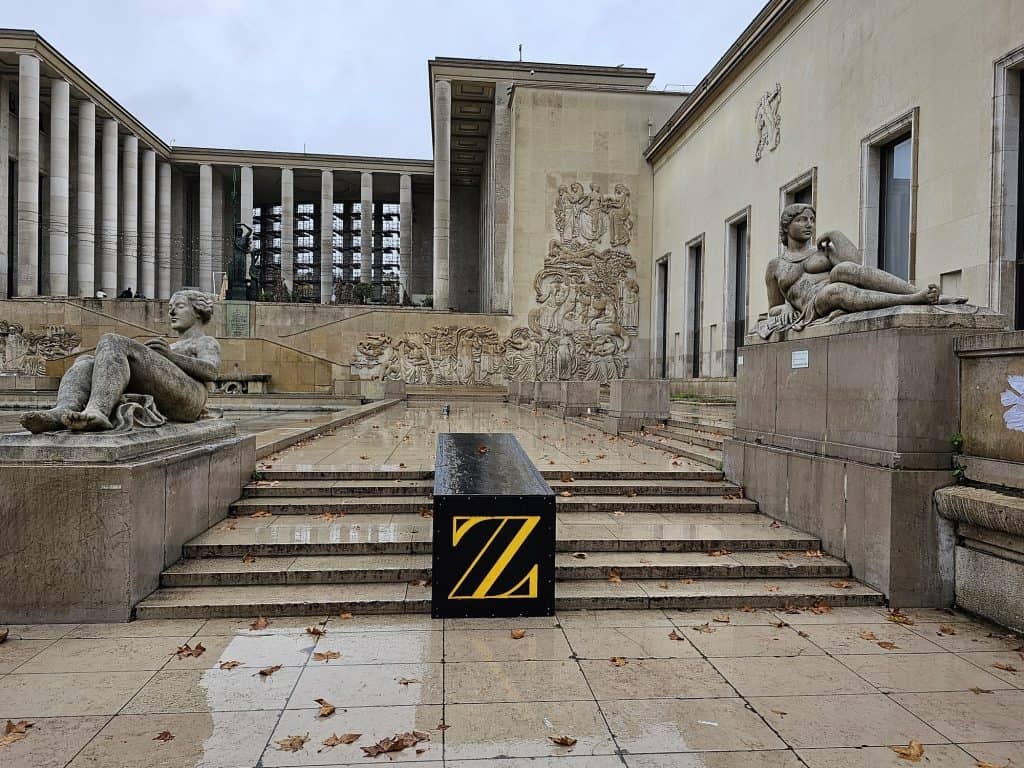
Photo taken outside the Palais de Tokyo/ Modern Art Museum in Paris.

Did you enjoy this article? TAIP is 100% reader-supported through tipping. If you want to leave us a tip of any amount it would be highly appreciated. These tips help support our efforts to keep TAIP an ad-free environment. Just as at a cafe, the tips are split evenly among the team.

Paris museum line

Free Cultural Activities in Paris

Are you new in Paris and wanting to visit its cultural heritages and emblematic places but are tight on a budget?

Don’t worry, we’ve got you covered.

Firstly, we recommend that you visit regularly the website of the Parisian Tourism Office which offers regular updates of the free cultural event agenda for Paris.

1. Free Museums and Monuments

Paris has many freely accessible museums and monuments. Many museums are also free every first Sunday of the month, which is quite amazing.

There is also a list of museums and collections that are accessible for free all year round. Below you can find a list of permanent free collections displayed in museums with their addresses and closest subway stations.

11 avenue du Président Wilson, Paris 16e — Métro Iéna

  • Maison de Balzac (gratuité des collections hors période d’exposition temporaire)

47 rue Raynouard, Paris 16e — Métro Passy

  • Musée Bourdelle (gratuité des collections seulement en partie en temps d’exposition)

16 rue Antoine Bourdelle, Paris 15e — Métro Montparnasse – Bienvenüe

23 rue de Sévigné, Paris 3e — Métro Saint-Paul Chemin Vert

7 avenue Velasquez, Paris 8e — Métro Villiers

  • Musée Cognacq-Jay (gratuité des collections seulement en partie en temps d’exposition)

Hôtel Donon – 8 rue Elzévir, Paris 3e — Métro Saint-Paul

Avenue Winston Churchill, Paris 8e — Métro Champs-Elysées – Clemenceau

Hôtel de Rohan-Guéménée — 6 place des Vosges, Paris 4e – Métro Bastille

16 rue Chaptal, Paris 9e — Métro Pigalle

You may find the list of museums which are free all year round below :

2 rue de la Légion d’honneur, Paris 7e — Métro Solférino

10 rue Mabillon, Paris 6e — Métro Saint-Germain-des-Prés

11 rue Pierre et Marie Curie, Paris 5e — Métro Cardinal Lemoine / Place Monge

3-5 square de l’Opéra Louis-Jouvet, Paris 9e — Métro Opéra

Hôtel de Police du Ve arrondissement – 4 rue de la Montagne Sainte-Geneviève, Paris 5e — Métro Maubert – Mutualité

47 rue Monge, Paris 5e — Métro Cardinal Lemoine

Place Georges Pompidou / Rue Saint Martin, Paris 4e — Métro Rambuteau

142 avenue des Champs-Élysées – 2ème étage, Paris 8e — Métro Charles de Gaulle – Etoile

Place Hannah Arendt, angle des rues des Alouettes et Carducci, Paris 19e — Métro Buttes-Chaumont Jourdain

  • Musée Zadkine (gratuité des collections hors période d’exposition temporaire)

100 bis rue d’Assas, Paris 6e — Métro Notre-Dame-des-Champs

17 rue Geoffroy l’Asnier, Paris 4e — Métro Saint-Paul

59 avenue Foch, Paris 16e — Metro Porte Dauphine

2. Free Cinemas and Open Air Cinemas

Next, if you are a movie lover, there are cinemas that display movies for free and every summer there is the open air cinema located in the 19th district, at Paris la Villette that displays a collection of classic and iconic movies.

There are also free movie festivals organized each year:

Earlier this month, associations in the Ménilmontant neighbourhood organized the Festival des canotiers. The programme includes film screenings, concerts and exhibitions, mainly on the Place Maurice Chevalier, in the 20th arrondissement.

The Silhouette festival takes over the Butte-du-Chapeau-Rouge square in the 19th arrondissement and other locations every year at the end of August and beginning of September and screens short films there. Here’s the information on this year’s program.

To see the best of the world’s short films, go to the Nuits en or: during three evenings in June, the UGC Odéon cinema shows the short films that have won awards at the various international film academies. A must!

The Cinéma du réel festival, which takes place every year in spring in various Parisian cinemas, offers a few free screenings. The programme includes international feature-length and short documentaries and retrospectives of great directors.

3. Free Guided Visits in Paris and Ballads

The Parisian City Hall offers several walking guides to discover the different districts of the city, and Balades Paris Durable, which offers almost twenty walking routes to discover the capital in a different way, encouraging sustainability and favoring the environment. They even have an app!

For lovers of the 7th art (seventh art = septième art in French refers to cinema and film making), the Paris City Council’s Cinema Routes invite you to discover famous, unusual or historic Parisian neighbourhoods based on films shot in the capital: Chocolat, La Môme, Ratatouille, Le Petit Nicolas, Le Diable s’habille en Prada

You can also discover the Tuileries Gardens with a free tour, accompanied by reception staff. From April to the end of October, meet on Saturdays, Sundays and public holidays at 3.30 pm at the foot of the triumphal arch of the Carrousel du Louvre.

Finally, there are all sorts of free cultural activities in Paris, including free exercise sessions. To find out more about the open air free gym sessions, you can also be on the lookout on the Paris Info website or follow the exosport page on Instagram for daily updates.

Finally, one more way to find out about free cultural activities is to go to the city hall of Paris in the 1st district (Hôtel de Ville metro station), where you can find flyers about new activities in Paris!

Free cultural activities are a great way to discover the city and even make new friends so we definitely encourage you to hop on this adventure and get out of your comfort zone!

Did you enjoy this article? TAIP is 100% reader-supported through tipping. If you want to leave us a tip of any amount it would be highly appreciated. These tips help support our efforts to keep TAIP an ad-free environment. Just as at a cafe, the tips are split evenly among the team.

Don’t Buy the Paris Pass

I really think that Americans in particular don’t leave enough unscheduled, unstructured “white space” in their European travels.  They run around, convinced that they will never return, and so they have to see everything.  I know.  I get it.  That was me once upon a time as well.  But while that allows you to mentally “check off” the big sites, it doesn’t really allow you to enjoy Europe and Paris the way these destinations are truly inviting you to enjoy them.  Here’s a sample of said freneticism, from an email I received from someone planning a trip:

Upon our arrival we are spending most of the day on the 26th at the Louvre.  On the 27th we are traveling to Versailles.  On the morning of the 28th I would love to accomplish two things, a quick tour of the catacombs and then a stroll in the areas of the fashion houses.  Is that at all possible to accomplish both?

I had only been in Paris a few months at the time, and I already knew that her itinerary was problematic, to say the least.  The lady had prefaced this by saying she had waited 28 years to come to Paris.  And this was her plan?  Alas she refused to take my advice to cut one or more things from her crazy itinerary.

This “do all the things!” trend seems to be endemic to Americans.  They want to see everything and are overwhelmed with advice and information (half of it terrible) from friends, family, blogs, and TripAdvisor.  If this attitude sounds familiar (no need to raise your hand!) the key is to focus and craft a schedule with the really important things you hope to do.  Add “white space” to the schedule: time to just relax and enjoy the city and the magic moments that can happen, instead of rushing around to see “the next thing.”

This leisured manner of sightseeing, that leads to lasting memories instead of a confused blur, is something you are unlikely to do with the Paris Pass, something designed for the FOMO-obsessed visitor who has to see everything.  So, to underline my perspective, here are four reasons you shouldn’t drop hundreds of euros on this tourist trap of a product.

1.  It’s overpriced.  As with most “deals,” you spend your time trying to knock out the big-ticket items so you can prove to yourself you got a deal, even if you have only the vaguest interest in said item.  Do you think they bundled all this together to save you money?  The Pass is about convenience, and they want to get paid for that.  Anyone who actually saved money using this thing only did so by running around the city at top speed.

2.  The bundled Museum Pass isn’t for everyone.  Yes, I’m an art lover and in a past life I gave private tours of the Orsay and the Louvre, but plenty of visitors are not that obsessed with art and museums, and are happy to just go to a few of the museums in Paris; they don’t want the weight of obligation (or the rushed timeline) that having a “pass” puts on you.

3.  You won’t use the metro nearly as much as you think.  This comes with an all-you-can-use Metro pass for a set number of days, which is a huge waste of money.  People have no idea that Paris is so walkable and beautiful to walk.  If you’ve walked enough, you can opt for the shared Velib bikes or the ubiquitous electric scooters.  If and when you need to use the Metro, use an easily refillable Navigo Easy.  If you are going to be here for more than a week, and plan to head out of Zones 1 and 2 a lot (Versailles, Disneyland, Fontainebleau, etc.) starting on a Sunday, Monday, or Tuesday, stop in and get a Navigo Decouverte.

4.  You will be stressed, not aided, by their 120-page book.  They boast entrance into places that are too varied and uneven in their characters to be “must-sees” for every single guest.  Even one of my favorite Parisian buildings (and included in the Paris Pass), the Garnier Opera House, is not a “must-see” on your first visit to Paris.

So, save yourself time, money, and stress by NOT buying the Paris Pass.  it’s for people interested in frantically running around the city so they can later tell people what a “deal” they got by buying some overpriced card, or for people who think Rick Steves knows what he’s talking about.  If you’re interested in taking this city on at a reasonable pace, with white space sprinkled throughout the day, and are willing to not see “all the things,” you should avoid the Paris Pass (and its advocates).  Paris is a place to be experienced, not a checklist to be achieved.

Did you enjoy this article? TAIP is 100% reader-supported through tipping. If you want to leave us a tip of any amount it would be highly appreciated. These tips help support our efforts to keep TAIP an ad-free environment. Just as at a cafe, the tips are split evenly among the team.

Ars et Metiers Museum Paris

Making the most of Free Museum Sundays

A large number of museums in Paris are free on the first Sunday of the month.  Some budget-minded travelers know this and schedule a visit to Paris around such a date to knock out some museums for free.  Is this a good strategy?  Yes and No.

I’ve done over 20 Free Museum Sundays (as I call them) since I arrived in Paris, and I’ve come to the conclusion that whether you’re a local or a tourist, this day is great to use for short, targeted visits to the little-known museums that go under the radar for people on a Museum Pass rampage, and also don’t draw big crowds on the 1st Sunday of the month. Don’t use it to go to the Orsay or the Louvre.  Trust me on this.

You can find the list of the dozens of museums that are free here, but here are three suggestions that I can make for you that would be good uses of your time.

The Gustave Moreau Museum

Moreau was born in 1826 and lived during a period of great change in France following the 1st Napoleonic era.  His art draws on too many influences to neatly fit into a school that you might know, and as such is singular in appearance.  As I think upon his body of work now, some pieces are too unfinished to even be “impressionistic,” and yet some, like his Orpheus, which often hangs on the first floor of the Orsay (when it’s not out on loan) recalls the Academic style so favored by the Salon.

This marvelous 3-story house, with a lovely and elegant preserved staircase to take you to the top floor, is the perfect showcase for this unique artist.  Even a gentle wander should run you at least 30 minutes.  A true visit should run you 60-90 minutes.

The Eugene Delacroix House

Delacroix is probably best known for his Liberty Leading the People, an image that hangs in a gallery in the Louvre roughly 30 meters from a beautiful painting of St. Joan of Arc at the coronation of the Dauphin.  I point out to my guests that this is an example of a contradiction the French are comfortable with: two women of power one supporting the monarchy, another leading the French over the bodies of the defenders of the monarchy.  The two Frances (one Catholic and royalist, the other anticlerical and republican) are on display for you in that gallery, if you just give yourself some time to make the connection.

But even royalists like myself can appreciate Delacroix, especially for his famous Dante and Virgil in Hell (which also hangs in the same aforementioned gallery in the Louvre, not far from Gericault’s Raft of the Medusa) and also for the ongoing transformation and maturation in his work and technique.  This museum is much smaller than the Moreau museum, but features a lovely garden to rest in.  A quick run can be done in 30 minutes, but no need to rush.

Arts et Metiers

This museum is the largest of the three I’m recommending today, and will take at least 2 hours of your time to see properly.  I call it the “Nerds’ Museum” because it has all sorts of wonderful inventions and gadgets from many different eras in it (think everything from the first barometer to a Cray supercomputer), including the highlight: Foucault’s Pendulum.  In 1851 Foucault used this device to prove that the Earth rotates.  Additional good news?  Every Thursday the museum is also free from 18h00-21h30.  So you don’t even have to wait for the first of the month.

Paris has over 50 museums.  No better time than the beginning of a new year to start seeing some of them.

Did you enjoy this article? TAIP is 100% reader-supported through tipping. If you want to leave us a tip of any amount it would be highly appreciated. These tips help support our efforts to keep TAIP an ad-free environment. Just as at a cafe, the tips are split evenly among the team.

arc de triomphe paris

The Paris Museum Pass: Worth it?

One of the things I’ve come to appreciate about working with accountants and lawyers over the years is their most frequent response to what a layman would consider a fairly innocent and straightforward question: “It depends.”

That “it depends” has many possible follow-ups.  “It depends on what you want your tax exposure to be,” or “It depends what your long terms goals are,” etc.  The “it depends” for the Paris Museum Pass isn’t dependent on how much you like art, but rather on how quickly you like to see your art.

For those who want to see their art “efficiently” (which was me once upon a time), read on for why the Paris Museum Pass is for you.  For those who prefer to see their art slowly, don’t worry, I’ve still got some helpful suggestions for you.

You Get to Skip the Line

For some of the museums there is a special entrance just for pass holders the one at the Louvre is particularly skip-tacular.  If there’s one thing no traveler really enjoys, it’s standing in long lines to get into places.  Often this is down to poor planning as today so many places offer online booking and so many internet reviews tell people exactly when the lines get ridiculous.

It Covers Monuments and Museums that Are Short Visits

When people hear the word “Museum Pass” they may think of museums, but they don’t think of National Monuments be they the Arc de Triomphe or Sainte-Chapelle.  Both of those are excellent short visits (your Museum Pass gets you to the top of the Arc, one of the best views of the city) and can be accomplished in under 30 minutes, if you time your entrance well.  Separate admission to these two places alone goes a long way to covering the value of your Pass.

Then there’s a museum like the Orangerie, which has a decent permanent collection but a spectacular “custom-designed” collection of Monets, which you can fully appreciate within half an hour.  There’s also Petit Palais, which does have a magnificent permanent collection, and can be comfortably seen in 2-3 hours, and that’s even with a break in its lovely inner courtyard.

You Save $$$/€€€/£££

The Museum Pass allows you to get into the “biggies” (think Louvre + Orsay + Invalides) but also gets you into dozens of lovely and under-appreciated museums as well.  This is a testament to Paris itself, as a city like New York doesn’t have anything like it, despite having many wonderful museums.  The existence of such a pass in a city known for its territorial curators is almost unbelievable.  Someone herded all the art cats into a room and got them to agree on this idea, to the benefit of all of us.

For locals, the next best thing to the Museum Pass is Free Museum Sunday (the first Sunday of the month).  That’s when we get into almost all the museums for free (the Louvre is seasonally on that list).  Serious value seekers have been known to time their Museum Passes to expire the day before that Sunday and add one more day onto their museum binge.  However, it’s a very crowded day so consider using Free Museum Sunday as a day to circle back to places you might have already seen, or luxuriously use it as a way to go into a place, see one or two things, then leave.

It Doesn’t Commit or Obligate You

When you buy tickets ahead of time for particular days and times at specific museums, you sometimes feel trapped should you feel ill or like doing something else on the appointed day(s).  If you realize the true value of the Paris Museum Pass, plan the three or four visits upon which you will immediately recoup the cost: you will see each additional visit as extra gravy for your Parisian “meal” of culture.

But It Doesn’t Cover Every Place Worth Visiting

Three favorites of mine that are not covered by the Museum Pass are the Musee Marmottan Monet, on the edge of the 16th, the Caillebotte Estates in Yerres, and Monet’s place in Giverny.  This is to say nothing of the Museum of the Liberation of Paris, the newly opened Bourse de Commerce, or the (finally) re-opened Carnavalet Museum in the Marais, one of the very best museums in the city.  And, just like the best things in life, all three of those are free.

Photo by Marcos Pena Jr on Unsplash

Did you enjoy this article? TAIP is 100% reader-supported through tipping. If you want to leave us a tip of any amount it would be highly appreciated. These tips help support our efforts to keep TAIP an ad-free environment. Just as at a cafe, the tips are split evenly among the team.