
French pharmacy with bikes in front of it

How Does CPAM Work?

Note from the editor: Navigating the French healthcare system as an expat is no easy feat, so we’ve partnered with Fab French Insurance to hopefully make things feel a little more straightforward for our TAIP readers. Below, they’ve done a wonderful job of explaining what CPAM is and how you can benefit from it when you’re a full-time resident in France. Enjoy! — MS

Joining the French healthcare system is one of the biggest milestones after moving to France, but it is also one of the most confusing. Between CPAM, Assurance Maladie, the carte Vitale, mutuelles, and reimbursement rules, many newcomers struggle to understand where to begin and what happens after they arrive.

The good news is that while the administration can take time, the system itself is logical once you understand how the different pieces fit together. If you’re planning a move to France or have recently arrived, here’s what you need to know about how CPAM works and what to expect during your first months.

What Is CPAM?

CPAM (Caisse Primaire d’Assurance Maladie) is your local health insurance fund, responsible for managing public health insurance in your area. It forms part of Assurance Maladie, which is the French public health insurance branch of the social security system.

Once you are registered, CPAM manages your healthcare rights, processes reimbursements, and eventually issues your Carte Vitale, the green health insurance card used throughout France. Each département has its own CPAM office, although most day-to-day administration can later be managed online through your Assurance Maladie account.

Who Can Register with CPAM?

The way you access French healthcare depends on your personal situation. If you begin working in France, your healthcare rights can generally begin from your very first hour of employment through the French social security system.

If you are not working, including many retirees and visitor visa holders, you may still qualify under Protection Universelle Maladie (PUMa). Non-working residents may apply under PUMa once they meet the conditions of stable and regular residence, which generally means living legally in France for more than three months.

Because every situation is different, the documents required and the registration process will vary depending on whether you are employed, self-employed, retired, joining family members, or applying through another residence status.

How Do You Apply?

Most first-time applications are made using Cerfa n° 15763*02 – Demande d’ouverture des droits à l’assurance maladie, which is submitted to the CPAM covering your place of residence together with your supporting documents.

According to Assurance Maladie, applicants will generally need:

  • Cerfa n° 15763*02 application form
  • Passport or national identity document
  • Original birth certificate (or an officially certified copy), issued within the last six months, together with a certified French translation (traduction assermentée) dated within the last three months if the document is not already in French.
  • Proof of legal residence in France
  • Proof of address
  • French bank account details (RIB)
Depending on your circumstances, CPAM may also request additional documents, such as an employment contract, recent payslips, family documents, or evidence supporting your residence status. Providing a complete application from the outset is one of the best ways to avoid unnecessary delays.

How Long Does Registration Take?

Processing can take weeks or months, depending on the workload of your local CPAM office and whether your application contains all the required documentation. If further documents are requested during the process, this can extend the timeline.

During this period, many newcomers experience what is often referred to as the “healthcare gap,” the time between arriving in France and officially obtaining healthcare rights.

For this reason, private health insurance is often essential during your first months in France. In fact, many long-stay visas require applicants to hold health insurance covering medical expenses, hospitalization, death, and repatriation costs for the duration of their stay until they become eligible for the French healthcare system.

What Is the Carte Vitale?

Many people think receiving the carte Vitale is the moment they join the French healthcare system, but legally, the important milestone is the beginning of their healthcare rights.

The carte Vitale is simply the card that allows healthcare providers to transmit your reimbursement claims electronically, making the system much easier to use. Once you receive it, you simply present the card during medical appointments or at the pharmacy, and reimbursements are processed automatically in most cases.

How Do Reimbursements Work?

The French healthcare system does not usually reimburse 100% of your medical expenses.

Instead, Assurance Maladie reimburses a percentage of an official tariff established for many healthcare services. If your doctor charges more than this official amount, known as dépassements d’honoraires, the additional cost may remain partly or entirely at your expense.

This is why many residents choose to take out a mutuelle, or complementary health insurance.

A mutuelle helps cover some or all of the costs that remain after Assurance Maladie has reimbursed its share, particularly for hospital treatment, specialist consultations, dental care, optical expenses, and hearing aids.

Once linked to your CPAM account, reimbursements between Assurance Maladie and your mutuelle are usually handled automatically.

Do You Need a Médecin Traitant?

As soon as you are settled in France, it is advisable to choose and declare a médecin traitant, your regular doctor.

Although most people choose a GP, French rules also allow certain specialists to act as your médecin traitant. The declaration can be completed electronically by your doctor or by using the official Cerfa S3704 paper form, meaning you do not necessarily have to wait until you receive your Carte Vitale.

Declaring a médecin traitant is not compulsory. However, if you choose not to declare one or regularly consult specialists outside the parcours de soins coordonnés (coordinated care pathway), Assurance Maladie will generally reimburse a smaller percentage of your consultation costs.

Can You See a Doctor Before Your Registration Is Complete?

Yes. You do not need to wait for your carte Vitale before receiving medical treatment. You can still consult doctors, specialists, hospitals, and pharmacies if necessary.

Whether you can later obtain reimbursement depends on when your healthcare rights are officially opened and whether you have the appropriate supporting documentation relating to the treatment period. This is another reason why maintaining appropriate private health insurance during your first months in France is strongly recommended.

CPAM Is Worth the Wait

The administrative process of joining the French healthcare system can feel slow, especially when you are simultaneously dealing with visas, banking, housing, and countless other aspects of relocating to France. However, once your healthcare rights are established and your carte Vitale arrives, the system becomes remarkably straightforward to use.

Combined with a suitable mutuelle, CPAM provides access to a healthcare system that offers predictable costs, excellent continuity of care, and largely automated reimbursements. Like many aspects of French administration, it requires patience at the beginning, but once everything is in place, it becomes one of the foundations that make everyday life in France considerably easier.

Fab French Insurance helps expats navigate this transition, from medical insurance cover to full public healthcare with the right mutuelle, so you are protected from day one.

Photo by Jossuha Théophile on Unsplash

Did you enjoy this article? TAIP is 100% reader-supported through tipping. If you want to leave us a tip of any amount it would be highly appreciated.  These tips help support our efforts to keep TAIP an ad-free environment. Just like at a cafe, the tips are split evenly among the team.


french house

How to Find an Apartment in France as an American

Note from the editor: We are constantly asked by our readers: how to find an apartment in France as an American? In this guest post, TAIP has partnered with EasyFranceNow, a platform for Americans looking to relocate and build their life in France. Enjoy their very detailed breakdown below, and be sure to tell them TAIP sent you when you contact them for assistance! — MS

Key Takeaways

  • The file decides it, not the budget. French landlords select on the completeness of your rental dossier, not a US credit score or bank balance that they cannot verify.
  • Income must be shown in euros, monthly, and regular. Agencies want a stable monthly income of about three times the rent, in euros rather than dollar figures or assets.
  • The free state guarantor rarely fits Americans. Visale is built around French employment, so most Americans on a visitor or long-stay visa use a paid guarantor service or pay rent in advance.
  • Deposits are capped by law. The security deposit is one month of rent (excluding charges) for an unfurnished lease and two months for a furnished lease, per service-public.fr.
  • A state-labeled dossier helps. The free government tool DossierFacile builds a verified, watermarked rental file that French agencies recognize and trust.
  • Speed and silence are normal. Well-priced apartments in Paris, Lyon, and Bordeaux receive many complete files within hours, and agencies often go silent instead of sending a rejection.
  • Help is operational. A relocation team runs the French outreach, packages your dossier, and coordinates viewings, while final decisions rest with landlords and agencies.

What Finding an Apartment in France Actually Involves for an American

Finding an apartment in France as an American means assembling a French-readable rental file, proving regular income in euros, solving the guarantor question, and moving fast enough to win a place before a dozen other complete files do. Americans usually discover them one at a time, after the search has stalled.

In the United States, renting runs on a credit check and proof of employment. France works differently. There is no national tenant credit score to pull, so the agency reads a paper file, the dossier de location, and checks whether your income is regular and large enough relative to the rent. A one-time balance counts far less than a verifiable monthly income.

If you would rather handle everything yourself, our step-by-step playbook for renting in France as an American covers the do-it-yourself path in full. This article is about what changes when you bring in help.

Why the French Rental Market Treats American Applicants Differently

French agencies are cautious with American applicants because the usual reference points, a French employment contract, a French-paid salary, and a French guarantor, are often missing, and they must assess an unfamiliar income source quickly in a market where demand outstrips supply.

Most agencies stop reading an application the moment they cannot see a stable, euro-denominated income up front. A remote worker, a retiree on a US pension, or a freelancer invoicing American clients all have a good income. Still, the proof arrives in dollars on US statements that the agent cannot scan in ten seconds, and a file that takes effort to read loses to one that is instantly legible. Most agencies expect net monthly income of around three times the rent, including charges, though it varies by city and landlord.

The Dossier is the Product: What a France-Ready Application Looks Like

A France-ready rental dossier is one clearly ordered file proving your identity, your right to live in France, and your ability to pay the rent each month in euros. Submitting it as a single labeled PDF in the order the agency expects changes whether it gets read. The free government tool DossierFacile is built for exactly this: it assembles your documents into a verified, watermarked file that French landlords and agencies recognize, which removes the agent’s fear that the paperwork is incomplete. The core set most agencies ask for:

  • Identity: a valid passport, plus your long-stay visa or residence permit (the VLS-TS or carte de sejour).
  • Proof of income: recent pay slips, pension statements, or freelance invoices and bank statements, ideally with euro equivalents noted. A US employment letter stating monthly gross pay helps a remote worker.
  • Tax document: a recent US tax return, or a French avis d’imposition, once you have one.
  • Proof of current address: see our guide to what counts as proof of address in France when you are still in an Airbnb, because this trips up almost every new arrival.
  • Guarantee: evidence of your guarantor solution, whether a paid guarantor service certificate, proof of rent paid in advance, or a Visale visa if you qualify.

Convert your key income figures to euros on a cover sheet and state the exchange rate and date you used. You are doing the agent’s mental math for them, removing the friction that gets American files set aside.

Guarantor, Deposit, and Money Questions Americans Ask First

A guarantor (a garant) is a person or service that pays your rent if you cannot, and in a tight market, most agencies expect one even when the law does not. Visale is a free state guarantor from Action Logement, but most Americans on a visitor or long-stay visa do not qualify, because the scheme is built around French employment. A reform effective January 6, 2026 kept Visale free and broadened access for some older salaried workers, but it still centers on people with French job contracts. That leaves a few realistic paths, which we cover in our guide to renting in France with no French guarantor:

  • A paid guarantor service. Private companies act as your guarantor for a fee, typically 3.5 to 5 percent of the annual rent, so an apartment at 1,200 euros per month usually costs around 500 to 650 euros a year.
  • Paying several months of rent in advance. Some landlords accept this in place of a guarantor. It is negotiable.
  • Visale, if you genuinely qualify. Worth checking eligibility, especially if you are under 30 or starting a French employment contract.

The security deposit (the depot de garantie) is capped by law: one month of rent excluding charges for an unfurnished lease, two months for a furnished lease, according to service-public.fr. Protecting it starts on day one, which is why our guide to protecting your security deposit and the move-in inspection is worth reading before you sign. For a furnished apartment, budget day-one cash for the first month of rent, a deposit of up to two months, agency fees, a guarantor service, and renter’s insurance, which must be in hand at signing.

How We Help Americans Find an Apartment in France

At EasyFranceNow, we run the French side of the search for you: building a France-ready dossier, contacting agencies and landlords in French, coordinating viewings, and pushing each promising lead to a concrete next step. We are not a real estate agency and we do not sign leases on your behalf. We remove the friction that makes the search slow when you are doing it from another time zone, in a second language, against applicants who already know the rules.

The work breaks down into a clear sequence:

  • Translate your situation into a France-ready file. We turn your income, status, and timeline into a dossier that a French agency can approve at a glance, with income in euros and the guarantor question solved.
  • Run the French outreach. We contact agencies and landlords, write the messages that get responses, and handle follow-ups in French so leads do not go cold while you sleep.
  • Coordinate viewings. Whether you are on the ground or still in the US, we line up viewings and help you see places quickly.
  • Keep the process moving. We chase responses, push for file review and viewing slots, and keep you credible and fast when an agency engages.
  • Support the move-in. Once you secure a place, we sequence renter’s insurance, the inspection, and the first administrative steps after signing.

If you are already in France and the constraint is speed, our Housing Fast-Track service is built for exactly that, including moving from an Airbnb to a long-term lease. If you want a single point of contact coordinating housing alongside the rest of your move, our end-to-end relocation support covers the whole picture. We do this every week for Americans moving to France: a disciplined process, a coherent file, and consistent follow-up in French. Final decisions still rest with landlords and agencies, so no honest team guarantees a specific apartment.

A Realistic Timeline: From Search to Keys

A realistic search runs about two to six weeks of active searching once your dossier is ready, plus a short window for signing and move-in, and the biggest variable is whether your file is ready before you start. Well-priced apartments in Paris, Lyon, and Bordeaux receive dozens of complete files within hours, so silence usually means someone faster and more complete got there first. If you are arriving with temporary housing, plan the transition deliberately: our seven-day action plan for moving from an Airbnb to a long-term lease shows how to compress the search once you are on the ground.

Different American Profiles, Different Paths

The right strategy depends on which kind of American mover you are. Retirees should lead with pension and Social Security income as a regular euro-equivalent monthly figure rather than assets; our guide to retiring in France as an American covers how housing fits with visa, healthcare, and taxes. Remote workers have a strong income but an unfamiliar contract, so an employment letter, pay slips, and statements showing regular deposits make the case, while a paid guarantor service fills the gap left by Visale. Families face a tighter market for larger apartments and should anchor the search around schools and neighborhoods first; our overview of how to choose where to live in France as an American is a useful starting point. Students often qualify for Visale, and unmarried partners should expect each adult’s income and status to be assessed.

Common Mistakes to Avoid

Most failed American searches fail for the same handful of reasons, and nearly all are avoidable:

  • Showing income only in dollars. The most common reason a file stalls is income shown only in dollars, on US statements, no one at the agency can read quickly. Convert to euros and label it clearly.
  • Leading with assets instead of monthly income. French agencies weigh regular monthly income far more heavily, so lead with it.
  • Assuming a US guarantor will work. A relative co-signing from the United States is almost never accepted.
  • Treating silence as a maybe. No response usually means the place is gone, so keep applying in parallel.
  • Sending a messy file. Loose photos and out-of-order documents get set aside. Submit one clean PDF or a DossierFacile link.
  • Paying before viewing. Never transfer money to reserve a place you have not seen. The Ministry of the Interior’s guidance on protecting your rental documents and avoiding scams is worth reading.

When to Get Help

You can handle the search yourself if you have time, some French, and a flexible move-in date, and our renting playbook is written for the do-it-yourself route. Help earns its cost when you are searching remotely and cannot attend viewings, when a short-term stay is running down, or when your income profile keeps getting your file set aside. In those cases, a bilingual team running the outreach and packaging the file is often the difference between weeks of silence and a signed lease.

Finding an apartment in France as an American comes down to one idea: the market selects on a clear, complete, euro-legible file that arrives fast. Solve the dossier, the income, and the guarantor question before you start, move quickly when a good place appears, and treat silence as a signal to keep applying, not a personal verdict.

If you would rather not do the French outreach and follow-up yourself, that is exactly the part we take off your plate. When you are ready, start with our Housing Fast-Track service if speed is the constraint, or our end-to-end relocation support to handle housing alongside everything else. Either way, you will not face the French rental market alone.

Photo by Emily Baruffaldi on Unsplash

Did you enjoy this article? TAIP is 100% reader-supported through tipping. If you want to leave us a tip of any amount it would be highly appreciated.  These tips help support our efforts to keep TAIP an ad-free environment. Just like at a cafe, the tips are split evenly among the team.
red car

How to Trade a US Driver’s License for a French Permit

In France, having a car is often not a necessity. Driving is not typically a part of daily life, except for in the most rural regions. This was quite the opposite of my experience of growing up in Texas, where having a car is essential for the simplest tasks like going to work, getting groceries, and meeting up with friends. This difference is one of my favorite things about living here. However, being in the French countryside, I was naturally curious if my American driver’s license had a French equivalent. 

France has an agreement between certain states that allows for the trade of one’s driver’s license for a French permit. As of 2026, there are 18 states on this list. You can check your state’s exchange status here. I was happy to discover that my home state of Texas was on the list, and therefore, my license was eligible for exchange. Although I was in no rush to start driving in France, this exchange of license must be made within the first year of a consecutive visa. Despite being on a temporary visa at the time, I met the minimum six-month visa requirement and decided that I would give the trade a try.

Preparing the Documents

As a part of my application I needed proof of identity (my US passport), proof of legal residence (my housing agreement), proof of address less than six months old (a bill with my name and address), my current driver’s license (issued by the state of Texas), a certificate of entitlement to drive less than 6 months old issued by the foreign authorities that issued the driving license (aka the state of Texas), certified translations of both english documents, and a passport-size photo less than six months old. Everything seemed pretty evident, except the “certificate of entitlement to drive.” I had a license but didn’t know where this document would be found. 

A little deeper dive led me to learn that each state’s respective driving authority distributes this record. For the state of Texas, it is the Department of Public Safety. Before leaving US soil, I made an online request for my driving rights from the state of Texas to prove I was in good standing. This was done through an online portal and cost approximately $12. If you are looking for a driving record from another state, be sure that you land on a webpage that ends in .gov to avoid being upcharged by a third-party. Shortly thereafter, I received the document by email reporting that I was in good standing. 

From there, I sought out the translation of my driver’s license and my driving record. I made the mistake of purchasing a certified translation from English to French while I was in Texas. The translation was correct, but the certification was made in the eyes of the US government and not in France. This put a delay on my permit exchange and cost me the fee for another translation that was certified in the eyes of the French court. When in need of translation for an administrative task in France, be sure to look for “traduction assermentée. 

Submitting the Application

Once in France, I headed to the ANTS website (Agence Nationale des Titres Securisés) to make my formal demand. One by one, I answered their questions and made my way through the form. When asked which state had issued my license, being from one of the states that are accepted kind of felt like winning the lottery. Eventually, I made it to a question asking for my AGDREF. My what? A little research led me to understand that it is the Application de gestion des dossiers des ressortissants étrangers en France. Specifically, it is a code connected with my titre de sejour, aka the visa. However, it was not on my VLS-TS. I managed to locate this identifier on my visa validation receipt. Thankfully, after a little file hunting, a quick copy and paste was sufficient. 

Later, I began to stress over the proof of residence, because none of the options laid out through their automatic approval matched what I had on hand. However, after reading the fine print, I realized that uploading from their selections was optional. Later in the form, I was able to upload a bill from my phone provider as another proof of residence. From there, I uploaded each document as requested, including the translations of my license and my driving rights certificate. I hit submit and the wait began. 

Staying in Touch

ANTS has an automated text messaging service to keep you informed on the state of your file. This has been handy as the wait has been long. When I mailed in my photo, I was notified it was received, and when my translation was rejected, I was flagged. This made it easy to watch as my application makes its way through the system, and perform any changes as needed. In an extended period of waiting like mine, keep both hands on the wheel and keep driving. Your proof of application gives you the clearance to continue to use your license just as any tourist. 

Have you traded in your US driver’s license for a French permit? Tell us about your experience below.

Photo by Sean Whelan on Unsplash

Did you enjoy this article? TAIP is 100% reader-supported through tipping. If you want to leave us a tip of any amount it would be highly appreciated.  These tips help support our efforts to keep TAIP an ad-free environment. Just like at a cafe, the tips are split evenly among the team.

How to Find a Certified French Translator

My search for a certified French translator began when I decided to trade in my American driver’s license for a French permit. I am still in the middle of that process, thanks to a few mistakes I made in the documents I submitted as part of my dossier (French for file). However, that’s a reflection for another day. For now I want to share my journey of attaining a certified translation of my English documents from the United States for my numerous French bureaucratic ventures. 

My first bit of research led me to a company that created certified translations based in Dallas, Texas. The price was $62 for two pages, which felt reasonable. Great, I thought. As I already alluded to, I thought wrong. Yes, it’s true, I went on to purchase a certified translation; however, that certification was in the eyes of the US government — and not the French. I thought I was ahead of the game to try to start this process before I left the States, but I was mistaken. A certified French translator will most likely offer their services in French. I made the blunder of searching the internet in English. 

It was not until many months later that I realized my error on receiving a notification from ANTS (l’Agence Nationale des Titres Sécurisés) that my file was on hold due to “uncertified translation.” They informed me that I needed a “Traduction Assermentée,” a translation certified by a court-certified translator. Cue deep sigh. Their reply pointed me down a rabbit hole that ended in a PDF list of certified translators in France —a 356-page document with translators of every language imaginable. From the extensive list, I chose to reach out to two who were certified to translate from English to French. From one, I received no response. The other quoted me 66 € per page of translation. I had two pages, so this was going to be a 132 € expense for a translation I technically already had.

Solving the Problem

In the midst of my regret and indecision, I decided to search “traduction assermentée” on the internet to see what I could find, this time in French. Sure enough, I found plenty of translation services, with promises to have a quoted price before the end of the day. The first quoted me 66 € total, 39 € for my rights as a driver in the state of Texas, and 27 € to translate my driver’s license from English to French. Their reviews were fine and the price was right, so I used their services. Five days later I received an email with the translations attached. I added them to my driver’s permit request and reactivated the online request.

Recently in need of translation for documents concerning my upcoming marriage in France, the stakes felt much higher. Instead of using the company I had used previously, or even searching on Google, I searched on Trustpilot. I found companies with high reviews, quick turnarounds, and reasonable prices. I ended up going with ML Traduction. Though they claim a 48-hour turnaround, I received a digital copy of the translation I needed in less than 24 hours.

Additionally, in search of a full-time teaching position, it became apparent that I would need a translation of my university diploma. This process of approval for foreign studies requires a certified translation of the diploma and the corresponding transcript; however, the submission portal specifies that the certification can be made in the eyes of France or the issuing country. If this had also been the case for my driver’s license application, my original translation would have been as good as gold, but I digress. 

Takeaways

This may seem obvious — it certainly does to me in hindsight — but if you’re looking for a “traduction assermentée,” you’ll most likely be navigating a website originally in French and be charged in euros. Average prices run from 25-70 € a page, depending on the word count and complexity of the document in question. When seeking out a translation for a legal process, ensure that your document can be a digital copy, or find a service that will send you the original signed version by post. This additional service could cost somewhere between 3 and 15 €. For an American in Paris, or any part of France for that matter, you’ll likely find yourself in need of certified translation sooner or later. Finding a provider you trust is one less reason to stress as you navigate the kinds of legal procedures that require them. 

Have you acquired a certified translation while in France? Would you recommend your translator to our community? We would love to hear about your experience. 

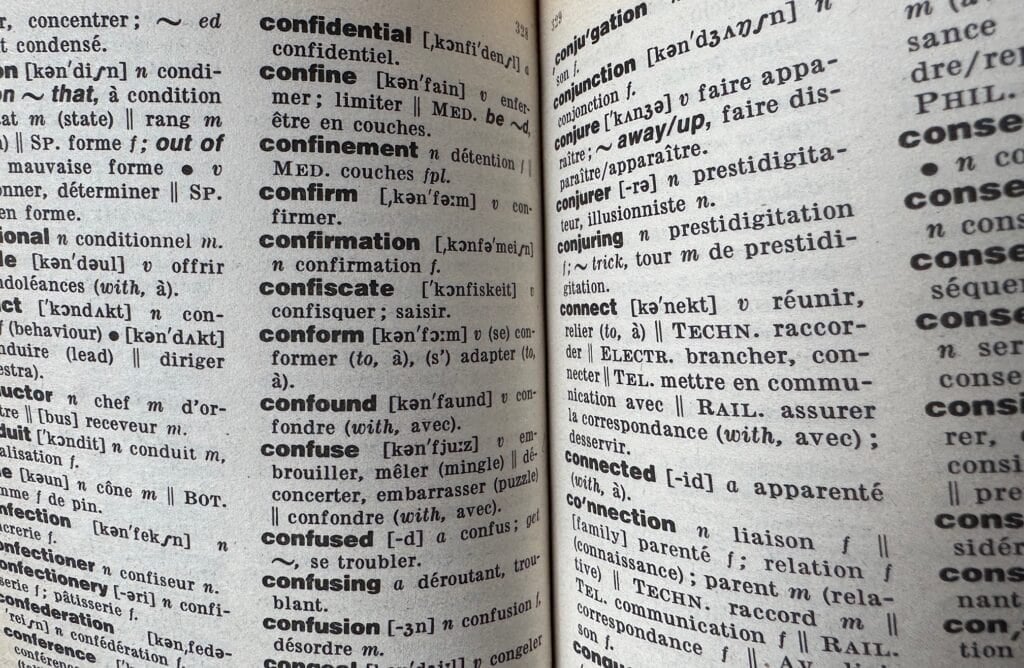
Photo taken of an English to French dictionary by your truly. 

Did you enjoy this article? TAIP is 100% reader-supported through tipping. If you want to leave us a tip of any amount it would be highly appreciated.  These tips help support our efforts to keep TAIP an ad-free environment. Just like at a cafe, the tips are split evenly among the team.

Building in Nice

Living in France as a Retiree: Part 3: Taxes and Succession

Don’t miss Part 1 and Part 2 of this series on Living in France as a Retiree

France has rather rigid laws, especially when it comes to taxation and succession. They are also quite unclear. Disclaimer: I am not an attorney, nor an accountant. However, I can inform any prospective retirees on issues to look out for. I used some of my own experience, but also that of other immigrants from the US to France with different financial and family situations.

Note of caution: French attorneys and tax accountants who deal with Americans tend to ask for a lot of money, and their advice is not always crystal clear. I don’t want to make a sweeping assumption, but this has been our experience.

Another note of caution: Laws change.

No Double Taxation

Who is a French tax resident? The French government uses several factors to determine whether or not you are a resident for tax purposes. A rough rule of thumb is that if you intend to spend more than 6 months of the year in France, you will probably be considered resident for tax purposes.

The good news is that there is a treaty between the US and France, and retirement income, at the very least, is not double-taxed.

Trusts

Many Americans have trusts. France does not recognize US revocable trusts as “transparent” for tax purposes, so every time you change or take a distribution of funds held in a trust, you will have to declare it to the tax authorities within 30 days. The penalties for not doing so are steep.

The current default position is that distributions are automatically treated as income and hence taxable. The onus is on you to prove that distributions are not income and thus not taxable, which means you will need a full accounting trail of the funds. If you have a revocable trust, you should consider removing any financial assets from the trust prior to moving to France.

Joint Ownership of Property

If you are buying property jointly (e.g., you and your spouse or partner), there are three ownership options:

1. En Indivision (Standard Joint Ownership)

This is the default and most common method. Each person owns a specific share (e.g., 50/50 or 60/40) based on their financial contribution.

  • Pros: Simple and flexible; reflects actual financial input.
  • Cons: If one (legal) partner dies, their share is subject to French inheritance laws. This means children (including those from previous relationships) automatically inherit a portion of that share, potentially making the surviving partner a co-owner with their children or stepchildren.
  • Best for couples with no children, or those who are comfortable with their children becoming immediate co-owners when one of the partners passes.

2. En Tontine (Survivorship Clause)

A specific clause is added to the sale deed stating that the survivor is deemed to have owned the entire property from the start. This needs to happen when the property purchase occurs.

  • Pros: The surviving partner becomes the sole owner automatically, bypassing “forced heirship” for that specific property. The children cannot claim their share until both partners have passed away.
  • Cons: It can be difficult to undo if the couple splits up, as both must agree to cancel it. There may also be higher tax implications if the property value is high and the couple is not married or in a PACS (official civil partnership)
  • Recommended for unmarried couples or those with children from previous marriages who want to ensure the survivor stays in the immediate family

3. SCI (Société Civile Immobilière) (Limited Liability Company)

You set up a French LLC to buy the property. The couple (and their children) then owns shares in the company rather than the real estate itself.

  • Pros: Offers the most flexibility for succession planning. Shares can be transferred more easily than real estate, and they can help non-residents manage French inheritance taxes.
  • Cons: Higher setup costs and ongoing administrative requirements (annual accounts). The shares must also be declared to the IRS every year.
  • Recommended for high-value properties or complex family situations where you want to avoid certain French succession rules.

Comparison of Couple Status & Protections

Status: Married

  • Inheritance Tax: Exempt (0%)
  • Automatic Rights: Strongest; can use a Communauté Universelle contract to protect the survivor

Status: PACS (Civil Union)

  • Inheritance Tax: Exempt (0%)
  • Automatic Rights: No automatic inheritance. You must write a French will, or the partner gets nothing

Status: Cohabiting

  • Inheritance Tax: 60% (yes, you read that correctly!)
  • Automatic Rights: None; the surviving partner is treated as a “stranger” for tax purposes

Inheritance Tax on Worldwide Income

When a French tax resident dies, their entire worldwide assets will be taxed by the French authorities. French inheritance tax rates and allowances depend entirely on the familial relationship between the deceased and the beneficiary.

  • Spouse/Civil partner: Fully exempt from inheritance taxes
  • Children/parents: biological, adopted: €100,000 tax-free allowance; above that threshold, a sliding scale: 5% to 45% (progressive)
  • Siblings: €15,932 tax-free allowance; above that threshold, a sliding scale: 35% to 45%
  • Nephews/Nieces: €7,967 tax-free allowance; above that threshold, 55%
  • Unrelated/Friends: €1,594 tax-free allowance; above that threshold, 60%. This category includes unofficial life partners, as well as stepchildren you may have raised, but are not officially your children

More notes of caution:

  • It is important to verify that adopted children will indeed inherit just like biological children; it isn’t always the case, especially if they were adopted as adults.
  • If you have a joint bank account, the wording in the title can determine what happens upon the death of one account holder. It is best to verify this when you open an account.
  • In France you cannot “disinherit” your children. If a couple jointly owns a property and one partner dies, the children of the deceased partner have automatic ownership rights on a portion of the assets and property of the deceased. This cannot be overridden by a legal contract.

The above is not a comprehensive account of all the details. However, at least this article can help retirees avoid some pitfalls and be prepared.

Photo of a building in Nice

Did you enjoy this article? TAIP is 100% reader-supported through tipping. If you want to leave us a tip of any amount it would be highly appreciated.  These tips help support our efforts to keep TAIP an ad-free environment. Just like at a cafe, the tips are split evenly among the team.

Applying for a Temporary Work Visa, TAPIF Edition

I am approaching the end of my second year teaching English in France as a language assistant through TAPIF, the Teaching Assistant Program in France. You can learn more about the program or read my demystifying reflections on teaching in France, respectively. However, today I want to zoom in on the visa application process that takes place after acceptance. This was extremely intimidating to me the first time I applied. My second go around, I took it so casually I almost messed the whole thing up. You could say I’m like Goldilocks, over-prepared, under-prepared, and finally — just right.

What Do You Need?

Language Assistants through TAPIF are eligible for a visa travailleur temporaire P2 VLS-TS. It is generally good for eight months, from September to June, depending on your personal travel plans and the entry date of the plane ticket presented by the assistant at the appointment. Considering that the work contract is from October to April, this leaves about a month buffer on either side of teaching. The golden ticket for this visa is the “arrêté de nomination” (official work contract) signed and provided by the language assistant’s hiring academy. An academy in France is the equivalent of a regional school district. These work contracts are distributed on ADELE, the teaching assistant application platform. In the best-case scenario, a hiring academy will provide this before the August vacations start, and most teaching assistant managers (though not all) are sensitive to the need to provide it sooner rather than later. The visa application process should not be launched until you have this in hand. 

Choosing a Visa Center

As of 2026, there are ten French visa application offices in the United States operated by TLS Contact, an outsourced management company. The office closest to me during both years of application was in Houston, Texas. In 2024, the building was dingy and cramped. I honestly wondered if I had the right address on my arrival. In the second year in 2025, the French application center had a change of address, and the building was remarkably well kept with less overlap of services between other countries. There was even free sparkling water and coffee in the waiting room, but you didn’t hear it from me.

The Timeline

Given the longterm cooperation of the US embassy with this program, the documents required for application are admittedly less than for other temporary situations. For example, language assistants don’t need proof of prior accommodation nor pay the TLS appointment fee. In 2025, a fee exemption letter was provided by my employer that I emailed to TLS upon booking my appointment through their portal. I received my work contract in July, which then permitted me to launch my visa application through France-Visas and to book a TLS appointment in August, roughly one month before my purchased flight to Paris in September. The tightness of this timeline certainly gave me reason to stress, but both years I received my temporary visa (a sticker inserted into my US Passport) by mail within a week of my appointment date with no issues. 

Confessions

My first year of application, I had all my ducks in a row. The second time around, I made the blunder of forgetting to hit the final submit button on my visa application until 72 hours before my appointment. You may wonder, how did that happen? I forgot that in the application process, when you are triggered to book an appointment with TLS, it requires you to exit the France-Visas website. After registering your visa application number and booking your appointment with TLS, the person is required to return to the France-Visas website to hit submit a final time. I was traveling at the time of submitting my paperwork and I’ll blame my error on being out of my normal environment and therefore, slightly distracted. A few weeks later, I double-checked my submission the week of my appointment to make sure that everything was correct. That was when I realized my mistake. I hit submit and thankfully there were no issues at my appointment three days later. I would not recommend testing the system as I have.

Other Tips

Both years, I opted to have my visa photo taken at the TLS office during my appointment. This removed the stress of wondering if an outside-provided photo would have been accepted, due to lighting, hair placement, recentness, etc. This extra service is totally worth the $20 charge and took less than a minute on site. Come to your meeting with extra copies of your proof of work (diplomas, emails, plane ticket receipt, and that golden arrêté). You’ll be grateful when you don’t need the extras, and even more so if you do. Lastly, take a deep breath. You’re gonna be just fine. 

Photo by Ian Taylor on Unsplash

Did you enjoy this article? TAIP is 100% reader-supported through tipping. If you want to leave us a tip of any amount it would be highly appreciated.  These tips help support our efforts to keep TAIP an ad-free environment. Just like at a cafe, the tips are split evenly among the team.

Coming down Mont Boron in Nice

Living in France as a Retiree: Part 2: Health Insurance, Medical Care, and Nursing Homes

Don’t miss Part 1 of this series on Living in France as a Retiree

Health Insurance

When you first apply for your long-stay visa for your first year in France, you are required to prove that you have health insurance. The less expensive way of getting it, for me, was via the visa website; it cost about $500 for the entire year, but it was not comprehensive, i.e., not for preventive healthcare, but rather for emergency situations.

Be aware that basic Medicare covers nothing outside of the United States. Some supplemental plans may cover expenses in other countries after a deductible is met.

After you have been residing in France for three months, you can apply for a numéro de sécurité sociale (social security number, which is not the same as Social Security in the United States). You’ll need proof of residence, a birth certificate, and your passport/visa. Usually the application is mailed to the local CPAM office. CPAM (Caisse Primaire d’Assurance Maladie: national health insurance) will probably request additional information by mail or have you fill in a questionnaire. 

The process can be quite daunting and appear illogical. You may be asked for the same document again and again, and then suddenly discover that you’ve been covered for a year! (You can request reimbursement for expenses incurred in the meantime.)

To apply:

  • Your name must be the same on your birth certificate and your passport. If not, you will need to prove that you are the same person through your consulate, and if there’s no consulate only an embassy.
  • If you live with someone without being married or “PACS‘ed” (officially partnered) you may be considered a concubine. It doesn’t have the same connotations as in English, or at least it’s not limited to those connotations. 
  • The CPAM agents usually answer any questions you may have on the phone, and while they are very polite they have little time to speak at length. Telephone number: 3646 (within France). You can request an English speaking agent when you call.
  • You’ll need a French RIB (Relevé d’Identité Bancaire, or bank identity) in order to be reimbursed.
  • To find your local branch, use the Adresses et Contacts (addresses and contacts) section on the Ameli website.
  • More information on French healthcare in English.

Once you have your French social security number, you must request the carte vitale, the health insurance card, which will then be mailed to you. The card is used by medical providers to enter your information, when you fill a prescription or visit a doctor.

Some areas of France are medical deserts, with few medical facilities. In larger towns, you’ll find many hospitals and medical practices, but wait times for specialists can be long and some don’t accept new patients. In Nice, where I live, it’s hard to find a dermatologist — they are often busy with cosmetic procedures!

There are different tiers of medical practices; for some, you don’t need to pay anything over the basic reimbursement offered by health insurance; for others, you’ll pay more. For tier 1 medical practices, you will often pay nothing out of pocket; the national health insurance will handle it.

You can also buy supplemental insurance, through a mutuelle, in a dizzying array of levels. A basic mutuelle subscription might cost €40 a month, and help pay for hospital stays, which can be very expensive. Higher premiums will help pay for hearing aids, glasses, higher-tier medical practice fees… the second year, I used a broker to help me choose.

Nursing Homes and Assistance for the Elderly

In the US, nursing homes often cost much more than many of us can afford, especially in larger cities on the coasts. In France, they are not inexpensive, but appear to be more affordable. There are a variety of systems.

There are senior living facilities for seniors who are well enough not to need assistance, mainly for people who would like to have a community, and in-house facilities.

EHPADs (Établissements d’Hébergement pour Personnes Âgées Dépendantes) are like our medicalized nursing homes. They are meant for people over 60 who need daily assistance. As far as I know, in 2025 they cost about €4,000 a month, but it varies. If you don’t have enough income, you may be able to stay at a lower cost, but when you pass, the difference will be taken out of your estate.

  • Public (government-run) homes cost less than privately-owned homes (nonprofit or for profit).
  • For more information (in French)
  • For a list of locations separated by area: Assistance Retraite (in French)

There are also agencies offering in-house care for a fee. I’m not sure, but if your income is below a certain level, and you are disabled or recovering from a hospital stay, you may be eligible for help paying for a nurse or a cleaning person.

In general, France is a good country to age in, once you have surmounted the bureaucratic hurdles! In my personal view, single-payer insurance is much better than the US system of many disparate for-profit insurance companies, especially as so many get left behind.

Some additional informational websites:

Photo of Mont Boron in Nice

Did you enjoy this article? TAIP is 100% reader-supported through tipping. If you want to leave us a tip of any amount it would be highly appreciated.  These tips help support our efforts to keep TAIP an ad-free environment. Just like at a cafe, the tips are split evenly among the team.

paris skyline

Finding an Apartment in Paris; It’s Not Them, It’s You. Tips to Secure Your Dream Digs

You’ve dreamt about this day for way too long. You’ve resent your application via La Poste (twice), you’ve signed the textbook-thick lease, and you’ve finally been given the keys to your dream Parisian home.

You walk up the 5 (read American 6) flights of stairs with a grin from ear to ear because when you reach the top level and insert that irreplaceable key into that beautiful door, you KNOW, it was all worth it.

Now lets go back, about 3-6 months, cue rewind montage.

Your time is ending in your Airbnb that you had to rent to fulfill the visa application requirements. You’ve had a great time playing house and are looking forward to bringing your own place to life with your own essence. But, where do you start?

Some might think you started a few weeks before you even moved over! But things are a bit different in our dear Paris. You see, finding an apartment in Paris, as a foreigner, is like finding a dinosaur fossil at an archaeological site. Not impossible, but it’s going to take time and you’re gonna need a fine-tooth comb. Yes, laugh, it’s okay, you’ll need to laugh to survive through this. 

Start Your Search

You have several options. The most popular route is renting a furnished flat through an agency. This is also the most expensive option because the rentals are overpriced from average, the furnishings are usually comfortable, but sometimes unkempt, and the agency takes a comfortable commission. The pros are that all communication is in English, you can access an online catalog and view the apartments online, making it much more streamlined to choose a place and have a “home” before you even step out of the CDG airport. A big con is that you don’t actually see the flat, or even the area in person, and that could yield an unfavorable disposition. Once you’ve signed a rental agreement, it’s nearly iron-clad, so breaking it is not much of an option.

Now, if you know a few things or two and are comfortable with speaking French, you might try your hand at sourcing a place on your own through the French version of Craigslist, Le Bon Coin. Here you can not only find your next dream apartment, but also a bicycle, clothes, instruments; absolutely anything under the sun has been or could be sold on Le Bon Coin. As the adventurous writer of this piece, who did not know a few things, I decided I didn’t need an agency and tried going down the rabbit hole of apartments listed by locals. And may I say, what. a. journey.

The Dossier

There are many inner workings to locking in a place, much more than scheduling a visit and meeting the owner. You can’t get any traction forward without a dossier, your application packet, essentially. You’ll learn quickly in this new French life that your dossier will be an invaluable collection of paperwork that you’ll use for finding a home, a job, opening a bank account, and more. The French like everything on paper and it’s important that you look excellent on paper.

But your experience and income may not translate through the language barrier. And if you don’t speak French, it will be difficult to garner confidence and gain trust that you, a foreigner, will be a worthy tenant who will never falter in paying their rent. If you’re wondering, no, I did not speak French at the time. It was just me and my blind confidence leading the way.

Asking For Help

After several weeks licking my wounds, I accepted that I needed a professional’s assistance, but I could not stomach paying the exorbitant fees of housing agencies, so I found a middle ground. A property search agency, Chasse immobilière, for freelancers and foreigners works exclusively with local realtors that speak English and know how to prepare an application packet best suited for a freelancer, non-native speaker, non-French person, and every other outside of the box scenario. They go through their network,  Le Bon Coin listings, and different realtor agency listings from all around the city (or country if you’re looking outside of Paris). I was fortunate enough to connect with a local realtor who sent me so many listings, made appointments, handled all communications with the owners, and honestly took off all of the burden. I just had to click through the photos, say yes or no, and we’d meet to view the listing. Thanks to her, I found my absolute dream apartment. With the big Brown door, on the top floor, with the gold lock, the ancient elevator, and the most Parisian view. There is a fee for this service, but I felt better knowing part of it went directly into my realtor’s pocket.

There is no wrong way to look for a home in Paris, but there are many more efficient ways, and I can’t recommend enough to consider hiring an agency to help you with the search. Alternatively, I’d be happy to recommend my realtor, now turned dear friend, who knows Paris inside and out.

Whatever path you choose, rest assured that your dream maison is waiting for you. Your Parisian home is only just around the corner.

Photo by Brian Potter

Did you enjoy this article? TAIP is 100% reader-supported through tipping. If you want to leave us a tip of any amount it would be highly appreciated.  These tips help support our efforts to keep TAIP an ad-free environment. Just like at a cafe, the tips are split evenly among the team.

View of Nice

Living in France as a Retiree: Part 1: Participating in Daily Life in France

In two previous TAIP posts (here and here), I explained all the steps needed to start a life in France as a retiree.

In the next three posts, I will explain what you need to take into consideration… very carefully. There are issues that may change your mind, much as you’d like to move to France. 

Public Transportation and Driving

In many parts of France, even in smaller towns, there will be some type of public transportation, even if it’s just a small bus. There are, however, areas such as small villages where buses may be scarce or even nonexistent, and in such cases you will need a car.

I live in Nice, in the city (albeit not downtown), and transportation is very good, especially the closer you are to the coastal area. As a senior citizen, you can get half off the monthly or yearly card. If you use buses and trams every day, transportation becomes very cheap. In a city like Nice, you can also walk to many places (good for your health!). Otherwise, one ride costs 1,70 €  — still not bank-breaking.

Paris and the surrounding areas have a fantastic transportation network: the famous métro, the very fast RER, and many SNCF trains further out to Fontainebleau or Beauvais (where there is a small airport mostly used by RyanAir).

If you need to drive (or just want to drive) and your US driver’s license is not from a state that has an agreement with France, after a year of residence you’ll have to get a French driver’s license. That is an expensive, time-consuming, and difficult proposition, albeit useful to understand French driving laws. If you don’t want to go through that, you need to plan at least a year in advance to obtain an accepted driver’s license, which could entail establishing residence in another state. You’d be surprised which states are not accepted, such as New York and California!

Note: Before you cancel your US car insurance, ask for a letter that shows your claims history (in theory, 14 years’ worth). Otherwise, you’ll be treated as a beginner driver when you buy a car and need to get insurance.

Participating in Demonstrations

Some of us are more political than others. We may wish to march in the street for a variety of reasons, but we have to be prudent when we are not in our own country (even in your own country you have to be careful, but that’s a different story for a different day). I read about an Italian semi-well-known person who was deported from France after she was seen demonstrating, even though she is a citizen of another European Union country; that surprised and worried me.

The good news is that French police are usually (not always) not too aggressive. I have seen demonstrations go by and the police remain close to observe in case of a problem. Otherwise, I have not seen them interfere.

Learning and Speaking French

If you never learned any other language than English in your life, it’s not easy to start learning French as an older adult. But if you are really motivated, you can reach a reasonable level of fluency. It will usually take several years. If you’re in a village with nobody around who speaks English, fluency will be achieved much sooner.

You cannot afford to be ashamed of your pronunciation or incorrect grammar. Practice is key, but so are good classes. It’s hard not to be discouraged when you are convinced you’re saying “une demi-baguette, s’il vous plaît” (a half baguette, please) correctly, and the boulangère (the baker or bakery lady) keeps on saying “Je ne comprends pas” (I don’t understand). Do try practicing “millefeuille” if you love Napoleons! 

There are classes for all kinds of budgets, from a private school in Villefranche to the free version of online language courses. Each person will find their fit according to their budget and learning style; more expensive doesn’t necessarily mean better, although some outlay of cash is necessary, as Duolingo, for one, only goes so far (but it’s a good start). 

Similar to Duolingo, there is Babbel, and several more. I have started using Skool, which has human instructors; this keeps you on your toes. Lawless French is another fantastic tool; Ms. Lawless is a stickler for grammar. Grammar is very important in French, and very complex. The main Lawless French site is free, and there is a paid Kwiziq add-on which is excellent (but don’t believe it when you are told that you have reached C1 level). And of course, there are many private instructors, in person or online. In the US, I used to teach via TakeLessons.

I’ve looked into YouTube videos, and it’s a mixed bag. Learn French with Alexa has proven useful to me as a French teacher. You can thank her by subscribing to her Patreon channel. Videos from some other creators had me seething with rage as they’re just clickbait.

Stay tuned for Parts 2 and 3 on health insurance and medical care as well as taxes and succession laws!

Photo of a view of Nice from a hill.

Did you enjoy this article? TAIP is 100% reader-supported through tipping. If you want to leave us a tip of any amount it would be highly appreciated.  These tips help support our efforts to keep TAIP an ad-free environment. Just like at a cafe, the tips are split evenly among the team.

True or False: Teaching English in France

When I first learned of TAPIF, the Teaching Assistant Program in France, it was the fall of 2023. I had been on the hunt for a way to work in France for a few months by that time and meeting someone who had done the program felt like an answer to my prayers. At the end of the day, whether or not teaching English was my passion, this was a short-term work contract that required a minimal level of French to give living in my dream country a go, without selling my freedom to a family as an au pair. Now, in the middle of my second year of teaching English in French public schools, you could say I’ve lost some of the starry-eyed perspective I had at first. Nonetheless, I can tell you I would do it again. 

TAPIF is the American Embassy’s face of a French government program that solicits young people from all over the world to teach their native tongue in French public schools. The program currently partners with 77 countries and in 2024 welcomed 2,992 language assistants to France from all over the world. Currently, applications for the next academic year are open to young professionals between the ages of 18 and 35. To learn more about TAPIF, its requirements, and this year’s deadlines, visit their official website here.

Thinking back to myself scouring the internet for information on TAPIF around this time just a few years ago, I am going to endeavor to give an honest and clear-eyed review as a second-year assistant. Bursting the bubble where necessary and reinforcing suspicions as able, here are some conclusions (true & false) that I have drawn from my experience. Let’s start with the false.

1. The program provides a livable wage.

False. During my first year, I burned through my savings with incredible speed. Inflation has hit France, and the wage of an assistant has not sufficiently taken this into account. About half of the 830 euros that hit my bank account each month go to pay my rent, and the other half pay for my groceries. Considering what it takes to move and settle into a new place, not mention in a new country, other expenses in the first two months should be expected. With six weeks of paid vacation during the school year, one naturally is going to want to travel, which is also not free. The French Education International boasts that language assistants have the right to demand lodging assistance by means of the CAF. However, even if you have your renter’s contract and all your paperwork submitted by October 1st, the wait for approval could be upwards of 2 months before receiving additional aid. 

2. It is a sustainable way to begin a long-term move. 

False. The proposal of TAPIF is not truly sustainable. It has a 3-year limit for renewing assistants and they clearly advise $3,000 in savings on top of the plane ticket to get here. Each year, assistants are obliged to return to their native country to renew their temporary work visa, an expense that is assumed by the assistant. Additionally, if French citizenship is the goal, you’ll need a long-term visa with renewable options. TAPIF is not that. Your yearly clock towards citizenship will not start with this program.

3. The paid vacation is generous. 

True. Today I am writing on day one of a two-week break in the middle of February, one of the four vacation periods that occur during the language assistant contract from October to April. Instead of favoring an extended summer, the public school system is built on six-week cycles that give students and teachers an opportunity to rest and refocus between periods. Being on paid vacation in Europe is certainly not a bad deal. I’ve taken advantage of these times by visiting many different parts of France, as well as its neighboring countries.

4. You will grow. 

True. One’s French can only improve in proportion to one’s courage to use it. In any case, you’re going to strengthen your resilience as you navigate French bureaucracy and the general discomfort that comes with living in a new country. Nothing causes growth like getting out of your comfort zone. I can assure you that living in a foreign country will mean getting out of your comfort zone.

5. It is the experience of a lifetime.

True. I have made friends for life and found a community that has become like family. This is by no means the experience of all who participate in TAPIF, but if you come with an open heart and seek out opportunities to integrate, you may just be shocked at the warm welcome you find. I was quick to join a choir, seek out a community of faith, and find other opportunities to explore my personal interests locally. I don’t know of an easier way to work less than part-time in a country as beautiful as France. Your bank account may not thank you, but your memory bank certainly will.

Have you participated in TAPIF or another teaching program in France? Share your wisdom with our community below. 

Photo by Ben Mullins on Unsplash

Did you enjoy this article? TAIP is 100% reader-supported through tipping. If you want to leave us a tip of any amount it would be highly appreciated.  These tips help support our efforts to keep TAIP an ad-free environment. Just like at a cafe, the tips are split evenly among the team.