a bicycle basket full of letters

When the Police Seize Your Bicycle: Part 2

What to do to avoid wasting time and energy if and when…


In April, five months after the police had seized my bicycle and broken my locks, I was “regretfully” informed that they found they were in no way responsible for this (costly for me) degradation of my property as the act was carried out in the name of security (which gives them any-and-every right to do whatever they want?). Originally, I gave up my quest for reimbursement figuring it was too hard to fight City Hall.

However, City Hall did not stop there and for some reason, the machine continued to churn. This prompted me to take up arms again and I can now share my learning experience of how to go about getting compensation for damage to property due to police action. 

At the end of May I got a letter from the Ministère de l’Intérieur et des Outre-Mer. In fact, while the Secretariat général pour l’administration Service des affaires juridiques et du contentieux had refused my quest, it was in fact the Préfecture de police de Paris – Dirction des usagers et des polices administratives – Bureau de la réglementation et de la gestion de l’espace public- Pôle réglementation et affaires juridiques to whom I should have sent my file. I was then invited to write to them.

I had let this sit a while. Just as I was going to address the question, about two months later, I got another letter from the Secretariat général pour l’administration at the Préfecture de Police inviting me to appeal the rejection within two months.

This got my dander up and I started to prepare a file to do so. I called the legal aid number attached to a magazine subscription I have and had a long talk with her. She found that the State was responsible for all damage to my property and suggested I even call the legal aid that comes with my house insurance. I decided to work on it myself for a while and looked up how to write letters of appeal online and found help here and here.

Then lo and behold, a week later I got a letter from the Secrétariat général pour l’administration offering me compensation, the sum of which was equivalent to the price of my two new locks. 

Getting Your Bike Back and Reimbursed for Damages

When police seize your bike for whatever reason, it will be brought to the commissariat of the arrondissement where it had been picked up. The only solution is to go there.

Once there, take pictures of proof of any damage, e.g. broken locks. Then go in to pick up the bicycle. You will be asked to sign the register. Insist, however, to draw up an état des lieux, or a description of the damages. You may have to insist very heavily, and even receive a rejection. Do not leave the commissariat without some written proof of their taking your bike. Refusing to leave, I finally got  a very ambiguous Mention de Service which did not recognize the damages, but could get nothing better (at approximately 10pm). It stated that “supposedly” (selon ses dires) three locks had been broken. Nobody was going to go out with me to check, although it would have been preferable to get a written statement of the damages. 

The next step is to collect every type of proof to defend the fact that you have been mistreated by the French administration, and to what measure: pictures, receipts for damages, proof of the seizure…

Then, take your file to the police department to lodge a complaint. It is illegal for the police to refuse a person’s complaint. If, like for me, they do refuse (I did not know that this was illegal), take a shot at another commissariat, for example the one your home address depends on, and try again.

Once you have established a nice, thick file, send your file registered mail with acknowledgement of receipt, along with a clear, polite explanatory letter of the circumstances, your grievances and a request for compensation to the Préfecture de Police, Service des Affaires Juridiques et du Ceontencieux, Bureau de Contencieux de la Résponsabilité  of the département where the bicycle was seized. If picked up in Paris, the address is 1 bis rue de Lutèce, 75195 Paris Cedex 04. 

Keep the tracking number, watch your mailbox for the acknowledgement receipt, hold on to it very carefully… and wait.

Obviously, in the simple Manichean universe of French administration there are only two possibilities: either they will offer you compensation, or they will refuse.

In the case of a refusal, you will be given two months to appeal. It will be best to get some competent French advice on how to phrase the responsibility of the administration not to damage private property. And again, the full file of documents should be sent along with your request to review the case again.

Should you be lucky and be offered compensation, bravo! This, of course, is not automatic. Be sure to read both sides of the letter and fulfil the requirements scrupulously. This includes signing two copies of an accord indemnitaire to be sent along with bank details and a copy of an ID card. 

Send in all the requested documents, with a polite message that you are responding to their letter. Again, post it registered mail with acknowledgement of receipt.

And I did all that. A little over a week later, I got another letter from the Préfecture de Police. Was this finally my check, although they had asked for bank identification? Of course not. It was one of the copies of my signed agreement to the compensation offered, this time with the signature of the Préfecture. Obviously what they had sent me previously was an unsigned form; the police don’t sign it until after they have our signature, never first. And still I waited for my money. 

Finally, the money arrived in my account a week later. For a process that began in November, a happy ending ten months later in September of the following year.

Of course, the best solution is to avoid having your bicycle seized at all. When I arrive somewhere, I might go all around the block to look for official bicycle racks to attach my bike these days. No lampposts or other railings for me.  

And, what the heck? I have chalked up this traumatic event to another learning experience in France.

Photo of said seized bike and some of the correspondence I’ve received about it.

Did you enjoy this article? TAIP is 100% reader-supported through tipping. If you want to leave us a tip of any amount it would be highly appreciated. These tips help support our efforts to keep TAIP an ad-free environment. Just as at a cafe, the tips are split evenly among the team.

When the Police Seize Your Bicycle

It was a great evening, an invitation to the opening night of the Fine Arts Biennale at the Grand Palais Ephemère. The works for sale were museum-grade (with prices to go with them!) and champagne was being served to one and all. There is no better way to enjoy fine art than with a bottomless glass of champagne in hand!

But then, a whole section was cordoned off and an enormous crowd had formed; Macron had arrived. No sweat. I had visited the whole fair and was about to leave. When I finally retrieved my things from the cloakroom and got outside, there was the first hint of trouble. Macron was leaving with his eight-car cavalcade (we, the taxpayers, pay for all these cars, gas, and people for a single person to visit the fair) and we could not cross the driveway where his car and his court of cars were about to leave the underground parking lot. And my bicycle was just on the other side of that driveway.

And even worse, my electric bicycle was no longer attached to the railing I had locked it onto. What to do? The police informed me that the bicycles in the area had been taken away (in case of a riot, someone could take off a front tire and throw it at the president was the reasoning). I would find the bike at the Commissariat de Police of the 7th arrondissement, a 20-minute walk away or two metro stops and a walk. And all I had wanted to do was to get home and nurse my champagne high.

A cold walk in the dark later, there I recognized my bike chained up outside the commissariat. I was received inside by a young, indifferent police officer, who wanted nothing better than to see my back. But I wanted proof that the police had taken my bike for I wanted someone to pay for my broken locks. I was told to go the next day to the Town Hall of the 7th arrondissement and ask for the Contencieux. Fully aware of the need for proof for any administrative undertaking, I insisted on getting an official paper stating that the police had taken my bike. The officer handed over the night’s register of events and told me to take a photo which I duly did. But not finding it official enough (Hey! What’s a telephone photo worth? Although, in fact, later I learned that it was so official that it was illegal for me to have a copy!) I persisted in demanding a signed document asserting that the bike had been taken by the police and the locks broken. This I got, in the form of a letterhead document in administrative ambiguity.

When I finally got my bike unchained and started off, I found the front brake did not work at all. So I tried to get back into the commissariat, only to be told to come back the next day to file a complaint. Thus, home I pedaled with a simple back brake should I need to stop, the champagne euphoria of the evening long gone from my system. 

The next day armed with copies of the register, my receipts for the locks, the “main” document, and pictures of the broken locks in the bike basket in front of the police station, I left my far-flung home in the 20th arrondissement to cross Paris back to the chic 7th arrondissement town hall.

“No, Madame, there is nothing we can do for you. We do not handle such problems. You must telephone the Contencieux and explain the matter.” 

Putting the next turn of my administrative peregrination on hold for another day, I decided that while I was in the 7th arrondissement I might as well return to the police station to file my complaint against the police. 

At the entrance to the police station, I was questioned as to my reason for being there. The statement that I wanted to lodge a complaint against the police did not go over well with them. Unwilling to allow me into the station, they asked for proof concerning my bike’s removal, and at the shock of seeing my copy of the night’s register, which should in no way be in the hands of unauthorized individuals, they accompanied me to the information desk and duly confiscated the paper. 

At the information desk, I was greeted with disdain and a refusal. I was, of course, not in the right place, but in fact had to go to the “Contencieux.” As one person was trying to find where, in fact, I should address my complaint, I insisted with another that the night police shouldn’t be sending law-abiding citizens all over Paris to the wrong places and that we should be informed correctly, I was given all the reasons no fault could be found on their part which freed them not to take action: “It has nothing to do with us.” “They have their “chef” who should take care of them.” “We don’t see them as we don’t work at the same time….” To get me gone, they printed out an information sheet with whom I should contact.

Intrepid, the next day I took the risk and bicycled to the Musée d’Orsay. But not totally unconscious of possible peril, I stopped on my way home at my favorite bicycle repair shop to get the brakes taken care of. Obviously, the bike had been badly manhandled; the cable had been totally detached from the front brake. They fixed it in a jiffy while I aired my discontent with Macron and the police.

However, it seems that my administrative scavenger hunt was not over. While they sent me to call the préfecture, which I did, and after following all the six steps of pressing at least one of two numbers to choose from, none of them corresponded to the Contentieux. So I simply pressed for the switchboard. Surprisingly, they answered within seconds, put me through to someone who had nothing to do with the Contencieux, who then, finally put me through to someone who was well-informed on how to go about getting my dégradations de véhicule reimbursed. It had, like everything else, nothing to do with the telephone numbers I had originally been given. As at the commissariat, I mentioned that everyone should be informed correctly as to the procedure. He answered that they had been, but the recipients did not seem to have paid any attention to the information. It was then his turn to complain, that he was tired of getting phone calls like mine and having to waste his time which could be better spent. I commiserated profoundly and he gave me the correct e-mail address (no telephone) at, in fact, the service des affaires juridiques et du contentieux

I immediately got to work on the email explanation of the case complete with receipts, pictures, and official documents. An hour later I sent it off to my son to correct the French: no errors allowed in any official correspondence if we want to be taken seriously.

Three weeks later, no response. So I sent the email again asking for a confirmation that it had been received; a notification came back immediately that it had gone through. 

Tonight, five months later, to my great surprise I have received a reply. In predictable bureaucratese, they are sorry to inform me that “the outcome of the investigation in accordance with the elements which have been communicated by the judiciary authorities whereby the removal of [my] bicycle had been carried out by police services to ensure security near this sensitive site … that [they] cannot reserve a favorable follow-up of my application to be compensated, since no heavy fault by the public services of justice has been characterized” (my word-for-word translation). And if I disagree with this outcome, I can take them to court.

But we all know what happens when we try to fight city hall. Thus, a sad end to a story whose moral is: keep yourself and your bicycle as far away from Macron as possible, and don’t park any place near where he might want to drive by.

Photo is the picture of my bike the police kindly asked me to take the night it was damaged.

One Last Step Before Applying for Citizenship

I’ve been following forums and Facebook groups more closely in the last few years, knowing I was going to be applying for citizenship soon. There are some areas of the country that have notorious reputations for that process. Montpellier, for example, has been known to have a five-year average waiting period from depositing your dossier to your interview. For some years Paris had a 18-24 month reputation, which all things considered, wasn’t too bad, and since I had spent the majority of my French life in Paris, I had set that expectation in my head for years.

But that changed with Covid and the dematerialization of the citizenship process.

Now, with the possibility of submitting everything online (you used to have to make an appointment and deliver everything in a folder in person, and if there was anything not satisfactory you were sent back to get it and had to make a new appointment), Paris was, by all reports, consistently tracking at 6-8 months, whereas the Department where I was living, Seine et Marne (77) was tracking at 18 months. Save a year by moving back to Paris? No brainer.

Except I didn’t end up saving that year, for what should have been the simplest of changes, but ended up being a nightmare instead.

For context, I’ve been dealing with the French authorities for more than a decade now, and have become so comfortable that I charge money for consultations and have written a book about how to move to France. But France always finds a way to humble those who think they have it all figured out.

Turns out, the nine-month delay (cutting into the 12-month savings I thought I was going to get by making the change to Paris) I ended up experiencing in turning in my citizenship dossier was held up by a dual address change, one for me, one for my business. Let’s start with the simpler one first.

Personal Address Change

Now I’m not talking about the regular “civilian” logistics of changing your address which include notifying your bank, etc. That’s covered in this article. This about an administrative address change, which is different from a simple postal address change.

So what’s the good news? There’s a dreamy new website that, while not perfect, makes the whole process of living in France as a foreigner so much easier. The Etrangers en France website allows you to:

  • Apply to renew your visa
  • Apply for French citizenship
  • Ask for a work permit
  • Apply for a new card because
    • You lost your old one
    • You changed your address
    • You’ve gotten married (or divorced)
  • You need a travel document (this is for people with special statuses, like refugees (TVE) or minor foreigners (DCEM)

So I put in for the address change and it took under five minutes to submit the form. My experience with the French told me it should take 2-3 weeks for them to process this.

Wrong.

I submitted in March 2023, hoping to pick up my card in May. Instead, in late April, six weeks after my initial submission, I messaged them, asking (with typical French politesse) if perhaps this had gotten stuck in the system somewhere. Within 48 hours, I was told that the change would be made. Just like I had done many years ago when I stuck a post-it note to a letter to the Carte Vitale folks, a simple short follow-up nudged my request out of the gears of bureaucracy into which it had fallen.

Sometimes it’s that easy.

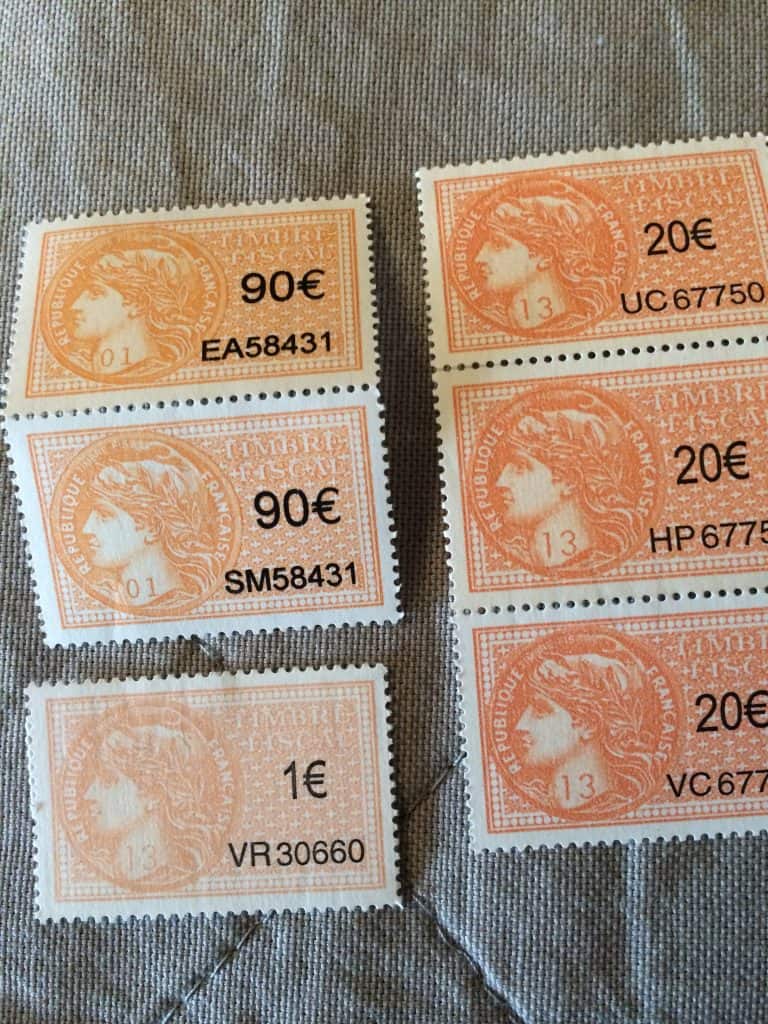
So what followed was another four weeks or so before I got a text message saying that my card was ready to be picked up in early July. It would cost 25€, to be paid by fiscal stamp (also, now available online). But the problem was that I had to make an appointment the old-fashioned Hunger Games way: by waiting with a bunch of other people here when new appointments were released, and then hoping I snagged one before they disappeared within four minutes or the system crashed, whichever came first.

I spent weeks trying to get an appointment before I landed one in mid-September (this was, of course, influenced by the aoutiens in the administration, who I can’t blame for their preference, since I’m of the same persuasion), in which I was able to come in and get the card. 

Make sure to get the right kind of stamp! We were witness to someone who had bought a stamp for a French citizen to get an identity card, which is not the type of stamp you need as a foreigner getting an identity card. People looked on as he haplessly held his phone on high, trying to get a cell phone signal so he could buy the stamp online, a signal which is elusive inside the Police Prefecture on Ile de la Cite. Select “titre pour etrangers” in step 1 to avoid this dilemma.

So, that problem was solved, six months after the initial request. 

Why did this matter in the first place? Because part of your citizenship dossier requires a current CDS, and since I wanted to apply for citizenship in Paris, my new Paris address, in the 12th, needed to be on my CDS.

As this was going on, another struggle was happening concurrently, that of my business address change.

Business Address Change

As I explain to my Profession Liberale clients who ask, when you move from one residence to another inside France, the authorities consider that your business has “closed” and “moved” to a new location too. Since you’re a sole proprietor/trader, that makes a certain amount of sense.

But this means that you will be issued a new SIRET, because the old SIRET was tied to the now “closed” location, which has implications for your invoices and tax returns.

But that’s okay. I’d actually changed my business address twice before, when I moved from the 2nd to the 19th, and when I moved from the 19th to Moret-sur-Loing, where I lived until March 2023. There was a fairly straightforward paper form known as a P2. You submitted it, the wheels of bureaucracy turned, and about a month later you would receive an all-important Certificat d’Inscription, with your new SIRET. You can take a look at it here, if you’d like, but it’s no use filling it out as it’s a now-defunct form.

A current Certificat d’Inscription is necessary for your citizenship application if you hold a PL visa, as I do.

The problem was that the dematerialization scheme which had created the new website I alluded to above had created one for small businesses as well. Welcome to INPI Connect.

The website is not intuitive, but with some trial and error I found the section that related to changing my business address. It took me about twenty minutes to figure out the forms, and then I attempted to submit my form but the website kept refusing to accept what I thought was a legitimately “signed” document.

Enter the QES.

Qualified Electronic Signature (QES)

So in the past, the P2 form worked like most administrative changes. I filled it out, signed it, and mailed it in. The idea that someone else would want to change my business address for nefarious reasons was as ridiculous then as it is now.

But that didn’t stop the French from requiring a level of security on an electronic signature that, unless you work in law, you have probably never heard of. If you want to get nerdy, you can read more here.

As I kept trying to upload the address change document that I had hand-signed, the website kept rejecting it (I thought this was like Docusign, like most e-signature systems that I had grown accustomed to.). I dug a bit deeper and saw that they tried to offer some helpful advice, along the lines of, “if you don’t have access to a QES, simply use FranceConnect+, which allows you to do this easily.”

FranceConnect+

So, FranceConnect is an awesome system that allows you to use some other user name/password to a website of French bureaucracy to login. It cuts down on having to maintain multiple passwords and gives the French confidence that it’s the same person. 

For example, for my login to the Etrangers en France website, I consistently use FranceConnect and my login and password for the Department of Finance (taxes). 

FranceConnect+ is heralded as an even more secure, even safer version of FranceConnect. The only problem? To use it, a foreigner needs a CDS that has more than 5 years validity. Well there’s only one such card, the golden 10-year Carte de Resident. Despite having lived in France ten years at that point, I didn’t qualify for this service though I was reminded once again that I should have gotten my ten year card years ago.

Which meant that I had to find a private service that would give me QES access. Enter ZealID.

Now I should pause for a moment. These discoveries did not all happen in one day. As with any project in life, you run into a frustrating wall and then you can pick up your task again when you have time and emotional stamina to try to overcome that wall. So this period of trying to make an address change, finding out that each of the changes had to be certified by a system that the French government had deemed I couldn’t have access to, then having to find such a system on my own, then finding out the address change had to be done in a certain order, was not something that occurred over a period of days, but over weeks which stretched into months.

And remember, I had thought I was going to save all this time by applying in Paris. 🙂

Anyway, I have nothing but wonderful things to say about the ZealID folks. They only charge something like 40€ for five signatures (when I bought it it was 25€ for three signatures) and their software is intuitive and easy to use. There may have been a fist pump (or three) when the INPI Connect at long last recognized that I had uploaded a document with a valid QES and queued it for processing.

Now I ran into my second problem.

I had mistakenly thought that I could change my personal address and my business address in the same form. I was told, in typical pedantic French bureaucro-speak that I was obviously too much of an idiot to realize that I needed first to change my personal address with one form, then submit a second form closing my old location and opening my new one, related to my new personal address.

How I could have found that out when no instructions existed on the site didn’t matter. And what mattered was that I had an answer, so I could move forward.

I had to wait some weeks for that first form to be processed before submitting the second form. Which also took some time to be processed.

Here’s where the digitalization came back into my my favor. They no longer mail a Certificat d’Inscription to you. You simply need to go to this site, enter your new SIRET and download the document that is generated. It’s not a Certificat d’Inscription but it is accepted as an equivalent. It is an “Extrait des inscription.” This is analogous to US state websites where you can print out certain forms that are equivalent to articles of incorporation, which you may need to open a bank account. 

About ten days after that final form was submitted, my new SIRET was active and I printed my form. It was the 19th of December. I had started the address change process for both my personal and business addresses in March of that year.

Now I was ready to apply for citizenship, humbly reminded that even ten years of experience doesn’t prevent papers from getting caught in the gears of bureaucracy. But the citizenship application process is a story for an upcoming article.

The photo is of the stamps that I first bought when I moved to France in 2013. They, like the Paris metro tickets, are history now.