The association of art and Paris is well deserved. Beyond its exceptional art museums, Paris is teeming with a plethora of galleries.
Any type of art can be seen in Paris’ galleries, from ancient Greek statues through renaissance works to the latest contemporary performances and installations.
Contemporary art galleries serve a double function in the art world. Art dealers scout young talent whose work they feel is worthy. If they decide to represent an artist they will take on all kinds of responsibilities to help the artist grow in the art market. They will incubate these artists, support them in many ways, promote them and get their work shown and out into the public eye. They act as a middle figure between artist and collector. This approach is referred to as the primary art market, i.e. the purchaser of such a piece is the first ever owner of that piece. Often, promising artists owe their coming out thanks to some gallery. Galleries are considered to be the “primary market,” where work that is on sale comes directly from the artist. It has been said that when buying a work on the primary market the purchaser creates a relationship with artist. When buying on the secondary market (i.e. from a previous purchaser, someone other that the artist or their gallery) the purchaser acquires an object.
Galleries are open to the public, to purchasers and visitors alike. While, of course, catering to collectors, they also welcome visitors who are interested in taking the pulse of the status quo of art and trying to snuff out the direction the art world is headed without necessarily looking to purchase.
It has been said that Paris’ galleries might be intimidating. Many are uncomfortable opening the door. One gallery owner on the rue Quincampoix that I spoke with after I dropped in by chance informed me that his American customers complained about (un)welcoming gallery personnel. He, of course, was the opposite: as soon as I stepped in he came over to ask me what I knew about the art and the artist, and as I knew nothing, he immediately offered to explain her technique. This is obviously a best case scenario, and in fact the most pleasant stop on my route that day.
Some galleries cannot even be seen from the street; they might be in a courtyard such as Perrotin, Templon, Mitterand, Aline Reche … or even upstairs like Putnam. Most visitors either know what particular big-league gallery is behind what door or they have read recommendations to see the artwork and learned the address. You may even have to ring a bell to have the gallerist ring you in to the gallery or to get into a building and find your way to the gallery. Obviously it does take some art world self-assurance to ring that bell if you are not really on a buying trip, knowing that the gallerist will be paying special attention to your presence.
So what can happen when you open the door of a gallery? Dealers know that most of those who come in are not purchasers but art enthusiasts. Clearly not many people can or are willing to pay, 50 000€ (or more) for a painting, 10 000€ for a small sculpture in plastic or even 2500€ for a small work. The basic assumption is that if you have entered, you are interested in the art and might simply be curious. Therefore, they leave you alone unless you open the conversation with a comment or a question. While all galleries exist to sell the art, they are well aware of their role to make the art they show available to be appreciated by the general public. The bigger, more important and international the gallery, the less they will notice who enters. So do step in.
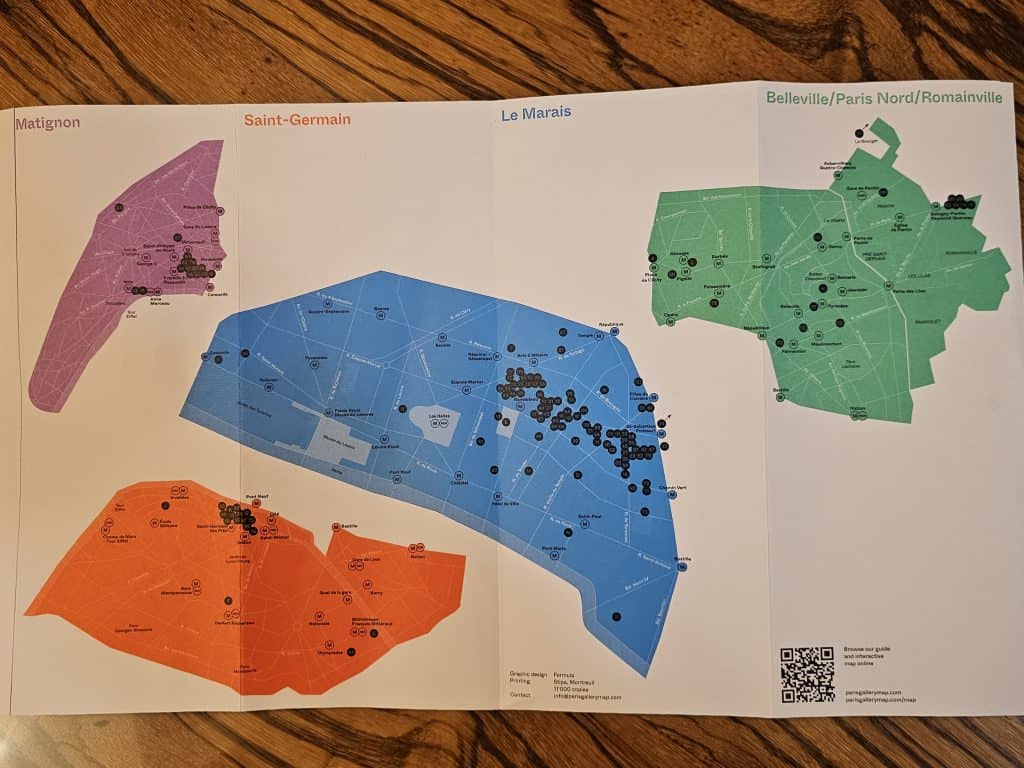
While one can always find a gallery or two in any area of the city, there are three main areas in Paris where galleries are concentrated and a fourth on the rise: the Marais (and the new Haut-Marais near the Place de la République), St Germain, Avenue Matignon and surrounding streets the east of Paris is slowly evolving. This loosely bound zone includes the Belleville area and extends beyond the ring road to Romainville and Pantin. Around Belleville the galleries are young and recently set up, showing emerging artists. Romainville presents a sort of art campus in a quadrangle with four galleries along one side, the FRAC reserve on another. The area is earmarked to become an art center. In nearby Pantin a few galleries have opened, spearheaded by the internationally famous Ropac Gallery.
While some galleries have closed their physical space to go digital, such as the urban art gallery Sakura, and the iconic Galerie Denise Renée where kinetic art got its lift into art history, others are moving in. And, as City Hall makes parking and driving in the Marais more and more difficult, some of the largest, international galleries originally established in the Marais have opened a (or another) site around Matignon catering to collectors who want to drive to their art spree expedition and park nearby.
Also, since Brexit, London is gradually yielding its position as the art center of Europe to Paris. Many internationally known galleries who have heretofore had bases in London, are now also opening shop in Paris. And besides these, new, emerging galleries are blooming in the city.
It is always a pleasure to stroll in any one of these areas and to pop into the galleries to feel invigorated by communicating with the art of the day. Slash is the perfect site to help plan such a walk. The home page will offer suggestions of galleries to visit and if something strikes your fancy, check out what else there is to visit in the area and go take a turn there. Even better, look up the openings that will take place. These are typically held on Thursday evening and sometimes on Saturday afternoon. Thursday evenings can range from a crowded celebration with drinks and even sometimes nibbles, to a quiet display undistinguished from any other day.
The traditional art nexus of the Marais, near the Centre Pompidou is particularly lively where crowds throng to its cafés, restaurants, trendy shops and, of course, its eclectic mix of galleries that can be large or small, unrenowned or prominent, French or international. Almost all the artwork being shown is by living, sometimes well-established (or not) artists using a multitude of techniques, with highly diverse materials and in wide-ranging styles.
The crescent-shaped Rue Debellyme has a particularly high number of galleries in a short distance including the particularly friendly Galerie Pierre-Alain Challier, the international Thaddeus Ropac and Galerie Karston Grève which has two separate spaces side by side. The small Rue Chapon is lined with many small galleries. On the Rue de Turenne are situated some of the largest international galleries such as Perrotin and Almine Rech with David Zwirner just off on the rue Vielle du Temple.
The international Galerie Continua, decorated in modern industrial style on Rue du Temple, is a bit of a labyrinthine affair with rooms going round and back on the ground floor and upper floor and sometimes the basement. It has a number of highly visible, internationally known artists on its roster. Strangely, and singularly, it even boasts a small café and ice cream parlor (an easy place on your itinerary to take a pit stop) which from the front windows overshadows the fact that this is indeed an art gallery. And the gallery continues and greatly expands its show space way out in the French countryside on two different former industrial sites in Les Moulins and Sainte-Marie. Unique in its business plan, once a year it offers a free bus excursion for an opening out to its two provincial galleries. Of a Sunday morning art enthusiasts are bussed out to Les Moulins, then around lunch time bussed from there to the Sainte-Marie site where they are served a picnic lunch. After lunch they have a couple of hours to visit the artwork and then get on a bus back to Paris. Follow the gallery on eventbrite to know of future events of this type.
Further north is what is now called the Upper Marais, a much trendier designation than “République area”, allowing galleries to psychologically annexe their location to the more fashionable Marais district. Here, an increasing number of emerging galleries are setting up shop where they can have more space at a lower rent with the advantage of a shopfront right at street level. The main streets for art exploration are the rue Béranger and rue Notre Dame de Nazareth. Also in this area, just behind the 3rd district town hall is the exhibition hall, Carreau du Temple, a complete transformation from what was once a leather goods market.
The galleries in the St Germain area tend to be small each with its own speciality: antiques, modern, contemporary, primary … Rue de Seine has become virtually generic to refer to this gallery area. The other most gallery-laden streets of this quarter are rue des Beaux Arts, rue Guénégaud and rue Mazarine.
Off the beaten path, and surprisingly so, but still in the sixth district, is the high-end, luxury department store, Bon Marché, which invites renowned artists to create works filling the height of its atrium space above and beyond the central escalators. The windows will also display works of the chosen artist. Artists who have exhibited in situ in this unusual space include, Ai Weiwei, Joanna Vasconcelos Suboth Gupta, Daniel Buren… These temporary exhibits are well worth the visit to the department store, where you can also shop for (expensive) items to take back home.
The highest end of the gallery quarters is on and around the Avenue Matignon, a short walk or even just across from the Elysées Palace where the president resides. Get off the metro at Miromesnil and start down Rue Déclassé and you nave entered the golden triangle of art galleries of Paris. Galleries line the street on the left side as you head toward the Champs Elysées. One of the first is Galerie Slato-Parra which specializes in Latin American artists and is run by a very knowledgeable Venezuelan. Don’t miss her openings with the pleasure of drinks in the back courtyard on a lovely summer’s evening. The side-streets toward the left: rue Mirosmenil, rue Penthievre, also boast numerous galleries. Most important is the Rue Faubourg St Honoré, on which is located the entrance to the Elysées Palace, with Sotheby’s right across from it. But if you are not side-tracked, Rue Déclassé turns into Avenue Matignon with some of the most prestigious international galleries coming to Perrotin’s three-floor gallery as you almost reach the Champs Elysées. And just before the Rond-Point is Strouk, which, although not a heavy-weight internationally, has some wonderful exhibitions. Immediately on the other side of the street is Christie’s auction house and Gagosian just around the corner on rue Ponthieu.
The galleries in the east are far-between, and more suitable to a hike than to a short walk. But when you reach Pantin, there is a nice stroll to take along the canal on a lovely, summer day.
Most galleries have, lying around somewhere (e.g. window-sill, floor, shelf, desk …), a free Paris Gallery Guide, which comes out four times a year and lists virtually every gallery in the main gallery areas, the artists on view, openings that are coming up and a relatively clear, colorful, coded map to find them.
So choose a gallery and an area, pick up a Gallery Guide, and enjoy “a pleasant walk, a pleasant talk” into Paris’ gallery culture.
Photo of a Gallery Guide.
Did you enjoy this article? TAIP is 100% reader-supported through tipping. If you want to leave us a tip of any amount it would be highly appreciated. These tips help support our efforts to keep TAIP an ad-free environment. Just as at a cafe, the tips are split evenly among the team.