“Photography is the process of making pictures by means of the action of light.” Clearly defined as a technique, how then should it be typecast: reporting, remembrancer, art … ?
While her work may be exhibited implicitly as art, the photographer, Tina Modotti, explicitly rejects the designation as an artist, and is “considerably affected” should the words “art” and “artistic” be applied to her work: “I consider myself a photographer, nothing more. If my photographs differ from that which is usually done in this field, it is precisely because I try to produce not art but honest photographs…” (1929). On the other hand, the impact of documentary photography is dependent upon its aesthetic value.
So when does photography become art? And if photography is to be considered an art, where then does it stand in a classification of the arts?
In the 19th century, Hegel defined five arts: architecture as the first, sculpture as the second, painting as the third, music as the fourth, and poetry as the fifth. By the 20th century in the European-centered art world, it was considered that there were ten arts:
- Architecture
- Sculpture
- Painting/Visual Arts
- Music
- Literature
- Performing Arts
- Film and Cinema
- Media
- Comics
- Digital art forms in general
This is open to debate and there is still no consensus on the possibility of more classes to include culinary art, fashion … Interestingly, at a meeting of photography aficionados, no one knew which ordinal had been applied to photography. And this is for a very good reason: in fact, while cinema/film-making gets its own ordinal as the seventh art (as defined by the French Ministry of Culture), photography might be subsumed under media or visual arts, depending. Under United States copyright law, photography is specifically included as a work of visual art.
In fact with so much that can be done with photographs today — they can be painted or embroidered on, be multiply exposed, colored, incorporated into mixed media artworks, lens-based or not — it would seem that photography merits an ordinal of its own.
Lydia Melamed Johnson, Executive Director of the 2023 Photography Show in New York “believes the best days of photography have yet to come.” And Anna Planas, artistic director of ParisPhoto considers that “Whether a reflection of reality or a product of imagination, photography has certainly established itself as one of the most opened (sic) medium onto the world, in direct and frontal contact with the author’s environment, be it true or staged…It is the material element that enables communication between its different actors: namely, the subject, the photographer, and the beholder. It is through this trio that the image fundamentally exists.”
The French, as a group, have always been particularly interested in photography well in advance of other cultural groups. In fact, the French Ministry of Culture takes photography very much to heart by promoting photographic creation and its dissemination through its support of photo fairs and institutions that sustain photographic art collections. It even has a specific delegué assigned to photography. Curiously it has not assigned a specific ordinal to photography. Might it be because photography would be forced too far down the list?
Museums
Today, “the art gallery context [for photography] looms larger and larger as the site where image-making is taken seriously and can take on serious value.” (Ben Davis 2024)
Maison Européene de la Photographie & Jeu de Paume
The Maison Européene de la Photographie (MEP) and the Jeu de Paume are the two main photography museums in Paris offering temporary exhibits. The MEP was the first institution in France to be fully devoted to photography and features contemporary, usually living, artists. On the other hand, the Jeu de Paume will show any important photographic art ranging from the nineteenth century to the present day.
Centre Pompidou
The Centre Pompidou devotes a room on its lower floor to small temporary photo exhibits which are free to the public at all times. It has also had a few large photography exhibitions on its main temporary exhibition sixth floor requiring an entrance fee.
Le Bal
Le Bal is a nonprofit organization that focuses on the eighth art of media and spotlights documentary photography, video, and film.
Henri Cartier-Bresson Foundation & Maison Doisneau
There exist two private museums within Paris devoted to specific artists: the Henri Cartier-Bresson Foundation and the Maison Doisneau. Both museums showcase their eponymous photographers but also present exhibitions of contemporary photographers. The HCB Foundation offers an exceptional type of book event more or less monthly called “feuilletage,” roughly translated as “leafing” in the sense of leafing through a book. This is a presentation by a contemporary photographer of his or her book whereby they leaf through a book of theirs commenting on the context of the photographs therein. The audience is shown each picture directly through the use of an overhead projector. And if you are willing to go just a little farther afield, there is the la Maison Doisneau in Gentilly, just outside Paris which can be reached by the RER B (a suburban subway line).
La FAB
La FAB (Fondation Agnès B), displays works from Agnes B’s personal art collection of which photographs comprise 60%. Thus, at any time there are always photographs on show, and oftentimes an exhibit devoted to photography, such as the extraordinary “histoire” de la photographie that I had the chance to see.
Albert Kahn Museum
The Albert Kahn Museum is free every first Sunday of the month (reservation recommended). Its “Archives of the Planet” presents “a kind of photographic inventory of the surface of the globe, occupied and organized by man, such as it presents itself at the beginning of the 20th century.” Come to see what photographs are on view; stay to wander through the extensive botanic gardens, and maybe find an art exhibition therein.
Photo Fairs
In November the Paris art world goes all out for photography. It’s the Month of Photography in France with the photography trade fair, ParisPhoto, as its heart. As one of the most important photography art fairs in the world, it endeavors to present a broad spectrum of the most significant photography to be had. Its innumerable participating galleries offer an array of photographic art ranging from that by the foremost classic photographers ever, to today’s emerging artists working in all forms of the medium using all types of supports. Here can be found traditional gelatin silver prints and digitally printed photos, photographic works with or without a camera, reworked numeric photography, and video art. In fact, so much is on offer here that it can be overwhelming.
Its free satellite fair, Photo Discovery, in a smaller space with table-top stands, puts the visitor in more convivial contact with its dealers who are happy to discuss the photos on offer.
During this time, many galleries, not necessarily specialized in photography, give way to photography exhibits. Photo St Germain is a walking, free photography festival where many of the galleries throughout the area opt into the art flavor of the month. The Photo St Germain organization puts up a daily program online, and during the month offers free guided tours of chosen galleries exhibiting photography in the area. Often, when such a group arrives, the gallerist will take a moment to present the photography on view. Probably the highlight of this open-air fair is a visit to the hotel, La Louisiane, which reserves its third-floor rooms for photographers to show their work, one photographer per room. Beds might be removed to create a gallery-type space, remain as a horizontal showcase, or even be used as part of an installation. It is as much fun to visit the exhibition for the photography as to meet with the artists or just to see the rooms of this famous hotel.
Auction houses, too, may have a special photography sale during this month.
As the name implies, Biennale de la Photographie du 13e is a photography fair that is hosted by the town hall of the 13th arrondissement of Paris every two years. It aims to exhibit together photographs by well-known photographers, those by young professionals at the beginning of their careers, and others by amateurs all following a given theme. In their program, they offer guided tours of the exhibit and various workshops in photography.
Galleries
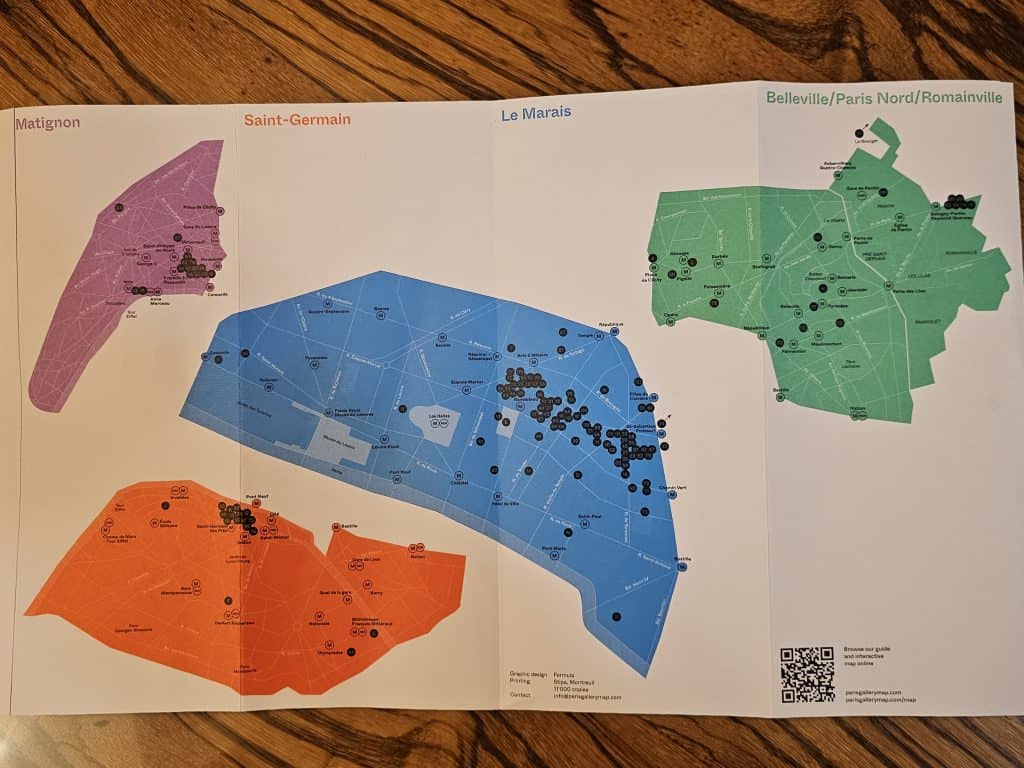
Paris, where photography was born, boasts more and more galleries specializing in photography scattered throughout the city. As photography becomes more and more prevalent as collectors’ art, such galleries have become fixtures of the art scene with some located in the heart of the gallery districts and others independent of of Paris’ art nexus.
Camera Makers
The makers of photographic materials have gallery spaces featuring photographers using their material — of course. These include Leica in the chic rue Boissy d’Anglas, Nikon Plaza on the Boulevard Raspail, and Pentax in the 10th arrondissement with its photo galleries. There can be found Les Douches la Galerie, created above a former public shower. The exhibitions are of top quality and worth the visit and you can count on being seriously ignored if you are not there as a purchaser. So enjoy the photography! Smaller but much more friendly is the stimulating Miranda gallery.
Magnum
The renowned Magnum photographer collective and agency, founded in Paris and New York in 1947 on the heels of the horrors of World War II, has opened a gallery in the 11th arrondissement of Paris. There it hosts four to five temporary exhibits of vintage prints and/or photographs of younger members in a modular, industrial décor. In a well-lit corner visitors can comfortably read or browse the books, and then buy some should they so desire. Thus we might say here can be found a library/librairie. Once a year it holds a square-print sale of moderately-priced, 6 x 6” original, signed prints readily available for purchase. Although somewhat off the beaten path of art galleries (as are most specialist photo galleries), it is still located in the heart of Paris and a must for any photography enthusiast.
Galérie l’Embrasser & Galérie Clémentine de la Ferronnière
Very centrally located on the Ile St Louis and situated on the same street, St Louis en Ile, are Galérie l’Embrasser and the Galérie Clémentine de la Ferronnière. The former, whose exhibitions are mostly of young emerging photographers is easily accessible to walk in. It also doubles as a tea shop. The latter, supporting its photographers on a long-term basis, is well worth the effort to find and visit. To enter, go through the porte-cochère where on the right is the intercom. Scroll to the “gallery,” ring and you will be let in. The gallery is all the way through to the second courtyard (an interesting site in itself), where the photographs on display can already be seen through the large bay windows. Feel free to go ahead in and look around.
Roger-Viollet
The Roger-Viollet agency, situated on the rue de Seine, almost in front of the river itself, has existed in its present premises since 1936. The walls are lined with labeled green boxes from floor to ceiling. Signs are posted asking visitors to please not open the boxes. Temporary exhibits according to given themes follow one after another. Reprints of the exhibited photographs, or for that matter of any of the six million photographs that make up its archives (i.e. what is in the green boxes), are available for purchase for a nominal sum on request.
Polka
Polka Gallery, well-known by the eponymous photography magazine, is mainly devoted to traditional photography by well-known photographers. There, crowds descend on opening night for the art, the animated exchanges among photographers, and the beer.
Speaking of magazines, it’s important to mention the free magazine The Classic. As the name implies, it runs particularly interesting articles on classic photography, exhibiting galleries, museums, and fairs, and comes out twice a year. It is published by Bruno Tartarin of Photo Discovery, The Place, a space located in the 2nd arrondissement and where hard copies can be picked up.
Galérie Thomas Zander & GalleryC
The small Zander Gallery in the 6th arrondissement always has a photography-related exhibit on show that is worth the detour. GalleryC which has a number of contemporary artistic photographers on its roster is well worth a visit where Tom will be glad to discuss the works being shown and the artists behind it.
Galérie 291
The tiny but exceptional Galérie 291 in the 14th district specializes in pictorialist photographs. At a time when photography was in its infancy photographers were dabbling in all kinds of chemical processes to develop their photographs. The aesthetic philosophy of this school of photography which had its heyday from the 19th to the beginning of the 20th century, was based on the idea that a photograph should incite an emotional reaction. The gallerist will kindly explain and present the beautiful photos of this period that he has in this tiny shop.
Fluctuart Urban Art Gallery
The Fluctuart urban art gallery which is located on a riverboat near the Invalides now has a sister ship with a photography gallery up the Seine from the Austerlitz train station, Quai de la photo – Centre d’art photographique. While upstairs can be found a café where you can contemplate the boats going by, downstairs is where the temporary photography exhibitions will be found.
PhotoHouseParis
And a very confidential photography space is PhotoHouseParis located in a beautiful house in a courtyard in the sixth arrondissement of Paris. A space well worth the visit if you can get an invitation there.
Street Exhibitions
In recent years the various protective railings surrounding monuments of Paris have become the support of street exhibitions, there for the unexpected pleasure of unwary passers-by or for intentional visits. The first ever of these monumental outdoor photography exhibits was Arthus’ “Earth from Above,” where photographs of 2×3 meters were mounted on the railing around the Luxembourg Park from the St. Michel gate to the Odéon gate. This exhibit created an enormous buzz, and many exhibits have followed. The powers that be in charge of other monuments then followed suit including the Hotel de Ville which hangs exhibitions on its fence along the rue de Rivoli. Among other important “railing exhibitions” is Unesco’s which can be found along the rue Suffren up to its visitors’ entrance.
It is also a welcome surprise to come upon the photography exhibitions to be found on the walls along the metro platform at Hotel de Ville on Line One of the métro. Sometimes they concern an important exhibition taking place in a Paris museum, such as the Vivien Maier exhibition that took place in the Luxembourg museum. Other times, galleries arrange such exhibitions for their artists, as was the case for the amazing exhibition of Patty Carroll’s satirical photographic works of women overwhelmed.
So take a metro ride, take a walk, and discover why the French are considered the photo aficionados of the world.
Photo taken by me while admiring photography in Paris.
Did you enjoy this article? TAIP is 100% reader-supported through tipping. If you want to leave us a tip of any amount it would be highly appreciated. These tips help support our efforts to keep TAIP an ad-free environment. Just as at a cafe, the tips are split evenly among the team.