This particular move features three major changes for me: a different country, a different language, and a different environment. I’ll start with the last one first.
The City
I was born into one of the densest cities in the modern world: Singapore. This tiny nation-state has 5.4 million people packed into 276 square miles (Americans might consider that 8.5 million people inhabit the five boroughs that comprise NYC, which sits on 303 square miles). Singapore taught me at an early age that a city can be a safe place for a kid. As a six-year-old, I excitedly rode the MRT (subway system) by myself on Mondays when I had altar boy duties at our parish across town. I heard different languages (Malay, Chinese, Tagalog) swirl around me. I saw every color of person imaginable. And the food. Well, let’s just say that in 2009, my first visit back to the island since I was 11, I gained ten pounds in three weeks. I firmly believe Singapore has the best food in the world, and still do, despite living in the country that literally gave the world the word cuisine. However, for all my love of cities, most of my life has been spent in suburban settings.
Because America west of the Mississippi was imagined and built around the car, my stints in Texas (Dallas), California (Los Angeles, Orange County), Kansas (Overland Park), and Missouri (St. Louis) all accepted as prima facie access to a vehicle. Access to this vehicle not only defined your everyday schedule but by and large, your entire lifestyle. This lifestyle, the suburban lifestyle, while comfortable, safe, and warm is a novelty in human affairs and is premised upon the lie of ongoing, infinite access to cheap and easy oil.
The rural life has some splendid isolation and the city is a collective of the culture of a society but the lukewarm suburbs are no real part of either. James Howard Kuntsler, in a myriad of jeremiads against the “noplace” that is suburbia, has made this case numerous times far more eloquently than I can. Take a read through his Home from Nowhere if you want to be confronted with the (un)reality of the modern suburb.
This is all to say that city living is radically different from suburban living, in so many ways. We can start with one of the costs of living: housing. It’s almost always more expensive to live in a city. A 10×10 room in Paris (I’m talking feet, not meters), as in NYC, will cost you at least $1,000 per month, and that is with no promise of either a shower or toilet ensuite. Unless you share a home or apartment, you will also be lugging your laundry to a laundromat.
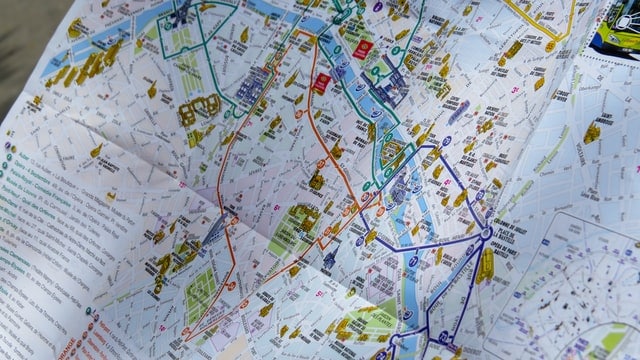
But after you’ve exhaled, realize the disappearance, or the decrease, at least, of another cost of living: transportation. I save roughly $120 (accounting for exchange rates) by not owning a car in Paris. I owned my last car free and clear so I didn’t have a monthly car payment, but I still paid $125/month in car insurance and at least $75/month in gas. This is to say nothing of car washes, oil changes, tire changes, routine maintenance, and of course, annual registration. I am now in possession of a monthly Metro pass which allows me to go anywhere that matters in Paris by train, tram, or bus. For an additional 29 euros per year, I’m also allowed to use the bikes all over the city for the first 30 minutes of my journey for free (the locations can easily be found on Velib, a smartphone app). I have never waited more than six minutes for a metro anywhere in the city, and because Paris is such an old city, it is eminently walkable (for an intact example of a medieval city, visit Assisi in Italy or Toledo in Spain, both of which can be traversed from one end to another in 20 minutes). Because of its layout you often won’t realize that you’re covering 3-4 miles per day on foot (though, if you’re not used to those distances, don’t worry: your body will inform you very shortly!).
This foot-driven travel forces you to meet your fellow city-dwellers. Americans prefer the quiet isolation of their cars. They have their own agendas and itineraries that are subject to no one else. City living doesn’t allow you that choice (well not without the hassle of traffic and not-free parking). You have to deal with the homeless, the musicians, the weirdos, the deviants, the children, the elderly, and all the fascinating tapestry of humanity that comprises any big city.
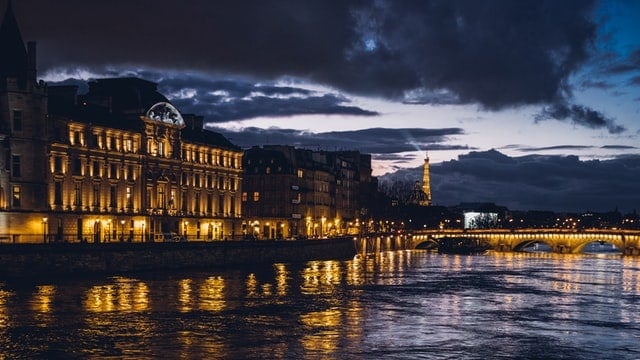
What makes Paris, and some big cities, special, is the architecture and history all around you. Architecture inspires and uplifts. It’s difficult to walk by things like the Arc de Triomphe or Notre Dame, or inside any number of the hundreds of churches in Paris, and not feel inspired (well, unless you’re already dead inside – but even then these can provide powerful return-from-death shots). The magnificence and beauty in those structures remind the ordered mind that building things that are worthwhile in this passing world is perhaps the most relevant harbinger of the eternity that is ahead for all of us.
The last opportunity I had to live in a city environment was during the year I finished my MBA in Saint Louis. I was in the Lou Monday-Friday and in Kansas City on the weekends (I drove the dreadful I-70 stretch twice a week. I know. Ugh.). In Saint Louis I lived in Lafayette Square, near the oldest park west of the Mississippi, in the largest collection of Victorian homes in the country. I loved it, and have always dreamed of a return to St. Louis since my 2011 departure (on a separate note, while beautiful churches are on the mind, I believe that the Cathedral Basilica of St. Louis is the most beautiful church in the United States. Check it out sometime).
It is perhaps the parks that are omnipresent in any well-planned city that are the greatest consolation for nature lovers. There is no shortage of places of quiet contemplation amidst the city that accepts 27 million visitors per year. Perhaps the reason this change has not been so drastic for me is that I’ve always despised suburban life, despite having existed in it most of my life. Humans have a remarkable capability to thrive even in the most spiritually impoverished environments.
The Language
The #1 stated reason for my move to France is and always has been to acquire an extremely high level of fluency in the language. I never thought this could be done outside of an immersive environment. I took a short holiday in London about 10 days after my move to France and I remember sharing with some friends that my French had advanced more during my ten days immersed in Paris than in my four previous trips to Paris and my five previous visits to Montreal (all of which were fewer than five days in duration). French, particularly for English speakers, has the double challenge of masculine/feminine words and unusual sounds. Too often those of us trying to speak the language fall into the trap of simply trying to mimic a sound we hear instead of accepting that sound on its own terms (my classic example is the word “un,” which means “one” in French. I don’t hesitate with the pronunciation now but I always did in the past.).
Perhaps even more fun than the disorientation of transitioning from being a native speaker of a language to being the primary school étudiant in another is the cultural exchange that happens as you explain idioms to new friends. These expressions don’t just define a way of thinking, but also can, in some ways, define a people. Speaking another language also helps you realize how grateful you are for the fun you can have as a native speaker with wordplay, puns, and literary allusions.
The Country
It would take too long to talk about all the misconceptions the French have about Americans and vice versa. That’s something I hope to cover in a future article. For now, I’ll leave you with two important facts: 1) the first treaty ever signed by the US government was with the France of King Louis XVI, without whose naval and military assistance the United States would quite possibly have never come into existence; 2) in the 1990s, Ambassador Walter Curley, perhaps on behalf of all Americans who have taken the time to study history, laid a wreath on the tomb of King Louis XVI in tribute of all he did for America.
While it is true that I love France — it is perhaps more true to say that I love the France of old. As a monarchist, I am drawn to the history of the kings in France while being simultaneously repulsed by the unmitigated horror show that was (and is) the French Revolution, with its disgusting tri-color flag, its monuments to murder, and its national anthem celebrating revolution and all the blood that flowed from it. Even though France is now in its 5th Republic (apparently the kings weren’t entirely clueless) the French remain a people and a country unable to fully accept the Revolution in all its implications. Over a million marched here in Paris just last year in protest against homosexual “marriage,” and a law just passed that outlawed “free shipping” of books in France.
Both of these events can help instruct those who are not familiar with the concepts of the two Frances: the two countries created within the minds of the French when Louis XVI’s head was separated from his body on that mournful day in 1793. There is the notion of the “real” France, which is Catholic and royalist, and the “legal” France, which is anticlerical and republican (this distinction does not exist in Anglo countries, due to Henry VIII’s dramatic unification of the church and state within his person – and the subsequent irrelevancy of the former during the ascendancy of the latter: by the time it came to the founding of America the masonic dream had been realized. America was a country founded on the absurd notion that God and His laws were a matter of taste, not fact). While since the 1960s the “legal” country has gained a decisive upper hand, the “real” France still manifests itself in conscious and subconscious ways. The march on behalf of traditional marriage is an obvious example of a conscious manifestation. As for the free shipping thing, we have to go further back in history, and we’ll also have to cut through the lies you were told about guilds and protectionism.
“Protectionism” as it might be understood broadly, accepts the fundamental premise that those who are close to you — whether they are family or simply your fellow citizens — are more important than foreigners or strangers. The subsequent principle that also follows is that money — the most important value in the modern world can never trump that sensibility. Guilds were a medieval expression of those principles within the marketplace. Guilds helped to control prices in a particular trade or craft so that no one newcomer could come and destabilize the entire industry through disruption. Innovations were shared so that the entire industry moved forward together (we see this in contemporary Japanese patent practice — all patents are published 6 months before the patent is put in place, which means all the competitors can adapt. The patent filing is hence more an object of pride that makes the entire industry move up together rather than the ossifying force it can be in US markets). People could come and apprentice in an industry (think internships, except you got paid and actually did work). They would, after a period of time, produce a “master-piece” (yes, that’s where the word comes from) which, if judged worthy, would launch their own independent career separate from the Master who apprenticed them. This also provided exit strategies for Masters to retire (there was a stream of capable people you had personal knowledge of who could buy your business or help you expand it). It also provided protection for those within the guild. If you became sick, injured, or God forbid, died in an untimely fashion, the guild would take care of your wife and children monetarily. After hundreds of years of this kind of thinking you can well imagine that the French, despite being a host country of the European Union, find it difficult to shake off the protectionist streak within themselves. Indeed, that is why Pandora, Netflix, and now Amazon’s free shipping, are outlawed.
France is trying to protect its market from foreign innovations. But coupled with a largely socialist mentality of the past decades one arrives at a swamp of indifference and inertia. The EU, a worldwide leader in free trade and open borders, is continuously pushing universalization “in diversity.” The French fancy themselves part of this as well, but their protectionist practices in the environment of hold-your-hand socialism provides an environment in which the young French are happy to enjoy every American innovation while not having any hunger to start their own copycats, even. The “anti-Amazon law,” as the French newspapers call it, is coming into existence to protect Frances’ many (and lovely) independent bookstores, bookstores which are considered part of the country’s “cultural heritage.” Free shipping from Amazon, coupled with the legally-mandated 5% maximum discount on book prices, gave Amazon an unfair competitive advantage. And this was unacceptable (although don’t doubt for a second that there wasn’t some political payback involved). But the reality of being unable to escape the French subconscious (sustainable and protectionist) traps the French in a self-satisfied dream of the past.
As with all rich and colorful dreams, the memories linger. Effects of the French domination of culture through its cuisine, language, art, and literature, still linger worldwide. But as the French celebrate the remnants of their past successes the world moves inexorably forward, led — for better or worse — by the country that France helped birth: Les Etats-Unis.
It is these three changes — the city of Paris itself, its language, and its history within France — that will linger with me long after I return to the New World. For now they are the changes I most celebrate and subsume myself in, because to understand the future we have to know the past.
Photo by Oksana Gogu on Unsplash
Did you enjoy this article? TAIP is 100% reader-supported through tipping. If you want to leave us a tip of any amount it would be highly appreciated. These tips help support our efforts to keep TAIP an ad-free environment. Just as at a cafe, the tips are split evenly among the team.