Notre Drame: the Fire

I was in a train back into Paris from Frankfurt when the news started to trickle in about our disaster here in Paris.  We’ve had various shocks during the time I’ve lived here, whether it was terrorist attacks in years past or yellow-vested “protestors” in more recent months, but this was of another kind entirely.

Friends who were there as it burned told me they stood in a sea of dismayed silence.  What could lay bare the thoughts of so many hearts at that moment?  The President referred to the idea that part of “us” had burned that night.

There’s been plenty of ink spilled on what should be done with the now more than € 1B pledged for Notre Dame, the symbolism of such an overtly Catholic building being destroyed in what is purportedly a secular country, and the growing suspicions regarding the origins of the fire.  But I’ll leave those matters to those with more breath than I have at the moment.

For me, more than anything, this was a lesson in losing the things you take for granted.  Just two weeks earlier, I took a friend inside to explain the genius of gothic engineering and architecture and to bask in the stunning beauty of those (still intact) rose windows.  I felt what I’d always felt since I first stepped foot inside the church in 2009: I’ll always have you.  But that’s not true.  We are not promised tomorrow.  Even centuries-old buildings made of stone are not promised tomorrow.

When you have an opportunity, take it.  If there’s a place in your locality that you’ve been meaning to see, go.  You have no guarantee that it will be there for you, or that you will have the health to see it in the future.  If you do take these opportunities, you’ll create lasting memories which thieves cannot steal, moths cannot eat, and fire cannot burn.

Part of the title for this article was lifted from a headline on one of the Paris newspapers the next day: indeed it was just as much “our drama” as “Our Lady.”

I took the photo in November 2015, on one of those nights when the light, the sky, and the night were perfect.

This story was also published on Medium.

TAIP is 100% reader-supported through tipping. If you want to leave us a tip of any amount it would be highly appreciated. These tips help support our efforts to keep TAIP an ad-free environment. Just as at a cafe, the tips are split evenly among the team.
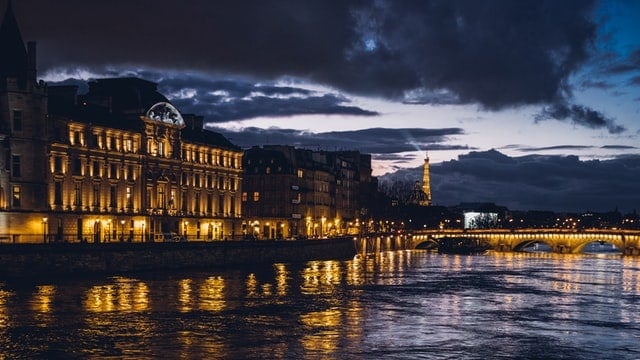
paris at night

Answering “Why Paris” Before I Ever Arrived

Once people get past the shock of my moving to Paris, the usual next question is, “Why?”  Perfectly reasonable question.

When I first started answering this question, I responded with, “If you’ve been there, you know why, if you haven’t, when you come you will understand.”  But in a country populated by fellow Americans, that answer didn’t fly.  I had to remember that I couldn’t assume everyone had a good experience in the city of my dreams.  In fact, the default expectation, over time, came to be that they had not.

One of the things I’ve tried to do when I educate people about Paris is try to point out that some of the things they try to put on the French or Parisians are neither “French” nor “Parisian.”  They are simply “city” things.

Take, for example, the sidewalk.  In a city like Paris, where walking is the norm and cars are the exception, there are certain lanes and flows.  There is a “fast-moving” lane in which people who know where they are going and are going there with a purpose and speed are walking.  There’s a medium lane where people know where they are going but aren’t in a hurry.  Then there’s the tourist lane.  Maps out, smartphones in hand, with the pace of a turtle.  Hey, we’ve all been there.  No harm in it.  Just don’t be upset when people bump into you because you stopped in the middle of a sidewalk.  It’s not your yard or a garden.  It’s a sidewalk.  And you would get bumped into in New York or Chicago just as easily as you would in Paris.

I’ve also been told about how many people are there.  No argument.  Almost 30 million people visit the City of Light every year, on top of the millions of French (plus one more American, soon!) who make that city their home.  But that’s part of city travel.  You’re not going to really understand how and why people live in the chaotic and yet ordered mess ANY city is unless you’re willing to lay aside some of your (unreasonable) prejudices and (reasonable) discomfort to simply move forward and embrace the experience.

Another is the language barrier.  Yes, sure there are French who genuinely don’t speak more than a few words of English.  But many French people do.  Americans often don’t understand what pride the French take in their culture, nation, and language.  But this is because France (for now) is both a nation and a people.  America is barely a nation and was never really a people.  From the beginning America has been a mix of Natives, French, Spanish, English, and later, Africans.  If you can understand that deep LOVE for a language (which English speakers, who rarely take pride in their language nor study its beautiful prose and poetry which can go head-to-head with any other language in quality, in my opinion) then you can and should understand that the BEST way to encounter the French is always to ask, in French, if they speak English.  “S’il vous, plait, parlez-vous Anglais?”  Phonetically this renders as “see voo play, pahr-lay voo ahn-glay?”  If they say no, try someone else.  If you just go up to them, speaking your language, assuming they too speak it, it’s not just rude, it’s disrespectful.  This is part of cultural exchange.  Americans are so used to everything being done in, around, and for them.  Going to other countries implicitly asks you to realize that they don’t necessarily go in for that (and why should they?).

But here I’ve been going on about answering objections to why people don’t want to go to Paris, and I’m missing the chance to tell you why I want to live there.

The food, of course.  The French take eating, mealtimes, and food very seriously.  It’s impossible to fathom the idea of eating at your desk, in your car, or from a drive-thru.  I look forward to breaking myself of those habits.

Seeing things that are hundreds, sometimes thousands of years old, staring back at you, with the detail and symmetry of a human hand unguided by computers.  And seeing stuff like this almost everywhere you turn.

And seeing it at night.

I can’t wait.

Photo by Robin Ooode on Unsplash

Did you enjoy this article? TAIP is 100% reader-supported through tipping. If you want to leave us a tip of any amount it would be highly appreciated. These tips help support our efforts to keep TAIP an ad-free environment. Just as at a cafe, the tips are split evenly among the team.