My First Week in France

This is part of a series of articles about the final days of preparing for moving to France and what happens when you get here, and those articles are part of a promotional series launching our new book, 29 Days to France, a book that all the writers wish they had had before we started our French adventures.  It’s now available for preorder, and those preorders come with a free 15-minute Q&A personal session about your French immigration plans.  Click here to learn more.

This is Luke’s final in a trilogy of articles sharing his first three months in France.  The account of his first three months can be found here, and his first month here

I recently learned that France is the most visited nation on the planet. If we look just at Americans, approximately 13,000 of us step off a plane here every single day. Most come for vacation, others for business, but for the few who have chosen to immigrate, our arrival marks the moment life starts over at zero. 

A new country! A new beginning! How exciting! 

Later, but perhaps not much later, we might begin to appreciate just how far down zero really is…

I arrived in France the greenest of greenhorns possible. I spoke essentially no French and certainly comprehended none. I had 150 pounds of luggage and three trains to catch in the middle of a nationwide transportation strike. Somehow I made it from the airport to Gare du Nord in downtown Paris, but then spent hours wandering all over that place unable to find my next train or even where or how to buy a ticket. 

On that day Gare du Nord seemed the most immense and confusing building in all the world, a kind of real-life M.C. Escher maze on a colossal scale. When I next happened to be in Paris almost two months later, I was genuinely surprised to see that it had shrunk considerably from my first impression. It was almost as if on that first day I had seen everything from the eyes of a small child — which in fact was not far from the truth.

The rest of that day I remember only as I might the images from a fever dream. My strength was depleted early on from shouldering and dragging so much weight up and down stairs and on and off trains. My hands were bleeding. All the exertion dehydrated me nearly to delirium, yet somehow I never had the sense of mind to buy a bottle of water. Although I did not recognize it then, I was already in a state of shock.

By some miracle I did eventually arrive at my destination of Amiens, long past dark and after having traveled through the fog the whole way there. I found my hotel and slept as if I would never wake again, having seen essentially nothing of France to that point.

Dreamland

The next morning, only very slightly recuperated and still very jet-lagged, I shyly ventured outside to see what my new surroundings had to show me. For someone coming from the suburbs of Kansas, I may as well have discovered a new planet. Down every cobblestone street was revealed a new and astonishing gift to the senses — the fanciful buildings, the canals, the little cafés, the unusual mode of dress, the smell of perfume and baked bread, the unintelligible language I heard all around me, and finally, the cathedral of Amiens which was by far the most beautiful thing I had ever seen. If this was a dream — and it certainly felt like it — I did not want to wake up. 

I had made an appointment at a student lodging complex to see about getting an apartment. The manager spoke no English but invited me into her little office and we communicated by taking turns at her keyboard typing our conversation into Google Translate. She agreed to rent me an apartment even though I was not a student and wouldn’t be there during the usual term. The true extent of her kindness and generosity, not to mention my great good fortune, wasn’t fully appreciated until much later when I better understood the bureaucratic frustrations that more usually attend to this process. 

The apartment was furnished but still lacked many day-to-day amenities, to say nothing of food. In America we drive our car to the massive big box place and buy everything we want all in one trip. Not so when your life is lived on foot. There is a limit to how much you can carry in your two hands, or on your back, and that is the limit to what you are going to bring home. In the early days it is never enough, and my first week in France was largely spent being a literal pack mule. I found myself resenting certain inanimate objects for the space or weight they took. Toilet paper weighs nothing but takes up a lot of space, meaning this particular trip isn’t going to accomplish much. Forget buying cases of your favorite soft drink, that’s too bulky and too heavy. Just as well, you’re not going to find your favorite soft drink in France anyway. What about a floor lamp? Not only is that going to be a single-item shopping trip, but afterward you are going to be walking down the street in the rain carrying a lamp over your head. However I learned this is not the most unusual thing you will see in France… 

It was frustrating, to say nothing of physically exhausting, to leave the store with my heavy burdens for the umpteenth time, knowing that half of what I wanted was still sitting in the store. The good news is that life in France, for this and many other reasons, is very conducive to weight loss

In the midst of all the logistical challenges to “installing myself” (as the French say), I was also trying to navigate the human and cultural dimensions of this foreign world, almost invariably with spectacular failure. An example symbolic of so many others was the door handles. 

Push (or Pull)

In my long life in America I had learned that handles on doors are meant for pulling. If instead a door needs to be pushed, Americans typically install a flat metal plate that, you know, you push. But in France the same pully-handle is very frequently installed on both sides of the door. How many times (I can’t even begin to count) would I approach a shop door on a gloomy winter day and see a nice warm interior through the glass, with cheerful humans doing happy humans things that I too wanted to partake of, and so to enter I pulled on the door handle — and nothing.

But it can’t be locked, the shop is clearly open, I can see everyone inside laughing at me. Maybe if I pull harder…nope, not budging. The thought of trying to push never entered my mind. What might have entered my mind was, By God I’ll show these Frenchies what American muscle looks like! If I have to grab this thing with both hands, lean back, and brace myself against the curb, this door is coming off! But the door didn’t come off, nor did it open, and never would it open until some exasperated occupant within did it for me, effortlessly and with the helpful comment that “Monsieur needs to push.”

In foreign environments it is necessary to bend or break, the problem is that at the beginning we don’t yet know enough to see when or how we should do that. But never fear: swiftly and painfully, the world is going to teach us. 

They Speak French in France

The doors were embarrassing enough, but by far the worst experiences involved any kind of communication. I suppose I had a vague idea that navigating the world in a foreign language would pose some kind of challenge, but having never been in that situation before I had no concept of just how bad it could be. 

Let me tell you: it was bad.

Before going anywhere I would memorize a phrase or two to get me through whatever I needed to do next. On my first night I walked into my hotel and said in French “Hello Ma’am, I have a reservation for tonight.” The receptionist behind the counter immediately broke into laughter. I looked around…was there a monkey behind me? Then she replied to my statement with a long monologue of which I understood precisely nothing. 

Other times someone would appear sincerely annoyed or even upset at something I had said, but in either case (both no doubt well deserved), I never had the first clue about what I had done to elicit the response I received. This added to a general sense of disorientation and regularly made me question my sanity.

Once, and I can assure you it was only once, I memorized a question for my apartment manager which I skillfully posed to her down in the office. Possibly my stupidity will surprise you, but it wasn’t until the very moment I had finished my question that I realized that whether she replied with a nursery rhyme, the formula to cure cancer, or even the answer to my question, it would make no difference — I couldn’t understand any of it. She did respond with something, I know not what, and I left feeling both like a moron and also completely helpless.

Worst of all was being asked a question by someone else. My first time at the grocery store I was hoping to just swipe my credit card and get out of there, but before ringing me up the cashier asked me something incomprehensible. 

I froze in terror. In an act of stupidity equal to the prior example, I finally croaked back “Pardon?” As if repeating unintelligible sounds a second time would make any difference! Yet she did repeat them, and I still didn’t have an answer. The people in line behind me were already getting impatient (it happens fast in France), and the cashier started to look as confused as I did. What did I do? Nothing. I just stood there with a dumb look on my face and prayed I would wake up from this awful nightmare, back in my warm bed with a binky. 

I know, you’re yelling at your screen right now — why didn’t you memorize the phrase for “Sorry, I don’t speak French”? Or just pipe up in clear English and say the same thing? Good idea, and sometimes I did just that, but what I am describing here are deer-in-the-headlight moments. It’s not that the deer has run out of options while he stands in the path of the oncoming car. It’s that some sudden fright has disengaged his brain completely. 

These moments were daily occurrences that first week (and well beyond). Within a very short period of time I had quite effectively been conditioned to associate any verbal interaction with embarrassment and panic. Like one of Pavlov’s dogs, I soon reached a state where even the thought of going to the bakery in the morning, and having to speak or hear even a few words of French, filled me with so much dread I felt physically ill. These emotions were often all out of proportion with reality (the bakery for example was always a pleasant place), and they persisted long after my French improved to where I was better able to communicate. These unwanted but involuntary responses, as well as my vain and often absurd attempts to avoid them, colored a good deal of my early experiences in France. 

At the end of my first week I was overwhelmed. I felt that I knew absolutely nothing about anything. I felt as if I had regressed back to a toddler of two years old: I could walk, I could feed myself, probably I was more or less potty-trained. But that was it. Into thin air had evaporated all the other competencies I as a grown man had once prided myself on, and before me lay the task of reacquiring the most basic of life skills. 

There was some good news. Underneath mental bewilderment and emotional mayhem, this daunting challenge served to order and simplify a more profound facet of being. In the midst of countless obstacles, life had begun to acquire a tinge of those things we often seek the most: purpose and direction. 

That manifested in the growing conviction, even that first week, that I was in the right place, on the right path, despite all the challenges and adversity (often self-imposed) that I was running into.

Photo of the Amiens belfry as seen from the cathedral tower.

Did you enjoy this article?  TAIP is 100% reader-supported through tipping.  If you want to leave us a tip of any amount it would be highly appreciated.  These tips help support our efforts to keep TAIP an ad-free environment.  Just as at a cafe, the tips are split evenly among the team.

My First Month in France

This is part of a series of articles about the final days of preparing for moving to France and what happens when you get here, and those articles are part of a promotional series launching our new book, 29 Days to France, a book that all the writers wish they had had before we started our French adventures.  It’s now available for preorder, and those preorders come with a free 15-minute Q&A personal session about your French immigration plans.  Click here to learn more.

You can find Luke’s first article in this series, about his first three months in France, here.

By the end of my first month in France I had experienced a good deal of the classic signs of culture shock, including strange food cravings, wild mood swings, and the ability to sleep more hours a night than I thought humanly possible.

But I was also making progress in this new world. I was no longer getting lost a few blocks from my own apartment. My ability to open doors was improving. I could more or less manage the bakery and went every morning for my croissant and daily bread.

My furnished studio had an impressive coffee maker and an electric kettle, but neither a stove nor microwave. There was instead a tiny oven with the outward appearance of a microwave (if we were making them for dwarves), and it didn’t seem to get very hot. What its purpose was I had no clue. I mostly used it to melt butter.

Having arrived at the planetary center of culinary excellence, my diet for a long time consisted almost entirely of baguettes and ramen. There were beautiful fruits and vegetables at the grocery store, but I observed that you had to take your produce to a guy behind a special counter to have it weighed. That was obviously far too terrifying to contemplate, but the internet informed me it took at least three months to develop scurvy and it was probably that long before I ever ate a nutrient. It took me a good month before I even had the courage to buy a crêpe from a street vendor.

Once again showing my naiveté, I decided to rent a car for a few days in order to get some things I thought I needed out in the suburbs at the hypermarché (these are basically like Walmart with the addition of a huge dead fish section). The topic of cars and driving in France could fill an entire book (Stephen reviewed an entire book just on the driver’s license issue), but suffice to say every hour in that car took about a year off my life — and I’m a car nut even by American standards. I returned it as soon as I could and was charged an extra 60 euros for an invisible scratch on the rear wheel, even though I had already bought their expensive insurance which cost as much as the rental itself. Had I understood French I might have better appreciated the beautiful French contours of this ripoff, but in the event I was just relieved the car hadn’t been totaled. I think driving in France is basically like being in a demolition derby, and navigating a French parking garage is to grapple with lunacy itself.

That odd experience led me to brave the buses. Yes I held up the line trying to figure out the QR code scanning deal (no I didn’t understand the possibly helpful advice from the bus driver) and of course I felt and looked like a moron. Even simple things are nerve-racking the first time, but with enough repetition they do get easier. Pushing myself over the initial hurdle usually took more energy than I thought I really had, and I admit there were times I wished I could just spend one day back in the easy world.

France too has Amazon and thank goodness, but the delivery process was a challenge for me. After being trapped at home all day long waiting for the package to arrive, not daring to leave even for a quick run to the bakery, I was informed late in the evening that “Sorry! Your package couldn’t be delivered because you weren’t home.” A rain-smeared paper slip would be found in the mailbox, with an indecipherable scribble telling me where I might go to pick it up. I learned to avoid having anything delivered to my apartment if at all possible, but thankfully in France you can frequently ship to a point relais (pickup place). These locations are quite random, they include the post office of course (usually also to be avoided), but also Carrefour, the wine shop, the book store, the vape store, the tailor or key maker, the weird printer cartridge place, and of course to the ubiquitous and versatile tabacs. There it waits until you have time to retrieve it on your own schedule — that is if you don’t forget your passport, and if the shop owner hasn’t decided to go fishing for the day.

Amidst all this running about what struck me as the biggest difference from the suburbs of America from whence I had appeared, were the vast quantity of people in…well I was about to say “in my life,” but that is not exactly correct. They were in my presence; or anyway, I was in theirs. They were out and about.

The sidewalks and pedestrian streets were every day crowded with what seemed like half the town. In America the main reason to go outdoors is to immediately get into our cars, and when we get out of the car, it is usually to go immediately inside somewhere else. This kind of lifestyle would scarcely be possible in France; even with a car one would end up doing a great deal of walking by American standards. There is most certainly no parking lot in front of your favorite French café.

Consequently being outside with hundreds of others is just part of everyday life, and not only in the big cities. It is no exaggeration to say that on any Saturday afternoon in the small French town where I live, I could leave my apartment and see more flesh-and-blood human beings in ten minutes than I saw in the last ten years combined in America.

I soon learned that it was practical and even (sometimes) enjoyable to walk distances far greater than I would ever have guessed. All that exercise and fresh air had a salutary influence on my health, and my waistline. Most notably, being in the presence of so many others in real life — not just people on Zoom, or in the car next to me on the freeway — provided a glimpse into community living that I had not seen in the US.

At the end of my first month I had learned how to get by, but my glimpse into French society remained just that. A crowd alone does not a community make, and to be present in the midst of one is not necessarily to be a participant. If anything I discovered a new type of isolation only possible to experience in the company of others, something which I think many expats can attest to.

Obviously my next objective was to get out and meet people, somehow. 

Photo of Notre-Dame d’Amiens as snow begins to fall. 

Did you enjoy this article?  TAIP is 100% reader-supported through tipping.  If you want to leave us a tip of any amount it would be highly appreciated.  These tips help support our efforts to keep TAIP an ad-free environment.  Just as at a cafe, the tips are split evenly among the team.

My First Three Months in France

This is part of a series of articles about the final days of preparing for moving to France and what happens when you get here, and those articles are part of a promotional series launching our new book, 29 Days to France, a book that all the writers wish they had had before we started our French adventures.  It’s now available for preorder, and those preorders come with a free 15-minute Q&A personal session about your French immigration plans.  Click here to learn more.

As a human being it goes without saying that I am possessed of my share of vices, but until moving to France jealousy was not usually one of them. In America at least, where every desire has been commodified and put on clearance, most of what we want or are told to want can be afforded by the average person, or got anyway on credit. But here, every French person, no matter how humble or poor possesses something which can’t be bought for any price: the ability to speak.

Even the small five-year-old on the street babbling to his mother about Père Noël filled me with envy. If only I could speak as well as a five-year-old, what high social circles would I then be soaring in?

In fact I had started studying informally even before my arrival. I did all the usual suspects like Coffee Break French, French in Action, and Comme une Française. I was sure I must have learned something, but whatever it was seemed to evaporate immediately the instant I needed to use it.

Once in France I re-doubled my efforts with Pimsleur, iTalki, and online courses from l’Institut Francais. When I wasn’t studying I had the news playing in the background. Whether I was desperately trying to learn it, or desperately trying to avoid having to use it, the French language became a ceaseless obsession.

Surprisingly along the way I felt I was learning as much about my native tongue as anything else. I was astounded to realize just how much we say with so little, and by comparison, how little I could communicate in French even with the substantial vocabulary I had theoretically memorized.

I was well aware of the cautionary tales of those who had moved to France, proceeded to surround themselves with a circle of Anglophone friends, and found themselves three years in without having ever made progress in the language. I was well aware of these cautionary tales because like anyone else in my situation, I had sat around in America watching expat YouTube for months on end before I arrived.

In my utter lack of perspective I concluded this was a serious hazard very much to be avoided. But I wasn’t long in France before I changed my mind and decided I could probably survive the risk of being ensnared by a cloistered group of Americans, if only it meant having a normal conversation for once. I told myself that the acquisition of a new language is a long-term undertaking and at each stage there has to be some concession to reality.

I got on Meetup. I created a Facebook account for the first time in my life. I was soon meeting exchange students, au pairs, and expats from all around the world. No matter how wildly different our backgrounds, as foreigners in France we all had at least one thing in common over which we could bond. We commiserated about the various idiosyncrasies of French life and regaled each other with our humorous stories of language failures and disaster.

I even encountered that breed of person, the complete inverse of myself, and strangely not so uncommon as might be imagined. Whereas I was waiting for perfection to say anything in French, they seemed to have started from day one with complete self-assurance. With little apparent concern for when, or if ever, their speaking abilities would catch up, they daily set off and traipsed unfazed through language landmines I had hitherto believed impossible to survive. Their willingness to place themselves into precarious situations meant they had faced far more difficult challenges than I had, and yet here they were, alive and still in good spirits.

“How could this be?!” I wondered in amazement. That almost seemed like cheating. But far from being jealous, I came to greatly appreciate these acquaintances and the many other types I met as well. From them I learned the important lesson that confidence and competence do not always walk hand in hand.

As I wasn’t expecting to achieve fluency much earlier than I was expecting to attain nirvana, this came as a significant relief.

My own meager confidence improved almost immediately simply by seeing that my predicaments were hardly unique. Even if I went alone to the barber shop, the doctor’s office, or the immigration bureau, I was no longer alone in an existential sense. I was buoyed by the knowledge that I was in good company, that others had tread these paths before, and that, so far as anyone could remember, no one had died from using the wrong verb tense at any of these places.

With this reassurance I found myself becoming less flustered, even though my ability to speak hadn’t changed at all. And in a virtuous circle, feeling slightly more at ease helped considerably with speaking.

Elsewhere in life, I had begun traveling weekends to visit the glorious gothic cathedrals of northern France. In a further sign of changing perspectives I had a surreal experience when I returned from my first trip out of town. Greeting me as I exited the train station back in Amiens were all the same sights I had encountered on my first day in France: the vaulted glass canopy of Place Alphonse, the Tour Perret, the neon Ferris wheel, and the slippery beige stones of La Rue des Trois Cailloux.

All the emotions and memories of that first introduction were brought to mind anew, only now all that had been so recently foreign was tinged with the warm glow of familiarity. No longer was this little town an unknown dot on the far side of the globe. Indeed, just at the other end of Three Pebble Street, and waiting for me to come in from the rain, sat my cozy apartment.

I was home.

Photo taken as I exited the Amiens train station on my first day in France.

Did you enjoy this article?  TAIP is 100% reader-supported through tipping.  If you want to leave us a tip of any amount it would be highly appreciated.  These tips help support our efforts to keep TAIP an ad-free environment.  Just as at a cafe, the tips are split evenly among the team.

OFII Visit for Long Stay Visitor Visa (2022 Update)

Note from the editor: In light of new guidance on remote working in France as shared by the official French tax office in June 2025, we have also officially changed our stance on remote working for a US company while living in France under the visitor visa. Read more here, and contact us with any questions or concerns. We’re here to help! — MS

So you have made it through the France-Visas & VFS Global maze, obtained your long-stay visiteur visa (in the form of a sticker pasted into your passport), and moved yourself to France. Congrats! But we are not quite finished with the intake process just yet, there remain a few steps to be completed in France to make ourselves official residents. Thankfully they are not at all difficult.

Stephen already wrote about his experiences and the two basic assignments remain the same now as when he went through them almost a decade ago we need to register our visa with OFII, and we need to complete a medical exam. The biggest change since Stephen’s time is that the registration portion is now done entirely online, and if that wasn’t great enough news, the process also involves fewer steps and requirements. It is completely painless (except for the 200 € fee) and can be completed in a few minutes.

The medical portion is also very straightforward, the only thing that requires forethought is that you will be asked to provide your vaccination records. Those will obviously be much easier to obtain when you are still in America so add that to your list of things to do before you leave.

OFII Registration

Registration with OFII (l’Office Français de l’Immigration et de l’Intégration) must be done within the first three months of your arrival in France. Since the process only takes a few minutes there’s no reason to put it off.

To start go to: https://administration-etrangers-en-france.interieur.gouv.fr/

If you prefer there is an option to set the website language to English though it might still leave you with some French phrases just to keep you on your toes! Several options are presented, we want of course: Je valide mon VLS-TS (Validate your VLS-TS long-stay visa).

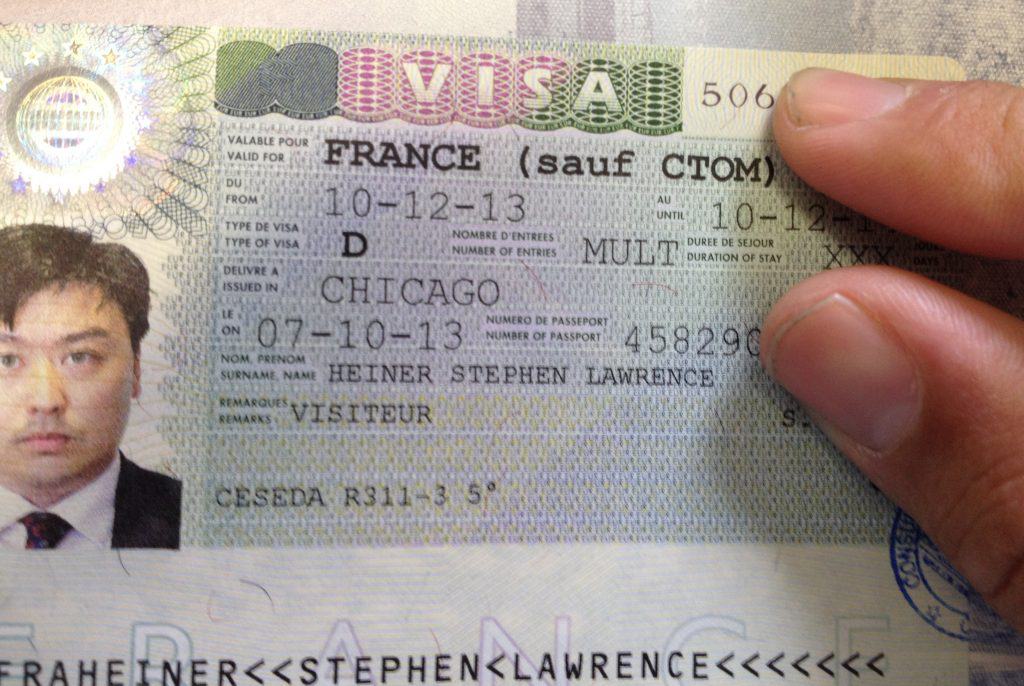
You will be asked to enter various pieces of information that are shown on your visa sticker, including the “from” date (de), the “until” date (au), and the “on” or issue date (le). Remember that dates are entered with the day first, then the month and year.

Under remarques (remarks) we will specify our visa type, for us this will be Visiteur. You will also be asked to select a Référence réglementaire (regulatory reference) number from a drop-down list. I found this number in small print on my visa, but we have heard this may no longer always be the case.  Since sometime around the year 2022 the code for Visiteur visas is CESEDA R431-16 16°. “CESEDA” stands for “Code de l’entrée et du séjour des étrangers” or in other words “entry and residence code for foreigners.” The specific number refers to the paragraph in the legal code that references the given visa type; as this law is occasionally updated, the numbers are subsequently changed (prior to 2022 the Visiteur visa code was R311-3 5°).

You will need to provide various pieces of personal information; all of it is straightforward and self-explanatory. Finally you will need to pay a fee that will cover the expense of your upcoming medical appointment. The payment can be made online with a credit card, but it wouldn’t be France if the process weren’t slightly convoluted.

First you will be sent to a site to purchase a timbre fiscal électronique (electronic tax stamp), and then you will need to return to enter the 16-digit timbre code given on your receipt as proof of payment. But at least you did not have to wait in line at the tabac to buy your stamp! At the time of writing the fee was 200 €.

Having provided proof of payment you are now done. Your visa is now registered and you will be assigned an identifiant (personal ID number) and password which you can use to access your personal account. We will use this same website and account a year later if we wish to extend our stay, and this ID number we are told is our official ID as a foreign national residing in France and “will be used in all administrative procedures while you are in France.” So probably best not to misplace it.

OFII Medical Visit

At the time your visa is registered you will be informed about the upcoming medical requirement, but this is just to forewarn you. There is nothing to do until they assign you an appointment time and place, in my case it was a further five weeks before I received my Convocation Visite Médicale (medical visit summons) by email.

This summons informed me of the date and location of my OFII medical appointment. I was additionally instructed to get a radio pulmonaire (chest x-ray) at a separate medical office of their recommendation. I needed to make the x-ray appointment myself, and it had to be performed before my OFII medical visit, as I would need to bring the results with me.

I walked down to the indicated radiology center and was glad I brought a printed copy of my convocation letter because they wanted to see it. (Buying a printer has been the best purchase I’ve made so far in France and saved me countless hours of walking to, and dealing with, the print shop.) Although the radiology lab was not affiliated with OFII they were used to having OFII immigrants come through so they knew exactly what I needed. Of course this visit was not to have the x-ray performed, it was simply to make the appointment. As they were apparently quite booked, the soonest they could schedule me for the x-ray was the day before my OFII visit! This seemed like cutting it a bit close for comfort but it all worked out.

It is entirely likely that in the larger cities these two steps (the x-ray and the OFII medical) are combined into a single visit, the way it was for Stephen in Paris. But if you find yourself in my situation, I definitely recommend not delaying at all to schedule the x-ray appointment.

Day of the X-Ray

I arrived at the radiology center at the appointed hour (for some reason these things are always at the crack of dawn). Along with my passport, I had once again, and as instructed, brought my convocation letter. Even though the convocation is not for the x-ray, it lets them know why you’re there to get one. After being checked in I was sent to a waiting room. A few minutes later I was summoned by a nurse into a small changing room where I needed to remove all clothes from the waist up. I was led to the x-ray machine which looked basically like a wall of glass. I stood on a little pedestal and was instructed to stand with my chest firmly pressed against the glass. At her command I was to take a deep breath and hold it (inspirez et retenez votre soufflé) while the x-ray was performed.

This done I redonned my clothes and returned to the waiting room. Barely ten minutes later I was handed an envelope with the x-ray image as well as a letter with their official conclusion: image thoracique normale. It was signed by Docteur Cockenpot, which I’m pretty sure is a name I hadn’t seen in America.

I was free to go, and there was no charge for this visit. I had spent less than one hour from the time I left my apartment to the time I walked back in my own front door. There are advantages to living in a small town!

Day of the OFII Visit

These are the list of items I was asked to bring to the OFII medical exam:

– Passport
– Printout of my OFII Convocation (the summons letter I was emailed)
Radiologies pulmonaires récentes (chest x-ray and letter)
Carnet de vaccination (vaccination records)
Comptes rendus d’hospitalisation (hospitalization records)
Lunettes de vue (prescription eyeglasses)
Carnet de maternité le cas échéant (maternity booklet, if applicable)

This appointment was held at my local OFII facility and also went quickly. After verifying my identity I was brought in to see the doctor. He posed a variety of questions such as my age, existing health conditions and whether I took any medications, marital and work status, and whether my teeth were in good condition (he took my word for it). He took my weight and height which was the extent of any physical “examination.”

I wore my glasses and even also brought my current eyeglass prescription, however I was not asked to show these. I had no hospitalizations to report.

He asked for the results of the x-ray which I had just taken, which I handed over. He then asked about my vaccination records. Of course the vaccine most on everyone’s mind today is the Covid vaccine. The question was asked if I had received it, and if you have by all means bring the documentation for it. However at the time of writing (February 2022) it is not obligatory to have received the Covid vaccine for purposes of your long-stay visa. Now if you want to drink a coffee outside a café, that’s a different story. 🙂

As for “regular” vaccines which is what they really want to know about, I had searched in vain for a list of requirements. As of 2018 France requires a total of 11 vaccines for children to enroll in school, but nowhere did I see what the requirements were for adult immigrants and of course most of us were born long before 2018. Although childhood vaccines in America are largely similar to the ones given in France, actual policies vary by state as well by which decade you were born.

My parents incredibly still had my little booklet from childhood in which was scribbled by half a dozen doctors the multitude of vaccines I had been given as an infant. I brought this with me to the appointment but I had a feeling it might not be considered the best possible record.

In anticipation that a more official (and legible) transcript might be appreciated, I had contacted my state health department before leaving the US. Practices no doubt vary from state to state, but in Kansas I was told that records are destroyed after 10 years. Being quite a bit older than that I found their policy to be somewhat inconvenient. No problem, they said, you can easily obtain a copy of your vaccination records from your old high school. Who knew the American public education establishment was the true repository of our nation’s vaccine records! Not me, as I had been educated outside of formal public institutions, but I list it here as another avenue you can pursue if you are looking for your own records.

There is yet another option, and that is to take what is called an “antibody titer test.” I was able to get one at my doctor’s office in America without trouble. It is a simple blood draw, and afterwards they provided me a nice printout showing my antibody levels for measles, mumps, rubella, varicella (chicken pox), and hepatitis B. I’d received quite a few other vaccines as a child but my doctor told me these were the main ones they tested for and I accepted his word for it.

I was right that the French doctor at my OFII visit didn’t seem too interested in looking at my tattered childhood vaccine booklet, but he had no problem with my titer results and proclaimed them satisfactory. I still can not claim to know what official list they are looking for specifically, but I suppose in the worst case they could ask you to retake some.

This ended the “examination.” I was returned to the waiting room and after a few minutes an attendant brought me two copies of a short letter titled Certificat de Controle Medical (Certificate of Medical Inspection). Along with my information was the following simple statement followed by the doctor’s signature: Remplit les conditions sanitaires pour être autorisé à résider en France, or, “Meets the health requirements to be allowed to reside in France.”

The attendant explained to me that one copy was for my own records and the second would need to be given to the prefecture at the end of my first year in France, if I chose to extend my stay beyond that point. If so, I would need to start the renewal process between 4 and 2 months prior to the end of my visa validity, using the same website listed above.

I was asked if I had any questions, the only one I could think of was, “Is there anything else I need to do?” The answer was no — I was free to live my life as a legal French resident for the next year.

Once again this whole process went very quickly, I was in and out in less than an hour. My interview with the doctor was conducted in French but I suspect he could have spoken English if necessary, and the attendant who dealt with me before and after spoke English.

A Note About Visas and “Titres”

The type of long-stay visitor visa we have obtained, and which was pasted into our passports by the French embassy before we left America, is called VLS-TS, which stands for Visa de Long Séjour – valant Titre de Séjour.

Translated that means a “long-stay visa that is valid as a residence permit.”

Technically speaking it is not itself a residence permit (titre de séjour), it is a visa that is valid as a residence permit. With this visa we can reside in France for one year without needing to do anything at the Prefecture. If we want to stay beyond the one-year validity period of our visa, then between 4 and 2 months prior to its expiry we need to apply to the Prefecture to renew our immigration status. It is then that we will finally be asking for a titre de séjour and if granted they will give us a physical carte de séjour visiteur (visitor residence permit card). This card will from thenceforth replace the sticker in our passport as our official identification.

I mention this in the event, that like me, you found yourself early in your research with a great deal of confusion about cards and permits and visas and stickers and their French translations, as many of these terms are used interchangeably by various people on the internet, and of course the process has changed over time and some information becomes obsolete. When Stephen went through the OFII process he received an additional sticker in his passport at the conclusion of the process. That no longer occurs. For our first year in France we will get nothing in addition to that, though as described in this article, we do need to register this visa with OFII in order to make it official.

Did you enjoy this article?  TAIP is 100% reader-supported through tipping.  If you want to leave us a tip of any amount it would be highly appreciated.  These tips help support our efforts to keep TAIP an ad-free environment.  Just as at a cafe, the tips are split evenly among the team.

How to Get a Long Term Stay Visitor Visa (VFS and Covid-19 edition)

Note from the editor: In light of new guidance on remote working in France as shared by the official French tax office in June 2025, we have also officially changed our stance on remote working for a US company while living in France under the visitor visa. Read more here, and contact us with any questions or concerns. We’re here to help! — MS

Those in our Facebook group know that for some time I have been seeking an updated version of my 2013 article on how I got my original visitor visa.  While that article was one of the cornerstones of this site and while certain principles of it still apply, since the advent of VFS taking over not just France’s, but other countries’ visa processes, and with Covid-19 limiting in-person meetings, I wanted an updated article from one of my visa clients who went through the process very recently, knowing that this would become an article that would be referenced for years to come.  Luke Middleton was kind enough to do just that for me and I enclose his very detailed story below.  For my video course that breaks down some of these steps in even more detail, click here.  If you’d like to read more of his writing you can do so here.

I also note that Luke got his visa while explicitly stating that he would be working his US job remotely, which once again undermines the misinformation peddled by Allison Lounes, that you cannot have a remote job on a visitor visa.  I stated as much when I applied (and renewed) such a visa almost a decade ago, long before remote work was something everyone knew about, and Luke has just done the same last month.  Alas, that means you don’t have to accept her narrative and drop $2000-$4000 using her services to get a Prof Lib visa, but I don’t suspect you’ll be upset about that.  -SH

How to Apply for a Long Stay Visitor Visa

After a long period of disruption due to Covid-19 the French authorities in the United States resumed processing all categories of visa applications in June 2021, including the visiteur category that Stephen has discussed so many times on this blog. 

The application process has changed from the one he encountered in 2013. Probably the biggest difference is that the French have now partnered with a third-party service provider which handles a portion of the application. While this arrangement may have streamlined things on the backend, some initial amount of confusion may result from having to interact with two completely different websites that have no evident connection to each other. And neither of these websites happens to be the website for a French consulate, which is where you might have started your Google search. In fact, there are nine consulates (and one embassy) in the US and each has its own page, presenting information in a slightly different way. All the information you need is ultimately out there but it certainly wasn’t as plainly presented as any might like. 

Let’s start with the two websites I mentioned earlier: 

The first is france-visas.gouv.fr (I will call it France-Visas going forward). This is where you will fill out and submit your visa application form. 

The second is VFS Global. (I will simply call it VFS after this).  This is the third-party provider with whom you will make an appointment to hand in your application form, passport, and other documents. Note that VFS handles visa applications to and from a wide variety of countries, not just for Americans going to France. So when you are on their website, make sure you are looking at the correct information. 

Here is the recommended order of steps as described by France-Visas: 

  1. Create an account at France-Visas.
  2. Fill out the online visa application form. Until you have “submitted” this form it can be saved and you are free to go back and edit it (well, you can edit some of it). You can even download a PDF version which will have a large “DRAFT” watermark on it. Once it has been submitted the DRAFT watermark will be removed and importantly at this point you are unable to edit, delete or recall the form. You are supposed to submit the form before proceeding to the next step, but I recommend you wait and will explain why shortly. 
  3. Next we need to go to the VFS website and book an appointment at one of the 9 VFS visa application centers. Here again they will ask in ALL CAPS if you have already submitted your form on France-Visas. I recommend you proceed with scheduling the appointment and only afterwards go back and submit your application at France-Visas.  
  4. Attend your VFS appointment where you will hand in your application form, various supporting documents as well as your passport, and have your biometrics taken. 
  5. After your appointment VFS will mail your documents and passport to the consulate in Washington DC (the only time the French authorities get involved). At this point your application is either approved or denied and your passport is mailed back to you. 

That is the recommended order and the one I followed but here is a potential problem: when you fill out the visa application form on the France-Visas website, you must specify which VFS application center you will be going to. I live in Kansas so I chose the center in Chicago since various internet searches told me that Chicago is the “consulate for my region” (in fact that is true, but it doesn’t matter as we will see).  Having completed the form on France-Visas I submitted it and only then went over to VFS to book my appointment. That is when I discovered to my dismay that the Chicago office had no openings available for as far forward as it would let me look. But once the application form on France-Visas has been submitted it can no longer be edited, and I had already told them I was going to Chicago! Also I wasn’t sure if I was even allowed to go to a different office. 

In the olden days, including when Stephen applied, you had to book an appointment at the French consulate for your region — you couldn’t just choose any one you felt like. But today we are not booking an appointment at the consulate, we are booking an appointment at a VFS Global Visa Application Center. These application centers just so happen to be located in the same cities as the French consulates (with the exception of New Orleans), but they are not the same thing! For example in Chicago the VFS center is about seven blocks away from the French consulate. 

With this change it no longer matters what VFS center you go to, you are free to choose whichever one you prefer. There are nine located in the following cities: Atlanta, Boston, Chicago, Houston, Los Angeles, Miami, New York, San Francisco, and Washington D.C.

Since you have to tell France-Visas which VFS center you are visiting, and you won’t know which ones have availability until you book an appointment, I recommend the following:

  1. Go ahead and fill out the application form on France-Visas so you are sure you are able to answer all the questions, but don’t submit it yet — just “save” it instead.
  2. Now go to the VFS site and book an appointment. 
  3. Then return to France-Visas and “submit” your form. If you had to select a different location, you will actually need to fill out a new form on France-Visas since it will not permit you to edit the location field. At least you will already know the answers to all the questions, and after you submit the correct form you can delete your earlier draft. 

This is not the recommended order but you will avoid what happened to me: since I couldn’t change my submitted application for Chicago, VFS instructed me to create and submit a second application. I managed to reserve an appointment in Houston and prayed I hadn’t hopelessly confused their computer system (it all worked out in the end). 

I am told that VFS posts new appointment availabilities on their website once a week, and they don’t open appointments more than a couple of months in advance. So if you really must go to a specific city you can also just keep checking back each week. 

Now let’s look at each step in more detail. 

Step 1: Begin the France-Visas Application Form

Create an account at France-Visas and start a new application. Most of the form is self-explanatory but I will highlight some important items here: 

  • Place of submission of application: for many TAIP readers, this is going to be the United States of America
  • City of submission of application: this is where you select one of the nine VFS cities, make sure you can get an appointment there first! 
  • Visa type requested: we are applying for Long-stay (1 Year+)
  • Your plans: this is actually where the visa type is specified. We want to select Visitor
  • Main purpose of stay: there are two options, Visitor (adult) or Visitor (minor). Most of us are presumably going to be adults, unless you are bringing your children with you in which case you will be creating a group application that includes forms for each person. 
  • Planned date of arrival in French territory: remember that you can not submit your application more than 3 months prior to your planned arrival date.  You don’t have to arrive in France on the day your visa begins, you simply can’t arrive before that day.

Further into the application you will be asked to give your Host person or organization. Since we are visiteurs, I selected the option to provide the Name of hotel or place of accommodation. And since my place of accommodation is an apartment I just typed in Appartement for the name, and then provided the address. If you don’t have a residence lined up yet enter the name of the hotel or other lodging you plan to stay at. 

Another section is titled Funding of travel costs. Once again we see various options that make more sense for visa types other than the one we are applying for, here are the ones most relevant for our purposes: 

  • Credit card
  • Cash
  • Other

I checked Credit Card, Cash, and for Other I put USA Employment Income since I am keeping my US job while living in France. There is also an option to give them the name of a French guarantor, which I suspect most of us will not have. 

Note: in several places you will need to provide a US address (for your current residence; where you were born; the address of your American employer if you have one, etc). Of course this form having been designed by the French you will only be given a City field, but not a State field. Type both the city and state in the City field. 

Another note: pay attention as well to date fields and remember that the French put the day first and then the month. I found that the VFS website also used this French convention. 

Ok, we’ve made it through the application form, but as discussed above let’s just “save” it and hold off on “submitting to the visa center” until we complete the next step. 

Step 2: Book an Appointment at a VFS Global Center

Next, create an account at VFS Global and schedule an appointment. Hopefully you created the account from the correct section of the site in which case you will be relieved to see that it knows you are an American applying for France, and not something else. During this process you will select which VFS city you want to go to. It will also ask you for your Appointment Category which in our case will be Long Stay Visitor

In general I found the VFS website to be unrefined and buggy. When it asked for my US location it forced me to select a city from a predetermined list which strangely did not include my actual city, the largest in the state. The list did however include several obscure towns out in the boonies that no one has ever been to (I just selected one at random, it doesn’t seem to have mattered in the end). Multiple times the site croaked, showed errors, or just directed me to blank pages (maybe this was to prepare me for French life?), and I had to fortify myself with whiskey before I could log back in. But persevere and eventually you should be able to make an appointment. 

Note: at the conclusion of this process VFS will provide you with an appointment receipt or “appointment letter” which will also be emailed to you. This letter will indicate the time and date of your appointment as well as the address of the VFS office. You need to print this letter and bring it with you to your appointment.

Step 3: Go Back and Submit Your France-Visas Application

Now that you know where you are going for your appointment, return to France-Visas and “submit” your application form for real. If you have to change your appointment city from what you originally specified, you will need to create an entirely new form. Save a PDF copy of your first draft so you have your prior answers, delete that application, use the draft to help you fill in the new one, and when done, submit it. 

Download the PDF of the final, submitted form and print it out (it should have no “DRAFT” watermark). This PDF will include three things — the completed application form, an application receipt, and a list of required documents to bring to the VFS appointment.

Note: depending on how you answered certain questions when filling out the application, there may be additional required documents not listed on the receipt, but which will be described nonchalantly in a wall of text on the confirmation page after you submit the application. So read that page well, because once you leave that screen you will never see it again.

If you, like me, answered “yes” to the question “Have you previously resided for more than three months in a row in France?” bring a copy of that previous visa.

Step 4: Show Up to Your VFS Appointment

Now you need to present yourself to the VFS office at the appointed hour, bringing with you all the supporting documents required. Don’t worry, this meeting will be in English and your documents can be in English as well.  As Stephen often reminds us, the visa interview is in the language of the country you are applying from.  They don’t assume you already speak French.

As already mentioned the required documents are listed in the same PDF as your France-Visas application form, but let’s go through them one by one: 

VFS Appointment Letter
This is not actually on the list, but I am repeating it here because you need to bring it.

Signed and dated application form
This is your France-Visas application. In my case the VFS person I dealt with already had a copy of this form on her computer and she preferred to use it instead of mine. All the same, bring your own copy since that’s what they tell you to do.

Receipt France-Visas
This is included in the same PDF file as your France-Visas application form, so you should already have printed it out. 

A travel document
The exact wording follows: “issued less than 10 years ago, containing at least two blank pages, with a period of validity at least 3 months longer than the date on which you intend to leave the Schengen Area or, in the case of a long stay, at least three months longer than the expiry date of the visa requested. Be sure to transmit (scan) ALL PAGES of your travel document containing visas, entry and exit stamps or any other inscription.” is included in the same PDF file as your France-Visas application form, so you should already have printed it out.” 

Clearly you need to bring your physical passport, which you will hand over to VFS and which will be returned to you later by mail. The language about transmit and scan I believe refers to the option to submit some documents electronically.

Although it is not explicitly stated, I remembered that Stephen was asked to bring a photocopy of his passport in addition to the original. Just to be safe I did the same thing (making copies of the title pages as well as all other pages with entries). The VFS lady took my copies without seeming to think that was unusual, so I would recommend you do the same. 

ID photograph
They are referring here to a passport photo. In my area of the country the usual place to get these are pharmacies. Your mileage may vary, but I went to two Walgreens stores and got terrible pictures both times (low resolution), but the ones from CVS were sharp and clear. White backgrounds are common so do not wear a white shirt or they may decline to take your picture as your head will appear to be floating in space.

As it turns out VFS will also be taking your photo as part of the biometric collection (in addition to your fingerprints). The photo that ended up on my visa is the one VFS took, not the one I provided. However it is listed as a requirement and they did ask me to hand it over, so whether they want to use it or not, bring one (I brought two but they only asked for one).

Letter from the employer or proof of business ownership/business license (if self-employed). If retired, pension certificate.
I am employed by an American company and I got my boss to sign a letter that made the following points:

  • so and so is indeed an employee at our company
  • we are aware that he is seeking French residency
  • he has our approval to do so
  • his relocation to France will not cause any change to his employment status since he is free to work remotely
  • his salary is $X which at the current exchange rate equals Y€ per month.

I had my boss sign multiple copies of these letters in case I need them for something else later, and gave VFS an original. I am less able to speak about the other cases, though presumably the student category should not apply to those of us applying for a visitor visa. What ramifications self-employment might have for the next item probably depends on what you do; if you need advice I would suggest posting your questions on the TAIP Facebook group.

Promise not to exercise any professional activity in France
I provided a signed letter declaring on my honor (as the French like to do) that I would “not exercise any paid professional activity in France.”  The fact that this follows directly after “letter from employer” means that the French do not consider your remote work “paid professional activity” for purposes of this visa.

Travel health insurance certificate
The text continues: “issued by the insurance company (covering any possible costs for medical repatriation, and emergency and/or hospital treatment, for a minimum amount of 30,000 €, valid in France for the whole stay. A copy of your American health insurance card is not acceptable proof of adequate coverage).”

For this requirement I chose to purchase an International Health Insurance plan from Cigna Global as Stephen did so many years ago.  This is a process in itself, but I will try to restrict my comments to the basics. They offer three levels of coverage which they call Silver, Gold, and Platinum. Even the lowest Silver level offers 800,000 € coverage for inpatient and emergency care, which is 30X above the French requirement. Gold and Platinum have increasingly higher coverage levels and also include maternity care. In addition to selecting the three coverage levels you also specify your desired deductible ($0-$10,000), percentage of cost share (0%-30%), and out-of-pocket maximums ($0-$5,000). Higher levels of these selections will reduce the price of your premium but will of course increase the sticker shock if you ever actually ever use the insurance. You can also choose to pay monthly, quarterly, or annually, with the latter two options offering a slight discount. Even without the discount it makes sense to buy a one-year policy since you need to show coverage for the full period of your visa.

After these selections you will be presented with various optional add-ons such as outpatient coverage, vision, and dental, etc. but don’t glaze over this section because you will absolutely need to purchase the “International Evacuation & Crisis Assistance Plus” add-on to meet the French requirement for medical repatriation coverage.

While the cost may vary based on your age, gender, and other factors, as a point of reference I chose the absolute cheapest Silver plan, maxed-out deductible, cost sharing, and out-of-pocket levels, with no other add-on except the international evacuation feature, and earned the discount for paying for an entire year upfront. My total came to $900. 

Several minor frustrations are encountered during this process. At the beginning of the insurance application they ask what country you will be living in, which is obviously France. Later you have to provide your mailing address and at this point the form will only accept a French address. Even if you know this address in advance (and some won’t), by definition we are not living in France yet and we may not want mail going there. However they do provide the option to receive communication electronically which solves the mail problem. If you don’t yet know your future French address you can just put down the address of your hotel.

A second frustration is that Cigna will not allow you to schedule your coverage start date more than 45 days into the future, but it is entirely possible you will need to buy it more than 45 days prior to your departure. This means your one-year policy period may not overlap exactly with your one-year visa; in my case it was off by about one month.  But ultimately that’s no big deal.  You may, like Stephen, end up ditching Cigna immediately and buying a much cheaper private French policy.

Finally after having forked over your money and waited several days for your Cigna account to populate, you will be able to download a one-page certificate of insurance. What concerned me is that this certificate does not explicitly describe the coverage levels: it showed that I had purchased the “Cigna Global Silver” plan, but who knows what “Silver” represents? I wrote several emails to Cigna asking if they could give me a more detailed cover letter, and never got a response. Afraid this would be a problem I printed off the entire 40-page Cigna Customer Guide and brought it to the appointment. I discussed the issue with the VFS representative and she thought the basic cover letter “should probably be enough.” My visa was approved so apparently it was. 

Proof of accommodation in France
The text continues: “property title deed, tenancy agreement or any other supporting document. Or proof that accommodation will be provided by a person residing in France, or if not, a document explaining the accommodation arrangements planned for France.

By various undeserved miracles I was fortunate enough to have an apartment lined up in advance and was therefore quite pleased with myself to be able to hand over a copy of my French contrat de location (rental contract). But my self-congratulation immediately ended with the next question: “Do you have a copy of your landlord’s identification?”

Uhm no, I did not. To my relief the lady once again said, “That’s ok, I think the contract will be sufficient.” And it was, but if this applies to you and you are able to obtain a copy of your landlord’s ID and electricity bill, it definitely won’t hurt.

If you don’t yet have housing arrangements made you will want to write a small letter explaining your plans to do so. 

Proof of enough resources to cover all expenses during trip
The requirement says bank statements and that is what I was asked for, so bring them whether they prove anything or not. Thankfully having now met the literal requirement I was permitted to provide other documentation as well; I gave them pay stubs from my employer and my savings account statement.  If you’re a pensioner that statement will come in handy.

If, like me, you decide you need to move funds around to present the best possible financial picture, make sure to plan ahead for the time it will take to make those transfers as well as for the statement to be produced from whatever account you move them to, since all of that will need to be done prior to your appointment.

After requesting each of these items in turn, my interviewer finished by asking “Do you have anything else you want to give me?” I did not. You don’t have to volunteer anything that is not requested, but by all means if there is something you think will help your case then provide it.  As Stephen often notes, have more documentation than you are asked for with you, but don’t hand it over unless they ask for it.  More does not necessarily equal better.

All that remains at this point is to pay for three things which will be combined into a single charge to your credit card (cash and checks not accepted): the visa application fee, a service fee to VFS, and the cost of overnight FedEx service to return your passport. Unlike in Stephen’s day you do not need to bring a pre-paid envelope with you, you will purchase it at the appointment. For me the total cost came to roughly $200 but no doubt this will fluctuate. 

Step 5: Wait for Your Passport to be Returned

At this point VFS will forward your application, passport, and documents to the French embassy in Washington DC where your case will be approved or denied. The VFS agent informed me at the time that they were currently very busy processing student visas (my appointment was in August) and she could neither guarantee nor estimate how long it would take to receive a response. She did say the consulate typically strives for a turnaround of two weeks. 

She also said that if the French authorities needed any more information they would contact me directly and if I didn’t want my application to end up in a forgotten pile somewhere I should respond as quickly as possible. 

In the end the French never asked for anything else and my approved visa was in my hands a mere seven days later. 

The visa appears as a large sticker on one of the pages of your passport. It will have a start date which in my case was two weeks earlier than the planned departure date I put down on my application.

Included in the envelope with my passport/visa were two miniscule slips of paper: 

  • The first informed me that upon arrival in France I would need to go online and register and validate my visa. This will be the subject of a future blog post
  • The second referred to current Covid travel regulations. Since these seem to change from week to week there is no point discussing them here, just check before you go and hope for the best. 

Whew! If you’ve made it this far and your visa was approved, congratulations — you’re going to France!

Final Thoughts

Start preparing early and try to think ahead as much as you can. Since you can’t submit the application more than three months prior to departure, and the recommendation is to schedule your VFS appointment at least 1 month prior to leaving, it can start to feel like a lot of activity is getting crammed into a very short period of time. Needless to say, these last few months are already going to be hectic with moving preparations. But there is nothing stopping you from starting to gather documents prior to the application process, and you will thank yourself for any groundwork you were able to do in advance. Bonne chance!

The process may be different now but the sticker in your passport will still look substantially similar to the featured photo above.

TAIP is 100% reader-supported through tipping. If you want to leave us a tip of any amount it would be highly appreciated. These tips help support our efforts to keep TAIP an ad-free environment. Just as at a cafe, the tips are split evenly among the team.