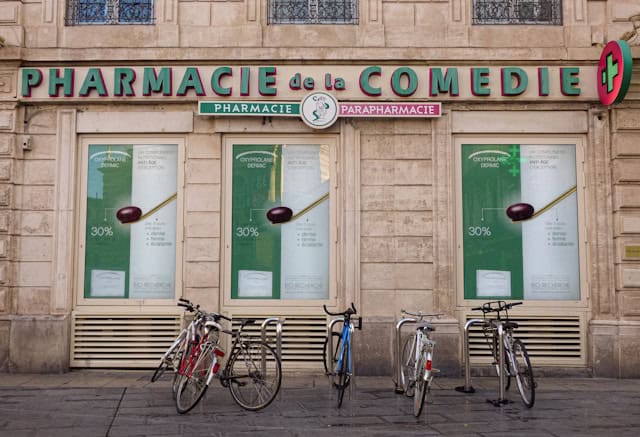
French pharmacy with bikes in front of it

How Does CPAM Work?

Note from the editor: Navigating the French healthcare system as an expat is no easy feat, so we’ve partnered with Fab French Insurance to hopefully make things feel a little more straightforward for our TAIP readers. Below, they’ve done a wonderful job of explaining what CPAM is and how you can benefit from it when you’re a full-time resident in France. Enjoy! — MS

Joining the French healthcare system is one of the biggest milestones after moving to France, but it is also one of the most confusing. Between CPAM, Assurance Maladie, the carte Vitale, mutuelles, and reimbursement rules, many newcomers struggle to understand where to begin and what happens after they arrive.

The good news is that while the administration can take time, the system itself is logical once you understand how the different pieces fit together. If you’re planning a move to France or have recently arrived, here’s what you need to know about how CPAM works and what to expect during your first months.

What Is CPAM?

CPAM (Caisse Primaire d’Assurance Maladie) is your local health insurance fund, responsible for managing public health insurance in your area. It forms part of Assurance Maladie, which is the French public health insurance branch of the social security system.

Once you are registered, CPAM manages your healthcare rights, processes reimbursements, and eventually issues your Carte Vitale, the green health insurance card used throughout France. Each département has its own CPAM office, although most day-to-day administration can later be managed online through your Assurance Maladie account.

Who Can Register with CPAM?

The way you access French healthcare depends on your personal situation. If you begin working in France, your healthcare rights can generally begin from your very first hour of employment through the French social security system.

If you are not working, including many retirees and visitor visa holders, you may still qualify under Protection Universelle Maladie (PUMa). Non-working residents may apply under PUMa once they meet the conditions of stable and regular residence, which generally means living legally in France for more than three months.

Because every situation is different, the documents required and the registration process will vary depending on whether you are employed, self-employed, retired, joining family members, or applying through another residence status.

How Do You Apply?

Most first-time applications are made using Cerfa n° 15763*02 – Demande d’ouverture des droits à l’assurance maladie, which is submitted to the CPAM covering your place of residence together with your supporting documents.

According to Assurance Maladie, applicants will generally need:

  • Cerfa n° 15763*02 application form
  • Passport or national identity document
  • Original birth certificate (or an officially certified copy), issued within the last six months, together with a certified French translation (traduction assermentée) dated within the last three months if the document is not already in French.
  • Proof of legal residence in France
  • Proof of address
  • French bank account details (RIB)
Depending on your circumstances, CPAM may also request additional documents, such as an employment contract, recent payslips, family documents, or evidence supporting your residence status. Providing a complete application from the outset is one of the best ways to avoid unnecessary delays.

How Long Does Registration Take?

Processing can take weeks or months, depending on the workload of your local CPAM office and whether your application contains all the required documentation. If further documents are requested during the process, this can extend the timeline.

During this period, many newcomers experience what is often referred to as the “healthcare gap,” the time between arriving in France and officially obtaining healthcare rights.

For this reason, private health insurance is often essential during your first months in France. In fact, many long-stay visas require applicants to hold health insurance covering medical expenses, hospitalization, death, and repatriation costs for the duration of their stay until they become eligible for the French healthcare system.

What Is the Carte Vitale?

Many people think receiving the carte Vitale is the moment they join the French healthcare system, but legally, the important milestone is the beginning of their healthcare rights.

The carte Vitale is simply the card that allows healthcare providers to transmit your reimbursement claims electronically, making the system much easier to use. Once you receive it, you simply present the card during medical appointments or at the pharmacy, and reimbursements are processed automatically in most cases.

How Do Reimbursements Work?

The French healthcare system does not usually reimburse 100% of your medical expenses.

Instead, Assurance Maladie reimburses a percentage of an official tariff established for many healthcare services. If your doctor charges more than this official amount, known as dépassements d’honoraires, the additional cost may remain partly or entirely at your expense.

This is why many residents choose to take out a mutuelle, or complementary health insurance.

A mutuelle helps cover some or all of the costs that remain after Assurance Maladie has reimbursed its share, particularly for hospital treatment, specialist consultations, dental care, optical expenses, and hearing aids.

Once linked to your CPAM account, reimbursements between Assurance Maladie and your mutuelle are usually handled automatically.

Do You Need a Médecin Traitant?

As soon as you are settled in France, it is advisable to choose and declare a médecin traitant, your regular doctor.

Although most people choose a GP, French rules also allow certain specialists to act as your médecin traitant. The declaration can be completed electronically by your doctor or by using the official Cerfa S3704 paper form, meaning you do not necessarily have to wait until you receive your Carte Vitale.

Declaring a médecin traitant is not compulsory. However, if you choose not to declare one or regularly consult specialists outside the parcours de soins coordonnés (coordinated care pathway), Assurance Maladie will generally reimburse a smaller percentage of your consultation costs.

Can You See a Doctor Before Your Registration Is Complete?

Yes. You do not need to wait for your carte Vitale before receiving medical treatment. You can still consult doctors, specialists, hospitals, and pharmacies if necessary.

Whether you can later obtain reimbursement depends on when your healthcare rights are officially opened and whether you have the appropriate supporting documentation relating to the treatment period. This is another reason why maintaining appropriate private health insurance during your first months in France is strongly recommended.

CPAM Is Worth the Wait

The administrative process of joining the French healthcare system can feel slow, especially when you are simultaneously dealing with visas, banking, housing, and countless other aspects of relocating to France. However, once your healthcare rights are established and your carte Vitale arrives, the system becomes remarkably straightforward to use.

Combined with a suitable mutuelle, CPAM provides access to a healthcare system that offers predictable costs, excellent continuity of care, and largely automated reimbursements. Like many aspects of French administration, it requires patience at the beginning, but once everything is in place, it becomes one of the foundations that make everyday life in France considerably easier.

Fab French Insurance helps expats navigate this transition, from medical insurance cover to full public healthcare with the right mutuelle, so you are protected from day one.

Photo by Jossuha Théophile on Unsplash

Did you enjoy this article? TAIP is 100% reader-supported through tipping. If you want to leave us a tip of any amount it would be highly appreciated.  These tips help support our efforts to keep TAIP an ad-free environment. Just like at a cafe, the tips are split evenly among the team.


My First Trip to the ER in France

Last month, I went on a four-hour hike through the snow in Chambéry, France. I put on my oversized jacket, layered up in every way, and put on my best wool socks. Equipped with a pair of leather, wool-lined boots, I thought this was going to be a walk in the park (or the woods). What I didn’t account for was the snow melting as soon as it touched my boots and my feet sitting wet for hours in the cold. The next night I discovered a small open wound had appeared by my toenail. By the next morning it was undoubtedly infected. 

Instead of immediately booking a doctor’s appointment, as I had just seen my doctor the day before the hike, I thought it would be fine if I tried to treat the wound myself. Given the title of this article, you can probably guess that wasn’t the best idea. 

By day two I was miserable, by the end of the week, I was in severe pain. No number of Manuka honey presses, green clay masks, red-light sessions, or bleach baths was healing me. So by the time I finally came to my senses on Sunday night, I realized my only option was to go to the hospital to get immediate care, only four days before my international flight to go home for the holidays. 

My French friends (pretty much family), advised I go early, so I arrived at the ER in my town at about 8:20am on Monday morning. There were 4 people waiting to be seen ahead of me. I approached the window to address the intake nurse. When she called me forward, I explained my injury. She took my carte vitale and told me she would return it after I was seen to complete payment. The carte vitale is the social healthcare card in France. It tracks healthcare visits and prescription fills, facilitating reimbursement when eligible. As a language assistant for the French public school system, I was provided one, first digitally, and eventually in card form once all my paperwork was processed. After I answered a handful of questions, I took a seat in a waiting chair. 

I was called back after about 15 minutes, this time met by a male nurse and a female assistant. Both looked relieved when they realized that I spoke French. I explained my situation and when I showed them my foot, they were immediately compassionate. They gave me a wristband to be processed as a patient and told me the doctor would call me back shortly. I returned to the waiting room for about 30 minutes. Soon enough, I was called into another room. There, a friendly young doctor of about my age explained that she would be doing an immediate procedure to remove as much of the infection as possible and to cut back the side of my ingrown toenail. 

I should probably preface this by saying that not only was this my first trip to the ER in France, but it was my first trip to the ER — ever. I took a deep breath and lay back on the operating table. We started with just local anesthesia, but the pain of the infection was quite intense, so another nurse was called in to give me laughing gas. Soon enough the procedure was over and I was able to sit up to receive my care instructions. 

I received my paperwork documenting the procedure and prescriptions to fill at the pharmacy. The doctor spoke slowly and I asked for clarification for the one word that was outside of my vocabulary. Limping back to the intake nurse to see what the damage was, she asked if I had a mutuelle, an additional private healthcare insurance to complement the social system. I replied no. She looked disappointed by the news, so I braced myself for the worst. Then she said, “That’ll be 19.98 euros,” the equivalent of about twenty dollars. Cue my sigh of relief. 

My prescriptions at the pharmacy came to another 30 euros, making my total expenditure about 50 euros. As an American, these numbers were simply astounding. I have never been so grateful for the French healthcare system. 

I won’t fool you and say it was all blue skies and rainbows from there. The following days, the pain returned and I was put on an antibiotic that contained pork and gluten — both of which I am allergic to. Passing through Paris with my suitcase and post-op foot was also not the most fun I’ve ever had. By the time I made it back to the States, I visited a doctor and received another antibiotic for $150. I guess that’s the difference between French and American healthcare, about 200%. 

My toe is fully on the mend and you can bet I’m watching my nails for any signs of ingrowth like a hawk. What a memory made! Though I’d be glad to have missed out on this experience altogether, I’m quite proud to have proven my French proficiency equal to the occasion. Have you ever gone to the ER or sought healthcare while in France? We’d love to hear about your experience. Cheers to firsts (and hopefully lasts)!

Photo taken by yours truly on the hike that started it all. Was the view worth it?

Did you enjoy this article? TAIP is 100% reader-supported through tipping. If you want to leave us a tip of any amount it would be highly appreciated.  These tips help support our efforts to keep TAIP an ad-free environment. Just like at a cafe, the tips are split evenly among the team.

doctor and nurse figurines in front of another on a hospital bed

How Healthcare for Expats in France Really Works

We often get asked questions about healthcare for expats in France. This is especially true for our older audience — retirees hoping to move abroad, folks over 50 who decide to make a life for themselves in Paris or elsewhere — they want to make sure they’ll have coverage.

It’s no surprise that Americans are concerned about this as our healthcare system is one of the most complicated, expensive, and challenging ones in the world (I said what I said). For many, healthcare is one of the biggest unknowns when moving to France. 

The good news is that France consistently ranks among the best in the world for quality and accessibility of care. I have had nothing but good experiences with healthcare in France (okay, maybe I’ll admit the one dentist I saw wasn’t the best), and I found it easy to navigate once I got the hang of it. 

We’ve already written about our experiences with osteopaths and chiropractors, how to get a numéro provisoire to get your carte vitale and sign up for a mutuelle, and the differences between the CSS and top-up insurance, but I wanted to create a deep dive to hopefully help quell some of your worries.

While the system may seem intimidating at first, healthcare for expats in France is surprisingly affordable and reliable once you understand how it works.

The Basics of French Healthcare

France operates on a universal healthcare system called the PUMA (Protection Universelle Maladie). This means that every legal resident — yes, including legal expats — is entitled to coverage. When you go to the doctor or a hospital, the state pays a percentage of your medical costs and you’re responsible for the rest.

The golden ticket to benefiting from this system is the carte vitale. This small green health insurance card is tied to your French social security number, and when you hand it over at the end of appointments or at pharmacies your reimbursement is processed automatically. 

Once you arrive, securing this card is one of the first big steps toward fully integrating into life in France.

Who’s Eligible and When

Generally anyone with legal residence in France can access the system. Non-EU expats (like Americans) typically have to wait three months after their arrival before they can apply. 

Students, salaried workers, and retirees each have slightly different processes:

While you wait for approval, we typically suggest you stick to the private health insurance you were required to have for your visa application. Cigna Global has great options for expats, as does AXA.

What’s Covered and What Isn’t

One of the best surprises about healthcare for expats in France in my opinion is just how much is included. Doctor’s visits, specialist appointments, hospital stays, prescriptions, and maternity care all fall under the state system. Most GP visits cost around 25 €, and the government reimburses about 70% of that (color me surprised at my first appointment when I only owed 7.50 €!). Hospital stays are reimbursed at 80%, and chronic conditions are covered 100%.

The biggest gap is in dental care, eye care (including glasses and contact lenses), and certain specialists. I personally found the cost to be nominal coming from the US, but after some encouragement from my mother-in-law, who was choquée that I didn’t have top-up insurance to cover it, I did end up signing up for a mutuelle to help cover the costs (more on that later).

One thing to note if you’re still waiting on your carte vitale — save your receipts. You’ll be required to pay up front, but as soon as you receive your card, you can submit your feuilles de soins for reimbursement later. And yes, I can confirm they actually do reimburse you.

The Role of the Mutuelle

A mutuelle is France’s version of supplemental private insurance, or “top-up” insurance. You can think of it as the add-on that fills any gaps left by the state. A typical mutuelle covers the remaining 30% of GP visits, plus higher percentages of dental and eye care.

Don’t let the word “private” fool you, it’s still very affordable especially coming from the US. You can expect to pay anywhere from 30 € to 100 € per month, depending on the coverage you choose. I wear glasses and contact lenses so I decided to get a plan somewhere in the middle and paid around 45 € per month. Most, if not all, of my appointments were covered and my glasses and lenses were very inexpensive.

For any of our salarié readers, if you’re employed in France your company is legally required to provide a mutuelle, and it’s usually one with very good coverage. Freelancers, students, visitors, and retirees need to shop around for themselves. I like Harmonie Mutuelle myself.

Tips for Using the System

Once you’re set up with your carte vitale and mutuelle (if you choose), daily life within the French healthcare system is very straightforward:

  • Finding a doctor: USE DOCTOLIB. It’s the easiest way for expats to find a doctor, especially if you haven’t made French friends yet who can recommend one. You can even set filters for providers who speak English. If you’re in the Paris area, I loved my team at Ipso.
  • Appointments: Remember to bring your carte vitale so you are reimbursed automatically. Otherwise, save your receipts to submit later.
  • Pharmacies: You’ll also need your carte vitale to pick up prescriptions. Another thing to mention: don’t be afraid to ask your pharmacist for advice on medications. I’ve found that they are incredibly helpful and knowledgeable and they served as an invaluable resource for me.
  • Emergencies: Don’t call 911 and expect to receive help. Instead, dial 15 for the SAMU (medical emergency line that can connect you to ambulances).

The one caveat about the French healthcare system that I feel called to share is that not all French doctors are well-trained in bedside manner. I do believe this is changing as more time goes on, but like many things, don’t expect to receive the same exact experience as you would in the US. 

The care is just as good, don’t get me wrong, but you likely won’t be coddled in the same way you would in America. Honestly, this is good advice to heed when it comes to adjusting to life in France as a whole (just saying).

Healthcare for expats in France may seem intimidating at first glance, but once you take care of the necessary paperwork, it will quickly become one of the more reassuring aspects of life there. With universal coverage, reasonable costs, and a mutuelle to handle all of the extras, feel confident that if something happens, you’ll be well cared for.

Photo by Annie Spratt on Unsplash

Did you enjoy this article? TAIP is 100% reader-supported through tipping. If you want to leave us a tip of any amount it would be highly appreciated.  These tips help support our efforts to keep TAIP an ad-free environment. Just like at a cafe, the tips are split evenly among the team.

An Expat Discussion of CSS vs Mutuelle

A note from the authors: In these articles, we (Molli — MS and Gracie — GB) have a conversation about a topic that’s familiar to both of us. In addition to providing information, our aim is to explore it from two different angles and give you a more in-depth view of the complexities of French life and the expat experience.  To get the most benefit, make sure you read our previous articles explaining CSS and mutuelles.

GB: Since moving to France, I’ve been both impressed and mystified by the French healthcare system. For a long time, I assumed everyone’s carte vitale was a magical debit card that paid all their medical expenses. Eventually, I learned that this isn’t the case and that many French people also have a mutuelle which acts as additional health insurance. My American perspective is to assume health care plans are linked to employers, so I figured a mutuelle had to come from a full-time job at a French company, and since I arrived in France on a specifically non-working visa, none of these options felt accessible to me. What were your first impressions of the French healthcare system, Molli? Did you have someone to help you avoid my misconceptions?

MS: I had a similar perspective as you! I think that in the U.S. there’s this big narrative around the fact that yes, health care is free in most other countries, but that it means low-quality care, long wait times, and old-fashioned hospitals and healthcare centers. I was also shocked to find out that the “free” health care so bragged about here isn’t actually free.

The first time I had to go to the doctor or hospital was when I was still an au pair. I cut my thumb on some broken glass and when the cut got infected my host dad took me to the hospital. I was pleasantly surprised at the normal wait times, friendly doctor, and standard hospital equipment that I was used to seeing in the US Yet another stereotype bit the dust that day. 

That said, one stereotype did come true that day, and it was the fact that health care here is extremely affordable albeit not free. You definitely don’t have to worry about going bankrupt if you end up in the emergency room and you don’t have a carte vitale, which I didn’t at the time. I was on some special au pair insurance that my host family had set me up with. If you’re wondering what a carte vitale is, think of it as a healthcare card similar to the insurance cards in the US. You use it at the doctor’s office, pharmacy when you pick up prescription drugs, and at the hospital. It also has your French social security number on it, as well as your name and picture.

I actually didn’t get my first carte vitale until I opened my auto-entreprise three years after I had been living in France. Interestingly enough, I should have been given one automatically when I began the intensive French language program I began after I decided to stop nannying, as all students are part of France’s social security system (which includes the carte vitale). But, in true French bureaucratic fashion, halfway into the school year I still wasn’t issued one. Luckily, I decided to start my auto-entreprise while I was still a student. 

I also had never heard of the concept of a mutuelle, and naively thought that I could go to any sort of doctor or specialist for free. I have since learned that if you have to go to the dentist, eye doctor, or physical therapist and you don’t have this extra coverage, things can get really expensive. Gracie, do you have extra coverage now that you understand the system better? And, speaking of which, when and how did you start to wrap your head around how everything works?

GB: Yes, I have extra coverage through complementaire sante sociale (CSS) in addition to a carte vitale. Having both of those together means the French government pays for most of my healthcare which makes me feel amazing and lucky. That said, it did take about a year and a half of filing paperwork and waiting to get the whole thing in place. And to qualify for a CSS, you have to be making very little money so I’m not sure if it will be a permanent solution, especially since you have to reapply each year. As with all French bureaucracy, they don’t make it easy. 

I started to wrap my head around how everything works after being in France for about two years.  I’d always assumed that I had to be a French citizen or have a more permanent visa (at the time all I had was a long-term visitor visa), but that wasn’t correct. France is actually fairly lenient about including immigrants in its healthcare system, and all you have to do is prove that you’re living in France in a “stable and regular manner.” This means you do not have to be born in France, married in France, or even working in France to register. It does mean you do have to have spent at least three months in the country and have a valid titre de séjour

This was one of those classic –– why didn’t anyone tell me this –– revelations. From there, I learned more from the assurance maladie office which told me I could apply for a permanent number and a carte vitale after I was PACSed and had a VPF visa. My primary care physician was also extremely helpful and advised me to apply for the CSS in the first place.

What about you — were there any specific moments or people who illuminated this process for you? And once you were in the French system, what made you decide to get additional coverage?

MS: It seems like I’ve had to just figure out everything as I go ever since I arrived in France. In all seriousness, when I was an au pair, my host family was very helpful, but almost too helpful because my host parents took care of almost everything for me, including a lot of paperwork. Once I became a student and was no longer living under their wing, a lot of things came as a shock and there was a massive learning curve!

I was really hesitant to get a mutuelle because up until very recently I had the mentality of “I’m healthy, I’m young, I’ll never have to go to the hospital, and I don’t want to spend the money on something I’ll never use.” And, until I was 26 and still under my parent’s insurance back in the States, I saved my yearly dentist and eye doctor appointments for when I went home to visit. 

My French mother-in-law actually pushed me to finally get a mutuelle. Since I’m turning 30 this year, it was about time, and ultimately I’m happy I took the plunge into the world of paying for my own healthcare. I pay around 30 € per month, and most of my prescription drugs are covered as well as the dentist and the ophthalmologist (I wear glasses and contacts). I have to admit, there’s something so sweet about going to the pharmacy and picking up medicine for free!

My last question for you about the CSS is, do you have the same coverage as someone like me who has a mutuelle? Or, are there things that I have access to and you don’t? 

GB: I’m pretty sure my CSS has the same coverage as a mutuelle, if not more. Although I haven’t taken it to every possible doctor, the documentation says it reimburses most glasses, prosthetics, and hearing aids, as well as all visits to the doctor, dentist, and hospital. I wear insoles and have been meaning to see my podiatrist about those, and I’m assuming that’s covered as well. I also have lofty ambitions to work with a kinesiologist and would love it if that was reimbursed since I know it’s only partially covered by the normal medical system. 

My admittedly American approach is to show up to any doctor, assume it will cost hundreds of euros, and be pleasantly surprised that it’s significantly cheaper than in the US. That said, the medical system here is much more transparent about costs –– all doctors post their fees on their website and in their offices, and they will explicitly tell you how much a procedure is and if you’ll be covered when discussing it with you. My dentist wanted to x-ray my teeth and told me it would only be partially reimbursed –– the x-rays cost 50 € and I’d get back 60%. The total cost was laughably small, especially since I used to pay $300 to have my teeth cleaned. That said, I’m grateful she had the conversation with me and wish the American medical system had the same transparency.

We hope this has been a helpful discussion of our experience with the French medical system. Feel free to comment with any questions or health insurance adventures of your own.

Photo by Marcelo Leal on Unsplash

Did you enjoy this article? TAIP is 100% reader-supported through tipping. If you want to leave us a tip of any amount it would be highly appreciated. These tips help support our efforts to keep TAIP an ad-free environment. Just as at a cafe, the tips are split evenly among the team.