
doctor and nurse figurines in front of another on a hospital bed

How Healthcare for Expats in France Really Works

We often get asked questions about healthcare for expats in France. This is especially true for our older audience — retirees hoping to move abroad, folks over 50 who decide to make a life for themselves in Paris or elsewhere — they want to make sure they’ll have coverage.

It’s no surprise that Americans are concerned about this as our healthcare system is one of the most complicated, expensive, and challenging ones in the world (I said what I said). For many, healthcare is one of the biggest unknowns when moving to France. 

The good news is that France consistently ranks among the best in the world for quality and accessibility of care. I have had nothing but good experiences with healthcare in France (okay, maybe I’ll admit the one dentist I saw wasn’t the best), and I found it easy to navigate once I got the hang of it. 

We’ve already written about our experiences with osteopaths and chiropractors, how to get a numéro provisoire to get your carte vitale and sign up for a mutuelle, and the differences between the CSS and top-up insurance, but I wanted to create a deep dive to hopefully help quell some of your worries.

While the system may seem intimidating at first, healthcare for expats in France is surprisingly affordable and reliable once you understand how it works.

The Basics of French Healthcare

France operates on a universal healthcare system called the PUMA (Protection Universelle Maladie). This means that every legal resident — yes, including legal expats — is entitled to coverage. When you go to the doctor or a hospital, the state pays a percentage of your medical costs and you’re responsible for the rest.

The golden ticket to benefiting from this system is the carte vitale. This small green health insurance card is tied to your French social security number, and when you hand it over at the end of appointments or at pharmacies your reimbursement is processed automatically. 

Once you arrive, securing this card is one of the first big steps toward fully integrating into life in France.

Who’s Eligible and When

Generally anyone with legal residence in France can access the system. Non-EU expats (like Americans) typically have to wait three months after their arrival before they can apply. 

Students, salaried workers, and retirees each have slightly different processes:

While you wait for approval, we typically suggest you stick to the private health insurance you were required to have for your visa application. Cigna Global has great options for expats, as does AXA.

What’s Covered and What Isn’t

One of the best surprises about healthcare for expats in France in my opinion is just how much is included. Doctor’s visits, specialist appointments, hospital stays, prescriptions, and maternity care all fall under the state system. Most GP visits cost around 25 €, and the government reimburses about 70% of that (color me surprised at my first appointment when I only owed 7.50 €!). Hospital stays are reimbursed at 80%, and chronic conditions are covered 100%.

The biggest gap is in dental care, eye care (including glasses and contact lenses), and certain specialists. I personally found the cost to be nominal coming from the US, but after some encouragement from my mother-in-law, who was choquée that I didn’t have top-up insurance to cover it, I did end up signing up for a mutuelle to help cover the costs (more on that later).

One thing to note if you’re still waiting on your carte vitale — save your receipts. You’ll be required to pay up front, but as soon as you receive your card, you can submit your feuilles de soins for reimbursement later. And yes, I can confirm they actually do reimburse you.

The Role of the Mutuelle

A mutuelle is France’s version of supplemental private insurance, or “top-up” insurance. You can think of it as the add-on that fills any gaps left by the state. A typical mutuelle covers the remaining 30% of GP visits, plus higher percentages of dental and eye care.

Don’t let the word “private” fool you, it’s still very affordable especially coming from the US. You can expect to pay anywhere from 30 € to 100 € per month, depending on the coverage you choose. I wear glasses and contact lenses so I decided to get a plan somewhere in the middle and paid around 45 € per month. Most, if not all, of my appointments were covered and my glasses and lenses were very inexpensive.

For any of our salarié readers, if you’re employed in France your company is legally required to provide a mutuelle, and it’s usually one with very good coverage. Freelancers, students, visitors, and retirees need to shop around for themselves. I like Harmonie Mutuelle myself.

Tips for Using the System

Once you’re set up with your carte vitale and mutuelle (if you choose), daily life within the French healthcare system is very straightforward:

  • Finding a doctor: USE DOCTOLIB. It’s the easiest way for expats to find a doctor, especially if you haven’t made French friends yet who can recommend one. You can even set filters for providers who speak English. If you’re in the Paris area, I loved my team at Ipso.
  • Appointments: Remember to bring your carte vitale so you are reimbursed automatically. Otherwise, save your receipts to submit later.
  • Pharmacies: You’ll also need your carte vitale to pick up prescriptions. Another thing to mention: don’t be afraid to ask your pharmacist for advice on medications. I’ve found that they are incredibly helpful and knowledgeable and they served as an invaluable resource for me.
  • Emergencies: Don’t call 911 and expect to receive help. Instead, dial 15 for the SAMU (medical emergency line that can connect you to ambulances).

The one caveat about the French healthcare system that I feel called to share is that not all French doctors are well-trained in bedside manner. I do believe this is changing as more time goes on, but like many things, don’t expect to receive the same exact experience as you would in the US. 

The care is just as good, don’t get me wrong, but you likely won’t be coddled in the same way you would in America. Honestly, this is good advice to heed when it comes to adjusting to life in France as a whole (just saying).

Healthcare for expats in France may seem intimidating at first glance, but once you take care of the necessary paperwork, it will quickly become one of the more reassuring aspects of life there. With universal coverage, reasonable costs, and a mutuelle to handle all of the extras, feel confident that if something happens, you’ll be well cared for.

Photo by Annie Spratt on Unsplash

Did you enjoy this article? TAIP is 100% reader-supported through tipping. If you want to leave us a tip of any amount it would be highly appreciated.  These tips help support our efforts to keep TAIP an ad-free environment. Just like at a cafe, the tips are split evenly among the team.


An Expat Discussion of CSS vs Mutuelle

A note from the authors: In these articles, we (Molli — MS and Gracie — GB) have a conversation about a topic that’s familiar to both of us. In addition to providing information, our aim is to explore it from two different angles and give you a more in-depth view of the complexities of French life and the expat experience.  To get the most benefit, make sure you read our previous articles explaining CSS and mutuelles.

GB: Since moving to France, I’ve been both impressed and mystified by the French healthcare system. For a long time, I assumed everyone’s carte vitale was a magical debit card that paid all their medical expenses. Eventually, I learned that this isn’t the case and that many French people also have a mutuelle which acts as additional health insurance. My American perspective is to assume health care plans are linked to employers, so I figured a mutuelle had to come from a full-time job at a French company, and since I arrived in France on a specifically non-working visa, none of these options felt accessible to me. What were your first impressions of the French healthcare system, Molli? Did you have someone to help you avoid my misconceptions?

MS: I had a similar perspective as you! I think that in the U.S. there’s this big narrative around the fact that yes, health care is free in most other countries, but that it means low-quality care, long wait times, and old-fashioned hospitals and healthcare centers. I was also shocked to find out that the “free” health care so bragged about here isn’t actually free.

The first time I had to go to the doctor or hospital was when I was still an au pair. I cut my thumb on some broken glass and when the cut got infected my host dad took me to the hospital. I was pleasantly surprised at the normal wait times, friendly doctor, and standard hospital equipment that I was used to seeing in the US Yet another stereotype bit the dust that day. 

That said, one stereotype did come true that day, and it was the fact that health care here is extremely affordable albeit not free. You definitely don’t have to worry about going bankrupt if you end up in the emergency room and you don’t have a carte vitale, which I didn’t at the time. I was on some special au pair insurance that my host family had set me up with. If you’re wondering what a carte vitale is, think of it as a healthcare card similar to the insurance cards in the US. You use it at the doctor’s office, pharmacy when you pick up prescription drugs, and at the hospital. It also has your French social security number on it, as well as your name and picture.

I actually didn’t get my first carte vitale until I opened my auto-entreprise three years after I had been living in France. Interestingly enough, I should have been given one automatically when I began the intensive French language program I began after I decided to stop nannying, as all students are part of France’s social security system (which includes the carte vitale). But, in true French bureaucratic fashion, halfway into the school year I still wasn’t issued one. Luckily, I decided to start my auto-entreprise while I was still a student. 

I also had never heard of the concept of a mutuelle, and naively thought that I could go to any sort of doctor or specialist for free. I have since learned that if you have to go to the dentist, eye doctor, or physical therapist and you don’t have this extra coverage, things can get really expensive. Gracie, do you have extra coverage now that you understand the system better? And, speaking of which, when and how did you start to wrap your head around how everything works?

GB: Yes, I have extra coverage through complementaire sante sociale (CSS) in addition to a carte vitale. Having both of those together means the French government pays for most of my healthcare which makes me feel amazing and lucky. That said, it did take about a year and a half of filing paperwork and waiting to get the whole thing in place. And to qualify for a CSS, you have to be making very little money so I’m not sure if it will be a permanent solution, especially since you have to reapply each year. As with all French bureaucracy, they don’t make it easy. 

I started to wrap my head around how everything works after being in France for about two years.  I’d always assumed that I had to be a French citizen or have a more permanent visa (at the time all I had was a long-term visitor visa), but that wasn’t correct. France is actually fairly lenient about including immigrants in its healthcare system, and all you have to do is prove that you’re living in France in a “stable and regular manner.” This means you do not have to be born in France, married in France, or even working in France to register. It does mean you do have to have spent at least three months in the country and have a valid titre de séjour

This was one of those classic –– why didn’t anyone tell me this –– revelations. From there, I learned more from the assurance maladie office which told me I could apply for a permanent number and a carte vitale after I was PACSed and had a VPF visa. My primary care physician was also extremely helpful and advised me to apply for the CSS in the first place.

What about you — were there any specific moments or people who illuminated this process for you? And once you were in the French system, what made you decide to get additional coverage?

MS: It seems like I’ve had to just figure out everything as I go ever since I arrived in France. In all seriousness, when I was an au pair, my host family was very helpful, but almost too helpful because my host parents took care of almost everything for me, including a lot of paperwork. Once I became a student and was no longer living under their wing, a lot of things came as a shock and there was a massive learning curve!

I was really hesitant to get a mutuelle because up until very recently I had the mentality of “I’m healthy, I’m young, I’ll never have to go to the hospital, and I don’t want to spend the money on something I’ll never use.” And, until I was 26 and still under my parent’s insurance back in the States, I saved my yearly dentist and eye doctor appointments for when I went home to visit. 

My French mother-in-law actually pushed me to finally get a mutuelle. Since I’m turning 30 this year, it was about time, and ultimately I’m happy I took the plunge into the world of paying for my own healthcare. I pay around 30 € per month, and most of my prescription drugs are covered as well as the dentist and the ophthalmologist (I wear glasses and contacts). I have to admit, there’s something so sweet about going to the pharmacy and picking up medicine for free!

My last question for you about the CSS is, do you have the same coverage as someone like me who has a mutuelle? Or, are there things that I have access to and you don’t? 

GB: I’m pretty sure my CSS has the same coverage as a mutuelle, if not more. Although I haven’t taken it to every possible doctor, the documentation says it reimburses most glasses, prosthetics, and hearing aids, as well as all visits to the doctor, dentist, and hospital. I wear insoles and have been meaning to see my podiatrist about those, and I’m assuming that’s covered as well. I also have lofty ambitions to work with a kinesiologist and would love it if that was reimbursed since I know it’s only partially covered by the normal medical system. 

My admittedly American approach is to show up to any doctor, assume it will cost hundreds of euros, and be pleasantly surprised that it’s significantly cheaper than in the US. That said, the medical system here is much more transparent about costs –– all doctors post their fees on their website and in their offices, and they will explicitly tell you how much a procedure is and if you’ll be covered when discussing it with you. My dentist wanted to x-ray my teeth and told me it would only be partially reimbursed –– the x-rays cost 50 € and I’d get back 60%. The total cost was laughably small, especially since I used to pay $300 to have my teeth cleaned. That said, I’m grateful she had the conversation with me and wish the American medical system had the same transparency.

We hope this has been a helpful discussion of our experience with the French medical system. Feel free to comment with any questions or health insurance adventures of your own.

Photo by Marcelo Leal on Unsplash

Did you enjoy this article? TAIP is 100% reader-supported through tipping. If you want to leave us a tip of any amount it would be highly appreciated. These tips help support our efforts to keep TAIP an ad-free environment. Just as at a cafe, the tips are split evenly among the team.
How to Get a Mutuelle in France

When I first decided to start my life in France after years of being an au pair and a student, I started to hear talk of something called a mutuelle. I had already been enjoying the benefits of seriously discounted health care for years at this point, and I often relished the fact that my monthly prescriptions were only a few euros instead of upwards of $40 per month back in the states.

You may be thinking, “Huh? But I thought going to the doctor was free in France and so was all medicine.” Health care is much, much less expensive here than in the United States, but as they say, nothing in life is free. 

Why You Should Get a Mutuelle in France

If you’re a permanent resident of France, you’re eligible to receive government-provided health insurance within the first three months of being here. It works like a co-payment system, and much of your medical costs are reimbursed up front by the standard, public health insurance. For example, if you go to the doctor and you’re uninsured, you’ll pay around 25 € (still a steal, if you ask me). If you sign up for public health insurance, you’ll pay around seven euros. If you get a mutuelle (some call it “top-up” coverage in English) in France, you’ll pay nothing.

Having that extra coverage ensures that you don’t pay anything at the doctor’s office and most prescriptions are covered too. If you have to stay overnight at the hospital, depending on the plan that you choose, you won’t have to pay for that either. 

If you wear glasses or contacts or enjoy having clean teeth, you’ll want to sign up for one as well. I wear both glasses and contacts (and like keeping my pearly whites, well, white) and so my mutuelle is a lifesaver. I went from paying hundreds of dollars every year for my eyes to paying nothing.

I haven’t even begun to mention all of the other perks you could be enjoying if you sign up for your own mutuelle. Specialists such as dermatologists, chiropractors, and osteopaths are also covered (again, depending on your plan). Furthermore, you can sign up no matter your medical history and without fear that a preexisting condition will make the monthly free skyrocket. Oh, and if you’re pregnant or plan to be, a mutuelle is also really helpful.

Shout out to my French mother-in-law for pushing me to finally sign up. I think for me, seven euros to go to the doctor just seemed so sweet that I couldn’t imagine paying even less. My American mentality prevented me from signing up for a mutuelle for several years when in reality I could have started benefitting from one all the way back in 2012.

How to Know Which Plan to Choose

Not all mutuelles are created equal, but neither are everyone’s health care needs.  Stephen, for example, almost never goes to the doctor, so a mutuelle for him would be a waste of money. Furthermore, if you don’t have terrible eyesight as I do, you don’t need a plan that will help you save on glasses and contacts. 

When you begin shopping around for a plan, you’ll notice that coverage is determined in percentages. I recommend opting for coverage that is over 100%. Start with at least 150%. And if you have problems with your teeth or need to visit the eye doctor, consider going up to 175-200% coverage. I know that asking for over 100% coverage may sound a bit much, but some doctors charge more than the standard fee set out by the government. You’re going to want that extra coverage just in case you find yourself at a specialist (like the dentist, ophthalmologist, or chiropractor) that naturally charges more than your primary care physician. 

You’ll be charged a monthly fee in order to benefit from your mutuelle. The cost is nominal, especially when compared to the ever-climbing costs of private health insurance in the US. For example, my mutuelle is one step above the “basic” plan, and I pay around 30 € per month. There are several different providers to choose from:

Once you sign up, you’ll receive your mutuelle card. It’s not a plasticized card like your carte vitale (the card you use to benefit from the standard public health care), but rather a small piece of paper you’ll have to be careful not to lose.

My advice? Take your time when comparing plans, ask your French friends for advice, and don’t get too hung up on finding “expat” specific plans. If you are a resident of France, you have all of the rights of a French person. These so-called expat-specific plans tend to be much more expensive for no real reason that I can see. And, if you don’t earn a lot of money, you could be eligible for a state-run mutuelle program called the CSS, so, if you can, don’t forget to look into that option, either.

There are plenty of mutuelle comparison sites that can help you decide as well. This one by Le Comparateur Assurance (The Insurance Comparer — a great resource for comparing any type of insurance in France) is my favorite. However, I will say this again, your French friends will be your best asset here. They’ve had this type of insurance their whole lives and are the best place to start for some advice!

Photo by National Cancer Institute on Unsplash

Molli offers private consultation services which range from help with visas and adjusting to life abroad to Paris travel itineraries. Fill out the contact form to learn more.

Did you enjoy this article?  TAIP is 100% reader-supported through tipping.  If you want to leave us a tip of any amount it would be highly appreciated.  These tips help support our efforts to keep TAIP an ad-free environment.  Just as at a cafe, the tips are split evenly among the team.

French Work Benefits Are Truly Unbelievable

We were in line to pay for our portions of the meal.  It was in Grenoble and many of my native French companions had opted for raclette, the delicious and hearty mountain food of the Alps.  I wanted to encounter Savoyarde cuisine a bit more “head on” and opted for tête de veau.  As the guest in front of me paid, she ripped off a sequence of cheques, each denominated in 10€.  My eyes drifted to the bottom of the cheque: it read “cheque vacance.”  I made the mental connection, and then incredulous, I started laughing.  “Quoi?” my friend nudged.  “You…you…you people get money to go on vacation?” I queried.  Julien laughed, “Oui, mon ami.”  As we got into the car to drive back to Paris after a weekend of skiing, I made a note in my journal: “Hunt down all French work benefits.”  That was almost two years ago, and it’s high time I finally shared my findings with you.  Americans, please take a seat.  You’re not going to believe this.

I’ve divided the benefits into two categories.  There are the benefits that are required by law, which everyone gets, and there are those “optional” benefits which are only provided by certain companies.  I’m going to leave aside the discussion of cadre/non-cadre as well as CDD vs. CDI for another time.  I just want to focus on benefits.

Standard Benefits (required by law)

RTT (Réduction du Temps de Travail)

Everyone knows about the 35-hour work week, but what you don’t know is that the French are required to be compensated for the time they work beyond those 35 hours, and that comes out to a minimum of 2.5 days per month, every month of the year, at most large companies for those on a CDI.  That adds up to 30 days per year using that accounting though some have told me they get as “few” as 10 days per year as they are only on the clock for 38.5 hours per week.

CP (Congés Payés)

Everyone is required, after the first year of work, to be provided with an additional five weeks of paid vacation per year.  If you add the RTT and CP, you can begin to understand why the entire country is gone from roughly July 15-September 1st, and still has leftovers for personal vacations in the Winter and Spring.

Fêtes Nationales

The National Holidays were actually more numerous before the disestablishment of the Catholic Church (“holiday” is simply an elision of “Holy Day”) and because Napoleon wanted to show his power over the Church, in the Concordat he signed with Pope Pius VII in 1801, he suppressed a number of ancient feast days.  So, the number of national holidays would be even higher if it weren’t for Napoleon, who had a bit of a workaholic streak in him.  As it is, the national holidays of France, long called “bank holidays” in England, to commemorate that country’s true religion, finance, include:

  • The Circumcision (January 1st)
  • Easter Monday
  • Labor Day (May 1st)
  • Ascension Thursday
  • V-E Day (May 8th)
  • Pentecost Monday
  • July 14th
  • The Assumption (August 15th)
  • All Saints (November 1st)
  • Armistice Day (November 11th)
  • Christmas (December 25th)

If you were keeping track, that’s 11 days.  For a so-called secular state, the French do keep an overwhelming majority of ancient Catholic feast days, with only one “commemoration” of the bloodthirsty revolution.  I suppose you could count Armistice Day and V-E Days as commemorations of the wars that democracy gave us.

Public Transport subsidy

If you take public transportation to work, your employer must subsidize at least 50% of the cost of your pass.

Food subsidy

I couldn’t get a clear answer on the exact amounts, but you get vouchers called “ticket restaurant,” which are a 50/50 split between you and your employer.  This means if you get a series of 10 € daily vouchers, you have contributed 5 € and your employer has matched 5 €, making for 10 €.  Some, like my friend Adam, get as much as 19 €/day, and keep in mind, you aren’t limited to buying lunch only with those vouchers: you can use them for grocery shopping.  There is some movement away from the vouchers into an electronic debit card-based system (to prevent hoarding and mass-cashing at the end of the year), but that will take a while.

American reaction: “You get free money!”
French response (glumly, with a frown): “Yeah, we pay half.”

American glares at French person.
French person shrugs, repeats and says, “What, it’s true!”

Tuition Reimbursement

If you wish to take classes or training, possibly even training to change your career and quit your current job, your employer has to pause your job and allow you to take those classes.  Your employer may refuse twice, but may not refuse if you request a third time.

Compte Professionnel de Formation (formerly droit individuel à la formation)

You earn points in a personal account even via part-time work.  You can use these points towards paid training and certifications either in your career or to change careers.  These points do not expire and belong to you, not your employer.

Wait, there’s more: Maternity and Paternity Leave

French women are entitled to 16 weeks of paid maternity leave and French men are entitled to 11 days of paid paternity leave, though the French men are having to be encouraged to use this benefit as its culturally quite new.

Life Days Off (yes, more vacation)

If you get married, you are entitled to 4 days off, if you get into a civil union, you can get 1 day off.  If there is a death in your direct family (spouse or children), you can get 2 days off.  If one of your children is getting married, you can get one day off.

Mutuelle (because inexpensive health care wasn’t good enough)

Beginning this year, the mutuelle, which was a paid private plan you could acquire (from a number of different companies) to make up the balance of payments of the 30% of medical costs you often handle (the State takes on 70%) now has to be provided for you by your employer.  So that bit of health care you did have to pay for?  That’s been taken care of as well.

Optional Benefits (yeah, there’s even more)

Treizième mois

So, some companies pay you for a “13th month” each year.  The purpose?  So you don’t have to set aside savings to pay for your taxes.

Cheques Vacance

You heard about this already this kicked off the idea for this article years ago.

Cheques Cadeau

Well, because at Christmastime, you can’t actually be expected to pull from your savings to buy gifts.  Grab your chequebook, with 10-15 cheques denominated in, you guessed it, 10 € increments.

Comité d’enterprise

If you have at least 50 employees, this is required and .2% of the company wages must be diverted to fund the benefits it provides, which include discounted movie and theater tickets, among other things.  Smaller companies do not necessarily have this.

* * *

So, whenever I begin to catalog this list of benefits to the French, I get some silly speech about how they “fought” for these “rights” and that they have been “earned.”  This is, of course, absurd.  No one has a “right” to a job.  Those of us who have actually signed the front of a paycheck, not just the back, know that.  These laws are coercive measures that are leveled by the French government on companies that do business in France.  It is to maintain a standard of living in this magnificent jewel of a country.  The only price?  Innovation.

The reason that the US and other countries so far outdistance not just France, but Europe, in innovation, is because startups are allowed to figure life out before they are yoked with the duties of taxation.  France, as the laws are currently construed, is a fundamentally anti-business country.  There is no balance whatsoever it is all about the responsibilities and obligations of the employers, which must take all the risk, while the State and the citizens/employees are completely shielded.  This is not real life.  This is the artificial reality created in France.

What do the French retain in exchange for losing the ability to innovate at the speed of the internet?  Stability.  The French have a really good life, thank you very much, and they don’t care if they aren’t keeping up with the rest of the world.  And that’s what those of us who come to this country to make our lives are fundamentally at peace with: the unbelievable burden carried solely by the private sector of the French economy is the price that is paid to have such a good life.  No one forces these French companies to stay here they can leave and go anytime they want and the young French don’t have to create companies here they can go to the US or other friendlier climes.  This isn’t to say that there is no startup scene here in France.  There is it’s exciting and I’ve been pleased and privileged to work with and interact with some of these startups in the guise of my own small French startup.  These French are earnest about the opportunities, okay with the lack of a safety net, and grateful for the flexibility that the startup universe offers.  But they face challenges they simply would not have to face in America and it slows them down.

But that’s the question at the heart of this: is speed what you’re after?  If so, then France isn’t for you, anyway.  Come here for stability, tradition, and pride.  But let’s be clear: these benefits cannot reasonably be construed into a narrative of “rights” that were “earned.”  It’s a ransom that is extorted.  It is paid perhaps reluctantly, but it is paid, nonetheless.  Because life really is that good here, despite all the hassles, paperwork, and these days, bombs and bullets.

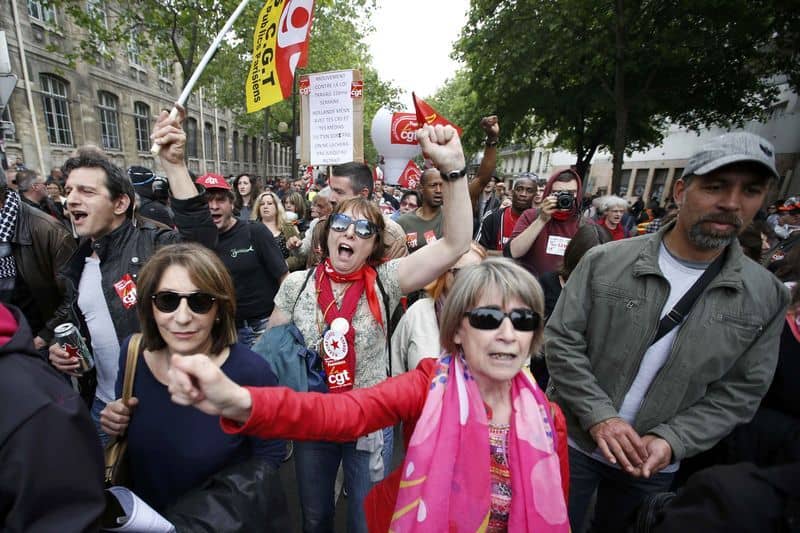
The photo was taken at the hottest times of the protests against the new reform of labor laws this year, back in May.  That was, of course, before severe flooding prematurely dampened the resolve of people complaining about gold-plated privileges they never earned and consider “rights.”

TAIP is 100% reader-supported through tipping. If you want to leave us a tip of any amount it would be highly appreciated. These tips help support our efforts to keep TAIP an ad-free environment. Just as at a cafe, the tips are split evenly among the team.