How Living in Paris Turned Me into a Bike Convert

How Living in Paris Turned Me into a Bike Convert

The Motorcycle

Long, long ago in the early 1980’s I had a car that broke down. As, at the time, I often had to go way out to the suburbs, I wondered how I was going to get out there where the transportation was complicated, to say the least. It was then that a friend suggested I get a motorcycle. At the time, the law was that if you had a valid driver’s license, you could drive a motorcycle up to 125 cc without taking a special exam.

So I took some lessons, bought a second-hand motorcycle, and learned that motorcycling was not just a means of transportation but fun in itself. So next step was to get a license, and to move up to bigger and bigger bikes. My last love was an 800cc BMW twin. I drove it everywhere in Paris and France, on vacation, with motorcycle clubs.

A Car & Public Transportation

And then I got pregnant and had a son. Motorcycling was not the best way to get around with a baby. I joined the millions of Parisians on public transportation and in the most typical American tradition I decided that with a baby I needed a car. My criteria? Small enough to park in Paris, comfortable enough to travel in, and automatic. The managing director’s chauffeur of the company where I was working recommended I get a Peugeot 205, a national favorite at the time. So I followed his advice and have been very happy with the choice.

But parking has always been a headache. Public transportation became my main means of travel in the city. My car was used less and less. I would do my food shopping typically on Friday afternoon, knowing that there would be street parking when I got back as everyone left in their cars for the weekend. I never took the car after 3pm on Sunday to be sure it was parked before everyone got back from their weekend. 

After about 12 years of cat-and-mouse parking, they knocked down a small factory across the street and started to build an apartment building in its stead — with parking spaces! The workers were still putting nails in the sign when I called the builders to inquire about buying a parking space. I was quickly informed that they were not selling parking spaces, but condominiums with the possibility of buying a parking space with it. Within the time of a single breath, I decided to sign for a condo. The smallest in the residence, but still I got a parking space. While a friend remarked that it was a particularly expensive parking space, it turned out to be a good investment.

It has been nice to jump into a car parked just across the street if I did not want to take the metro for an evening outing or go food shopping, or pick up or deliver something cumbersome or heavy. Public transportation remained my main means of transport in the city.

The Paris Mayor and Her Crack-Down on Cars

Then our supposedly ecology-minded mayor (perhaps in cahoots with the automobile industry) created a policy of dividing cars into 5 ecological categories to determine whether or not the car could be driven in Paris. Studies have shown that the most ecological use of a car is to keep it as long as possible until it gives up the ghost. Notwithstanding, the law was based on age, the older the car, the less it could be legally driven in Paris on weekdays or high pollution days. Thus a new, large gas-guzzling diesel-run car was free to be driven in Paris, while a small, less-polluting, gasoline-run car, albeit old, could not. CO2 statistics did not enter into the new law.

But my car ran beautifully, had little mileage, and I did not need a car sufficiently to buy a new one. And, 30-plus years after the original purchase, the baby has got much bigger, the driving in Paris has got more and more difficult (not to mention parking!), and I have needed to cross the “périphérique” less and less; thus my use of a car has dwindled. 

Lucky for me is the loophole in the law whereby after 30 years a car can be declared a collector’s item and can be driven anytime, anywhere. So I picked up the end of France’s red tape and with a good amount of yanking turned the jalopy into a collector’s car

Meanwhile, our mayor has continued on her warpath against gas-powered vehicles (and cars in general) in Paris. Traffic has become horrendous with more and more draconian road policies for cars, thereby creating worse and worse traffic and — as an obvious result — more and more pollution from stagnant cars.

Bicycles in Paris: The Good, the Bad, and the In-Between 

On the other hand, Madame la maire has aggressively been installing bicycle paths. Perhaps she imagines Paris as a little Amsterdam

I had often thought of acquiring a bicycle, but I was too familiar with the hard ride up the Père Lachaise hill which I had been navigating for the past 20 years on the way back from the Friday night then Sunday organized skate tours of Paris. By the end of my roller-blading days, I would skate from bench to bench up the hill with a stop at each bench on the way up to catch my breath.

In a win-win solution, a friend who had moved to the far suburbs had bought an electric bicycle to get to the train station and then around Paris. His very legitimate fear was of having the bicycle stolen when he was away traveling.

The solution? He parked the bike in my inner courtyard garden and it was mine for the taking as long as it was there. So off and on for a year, I became a happy bicycle rider in Paris.

I rode through all the new street works as bicycle paths were slowly constructed, observed the growing traffic jams, and enjoyed viewing Paris above ground. I also became adept at watching out for thoughtless scooters,  pedestrians on their phones, and other bicyclists going through red lights. The upshot of the experience was that I got hooked on bicycling in Paris. So when my friend informed me he was leaving Paris for good for the U.S. and selling the bike that I was beginning to think of as my own, I jumped at the chance to really make it mine.

On a beautiful day, what a pleasure to pedal around Paris, and no worries about hills with an electric motor assist. On the other hand, having put up with rain in Paris for months, the metro is often to be preferred. And yet, if the walk from a station is to be long, and the ride otherwise short, I might just get the rain gear on and face the elements. It is good to have a choice.

With the new and many bicycle lanes, riders are relatively protected from automobile traffic, which is quite comfortable for us. The difficulty comes when cars need to turn right across the bike lane or as bicyclists we have to turn out of the lane and cross traffic. Too, cars tend to try to go through a crossing at the end of a light and we find them sitting on the bike lanes making it difficult to cross or even move into the pedestrian crossing. I have found a particularly dangerous spot at Place Gambetta where cars come careening off the roundabout, shooting toward the pedestrian crossing where they aim to stop short; unfortunately, the bicycle crossing that comes before is more often than not overlooked. These are examples of tricky situations.

Additionally, there are the incoherences of the lanes. For example, as I wheeled around the Place d’Italie, I somehow lost the path in front of the Galaxy shopping center. And there stood the police seemingly waiting to inform me that I had in some way ridden onto a pedestrian area where I could be fined 135€. I, of course, excused myself and explained that I had somehow lost the bicycle lane. They pointed to where it was (not too clearly marked), had me get off and walk the bike, and in parting, suggested that if I was having difficulties I should go to Amsterdam. 

One of the worst lane tracings can be found on the Boulevard des Maréchaux. For a quarter tour of Paris, from Porte de Bagnolet to Cité Universitaire there must be at least 10 crossings from the outer cycling rim to the inner rim. I cannot say how many times I have lost the path only to notice it has meandered off to the other side of the four car lanes and two tram lines. This means a number of riders (myself included) sometimes just stay on one side knowing we will be in the right lane soon enough. On the other hand, we find ourselves facing oncoming bicycles in a narrow single-bicycle lane or oblivious pedestrians.

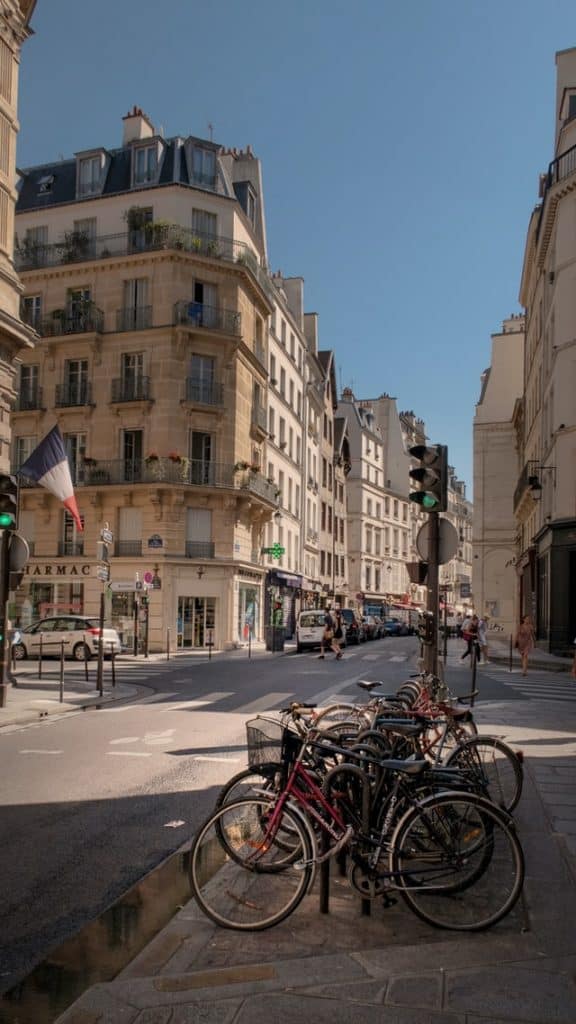
Then, of course, there is parking. Now that so many Parisians have turned to bicycles it has become difficult to park, sometimes almost as difficult as to park as a car. Having had my bicycle seized by the police for attaching it to a mundane fence, I do not wish to leave it anywhere but in bicycle racks which are not always nearby or with free spaces. On the other hand, a friend always avoids racks as many cyclists pay no attention to other mounts when getting their own bike in or out of the rack, thus damaging nearby bikes. To each their own parking traumatism and parking choice.

But all in all, having learned to deal with the difficulties, I can only appreciate the freedom of bicycling in the city. It is always quicker than walking and often faster than the metro depending on the necessity of changing lines. And with Olympic fever, the metro has become a hassle with many closed stations and fewer trains in accordance with the summer season.

It is interesting to think that when we were kids in the U.S. we could not wait to get our driver’s license, give up the bicycles of childhood, and get a car, one of the first badges of adulthood. Now, at least in Paris, more and more adults are giving up their cars for the simplicity of a bicycle. 

With the city bicycle-renting possibilities (which I have never tried), it is worth giving this above-ground, Paris-friendly means of transportation a shot. Because, when we think about it, viewing the city is why we are here.  

Photo taken in front of the Comédie Française.

Did you enjoy this article? TAIP is 100% reader-supported through tipping. If you want to leave us a tip of any amount it would be highly appreciated. These tips help support our efforts to keep TAIP an ad-free environment. Just as at a cafe, the tips are split evenly among the team.
bicycode marking

Add a Bicycode to Your Bike

Once you’ve spent a lot on a brand new electric bike (even if you got much of it subsidized) you want to protect it from theft.  Unfortunately, not only is Paris a place where more than one of us have at least one “I got pickpocketed” story, but it’s also a place where bikes get stolen: in France 400,000 are stolen annually.  So apart from using one or two strong locks on your bike, what else can you do to protect yourself?  Enter Bicycode.

French Federation of Bicycle Users

When the authorities do manage to find stolen bicycles, it’s challenging to return the bikes to their rightful owners because of changes/damage to the bike.  The French Federation of Bicycle Users (FUB) set up Bicycode back in 2004 with the idea that a “tattoo” on the bike frame would offer a point of identification that could connect a stolen bike to its rightful owner.  It has since marked almost 250,000 bikes in France and Switzerland.

Now, this isn’t to say that your would-be thief is going to see a Bicycode sticker on your bike frame and be scared off from stealing your bike.  It’s just an additional measure you can take to make sure that if your bike is stolen, you’re at least giving yourself some chance of getting it back.  Of the 400,000 annually stolen bikes in France, 150,000 are recovered, and Bicycode at least gives you some kind of shot at recovering your wheels.

Getting Your Bicycode

Once I was sold on this short and easy measure I went to the interactive map showing who the retail providers are and made an appointment.  A number of shops in Paris are not doing them on a regular basis so I ended up going to Melun, which has a shop doing them all the time.

I had to do some basic paperwork (this is France, after all) to establish that I was the owner of this bike and was registering it at an address I had proof of living at. If you ever sell your bike in the future, you can give the buyer your registration material and Bicycode provides a way for the new owner to then register the bike in his/her own name.

Once all the paperwork was done (probably ten minutes of work in total), I handed over 10 € and he got to work.

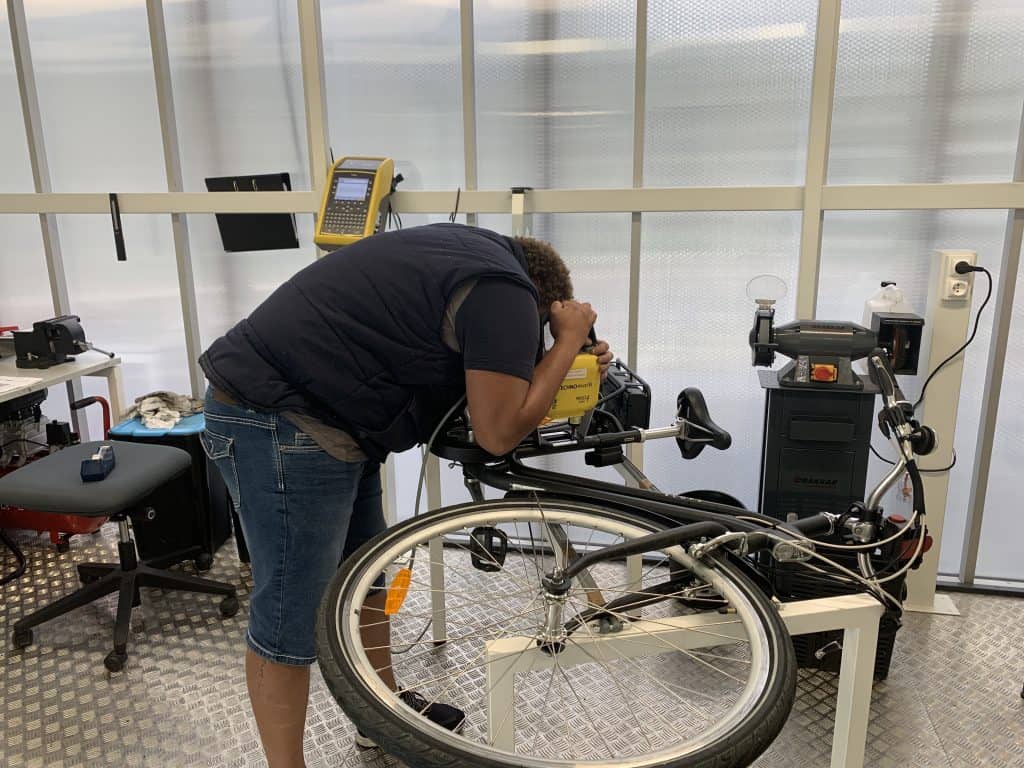
The technology used is apparently resistant to weather, water, UV damage, and high-pressure washing.  The tech took 15 seconds to engrave it once he had the bike in the right position.  The code he put on the bike is unique and linked to my bike’s serial number, my name, and my email address.  If your bike is stolen you log onto your Bicycode account and declare the bike as stolen and give the address of the police station where you made the report (which assumes, of course, you’ve done that as well).

Add to Your Insurance As Well

I also contacted my renter’s insurance to ask them if a bicycle theft was covered and they said it was.  They just needed some paperwork (of course).  I sent them proof of purchase and the serial number of the bicycle and signed a rider to the policy adding the bike.  No change in my premium and the bike was now included.

You can’t prevent your bike from being stolen in all circumstances.  Basics include:

  • using at least one bike lock to secure your bike
  • securing the lock through the frame of your bike rather than the wheels
  • using one of the ever-increasing bike stalls throughout the capital, which have strong metal bars for you to use

But once you’ve added a Bicycode and added the bike to your insurance, there’s nothing more you can do to protect yourself.  Enjoy your ride!

Photo is of the technician marking my bike with its unique Bicycode.

Did you enjoy this article?  TAIP is 100% reader-supported through tipping.  If you want to leave us a tip of any amount it would be highly appreciated.  These tips help support our efforts to keep TAIP an ad-free environment.  Just as at a cafe, the tips are split evenly among the team.
bikes in Paris

How Paris Quietly Became a Bike City

When I moved to Paris in 2013 one of the first things I did was obtain a Navigo card and after a couple of months of buying monthly passes manually via machines I switched to an annual pass and have not had to think about topping up again.  The métro was the way I moved about Paris.

But after getting to know the Métro fairly well you realize that it’s often just as easy to walk to a certain location and you start making choices about what form of transportation makes the most sense given the weather, your mood, what you’re carrying, and what else you still need to accomplish.  Vélib was already around when I arrived in 2013 and the shared bike boom followed by the rise in trottinette usage meant that options for transport have only multiplied since then.  The one form of transport that has received an explosive infusion of support from local government is bicycles.

Infrastructure

Now that bike lanes are so well-established in Paris, I wonder how so many of us were brave enough to ride with vehicle traffic for many years prior.  Cars and their drivers, convinced that everyone but them were simply “intruding” on their entitled space, didn’t make life easy for those of us on bicycles, but we figured that was simply the way it would be.  I mean, this wasn’t Amsterdam after all.  But little did most of us know that the Dutch model was exactly what Mayor Anne Hidalgo had in mind to transform Paris from the ground up.

Plan Vélo

Back in 2015, a year after Hidalgo’s first term began, the city started a project called Plan Vélo.  This was a big play to make it significantly easier for bicyclists to navigate the city by creating north-south and east-west réseaux express vélos (REVes), or “bike express lanes.”  Similar to what you are going to see on almost every street in the Netherlands, this is a protected bike lane that not only provides bidirectional traffic but also allows bikes to continue moving when their right-of-way is not impeded by traffic.  If you haven’t ridden in one of these before, you can’t possibly know how transformative it is.  It changes the experience of bicycling in the city from one analogous to driving a car, i.e. having to always pay attention while being subject to a lot of traffic and stoplights, to one of breezy insouciance: these north-south and east-west corridors make point-to-point travel significantly faster, safer, and more pleasant.

Plan Vélo has paid off in numerous ways, not least of which was featuring as the centerpiece of Hidalgo’s successful re-election bid as Mayor.  Paris jumped up into the top ten of bicycle-friendly cities in the world during her first term.  The infrastructure in place during the late 2019 transportation strike also allowed for an overnight 54% jump in bicycle use among Parisians, many of whom did not go back to the Metro even after the strike ceased.

Hidalgo also seized on Danton’s (in)famous notion of audacité during the early days of Covid-19 and took back Rue de Rivoli, the longest street in Paris, and limited it to one lane for buses and taxis.  She also created a number of “coronapistes” which created new protected bike lanes via removable plastic cones.  The reasoning given was that fewer cars were on the road because of lockdown and some people weren’t comfortable traveling in the confined spaces of the Métro.  But, just as with the accompanying “extended terrasse” permissions given to the restaurants, rights ceded were not going to simply be given back, and now Plan Velo 2 has arrived.

Plan Vélo, Acte 2

Part of the infrastructure changes needed to pérennisée both the so-called coronapistes and the extended restaurant outdoor terraces was the removal of the largest enemy of vibrant life in any city: cars.  Cars need a “home” in the form of parking places and 70% of the existing on-street parking spots designated for cars are being removed.

Hidalgo is running for President on the slimmest of chances and Plan Vélo Acte 2, released last month (two days before her announcement to run for President), has to be seen as part of her case for progressive measures to form economic and social life at a granular level.  The benefit is enormous for those of us who live in the city (Paris as 100% cyclable by 2026, it promises), but it’s doubtful that people outside of Paris really care, as life in the French countryside, like life almost everywhere in America, is unimaginable without cars.  Indeed, such denizens would snort at her proposed 2030 gas-powered car ban, which seems quite reasonable to those of us who live in the capital, but might seem very odd to those who don’t.

That said, this plan involves investing 250M euros to make the entire city bikeable by adding another 180km of dedicated two-way cycling paths in addition to making permanent the 52km Hidalgo and her team snuck in via the coronapistes last year (to put that in perspective, at the moment we already have more than 1,000 km of bike paths, quite a few snaking into the suburbs).  There’s also a budget for more passenger and cargo bike parking spots and cleaning and trash removal for cycling paths.

In addition there will be programs to teach children to ride bikes in schools, repair workshops in each arrondissement, and a cycling tourism push.

Mindset Shift

But having the infrastructure in place is only one part of the problem.  The second is getting Parisians to realize they are now living in a bike city and to make the changes in their behavior necessary.

In my early years of living in Europe I often said that the Netherlands was the only place in the world in which I was terrified of bikes.  The “ding ding” I heard struck fear into my heart as I wondered if I was standing in the wrong place, completely oblivious to my pending death at the hands of some kind person mounted on one of the country’s 23M bikes who would mutter “wat jammer” before moving my body to the side of the road and making a call to the relevant authorities to take care of my remains.

Often I was standing “in the wrong place” and quickly moved to avoid being mowed down.  Sometimes I wasn’t and it was someone else who was needing to be “dinged.”  The reason I was “terrified of bikes” in the Netherlands was because I didn’t have the right mindset.  After my first visit to what the French call the “low country” I flicked on a mental orange switch every time I came to the country (more than half a dozen times since 2014) that I was in a place where bikes, not cars, ruled.  I even, like a new car driver, ventured into the bike lanes on a borrowed bicycle and realized just how different the bicycling experience was when it was treated as a legitimate source of transportation.

Now that 95% of my trips in the city are on a bicycle (which Anne Hidalgo and her team helped pay for) I’m very aware that there are many Parisians who continue to remain as I was on my first trip to the Netherlands and thus have failed to install that mental switch.  This leads to near-misses with pedestrians including one time that I braked hard enough to simply gently bump into an instantly apologetic female pedestrian.

The lack of mindset shift is the same for Parisian bicyclists.  Many of them, like me, are new and don’t even use the proper hand signals for turning, thinking that a left turn means just putting your left hand out the way you do with your right hand to indicate a right-hand turn, or never thinking to signal for an unexpected stop.

This all leads to a sometimes dangerous mix of cars, pedestrians, and cyclists who are getting used to a new way of living with each other which leads to situations like the one well-captured in the tweet below at Bastille.

One of the reasons that bicycling is so safe in the Netherlands is that every single car driver is a bicyclist as well.  That leads to an awareness that is now normative in the entire country.

While I don’t expect the unbelievable growth in bicycles here in the capital to lead to changes everywhere in France, it’s clear to me that cities that protect bicycles necessarily change the mindsets of the pedestrians and the car drivers.  It only takes one near miss by a careless pedestrian in the bike lane to suddenly render visible to that pedestrian what was previously an “invisible” bike lane.

It’s also clear that whatever will happen to her presidential ambitions, Hidalgo’s mayoral legacy is assured, if only for the transformation she has achieved for bicycles in the City of Light, a transformation that she persevered in against the noisy protests of car owners and their lobbyists, who seem to have forgotten that Paris and the rest of the world managed to exist, and exist quite well, thank you very much, without personal cars, for centuries.  For her work on this issue, Hidalgo deserves every Parisian’s gratitude.

This change to our city will take time.  In the meantime I’m enjoying all the benefits that come with riding a bicycle in Paris: a different perspective, speed of transportation (I regularly beat friends who take the Métro and leave at the same time I do for a shared destination), and thanks to the aforementioned Plans Vélos, more protected infrastructure.

Ding ding.

Photo by Svetlana Gumerova on Unsplash

Did you enjoy this article?  TAIP is 100% reader-supported through tipping.  If you want to leave us a tip of any amount it would be highly appreciated.  These tips help support our efforts to keep TAIP an ad-free environment.  Just like at a cafe, the tips are split evenly among the team.
This article also appeared on Medium.

The Bike Explosion Happening During the Vélib Transition

While it’s true that you often don’t know how good something is until it’s gone, you also don’t realize how much better things can be until you get to try alternatives, and during the last 60 days, as Vélib stations have been slowly but surely been deactivated and then ripped up for refurbishment, the dockless solutions of Gobee, Ofo, and Obike have cropped up seemingly everywhere.

Vélib

Before we talk about the new kids on the boulevard, it’s probably best to understand how we got here in the first place, and that is because of the dreadful performance of JCDecaux, who had the Vélib contract from the beginning.  It was their complacency that brought us to this exciting (though painful) new start.  For those who don’t know, Vélib is Paris’ docked bike-sharing system and was originally pitched not only as a system that wouldn’t cost Parisians a penny, but would make the city money.  I know, don’t laugh too hard at socialists promising to turn a profit on a capital-intense venture.

But the reality wasn’t just that Vélib failed to be revenue neutral.  It seems that for at least the last 5 years, Velib’s 24,000 bikes have cost the city of Paris about 15 million euros per year.  Those costs can be broken down into vandalism repair (10%), deployment to far-flung suburbs (75%), and maintenance (15%).  As most French firms sitting on a fat contract do, JCDecaux failed to proactively fix the system and predictably they were replaced at the first opportunity by a Montpellier-based company called Smoove which will offer a lighter bike, with over 1/3 of the inventory of the bikes in Paris being electric, which will surely help with the uphill/downhill problem in places like Montmartre and La Villette (people are happy to ride the bikes downhill, but uphill, not so much).  Unsurprisingly, JCDecaux reacted in a predictable French way when they lost the contract: crying, appeals, and attempted striking.

Dockless Options

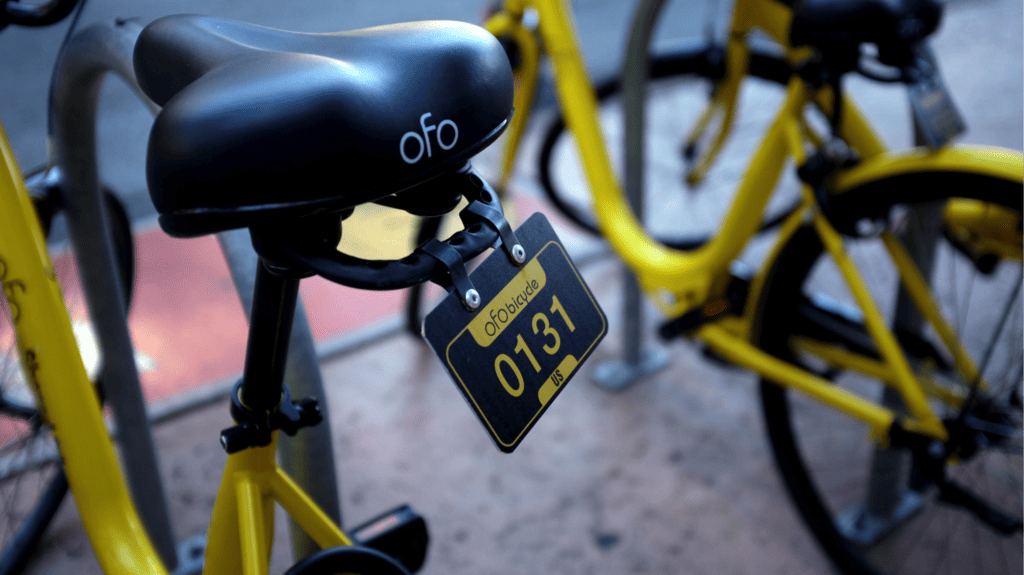
While this has been going on in the foreground, regular Vélib users like myself, reluctant to change from a system we knew well (though didn’t especially love), started to see some of the dockless bikes show up in the city.  Velib is docked meaning the bikes are parked at specific stations, whereas the dockless ones can be parked, well, anywhere.  Now, while the apps all give you ways to find appropriate places to “park” the bikes not everyone pays attention, and at the moment at any given moment you could find a rainbow of bikes around you (Gobee is bright green, Ofo is bright yellow, and Obike is a subdued yellow).  I didn’t switch to trying dockless bikes until it became impossible to reliably use Vélib.  The native Vélib app and apps like Citymapper that scraped from the information provided by that app were not indicating which stations had been shut for maintenance, so sometimes you would have to hunt for a place to park your bike, with no reliable guide other than trial and error.

That’s what led me to first try Hong Kong-owned Gobee’s system first.  They had flooded the inner city of Paris with bikes and I needed a reliable bike system as I went about Paris on a daily basis and Vélib in complete rebuild mode wasn’t going to cut it.  For flat riding in short distances, the bike is certainly adequate.  When you download the app you put in a 20 € deposit and then add money to your account.  With most rides costing around 50 cents, 5 € is plenty to get started with.  The downside?  They clearly didn’t adequately plan for this deployment.  A couple of weeks ago I tried to unlock 9 different bikes in the span of 15 minutes and each time I was told that the bike was broken, though the status of the bikes had not been updated in the app, leading to a waste of time for the end user as he/she tries to unlock a bike that is showing in the system as available when it really isn’t.  Such unreliability has meant that I’ve tried to unlock bikes that are not only off the system but have a hanging tag that says “I’m broken” but still managed to unlock and work for me.  The QR scanner technology is also not great and almost always you will have to manually enter your bike number to unlock it.  Will Gobee figure it out?  We’ll see.

Taking a much more cautious approach was venture-backed Ofo out of China.  They had been in talks with the City of Paris to make sure that the deployment of the bikes was something that the city approved of and they sought a collaborative process.  Given the speed of the French government, this meant that they were slower to deploy their bikes (they’ve only got about 1000 out at the moment).  Because they are pretty rare I only rode my first one a few days ago, but I have to say these bikes are dreamy.  Unlike the single-speed Gobee bikes, the Ofo bikes have three speeds and simply feel stronger and sturdier.  This does make them a little heavier than the Gobee bikes, but the Ofo bikes are superior to the old Velib bikes, with the new Vélib bikes not due to make their appearance until early next year.  As far as their app goes, unlike Gobee, their QR scanner works flawlessly in well-lit conditions and I have yet to run into a situation in which I scan a bike and then the app apologizes, telling me that the bike is actually broken, not available.  They also don’t require a 20 € deposit (for now).

There’s also Singapore-based Obike, but I’ve really only seen those bikes in the Marais, so alas, I don’t have anything to report there.  I do know that their bikes and pricing are the same as Gobees: single-speed and 50 cents per 30 minutes, as opposed to Ofo’s multi-speed bikes costing 50 cents per 20 minutes.

What’s fascinating is that studies show that dockless solutions do not necessarily eat into the revenues of an existing docked solution, but create more user demand for bikes overall.  This makes sense as I very readily joined up to two dockless schemes despite being a Vélib user since 2014.  Will I go back to docked once I’ve gone dockless?  The 29 € annual rate for a Vélib subscription is likely to rise, and given my current rate of use on the dockless schemes, Vélib, even with a price increase, is likely to remain the most economical.  What has changed is that Parisians have been freed from the staid shackles of one “okay” choice in bike sharing and have multiple options of varying quality.  Instead of solely relying on Vélib, active users like myself are likely to retain accounts with whatever solutions are out there and use them as time and occasion dictate.  Whatever 2018 holds for bike sharing in Paris, it’s going to be orders of magnitude better than what we’ve had until now.

Did you enjoy this article? TAIP is 100% reader-supported through tipping. If you want to leave us a tip of any amount it would be highly appreciated. These tips help support our efforts to keep TAIP an ad-free environment. Just as at a cafe, the tips are split evenly among the team.