The Motorcycle
Long, long ago in the early 1980’s I had a car that broke down. As, at the time, I often had to go way out to the suburbs, I wondered how I was going to get out there where the transportation was complicated, to say the least. It was then that a friend suggested I get a motorcycle. At the time, the law was that if you had a valid driver’s license, you could drive a motorcycle up to 125 cc without taking a special exam.
So I took some lessons, bought a second-hand motorcycle, and learned that motorcycling was not just a means of transportation but fun in itself. So next step was to get a license, and to move up to bigger and bigger bikes. My last love was an 800cc BMW twin. I drove it everywhere in Paris and France, on vacation, with motorcycle clubs.
A Car & Public Transportation
And then I got pregnant and had a son. Motorcycling was not the best way to get around with a baby. I joined the millions of Parisians on public transportation and in the most typical American tradition I decided that with a baby I needed a car. My criteria? Small enough to park in Paris, comfortable enough to travel in, and automatic. The managing director’s chauffeur of the company where I was working recommended I get a Peugeot 205, a national favorite at the time. So I followed his advice and have been very happy with the choice.
But parking has always been a headache. Public transportation became my main means of travel in the city. My car was used less and less. I would do my food shopping typically on Friday afternoon, knowing that there would be street parking when I got back as everyone left in their cars for the weekend. I never took the car after 3pm on Sunday to be sure it was parked before everyone got back from their weekend.
After about 12 years of cat-and-mouse parking, they knocked down a small factory across the street and started to build an apartment building in its stead — with parking spaces! The workers were still putting nails in the sign when I called the builders to inquire about buying a parking space. I was quickly informed that they were not selling parking spaces, but condominiums with the possibility of buying a parking space with it. Within the time of a single breath, I decided to sign for a condo. The smallest in the residence, but still I got a parking space. While a friend remarked that it was a particularly expensive parking space, it turned out to be a good investment.
It has been nice to jump into a car parked just across the street if I did not want to take the metro for an evening outing or go food shopping, or pick up or deliver something cumbersome or heavy. Public transportation remained my main means of transport in the city.
The Paris Mayor and Her Crack-Down on Cars
Then our supposedly ecology-minded mayor (perhaps in cahoots with the automobile industry) created a policy of dividing cars into 5 ecological categories to determine whether or not the car could be driven in Paris. Studies have shown that the most ecological use of a car is to keep it as long as possible until it gives up the ghost. Notwithstanding, the law was based on age, the older the car, the less it could be legally driven in Paris on weekdays or high pollution days. Thus a new, large gas-guzzling diesel-run car was free to be driven in Paris, while a small, less-polluting, gasoline-run car, albeit old, could not. CO2 statistics did not enter into the new law.
But my car ran beautifully, had little mileage, and I did not need a car sufficiently to buy a new one. And, 30-plus years after the original purchase, the baby has got much bigger, the driving in Paris has got more and more difficult (not to mention parking!), and I have needed to cross the “périphérique” less and less; thus my use of a car has dwindled.
Lucky for me is the loophole in the law whereby after 30 years a car can be declared a collector’s item and can be driven anytime, anywhere. So I picked up the end of France’s red tape and with a good amount of yanking turned the jalopy into a collector’s car.
Meanwhile, our mayor has continued on her warpath against gas-powered vehicles (and cars in general) in Paris. Traffic has become horrendous with more and more draconian road policies for cars, thereby creating worse and worse traffic and — as an obvious result — more and more pollution from stagnant cars.
Bicycles in Paris: The Good, the Bad, and the In-Between
On the other hand, Madame la maire has aggressively been installing bicycle paths. Perhaps she imagines Paris as a little Amsterdam.
I had often thought of acquiring a bicycle, but I was too familiar with the hard ride up the Père Lachaise hill which I had been navigating for the past 20 years on the way back from the Friday night then Sunday organized skate tours of Paris. By the end of my roller-blading days, I would skate from bench to bench up the hill with a stop at each bench on the way up to catch my breath.
In a win-win solution, a friend who had moved to the far suburbs had bought an electric bicycle to get to the train station and then around Paris. His very legitimate fear was of having the bicycle stolen when he was away traveling.
The solution? He parked the bike in my inner courtyard garden and it was mine for the taking as long as it was there. So off and on for a year, I became a happy bicycle rider in Paris.
I rode through all the new street works as bicycle paths were slowly constructed, observed the growing traffic jams, and enjoyed viewing Paris above ground. I also became adept at watching out for thoughtless scooters, pedestrians on their phones, and other bicyclists going through red lights. The upshot of the experience was that I got hooked on bicycling in Paris. So when my friend informed me he was leaving Paris for good for the U.S. and selling the bike that I was beginning to think of as my own, I jumped at the chance to really make it mine.
On a beautiful day, what a pleasure to pedal around Paris, and no worries about hills with an electric motor assist. On the other hand, having put up with rain in Paris for months, the metro is often to be preferred. And yet, if the walk from a station is to be long, and the ride otherwise short, I might just get the rain gear on and face the elements. It is good to have a choice.
With the new and many bicycle lanes, riders are relatively protected from automobile traffic, which is quite comfortable for us. The difficulty comes when cars need to turn right across the bike lane or as bicyclists we have to turn out of the lane and cross traffic. Too, cars tend to try to go through a crossing at the end of a light and we find them sitting on the bike lanes making it difficult to cross or even move into the pedestrian crossing. I have found a particularly dangerous spot at Place Gambetta where cars come careening off the roundabout, shooting toward the pedestrian crossing where they aim to stop short; unfortunately, the bicycle crossing that comes before is more often than not overlooked. These are examples of tricky situations.
Additionally, there are the incoherences of the lanes. For example, as I wheeled around the Place d’Italie, I somehow lost the path in front of the Galaxy shopping center. And there stood the police seemingly waiting to inform me that I had in some way ridden onto a pedestrian area where I could be fined 135€. I, of course, excused myself and explained that I had somehow lost the bicycle lane. They pointed to where it was (not too clearly marked), had me get off and walk the bike, and in parting, suggested that if I was having difficulties I should go to Amsterdam.
One of the worst lane tracings can be found on the Boulevard des Maréchaux. For a quarter tour of Paris, from Porte de Bagnolet to Cité Universitaire there must be at least 10 crossings from the outer cycling rim to the inner rim. I cannot say how many times I have lost the path only to notice it has meandered off to the other side of the four car lanes and two tram lines. This means a number of riders (myself included) sometimes just stay on one side knowing we will be in the right lane soon enough. On the other hand, we find ourselves facing oncoming bicycles in a narrow single-bicycle lane or oblivious pedestrians.
Then, of course, there is parking. Now that so many Parisians have turned to bicycles it has become difficult to park, sometimes almost as difficult as to park as a car. Having had my bicycle seized by the police for attaching it to a mundane fence, I do not wish to leave it anywhere but in bicycle racks which are not always nearby or with free spaces. On the other hand, a friend always avoids racks as many cyclists pay no attention to other mounts when getting their own bike in or out of the rack, thus damaging nearby bikes. To each their own parking traumatism and parking choice.
But all in all, having learned to deal with the difficulties, I can only appreciate the freedom of bicycling in the city. It is always quicker than walking and often faster than the metro depending on the necessity of changing lines. And with Olympic fever, the metro has become a hassle with many closed stations and fewer trains in accordance with the summer season.
It is interesting to think that when we were kids in the U.S. we could not wait to get our driver’s license, give up the bicycles of childhood, and get a car, one of the first badges of adulthood. Now, at least in Paris, more and more adults are giving up their cars for the simplicity of a bicycle.
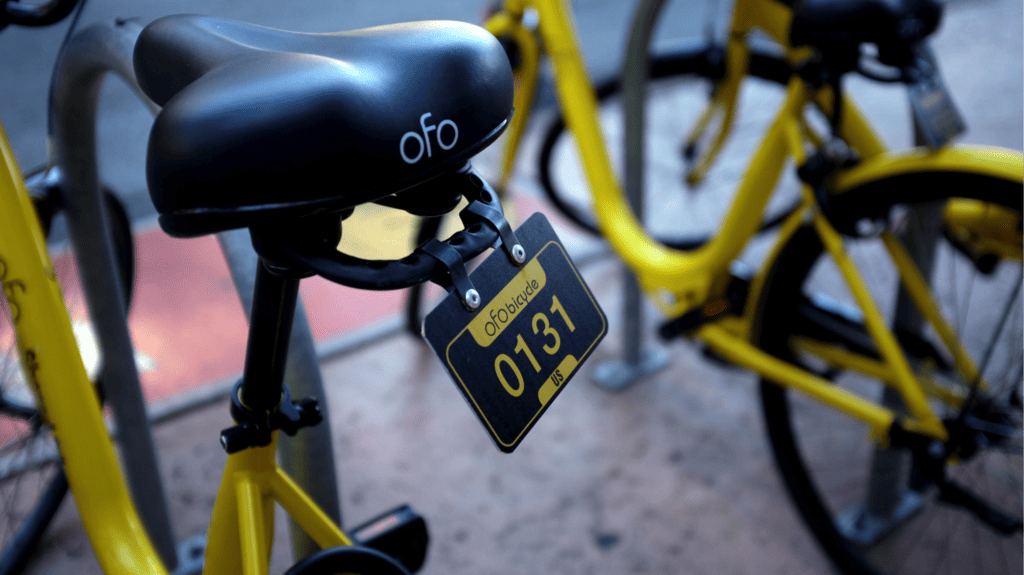
With the city bicycle-renting possibilities (which I have never tried), it is worth giving this above-ground, Paris-friendly means of transportation a shot. Because, when we think about it, viewing the city is why we are here.
Photo taken in front of the Comédie Française.
Did you enjoy this article? TAIP is 100% reader-supported through tipping. If you want to leave us a tip of any amount it would be highly appreciated. These tips help support our efforts to keep TAIP an ad-free environment. Just as at a cafe, the tips are split evenly among the team.