
When you move to a new town, you need to start from scratch to find businesses.
For grocery shopping, if you’re lucky, there will be a nearby supermarket, but other businesses may be further away from home.
Having moved to Nice, at one point I needed a shoemaker, and entered a small shop I found in the Old City. I was surprised to find a female shoemaker; until now, all my shoemakers were male, and in the US, they are often of foreign origin.
Below are some of my preferred female artisans and women-owned businesses in Nice that I recommend to anyone visiting (or living!) there.
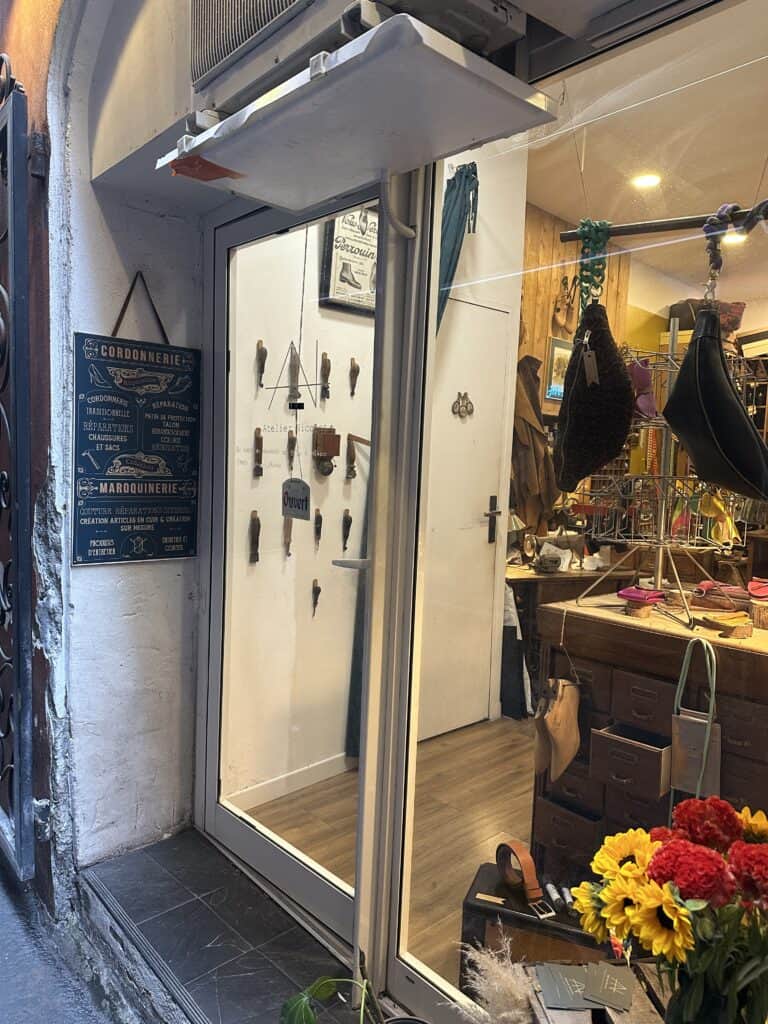
Cordonnerie Atelier Nicolet
Ms. Nicolet always liked working with her hands, but attended university and obtained a degree in literature. However, after attending an event about the bottier (shoemaker in the sense of making shoes) profession, she signed up. In 2008, women were accepted into at least this area of the Compagnonnage du Devoir (craftspeople guild). She found an apprenticeship in Nice, where for two years she alternated between 6 weeks of work in Nice and 2 weeks of training in Paris. After finishing her apprenticeship, she was hired by a Paris-based shoemaker in the Bastille area (which is close to the traditionally artisanal neighborhood of the Faubourg St. Antoine), where she worked for four years.
In the meantime, her partner had been sent to work in Montpellier, and she went to join him, working for another shoe repair company. They both returned to Nice after another four years. However, in Nice, there were few jobs, so she decided to open her own shop in the Old Town, where she was raised, six years ago. Having grown up there, she loves the fact that it is a true neighborhood, even though it is now changing with ever more temporary rentals for tourists.
She sells a few of her own creations, but she likes doing repairs the most, as every project is a new adventure. Many shoemakers refuse to do some repairs, such as zippers.
Later, after renovating an apartment, it was time to hang art on the walls. I had removed many items from their frames to ship them. An online search for picture framers led me first to one that didn’t exist, so I kept on walking (you can walk to many places in Nice, it’s not an enormous city!) and entered the next shop I found that seemed attractive. Once again, I was welcomed by a woman.
Ateliers Marianne Strauch
Ms. Strauch herself runs the atelier, and she did her best to offer advice for the painting I brought in, using an old-fashioned wood frame I purchased at the flea market. She was very thorough in explaining the process, and I was curious as to how she came to this particular profession.
She was raised in Nice; her parents were photographers; her father also taught photography. They were not enthused by their daughter’s love for handicrafts. Marianne would spend time at the local ébénisterie (high-end woodworking, from the word ébène, ebony) but to please her parents, she attended college to obtain a BA in history.
However, she didn’t enjoy the notion of continuing to an advanced degree, and set off to tour French workshops around the country, specializing in gold leaf technique, to become an apprentice. Everywhere she was told that she was too old (at 20… usually apprentices start at the age of 13) and that, anyway, she was a woman.
She came back to the Nice woodworking shop, whose owners knew her well by then. She worked there for a while, but what she really wanted to do was leaf gilding. She was finally able to start training (after sweeping the floors for 6 months) at a Monaco multi-technique establishment which served the Palace. She had to sign a pledge, somewhat like a compagnonnage.
She went on to work overseas in Greek Orthodox monasteries in Greece, Turkey, Egypt, and Russia, in leaf gilding, for several years, then returned to France to work on church furniture in the Ardèche region. There she met her future husband, with whom she had three daughters. When the marriage fell apart, she returned to Nice. 11 years ago, she opened the current shop on Rue Beaumont. Her clients come from all over the region and from all walks of life. One day perhaps… she’ll return to the monasteries!
In more traditionally female-run businesses, I found a wonderful consignment shop in the Riquier neighborhood (east Nice). Old Town is chock full of secondhand shops, but I rarely find anything useful for my needs there.
Au Fil du Temps
Or, “as time goes by” is run by Melissa. The first thing I noticed was how carefully curated the shop is. Nothing is random.
Having been raised by a creative mother, Melissa started out with a technical degree in the clothing industry. She spent a short time studying law, but left to work for the lingerie company Etam, where she climbed the ladder to become a store manager. She remained at Etam for 13 years.
She’s always loved the thrill of thrifting when she was younger. After analyzing the secondhand clothing environment, she decided against an Old Town location, as the customer base would be more transient (for those who don’t know Nice, Old Town is a big tourist attraction, along with the seashore boulevard, the famous Promenade des Anglais). She wanted a neighborhood shop, where customers would shop regularly. Tourists who come to the shop find her through online searches.
She’s now run the shop for 17 years. Her goal is not to grow exponentially, but to continue to be able to take care of her business on her own, especially as then she’d need to move.
Au Fil du Temps is for the women who want good brands, who want to look good, without breaking the bank, while helping the planet by shopping secondhand.
The Notion of Sustainability
After interviewing these three remarkable women, I realized that all three of them in some way work towards a more sustainable planet: through repairing shoes and bags, instead of discarding them; through reusing materials to make new frames; and, of course, through selling secondhand clothing.
What was also interesting was that all three were raised in Nice, and even if they left at some point, they returned to their hometown.
My erroneous assumption was that the craftspeople would have inherited their shop from a father or a grandfather; it’s quite the contrary when it comes to women!
Photo of the leather repair shop Atelier Nicolet
Did you enjoy this article? TAIP is 100% reader-supported through tipping. If you want to leave us a tip of any amount it would be highly appreciated. These tips help support our efforts to keep TAIP an ad-free environment. Just as at a cafe, the tips are split evenly among the team.