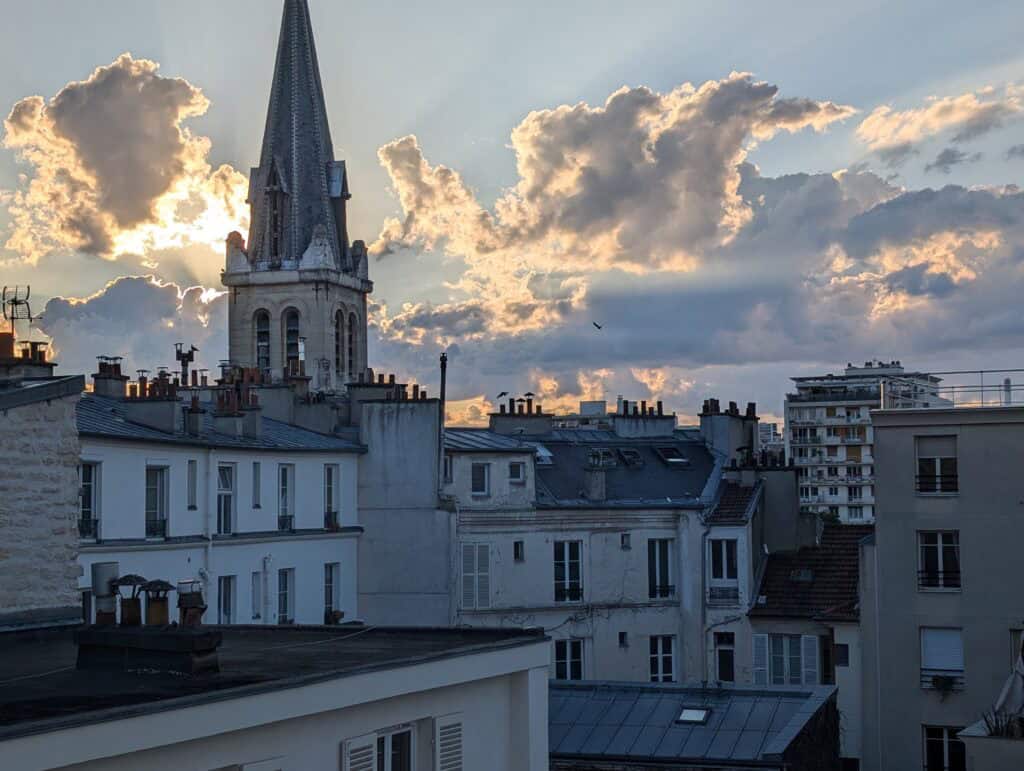
paris skyline

Finding an Apartment in Paris; It’s Not Them, It’s You. Tips to Secure Your Dream Digs

You’ve dreamt about this day for way too long. You’ve resent your application via La Poste (twice), you’ve signed the textbook-thick lease, and you’ve finally been given the keys to your dream Parisian home.

You walk up the 5 (read American 6) flights of stairs with a grin from ear to ear because when you reach the top level and insert that irreplaceable key into that beautiful door, you KNOW, it was all worth it.

Now lets go back, about 3-6 months, cue rewind montage.

Your time is ending in your Airbnb that you had to rent to fulfill the visa application requirements. You’ve had a great time playing house and are looking forward to bringing your own place to life with your own essence. But, where do you start?

Some might think you started a few weeks before you even moved over! But things are a bit different in our dear Paris. You see, finding an apartment in Paris, as a foreigner, is like finding a dinosaur fossil at an archaeological site. Not impossible, but it’s going to take time and you’re gonna need a fine-tooth comb. Yes, laugh, it’s okay, you’ll need to laugh to survive through this. 

Start Your Search

You have several options. The most popular route is renting a furnished flat through an agency. This is also the most expensive option because the rentals are overpriced from average, the furnishings are usually comfortable, but sometimes unkempt, and the agency takes a comfortable commission. The pros are that all communication is in English, you can access an online catalog and view the apartments online, making it much more streamlined to choose a place and have a “home” before you even step out of the CDG airport. A big con is that you don’t actually see the flat, or even the area in person, and that could yield an unfavorable disposition. Once you’ve signed a rental agreement, it’s nearly iron-clad, so breaking it is not much of an option.

Now, if you know a few things or two and are comfortable with speaking French, you might try your hand at sourcing a place on your own through the French version of Craigslist, Le Bon Coin. Here you can not only find your next dream apartment, but also a bicycle, clothes, instruments; absolutely anything under the sun has been or could be sold on Le Bon Coin. As the adventurous writer of this piece, who did not know a few things, I decided I didn’t need an agency and tried going down the rabbit hole of apartments listed by locals. And may I say, what. a. journey.

The Dossier

There are many inner workings to locking in a place, much more than scheduling a visit and meeting the owner. You can’t get any traction forward without a dossier, your application packet, essentially. You’ll learn quickly in this new French life that your dossier will be an invaluable collection of paperwork that you’ll use for finding a home, a job, opening a bank account, and more. The French like everything on paper and it’s important that you look excellent on paper.

But your experience and income may not translate through the language barrier. And if you don’t speak French, it will be difficult to garner confidence and gain trust that you, a foreigner, will be a worthy tenant who will never falter in paying their rent. If you’re wondering, no, I did not speak French at the time. It was just me and my blind confidence leading the way.

Asking For Help

After several weeks licking my wounds, I accepted that I needed a professional’s assistance, but I could not stomach paying the exorbitant fees of housing agencies, so I found a middle ground. A property search agency, Chasse immobilière, for freelancers and foreigners works exclusively with local realtors that speak English and know how to prepare an application packet best suited for a freelancer, non-native speaker, non-French person, and every other outside of the box scenario. They go through their network,  Le Bon Coin listings, and different realtor agency listings from all around the city (or country if you’re looking outside of Paris). I was fortunate enough to connect with a local realtor who sent me so many listings, made appointments, handled all communications with the owners, and honestly took off all of the burden. I just had to click through the photos, say yes or no, and we’d meet to view the listing. Thanks to her, I found my absolute dream apartment. With the big Brown door, on the top floor, with the gold lock, the ancient elevator, and the most Parisian view. There is a fee for this service, but I felt better knowing part of it went directly into my realtor’s pocket.

There is no wrong way to look for a home in Paris, but there are many more efficient ways, and I can’t recommend enough to consider hiring an agency to help you with the search. Alternatively, I’d be happy to recommend my realtor, now turned dear friend, who knows Paris inside and out.

Whatever path you choose, rest assured that your dream maison is waiting for you. Your Parisian home is only just around the corner.

Photo by Brian Potter

Did you enjoy this article? TAIP is 100% reader-supported through tipping. If you want to leave us a tip of any amount it would be highly appreciated.  These tips help support our efforts to keep TAIP an ad-free environment. Just like at a cafe, the tips are split evenly among the team.
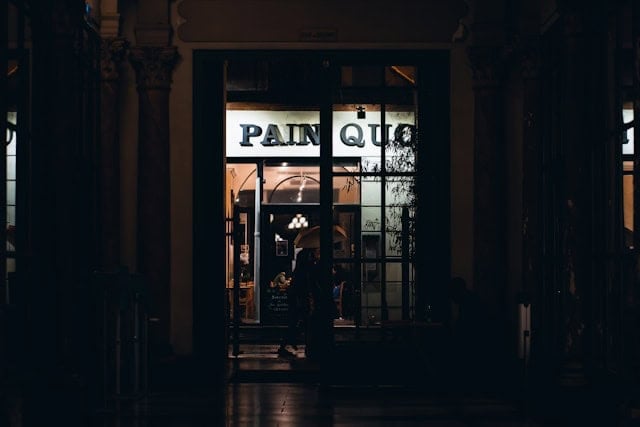
people walking in front of a restaurant at night in Paris

Paris is Still Just a City

In my final year at university, amidst the chaos of final exams, graduation, and a future being all mine for choosing, moving to Paris was all I could really think about. I didn’t care about making a name for myself or carving out a place in the land of interns, waiting eagerly to climb the corporate ladder. All I cared about was getting out of Texas, seeing something new.

I dreamt of the days I studied abroad here, drinking absurdly cheap wine, eating fresh pastries, discounts at the cinema, free entries to museums. I dreamt of a life Paris had afforded me when I was younger. One that was reckless, one where I had no responsibility besides to fall in love with the city, new friends, even a cute boy. 

When I graduated, I remember the world seeming so big, and I felt so lucky to have all these possibilities laid out in front of me. I had a degree now, even though I could hardly remember how I got it, and I naively believed that things would continue just as smoothly for me as they had been, given my life thus far. So, I took the leap, did the big, courageous thing it was for a well-off girl like me to do, and I made the big move to Europe. 

I emerged from the metro at Place d’Italie on a busy Sunday afternoon, with a suitcase in my hand, and an overstuffed backpack hanging from my shoulders. Police sirens rushed past, pedestrians made way for themselves regardless of others, and there stood directly in my line of vision, a big, metallic, soulless shopping mall that was the point of reference for my new neighborhood. Some residents have the Eiffel Tower. I had Italie Deux. 

I looked down at my jean shorts and sneakers, then up at the Parisians sporting black slacks and light summer jackets. An elderly lady came up to me, asking for directions. For a while, I tried to help. I looked at where she wanted to go on my phone and attempted to explain directions in French. She appeared frustrated, not being able to understand me, and gave a look like I was wasting her time. She walked off and demanded the next stranger for help.

I was breathless after having dragged my suitcase up several flights of stairs to my new apartment. After having unlocked the door with my comically long skeleton key, I immediately sank to the wood-paneled floor. I sat there, looking up at the crown molding on the ceiling and felt completely happy. A wave of warmth rushed over me. This is what I wanted, I thought. Crown molding, how lucky am I? Sure, there was an unbelievable amount of dust and mold bordering the windows, and the previous tenants had left a bunch of clutter, but here I was finally in my new place in the city I’ve been dreaming about ever since I left.

Weeks passed and I put off essential errands that would make my life feel more real and viable here. I needed a bank account, a social security number, a phone number, WiFi. But I was scared. 

Hidden within my fear were my memories, and suddenly, they all came flooding back. My face felt hot. I suddenly remembered what I was so quick to forget: how humiliated I felt when I was studying here, trying to disguise my Americanness yet it was inescapable. How I was still incapable of mastering the language. How it felt like anxiety was always trailing me, hiding behind every corner ready to pop out and remind me that this was not my home, things work differently here, and they don’t really work for you. 

I broke out into a cold sweat. What was I doing? I came over signed to a nannying agency, meanwhile I had spent the majority of my life working with kids and after finally having a college degree, I was longing to do something else. What was I doing? I was wasting time while everybody was back home applying for jobs that they could actually get. 

My panic broke me. I applied to so many jobs and internships, all of which were hindered by the fact that I wasn’t yet bilingual, nor was I enrolled in higher education. I felt trapped. I felt trapped in this undeniably beautiful, bustling, and some might say, I know I sure did, magical city. 

I remember looking for signs to bring me back to America. A cop out. A scapegoat. I began applying to these outrageously prestigious Master’s programs in America whose acceptance rates were laughable and exclusively marketed for geniuses. I convinced myself into believing they were targeted at me. I told myself, if I get into one, then it’s destiny. Then I’m going home and never looking back. They need me. America needs me.

The advertisements that fluttered the walls in metro stations began speaking to me. Women and men, children and the elderly, all those whose faces were plastered on these posters, urged me, begged me to come back. “You’ll be safe there,” they teased. “Life will be easier. You’ll get a nice job, one that fulfills you.” I ran to catch the stalled train before the doors shut, wanting to give in but also not wanting to give up. Making that decision to move back home would feel like both.

The image I held in my head of my study abroad days no longer held up. The lights dwindled, the magic faded. Paris is beautiful, yes, but there’s a lot of dog poop smeared across the sidewalks. And cigarette butts. And trash. There’s almost no relief from the heat in the summer, so it’s best to get away, if you can afford it. People can be mean and creepy. All of these things are not just exclusive to American cities — they are caveats of every major metropolitan area, including Paris. 

It took me two years. Two years of indecisiveness, of failed dreams and miraculous resurrections, to realize that fighting to live in Paris is worth it. 

I can’t exactly say what the catalyst was to deciding that I was going to stay, that I’ll fight to carve out a life for myself here. Maybe it was the political climate in America, making my idealization of the country come to a screeching halt. Maybe it was the realization that nostalgia is often manipulating, a poison for the brain to make the past seem so alluring when that’s exactly what it’s meant to be: something that builds our story, but remains there, stuck. 

Maybe it was the realization that the job market is incredibly difficult everywhere right now. Maybe it was (it definitely was) that the cute boy and I started to become even more serious in wanting to integrate our lives with each other’s. 

It was probably all of those things that made me decide to stay, despite the hardships, despite the seeming impossibility of it all, despite the all-consuming nostalgia, and, at times, maddening cultural differences. I was overly confident two years ago, I have to admit. I thought I was ready to move my life abroad back then, but in fact it took me two years of living here to confirm exactly that. 

Paris has been a city that I hate(d), that I love(d), that I couldn’t/can’t seem to get over. Paris is still just a city, with all its flaws and glamour. But now, it’s my city.

Photo by Elric Pxl on Unsplash

Did you enjoy this article? TAIP is 100% reader-supported through tipping. If you want to leave us a tip of any amount it would be highly appreciated.  These tips help support our efforts to keep TAIP an ad-free environment. Just like at a cafe, the tips are split evenly among the team.

top floor apartment in paris

What No One Tells You About Finding an Apartment in Paris

We often talk about the lengthy and sometimes complicated process of applying for a visa to live in France, what it’s like to move away from friends and family, and better ways to learn French. But, something we’ve discussed only a handful of times is perhaps one of the most important — and potentially most frustrating — parts of moving to France: finding an apartment in Paris.

The good news is that it’s not just you. Apartment hunting in Paris really is that hard. 

Thinking about all of this, a story comes to mind. Stephen and I have worked together on so many different things, from walking tours and picnics to Airbnb and beyond. One of those random projects and gigs included showing apartments in Paris together. He had some contacts with people who wanted someone trustworthy to actually show places to potential tenants and serve as an initial judge of whether said tenants would make a good fit.

He gave me RDV on rue Jacob in the 6th arrondissement — coincidentally right around the corner from where I lived as a student during my semester abroad and one of my favorite areas to walk around to this day. I was excited to go back to my old haunts and earn a little extra cash from helping him out.

I rounded the corner of the rue Bonaparte and saw a massive line of people, seemingly waiting to enter the Ladurée boutique. I kept walking towards the address I wrote down, and noticed that the line snaked up the street in the exact same direction I was going. Weird, I thought — but chalked it up to it being a busy part of town. Imagine my surprise when I saw the line of people waiting outside the address that Stephen told me to meet him at.

I skirted around them and headed up the stairs — I knocked on a door that was left slightly ajar and told Stephen about the line. He said he wasn’t surprised, there was a lot of interest. When all was said and done, we showed the place to more than 40 people.

So, why am I telling you this? Because this little walk down memory lane is a perfect example of how competitive the real estate market is in Paris, even for rentals. Now, that’s not to say it’s impossible. I’ve never been homeless in Paris, but I have had to shift my expectations since living there. 

And today, I’m sharing everything I’ve learned along the way so you don’t make the same mistakes I did.

Know What You’re Really Getting Into

As I’ve alluded to in the form of my story above, finding an apartment in Paris is nothing like what you may be used to in the US, or even elsewhere in Europe. Things move a lot more slowly, and it’s very competitive.

Many listings are already taken by the time you send your first message, and the best places are often only available if you know someone. You might tour an apartment, think it went great, and never hear from the landlord again (been there). As a note, French landlords can be extremely picky, especially with foreigners and expats. There’s a fear that you’ll just “leave the country” and never pay your rent. In a way, I get it.

Some also want proof that you already live in Paris and pay your current rent on time before they’ll rent to you. Like so many other French administrative processes (like getting a bank account or cell phone, though those are much easier nowadays), you basically need an apartment to get an apartment. 

Another big surprise? An unfurnished apartment likely won’t even have kitchen appliances (yes, not even a stove), and also means committing to a three-year lease, minimum

Decide Where (and How) You Want to Live

As we’ve noted in our Paris neighborhood guide series and in a recent YouTube episode, every arrondissement is different, boasting its own unique charm, vibe, lifestyle — and budget. So, before you really start your hunt, it’s important to have a general idea of where in the city you’d like to live and what kind of housing would work best for you.

Here are just some of the options:

  • With roommates (often called a ‘flatshare’ or colocation in French)
  • A small studio apartment (usually under 20m² or 215 square feet)
  • A chambre de bonne (tiny top-floor former maid’s quarters with shared bathrooms)
  • A traditional apartment (if you’ve got the budget/dossier for it)

You could also do what Stephen did for his most recent apartment. He couldn’t find anything, so he went to Airbnb to see if a host would be willing to rent to him more long-term. He met them for a coffee, talked things through, saw the apartment in person, and signed the lease. It’s an excellent example of how, sometimes, you need to be willing to be scrappy to snag the Parisian apartment of your dreams.

Now, as mentioned, finding an apartment in Paris isn’t always easy, so you also need to be prepared to take what you can get. I don’t mean you should settle for a shack in the middle of nowhere, but if you can’t find what you’re looking for in, say, the 5th arrondissement, be willing to look in, say, the 19th.

The All-Important Dossier

If you’ve managed to apply for and obtain a French visa, you already know the importance of paperwork in this country. France wants proof for everything — you can’t just show up for an apartment tour and say you’re a great tenant. They want to know your name, date of birth, occupation, how much you make, where you’ve lived in the past, and all of your deepest hopes and dreams. Okay, the last one is an exaggeration, but you get the gist.

In fact, most landlords or rental agencies will ask to see your dossier before they’re willing to even speak to you. At minimum, it should include:

  • A copy of your passport and visa
  • Proof of income (French pay stubs are strongest, or bank statements)
  • A work contract or school enrollment letter
  • Recent utility bills or proof of address
  • A French bank account to prove you have one
  • A ‘garanteur’ or someone who makes more money than you, who is willing to back you up, like a parent or relative

Here’s the catch: even people with great salaries or a chunky savings account struggle. French landlords want to see French paperwork, and without that, they may see you as too much of a risk. And, the truth is, I also know dozens, if not more, French people who struggle to provide solid dossiers too. I know many who use fake pay stubs and bank statements to make them look better off than they are. That’s how competitive this is!

There are services in place for foreigners or folks without well-off family members, like GarantMe or Visale, but I also know there are some landlords who won’t accept them.

I know it’s not fair, but it’s how the system works.

Where to Look

There are several rental platforms to choose from, but I’ve had the best luck personally on SeLoger, PAP, and Facebook. Craigslist Paris is also worth checking out, but it is full of scams, so be careful. HiPParis has some cool options, but mostly only for buying. Don’t forget Stephen’s Airbnb trick too. There are also rental agencies that specialize in helping expats (if there’s an interest, I can do some digging on ones to try!).

Your best bet? It’s all about word of mouth and people you know.

I know, I know — but, Molli, what if I just moved to Paris and I don’t know anyone yet? I get it! Building community and finding your people takes time, but once you do, a whole new world will open up to you. You never know who you may meet, who may have a friend looking for someone to take over their lease, or an aunt who needs someone to stay in their apartment for a year while they travel.

Like anything else, getting to a point where you can simply ask around and find an apartment in Paris will take some time.

And a lot of times, just when you think it’s never going to work out, it does. You’ll get the call. You’ll sign the lease. You’ll move in.

Prefer video? Watch us discuss finding an apartment in Paris on YouTube!

Photo by Doctor Tinieblas on Unsplash

Did you enjoy this article? TAIP is 100% reader-supported through tipping. If you want to leave us a tip of any amount it would be highly appreciated.  These tips help support our efforts to keep TAIP an ad-free environment. Just like at a cafe, the tips are split evenly among the team. 

Bir-Hakeim Bridge in Paris

Paris and its Bridges: A Story

Note from the editor: While not an American in Paris, guest writer and photographer Tayeb Bouzid lives in the French capital and is part of the Paris Greeters, which offers free tours of Paris in English and other languages. After he spent his youth in Algeria and 15 years in the Marseille area, he came to Paris in June 1988 for a 3-month-long job and is still here after 36 years. Passionate about photography, architecture, and Paris, here, Tayeb provides his expertise on one of the more fascinating parts of the City of Light: the bridges that cross the Seine, connecting two sides of the city to form one. Enjoy. — MS

Paris would not be Paris without its bridges, and there are 336! That many? Yes! But only 37 of them are along the Seine. The others are for pedestrians, trains, the métro, or to connect other streets.

Below we’ll look at some of those 37 spread over the 8 or so miles of the Parisian Seine. They’re real links between its banks, inhabitants, and historical monuments. Enjoy this non-exhaustive guide to Paris and its bridges, from the longest to the most graceful, the most revolutionary to the most futuristic. You may discover an anecdote or an unusual detail you’ve never seen before.

The Most Sumptuous 

Decorated with candelabra, street lamps, and copper and bronze sculptures, the Alexander III bridge majestically straddles the Seine between the 7th and 8th arrondissements. 

Born during the 1900 World’s Fair, at the time it also represented the new Franco-Russian alliance. On October 7, 1896, Tsar Nicholas II laid the first stone in the presence of the President of the Republic, Félix Faure. Boxed by monumental pylons ornamented at the top of a pegasus of gilded bronze, the metalwork draws a royal road to the Grand and Petit Palais. 

Classified as a historical monument, it’s often seen in films of famous directors (Michel Audiard, Woody Allen, and Luc Besson, to name a few).

The Most Filmed 

The Bir-Hakeim Bridge is also in great demand for commercials, television series, and films. 

Jutting out from both sides of the Île aux Cygnes, this metallic structure, designed shortly after the World’s Fair of 1900, connects the 15th and 16 arrondissements. It’s made up of two floors — the upper one is for the metro, and underneath is designated for cars, pedestrians, and bicycles.

The Most Famous 

Its name may be misleading, but the Pont-Neuf, or “new bridge,” in the 6th arrondissement is actually the oldest in Paris. 

Also classified as a historical monument, it’s famous for its medieval design that looks almost like a castle. On May 31, 1578, Henry III laid the first stone, finally connecting the two shores of the Seine. The first bridge in Paris made of stone and not wood, Pont-Neuf also once supported homes and other dwellings, as was customary at the time. Paris was already overcrowded, so they needed all the space they could find. 

Pont-Neuf is also the first bridge to be decorated with turrets. Its 384 macarons adorn its cornices, and an equestrian statue of Henri IV can be found in the center of the bridge.

The Most Graceful

Reserved for so-called “soft” transport (such as pedestrians and bicycles), the Simone de Beauvoir bridge is the 37th bridge in Paris. Completed by the Austrian architect Dietmar Feichtinger and inaugurated in 2006, its graceful steel and wooden structure uses the most advanced construction techniques. Composed of two curves that intersect, it connects the François-Mitterrand library in the 13th arrondissement to Bercy Park in the 12th.

The Most Revolutionary 

The Pont de la Concorde was built between 1787 and 1791 in the middle of the French Revolution. Even more revolutionary, it was built with some of the stones of the old Bastille prison that was destroyed during the insurrection of July 14, 1789. 

It allowed Parisians to walk over a symbol of the fallen royalty, as they crossed the Seine from the Place de la Concorde (formally named for Louis XV) to the National Assembly. Another interesting particularity: unlike the other bridges in Paris, it does not have ring moorings so as not to bring to mind the poor prisons who were chained to the wall of the Bastille.

The Most Futuristic 

Designed and built between 1993 and 1996 by architects Arretche and Karasinsky, the Charles de Gaulle Bridge is the most recent road bridge in Paris. With an elegant appearance of a white steel aircraft wing, it fits perfectly in the modern district of Bercy and the Bibliothèque nationale.

The Most Poetic 

The Mirabeau Bridge was immortalized by Guillaume Apollinaire (1880-1918) in his famous poem “The Mirabeau Bridge” published in 1913.

“Under the bridge Mirabeau flows the Seine (Sous le pont Mirabeau, coule la Seine)
And our loves (et nos amours)
Should he ask me? (Faut-il qu’il m’en souvienne ?)
Joy always came after sorrow… (La joie venait toujours après la peine…)”

Another bridge classified as a historical monument, the Mirabeau was built by engineers Jean Résal, Rabel, and Alby at the very end of the 19th century to connect the André-Citroen quai on the left bank to the Louis-Blériot quai on the right bank. 

The beautiful metallic masterpiece offers wonderful views of the City of Light. It’s adorned with four bronze sculptures made by the sculptor Jean-Antoine Injalbert, representing the City of Paris, Commerce, Navigation, and Abundance.

The Longest 

Spanning a little over 1,025 feet, the Aval Bridge is strictly for cars and is part of the highway that circles Paris, also known as the Boulevard périphérique. Inaugurated in 1968, it’s the longest bridge in Paris (the shortest being the Petit-Pont-Cardinal Lustiger, close to 105 feet long). 

Located between the 15th and 16th arrondissements, it doesn’t have an official name. Many do refer to it as the Pont aval (downstream bridge) as I do here, as it is the last downstream bridge you can take to cross the Seine and circle the west of the capital.

The Most Beautiful Metro Viaduct

Finally, the Austerlitz Viaduct is a railway bridge used by line 5 of the metro, connecting the Austerlitz and Quai de la Rapée stations. It’s a curved artwork in and of itself, measuring 246 feet wide and 360 feet long.

Construction took place between 1903 and 1904 and at the time, it was the longest Parisian bridge. Its design was entrusted to Jean Camille Formigé, who also designed parts of the métro. It features various marine-focused symbols, like fish, oars, anchors, and tridents, and the arms of Paris can also be seen at the bottom of the arches. It was listed as a historical monument on June 12, 1986.

Photo of the Bir-Hakeim Bridge taken by Tayeb.

Did you enjoy this article? TAIP is 100% reader-supported through tipping. If you want to leave us a tip of any amount it would be highly appreciated. These tips help support our efforts to keep TAIP an ad-free environment. Just as at a cafe, the tips are split evenly among the team.