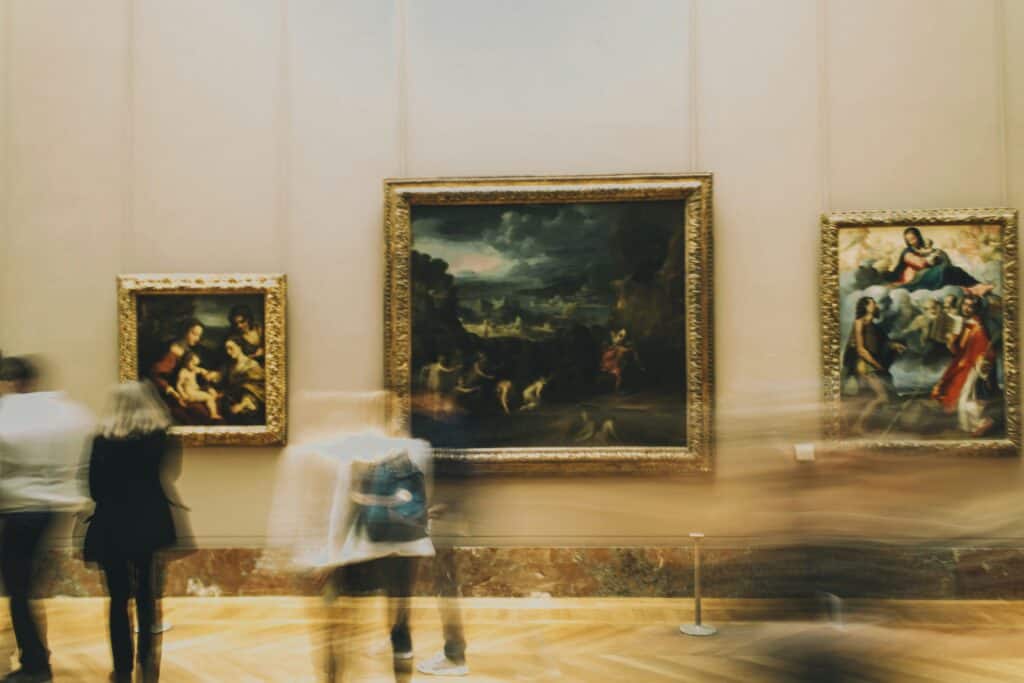
people walking past paintings in the Louvre, Paris

You Have to Make Your Life

Having to stand up for myself in a country where I’m trying to establish the rest of my life has been no easy feat. 

A thin layer of perspiration has formed and now permanently coats my face simply because I’m trying to work up the nerve to ask a follow-up question. 

Standing up for myself takes everything out of me. It takes all my guts. 

And yet, I still decide to get up every morning and do it again. And again. And again. 

When I’m lying on my bed at night, thinking about what little ground I’ve covered, yet how much energy I’ve used to defend my honor, I’m struck, asking myself the question: When does one learn to do this? When does one learn how to stand up for themselves? Because I think I might’ve missed the memo.

As children, it’s our parents’ job to be our biggest advocate. Defend our rights. Speak to our needs.

During adolescence, we often wade in a state of constant humiliation, so much so that it feels like we’re drowning in it. We’re barely hanging on. Dogging-paddling to stay afloat. We couldn’t care less about fighting for our rights, what we deserve, we’re living day-by-day and our friends are our safety floats.

Then one day we wake up and come to the jarring realization that we’re the adults now. It seems as if we’ve just been living as passerbys to our own lives until suddenly we’re thrown into the wild, taught to fight it out, and see if we come out alive. 

In adulthood we’re confronted with the desire to carve out a life of our own. And if you want to do that — to make your own life — it means getting used to confrontation and passive-aggressive responses and learning to be your biggest protector. 

When I moved to Paris in my early twenties, my question changed in accordance with my new context. Having to deal with bureaucracy, confrontations on the street, and landlords all in a foreign language on a foreign land, I wondered, “But who stands up for us?” I felt that someone should. 

Sticking up for myself within a new identity became an even bigger challenge, yet increasingly vital. 

Initially, I relied on handling administrative tasks in a group effort, surrounded by my closest expat friends. This way, if we worked together, chainlinked our arms around one another’s, no one could take us down. 

One thing led to another and the group eventually did collapse. 

Someone would ask for a raincheck the day we planned to meet up and check things off our to-do lists, so we’d take it as a sign to put our tasks off for another week. Another would fill our souls with hope by promising to look into something for the group and relay their findings. In the end, they’d never get around to it.

Relying on others to help cushion the embarrassment by being there with you when you fall from grace is undeniably nice, but it also tends to be a huge waste of time.

I even tried relying on my boyfriend for this sort of support, telling myself that once he got home from work he would sit by my side and help me as I called CAF. When he would come home, we’d make dinner while listening to music or turn on the TV in the guise of just wanting to watch the news for a few minutes, then like magic, a movie would switch on and we’d get sucked in. 

We always told each other tomorrow. Tomorrow is when we’ll spend countless hours on hold together. 

The thing is, time moves slowly when you’re always waiting on others. 

I watched as people made their own lives around me. Big things were happening to people. Law school. Jobs in fields that nourished them and some that even paid them well. Marriage. An evolving social status.

It felt like nothing was happening to me. People were moving around me, things were moving around me, but I wasn’t. I was stuck in the middle of a whirlwind. 

I was with one of my expat friends at the Musée de l’Orangerie, wandering around the Berthe Weill exhibit and reading about her legacy and the kind of life she led in Paris. I remember feeling low at the time. Bad news kept toppling onto my lap. Yet again, I was passing nights lying on my bed, questioning everything. The central one being: why am I here? Every bright light at the end of the tunnel seemed to be misleading. Caveats adorned everything I pursued, ultimately preventing me from simply living in the city where I wished to be. I couldn’t feel any relief. But then I saw this quote plastered above some of Weill’s collection and a smile couldn’t help but creep upon my face. My stomach felt warm. My giddiness started to rise. 

“I started out with just 50 francs in hand and went into debt to pay the costs involved in opening a shop. Obviously, the situation wasn’t ideal, but I couldn’t back out now. Besides, what was the worst that could happen? Not being able to hang on? I WILL HANG ON!” – Berthe Weill

Be brave. Do the thing. Bear the challenge. If anything, it won’t wear you down; you’ll wear it.

In the end, I sucked it up. I put on my big girl pants, and I learned how to fight for my life and how to find pride in saying that I made it my own. Learning to stick up for yourself in a “ce n’est pas possible” culture is not my kind of fun. In fact, I used to take offense to it. With nearly every interaction, I have to fight for what I want. As an American, having arguments, even little ones, doesn’t just brush off my back. I don’t call that an interaction. I call that a dispute, and it makes me feel icky. They stick with me. I feel ashamed, or if I’m lucky, I learn to think of the other person as evil. 

Here, it’s almost like a game. Oh, you want something? You’re gonna have to beg me for it. 

I now treat it as such. Once I crack the code and win the game, receiving what is rightfully mine, I become overjoyed. It’s made the reward feel even better. It’s turned it into a testament to my wit, my charm, my insatiable persistence. 

Still, I find it demanding to stick up for myself and fight for what is rightfully mine, but I’m happy to say that I try to take it less seriously these days. Laughing more about it helps. What do you mean it’s not possible to do something that is very clearly possible? 

In doing the hard work, I’ve felt a strange conglomeration of feelings: being absolutely on my own, yet feeling powerful because of it. I’ve learned, reluctantly, that I can’t wait and sit back and watch how my other expat friends have done it or wait till my French boyfriend can help me.

If I want things to happen for myself, I need to make them happen. And in the meantime, regardless of what will happen with my life, I WILL HANG ON!

Photo by Diogo Fagundes on Unsplash

Did you enjoy this article? TAIP is 100% reader-supported through tipping. If you want to leave us a tip of any amount it would be highly appreciated.  These tips help support our efforts to keep TAIP an ad-free environment. Just like at a cafe, the tips are split evenly among the team.

a woman standing in front of a colorful flower shop in Paris

Living in France Changed my Relationship with Time

To be honest, I never really thought much about my relationship with time. Until I moved to France and realized just how differently they approach it in terms of, well, almost everything.

Things that have become normalized in the US, like eating lunch at your desk, sandwich in one hand, typing away with the other, working multiple jobs to make sure I had some cash to enjoy the little time off I had, squeezing in dinner before a workout, falling into bed at night from pure exhaustion… the list could go on and on. 

The addiction to the hustle and “being busy” is very real in the States. Not to say I didn’t have to hustle a little to live in France (in fact, it’s how I met Stephen originally), there’s no denying that life moves at a much faster pace for the average American compared to the average French person.

When I moved to France, suddenly I was living in a country where “urgent” rarely means what you think it does, where many shops close for lunch, and where a vacation is treated as sacred, not optional. My busy American brain didn’t know what to do with this at first, but I got used to it very quickly, and ultimately learned to absolutely adore it.

This slower pace of life is something Stephen and I talk a lot about on our YouTube channel — it seems to come up time and time again. While some aspects certainly took getting used to, we both agree how refreshing it was to have more time and space in our lives… without feeling guilty about it.

Slowing Down, Whether You Want To or Not

One of my very first culture shocks was the fact that most shops and stores are closed on Sundays, even in a massive city like Paris. Now, that has changed a bit, and nowadays you’ll be able to find at least a grocery store or two open. But it’s nothing like in the US, where things seem to be open 24/7, or at least seven days a week.

In Paris, there aren’t many shops that close for lunch, but in smaller places (even Bordeaux, which is still a pretty major city for France standards), you’ll be hard pressed to find a pharmacy or boutique open from noon to 2pm. 

Not to mention the whole country seemingly shutting down for the entire month of August. I remember being in a panic one fateful summer, when I was waiting for a very important piece of administrative documentation needed for an upcoming student visa I had to apply for. The offices at the school were closed promptly at 4pm on July 31 and I unfortunately did not have the forethought to go pick up my paperwork before then. I had my visa appointment in mid-August and quickly began to panic.

Shockingly, when I explained the issue back at the Boston consulate, they totally understood and ended up issuing my visa anyway, thanks to a few other key pieces of paperwork I did manage to get my hands on. I do NOT recommend trying to do the same, but it just goes to show that not being able to get anything administrative done in August is a cultural and accepted norm in France.

My shift toward this new concept of time didn’t happen overnight and it was extremely frustrating at first. But slowly, I got used to it and even began to lean into it myself.

Learning to ‘Be’ in a Culture That Values ‘Being’

Everything takes more time in France and they like it that way. A two-hour dinner isn’t a luxury, it’s normal. Even average, weekday dinners at my in-laws are often at least one hour long. They do not rush through meals, and it’s something I personally love about the culture.

Weekends are for friends, relaxing, long walks, and markets. Sundays are for staying at home. And five weeks of paid vacation isn’t a perk or “benefit,” it’s your right. Coffee dates aren’t 20-30 minutes long, they often span over several hours and may even turn into a meal if you time it right. It’s better to take the scenic route. It’s okay to just… sit.

There’s less competition in France too, which I think influences this attitude of “it’s okay to take your time.” I don’t think all Americans are competitive in nature, but it’s so ingrained in our culture that we don’t see the little ways it affects our everyday lives. It’s also worth noting that France is not a capitalist country. Now, if you talk to most French people, they’ll say that this is changing (no thanks to American influence), but it still is nothing compared to the consumerism-obsessed États-Unis.

As someone who grew up in the US, it’s so, so refreshing.

Now that my French husband and I are back in the States (for now), I won’t lie: it’s been difficult to keep the slow-paced French lifestyle here. There are just so many more pressures. Pressures to earn more because the cost of living, at least in our situation, is four times what it cost us to live in Paris. Pressures to have the latest and greatest car/gadget/home/clothing/electronic/etc. Pressures to keep up with everyone else around us.

But, ultimately, I am so glad to be back here with my husband because he often reminds me to slow down and lean back into the French way of life. We’re slowly but surely creating our own little pocket of France in our little beach house on the East Coast. And constantly reminding ourselves: ‘more’ doesn’t always mean happier. Because it often doesn’t.

Photo by Eliott Goutard on Unsplash

Did you enjoy this article? TAIP is 100% reader-supported through tipping. If you want to leave us a tip of any amount it would be highly appreciated. These tips help support our efforts to keep TAIP an ad-free environment. Just as at a cafe, the tips are split evenly among the team.

fresh produce in baskets

How to Shop at an Outdoor Market in Paris

Visiting the marché is one of my favorite weekly activities, and I especially love going with either my French husband (a professional chef) or my French mother-in-law (an incredible cook herself). They seem to know exactly where to go, who to talk to, and what to choose. 

It’s almost as if they’ve lived here their whole lives… oh, wait.

Outdoor markets are a staple of daily life in France and Paris is no exception. You’ll find everything from farm-fresh produce to artisanal cheeses and even household goods, depending on where you go.

Shopping at an outdoor market in Paris is a must, whether you live here too or are just passing through. Here are a few things I wish I had known before going for the first time.

When to Go

Paris markets have specific opening times, so knowing when to go is the first step in planning your visit. Most operate two to three days a week, and the hours can vary from one market to another. Typically, they’re open in the morning and close by early afternoon — usually around 1 or 2pm.

I hate to say it for all of my fellow night owls, but to beat the crowds and get the best selection, you have to get there early in the morning when the vendors are just setting up. My mother-in-law lives and breathes by this. Oftentimes, if she can’t get there by 8am (her market opens at 7am), she won’t go at all. Quel est l’intérêt ? “What’s the point?” she’ll shrug when asked.

Now, there is a caveat to this if budget is a real concern. The other option would be to head out just before closing, as many vendors will be eager to clear out their stock before the next day — at reduced prices to boot.

To find the exact days and hours of the markets you’re interested in, check online or use the app Marcoo.

What Stalls to Expect

If you’ve never been to an outdoor market in Paris before, you’ll notice there’s a wide variety of stands that offer all kinds of things. Wandering through one is truly a feast for the senses — I don’t recommend shopping while you’re hungry or you may end up with a lot more than you originally planned for.

Here’s what you can typically find:

  • Seasonal fruits, vegetables, and herbs.
  • High-quality cuts of meat, poultry, fresh fish, and seafood.
  • A selection of French cheeses, farm-fresh eggs, and sometimes butter.
  • Freshly baked bread, pastries, and viennoiseries.
  • Rotisserie chicken, roasted potatoes, paella, and other prepared foods.
  • Olives, nuts, honey, jams, and spices.
  • Some also have stalls with flowers, kitchenware, linens, and apparel.

One of my top questions when shopping with my French fam is: how do you know which vendor to choose? There are often several stalls that sell the same or similar items… how can you tell which one is the best?

After insisting that, “Well I’ve been coming here so long I just know,” didn’t satisfy my curiosity, my husband broke it down a bit further.

Freshness and quality matter. Take a good look at the state of the produce — bright, vibrant colors and firm textures usually mean it’s fresh. Stalls with steady lines of locals are a great place to start, and if the vendors are talkative and friendly (yes, they exist in France) it’s also a good sign. Prices will vary, but steer clear of drastically lower ones as that could indicate, well, lower quality.

And, in the quintessentially French manner, the hubs says very simply that le feeling (the vibe, the ambiance) he gets when stepping in front of a stall determines where he’ll spend his money. 

I’ve somewhat stopped trying to understand what that really means, but that’s another story for another article.

How to Choose Your Produce

Shopping at a French market is different from grabbing groceries at a supermarket. Vendors take pride in their products, and bien sûr, there’s a bit of etiquette involved.

  • Look for seasonal produce: French markets focus on in-season fruits and vegetables, so don’t expect to find strawberries or tomatoes in December.
  • Check for quality: Remember to look for vibrant colors and firm textures, as well as fresh smells.
  • Know Thy Categories: Some markets label produce by origin — bio (organic), local, or imported. I typically go for the organic local stuff over anything imported, unless it’s from Spain, Italy, or another closeby country.
  • Let vendors choose for you: Unlike in the US, it’s considered rude to handle the produce yourself. Nothing against you or your cleanliness, but in France, interacting with the vendors is all a part of the experience. Tell them what you want, and they’ll pick the best items for you.
  • Ask for recommendations: They also know their products well. Don’t hesitate to ask which melon is the sweetest or what’s best for a recipe you have in mind.

The Best Outdoor Markets to Visit in Paris

There are more than a whopping 80 markets in Paris going on in a given week — from small neighborhood spots to sprawling marchés with stall after stall of goods. Here are a few of the most popular ones, plus one of my personal favorites:

  • Marché Bastille (75011): One of the biggest, with everything from organic produce to artisan bread.
  • Marché des Enfants Rouges (75003): The oldest covered market in Paris offers a mix of fresh produce, international foods, and one of the best sandwiches I’ve ever tried from Alain Miam Miam. Trust.
  • Marché d’Aligre (75012): Known for affordable produce and antiques.
  • Marché Raspail (75006): Great if you love organic food and other high-quality products.
  • Marché de la Place Monge (75005): My top choice for its intimate, small neighborhood feel and high-quality produce, fresh seafood, and cheeses. It’s right near the Arènes de Lutèce in the 5th arrondissement.

Before you walk out the door, make sure you have cash and reusable bags, and get ready to practice your French. A polite bonjour here and there will get you a really long way. So will a French friend, so bring one of those if you’ve got ‘em too.

Photo by Anurag Arora on Unsplash

Did you enjoy this article? TAIP is 100% reader-supported through tipping. If you want to leave us a tip of any amount it would be highly appreciated. These tips help support our efforts to keep TAIP an ad-free environment. Just as at a cafe, the tips are split evenly among the team.

How Living in Paris Turned Me into a Bike Convert

How Living in Paris Turned Me into a Bike Convert

The Motorcycle

Long, long ago in the early 1980’s I had a car that broke down. As, at the time, I often had to go way out to the suburbs, I wondered how I was going to get out there where the transportation was complicated, to say the least. It was then that a friend suggested I get a motorcycle. At the time, the law was that if you had a valid driver’s license, you could drive a motorcycle up to 125 cc without taking a special exam.

So I took some lessons, bought a second-hand motorcycle, and learned that motorcycling was not just a means of transportation but fun in itself. So next step was to get a license, and to move up to bigger and bigger bikes. My last love was an 800cc BMW twin. I drove it everywhere in Paris and France, on vacation, with motorcycle clubs.

A Car & Public Transportation

And then I got pregnant and had a son. Motorcycling was not the best way to get around with a baby. I joined the millions of Parisians on public transportation and in the most typical American tradition I decided that with a baby I needed a car. My criteria? Small enough to park in Paris, comfortable enough to travel in, and automatic. The managing director’s chauffeur of the company where I was working recommended I get a Peugeot 205, a national favorite at the time. So I followed his advice and have been very happy with the choice.

But parking has always been a headache. Public transportation became my main means of travel in the city. My car was used less and less. I would do my food shopping typically on Friday afternoon, knowing that there would be street parking when I got back as everyone left in their cars for the weekend. I never took the car after 3pm on Sunday to be sure it was parked before everyone got back from their weekend. 

After about 12 years of cat-and-mouse parking, they knocked down a small factory across the street and started to build an apartment building in its stead — with parking spaces! The workers were still putting nails in the sign when I called the builders to inquire about buying a parking space. I was quickly informed that they were not selling parking spaces, but condominiums with the possibility of buying a parking space with it. Within the time of a single breath, I decided to sign for a condo. The smallest in the residence, but still I got a parking space. While a friend remarked that it was a particularly expensive parking space, it turned out to be a good investment.

It has been nice to jump into a car parked just across the street if I did not want to take the metro for an evening outing or go food shopping, or pick up or deliver something cumbersome or heavy. Public transportation remained my main means of transport in the city.

The Paris Mayor and Her Crack-Down on Cars

Then our supposedly ecology-minded mayor (perhaps in cahoots with the automobile industry) created a policy of dividing cars into 5 ecological categories to determine whether or not the car could be driven in Paris. Studies have shown that the most ecological use of a car is to keep it as long as possible until it gives up the ghost. Notwithstanding, the law was based on age, the older the car, the less it could be legally driven in Paris on weekdays or high pollution days. Thus a new, large gas-guzzling diesel-run car was free to be driven in Paris, while a small, less-polluting, gasoline-run car, albeit old, could not. CO2 statistics did not enter into the new law.

But my car ran beautifully, had little mileage, and I did not need a car sufficiently to buy a new one. And, 30-plus years after the original purchase, the baby has got much bigger, the driving in Paris has got more and more difficult (not to mention parking!), and I have needed to cross the “périphérique” less and less; thus my use of a car has dwindled. 

Lucky for me is the loophole in the law whereby after 30 years a car can be declared a collector’s item and can be driven anytime, anywhere. So I picked up the end of France’s red tape and with a good amount of yanking turned the jalopy into a collector’s car

Meanwhile, our mayor has continued on her warpath against gas-powered vehicles (and cars in general) in Paris. Traffic has become horrendous with more and more draconian road policies for cars, thereby creating worse and worse traffic and — as an obvious result — more and more pollution from stagnant cars.

Bicycles in Paris: The Good, the Bad, and the In-Between 

On the other hand, Madame la maire has aggressively been installing bicycle paths. Perhaps she imagines Paris as a little Amsterdam

I had often thought of acquiring a bicycle, but I was too familiar with the hard ride up the Père Lachaise hill which I had been navigating for the past 20 years on the way back from the Friday night then Sunday organized skate tours of Paris. By the end of my roller-blading days, I would skate from bench to bench up the hill with a stop at each bench on the way up to catch my breath.

In a win-win solution, a friend who had moved to the far suburbs had bought an electric bicycle to get to the train station and then around Paris. His very legitimate fear was of having the bicycle stolen when he was away traveling.

The solution? He parked the bike in my inner courtyard garden and it was mine for the taking as long as it was there. So off and on for a year, I became a happy bicycle rider in Paris.

I rode through all the new street works as bicycle paths were slowly constructed, observed the growing traffic jams, and enjoyed viewing Paris above ground. I also became adept at watching out for thoughtless scooters,  pedestrians on their phones, and other bicyclists going through red lights. The upshot of the experience was that I got hooked on bicycling in Paris. So when my friend informed me he was leaving Paris for good for the U.S. and selling the bike that I was beginning to think of as my own, I jumped at the chance to really make it mine.

On a beautiful day, what a pleasure to pedal around Paris, and no worries about hills with an electric motor assist. On the other hand, having put up with rain in Paris for months, the metro is often to be preferred. And yet, if the walk from a station is to be long, and the ride otherwise short, I might just get the rain gear on and face the elements. It is good to have a choice.

With the new and many bicycle lanes, riders are relatively protected from automobile traffic, which is quite comfortable for us. The difficulty comes when cars need to turn right across the bike lane or as bicyclists we have to turn out of the lane and cross traffic. Too, cars tend to try to go through a crossing at the end of a light and we find them sitting on the bike lanes making it difficult to cross or even move into the pedestrian crossing. I have found a particularly dangerous spot at Place Gambetta where cars come careening off the roundabout, shooting toward the pedestrian crossing where they aim to stop short; unfortunately, the bicycle crossing that comes before is more often than not overlooked. These are examples of tricky situations.

Additionally, there are the incoherences of the lanes. For example, as I wheeled around the Place d’Italie, I somehow lost the path in front of the Galaxy shopping center. And there stood the police seemingly waiting to inform me that I had in some way ridden onto a pedestrian area where I could be fined 135€. I, of course, excused myself and explained that I had somehow lost the bicycle lane. They pointed to where it was (not too clearly marked), had me get off and walk the bike, and in parting, suggested that if I was having difficulties I should go to Amsterdam. 

One of the worst lane tracings can be found on the Boulevard des Maréchaux. For a quarter tour of Paris, from Porte de Bagnolet to Cité Universitaire there must be at least 10 crossings from the outer cycling rim to the inner rim. I cannot say how many times I have lost the path only to notice it has meandered off to the other side of the four car lanes and two tram lines. This means a number of riders (myself included) sometimes just stay on one side knowing we will be in the right lane soon enough. On the other hand, we find ourselves facing oncoming bicycles in a narrow single-bicycle lane or oblivious pedestrians.

Then, of course, there is parking. Now that so many Parisians have turned to bicycles it has become difficult to park, sometimes almost as difficult as to park as a car. Having had my bicycle seized by the police for attaching it to a mundane fence, I do not wish to leave it anywhere but in bicycle racks which are not always nearby or with free spaces. On the other hand, a friend always avoids racks as many cyclists pay no attention to other mounts when getting their own bike in or out of the rack, thus damaging nearby bikes. To each their own parking traumatism and parking choice.

But all in all, having learned to deal with the difficulties, I can only appreciate the freedom of bicycling in the city. It is always quicker than walking and often faster than the metro depending on the necessity of changing lines. And with Olympic fever, the metro has become a hassle with many closed stations and fewer trains in accordance with the summer season.

It is interesting to think that when we were kids in the U.S. we could not wait to get our driver’s license, give up the bicycles of childhood, and get a car, one of the first badges of adulthood. Now, at least in Paris, more and more adults are giving up their cars for the simplicity of a bicycle. 

With the city bicycle-renting possibilities (which I have never tried), it is worth giving this above-ground, Paris-friendly means of transportation a shot. Because, when we think about it, viewing the city is why we are here.  

Photo taken in front of the Comédie Française.

Did you enjoy this article? TAIP is 100% reader-supported through tipping. If you want to leave us a tip of any amount it would be highly appreciated. These tips help support our efforts to keep TAIP an ad-free environment. Just as at a cafe, the tips are split evenly among the team.

a dining table with glasses and plates

Navigating a Parisian Dinner Invitation

Note from the editor: Parisian for more than a decade, ex-chef turned food tour guide Chef Tris shares his passion for French food and life in Paris on his blog Eat Like the French. Tris has recently joined the TAIP team with the hope of guiding us through the culinary minefields of Paris to ensure you always eat like a local in France. — MS

“I’m never inviting young Americans to my house ever again,” said my wife, her voice tinged with exasperation, as our two new American friends left our Parisian flat. The evening, which began with excitement over a Dungeons and Dragons game, had devolved into a lesson in cultural missteps. This stark declaration was a wake-up call — a reminder that French dining etiquette is an art form, one that demands respect and understanding. I love sharing my passion for French food and the art de la table, and was delighted to write a blog post for TAIP to act as your guide to navigating a Parisian dinner invitation with grace and charm.

The Invitation

It is rare to be invited to a Parisian’s flat for dinner. Some think it’s due to the size of the apartments, while others claim it’s because Parisians much prefer to eat in the plethora of restaurants and bars that the city has to offer. If you’re lucky enough to receive an invitation to a Parisian’s home, the first rule is to RSVP promptly. A swift response shows respect for your host’s planning and reflects your appreciation for the invite.

Punctuality in Paris isn’t the same as in the US. Aim to arrive 10 to 20 minutes after the appointed time — this is known as the petit quart d’heure de politesse, a little buffer to allow your host those final moments of preparation.

Prepping for the Visit

Choosing the right outfit is crucial. Parisians have an innate sense of style — think smart-casual but with a touch of chic. And don’t forget a gift! While flowers are lovely, wine or beer is the norm. If wine seems daunting, especially in a country where it’s an art form, visit an independent caviste. Tell them your budget and trust their expertise to select a bottle that will impress. Champagne is always a hit if you’re unsure, although we prefer pét-nat or crémant for more bang for your buck. Rely on the expertise of your caviste; they all speak English and will offer excellent and honest advice. If children are present, bring something delightful for them — sweets or chocolates, or a unique treat from your home country. My daughter was over the moon with a box of Fruit Loops, a sugary cereal delight from America that struck fear into my wife’s heart.

Whatever you bring will be opened and eaten in front of you because the French think that’s the polite way to do it.

The Arrival

Walking into a Parisian home is an exercise in social grace. The moment you cross the threshold, greet everyone with a warm “bonsoir” and the customary bise — two cheek kisses. This isn’t just a formality; it’s a way to break the ice and show respect. Your host will likely take your coat and offer you a drink. Engage in small talk, and make it a point to remember names. An easy icebreaker is to ask, “How do you know our host?” Avoid the banality of questions about work, as the French work to live, not the other way around.

Dining Etiquette

Dinner in Paris is a dance of manners and tradition. Your host will indicate where to sit, so wait for their cue. Keep your hands visible on the table, but never your elbows. When it comes to serving yourself, take modest portions. It’s polite to leave a bit on the serving plate in front of you, signaling that you’re satisfied but respectful of the host’s effort.

The table may be set with many glasses and different types of cutlery; do not be scared to ask questions if you do not know. My wife’s eyebrows hit the ceiling on seeing one of our guests pour wine into a water glass. What ensued was a long conversation about the glassware and which you should use for what.

Do not be scared to ask questions. If there is one thing every French person I know loves to talk about, it is the food and the traditions around it. Teaching you how to act at a dinner table is something they love, and they will always be happy to educate you.

The highlight of the meal is often the cheese course. In France, cheese isn’t just food; it’s a cultural icon. Treat it with reverence. Take small portions from the cheese board onto your plate using the cheese knife provided, and then put more cheese onto a tiny piece of bread so that the bread acts as a vessel for the cheese, not the other way around.

Never mix different types of drinks in the same glass, especially not wine. If in doubt, don’t hesitate to ask your host for guidance.

The Conversation

Parisians value authenticity and depth in conversation. Be prepared for directness. Parisians will always avoid superficial topics and will always tell you what they are thinking. Engage genuinely, listen attentively, and don’t shy away from intellectual discussions. They can spot insincerity from a mile away, so it’s best to be yourself.

The Departure

When the evening winds down, thank your host sincerely. While a Parisian will never request for you to leave, and an evening at a Parisian’s house may last into the early hours, pay attention to the stifled yawn or the question of how you are planning to get home. The metro rules the transport roof in Paris, so if in doubt, explain you must get the last metro home and ask for advice on how to get there. Before you leave, offer to clean the table or carry a few dishes to the kitchen. A follow-up message the next day expressing your gratitude will leave a lasting positive impression.

Being invited to a Parisian home is more than a social event — it’s an immersion into French culture. With these tips, you can navigate the evening with confidence, leaving your hosts impressed by your respect and understanding of their customs.

Photo by Nils Stahl on Unsplash

Did you enjoy this article? TAIP is 100% reader-supported through tipping. If you want to leave us a tip of any amount it would be highly appreciated. These tips help support our efforts to keep TAIP an ad-free environment. Just as at a cafe, the tips are split evenly among the team.
Sotheby April 2024 evening sale

Art Fairs and Auctions to Explore in Paris

If you are thinking of collecting art, much thought should go into your choices before purchasing. First, you need to know what you like, what moves you. Visit galleries, go to art exhibitions and fairs. Discuss art with friends; define your tastes. Then you can follow artists that interest you. 

Trade Fairs

Fairs are a concentrated marketplace for art. The visitor can see much of what is currently occurring internationally within a given time and place. 

Paris hosts a number of art trade fairs during the year where booths are set up for galleries to display their wares.  The major fairs typically occupy the Grand Palais during their short tenure, although between 2021 and April 2024, while the Grand Palais underwent massive renovations, they relocated to the Grand Palais Ephémère. Other regular fair sites include the Carreau du Temple and the Carrousel du Louvre

As a rule, many fairs will take place at the same time, organized as satellites around a renowned central fair, thus creating an “art week” with its overwhelming offer of fairs, exhibitions, and events throughout the city. If you are lucky enough to find a way to beg, borrow, or steal a VIP pass to the main fair, you will also be invited to free museum entrances, private visits to artists’ studios, museum exhibitions, and various openings. Even without the coveted pass, art weeks can become quite an overwhelming whirlwind of art with all that is happening during the same short week.

There are two major art weeks in Paris: the first built around Paris+ by Art Basel which takes place in October, and the second around ArtParis which occurs at the beginning of April. 

Of the two, Paris+ is THE major art fair in France with the world’s most high-flying galleries participating. While this very exclusive fair is particularly parsimonious with its invitations (even a reporter friend was not let in free of charge), there are enough satellite events to keep the most hyperactive of art lovers sufficiently busy.

For example, in 2023 satellite fairs (some of which are free) included Moderne Art Fair, AsiaNow (at the Monnaie museum), Paris Internationale (free), AKAA (Also Known as Africa), Offscreen (free — mainly showing video art and situated interestingly in a garage with the advantage of having no stairs but ramps up to the various floors of the “showroom”), and Art Shopping (free with invitation on its internet site). Traditionally during the Paris+ art week Palais d’Iena (free) offers an exhibition of renowned artists, the Tuilleries (free, outdoor) is turned into a contemporary sculpture park and galleries show off the best of their blue-chip artists.

Art fairs covering specific art media are Salon du Dessin and ParisPhoto, each with their satellite exhibitions, some free some for a fee. Salon de Dessin is the central exhibition with Drawing Now as the secondary one. During drawing week (La semaine du dessin), free visits are offered for the general public in various museums and institutions if you sign up quickly enough after they are announced. Orbiting around ParisPhoto is the gallery fair, Photo St. Germain where many galleries give their space over to photo exhibitions. Another is the Urban Art Fair, with no satellites (to my knowledge) although many galleries will give themselves over to urban art at the time of the fair.

The historical Salon de Paris and the Salon des Independants seem to have receded into a more general contemporary art fair known as Art Capital, which is subdivided into four constituent art fairs. For the most part at each of these fairs’ works are arranged according to various themes, and only a few pieces of any given artist will be found. Such an agglomeration of so many little-related artists can be quite mind-boggling.

While most fairs are more often than not an aggregate of galleries, the atmosphere at a fair is generally more hard-sell than at the galleries’ premises. Prices are rarely posted, but there is always a sheet nearby with a price list or the gallery’s representatives have a crib sheet of prices on hand. And whether you are a purchaser or not, it is a great pleasure to see all the art concentrated in a single, limited space. Of all the thousands of works on view, see what styles, palettes, strokes, forms, lines, and movements grab you — and which do not. They are a great place to clarify your personal taste.

Auctions

Auctions are the number crunchers of the art world. They are the reference point of the value of an artist’s work which is calculated according to the latest prices paid for pieces created by that artist. Auctions are the kings of the secondary art market, i.e. when works are not sold directly by an artist or their gallery, but by previous owners of the work in question whether they had bought it at a gallery or through auction.

Visit a pre-exhibition of an auction and the plate describing the work will typically offer an estimation of its value in the form of a price bracket. This valuation is typically set on the suggestion of the auction house’s expert as compared to other works by the same artist previously sold at auction.  Bidders, then, are the final decision-makers concerning the value of an artwork.

There are a number of auction houses in Paris. The big names include Sotheby’s, Cristie’s, Artcurial, Piasa, Tajan, Bonhams, and Aguttes. All of these have their own premises to exhibit and auction off art. These auction houses will announce the type of art they will be selling, e.g. Modern and Contemporary, Works on paper, Urban art, and 17th-19th-century art. Often a sale may consist of a given individual’s complete collection. Depending on your interests, these exhibits are well worth visiting for your viewing pleasure.

Of particular interest to everyone, whether a potential purchaser or not, there are times when an auction house hosts the sale of a single artist’s work. The exhibit before this type of sale can be especially enticing as it is equivalent to a museum’s temporary exhibition of the artist. I will never forget Artcurial’s sale of Utrillo — three floors of nothing but this artist’s works, none of which I could afford, but a wonderful exhibit all the same.

And just like for trade fairs, if you can get on to a big auction house’s VIP list, there are invitations to openings of a sale’s exhibit, whereby a pleasant visit of the works can be enjoyed, full champagne glass in hand. 

Hotel Drouot, often considered a monolithic auction house, is in fact a building consisting of 16 rooms where 70 independent auction firms affiliated with the Hotel Drouot exhibit and hold their auctions. They maintain offices elsewhere, for the most part, nearby. Thus there is a large turnover as to who will be occupying the various rooms in the building on any given day. One might pop in to see particular works that have been advertised, or just to take a look around at whatever might be on sale. I once went for just a look around and ended up bidding on and winning a beautiful Christian Lacroix set of dishes for twelve, which I set out every Thanksgiving and for other special occasions. 

Auctions are not the place to start collecting. Once you have an idea of those artists you would like to collect you can register on the Drouot site and ask to be alerted to sales of those artists. A myriad of auction houses throughout Europe have enrolled with Drouot and register their upcoming catalogs with them. The site scans all the artwork for sale and sends out alerts when the work of an artist or category of art you have subscribed to comes up for sale. 

Bidding at auction can be done in person, by phone, or online. Concerning auctions, it is recommended to see the work before it goes up for bidding. Check for flaws — ask to pick up a piece or to see the back of a work which will often have information about galleries from which it was sold, or even other auction sales. Think ahead on your ceiling price keeping in mind the added fees which will include tax and commission, typically 30% above the hammer price. During the auction, you will need to make up your mind very quickly, within seconds, as concerns the price — raise or drop out? It is hard to resist the temptation from within and from the auctioneer to go higher than the maximum you have set. On the other hand, I have mourned years for some works I have let get away.  

And of course, be careful. I have just heard from a friend who was watching an auction online at Christie’s, and it seems that just as he was cleaning his touch-screen, he found himself the top bidder for a work he did not particularly want. He is now figuring out what he wants to do with the work. Personally, I like it, and he got it (albeit unwillingly) under the low estimate. He might have made the right purchase for the wrong reason, but that waits to be seen.

Sometimes the lower estimate acts as the reserve price, the price below which the consignor will not sell. While sometimes the reserve is even less than this estimate, the reserve cannot, by law, be higher. 

One interesting possibility, on the other hand, is not to take part in the auction at all, but to wait to see if the work sells. If it does not reach its reserve price, it is considered unsold. In this case, you can contact the auction house and make an offer within a few days; this is called an after-sale offer. The auction house will contact the consignor to see if they accept. One reasonable offer is the low estimate commission included, which means 30% lower than if you’d taken part in the bidding war. A friend often offers 50% of the lower estimate, plus commission. It’s for you to decide on an acceptable price for you and for the consignor to accept or not.

When considering the secondary market, some ask, “Which is better, buying at auction or from galleries?” As a friend once said, “In an auction, the price only goes up; in galleries, you can negotiate down.” True, but… galleries sometimes put prices up higher than an auction estimate. On the other hand, galleries sometimes let you pay over time, or even trade from your collection to offset the price of a work. Also, you can take time to think. Auction houses demand full payment within a few weeks, as they need to pay the consignor. Obviously, this all depends on how much you want a work, and how much you can afford.

Investing in art is a bit like the stock market: works can go up or down in price. But contrary to cold numbers you get the pleasure of living with a work that speaks to you. 

And remember, too, should you be stirred by art (purchaser or not) and thirsty to learn more, art fairs and auctions, while they exist for selling, are also great places to see art that will soon be outside the public domain. Take advantage of these possibilities, and enjoy!

Photo taken at Sotheby’s April 2024 evening sale.

Did you enjoy this article? TAIP is 100% reader-supported through tipping. If you want to leave us a tip of any amount it would be highly appreciated. These tips help support our efforts to keep TAIP an ad-free environment. Just as at a cafe, the tips are split evenly among the team.

My Journey to France Part 2

In case you missed Part 1, I’m sharing my unique journey from I’ll-never-live-abroad to nearly-10-years-in-France-and-counting. 

I’m often asked how I did it — and while several of my articles on TAIP touch on how I’ve been able to stay, I wanted to write it all out in a way that could be copied by anyone reading. Okay, maybe not anyone. It took a lot of hard work to build my life here in France, and it isn’t over yet. I’ll be starting my journey to citizenship next, which promises to be full of paperwork and even more determination.

But, I’m getting ahead of myself. Below I’m picking up where I left off on Part 2: I was an au pair, didn’t want to continue on as an au pair, but didn’t want to go back to the US just yet. Here’s how I figured out a way to stay.

Back to School, It Is

I was always one of those people who said, “Never again!” after finishing my undergrad. It wasn’t that I didn’t like school — on the contrary, I’ve always enjoyed learning — but I was sick of papers and tests and all of the other coursework that went along with it.

Famous last words. As I finished up my second year as an au pair, I didn’t have many options other than the easy-to-obtain student visa. I decided I wanted to get my master’s degree. Public education is cheap here and I knew I’d regret it if I didn’t. This time, however, I was going to study something I was actually interested in, not something that would lead to a job one day.

I settled on French Literature. I’ve always loved reading and writing and I figured I might as well study the greats while I was in the city where many of them worked and lived. The only wrench in my plan? I still, after 2.5 years, could not speak or read French. In my defense, I came over here only knowing the basics, and as an American au pair, I was required to speak English with the children I took care of. At this point, I knew could understand about 75% of what was said to me, but I couldn’t speak back. It was a combination of a lack of vocabulary and confidence.

What’s more, I knew I wanted to go to a public school (again, cheap), and to do so as a foreigner I had to have a certain level of French, with a certificate to prove it. So, I looked around for some programs that would meet the student visa requirement of 20 hours per week. I found two: one at the famous La Sorbonne and one at the also famous Université Nanterre. I missed the deadline for La Sorbonne so that left me with Nanterre.

I applied, got in, looked for housing (and found the deal of a lifetime: I traded 10 hours of English lessons per week for a 9m2 sardine box in the sky), went back to America for a few weeks, got my student visa, and returned to home to Paris. Back to school, I went.

(Finally) Learning the Language

And so began my year-long journey to learning French. I loved my program — and recommend it to anyone who wants to live here long-term — I was the only Anglophone and so the only common language my classmates and I had was (broken) French. Our teachers also insisted that we speak in French instead of our native language. It was difficult, but it also felt like the best place to do it. Everyone had an accent, and everyone was trying to learn.

I met some very kind people, finally learned French, and also discovered more about French culture. We went on field trips in Paris and the Île-de-France region and ultimately all became quite close. Spending 20+ hours per week together will do that.

With my B2 certificate in hand, I was finally ready to apply for my master’s. I still wanted to study French Literature, and so started to look at those kinds of programs. I had a couple of informational interviews at various universities in town, before sitting down with one guidance counselor in particular. 

She looked over my resume and experiences and asked why I didn’t want to study English Literature instead of French. At this point, I had started dabbling in freelance writing and had indicated that on my CV, and well…the whole “native English speaker” thing. I told her it felt silly to come all the way to France only to study English. Mais non! she assured me, and encouraged me to look into English Literature programs instead.

The meeting piqued my interest, and soon the curse of the missed deadline struck again — but it was for the best. Nanterre University, where I completed my French course, had a bilingual English Literature master’s program. Because I was already in their system, it was very easy to apply. I was accepted almost immediately (again, native English speaker), paid my tuition (400 € for the year), and began.

I loved my teachers, loved my program, and bonded with my peers. No, I never wanted to go back to school, but completing my master’s at a French public university was one of the best experiences I’ve ever had. I’ll never regret it. 

But Wait, I Don’t Want to Leave

After my two-year program, spoiler alert, I still wasn’t ready to go home. I met my now-husband about halfway through year one and things had gotten very serious very quickly, in true French dating fashion. We were making serious plans for the future. But…what about my visa?

I obtained the APS visa, which gives you a year to look for work after you graduate from a French institution. I did look for a job but I knew I wanted to work in English (even to this day I can’t write in French beyond simply texting), and finding a job that aligned with that was difficult. I had no issue finding Anglophone clients, but there wasn’t a need for full-time English writers in Paris — or at least, the jobs that I found didn’t pay very well.

The APS visa was quickly running out, so what’s a girl in a relationship with a French person to do? The marriage conversation happens. I’m lucky that I was with someone who I knew I wanted to spend my life with, visa issue or not. So, we made plans to quickly marry at the town hall so that I could obtain the vie privée et familiale visa.

Long story short, I did get that visa and so my future in France was secured for life. I’m not saying that everyone needs to meet a French person and marry them in order to stay here (indeed, there’s an entire shady trade in this which we may write about in the future) — there are a lot of other options out there including the profession libérale visa, or even a long-stay visitor visa if citizenship isn’t important — but in my unique situation, my husband is the reason I was allowed to stay.

That’s the gist of it — a couple thousand words on my journey to France. I hope it will serve as inspiration for anyone else who may find themselves thinking, but wait, I don’t want to leave too.

Photo by Salomé Watel on Unsplash

Did you enjoy this article? TAIP is 100% reader-supported through tipping. If you want to leave us a tip of any amount it would be highly appreciated. These tips help support our efforts to keep TAIP an ad-free environment. Just as at a cafe, the tips are split evenly among the team.