
a field of purple flowers

On Living Two Lives

I’ve heard of people going back home after living abroad for a while and feeling self-conscious, out of place. As if they can no longer relate to the people from their hometown. It’s isolating, I imagine, to feel disconnected from the people and the place that witnessed their formative years.

For me, going back home for the first time since expatriating was disorienting, but I had a different experience.

Stepping back onto the soil I knew so well — the smells of Texas, the long stretches of overpasses that led to shopping plazas or nothing at all, and that heat, my God, that heat — transported me back to my adolescence. 

This was the town I hit puberty in. The town where I first learned what it was to like someone so much it hurts. The town where I spent almost all my weekends at the age of fourteen at the roller rink. The same town that I knew like the back of my hand — I could still drive the same mindless routes to the superstores that my friends and I wandered around in when we had nothing better to do (and in the suburbs we almost never had anything better to do). 

This was the town that I hated, that I so badly wanted to flee from, the town I associated with boredom, ignorance, bigotry. I remember so vividly feeling like an alien on my home planet.

But also, it was the town that raised me. I thought I always knew there was life outside of Katy, Texas but I didn’t really get to experience it and truly understand everything that it encompassed until I left for a while.

When I came back home for the first time I was awoken, rather briskly, by the realization that there was this other person inside of me, one that walked with her chin held high and in a confident posture. I felt unafraid of the world. 

Because in Texas, I have no shame. These people don’t impress me. They don’t intimidate me. I know them for who they are — so easily placeable in a tight, little box. Film bro, sorority girl, liberal, conservative, someone who gets me, someone who doesn’t. 

I’m the funniest when I’m at home. The most reckless. I have no care in the world. I’m happy, I’m generous, I speak up for myself effortlessly. 

In Paris, another less familiar, less well-acquainted side comes out. I’m shy. My self-advocacy is easily thrown out the door. It’s something I have to think about. Put energy into. Relearn every day.

I’m drawn into myself. I’m self-conscious. I can come off as mean. I like to think it’s because I’m protecting myself, but really, it’s because of all my nerves and how scared I am. How hard it all is.

So at first, I was shocked and also liberated to come home and release this lighter, funnier, kinder version of myself into the spotlight again. I exhaled, so incredibly relieved. I am layered. I am complex. I am not this way, or that. No one can fit me in a box because I’ve moved away from that possibility of being stuck there for too long. 

And finally it all starts to make sense — I am nice, I am adventurous, I am brave — moving to Paris, becoming an expat has made me believe I was one way, it hardened me, convinced me I’d be like this forever, but my life here is just starting out. Of course I’m acting like this. Of course all I can think about are the differences between home and here. There’s still so much room for my life to change. 

I feel immensely fortunate to have been struck by this sense of duality. While I know fear and anxiety well, I also know assurance, confidence, comfortability. Not everyone gets to feel these things. I am so lucky to have two lives, one that can nourish the other while in pain. One that discovers something that helps revitalize the broken side of myself. Not everyone has this same experience being an expatriate and I will always count my lucky stars for this.

And I’m not saying I felt this ease and comfort right after I stepped off the eleven-hour plane ride. I remember initially wincing at the loudness of public spaces. The airport, coffee shops, malls. I’d cover my ears and buckle down — bracing myself for all that noise. It was the first time I truly recognized how loud Americans tended to be. 

But eventually I embraced it. I rejoiced in it. These are my people. My silly, ignorant, superficially sweet people. 

I learned to collect the noise, open my heart up to it, and embrace that cafe culture in America wasn’t just about working on your laptop. It was also about eavesdropping too.

I learned to feel completely and utterly at peace. Despite all the noise. Because while I know people can sometimes feel lost going back home, I felt revitalized.

Photo by Roberta Guillen on Unsplash

Did you enjoy this article? TAIP is 100% reader-supported through tipping. If you want to leave us a tip of any amount it would be highly appreciated.  These tips help support our efforts to keep TAIP an ad-free environment. Just like at a cafe, the tips are split evenly among the team.

people walking past paintings in the Louvre, Paris

You Have to Make Your Life

Having to stand up for myself in a country where I’m trying to establish the rest of my life has been no easy feat. 

A thin layer of perspiration has formed and now permanently coats my face simply because I’m trying to work up the nerve to ask a follow-up question. 

Standing up for myself takes everything out of me. It takes all my guts. 

And yet, I still decide to get up every morning and do it again. And again. And again. 

When I’m lying on my bed at night, thinking about what little ground I’ve covered, yet how much energy I’ve used to defend my honor, I’m struck, asking myself the question: When does one learn to do this? When does one learn how to stand up for themselves? Because I think I might’ve missed the memo.

As children, it’s our parents’ job to be our biggest advocate. Defend our rights. Speak to our needs.

During adolescence, we often wade in a state of constant humiliation, so much so that it feels like we’re drowning in it. We’re barely hanging on. Dogging-paddling to stay afloat. We couldn’t care less about fighting for our rights, what we deserve, we’re living day-by-day and our friends are our safety floats.

Then one day we wake up and come to the jarring realization that we’re the adults now. It seems as if we’ve just been living as passerbys to our own lives until suddenly we’re thrown into the wild, taught to fight it out, and see if we come out alive. 

In adulthood we’re confronted with the desire to carve out a life of our own. And if you want to do that — to make your own life — it means getting used to confrontation and passive-aggressive responses and learning to be your biggest protector. 

When I moved to Paris in my early twenties, my question changed in accordance with my new context. Having to deal with bureaucracy, confrontations on the street, and landlords all in a foreign language on a foreign land, I wondered, “But who stands up for us?” I felt that someone should. 

Sticking up for myself within a new identity became an even bigger challenge, yet increasingly vital. 

Initially, I relied on handling administrative tasks in a group effort, surrounded by my closest expat friends. This way, if we worked together, chainlinked our arms around one another’s, no one could take us down. 

One thing led to another and the group eventually did collapse. 

Someone would ask for a raincheck the day we planned to meet up and check things off our to-do lists, so we’d take it as a sign to put our tasks off for another week. Another would fill our souls with hope by promising to look into something for the group and relay their findings. In the end, they’d never get around to it.

Relying on others to help cushion the embarrassment by being there with you when you fall from grace is undeniably nice, but it also tends to be a huge waste of time.

I even tried relying on my boyfriend for this sort of support, telling myself that once he got home from work he would sit by my side and help me as I called CAF. When he would come home, we’d make dinner while listening to music or turn on the TV in the guise of just wanting to watch the news for a few minutes, then like magic, a movie would switch on and we’d get sucked in. 

We always told each other tomorrow. Tomorrow is when we’ll spend countless hours on hold together. 

The thing is, time moves slowly when you’re always waiting on others. 

I watched as people made their own lives around me. Big things were happening to people. Law school. Jobs in fields that nourished them and some that even paid them well. Marriage. An evolving social status.

It felt like nothing was happening to me. People were moving around me, things were moving around me, but I wasn’t. I was stuck in the middle of a whirlwind. 

I was with one of my expat friends at the Musée de l’Orangerie, wandering around the Berthe Weill exhibit and reading about her legacy and the kind of life she led in Paris. I remember feeling low at the time. Bad news kept toppling onto my lap. Yet again, I was passing nights lying on my bed, questioning everything. The central one being: why am I here? Every bright light at the end of the tunnel seemed to be misleading. Caveats adorned everything I pursued, ultimately preventing me from simply living in the city where I wished to be. I couldn’t feel any relief. But then I saw this quote plastered above some of Weill’s collection and a smile couldn’t help but creep upon my face. My stomach felt warm. My giddiness started to rise. 

“I started out with just 50 francs in hand and went into debt to pay the costs involved in opening a shop. Obviously, the situation wasn’t ideal, but I couldn’t back out now. Besides, what was the worst that could happen? Not being able to hang on? I WILL HANG ON!” – Berthe Weill

Be brave. Do the thing. Bear the challenge. If anything, it won’t wear you down; you’ll wear it.

In the end, I sucked it up. I put on my big girl pants, and I learned how to fight for my life and how to find pride in saying that I made it my own. Learning to stick up for yourself in a “ce n’est pas possible” culture is not my kind of fun. In fact, I used to take offense to it. With nearly every interaction, I have to fight for what I want. As an American, having arguments, even little ones, doesn’t just brush off my back. I don’t call that an interaction. I call that a dispute, and it makes me feel icky. They stick with me. I feel ashamed, or if I’m lucky, I learn to think of the other person as evil. 

Here, it’s almost like a game. Oh, you want something? You’re gonna have to beg me for it. 

I now treat it as such. Once I crack the code and win the game, receiving what is rightfully mine, I become overjoyed. It’s made the reward feel even better. It’s turned it into a testament to my wit, my charm, my insatiable persistence. 

Still, I find it demanding to stick up for myself and fight for what is rightfully mine, but I’m happy to say that I try to take it less seriously these days. Laughing more about it helps. What do you mean it’s not possible to do something that is very clearly possible? 

In doing the hard work, I’ve felt a strange conglomeration of feelings: being absolutely on my own, yet feeling powerful because of it. I’ve learned, reluctantly, that I can’t wait and sit back and watch how my other expat friends have done it or wait till my French boyfriend can help me.

If I want things to happen for myself, I need to make them happen. And in the meantime, regardless of what will happen with my life, I WILL HANG ON!

Photo by Diogo Fagundes on Unsplash

Did you enjoy this article? TAIP is 100% reader-supported through tipping. If you want to leave us a tip of any amount it would be highly appreciated.  These tips help support our efforts to keep TAIP an ad-free environment. Just like at a cafe, the tips are split evenly among the team.

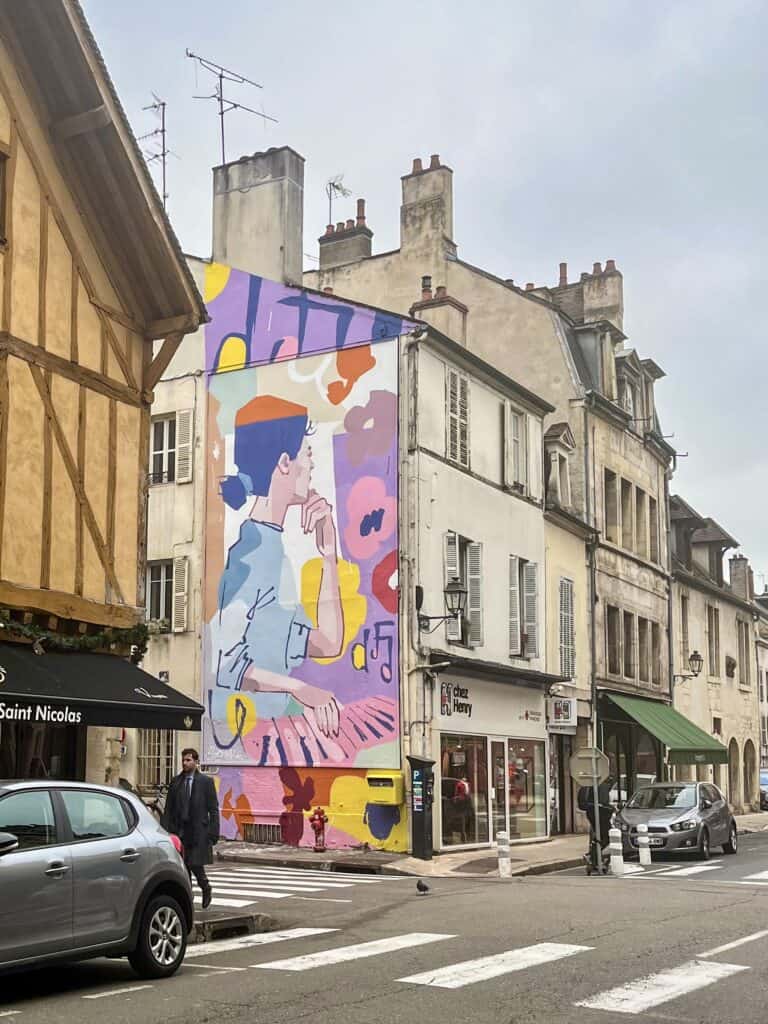
building in Dijon, France with hand painted mural

American Social Norms in France and Why They Don’t Always Translate

As children, we aren’t always taught that what is considered polite to you isn’t necessarily what is polite to another. As an American (especially one from the Midwest), I was raised with a distinct fear of being seen as rude, so when I moved to France this fear followed. It blossomed even more a few months into my new expat life when I realized that much to my surprise, what I was doing to be polite often had the opposite effect.

I did everything I had been taught to make connections, but time and time again conversations ended in tight, awkward smiles and a distinct feeling that things had not gone well despite my efforts. 

I would smile when passing someone by, and if greeted I would say bonjour and try to start a conversation with small talk on the weather or work. If you have spent much time in France maybe you can already see how this eagerness caught locals by surprise and didn’t help assimilation into the French lifestyle. 

Of course, I had been warned about the culture shock and mistranslations, but the sinking realization that I could speak the language but not communicate was heavier than anticipated. So much of what I knew to be polite at home came across as disingenuous, even tedious to my French peers. 

To be completely without cultural misunderstanding is unrealistic, but maybe knowing these social faux pas can help save you a headache or two.

General Conversation and Personal Questions

While living abroad, I found work to be a topic of conversation less welcomed in France. 

In America, work can be seen as a synonym for passion, and asking someone what they do for work is similar to asking what they’re passionate about, but in France that line is less direct. I once heard someone remark, “The French work to live and Americans live to work.” It’s a stereotype that rings true in my experience. 

When I would meet someone, one of the first questions I would ask was what they do for work. To be fair, this question is not always considered impolite, but more than once I would receive a look of someone humoring a child who didn’t know they had done something rude.

It wasn’t until I asked a coworker that they explained in France work is work and passion is passion; not inherently separate but never synonymous. So when asked what one does for a living, the underlying implication isn’t what are you passionate about? and more so, what is your social standing? which (for anyone wondering) is not polite. 

Personal Boundaries and Small Talk

Small talk is considered the necessary evil of getting to know someone in America. We ask questions to build connection, putting in effort and interest, which for many is a show of goodwill. 

However, this form of goodwill didn’t translate and more than once I caught myself outstaying the welcome of French pleasantries. I knew to say bonjour when entering a building, but I mistook this as an invitation for conversation as well, as it had been back home.  

The French show goodwill much longer after getting to know someone than Americans typically do when building a connection. They’re not the type to share as much with strangers and lack the knee-jerk reaction that Americans have to filling silence. Don’t be afraid to let silence sit, and know that most French people build relationships slowly, not through a lot of small talk. 

Performance Cues and Active Listening

Have you ever wondered why Americans do so much active listening? It wasn’t until I was comparing culture shock notes with another American expat that she brought up a conversation she had recently had with her French coworker. 

He mentioned how often Americans smile, nod, and mhmm in conversation and how silly it made them look. It’s true, active listening isn’t done as much in France, and the theories as to why we do this vary from America’s history as a country of immigration to the ever-present “corporate communication” in our daily life. In France however, the bobblehead-ness of active listening more often than not gives Americans an overly earnest appearance.

While at lunch a French friend once remarked that when we first met I had been akin to “Bambi the little deer,” wide-eyed and unsure. He credited the change to my growing confidence, but largely this difference came after I learned to converse without the constant show of attention.

Still show interest, but know the French don’t have to be convinced that you are listening to them. Additionally, know that just because a French person isn’t doing the typical actions we correlate with listening doesn’t mean they aren’t engaged.

Material Expression and Gift Giving

Even after I had finally gotten past the growing pains of forming a cross-cultural relationship, I found my way of showing politeness still tripped me up in terms of appearing overly concerned with material things and gift-giving. 

As an American, it’s often assumed the nicer (and more expensive) the item the better the sentiment. We go out of our way with housewarming events and holidays to show affection through gifts. In France however, the line between good taste and excessive wealth is much thinner. 

More than once I heard someone describe a neighbor or peer as boastful, and when asked why, they would mention something along the lines of how they only drink expensive bottles of wine, or post about fancy vacations and the expensive cars they drove.   

While gifts are still, of course, appreciated, there is more weight behind how much one might pay or “show off” in France. I once had a friend remark on the number of gifts I had given her. It was in an affectionate teasing way the French do when they like you, but it was also a reminder that something that felt so customary to me was not necessarily so for her. 

In all, it took me a while to really evaluate the type of politeness I was raised on and how Midwest manners might not mesh with the lifestyle and culture in France.

While what is polite does not always translate neatly, showing effort is at least a way to communicate that you mean well. When met with communication mishaps, that was one thing that could usually save me, and any expat will tell you all you can do is be patient and sincere in your efforts while living abroad.  

If you find yourself wanting to learn more about American vs French culture I highly recommend the book Cultural Misunderstandings: The French-American Experience by Raymonde Carroll. It’s a great resource and an interesting read filled with personal anecdotes by French anthropologist Carroll, who can possibly help explain why that interaction at the market ended so poorly.

Photo taken in Dijon, France

Did you enjoy this article? TAIP is 100% reader-supported through tipping. If you want to leave us a tip of any amount it would be highly appreciated. These tips help support our efforts to keep TAIP an ad-free environment. Just as at a cafe, the tips are split evenly among the team.

closed shutters on a Parisian building

Why Everything Closes in France in August

If you’ve ever tried to do anything administrative in France during the month of August, you’ve probably hit a wall — or a closed door. Or maybe a handwritten note taped to a window that reads, “fermeture annuelle, réouverture le 2 septembre,” or something similar. 

Most shops close down too (with the exception of many places in Paris that cater to tourists), bakers disappear, your doctor and dentist seem to vanish, and entire neighborhoods go quiet. I remember being extremely confused the first summer I moved here. Why does everything close in France in August? I wondered. 

The short answer? Vacation is sacred here. The long answer is tied to French labor laws, cultural values, and a national love of slowing down. What was once very confusing to me makes total sense and has become just one more thing about the French I admire deeply.

The History Behind August Shutdowns in France

The long-standing tradition of closing up shop in August began in the early 20th century when France introduced paid vacation leave for all workers in 1936. At first, it was only two weeks (the unfortunate truth for most Americans à nos jours), but it eventually grew to the five weeks of paid leave the majority of French employees enjoy today.

For the working class, August was the logical time to take that break. School was out, the weather was nice across most of the country, and most factories and workplaces already had reduced activity. It soon became part of the social rhythm in France, where everyone from small business owners to government workers collectively stepped away from their responsibilities and headed out of town.

Even now, many companies shut down entirely for the month. Government offices operate on reduced staff and administrative processes grind to a near halt (good luck renewing your visa in August). Again, this is something I admire so much about the French, and is something that would never happen in the US. When Americans want something done, they want it done yesterday. In France, there’s a better understanding that, actually, we are human beings, and every human being deserves a break. Wild concept, isn’t it?

Where Does Everyone Go in August?

As they should, the French love their summer exodus, and in true French fashion they even have words for it:

  • Les juilletistes: those who vacation in July
  • Les aoûtiens: those who vacation in August

August is more popular, but I also understand why some people prefer to take their vacation in July — there’s something to be said about taking a holiday before everyone else does and a few of the families I used to babysit for leaned much more juilletiste.

Many French families have long-standing vacation traditions, like returning to the same small village year after year, maisons de campagne that have been in the family for generations (surprisingly, unlike in the US, families of nearly all social standings have “country homes,” another thing that initially shocked me), and spending time with the same neighbors who may have also fled the city. For others, it’s a chance to disconnect, travel internationally, or just step away from the daily grind.

So, What Actually Closes in August?

My American brain initially really could not comprehend the idea of the majority of businesses closing in August. But, how are they okay with nothing getting done for an entire month?! I wondered constantly. Growing up in a capitalist country where the bottom line is the most important thing, this cultural norm seemed impossible. 

But, folks… it is certainly possible and the country doesn’t fall apart at the seams every summer. The real answer to what actually closes is: more than you think, but technically, not everything. 

Here’s what you can expect to be closed:

  • Independent boulangeries and patisseries
  • Pharmacies (unless it’s their turn to be the “pharmacie de garde,” or an emergency pharmacy that’s required to stay open)
  • Family-run restaurants and cafés
  • Doctors, dentists, and specialists
  • Small boutiques and bookstores
  • Many post offices, banks, and local government buildings

Again, this isn’t always the case in Paris, where tourists have forced the city to Americanize in many ways. But, in smaller towns and residential areas in larger cities, it’s not unusual to find entire streets shut down.

Here’s what tends to stay open:

  • Large supermarkets like Carrefour, Monoprix, and Franprix
  • Chain restaurants and fast food restaurants
  • Tourist attractions, museums, and monuments
  • Major transportation hubs

What This Means for Daily Life

August in France definitely requires some adjustment, but once you hop on the vacances train you’ll see it’s not that complicated. Make a note to check your favorite store windows for handwritten closure signs. Refill any necessary prescriptions early and make doctor’s appointments well in advance (or simply wait for September). And, by all means, avoid anything involving French bureaucracy until la rentrée, for your own mental sanity. 

I often learned this the hard way, but once I did, I got used to it and the August closures became another part of my normal everyday French life.

These closures are a direct reflection of how the French think about time, work, and rest. Unlike many Anglophone cultures, where rest is earned through burnout, the French see vacation as a right, not a reward. And it’s not just a week or a long weekend, it’s a true break.

What’s more, there’s no guilt attached to this rest. No pressure to stay plugged in, and certainly no Slack messages coming through. No, “I’m technically on vacation, but feel free to reach out.” A French person would never say something like that, and I really respect them for it.

As such, TAIP will also be taking our summer holidays for the rest of the month of August. We’ll resume posting regularly after la rentrée — see you all on the other side 😉

Photo by Eric Prouzet on Unsplash

Did you enjoy this article? TAIP is 100% reader-supported through tipping. If you want to leave us a tip of any amount it would be highly appreciated. These tips help support our efforts to keep TAIP an ad-free environment. Just as at a cafe, the tips are split evenly among the team.

a woman standing in front of a colorful flower shop in Paris

Living in France Changed my Relationship with Time

To be honest, I never really thought much about my relationship with time. Until I moved to France and realized just how differently they approach it in terms of, well, almost everything.

Things that have become normalized in the US, like eating lunch at your desk, sandwich in one hand, typing away with the other, working multiple jobs to make sure I had some cash to enjoy the little time off I had, squeezing in dinner before a workout, falling into bed at night from pure exhaustion… the list could go on and on. 

The addiction to the hustle and “being busy” is very real in the States. Not to say I didn’t have to hustle a little to live in France (in fact, it’s how I met Stephen originally), there’s no denying that life moves at a much faster pace for the average American compared to the average French person.

When I moved to France, suddenly I was living in a country where “urgent” rarely means what you think it does, where many shops close for lunch, and where a vacation is treated as sacred, not optional. My busy American brain didn’t know what to do with this at first, but I got used to it very quickly, and ultimately learned to absolutely adore it.

This slower pace of life is something Stephen and I talk a lot about on our YouTube channel — it seems to come up time and time again. While some aspects certainly took getting used to, we both agree how refreshing it was to have more time and space in our lives… without feeling guilty about it.

Slowing Down, Whether You Want To or Not

One of my very first culture shocks was the fact that most shops and stores are closed on Sundays, even in a massive city like Paris. Now, that has changed a bit, and nowadays you’ll be able to find at least a grocery store or two open. But it’s nothing like in the US, where things seem to be open 24/7, or at least seven days a week.

In Paris, there aren’t many shops that close for lunch, but in smaller places (even Bordeaux, which is still a pretty major city for France standards), you’ll be hard pressed to find a pharmacy or boutique open from noon to 2pm. 

Not to mention the whole country seemingly shutting down for the entire month of August. I remember being in a panic one fateful summer, when I was waiting for a very important piece of administrative documentation needed for an upcoming student visa I had to apply for. The offices at the school were closed promptly at 4pm on July 31 and I unfortunately did not have the forethought to go pick up my paperwork before then. I had my visa appointment in mid-August and quickly began to panic.

Shockingly, when I explained the issue back at the Boston consulate, they totally understood and ended up issuing my visa anyway, thanks to a few other key pieces of paperwork I did manage to get my hands on. I do NOT recommend trying to do the same, but it just goes to show that not being able to get anything administrative done in August is a cultural and accepted norm in France.

My shift toward this new concept of time didn’t happen overnight and it was extremely frustrating at first. But slowly, I got used to it and even began to lean into it myself.

Learning to ‘Be’ in a Culture That Values ‘Being’

Everything takes more time in France and they like it that way. A two-hour dinner isn’t a luxury, it’s normal. Even average, weekday dinners at my in-laws are often at least one hour long. They do not rush through meals, and it’s something I personally love about the culture.

Weekends are for friends, relaxing, long walks, and markets. Sundays are for staying at home. And five weeks of paid vacation isn’t a perk or “benefit,” it’s your right. Coffee dates aren’t 20-30 minutes long, they often span over several hours and may even turn into a meal if you time it right. It’s better to take the scenic route. It’s okay to just… sit.

There’s less competition in France too, which I think influences this attitude of “it’s okay to take your time.” I don’t think all Americans are competitive in nature, but it’s so ingrained in our culture that we don’t see the little ways it affects our everyday lives. It’s also worth noting that France is not a capitalist country. Now, if you talk to most French people, they’ll say that this is changing (no thanks to American influence), but it still is nothing compared to the consumerism-obsessed États-Unis.

As someone who grew up in the US, it’s so, so refreshing.

Now that my French husband and I are back in the States (for now), I won’t lie: it’s been difficult to keep the slow-paced French lifestyle here. There are just so many more pressures. Pressures to earn more because the cost of living, at least in our situation, is four times what it cost us to live in Paris. Pressures to have the latest and greatest car/gadget/home/clothing/electronic/etc. Pressures to keep up with everyone else around us.

But, ultimately, I am so glad to be back here with my husband because he often reminds me to slow down and lean back into the French way of life. We’re slowly but surely creating our own little pocket of France in our little beach house on the East Coast. And constantly reminding ourselves: ‘more’ doesn’t always mean happier. Because it often doesn’t.

Photo by Eliott Goutard on Unsplash

Did you enjoy this article? TAIP is 100% reader-supported through tipping. If you want to leave us a tip of any amount it would be highly appreciated. These tips help support our efforts to keep TAIP an ad-free environment. Just as at a cafe, the tips are split evenly among the team.