Contemporary Art in Paris: Galleries

The association of art and Paris is well deserved. Beyond its exceptional art museums, Paris is teeming with a plethora of galleries. 

Any type of art can be seen in Paris’ galleries, from ancient Greek statues through renaissance works to the latest contemporary performances and installations.

Contemporary art galleries serve a double function in the art world. Art dealers scout young talent whose work they feel is worthy. If they decide to represent an artist they will take on all kinds of responsibilities to help the artist grow in the art market. They will incubate these artists, support them in many ways, promote them and get their work shown and out into the public eye. They act as a middle figure between artist and collector. This approach is referred to as the primary art market, i.e. the purchaser of such a piece is the first ever owner of that piece. Often, promising artists owe their coming out thanks to some gallery. Galleries are considered to be the “primary market,” where work that is on sale comes directly from the artist. It has been said that when buying a work on the primary market the purchaser creates a relationship with artist. When buying on the secondary market (i.e. from a previous purchaser,  someone other that the artist or their gallery) the purchaser acquires an object.

Galleries are open to the public, to purchasers and visitors alike.  While, of course, catering to collectors, they also welcome visitors who are interested in taking the pulse of the status quo of art and trying to snuff out the direction the art world is headed without necessarily looking to purchase. 

It has been said that Paris’ galleries might be intimidating. Many are uncomfortable opening the door. One gallery owner on the rue Quincampoix that I spoke with after I dropped in by chance informed me that his American customers complained about (un)welcoming gallery personnel. He, of course, was the opposite: as soon as I stepped in he came over to ask me what I knew about the art and the artist, and as I knew nothing, he immediately offered to explain her technique. This is obviously a best case scenario, and in fact the most pleasant stop on my route that day. 

Some galleries cannot even be seen from the street; they might be in a courtyard such as Perrotin, Templon, Mitterand, Aline Reche … or even upstairs like Putnam. Most visitors either know what particular big-league gallery is behind what door or they have read recommendations to see the artwork and learned the address. You may even have to ring a bell to have the gallerist ring you in to the gallery or to get into a building and find your way to the gallery. Obviously it does take some art world self-assurance to ring that bell if you are not really on a buying trip, knowing that the gallerist will be paying special attention to your presence.

So what can happen when you open the door of a gallery? Dealers know that most of those who come in are not purchasers but art enthusiasts. Clearly not many people can or are willing to pay, 50 000€ (or more) for a painting, 10 000€ for a small sculpture in plastic or even 2500€ for a small work.  The basic assumption is that if you have entered, you are interested in the art and might simply be curious. Therefore, they leave you alone unless you open the conversation with a comment or a question. While all galleries exist to sell the art, they are well aware of their role to make the art they show available to be appreciated by the general public. The bigger, more important and international the gallery, the less they will notice who enters. So do step in. 

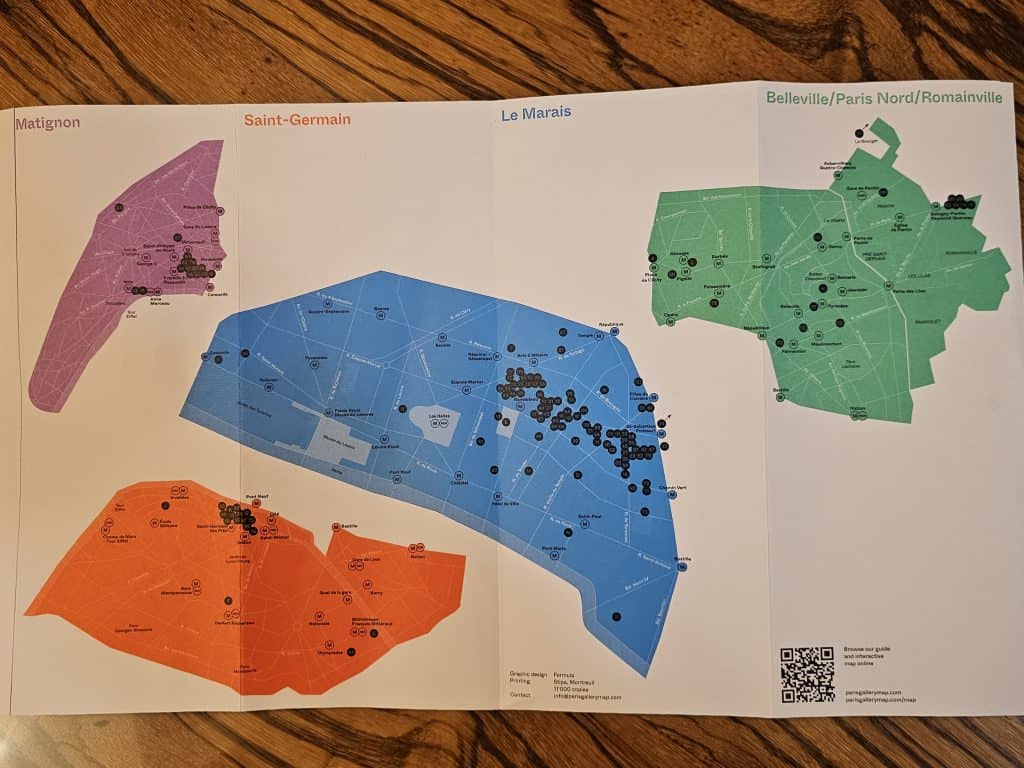
While one can always find a gallery or two in any area of the city, there are three main areas in Paris where galleries are concentrated and a fourth on the rise: the Marais (and the new Haut-Marais near the Place de la République), St Germain, Avenue Matignon and surrounding streets the east of Paris is slowly evolving. This loosely bound zone includes the Belleville area and extends beyond the ring road to Romainville and Pantin. Around Belleville the galleries are young and recently set up, showing emerging artists. Romainville presents a sort of art campus in a quadrangle with four galleries along one side, the FRAC reserve on another. The area is earmarked to become an art center. In nearby Pantin a few galleries have opened, spearheaded by the internationally famous Ropac Gallery. 

While some galleries have closed their physical space to go digital, such as the urban art gallery Sakura, and the iconic Galerie Denise Renée where kinetic art got its lift into art history, others are moving in. And, as City Hall makes parking and driving in the Marais more and more difficult, some of the largest, international galleries originally established in the Marais have opened a (or another) site around Matignon catering to collectors who want to drive to their art spree expedition and park nearby. 

Also, since Brexit, London is gradually yielding its position as the art center of Europe to Paris. Many internationally known galleries who have heretofore had bases in London, are now also opening shop in Paris. And besides these, new, emerging galleries are blooming in the city. 

It is always a pleasure to stroll in any one of these areas and to pop into the galleries to feel invigorated by communicating with the art of the day. Slash is the perfect site to help plan such a walk. The home page will offer suggestions of galleries to visit and if something strikes your fancy, check out what else there is to visit in the area and go take a turn there. Even better, look up the openings that will take place. These are typically held on Thursday evening and sometimes on Saturday afternoon. Thursday evenings can range from a crowded celebration with drinks and even sometimes nibbles, to a quiet display undistinguished from any other day.

The traditional art nexus of the Marais, near the Centre Pompidou is particularly lively where crowds throng to its cafés, restaurants, trendy shops and, of course, its eclectic mix of galleries that can be large or small,  unrenowned or prominent, French or international.  Almost all the artwork being shown is by living, sometimes well-established (or not) artists using a multitude of techniques, with highly diverse materials and in wide-ranging styles. 

The crescent-shaped Rue Debellyme has a particularly high number of galleries in a short distance including the particularly friendly Galerie Pierre-Alain Challier, the international Thaddeus Ropac and Galerie Karston Grève which has two separate spaces side by side. The small Rue Chapon is lined with many small galleries.   On the Rue de Turenne are situated some of the largest international galleries such as Perrotin and Almine Rech with David Zwirner just off on the rue Vielle du Temple. 

The international Galerie Continua, decorated in modern industrial style on Rue du Temple, is a bit of a labyrinthine affair with rooms going round and back on the ground floor and upper floor and sometimes the basement. It has a number of highly visible, internationally known artists on its roster.  Strangely, and singularly, it even boasts a small café and ice cream parlor (an easy place on your itinerary to take a pit stop) which from the front windows overshadows the fact that this is indeed an art gallery.  And the gallery continues and greatly expands its show space way out in the French countryside on two different former industrial sites in Les Moulins and Sainte-Marie. Unique in its business plan, once a year it offers a free bus excursion for an opening out to its two provincial galleries. Of a Sunday morning art enthusiasts are bussed out to Les Moulins, then around lunch time bussed from there to the Sainte-Marie site where they are served a picnic lunch. After lunch they have a couple of hours to visit the artwork and then get on a bus back to Paris. Follow the gallery on eventbrite to know of future events of this type.

Further north is what is now called the Upper Marais, a much trendier designation than “République area”, allowing galleries to psychologically annexe their location to the more fashionable Marais district. Here, an increasing number of emerging galleries are setting up shop where they can have more space at a lower rent with the advantage of a shopfront right at street level. The main streets for art exploration are the rue Béranger and rue Notre Dame de Nazareth. Also in this area, just behind the 3rd district town hall is the exhibition hall, Carreau du Temple, a complete transformation from what was once a leather goods market.  

The galleries in the St Germain area tend to be small each with its own speciality: antiques, modern, contemporary, primary … Rue de Seine has become virtually generic to refer to this gallery area. The other most gallery-laden streets of this quarter are rue des Beaux Arts, rue Guénégaud and rue Mazarine. 

Off the beaten path, and surprisingly so, but still in the sixth district, is the high-end, luxury department store, Bon Marché, which invites renowned artists to create works filling the height of its atrium space above and beyond the central escalators. The windows will also display works of the chosen artist. Artists who have exhibited in situ in this unusual space include, Ai Weiwei, Joanna Vasconcelos  Suboth Gupta, Daniel Buren… These temporary exhibits are well worth the visit to the department store, where you can also shop for (expensive) items to take back home.

The highest end of the gallery quarters is on and around the Avenue Matignon, a short walk or even just across from the Elysées Palace where the president resides. Get off the metro at Miromesnil and start down Rue Déclassé and you nave entered the golden triangle of art galleries of Paris. Galleries line the street on the left side as you head toward the Champs Elysées. One of the first is Galerie Slato-Parra which specializes in Latin American artists and is run by a very knowledgeable Venezuelan. Don’t miss her openings with the pleasure of drinks in the back courtyard on a lovely summer’s evening. The side-streets toward the left: rue Mirosmenil,  rue Penthievre, also boast numerous galleries. Most important is the Rue Faubourg St Honoré, on which is located the entrance to the Elysées Palace, with Sotheby’s right across from it. But if you are not side-tracked,  Rue Déclassé turns into Avenue Matignon with some of the  most prestigious international galleries coming to Perrotin’s three-floor gallery as you almost reach the Champs Elysées. And just before the Rond-Point is Strouk, which, although not a heavy-weight internationally, has some wonderful exhibitions. Immediately on the other side of the street is Christie’s auction house and Gagosian just around the corner on rue Ponthieu. 

The galleries in the east are far-between, and more suitable to a hike than to a short walk. But when you reach Pantin, there is a nice stroll to take along the canal on a lovely, summer day.

Most galleries have,  lying around somewhere (e.g. window-sill, floor, shelf, desk …), a free Paris Gallery Guide, which comes out four times a year and lists virtually every gallery in the main gallery areas, the artists on view, openings that are coming up and a relatively clear, colorful, coded map to find them.

So choose a gallery and an area, pick up a Gallery Guide, and enjoy  “a pleasant walk, a pleasant talk” into Paris’ gallery culture.

Photo of a Gallery Guide.

Did you enjoy this article? TAIP is 100% reader-supported through tipping. If you want to leave us a tip of any amount it would be highly appreciated. These tips help support our efforts to keep TAIP an ad-free environment. Just as at a cafe, the tips are split evenly among the team.

Contemporary Art in Paris: Institutions

Once, when I had been asked to pick up the artist wife of a film-maker for “Festival America” (a biennial fair in American literature where numerous writers are invited to present their books and literary subjects in general), she asked me about where to see contemporary art. At the time I had to think a bit and did not get back to her until a few days later. Unfortunately she no longer had time to visit. Today, some years later, I have a plethora of recommendations, because, on the one hand I have been thinking about and following contemporary art, and on the other, because there are now so many venues that cater to contemporary art today. Beginning with Paris’ contemporary art museum, Palais de Tokyo and the regional contemporary art museum, Mac/Val, there are also a number of fondations, privately owned museums and museum-like galleries as well as various structures set up to encourage talented young artists.

Palais de Tokyo, Europe’s Largest Center for Contemporary Art Today

One of the three 1937 Universal Exhibition edifices built for posterity, the Palais de Tokyo is so called because it was constructed on the then “Quai de Tokyo.” While the street is now called “Avenue de New York,” the edifice has kept its original name. 

Originally slated to become a national art museum, the Palais has, during its turbulent history, also served as the Nazi’s collection point for looted art to be stored and inventoried before its transfer to Germany. 

After the war, it finally came into its own as a national museum of modern art until 1976 at which time the art it held was removed to the new Centre National d’Art et de Culture Georges-Pompidou. Employed for various purposes then, it fell into neglect until it became earmarked in 1999 as a contemporary art museum. The architects, Anne Lacaton and Jean-Philippe Vassal gutted the site down to its bare-bones cement structure, which is how we encounter the institution today.

Palais de Tokyo is devoted to exhibiting established contemporary artists, or those who are on the cusp of becoming so. Contemporary art being what it is today, I have seen extraordinary exhibitions of artists such as Le Parc, and Saraceno, Theaster Gates…a number of forgettables, and controversial others such as Miriam Cahn’s recent exhibition with her painting, Fuck Abstraction. Typically a number of artists will be exhibited at any one time and in the basement there is an area dedicated to video art. The museum also boasts a restaurant and a bookshop. 

The museum has also been used as a discotheque and for rave parties. Thus, locked under normal conditions, can be found walls and staircases covered with fantastic spontaneously-created art. These areas can only be visited on a specially organized guided tour.

A good place to go after other museums have closed, it can be visited until late at night (22h) and even later for evenings when an exhibition first opens. An added bonus for vernissage nights is that museum entry is free and therefore should be watched for.

Another important contemporary art museum, this one outside Paris, is MAC/VAL located in Vitry-sur-Seine. While a bit way out (approximately an hour by public transportation), this relatively new building houses a very good collection of specifically French contemporary art and presents two temporary exhibits per year. If time is not of a premium, this museum (free to the public), of very high caliber, is well worth a visit.

Establishments Exhibiting Contemporary Art

There exist both public and private organizations whose objective is to exhibit the work of living artists. 

In 1982 Jack Lang, the then-Minister of Culture, set up a network of institutions, named FRAC (Fonds Régionaux d’Art Contemporain) to encourage the collection and showing of contemporary art in all of France’s regions.  The FRAC of Ile de France is located at 22 rue des Alouettes, 75019.  Admission is free and it typically offers exhibits of living, contemporary artists, both French and international. It has a second location in the new, contemporary art center in Romainville. This extension is known as “Les réserves.” Although slightly outside Paris, it can be reached by metro line 5. 

The Cent-quatre-Paris is a multipurpose art space offering contemporary art exhibits (ticket fees apply) as one of many other activities. The center includes an auditorium for lectures and performances, various restaurants, a book exchange, activities for children…and a large central space where visitors can see various groups practicing their hip-hop dance moves and sequences. 

The beautiful 13th century College des Bernardins often provides a venue for artists to create and set up installations adapting and highlighting its Cistercian architecture. Whatever the exhibition, the sheer beauty of its rows of stone pillars and gothic arches offer the visitor a moment of tranquillity and spirituality. 

To create a marketable aura and gain a reputation as a patron of the arts, various private corporations have created exhibition spaces which can be as grand as a quasi museum. The largest and most famous of these have been created by France’s art-collecting billionaires: Bernard Arnaud who heads LVMH and François Pinault.  

The former had the architect, Frank Gehry, build an architecturally fantastic structure in the likeness of a ship in Neuilly, a near-western suburb of Paris. Visiting exhibits at the Fondation Louis Vuitton means following a bit of a labyrinthine course, but the tour offers artistic and architectural wonders around every corner. When there is no special temporary exhibit on show, the walls will be hung with Arnaud’s own collection of modern and contemporary art. This Fondation is also known for its blockbuster temporary exhibits, which are a must for any art lover.

The latter renovated the former Bourse de Commerce (Paris’ old stock market building) to create a center for exhibiting contemporary art, much of which is from his personal collection. Temporary exhibits may change every quarter or semester. Here can be seen the most well-known artists of today’s contemporary art scene. Constructed in a circle around a central atrium, this building is also well worth a visit for its architecture as well as for the art. For those on a tight art budget (and who isn’t?), it is important to note that the museum is free the first Saturday evening of every month where explainers are available to offer (sometimes very necessary) insights into the exhibitions. Be sure to reserve a time slot as early as possible for these tickets go quickly.

The Cartier Foundation for Contemporary Art hosts temporary exhibits of contemporary art both on the ground floor of Jean Nouvel’s modern, light-filled, high-ceilinged rooms on its ground floor and in a more muted locale in the basement. Artists are typically already well-known internationally, such as Damien Hirst, Ron Mueck, Fabrice Hyber … Out back, there is also a lovely garden with a cafe which is a great place to spend some time on a sunny afternoon and discuss the current exhibition with friends.

Galéries Lafayette has taken over a building in the Marais to produce ever-changing temporary exhibitions in its contemporary art space, Lafayette Anticipations. Each exhibit is typically devoted to a single artist. No reservations are needed, except for their guided tours every day (except Tuesday when it is closed) at five in the afternoon; these are well-worth signing up for. 

Fondation Pernod-Ricard has moved its small art quarters near the Concorde to a spacious new building just behind the Gare St Lazare. Here they offer free entrance to temporary exhibitions of hand-picked contemporary artists. Vernissages, which are always of particular interest, are indeed open to all where Ricard cocktails flow free and freely to celebrate the event.

With an aim to promote their culture, a number of countries have reserved a space for art exhibitions in their embassies or cultural centers. Thus without leaving the city, any art enthusiast can feel the pulse of artistic creation in various nations around the world. Countries particularly engaged in presenting their contemporary art include ItalyCzech Republic, Canada, Australia, Korea

Artists’ Compounds

Then there are artists’ residences, where young artists are given a studio to work in and create. They also offer venues for these young artists to exhibit. 

In the center of Paris right on the Seine is the Cité des Arts, a complex where promising young artists have won a residency. Every Wednesday is open house from 6pm to 9pm when the general public can visit artists in their studios and see their work in progress. Every so often exhibitions are staged to display the residents’ works. In the lower level, there is a small auditorium, which offers conferences and concerts. Attached to this residence is a second compound of studios overlooking gardens located way up on Montmartre.

And far off the beaten track, in Clichy, as part of Greater Paris, an industrial site has recently been repurposed into a new artists’ residence.  Entitled Poush, it also offers visits and exhibitions to the general public, promoting the artists who are living and working there.

Les Frigos (the refrigerators) was once just that, a refrigerating edifice on the left bank of the Seine to store perishable foodstuffs until they were brought to Paris’ central market, Les Halles. Each distributor had its own refrigerator in the building. When the market was moved out of Paris to Rungis the building was abandoned no longer serving a purpose. It was then that the artists moved in, created windows, dismantled the refrigerator doors, installed plumbing and in a word, undertook all the installations necessary to make the various rooms viable and to set up work studios.  Once or twice a year Les Frigos are opened to the public to visit the studios housed behind each disabled refrigerator door.  A curious and totally unconventional art scene not to be missed.

Then there are the various open house days set up independently in different sectors of Paris and its suburbs where artists might have studios. These include, among others, areas such as Belleville, Père Lachaise, Ménilmontant, Montmartre, Glacière … most of the districts of Paris and suburbs such as Montreuil. Each neighborhood is free to decide on the dates for this type of event although typically they occur during the Spring months.

While what has become a plethora of institutions and venues offering exhibits of contemporary art, the above-mentioned list, as daunting as it might seem, is certainly not exhaustive.  It is only the beginning for a foray into the present day’s contemporary art, both French and international.

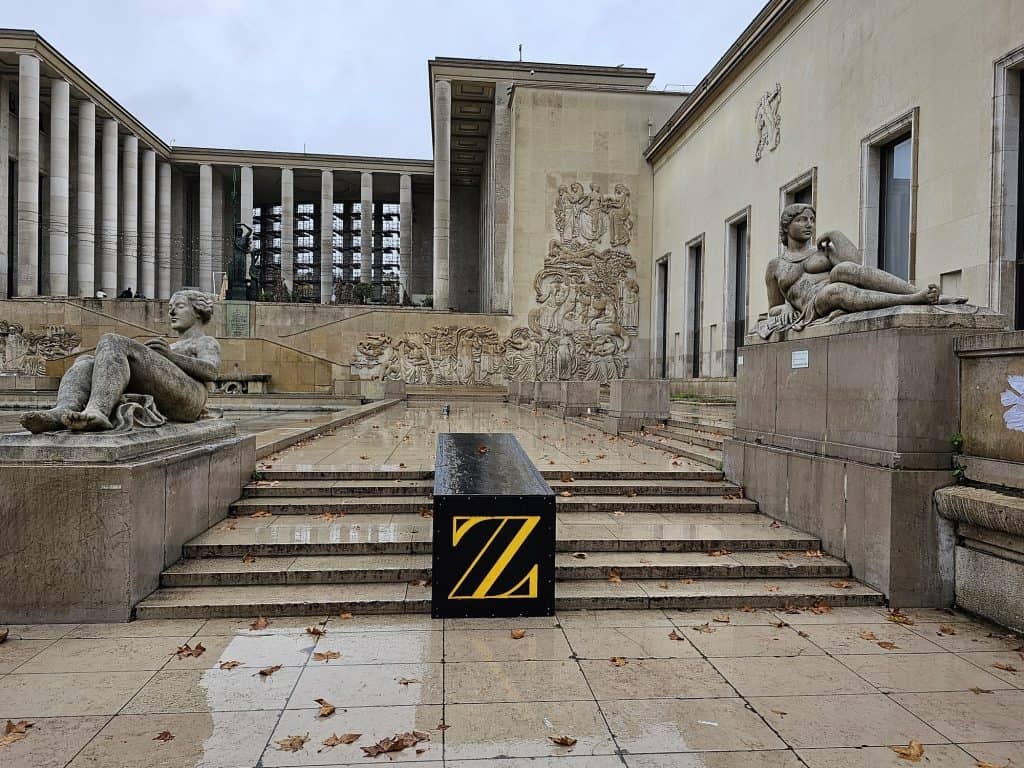
Photo taken outside the Palais de Tokyo/ Modern Art Museum in Paris.

Did you enjoy this article? TAIP is 100% reader-supported through tipping. If you want to leave us a tip of any amount it would be highly appreciated. These tips help support our efforts to keep TAIP an ad-free environment. Just as at a cafe, the tips are split evenly among the team.

students in a classroom

France’s Education Nationale

If I told a French person I would try to explain France’s Education Nationale to foreigners, they would probably reply “C’est tout un programme!” (That’s an all-out program!)  

But I will begin with a disclaimer concerning my subjectivity. With my American background and French citizenship, I obtained the much sought-after position as Maitre de Conférences (approximately associate professor) in the French university system as a teacher-trainer in English for both primary and secondary teaching. This means I was fully involved in the training system with French-born trainers and that I was among the few allowed into French classrooms to observe the teaching.

The following, then, is a contrast (not a comparison) of the two types of schooling based on my own observations of the French classroom, given my American upbringing and differences in teaching, which would seem to arise from a dissimilitude in culture.

Begin at the End

Probably, the most noticeable divergence is that the French system counts grades backwards. Middle school begins in sixième (sixth grade) and children move up to cinqième (fifth grade) quatrième (fourth grade) and so on to première (first grade) and terminal (senior year). There are three grades in kindergarten beginning age 3, petite (small), moyenne (middle) and grande (big) section, and 5 grades of primary school: CP, cours préparatoire, CE (Cours élémentaire) 1 and 2, CM 1 and 2 (Cours moyen). For much more detail on the subject of the system, there are some very good sites on internet beginning with the official French governmental site, The French Education System: Welcome to France, and many others: e.g., The French school system explained, The French Education System: A guide for expat parents, The French school system explained: 3-18 years old, just to get you started.

About three decades ago, I attended a presentation concerning education by a representative of the American Embassy. He claimed that the best American schools are better than the best French schools. However, the worst American schools are worse than the worst French schools. And I totally agree.

Curriculum Rules

Probably the reason for this is that the French system is national, whereby the American system is local. In France, the powers that be write up the national curriculum for every subject at every level that is to be taught in the schools from kindergarten (école maternelle starting at age 3) to senior year in high school (terminal). This is published every year in a journal, the Bulletin Officiel (B.O. for short). Teachers are then expected to totally follow and fulfill the directives therein. It was once said that if a child moved from Paris to Nice over the weekend, he or she when entering class on Monday would be picking up exactly where he or she had left off on Friday. The truth of this theory is, of course, open to question, but it is anchored in the French belief system about its schools.

That some states in the U.S. can decide to teach creationism rather than the theory of Darwinian evolution could never happen in France. On the other hand, teachers have their eyes on the curriculum rather than the children’s learning as they are expected to teach all and every point that might be mentioned in a particular subject, whether all the children can keep up or not. 

Emphasis in class, especially as concerns middle and high school, is subject-oriented, rather than learner-oriented. This means that children’s needs are secondary to the necessity of approaching a subject in accordance with the pedagogical material as presented in books that have been written and published in France and which religiously follow the B.O. 

The notion of learning styles and teaching styles is almost non-existent. Every subject is to be taught in a given way to everyone. And take heed, the teacher who strays from the path of prescribed teaching methods!  When the inspector comes to visit and grade the teacher in class, any deviation will be noted and cause for criticism and a bad report. 

In a course I once gave on good performance during oral exams, a student in philosophy presented an excerpt of a text by Alain concerning education. I was stunned by Alain’s notion that teachers should not attempt to make lessons amusing; the learning itself should purely be its own reward.

Brutal Learning

French schools tend to be very hard on their kids.

In another class, I asked student teachers to finish the sentence, “If you praise a child’s work, they will…” my expectation was something like “apply themselves more,” “develop self esteem,” etc. In fact, the majority of the class came up with endings of the type, “stop working.” 

Grading is based on a twenty-point system from a theoretical zero to twenty where a grade of ten is passing and anything below ten is a fail.  However the full system is not employed. Grading is not according to specific criteria, but according to an underlying social theory. No child can get a twenty, as this represents perfection, and nobody is perfect. 19 is not utilized, as this represents the teacher’s ability, and no child is ever as good as the teacher. This is how, bilingual English-French children only get 18 in English, as teachers cannot admit the children speak better than they do. 

An example of the epitome of this system was when my son was in fifth grade. The criteria for the subject of English was to be able to say things like: “It’s a book,” “It’s green, ” “My name is,” etc. He could, of course, carry on conversations with native speakers on any subject that would come up. But he only received a 19.5 for the course. This grade speaks more about the teacher than about the student.

American Discount

As another example, for a written paper my son only received a twelve, but his classmate, whose English was much less good, got a 14. When he asked the teacher why this was, she replied, “You got a twelve for being an American.” The grading system can unexpectedly become skewed to make sure students’ grades can be kept down. 

On the other hand, the grades 0, 1 and 2 are never used, as no one can be all bad.

Thus a 20-point system is reduced to 16 possibilities, emphasizing to children that they can never reach the top.

“Grading on a curve” has no translation in French and the notion is foreign and unheard of. It is not unusual for the average grade on a test to be below 10, in which the majority of the class fails the exam. Teachers take points off for any mistake, sometimes heavily, and what is left after subtraction is the student’s grade on a given test or work. Even with a high number of failures, there is no question of whether the test was too hard, or that the teacher had not sufficiently worked on the subject being tested. The test represents an ideal, and if the students do not reach this ideal, it can only be due to their inadequacy.

Brutal for Teachers and Students

Typically French teachers (and parents) go heavy on correction and negative reinforcement (in class sometimes to the extent of humiliation) and shun positive reinforcement. Very early on, children develop defense mechanisms against disapproval which makes it hard to accept correction or criticism, and they do not learn to accept compliments either, which are often considered as not possibly true.

Once, after a student teacher had given a class, I complimented her on her relationship with the children which came across as warm and benevolent. To my surprise, she burst into tears saying, “That’s the first compliment I’ve received in my full two years at the teachers college.”

Much about the system is dysfunctional. For example, teachers are supposed to have 2 years of training: the first year is to prepare them to take the licensing exam, (professor des écoles for primary school, CAPES or Agrégation for middle and high school).  The test is considered to be a “contest” (concours), where only a given number of students pass, the number to be decided upon by the needs of the school system in the given year. Everyone is ranked. Those who rank within the number of new teachers to be taken into the system will be trained the following year. Ranking then continues for those who were not accepted; this is called the liste complementaire, a sort of waiting list. It is from this waiting list, in order of rank, that substitute teachers will be taken: should a classroom teacher fall ill, one of those not good enough to be taken immediately into the system will be put in front of a class overnight to teach for the rest of the year. They will then have gained the right to be trained the year after. The pupils, however, will finish their year with an untrained substitute body in front of the class, who is doing the best they can, in a best-case scenario. 

Teachers are given tenure after a single year of internship. After that, no one can be let go, whether or not they become good teachers, not even if they become alcoholic. For 40 years, 30 students might pass through the classes of an inept teacher and it is considered that “nothing can be done.”

Promotion or movement in the system comes through a point-system, mostly based on seniority and very little on merit. Even the choice of primary school teachers who might want to specialize in English teaching and go from school-to-school rather than having a class of their own, is based on points earned, not on best competence in English. 

For all these reasons, children who have begun growing up in an American or British system will have great difficulty adapting to the strict French system of education. Even French parents, when they come back to France after bringing children up in another education system need to be aware of this and plan for their children’s support.

For those who like to think that Europe has everything figured out and America is hopelessly backward, on this particular issue they are in for a rude awakening.

Did you enjoy this article? TAIP is 100% reader-supported through tipping. If you want to leave us a tip of any amount it would be highly appreciated. These tips help support our efforts to keep TAIP an ad-free environment. Just as at a cafe, the tips are split evenly among the team.

France and the US

In Between Two Cultures: My Life as an American in France

There are those who expatriate for a determined amount of time for their work. Others decide to definitively expatriate for various reasons of their own.  And others just drift into expatriation. Some expats return to their original country; others stay on, and so on. Expatriation is not lived as a fixed state of mind. Attitudes will change as the out-of-original-country time period lengthens. 

Once upon a time, more than half a century ago, I came to France on a whim. No expectations, just a quest for a change in experience. Pete Seeger’s “Little Boxes” was not for me. Then, somehow I did not make it back to the USA for more than occasional visits from one side of the year 2000 to the other.  Given such a stretch of time, my expat experience could only evolve. 

At first, there was no question of being an expat; I was just here. And I always felt that if things got rough, I could always go back. Little did I know about the point of no-return.

In my family if you don’t know what to do with your life, you study. So I got a DEUG (the title of a 2-year degree at the time). Of course, as my stay in France lengthened, my parents wanted me back in the US. They resorted to the tough love approach of cutting me off financially. So I had to find a job. At the time, all the language schools were vying for native speakers as English teachers and I easily got jobs, even with little experience. As I finished my DEUG and still did not know what to do, I studied for a License, then a Master’s and a Doctorate. 

By this time I had developed a career as an English teacher and had slid into “expathood.” Going to the States was no longer a re-turn, but a turn. I had somehow unknowingly passed that point of no-return. Leaving France for the US or anywhere else presented the same difficulties: I would have to start a new life, make friends, find a job, housing…culture-shock in a new country, or return culture shock to an old one would be in the works.

It was too hard to go back, and not worth the bother. I was too lazy to go off to another country; I stayed on in France and made my life as an expat, but, staying in France for the duration necessarily involves adapting to different habits, attitudes, thinking. This begins by learning the language with its specific concepts of the world, e.g. the difficulty of translating the difference between gourmet and gourmand into English, and how it carves up the reality of the world, e.g. where in French an “armchair” (fauteuil) is not categorized as a “chair” (chaise). And more hazy rules and customs concerning personal space, time, body language…

Long-term living in another country necessarily changes one’s point of view and thinking about what had been culturally invisible (cf. Raymonde Carroll Cultural Misunderstandings translated from the original French Evidence Invisibles.) Knowing only one culture is like being a fish in water: it does not know it is surrounded by water. To analyze one’s own culture there must be a point of comparison/contrast with another. 

An expat comes to metaphorically sit up high on a theoretical fence looking down, where one’s original culture is on one side and the adopted culture on the other, espying the differences.

Leaving one’s country of origin for another brings up the questions of “home” and of identity. Tony Morrison’s book, Home treats the question of defining “home.” Is it a geographical location? if so, where? Is it where one has grown up, but a place that has been taken over by others where one cannot go back? Is it another place where one has been? Is it people? Is it a question of belonging?

These are the same questions an expat needs to answer to define “home.” Is it where one was brought up or where one is living at the moment? And how long has the moment lasted? Where is this person referring to when s/he says, ‘I’m going home.” 

As to the question of “identity” how does the expat identify his/herself? 

Interestingly, I still identify mainly as American, except when I am in the US! In fact, I identify by difference from whichever of the two countries I happen to be situated in at a specific moment. On the other hand, I identify with either culture when I am neither in the US or France, depending on mood, feeling, or convenience. For example, when in the Casbah of Istanbul, I was asked where I was from and answered, “France.” The merchant heard my accent, took one look at me and answered, “You’re French the same way I’m French!” I laughed in agreement and acquiesced.

In fact, the United States is my reference, but no longer my home. When someone in France speaks about walking dogs, customer service, schools, etc…I often answer with, “But in America …”

And then, if one has lived in a “new” country long enough to become a citizen of that country, can this person still be called an “expat”? They are living in the country of (one of) their citizenship(s). And if they have children born in this country, the children might have double nationality, but they are certainly not expats.  It would seem by this time the expat is no longer, but is rather a former expat gone native. I prefer the term bi-cultural.

What does it mean to be bi-cultural? What does it mean for a child to be brought up bi-culturally?  This makes for some interesting encounters, for example, in a restaurant when a waiter, wanting to be friendly and hearing my son & I speaking in English asks where WE are from. Mother & son are not FROM the same place. I’m American, but he’s French-born.

A bi-cultural is no longer either/or, but a mixture of both. How much of one, and how much of the other depends on how attached one is feeling toward one culture or the other.

After a recent long and arduous trip back to the suburbs of Chicago for a funeral, as we got close to my parents’ home, my son suddenly turned to me saying, “Mom, I’m confused.” In no state to respond, I asked, “What are you confused about?” And he replied, “When I am in France people say I’m American. When I’m in America, people say I am French. I don’t know what I am.” My immediate reply was that no one decides who you are. You decide for yourself. Secondly, it does not need to be all or nothing. It can be 50/50, 60/40, 70/30…and as I think about it now, it can even change over time.

The bi-cultural is aware of differences between their cultures and can conform with one or the other depending on where they are and who they are with. They perceive the best and the worst, as well as what is in-between, and in the end, they identify with both, to some extent. 

Thus, over time, the expat assimilates customs and mores of the second culture, metamorphosing into a bi-cultural butterfly.

Did you enjoy this article? TAIP is 100% reader-supported through tipping. If you want to leave us a tip of any amount it would be highly appreciated. These tips help support our efforts to keep TAIP an ad-free environment. Just as at a cafe, the tips are split evenly among the team.

real estate in Paris

Finding Your Dream Home in Paris Part II: Financing and Signing for Your Property

If you’ve decided to stay in Paris long term, you may become interested in owning rather than renting. In Part One of this two-part series, I outlined how to find your ideal property. 

Now, as you follow your dream of owning a piece of Paris, the next step is to start thinking about financing your new home as well as how to legally sign for it.

Step One: Choose Your Bank

Check out different banks as to their lending rates. You will want to look at their TAEG (Taux annuel effectif global) which includes various fees above and beyond the interest rate and spread over the time of the loan. Sometimes banks announce a low lending rate but then the fees bring up the cost and the TAEG. Have them print out a proposal for a repayment schedule (échéance de prêt) and simply compare the monthly mortgage offers. Remember, only a couple of tens of euros per month can bring up the total cost of the loan into the thousands.

Also, see how comfortable you are working with a particular bank. The bank will ask you to open an account with them and transfer all your banking needs to that account, i.e., income and all regular transfers. For my last acquisition, I was looking into three banks, including BanquePostale. BanquePostale had the best rate. But, when they became very picayunish as to more document demands, I decided I did not want to spend fifteen years of my financial life with them. However, I was able to use their offer to more strongly negotiate with another bank and then got a good deal from a bank I have been happy to work with since then.

Get a potential agreement from a bank(s) to know where they stand on your real-estate project. They will not sign for a loan until you come to them with a notarized pre-sales agreement. However once that is done, you will only have a short time to get the loan processed. The final negotiations with these banks, and your choice of bank, will take place typically within a month after this agreement is in hand.

Banks can be difficult in awarding loans. The budget question concerns not only how much money you already possess, but how much the banks will be willing to lend. There is a law to protect people against accumulating too much debt (loi surendettement). They must check whether you might be overextending yourself and make sure that you do not. If they do not carry out this role, they can become responsible for your loan. The rule of thumb is that the banks will only lend an amount whereby the monthly payments will not go over 30% of your income, preferably salary.

They do not want to lend to those whose incomes are unsure. They are particularly happy to loan to civil servants, as the latter cannot lose their jobs and therefore can necessarily pay off their loan as planned. They also offer loans to those who have a CDI (Contrat de duréee indeterminée, long-term, unending contract), as such a contract means the person is most likely not to lose their job. On the other hand, if you are neither a civil servant nor have a CDI, but only have a CDD (Contrat à durée déterminée, a fixed term contract) or even worse, you have a freelance job, they may not want to lend to you as they fear you might lose your job and then default. These eventualities must be worked out with the bank.

As a case in point, after three years of legal work to get permission to enlarge my house, I lost my job. Among the answers I got to queries for a bank loan, was the memorable, “Madame, come back to us when you find a job.”

Banks get cold feet and do not want to bother with repossessing your property, no matter its worth, no matter the collateral you offer. They would much rather you just pay and not make waves. It might be mentioned, too, that the law of repossession here is different from in the US. If you walk away from a loan, the bank will sell off your property. If they sell it for more than you owe, they will give you the difference. If, on the other hand, they sell it for less, you remain liable for the difference.

Another French banking difficulty is age. I have just learned that banks will only lend up to the time you are 75 years of age. This means, for example, if you need to borrow 100 000€ at age 65, you must be able to pay back the loan within ten years. Considering interest, insurance, bank fees, mortgage fees… etc. I will ballpark a figure of being capable of paying 1000€/month, and this with an income of a minimum of 3000€/month.

The bank will also try to force you into having your loan insured by them, typically at a rather high cost. Legally you can look for other insurance companies to insure your loan. If you feel the bank will refuse the loan if you do not accept their insurance policy, you might want to accept it just to be able to close, and then change your policy after a year. The law protects this right, but the banks do whatever they can to make it difficult.

Step Two: Make Sure The Bank Likes Foreigners

For Americans who might be buying with money being brought over from the United States, it would be good to discuss the question with a financial advisor, both in the US and France. By law, banks report all cash transactions that exceed $10,000 — the international money transfer reporting limit set by the IRS. This means you need to report any large sum you are bringing over both to the IRS and to the French finance ministry.

The question of foreign transfers gets even thornier in the case where the down payment might be a gift from a US parent. For example, a mother might want to gift her only son $100,000. Under US law she is allowed to gift him $15,000 tax-free per year. After that, a tax applies. 

Under French law, she can gift her son up to 100 000 € every fifteen years. In this case, although he must report this gift to the French Finance Ministry, or his tax office, there should be no French tax on the amount. Before transferring any large amount of money from one country to another be sure to get advice from a professional.

If you want a list of banks that like dealing with Americans, the comments section on this article we wrote is constantly being updated with names of banks.

Step Three: Work With a Notaire to Sign Your Real Estate Sales Acquisition

A real-estate sales acquisition must necessarily take place through the services of a notaire (real estate-inheritance lawyer). You must calculate in your budget the sum over and above the price of the property that must be paid in government taxes and notaire’s fees which are commonly combined and called frais de notaire. A good rule of thumb is to count ten percent, although it usually comes to a bit less.

Once you and the seller have agreed to the sale, the first step is to go to a notaire to sign a promesse de vente (pre-sales agreement). Once the purchase is concluded, the buyer becomes tied to the notaire until the property is no longer theirs. For this reason, it is the buyer who chooses the notaire. Get a recommendation; some do their work better than others and there is relatively little difference in the price. Remember this is a relationship that will last for better or for worse until you sell the property or your children inherit.

This agreement will include the agreed-upon price as well as the time-lapse (typically a month) that is allowed for the purchaser to get (or not) a bank loan. It will also state when the sale is to be signed. Make sure there is a clause that states that if no bank offers a loan, the sale is off at no cost to the purchaser. 

When signing the sales agreement the purchaser will leave a down payment for the seller, but the sum will stay in the hands of the notaire until the final sale is signed. The notaire will also issue you a special document to use whereby should you change your mind within seven days, you will not lose your down payment.

Step Four: Finalize The Negotiations

It is now that you will finalize the negotiations with all those banks you had talked with and make your final decision as to whom you will sign with. On my last purchase, I signed the agreement on a Friday, saw one bank that evening, another the next morning, and left for Chicago on Monday. The rest of the negotiations took place by phone (whereby I got one bright, cheerful call at 3am Chicago time!) and email. I made my final decision on my return three weeks later.

While you are getting your loan in order, the seller will be getting a diagnosis of the property including an ecological report, the final number of square meters and a geological report including whether there is/was a quarry under your building or an underground river bed, whether there are termites, various types of pollution, energy efficiency…

Other things to keep in mind as you prepare to buy: 

  • Are you buying alone? 
  • If there are two of you, are you both signing 50/50 or will the condo belong to only one of you? 
  • Who is paying, or are you both paying? 
  • What is the percentage each one is contributing to the purchase? Remember, in case of any separation the condo will be divided according to each person’s contribution as stated in the deed.

It is possible to make the purchase as an inheritance hedge. For example, you can buy in the form of what is called indivision whereby one person, typically a parent or spouse, will have exclusive use of the property (usufruit) and the other will have ownership. In this case, when the usufruitier passes away, the heir will have untaxed, complete ownership of the property.

Finally, with the bank’s agreement, you can set an appointment and return to the notaire’s for the final signature. The notaire will read aloud every bit of information they have gathered including the date of birth of the previous owner, their profession, how they got the condo, e.g. who they bought from, inherited from, or their loan. On my last acquisition, I was stupefied to learn that the owner had only had a seven-year loan to pay for the property. Those were the days!

Step Five: Pay Attention

Be sure you listen attentively to every word, as boring as it might be. There will be the yearly real estate taxes to be divided up. Now that the living tax (taxe d’habitation) has been more or less phased out, there remains taxe foncier. Normally this will be divided on a pro-rata basis, that each owner will pay the percentage of the part of that year that they owned the property. 

At my last signature, in a second week of September, the owner gracefully said she would fully pay for the taxe d’habitation of that year. I accepted the taxe foncier as of the first week of September, although we only signed on the second week, allowing for a simple division of three quarters and one quarter. It was a very pleasant signature process. The surprised notaire told us the story whereby the buyer and seller negotiated the taxes down to exact pennies.

Make sure everything that was said to be included is indeed included in the deed. For example, my ground-floor neighbor in the main building of my condo gets full use of the garden attached to the building up to the fence where my garden begins. Her exclusive use of the garden was not included in what the notaire read out, and she refused to sign until it was added. In another case, there was a mix-up of storage lockers, and the notaire held back 10 000 € until the right locker was emptied and ready for use for the new owners. Know what you are getting into. You can still refuse to sign if there is a problem that you had not been made aware of.

And now, assuming all has gone well and all the parties concerned have signed all the documents, you will simply leave the notaire’s office, keys in hand, the happy owner of a Paris property. And the rest of the story is yours.

Did you enjoy this article? TAIP is 100% reader-supported through tipping. If you want to leave us a tip of any amount it would be highly appreciated. These tips help support our efforts to keep TAIP an ad-free environment. Just as at a cafe, the tips are split evenly among the team.

your home in Paris

Finding Your Dream Home in Paris Part I: Location, Location, Location

If you’ve made the decision to stay for the long haul in Paris, you should be thinking about purchasing your primary residence. As a friend once said to me, paying rent is money thrown away. In spite of rent control, rents do keep increasing. And your landlord/lady can always ask you to leave should they want to sell the condo, house a family member, or move into the condo themselves.

Of course, finding and buying real estate in Paris is easier said than done.

Step One: Determine Your Budget

The first step of your search-and-purchase is setting a budget and deciding on an area. The latter often depends on the former, which implies possible trade-offs in comfort and size for location and price.

The size of the condo will be expressed in square meters (mètres carrés), rather than by its number of bedrooms, all rooms being considered equal. You can thus find a single-room studio condo of 30 square meters, (for a ballpark figure, I tend to multiply by ten to get the number of square feet, thus 300 square feet more or less) just as the same size condo can be divided into 2 rooms. Various sites will inform you of the average price of a square meter in the twenty arrondissements of Paris. You can start by looking here and here.

How these square meters are calculated has been regulated by the loi Carrez which was passed in 1996. It legally defines the living area (surface habitable) of a condominium apartment and must appear in the deed of sale (acte de vente). 

However, the “real” living area may be greater than the living area as defined by the loi Carrez, as it does not include any floor space under 1m80. This means, for example, any sloping roof area in a top-floor apartment, does not count until it reaches 1m80, nor does the area under a staircase until it reaches a height of 1m80. Balconies are not included in this calculation, although they do bring up the price (per square meter) as they make the property more attractive. Also, as another example, my finished basement cannot be considered in the calculation of my house’s liveable surface as the ceiling is at 1m78.

You will thus find announcements that give both loi Carrez (official) living space size and general floor space which might differ, especially for condos on the top floor. The advantage in purchasing a property with such differences is that you can find a nice condo on a top floor, for example, at a lower cost per square meter as it has a sloping ceiling. 

A friend of mine has a wonderful, bright, single-room studio with few square meters according to the loi Carrez, but in fact, has a second floor with a sloping ceiling which serves as a bedroom and bathroom making it into a quasi two-room apartment.

There are, of course, disadvantages. If you ever want to rent out the condo, it is only the square meters according to the loi Carrez that can be taken into account for the Paris rent-control price. Also, you cannot rent out a condo that is smaller than nine square meters according to the loi Carrez, no matter how much floor space there is.

It is to be noted, too, that normally a surveyor has calculated the exact number of square meters in a given condo and this number will be transcribed in the sales deed. You can, once you move in, call in your own surveyor if you believe there is an error in the calculation. If it is found that the condo is more than five percent smaller than the declared surface on the sales deed, you can ask to get a refund for the difference.

Step Two: Determine Where You Want To Live

Check out the average price/square meter in the area you are looking to know in advance if your budget is realistic for the size of the apartment you are looking for. If not, which is more important, location or size? A two-room apartment (i.e. one-bedroom) in the center of Paris, or a three-room apartment in the much less trendy east? Who inhabits the area? Will you be comfortable there? 

An area can differ from one street to another. I was looking for a studio in the 2nd arrondissement and got a call from an agency. He asked if I knew the rue Blondel. No, I didn’t. “There are prostitutes plying their trade there; is that OK with you?” “No thanks, I won’t visit,” even though the price was right. I’m not particularly bothered by prostitutes, but the johns and pimps that accompany them make me uncomfortable.

Visit all the real estate agencies in the area. Get on their lists to be called when something that responds to your criteria comes in. Check online. Agencies advertise on SeLoger, Logic-Immo, and others.

Particulier à Particulier is a site where owners put up their real estate for sale without going through an agency. This is how I found my last purchase, un perle rare (a rare pearl), a French expression for something exceptional: a large studio at a price much lower than the average market price per square meter for the area located in the 100-meter long street that I’d fallen in love with. I badgered the poor seller every evening to get her to let me visit as soon as possible and got myself first in line. After a year of real-estate hunting (the average search time), I knew the prices, knew what I wanted, and neither hesitated nor negotiated and said I’d take it!

Step Three: Get Specific

To save time in your search, when you visit an agency or get a call, ask basic questions beyond the price: 

  • How many square meters is the apartment? Divide the price by the number of square meters and you will get the price/square meter. 
  • What floor is it on? 
  • Is there a lift? 
  • What’s the height of the ceiling? Some ceilings are particularly low; others might be comfortably high. The average is about 2m50. 
  • Is the toilet electric or not? Non-electric toilets are called sani-broyeur. Some toilets have been added to apartments where there are no special toilet pipes and therefore whatever goes in must be ground down. Such a toilet is fragile and always needs changing sooner or later and becomes costly in the long run.

There are various differences in condos to keep in mind. The idea of a “penthouse” is inexistent in Paris. The étage noble (the grand floor, the most opulent of old buildings) is usually the first floor (the one above the ground floor, the second floor in the US) with higher ceilings than the rest of the building, but also more expensive. Top floors, in fact, can be very hot in summer and cold in winter, and usually have sloping ceilings. Ground floors are easy for robbers to get into, tend to be noisier and dirtier from the street, but again, cheaper.

Lift or no lift? It depends on how high your floor is. 5th-floor walk-ups are not uncommon, but less expensive than other floors or apartments that have an elevator. No matter what floor you live on, later you will pay co-owners dues on the lift if there is one.

It is always recommended to ask to see the minutes of the last meeting of the co-owners association (procès-verbal d’assemblée générale) and a copy of the last year’s fees (appels de fonds et de charges). The latter documents will inform you of the approximate yearly cost you will have to pay once you acquire the property. The former will inform you if there are any difficulties within the co-owners association, whether the co-owner selling the property is up to date on their dues, and whether there are any works that have been voted on that you will have to pay for once the property is yours. 

Not looking over these documents may mean you are in for some bad surprises, e.g., animosities among the co-owners making it difficult to get important works done and then paying for them. After moving in I found a wall of my house was separating from the rest of the construction and I had to take both the co-owners association and the contractors next door to court (a two-year process which I won and got everything fixed and all has been well ever since). 

Friends have found an electricity bill that was never paid whereby the new owners cannot get electricity until they can come to an agreement with the utility company. Check, too, the cost of yearly real-estate tax, (taxe fonciere) which you will probably find surprisingly low as compared to US real estate taxes. As a comparison, I pay about 10% of the real estate tax for a similar property in the Chicago area. In fact, Paris real estate taxes tend to be lower than those in other parts of France, as companies pay a good proportion of Paris’ real estate tax. However, our present mayor, Anne Hidalgo has been overspending and this reflects in a yearly rise in the Paris tax bill.

On the other hand, if you find what you believe is your dream property that many others are clamoring for, it can be worth taking the chance (cf. above, my last acquisition) of not looking into these financial questions. I have friends who had seen a condo, checked all the papers, negotiated the price and just before signing the pre-sales agreement, the owner found another purchaser. They finally did buy another condo, but continued to regret the one that got away.

“Seek and Ye Shall Find”

Searching for just the right place to call your own can be exciting, frustrating, long, and time-consuming. But think of it as an adventure as you learn about all the unbelievably different types of living spaces that can be found in Paris. And until you find THE one, consider it a way of learning about this city that you have elected to become home.

In the next article we’ll discuss the financial paperwork necessary to close your real estate deal.

Photo by Isaiah Bekkers on Unsplash

Did you enjoy this article? TAIP is 100% reader-supported through tipping. If you want to leave us a tip of any amount it would be highly appreciated. These tips help support our efforts to keep TAIP an ad-free environment. Just as at a cafe, the tips are split evenly among the team.
Enlarging a Condo in Paris

As the owner of a condominium in Paris, have you ever wanted to figure out how to get more space without moving out? 

There are various ways this can be done. For example, you can try to buy the unused attic area of a building if you live on the top floor, in which way you can create an extra floor under the roof. Or you might try to buy a piece of a hallway attached to your condominium that is unused by other owners to add square meters to your living space. In a condominium context, and particularly in Paris and France, the key word here is try. And with luck, patience, euros, and most of all the goodwill of the other owners, you’ll succeed. 

How does this work? First of all you’ll need an architect and a surveyor to measure the exact number of square meters you want to transform from common ownership to private ownership.  Then the owners’ association must vote unanimously to sell you the desired square meters and, of course, set a price. Once this is accepted, the buyer will pay for those square meters, all the renovations, the legal fees of the purchase, and for the cost of changing the co-ownership regulations. The new regulations will now include a new private lot equivalent to the purchased square meters. The owner will then have a higher percentage than before of the general condominium and will thus pay more in condominium association dues forever after.  

My case is relatively rare: I live in one of the 3,500 houses that still exist in Paris. And fewer still are condominium houses typically located in a courtyard behind a street side apartment building. 

What I originally bought was a small, two-room house (more a cottage than a house) behind a four-story building: about 50 square meters of living space with a small living room, kitchen, and WC on the ground floor and a bedroom and bathroom (no WC) above those rooms on the second floor. There is a basement below, but the best of all was the 75 square meter garden, facing south toward other gardens and all that at 100 meters from a metro station within Paris boundaries. 

Condominium housing normally is divided into “parties communes,” belonging to the condominium as a whole, and “parties privatives,” belonging to a specific condominium lot. However there is a third possibility for some spaces which are considered to belong to the condominium as a whole, but whose use is attached to only one private lot. This is the case of my garden: it is mine to enjoy exclusively, but does not belong to me. 

Making Changes

While I lived alone in the house, the two rooms were sufficient for my needs. However, when my son was born, space became tight. My first course of action was to make use of the empty stairwell where I had someone come in and create a two-part deck, each 120 x 120 cm: the lower part would contain the crib and a little standing space; on the higher one I had a dresser built in.  

This was a perfect temporary solution, but I knew there would come a time when the baby would outgrow this space. To plan for the future three options presented themselves:

  1. sell the house and buy a condominium apartment in Paris
  2. sell the house in Paris and buy a house in the suburbs
  3. enlarge the house

Options 1 and 2 held no appeal for me, so I went for (what I didn’t know at the time was) the most challenging one, door number three.

Probably, had I known what I was up against, I would have given up before starting. But I was only ever informed of each step as it came up. And no single step was unsurmountable, although the whole process would easily have seemed so. 

Find Your Architect

The first step was finding someone to help me with design. After speaking with one architect and then another, I finally found one who was (somewhat) interested in the project and got started with him. He was not the best, I was to learn in hindsight, and one more interested in the Van Gogh museum for which he’d been retained by the State than in my little enlargement. I was later to find that he and his maître d’oeuvre (the overseer of the project to try and put it simply) were padding my estimate in unnecessary ways, akin to a government contract. 

Before accepting the project, he sent me off to the Paris urban planning office (Centre d’information, de Documentation et d’Exposition d’Urbanisme et d’Architecture de Paris et de la Métropole parisienne). In this building, where free exhibitions concerning Paris architecture often take place, and which is easily reached by metro Sully-Morland, I wandered a bit. Most of the offices were empty due to it being an extended weekend in May. However I did encounter a relatively relaxed city architect who, when hearing of my project responded, “If that is your dream, go ahead.” And this I reported back to the architect. 

Find Your Limitations

Next you’ll need to learn about all the constraints that Paris urban planning will set on the construction. In this case, I was required to be set back a minimum twenty meters from the street, and could build no higher than eight meters (on account of the building situated behind the house). My criteria was that the new wing would look as if it had been built with the original house, and when moving around within the house I would not feel as if I were going into a different building.  

In agreement with all these criteria, a plan was drafted by the architect which included the contractor he wanted to work with. Because the ground floor of the original house is raised, this height unfortunately did not allow for two floors in the new wing. While the architect was only going to give me a single room of normal height, I told him that if the urbanisme allows up to eight meters, I wanted eight meters. I would decide how to fill the space of the cathedral ceiling later.  

As he could not figure out how to attach the new wing to the original house owing to a very complicated roofing pattern, he decided to simply attach the wing at ground level, and leave a  balcony upstairs with a skylight over what would become the dining room.  

These plans were then submitted to Paris urban planning and he did what he had to do to get the proposal accepted. I have heard there was a lunch involved, which can be a solution to quite a few problems with bureaucracy in France.

Put It to a Vote

Once accepted, the plans had to be voted on with the owners’ committee and the price for the land the wing would be built on had to be negotiated. I probably could have negotiated better and saved a bit of money, but no one helped and it was me against the rest of the owners. The important point is that the vote came out in my favor and I could move on with the official purchase of the land at the notary’s and the construction.  

It so happened that before signing on with the contractor, my central heater broke down. A friend whose father had worked at a company making central heaters recommended what I should get. I ordered the heater and water heater he recommended.

However to finish the installation, an electrician needed to come by. As I was about to work with a contractor, I asked him to send someone to take care of it without asking for an estimate. Big mistake. When the invoice came in I had been billed at the price of three hours for the work of a full-fledged engineer and not just an electrician. This got me wondering as to the billing for the enlargement. 

Lucky for me, by chance I met an architect who recommended a contractor. I gave him a copy of my estimate, minus costs, and had him fill in his prices. The result was about a third less than the architect’s contractor

Final Meeting

Not long after we had a meeting at my house for the final signature. Being a lone woman, and knowing I would be at a disadvantage with these people, I had a male friend come in a back me up.  First I attacked the price of their electrician, whereby they immediately accepted the average price for the work. Then I presented the second estimate. Both contractor and architect noted immediately it was exactly the same work (minus details like setting up a pre-fab temporary housing for the workers in the street — after all I said they could change in my house and use the bathroom!). Both architect and contractor refused the lower price and withdrew from the job.  

This left me as my own “maître d’oeuvre” in spite of my knowing little about architecture. Not really the best state of affairs. But who knew? 

At this point, approximately four years after the enlargement was simply a glint in the back of my eye, the construction of the wing began while I continued to live in the main house. This wasn’t a problem while the foundation was being dug, the walls built up, and the roof was laid on both old and new structure. But when

  • the old oak, ironwork, and glass door and the oculus window were to be repositioned into their new frames, and
  • the kitchen window was to become the opening into what would be a small dining area, and 
  • a door was to be created onto the new balcony 

we began living with the dust and dirt of these transformations and the interior work.

Get Me an Estimate

And there were those changes in plans that needed to be estimated and negotiated.

“Only a two-meter window in the room? No, I want three meters.” “That will cost you,” said the contractor. “OK, get me an estimate.”

The electrician found antique 1930’s textile-covered wiring in the original house. “Spaghetti!” he called it. And you cannot put new wiring on old; all the wiring had to be redone. “OK, get me an estimate.”

I wanted a second toilet room to be put in upstairs as they built the balcony. “Costly” said the contractor. “Get me an estimate.”  

Then the neighbors next door did not want to look onto a blind cement wall, “Please put in face brick. And do something to break it up.” Again I turned to the contractor, “Get me an estimate.”

We decided on putting in a meter of glass brick to break up the wall. But, it was only sold in two square-meter boxes. What to do? “Put it all in!” And so, I now have light streaming in through two square meters of glass brick on my south wall.  

Mistakes

When I gave the brand name “Acova” for the radiators, the contractor said we could get others that were less expensive and “the same”. Not really; I had to change radiators down the line. 

For the tile in the toilet room, the contractor handed me a single type of tile and said to choose the color I wanted. I should have gone to a tile place and chosen from all the existing possibilities. 

Four years for administrative work, four months for construction. Time for a house-warming party in the totally empty new wing and to begin living in the enlarged house. 

Was the work finished? Not by a long shot. 

More to Do

When I went to install a new fitted kitchen, and all had been removed, the plaster was found to be humid and failing. Taking out all the plasterboard down to the beams, we discovered a crack in the “party wall” of the house, the wall that separates our condominium property with the one next door.  

According to law, this wall does not belong to me, but is part of the common property of the condominium as a whole. That meant calling in the insurance experts and getting the co-owners to accept the estimate for repairs. These were three months my five-year-old and I spent with no kitchen at all, just a refrigerator and microwave in the new living room. Dishes were done in the sink upstairs.

Later the ceiling under the new balcony began leaking. I called in the contractor to fix it. He never did get it repaired. We found that in fact, he had never put in water-proofing, so where the cement met the wall, water came through. Meanwhile, his company filed for bankruptcy.

After putting up with two years of leaking while I worked to get a decent estimate to waterproof the balcony (no roofing companies want to do the small stuff of an eight-square-meter roof) I got the roofers doing the new building across the street to write up a detailed four-page estimate of the work. I signed.

But the roof began leaking again because of faulty workmanship. I refused to pay and had to sue the company before I could bring in another roofer. Two years later, the roofing finally got done correctly and I have had no problems ever since. “Jamais deux sans trois” (Never two without a third) as the French say. I continue to keep my fingers crossed every time it rains. 

And only recently I learned that the contractor had cut corners on the flashing on the roof, literally. His lead flashing was too narrow and was not even of a minimum regulation width. With humidity entering the roofing and the prospect of leaks, I have just had the flashing changed.  

What About the Ceiling?

Then there was the high cathedral ceiling. My plans were clear; I would get a cabinetmaker friend to build a deck that would become my office. The challenge was to create a floor that looked good both from above and below. He did a beautiful job using a mix of oak and maple wood for the deck and the shelves. Happy and ready to install my computer equipment, I suddenly realized there was no electricity up there. You know the score by now: recommendations and estimates to bring the electricity to that floor. 

One contractor who came around looked up and said, “If I were you I would put in a skylight, too.”  Wow, what an idea! And so, estimates for a skylight were called in. Today I work in a light-filled “eyrie,” as a friend calls my office. 

Almost “Done”

Over time I have had other work done: I had stained glass created for my oculus window as well as for my door.

My son’s room needed to be rewired because after 40 years in this house, we only just discovered the electricity was not grounded.

I’ve put in air-conditioning.

I have had the wooden stairs leading to the basement removed to be replaced by cement, as I could not get rid of the woodworm that had set in.  

Big stuff, small stuff, a house remains forever a work-in-progress. But more importantly, as other authors have often shared on the blog, it’s about the willpower to complete a project paired with the patience to put up with the lunacy of how building works in a country like France and a city like Paris compared to how it can in America.

Still and all, it was worth it, and my friends love the “garden parties” they can attend with me without having to leave the city.

Photo is the home as seen from the entrance to the garden. The building on the right is the “addition.”

Did you enjoy this article? TAIP is 100% reader-supported through tipping. If you want to leave us a tip of any amount it would be highly appreciated. These tips help support our efforts to keep TAIP an ad-free environment. Just as at a cafe, the tips are split evenly among the team.

collector car

How to Get the Collectors’ Car Status in France

I first met Marlene some years ago when she started coming to my Paris Shakespeare Project. We’ve since become good friends and recently were in Stratford-on-Avon together to take in a couple of plays from the Bard at the Royal Shakespeare Company. This non-Shakespearean article is her first one for TAIP, though her fifty years here in France dwarfs that of any of our other writers, and I hope she will continue to write many more for us. This article illustrates that even when you’ve lived in France for fifty years, you may have to literally scale fences to get French bureaucracy to work for you. -SH

As you drive out of the car dealer’s in your shiny, brand-new car, do you wonder how long until it will seem to be getting old? When does it become an old wreck and when, by magic, will it become a collector’s item worth more than you originally paid for it, inflation notwithstanding? 

Cars lose 20-25% of their value after the first year, and continue dwindling every year thereafter.

There exists in France what once was a magazine and has now become an internet site called L’Argus, analogous to what Americans know as the Kelley Blue Book. Since its inception in 1927, it gives an average/fair price for a second-hand car according to make, model, age, and condition. All negotiations for buying and selling a used car begin with the Argus. A new car dealer may offer “the Argus + 10%” as a trade-in incentive for an old car. A car with fewer than the average 10,000 km/year on the meter should be worth “more than the Argus.” Insurance companies reimburse the Argus value (and no more!) in case of an accident. During WW2 the French government used the Argus value to determine how much an owner would receive if their car was requisitioned.

Obviously, as a car gets older its Argus value declines until at 15 years of age it slides off the charts. At this point insurance companies will give nothing for it in case of an accident, or a nominal sum as junk-yard material.

My Peugeot

So consider the case of my beloved Peugeot 205. I bought it when my son was born with basic criteria: automatic, 4-door, small enough to park in Paris (a survival criterium), yet comfortable enough for travel. With no second thoughts concerning its age on one occasion I drove from Paris to the boot of Italy with my two 7-year-olds: car and son. No disasters occurred.

As the car aged (along with my son and myself) there was no reason to change. I drove it less and less as Paris traffic and parking became worse and worse and my preferred travelling means was by train and plane. The car became a simple convenience to do twice-a-month shopping. I get it tuned up every two years according to French law and have bought a parking place for it in the garage across the street where it sleeps mostly collecting dust, getting washed only every few years. I figured there was no reason to get a new car as this one works and responds to my few needs. 

However, with the recent ban on old cars in Paris during work hours, I was awakened to a conundrum: I have a perfectly functional car that suits me, with less than 90,000 km on the dial, whose use has become restricted; what should I do? Living near the Paris borders and only using the car for short runs to the supermarket, I did as all the French do and depended on “tolerance” in the law: If I got stopped by the police I would look them sadly in the eye and say, “I’m so sorry officer, but at my age what do I want with a new car to do my once-a-month shopping?” So far I’ve never been stopped for the age of my car and haven’t been able to try out my line.

Solution

But a new solution eventually came to light. If the car is declared a collectible, it can be driven anywhere, anytime. The other perks of this denomination are that it must pass a compulsory vehicle inspection every five years instead of two, and, wonder of wonders, the cost of insurance goes down, even as the value of the car goes up!

In a country where every aspect of life is regulated from cradle to grave and everything in-between (my father once asked, “Don’t they let you breathe over there?”) car collectability is not neglected. Only in France, does a car become a collector’s item through the government administration whether the collectors are out there or not!

A car becomes eligible as a collector’s vehicle at 30 years old. However, this is not automatic. Interestingly, before the administration will even consider a car as a collectable the government depends on its being vetted by a private organisation, the Fédération Française des Vehicule d’Epoque (FFVE). This association pools together 1,300 vintage vehicle clubs and museums in France. But the private process smacks very much of government bureaucracy and includes filling in an application form identifying the car in detail: make, model, series, color, weight, horsepower, license number, ownership history …sending copies of the owner’s ID, insurance card, registration (carte grise) … and hardest of all, enclosing five pictures of the car from front, back, sides, inside. For a car that hadn’t been washed in five years, this was the most burdensome! 

Car Wash + Attestation

So off we went to a high-end car wash to get her spruced up for her photo session. Do we only want her hand-cleaned inside and out (60 €) or the full works: cleaning, polishing, simonizing…for big bucks and three days of work (they said). I was promised the car would look like new. And what’s a couple hundred euros spread over 31 years, and for a good cause? To their credit, the car did look like new. They had even fixed up some spots with paint I gave them, and vacuumed the area under the hatchback seats, which hadn’t been touched since I had bought the car. They even filled out the complicated application form for me and took the pictures. 

This being done, I could finally start unwinding the first strand of red tape leading down the road to collectability. The copies, photos, and forms could be sent, snail mail no less, to be scrutinized as to whether my little old sub-compact was collectable material.

Six weeks later I received the coveted “Attestation pour l’obtention d’un certificat d’immatriculation vehicule de collection,” the key idea being that it only certifies that the former jalopy is now worthy of collectable status, but that obtaining that status can only come from the powers that be. 

ANTS

The next, but first official administrative step, toward collectable status, is to contact ANTS (Agence nationale des titres sécurisés), the national highway safety department, a sub-department of the Préfecture de Police, the central administration of any given département (French province). The prequel to using the online services of the ANTS is to create a France Connect identity. According to the official government site, France Connect:

“simplifies all governmental procedures. It is the solution offered by the State to simplify one’s connection to more than 1,000 services online. Save time. Keep your information secure. You no longer need to create new accounts.” (my translation) 

This waits to be seen. Not to mention that this might be a way for government agencies to collate information on a single person.

France Connect Hurdles

To create a France Connect account, you need to already have (prequel to the prequel?) an online account with either the Post Office, the Income Tax Bureau, or the French National Health (Sécurité Sociale whose online designation is Améli). In my particular case, one that falls through the cracks, the Post Office sent me on a vicious Sartrean circle with no exit whereby when I filled in my email but clicked on “forgot your password,” I received a message saying the account did not exist. On the other hand when I tried to create an account, I was informed that the email address belonged to an existing account. No solution for France Connect there. 

When I did the same on my income tax account, the problem was that they sent the mail allowing me to change my password to an email account that had been closed 3 years earlier. Thus there was no way for me to receive a password to enter my account.

Thirdly, as my National Health ID is affiliated with the National Education Health platform, I have no Ameli account and thus I am not part of the general Sécurité Sociale.

Meanwhile, at each aborted try, I sent a mail to the France Connect help site, but never, ever received an answer. All requests for help fell into some dead-letter box. 

Totally frustrated, I headed to my local town hall for help. Once upon a time, before the government services went to the internet, it was there that car registration was effected. But no longer; all the help I got was a sheet of telephone numbers, with the one for the Préfecture de Paris where I could ask for help.

To my surprise, after going through various boxes and numbers, a real person answered and set up an appointment for me to go in to take care of my ANTS (without France Connect).

Scaling the Police Station’s Fence (Seriously!)

The following week I was right on time outside the Préfecture de Police, a modern unassuming building with a small fence around the stairs down into the entrance. However the gate was locked and there was no bell to ring. After going around looking for a “real” entrance, this seemed to be the only one. As it was getting late, and I saw no other solution in spite of my fear of being bawled out by the police, but to clamber over the fence and start down the stairs. As I entered the building, the receptionist looked up. When I tried to excuse myself and explain the difficulty, he answered, yes, the electronic lock was out of order, and scaling the fence is the only way to enter.

All went well when I found the person to take care of my ANTS account. I had brought over reams of documents, well above and beyond the few I had been told to take, and I was right. Otherwise, we would have got nothing done. Experience had taught me that one brings to the French administration every document we think might possibly be needed, not only the few we are told to bring. 

I was given a receipt of my application and sent off with the recommendation to get my France Connect account in order at the Income Tax Bureau.

The Ministry of Finance

Next morning, still running on my administrative momentum I showed up at my income tax bureau which was operating under strict Covid regulations: a two-meter fence barricaded all approach to the door. All visitors had to wait for a guard to come to the security barrier who then asked the reason for our being there before letting us into the front courtyard of the building where we lined up outdoors in freezing weather a meter away from the next in line. Should two clients approach each other to chat, we were quickly brought into line (literally) to heed the mandatory distance. 

As we waited outside in the cold, apparently so as not to catch Covid, nothing prevented our catching pneumonia!

About a half-hour later I was allowed to enter the building and remain standing in line as the chairs of the waiting room had all been pushed into a corner with barricade tape extended over the lot. 

When my turn finally came I found myself in front of an unexpectedly friendly and competent representative who quickly got my France Connect account set up and with whom I had an interesting exchange on the names of punctuation marks in English and in French as I wanted to include some in my password.

Back at the ANTS site, France Connect got me into my account and after scrounging around (more like scuba-diving than surfing) I found the coveted Certificat Provisoire d’Immatriculation (Temporary automobile registration certificate) which I printed out. And only a couple of days later, the permanent carte grise arrived by registered mail. 

Still More to Do!

My old license plate number had been stricken from the books and my car now had its new (collectable!) registration number. But what now, if I am stopped by the police? My car is still sporting the old plate numbers, but it is registered with another number. Obviously I had to get new plates. 

So I called my garage to get the black back-grounded plates for collectable cars. The head mechanic, did not seem to know what I was talking about and suggested I just bring the car in. This left me quite doubtful as to the results. So I called other garages to find no one in Paris to create these rare plates. Thus, it was back to the internet. 

There I found a few sites that specialize in these plates, one in Spain and a few in France. I finally chose the Rebel Car site, located in France, where all I had to do was type in the brand, the type of car, and the date and they came up with the exact size of plates to fit my car. I even had a small choice of fonts & whether I wanted hyphens or not between numbers. Of course I had to include a copy of my car registration certificate with the order. Less than a week later, within minutes and between more major repairs on other cars, my auto mechanic had secured my bright black plates announcing to the world that this car was a collectible!

Insurance, Too!

Lucky for me this had all taken place at the end of the year, for then I received my insurance sticker for the car. No rest for the wicked, I still had not completed the changeover. Now the insurance had to be modified, beginning by changing the registration number, as well as the description of the car, i.e., as a collectable. 

As the car is insured by my bank, lucky for me, my banker also has a “young-timer” (the French expression to refer to a vintage car that is not yet an antique) and we had a pleasant conversation on the joys of belonging to the young-timer community in France. Besides, he knows all about the special insurance, with the great finding that the cost of my insurance policy for a collectable is 1/3 of that for an older car.

Four months after beginning the procedure, the old jalopy has metamorphosed into a black-licensed, rare collectable that hordes of drivers can (enviously?) contemplate when I drive my privileged son to the airport. 

Photo is of the car with the new “fancy” collector’s license plate.

Did you enjoy this article? TAIP is 100% reader-supported through tipping. If you want to leave us a tip of any amount it would be highly appreciated. These tips help support our efforts to keep TAIP an ad-free environment. Just as at a cafe, the tips are split evenly among the team.