What It’s Like Living In The “Worst” Part Of Paris

It’s no secret that finding an apartment is difficult in Paris. People don’t realize how small this city is. For comparison, London is 600 square miles while Paris is 40 square miles. Consider this, and then remember how much space is used for parks, hotels, shops, etc. There’s limited space, so when it’s time to search for a place to live, there are limited options. This is the reality, so have reasonable expectations when getting on your feet here.

The Dossier

If you’re unfamiliar, the French require a dossier (and a weighty one at that) for every apartment you apply for. To put into context the peculiarity of the French dossier, the first application I submitted was rejected because of the kind of work contract I have, which is a freelance contract. My employer even called the agent to explain and verify my contract, but it was to no avail. It stated indefinite work and my salary, but simply because it wasn’t a CDI, they found it “too complicated” to accept my file.

In brief, a dossier contains:

1) valid ID

2) visa

3) the last year’s tax documents (the more taxes you pay, the more money you make)

4) work contract

5) last three months of payslips

6) a garant

7) last three quittances de loyer

8) RIB of your French bank account

My Lack Thereof

I knew that my situation on paper wasn’t as strong as others applying for the same apartments. Landlords (understandably) favor French citizens over foreigners, and at the time, I didn’t even have a French bank account.

Basically, I was working with:

1) valid ID

2) visa

3) work contract (remember, freelance!)

4) tax documents from a year when I was hardly working

5) three months of payslips when I was, again, hardly working

I was missing integral parts of my file like a RIB, a guarantor, and proof of income. My options were even more limited than the average flat seeker.

Desperate Times Call For Desperate Measures

After some weeks went by without success on PAP.fr, I asked a friend if she knew anyone who had an apartment to rent. This question can seem nervy to some, but if you’re familiar with the “Aladdin Factor,” you can’t get what you don’t ask for. To my surprise, she actually did know someone, and I called that person up the moment her contact was sent to me. She happened to be a realtor who works for an agency that specializes in renting apartments to foreigners. It turned out the apartment in question was her own, thus allowing us to forgo agency fees and conclude a private contract.

I should mention that her willingness to rent to me came from the fact that she herself was once a foreigner getting on her feet in this city. The day we met, she was explaining how hard it was to get all the paperwork in order for a proper dossier when she first moved here. She was kind and understanding of my situation because of our shared experience. Once we signed the contract, I was then given the keys and promptly sent her my deposit. It was an accomplishment for someone in my shoes.

Wonderful, But Weird

The apartment is bright and clean and in a building with kind neighbors. I usually have plans in the evenings, but they frequently have apéros which I’m always welcome to join. They even included me in their building group chat when I first moved in.

When I began telling my friends and colleagues about the apartment, they were happy for me, until I told them which métro stop I lived on. My boss told me, “I have one rule for myself. I never go to La Chappelle or Goutte D’Or. You can’t move there.” I have a good friend who grew up in Montmartre, which is not far from me at all, who explained there are a few good streets and my apartment just so happened to be on one of them. The area is “un quartier populaire” which frankly I haven’t found a good translation for. It’s been described to me as a neighborhood mixed with working class, upper class, and immigrants. Some French speakers who use this term, however, might just be trying to be polite in calling your neighborhood the ghetto (and it isn’t always warranted).

You have to be careful wherever you are, and this place is no different. I personally haven’t been put in any situation in my neighborhood that made me feel in danger. I don’t feel more unsafe here than anywhere else.

The Pros

There’s a market along Rue de L’Olive which has fruits, vegetables, cheese, butter, flowers, etc. Chez Meunier is at the Marx Dormoy metro station on your immediate left. Lomi is down the street across the bridge heading to Montmartre. Lest we not forget the one and only Bob’s Bakehouse. There are other great spots nearby, I’m only listing a few. The intensely bad reputation that Marx Dormoy has is mostly outdated. As one would anywhere else, be aware of your surroundings and you’ll be fine.

As a single woman who often gets home after midnight, I haven’t been followed or harrassed. From what I’ve gathered by talking with people who have lived here much longer than me, the area has been cleaned up from what it once was. It’s still in the process of getting better. All this is to say, Paris as a whole is pretty safe. I feel more uncomfortable on the East Coast of the US in New York or in Philadelphia where I grew up.

I don’t live in a glamorous neighborhood, but I don’t fear for my life. Living in Marx Dormoy for me has its functional benefits. It’s less expensive than other areas and the apartments are a comfortable size. I’ve been inside a few, and I only have praise for the ones I’ve seen. They’re clean and spacious. For example on the main street there’s an apartment building with a shared garden, it’s shockingly quiet and smells amazing because of the flowers.

The Cons

The area isn’t as built up as other parts. It isn’t as beautiful or trendy. There’s underutilized space that people take advantage of for the wrong reason. It’s crowded with people either begging or selling cigarettes right outside of the métro. There’s a whole area along the main street which would be perfect for outdoor seating if it could be cleaned up. Along one of the streets heading to my apartment men at night like to sit along the fence, drink, and sometimes leave their trash behind.

It’s not central by any means. In my case this doesn’t pose too many issues since I mostly travel to central areas. When it’s time to go to places like Bastille, that’s where it gets a little annoying. Once I rode my bike to Supersonic and had to leave it there for a few days because of a flat tire. I eventually walked it back, but it was about an hour on foot.

In Conclusion

The worst part of Paris may be my next-door neighbor, but Paris is still Paris. As long as you’re careful then you should be fine. “Area” doesn’t always determine if you’re in danger or not. There are reports everywhere of pickpockets and people getting mugged, even in Bibliothèque François-Mitterrand.

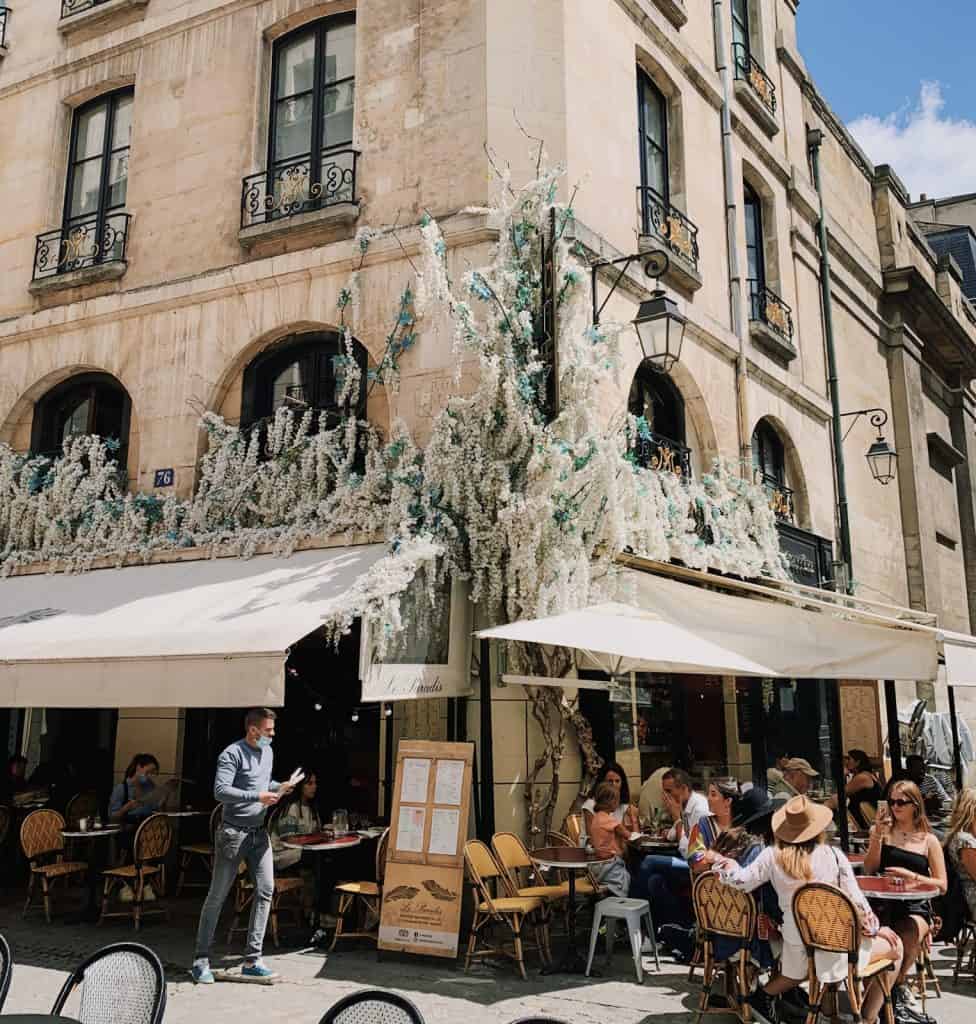
Photo was taken near Rue de La Chapelle while heading to the Marx Dormoy metro.

Did you enjoy this article? TAIP is 100% reader-supported through tipping. If you want to leave us a tip of any amount it would be highly appreciated. These tips help support our efforts to keep TAIP an ad-free environment. Just as at a cafe, the tips are split evenly among the team.
moving to Paris

Why I Moved to Paris and How I Made It Happen

If you’d like to learn a bit more about Alexa you can click here.

During the first lockdown I was living alone in Princeton, New Jersey, and when the opportunity to move to Upstate New York presented itself, I took it without hesitation. I expected to be part of a creative and supportive group of friends, inclusive, and fun. My experience in that area was, to be polite, different.

I can appreciate that people move thousands of miles to live in the Hudson Valley and find what they’re looking for. Yet, despite our similar goals, there was little compatibility between me and them. If I had stayed, I would’ve melted into oblivion.

It turns out Paris is what I wished New York could have been.

A Time to Search and a Time to Give Up As Lost

I had the summer off from work in 2021, right as France reopened their borders. I needed change, so I called a friend living in Paris and asked for her insider knowledge. “Is it actually safe there?” She was very reassuring. Remember, at this point during the pandemic, traveling was taboo. But I made up my mind and got in touch with her friend who rents out his studio to visitors in Montmartre. I could stay for the entire month, so I booked my flight.

From idea to reality, it was about two and a half weeks until I arrived in France.

Unsurprisingly, I wanted to move here as soon as I arrived. I chalked it up to being whimsical or naïve, but it was like going to a pet store and saying, “I’m just looking.” I should have known better since that was how I ended up with my childhood dog (RIP Julie).

It wasn’t my first time toying with the idea of moving to France either. Five years earlier, I was living in Turin and took a bus to Paris for the weekend. I wanted to stay forever. It rained the whole time, but I only saw sunshine — it was le coup de foudre. Love at first sight. In retrospect, I wasn’t ready then, so I didn’t take it seriously.

An integral part of why I fell in love this time had to do with old friends from the States living close by in Montmartre. Days before I arrived, they moved to an apartment down the street from where I would be. I was immediately embraced by them and their friends.

From Day One, (Unlike New York for Me), It Was Easy to Love and Be Loved in Paris

One day, at the aforementioned friend’s house, she starts telling me about a situation needing figuring out. Her friend across town was away visiting family and needed someone to feed her goldfish. Unfortunately for this fish, his secondary caretakers were also going to be away longer than he could stand without food. I was available that weekend, so I offered to take care of Harald the fish for this girl I’d never spoken to before. I got her key and number, and she gave me the rundown of how to take care of him and his tank.

I found it all kinds of comical and wanted to see this girl who I’d met through a fish, so we made dinner plans for when she returned to Paris. We didn’t need much of an introduction, despite having never met before in person.

I should mention that on my way to her place while grabbing moelleux au chocolat and berries for dessert, I settled in my heart that I wanted to stay permanently. I was going to take it seriously this time. Walking down the steps to Lamarck-Caulaincourt I remember begging God to let me live here. I guess that prayer worked because it was this dinner that officially started it all.

A Time to Keep and a Time to Throw Away

She mentioned to me that her friend was in need of a sublessor for her apartment for a year starting in October and that I should take it. Of course I was interested, but it came down to impossible timing. Although I did text a friend back in the States to see if anyone in his group could take over my lease in New York, I would need to get my documents in order, find remote work, apply for a long-stay visa, and obtain said visa in two or three months. Plus, I’d already agreed to return to the family I was working for in the autumn. If I was going to do this, I wasn’t about to burn bridges and leave everyone in a dramatic tizzy.

I came away from this conversation knowing two things:

  1. what was out there for me
  2. where I was wanted

To be sure of the second, I wanted further evidence. Was this a casual or halfhearted invitation? For months I kept my eye out for proof that I found the kind of friendships I’d been looking for, being careful not to project my own hopes and ideas onto them.

My first tip came in August, a month after I left France. I was on a bus in Croatia looking out of the window wondering: Would I be supported in this move? Would I be a burden? I wanted clarity, and soon clarity would come. When my phone connected to WiFi that afternoon, I noticed a missed call from a French number I didn’t know accompanied by a text which read “Just wanted to say welcome.” I was stunned, not only by the sweet sentiment, but by the impeccable timing.

We share mutual friends, and she was under the impression that I had already moved to France. Nevertheless, it showed me what I needed to see.

A couple of months later I found cheap tickets from New York to Paris and went for a weekend in November to visit friends (yes, a weekend trip is possible.)

I wanted further proof that I wasn’t forcing this move, but rather that it was organic and healthy. I arrived, was invited to meet people the next day, and stumbled upon the last and final piece of evidence. I had met everyone that evening, but it was like we’d known each other for years. It felt like home. I was being encouraged to move and reassured everything would work out. It wasn’t empty words either. My friend who I was visiting offered to let me stay with her long-term until I got on my feet. She was willing to host me and prepare all the documents necessary. She went above and beyond anything I could have ever expected, even ordering me a SIM card for my arrival.

A Time to Plant and a Time to Uproot What Was Planted

The process of applying for a tourist visa was actually quite easy. I can’t say what it was like pre-Covid because I never looked into it. During the pandemic the timeline of events went like this:

  1. Submit the visa application form online
  2. Make an appointment with the nearest VFS
  3. Gather the following documents:
  • visa application and checklist
  • copies of my passport and license
  • three months of bank statements (I also included my meager 401k and volatile crypto investment accounts)
  • proof of additional income (from June 2021 until June 2022 I will receive $500 of guaranteed income per month, so I included this letter in my file)
  • proof of employment (I had my company write a stamped letter stating my salary)
  • expat health insurance (WorldTrips was quick and easy, they also provided me a confirmation of coverage in French upon request)
  • a sworn statement that I would not take up employment in France
  • visa cover letter explaining why I wish to come to France, including my intentions to return to the US
  • Attestation d’hébergement (including my friend’s lease and copy of her passport)

If you purchase the special VIP package with VFS like I did, they will make high-quality copies for you along with taking your picture for the biometric visa. I came prepared with my own photo to be on the safe side, but in the end I didn’t need it.

I researched for months which extra documents I thought they wanted, read countless blog articles (including TAIP), and called friends of friends of friends to learn every detail. If I could go back in time, I would tell myself to calm down and follow the simple checklist included in the visa application. That’s all they required.

Due to the pandemic, all consulates are closed, so the visa application center (VFS) has taken over. They are incredibly nice, but it’s worth mentioning they have no influence over whether your application is accepted or not. Their job is to organize your file, make sure it has all the needed documents, take your biometrics, and send it along to the embassy.

Still, I was stressed out on the day of my appointment. I was having these irrational fears that they would take one look at me and think “I don’t like your face” and dismiss me without taking my file. That didn’t happen. The process was painless. They even took me before my scheduled appointment time. I believe it was 30 minutes from start to finish.

My appointment was on Friday the 14th of January and my Long Sejour Temporaire 12-month visa was delivered on Wednesday the 26th of January. 12 Days in total.

A Time to Embrace

I’ve been here nearly three weeks, and I’ve landed a new job, a roommate, and beautiful friends. All in all, I’ve found what I was looking for.

I brought what could fit in my Osprey backpack, a carry-on, and a personal item. I donated everything I owned, minus some sentimental furniture I left with my grandparents. It was worth it.

Forgetting the Things Behind and Stretching Forward to the Things Ahead

Next on the agenda is finding a permanent apartment and figuring out how to change my visa type for my new job.

But I’ll save all that for a future article.

Photo was taken while vintage shopping in Les Halles.

Did you enjoy this article? TAIP is 100% reader-supported through tipping. If you want to leave us a tip of any amount it would be highly appreciated. These tips help support our efforts to keep TAIP an ad-free environment. Just as at a cafe, the tips are split evenly among the team.