Day Trips: Chantilly

I’ve always emphasized that this is a Paris blog first and foremost, but that picture of Paris is incomplete if it doesn’t include the day and weekend trips I take around this beautiful country.  I always tell Americans that France is 75% the size of Texas, which simultaneously conveys how large France is (because Texas is BIG) while giving a sense of how small it is in comparison to the continental 48 United States.  You can get almost anywhere in France within a day’s drive.

As I’ve said to many, after 500,000 miles (more than 1M kilometers) driven in the US, I’m retired from driving other than when I have absolutely no choice, and weekends away are no different.  I’m almost always going to take the train where I’m going.

On the border of Île-de-France is Oise, which has the stop Chantilly-Gouvieux within its borders.  Nine euros each way and about 45 minutes later on the train you will find yourself a 20-30 minute (scenic) walk, at a decent pace, from the stables and Château of Chantilly.

Most of the château dates from after the French Revolution, as during that disgusting and disgraceful time of French history the revolutionaries burned and destroyed so many beautiful things, and murdered so many people.  And yet, the history of the grounds, château, and stables, for anyone who bothers to read about it, is the typical story of noblesse oblige, conservation, and heritage that made France such a jewel of Europe.

I’ve been to Chantilly three times now, and each time I’ve been joined by friends for a picnic beforehand.  I bought an Annual Pass on my first visit as I could see that I would need a number of visits to properly see it.  On my first visit I thoroughly visited the gardens, designed by Andre Le Nôtre, who designed, among other masterpieces, the Gardens at Versailles.  On my second visit I visited the stables and the museum of the Grand Écuries, which is adjacent to the château.  I didn’t have time to go see a horse show, alas (the property famously hosts two major races each year, on par with America’s Kentucky Derby).  I also took a tour of the private apartments.  On my last visit, just this last month, I finally took in the château itself, with its very fine art collection.  Indeed, there are almost as many Poussins here as in the Louvre!

And no visit to Chantilly would be complete without tasting that famous Chantilly cream, which you can eat just out of the bowl, as my friend Linda did, or if you’re feeling more traditional, with some fruit and sorbet.

This was one of those photos that you can’t believe look so picturesque, even as you’re taking it.

Did you enjoy this article? TAIP is 100% reader-supported through tipping. If you want to leave us a tip of any amount it would be highly appreciated. These tips help support our efforts to keep TAIP an ad-free environment. Just as at a cafe, the tips are split evenly among the team.

Why So Serious: French Advertising

More and more American audiences are getting used to something that has happened in French movie theaters for some years now: advertising that has nothing to do with movies, but is cinematic (and often quite serious) in scope.  The challenge is that it’s hard not to laugh at any of these pleas for you to buy stuff.  Sometimes it’s just so over the top.  As I’m often the only one laughing when this stuff comes on I try to laugh quietly so as not to be the obvious American who finds it ridiculous.  Take, for example this ad for Dior Sauvage starring Johnny Depp, which plays on all the mysterious and bad-boy tropes that the French love.

Depp manages to be Captain Jack Sparrow while fearing and loathing Las Vegas.  Oh, yes, and I’m supposed to want Dior after all this dark mystery.  Is this aimed at me or the ladies?

But, Dior has a diverse portfolio, and for the vampire types who like Led Zeppelin, you can watch Robert Pattinson.

Dior is playing the “get the girl” card that you normally associate with these male cologne ads.  Along with this, it’s now the mode to use English in your ads.  Witness this hilarity in which an advertisement designed for the French marketplace ends with a subtitle for the English catchphrase at the end of it.

Diesel ups the “get the girl” ante with Thor’s brother, Chris Hemsworth, in this ad.

Yes, buying cologne is now an act of bravery.

I understand I’ve only been focusing on the obvious (yes, Stephen we get that the French are into their cologne). But, coffee is also a pretty serious thing in La France.  When I was first in France the famous (now long past) campaign of George Clooney for Nespresso was part of my introductory French language class, as it featured some simple subtitled text for us to translate and practice. I found the campaign to be funny, intelligent, and perfect for Nespresso. Unlike the other commercials I’ve shown so far, the series that Clooney did was all about poking fun at himself he always thinks the women know who he is (and desperately want him), but they are always interested solely in the coffee.  For the record, this is my favorite one.

This campaign introduced an expression that’s part of pop vernacular now. Clooney says, “What else?” and in French this translates to “Quoi d’autre?” You can use this expression in situations and almost everyone knows what you are alluding to (the expression, as its equivalent in English, obviously stands alone apart from this ad, but the intelligence of the writers was in co-opting it).

The French take their advertising seriously. So, promise me not to laugh too hard when you watch it with them. 🙂

This story also appeared on Medium.

Photo by Alexis Fauvet on Unsplash

Did you enjoy this article? TAIP is 100% reader-supported through tipping. If you want to leave us a tip of any amount it would be highly appreciated. These tips help support our efforts to keep TAIP an ad-free environment. Just as at a cafe, the tips are split evenly among the team.

The Airbnb Wars Continue in Paris

I wrote some time back rather passionately about forces conspiring to stifle Airbnb and Uber in Paris.  The City of Paris recently upped the ante by publishing a website that shows all the properties that are “properly registered” as an Airbnb in the city.  Unsurprisingly, the French, operating from a cultural sensitivity to “denouncements” of neighbors during WWII, reacted strongly to this and labeled it a “rat on your neighbors” policy.  If anything, it will cause a backlash among even those neutral to slightly negative on Airbnb.

To catch up those who aren’t familiar with the intricacies of Parisian housing policy, anyone is allowed to rent space within their own personal home, for example a spare room or a couch in a living room, provided that they either own the space or have permission from the landlord.  In one recent landmark case, an owner sued a tenant and won for letting out an apartment without permission.  The law additionally allows you to rent a space you don’t occupy for up to 120 days a year, which would cover a long absence from Paris (or several) for whatever reason.

The argument goes that these short-term rentals are changing the makeup of the city and of particular neighborhoods, and to an extent, this is true.  And yet, all these short-term rentals represent opportunities for pure revenue for Paris everyone coming to the city is going to spend money and hotels and hostels alone don’t meet demand.  Indeed, Airbnb has moved the goalposts on what a travel stay consists of now no longer prisoner to the social desert of a hotel or the social overload of a hostel, people can choose a third way, in which they sometimes have an unofficial guide to the city, whether that be as simple as answering a few questions before arrival or as far as leading them on a cool walk about town.  Airbnb is now saying, “don’t just visit there, live there, if only for one night.”

Paris is unlikely to get Berlinian about Airbnb, but given that there are fewer than 200 properties on the “official” register out of over 40,000 listings makes it clear that there is still a gap in reality and expectation between a city being brutally lobbied by the hotel industry (and a république that is insistent on taxing everything it can touch, and even what it can’t) and a Parisian populace only too glad to get some help paying the bills by renting out some personal space.  In a way, it’s time for the residents of Paris to benefit from Paris’ reputation as well given that they have to put up with (without compensation) a neverending flow of tourists throughout the year.

For now, it seems clear that anyone who is renting out wholly unoccupied spaces on a short-term basis 100% of the year better watch out.  I suggest divesting yourself or pivoting into long-term rentals.  Otherwise, be warned that the city is coming for you, and it will cost you tens of thousands of euros if you get caught.

Did you enjoy this article? TAIP is 100% reader-supported through tipping. If you want to leave us a tip of any amount it would be highly appreciated. These tips help support our efforts to keep TAIP an ad-free environment. Just as at a cafe, the tips are split evenly among the team.

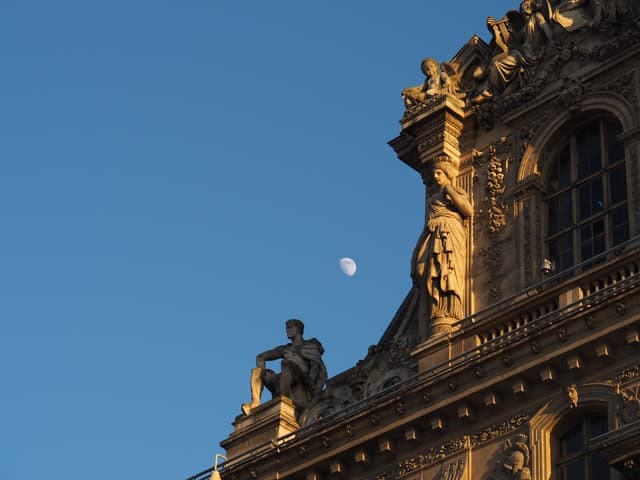
moon

Book Club: Paris to the Moon, by Adam Gopnik

My favorite book written about Paris from the expat perspective is the series of essays written for The New Yorker by Adam Gopnik that was later compiled into a book called Paris to the Moon.  As the book’s magical title promises, it is a thoughtful and earnest look at a city Gopnik never intended to permanently live in, but experienced more deeply in six years than some people do in a lifetime. 

Gopnik has gifted me with some ways to express feelings and sentiments I have in my new country, from saying that we “breathe in our native language, but swim in our second,” to his chapter on “Distant Errors” in which he deconstructs, albeit kindly, the French tendency to look at problems or errors as distant as something external rather than related to their own thinking and behaving, to his explanation of “white helicopter” thinking among the French (in contrast to the American “black helicopter” idiom, which is a meme for conspiracy theories) that there is always the possibility that a future government will offer a higher pension and a lower retirement age.

Adam’s approach to life in France is certainly one I wish to emulate, though my French needs to improve in order to do so.  He is at home as the American he will always be, while truly attempting to live life as the French do, day in and day out, in dealing with strikes, protesting the takeover of a favorite restaurant, by enjoying holidays enthusiastically (I wonder sometimes if the French love the planning and anticipation more than the holiday itself), and even in the ceremony of childbirth, which both he and his wife participate in.

I’ll leave you with a quote from the book particularly germane to the subjects covered in this blog: “Everything about moving to Paris has been wonderful, and everything about emigrating to France, difficult.”

As it perhaps, should be.  This life should only be available to those who truly want it.

Photo by Rafael Garcin on Unsplash

Did you enjoy this article? TAIP is 100% reader-supported through tipping. If you want to leave us a tip of any amount it would be highly appreciated. These tips help support our efforts to keep TAIP an ad-free environment. Just as at a cafe, the tips are split evenly among the team.

You Have to File Taxes as a Fiscal Resident of France

So in France you receive a tax bill for the current year based on what you were assessed the previous year.  You then pay that bill in payments so that by the time that year’s taxes are due, you will ostensibly be “ahead of the game.”  Of course, this depends on your income stability.  If you make a lot more money this year than last year, then those payments are simply a down payment on your future tax bill.  Conversely, if you are unemployed, you will still be paying into the system at the rate you did when you were employed.

Wait, Stephen, I thought you said I didn’t have to pay taxes?  You’re right, as a visitor, I don’t have to pay taxes, but I still have to file and declare taxes.

But the French government didn’t do their sums correctly, and I had to do a bit of correspondence with them to fix it.  In this blog post I told you that they recognized this error but they ended up only removing some of the amount, so I had to write another letter explaining that I didn’t owe anything.  It only took four months and two letters. 🙂

But the person who issued my corrections didn’t update my file, because I got a notice to start paying taxes based on last year’s amount…which I got dismissed.  So I had to draft another letter explaining (with photocopies of the dismissals) that not only did I not owe taxes for the 2014 taxes, but I did not owe advance payments for 2016, as I wouldn’t have any tax liability in 2015 either.  I only moved to my right-to-work status in January so next year I will actually owe something.

Remember in dealing with the French: be patient, have your documentation to the Nth degree and backups, and trust the process.  The fastest road to frustration is to imagine you are entitled to anything.

I expect to get a dismissal of my current tax bill.  I’ll let you know if something else happens.

Did you enjoy this article? TAIP is 100% reader-supported through tipping. If you want to leave us a tip of any amount it would be highly appreciated. These tips help support our efforts to keep TAIP an ad-free environment. Just as at a cafe, the tips are split evenly among the team.
OFII for Prof Lib

It was 07h40.  “I’m early,” I thought, and decided to stop in for a quick breakfast.  It was a patisserie on rue de la roquette, halfway between Bastille and my 08h00 appointment that morning.  My thoughts flashed back to my first visit to OFII, back in 2014.  What a greenhorn I was back then worried that my French wouldn’t be good enough, or that I wouldn’t have the necessary documents.  How times change.

I took my last sip of coffee after finishing off a strawberry beignet and at 07h55 casually sauntered towards OFII (L’Office Francais de l’immigration and de l’integration).  There were two lines.  The one on the left was for asylum-seekers.  My eyes involuntarily flicked up to the 6-8 souls in line, who looked forlorn.  I couldn’t imagine their individual situations and stories.  Then my gaze fell on the line on the right, my line, which was already 20 deep.  I wondered to myself why they had felt the need to get there early.  But then I realized that some of these people may have just arrived in France, and like me in those early days, didn’t want to take a false step: cue arriving 15-20 minutes early for your appointment.  Good on them!  I, on the other hand, wasn’t going to get there until right about 08h00.  I love my sleep and I knew this wasn’t really going to be that stressful.

I’ve written before about the dread that one might feel about entering a prefecture.  How many dreams and plans have foundered and died on the shoals of French bureaucratic requirements and the moodiness of civil servants!  And yet, I’ve always maintained that the antidote to that dread is to be overprepared.

But the Prefecture is the “scary” part: you are getting authorization from the French government to be here, legally.  OFII, by comparison, would be giving me the bise, and welcoming me to France, which is why I wasn’t carrying a thick sheaf of papers, but rather a book to read while waiting.

Promptly at 08h00 we started shuffling forward.  One guard checked the nature of our appointment to verify we were at the right place at the right time.  The second guard verified by ID (I brought my passport and récipisse).  We then went upstairs and got into another line, to check us in for our orientation.

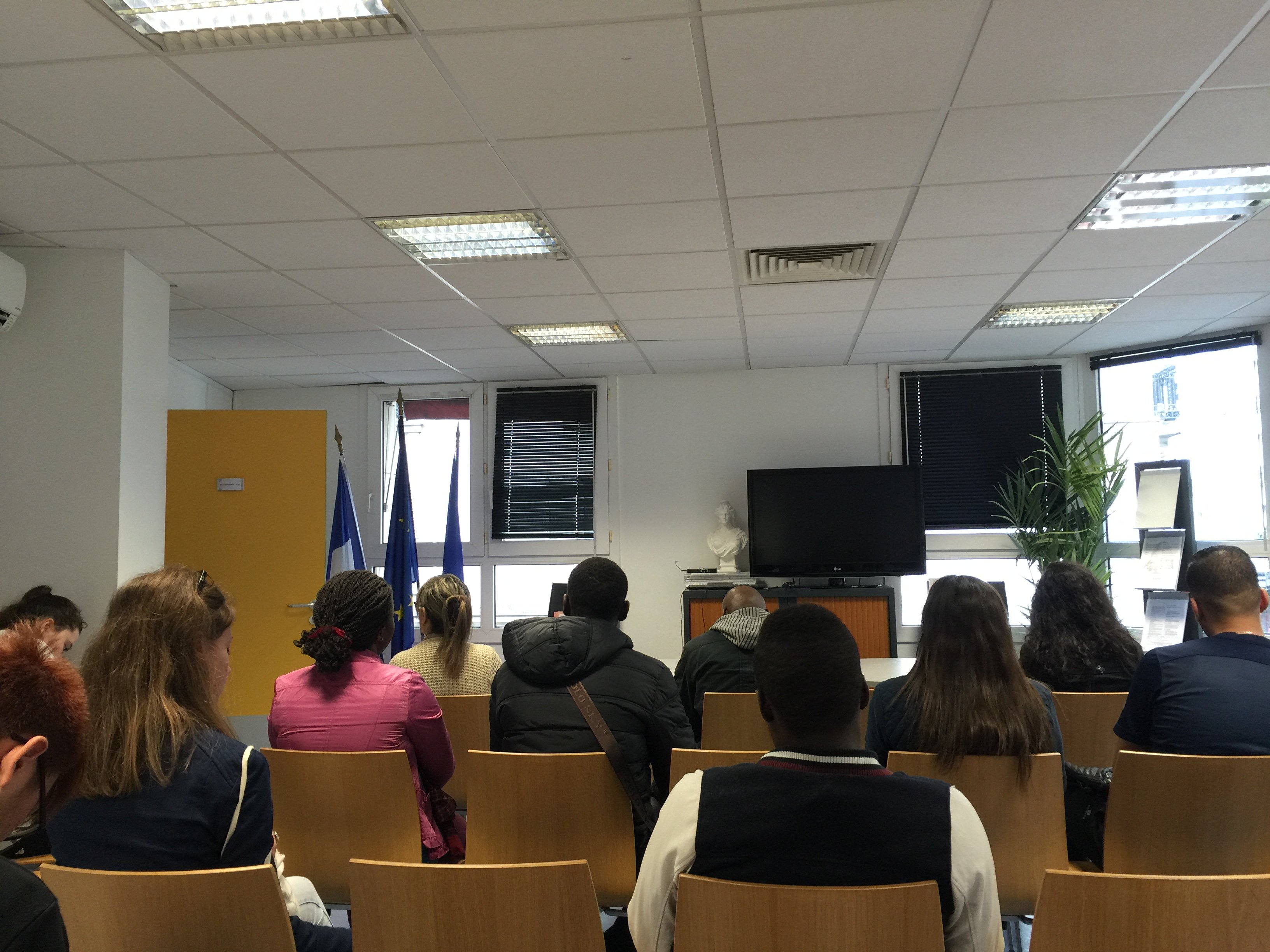
The lady at the desk verified our names, checked us off her list, and verified which language we would be interviewed in after the orientation.  We then shuffled in, one by one, into this room.

IMG_1900

At about 08h20 or so we were all assembled, roughly 25 of us, and our orienter came to tell us what would be happening today.  She spoke entirely in French, but not with the typically hurried Parisian cadence, but the slower measured cadence of the south, knowing she was dealing with many novices of the language.

She said there would be three parts of our day: a video, an interview, and a physical.  The video also worked with individual audioguides you could hold up to your ear which would allow you to follow along in real-time in the language of your preference.  One of our class requested Arabic, and another Kenyan.  If you’re uncertain, be brave and ask for Anglais, svp.  No one cares about your French level at this point, I promise.

The video was quite good, as orientation videos go (not too many cheesy situations or fake drama).  Obviously, as a royalist, I smirked a bit as the narrator spoke about the French “values of the Revolution,” considering that France was built upon superior values that predated that revolution by centuries, if not a millennium, but today was a day for quiet learning, not for a disquisition from Stephen on the murders, excesses, and poor logic of that revolt.  The video concluded with an explanation of the necessary steps of integration we would all need to go through now, namely:

  1. Attendance at a one-day class in French civics, with a translator supplied if requested.  This class purports to teach you about liberté, égalité, fraternité, laïcité, solidarité, and any other és that I may have missed.  They will also teach you the mechanisms of the French state, for example, that the President of the Republic still wields the ancient power of the Kings of France, i.e. the ability to pass a decree without legislative consent.  The class is one day, goes from 09h00-17h00, is obligatory, and is scheduled during your interview.  Mine was scheduled for the 30th of June, about 6 weeks from the visit I made to OFII yesterday.
  2. Attendance at a one-day class in “living and gaining employment in France.”  As with the aforementioned civics class, this one is obligatory, is one day only, and requires you to bring your ID.
  3. Attendance at free French language classes to obtain a basic level of competence as determined by the French state.  The course runs a minimum of 50 hours, and a maximum of 100.  You simply ask to test whenever you are ready.  This condition is in force unless, when you do your interview at OFII, your French is competent and clear.  Then you get an attestation that you don’t have to take the class.
  4. Your signature on a contract which commits you to do all of these tasks within one year, and that you will integrate into French life and the French way of thinking “avec assiduité.”

I was pleased to be exempted from the French courses via my interview.  If you are required to take the classes I believe they occur on either Mondays or Saturdays in your arrondissement.

She then asked if I had kept my medical exam from OFII from my 2014 visit.  I laughed and told her that I kept ALL THE PAPERS, gesturing to simulate a large stack.  She laughed and asked if my visa renewals were continuous, with no gaps.  I replied in the affirmative.  She then told me I was done for the day, as I didn’t need a new physical (which I ostensibly would have if I didn’t have that record or hadn’t kept a continuous immigration record).

She printed out my appointments, had me sign the contract, and gave me a lovely folder to put it all in.

It was 09h30 and I was done for the day!

Three things to note:

  • I was the first person called after we watched the video and our orienter briefly recapitulated the important points and answered some stray questions.  My being called first may only have been because they knew I didn’t need a physical and wanted to see me first.  But I don’t think you need to schedule more than a half day for this appointment, even for a worst-case scenario.
  • You will get the convocation to go to OFII after your second Profession Liberale appointment.  If you can’t make the date they give you, reschedule as soon as possible so as not to hold up this end of the process.
  • If you bypass my two-years-as-a-visitor route and go straight to Profession Libérale, you’ll be doing this appointment 90 days after you first officially move to France.

* * *

I slowly walked to Bastille after the appointment.  I was in the official “immigrant” stream.  The appointment went well, and I felt welcomed to my beloved France.  That, after all these years of hard work, felt good.

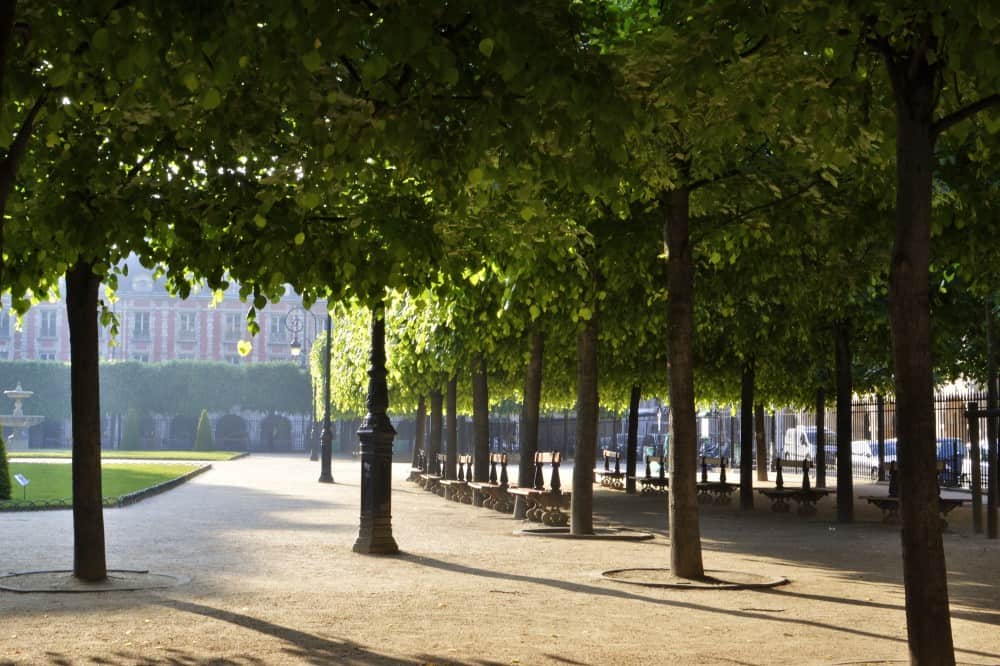
Featured image of an early morning Place des Vosges, not far from OFII, originally appeared here.  Follow the photographer here, who gave permission for this photo to be used.

Did you enjoy this article? TAIP is 100% reader-supported through tipping. If you want to leave us a tip of any amount it would be highly appreciated. These tips help support our efforts to keep TAIP an ad-free environment. Just as at a cafe, the tips are split evenly among the team.

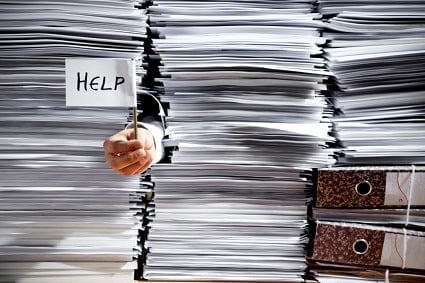
paperwork

Profession Liberale Visa: Part 2 (90 Days Later)

Ninety days after you obtain your profession libérale visa, assuming you have done everything correctly after that momentous day at the prefecture, you will have a number of new documents to present to the Prefecture for your follow-up visit.

Chief among those “correctly done things” is a visit to URSSAF within 24-72 hours after you obtain your visa.  I went to the office near the BnF right when it opened, and completed my appointment within 20 minutes.  I showed her my récipisse designating my new status, as well as answered some basic questions regarding where I lived and which specific classification I was looking for.

URSSAF is in charge of social security contributions, among many other things, and feeds out its information to other agencies, including RSI, INSEE, CIPAV, Ram, and the Ministry of Finance.  In turn all these agencies will start flooding your mailbox, asking you to send them follow-up documents.  This is a dizzying number of acronyms so let me start with the easy one first, and perhaps the most important.

INSEE is the Institute de la statistique et des études economiques and is responsible for issuing you a national identification number, which you will need now that you are formally entering French society.  It’s similar to the American “social security number,” though your French one is oddly longer but easier to decode.

RSI is the Régime Social des Indépendants and is a mutuelle it’s a subassociation of URSSAF (which, by the way is Unions de Recouvrement des Cotisations de Sécurité Sociale et d’Allocations Familales).  Without taking you too far into the woods of unnecessary and redundant and overlapping French agencies, RSI serves as a “mutuelle” for health insurance and pays the difference between what the national health insurance pays and what you owe.

Ram is a partner agency of RSI that works with small business owners and artisans.  They are, in my case, responsible for issuing my Carte Vitale, which is what you use to pick up meds at the pharmacie and for all your medical visits.

Finally, there is CIPAV (still with me?)  Caisse Interprofessionelle de prévoyance et d’assurance vieillesse.  They are in charge of your pension, and no, you cannot opt out of contributing.

If you end up getting employees (I have absolutely zero intention of doing so, given the draconian anti-business laws in this country) you will also need to know about one of the huge mutuelles, like Malakoff-Mederic, for example, who would handle health care, insurance, and retirement for your employees.

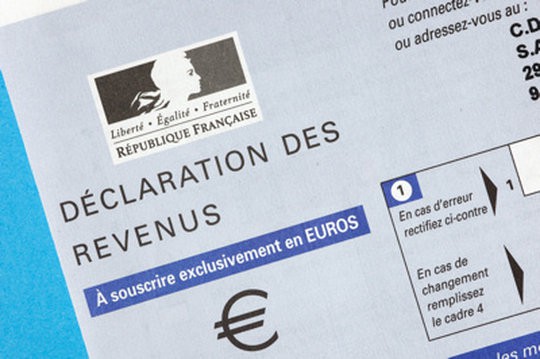
The Ministry of Finance, of course, handles your taxes and they have a very distinctive-looking envelope.  As I was writing I turned to a colleague at my coworking space and told her, “Nothing good ever comes in this envelope!”  She laughed in agreement.  They want to know what space, if any, in your home is going to be dedicated to your work.  I maxed that out.

Registering at URSSAF after you obtain your visa will trigger letters from all of these places.  Don’t worry, you don’t need to register individually!  You’ll also get schedules of future billing membership ain’t free.

You will also need to bring your first 3-5 invoices from your new professional life, proving you’ve already started working.  My agent raised her eyebrows at the four invoices I handed her.  “Not bad!” she said in French and smiled.  I reminded her that she was the agent who had approved my first long-term visitor renewal, back in 2014.  “It’s a long way!” she said.  My nod didn’t convey just how much I agreed with her sentiment.

And finally, you’ll need to show them your shiny new French bank account dedicated solely to your new business.  If you aren’t well advised, when you go to open one you’ll ask for a professional account and pay all the fees that come with that designation.  Both my accountant and my attorney advised me to get a simple personal account and dedicate it to my business, which I did.

I have been extremely satisfied with Société Générale, but by way of auditioning a new bank (and giving myself more options), I opened an account at BNP Paribas.  With the recent implementation of FATCA and my US citizenship, this was anything but a smooth ride, but I’ll talk about that in another article.

So bring them most of this documentation (they don’t care about your CIPAV stuff, for example, but as I’ve said in previous posts, bring the second folder with all the “just in case they ask” material), along with “the usual,” i.e. your lease, renter’s insurance, passport, and récipisse.

Your agent at the prefecture will double-check all your paperwork, and then cross-check it with your file from 90 days before.

They will then print another récipisse and have you sign in two boxes in the application for your physical carte.  Processing time is about 10 weeks at the moment.  I got a July 13th pickup date from an April 21st appointment.  And, thankfully I always keep all the paperwork that I’ve ever done for French immigration, as I have to bring the original police report I received when I lost my last card.  And I get to pay extra (16€) for losing that card, despite having paid over 100€ to pay for the card in the first place.  Remember, this is France, not Germany. 🙂

It’s sinking in.  I work in France, legally.  I’m on the long road to citizenship which comes with paying taxes here.  I know that all these acronyms and agencies can be scary and intimidating, but honestly, it’s also a great filter to separate the dreamers from the doers.  Those who want to be here will laugh through this process because a little (or a lot) of paper shouldn’t stand between you and your dreams.

Featured image comes from the Australasian Mine Safety Journal, under creative commons usage.

Did you enjoy this article? TAIP is 100% reader-supported through tipping. If you want to leave us a tip of any amount it would be highly appreciated. These tips help support our efforts to keep TAIP an ad-free environment. Just as at a cafe, the tips are split evenly among the team.
Don’t Buy the Paris Pass

I really think that Americans in particular don’t leave enough unscheduled, unstructured “white space” in their European travels.  They run around, convinced that they will never return, and so they have to see everything.  I know.  I get it.  That was me once upon a time as well.  But while that allows you to mentally “check off” the big sites, it doesn’t really allow you to enjoy Europe and Paris the way these destinations are truly inviting you to enjoy them.  Here’s a sample of said freneticism, from an email I received from someone planning a trip:

Upon our arrival we are spending most of the day on the 26th at the Louvre.  On the 27th we are traveling to Versailles.  On the morning of the 28th I would love to accomplish two things, a quick tour of the catacombs and then a stroll in the areas of the fashion houses.  Is that at all possible to accomplish both?

I had only been in Paris a few months at the time, and I already knew that her itinerary was problematic, to say the least.  The lady had prefaced this by saying she had waited 28 years to come to Paris.  And this was her plan?  Alas she refused to take my advice to cut one or more things from her crazy itinerary.

This “do all the things!” trend seems to be endemic to Americans.  They want to see everything and are overwhelmed with advice and information (half of it terrible) from friends, family, blogs, and TripAdvisor.  If this attitude sounds familiar (no need to raise your hand!) the key is to focus and craft a schedule with the really important things you hope to do.  Add “white space” to the schedule: time to just relax and enjoy the city and the magic moments that can happen, instead of rushing around to see “the next thing.”

This leisured manner of sightseeing, that leads to lasting memories instead of a confused blur, is something you are unlikely to do with the Paris Pass, something designed for the FOMO-obsessed visitor who has to see everything.  So, to underline my perspective, here are four reasons you shouldn’t drop hundreds of euros on this tourist trap of a product.

1.  It’s overpriced.  As with most “deals,” you spend your time trying to knock out the big-ticket items so you can prove to yourself you got a deal, even if you have only the vaguest interest in said item.  Do you think they bundled all this together to save you money?  The Pass is about convenience, and they want to get paid for that.  Anyone who actually saved money using this thing only did so by running around the city at top speed.

2.  The bundled Museum Pass isn’t for everyone.  Yes, I’m an art lover and in a past life I gave private tours of the Orsay and the Louvre, but plenty of visitors are not that obsessed with art and museums, and are happy to just go to a few of the museums in Paris; they don’t want the weight of obligation (or the rushed timeline) that having a “pass” puts on you.

3.  You won’t use the metro nearly as much as you think.  This comes with an all-you-can-use Metro pass for a set number of days, which is a huge waste of money.  People have no idea that Paris is so walkable and beautiful to walk.  If you’ve walked enough, you can opt for the shared Velib bikes or the ubiquitous electric scooters.  If and when you need to use the Metro, use an easily refillable Navigo Easy.  If you are going to be here for more than a week, and plan to head out of Zones 1 and 2 a lot (Versailles, Disneyland, Fontainebleau, etc.) starting on a Sunday, Monday, or Tuesday, stop in and get a Navigo Decouverte.

4.  You will be stressed, not aided, by their 120-page book.  They boast entrance into places that are too varied and uneven in their characters to be “must-sees” for every single guest.  Even one of my favorite Parisian buildings (and included in the Paris Pass), the Garnier Opera House, is not a “must-see” on your first visit to Paris.

So, save yourself time, money, and stress by NOT buying the Paris Pass.  it’s for people interested in frantically running around the city so they can later tell people what a “deal” they got by buying some overpriced card, or for people who think Rick Steves knows what he’s talking about.  If you’re interested in taking this city on at a reasonable pace, with white space sprinkled throughout the day, and are willing to not see “all the things,” you should avoid the Paris Pass (and its advocates).  Paris is a place to be experienced, not a checklist to be achieved.

Did you enjoy this article? TAIP is 100% reader-supported through tipping. If you want to leave us a tip of any amount it would be highly appreciated. These tips help support our efforts to keep TAIP an ad-free environment. Just as at a cafe, the tips are split evenly among the team.
jill jonnes

Book Club: Eiffel’s Tower, by Jill Jonnes

“But there’s no such thing as Paris without the Eiffel Tower,” said my friend Florence the other day.  Locals have complicated views about the tower of iron, but perhaps she is right.  But the beginning of pondering that question should
start with Jill Jonnes’ fascinating book, Eiffel’s Tower: The Thrilling Story Behind Paris’ Beloved Monument and the Extraordinary World’s Fair That Introduced It.

In this book you learn just how much it took for Eiffel to overcome in order to build this true architectural achievement of its time.  It stood as the world’s tallest building for 30 years, and took only 2.5 years to complete (perhaps one of the few French building projects ever completed on time).  In contrast the previous “tallest building” in the world was the Washington Monument in Washington D.C., which was half the height of the Eiffel Tower and took 40 years to complete.  Mind you, there was a little thing called the War Between the States during that 1848-1888 period of construction, but still, you can imagine many Americans, including Thomas Edison, felt a bit of envy to have the French claim a technological achievement before America did.

Edison was feted when he visited the Tower he was the great man of innovation and ideas and Eiffel toasted him with champagne at the summit of the Eiffel Tower.  But he emptily boasted that for the upcoming Chicago World’s Fair that they would build something twice as tall at half the price.  The French raised their eyebrows, understandably so when what ended up being invented for that event was not some tall tower, but the Ferris Wheel.

Jonnes writes a compelling narrative, bringing all the characters together in a cohesive story that is, oddly, suspenseful, especially given that we already know how events turned out.  I shared this book with some local Parisians and they told me it forever changed how they saw and understood the Tower, which is just the sort of antidote you need, especially when you’re walking past the Selfie Nation on the Champs de Mars.

But perhaps you will be most edified to learn how well Eiffel bore up under the most vile and vicious attacks, before, during, and well after the construction of the Tower.  It is his entrepreneurial genius something the French could allow to flourish a bit more these days that is the true story behind this great little book.

Photo by Mika Baumeister on Unsplash

The Kind of Afternoon You Want to Lose

Matt was standing outside about to message me but I spotted him through the window.  I was working at Le Poncelet, my favorite cafe in the 17th, the arrondissement I spent my first year in Paris in.  I waved him in.

Le Poncelet for me is a perfect modern Parisian cafe.  It has trouble-free wifi, a great lunchtime special, usually around 12€ (and is sold out of by 13h00), and an unhurried manner that never makes me feel guilty when I sit and work there for hours on end.

Matt and I met for coffee at 10h00.  At 11h45 he signaled for another coffee and Anne-Sophie (one of the four waitstaff, who, in addition to the owner, I’ve come to know by name) politely told him in French that they were going to need our table for lunch.  Understandable: Paris cafes are a sort of no-go zone for the casual coffee drinker between the hours of 11h30-13h30 for the simple reason that the cafe wants to maximize dining revenue by using every available table.  You can always sit or stand at the bar during this time period the prices are cheaper anyway remember that an espresso at the bar might cost you 1€ whereas the exact same one sitting down might run you 2€.

Matt and I had separate plans to go elsewhere and simply work digitally after our coffee.  I needed to continue to move closer to the Louvre, as I was giving four guests a private tour there that night.  We were not far from the Champs and I picked a zany and open Starbucks location there where we might chat in peace and not be pressured into more coffee.

I ordered an Uber for us.  It came 2 minutes later.  I raved about how great the service is in Paris, and he reflected that his terrible experiences on Uber in our city may have been a result of always needing to order a van (he is married with three daughters).

We kept chatting at our new location where we watched a professional panhandler do laps among the crowd, all with a fake crutch.  He occasionally helped himself to abandoned muffins and juice.  Finally a Starbucks employee chased him out.

Matt and I were continuing our conversation we had long ago left visas and expat topics, which was probably the original premise of the coffee (I love to meet my readers in person).  We were now into the area of monarchy (I’m a royalist) vs. anarchy (Matt is an anarchist) and I was making the case that both of these systems depended heavily on personal responsibility.

We had almost finished solving the problems of the world when I suggested we move one more time.  Again to a Starbucks (I’ve explained before how useful they are as lily pads), but this time close to the central tourism office near the Garnier Opera so I could buy the Louvre tickets I would need for my guests.

We commandeered two seats upstairs (where we had this view), and got to work.  Matt got the coffee, as I had gotten another Uber to catapult us here.

Ultimately, I wish that kind of luxury that Matt and I had that afternoon for all of you.  Yes, we had work to do, but, yes, it could wait.  We were having that kind of conversation the kind that many of us associate with a fireplace or a holiday or preceded by a number of adult beverages.  We were stone cold sober, in the middle of a beautiful Parisian afternoon.  We were Americans far from our old homes, who had intentionally created lifestyles that meant we could have this kind of rich and thoughtful conversation on a random weekday a true sharing of ideas, not in which either of us attempted to “convert” the other on particular issues but in which we basked in the challenge of seeing things from another point of view.

When was the last time you had that kind of conversation?  I reckon you’re overdue.

Image from pixabay.com

Did you enjoy this article? TAIP is 100% reader-supported through tipping. If you want to leave us a tip of any amount it would be highly appreciated. These tips help support our efforts to keep TAIP an ad-free environment. Just as at a cafe, the tips are split evenly among the team.