The Expat Visits “Home”

If you’ve built a full and rich life someplace before coming to Paris, visiting that place is much less a “vacation” than a carefully and meticulously planned series of meetings, appointments, coffees, and meals.  Throw in the occasional doctor/dentist visit and you’re pretty full up (for those wondering, I still visit my US doctor/dentist.  I have almost a decade of experience with them that I treasure and I maintain my health well enough for now to not have to find their equivalents in France.  As I move into the French health care system this summer I will finally at least meet these specialists).

The Good News

  • It is great to catch up with friends and family.  They are anxious to hear about your life, and are truly happy to see you, knowing how impacted your schedule is.
  • You get a better sense of what’s going on there.  Before I left I authored a piece on Trump, then went on to follow it up with the research of asking Americans who actually lived in America about some of my conclusions.

The Bad News

  • There’s a reason you’re in Paris.  You love it here and you don’t really like to be away for any period of time much less the 3-4 weeks you are gone to make an intercontinental flight worthwhile.  I don’t like being away from Paris, but…
  • It’s a necessary evil.  Having the first world luxury of emigrating to a country of your choice far away from these smiling faces means that you simply have to accept the division in your life that you have created by moving to a foreign land.
  • I’ll return to the US later this year for my youngest sister’s wedding.  I won’t bring books to read, as I won’t have time.  I’ll bring my smile and my energy to see as many people as I can during my visit.  Those conversations will linger with me long after I return to my new home.

Where is “home” anyway for people like me?  Start by watching Pico Ayer’s TED talk on the issue.

Did you enjoy this article? TAIP is 100% reader-supported through tipping. If you want to leave us a tip of any amount it would be highly appreciated. These tips help support our efforts to keep TAIP an ad-free environment. Just as at a cafe, the tips are split evenly among the team.

The US Visit: Tips & Tricks

I’m just returning from my fourth visit to America after relocating to France, and I thought I might share some tips and strategies to help you when you make your flights back.

Consider Flying Out of London

The fares are simply much more aggressively priced out of there and I got a $600 roundtrip ticket from London to Los Angeles on just 120 days’ notice.  Outside of the ultra-low-cost carrier market, prices are always higher when you fly to a country that doesn’t speak the language of the country you’re flying from.  For example, Paris to Martinique (French-speaking to French-speaking): $450 when I was scouting those fares a couple of months back.  Paris to Grand Cayman (French-speaking to English-speaking), just minutes further away?  $800.  It would make sense to fly to Martinique and then hop a small flight to the Caymans if that was your destination (but why not just try Martinique?  Grand Cayman, Little Cayman, and Cayman Brac will be there for you next time 🙂 ).  The airlines are guessing (rightly) that you’re probably a tourist, not just visiting family, and hence feel they can charge you more.

The same applies here in Europe.  If you book far enough ahead you can get 60€ roundtrip tickets on Eurostar (no I’m not kidding) for Paris-London and then fly from London.  Or you can make a side trip to London out of it.  You’ll still be ahead based on your savings from not flying out of Paris.  The exact same flight I took from London had a connecting leg from Paris…for $300 more.

Realize That Three Flights Are More Expensive than Four (But Are Also Easier)

I’ve visited America as a leg of a visit to South America.  I’ve also done the additional internal roundtrip route.  The latter is definitely cheaper.  My parents live in California so my inbound and outbound flights were out of Los Angeles but I also spent a week in Kansas, which I flew to directly using Spirit Airlines, the only ultra-low-cost carrier (read: charges for water and carry-ons) in North America.  The $200 for that flight (Los Angeles-Kansas City-Los Angeles) plus the original $600 for the London-Los Angeles segment added up to $800, or roughly $400 cheaper than the London-Los Angeles-Kansas City-London route I had priced out at $1225.  Of course the “savings” cost me 6 hours as I had to fly “back” to LA, away from Europe, and as I landed in LA to spend a few more days with my parents after visiting friends and family in Kansas I decided to do the easier 3 flight journey for my sister’s upcoming wedding in October.  After this most recent trip, I think the extra cost will definitely be worth it.

Consider Flying Air New Zealand if They Are on Your Route

I was so pleased with my experience in coach of all places that I wrote about it the day after I landed!

Use Priceline for Rental Cars

Name Your Price is still alive and well and I used it to get a car for $20/day USD in Los Angeles, with Avis.  If you want to know the hack, send me an email.

Keep Some Loose Cash with Your Electrical Adapters

You won’t have to go to an ATM right away when you deplane, and you also won’t forget the adapters you need.

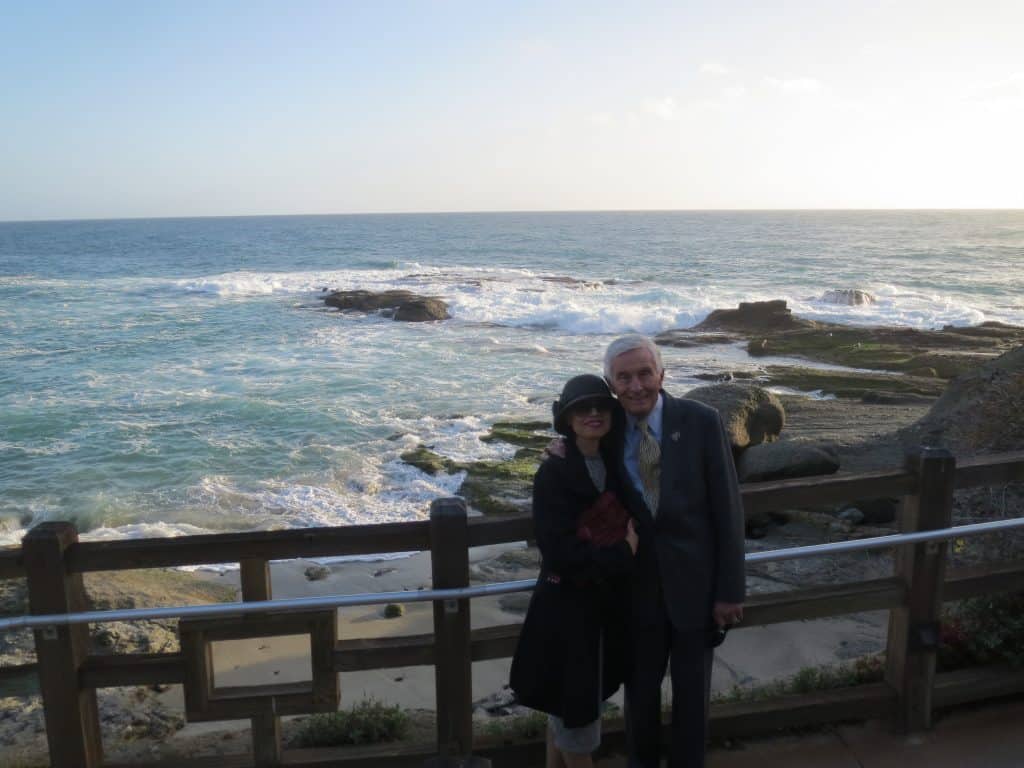
Photo was taken by me this month on the rocky Laguna Beach shoreline.  My amazing parents, celebrating 40 years of marriage this year.

Did you enjoy this article? TAIP is 100% reader-supported through tipping. If you want to leave us a tip of any amount it would be highly appreciated. These tips help support our efforts to keep TAIP an ad-free environment. Just as at a cafe, the tips are split evenly among the team.

How to Get a Same Day US Passport (in Los Angeles)

One of the challenges of living in Europe is that you may get your passport stamped a lot.  I say may because there are times I’ve traveled through four countries and never been asked for ID, much less a passport.  But if you do leave Schengen (most notably, to go to the UK, or to the newer Eastern European members of the EU, i.e. Poland/Hungary/Croatia, etc.) you will probably be asked for your passport.  If you have your French carte de sejour (the card version, not the sticker in your passport one) you can sometimes use this in the EU passport line.  I’ve tried it more than once with success, and always had the backup plan of playing “dumb American” if it didn’t work. 🙂

This is all to say that my 26-page US passport was coming to the end of its useful life last November.  Though it was still 3 years to go until renewal (American passports are good for 10 years these days), I was out of pages for stamps.  Yes, I know, tough life for Stephen.  My problem was compounded by the fact that the US Embassy in France was directed to stop adding extra pages to passports on December 31, 2015, a fact I found out in late November when looking through their website.  Given that I would need my passport all throughout December for travel, I couldn’t spare it for the 2-3 weeks the embassy would need to make the extra pages.

By the time I had a moment to go to the US Embassy in Paris in late January of this year, I had figured out that I had to renew in person: foreign residents aren’t permitted to mail their passports back to the US for extra pages service (which still exists there, anyway).  The instructions stated this in bold and the embassy employee confirmed it.  Again, due to travel, I couldn’t surrender the passport for 2-3 weeks or even the 2-3 business day expedited service.  My “I’m out of pages” reason didn’t qualify for any higher level of expediting.  And given how customs officials don’t seem to care about stamping over previous stamps, perhaps it wasn’t that big of a deal anyway.  But I didn’t want to chance it.

“So I should do rush processing when I’m in America next month?” I asked.  He shrugged, then nodded as he realized that would be easy.  I told him I would be in Los Angeles for a segment of my trip and he said they did same-day processing.

As I got ready to leave France I called 1-877-487-2778, which is the number to make an appointment for passport services in the USA.  Since I wasn’t 14 days from leaving the US (I hadn’t even technically arrived), they said I couldn’t make an appointment yet (I found out later this wasn’t true).  She then told me to call back 14 days prior to my leaving with the date I wanted the appointment.  Alas, the next available time was while I would be in Kansas City for a week visiting friends and family and there was no regional consulate there.

After perusing the interwebs, I gleaned that I might be able to get in with no appointment IF I showed up at some terrible hour in the morning (note: terrible is generally anything prior to 10am), but in this case it would be compounded by waking up even earlier to drive there.  I left north Orange County at around 5am to arrive at 11000 Wilshire Blvd at 6:30am, 30 minutes before the opening time on a Wednesday (normal hours are 7am-3pm).  The line was 30 deep already, but of the 20 only 5 were without appointments, including a couple who had their suitcases with them!

When I got to the window around 7:15am I got the skinny which the interwebs didn’t provide: no-appointment folks (like myself) would only be seen if they had proof of travel within 48 hours.  I was 12 days out, timely by appointment standards, but not by standby standards, which was only for the most desperate.  “Make an appointment for 2 days before you leave,” he told me in response to my stating I was going to be in KC shortly.  Trusting in the “we see everyone in line on Fridays” rule (my flight to Europe would be on a Sunday) I called the 800 number again and this time used the automated system to get an appointment for a date and time of my choosing, which would be the 18th of March at 7am.

* * *

This time, I left at 5:30am, with the confidence of someone who had an appointment in hand and who understood how the system worked.  Even better, I was a veteran of the French immigration system.  Did these Americans, with their simple and easy five requirements, think they could intimidate me? 🙂

Everyone lined up in the same place as before, but the line was longer as I arrived right at 7, not at 6:30 as I did the time before.  After a few minutes, the guard left the main lobby and walked over to that side of the building and that line and directed those who had appointments to go to the lobby and everyone else (non-appointment peeps) to stay there.

Anticipating this, I had loitered in sort of a neutral in-between spot, pretending to look at something important on my phone.  As the line started moving my way I slowly ambled towards the main lobby to the line outside to enter the security check.  I was third in line to enter.  The French “lines are for other people” attitude was engrained, I guess!

I had my paperwork ready to go after I passed the security check, and 20 minutes and $200 USD later, I had a claim check and a 2:00pm pick-up time.  The costs included a passport book (the super size 52-page edition, no extra charge), a passport card (used for travel in North America and the Caribbean: I figured why not pick one up since I was there anyway), and the expedite fee.

I got breakfast, went to the beach, about 10 minutes away, then whiled away 2 hours at the amazing Getty Center, just a few miles up the road, and one of my favorite places in Southern California, and returned at 2pm thinking I would simply go back into the building and high five myself after getting my new stuff.  The guard pointed me in the direction of a line that was three times longer than the morning line.

“But I’m here to pick up,” I said, thinking I was special.  “So are they,” he must have said for the thousandth time.  And coming back earlier wouldn’t have helped a couple who came at 8 got into the line at 1 so they would get to the window at 2.  No luck theirs wasn’t ready yet.

So I plopped down at the end of the line and read for about 90 minutes as the line slowly snaked forward.  As it got closer to 3pm some nervous nellies asked the guard if they would close the window at 3pm.  “We’ll see everyone in line,” he said patiently.  And it made sense.  It was a 120-second interaction for the slowest, as far as we could tell, and about 30 seconds for the fastest.  You or a designated agent hand over a claim check, show ID, sign, and get the passport.

So around 3:30pm I finally pulled onto the 405 to go back to Orange County, which most people know is precisely the wrong time to get on that freeway, and the carpool lane didn’t have it any better.

So, I “lost” almost a full day bringing you this information, and you will likely lose the same executing this, but bring a book, some snacks, a friend, and a fully-charged phone, and you’ll be fine.  To say nothing of the fact that you’ll have a brand new passport in your hand that same day.  That will make it all worthwhile.  Even the 4am wake-up part.

Featured passport photo taken by Lena LeRay and used by Creative Commons copyright.  

Did you enjoy this article? TAIP is 100% reader-supported through tipping. If you want to leave us a tip of any amount it would be highly appreciated. These tips help support our efforts to keep TAIP an ad-free environment. Just as at a cafe, the tips are split evenly among the team.
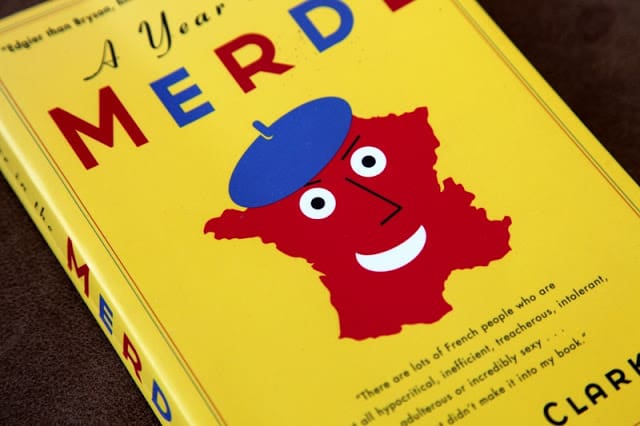
Book Club: A Year in the Merde, by Stephen Clarke

I read a lot of books about Paris and France before moving here and I’ve only recently realized I might do well to share them with you.  So, I’ll start with an old favorite.

It was the second week I was in Paris.  I had just gone to an Asterix exposition at the ugly BNF (Bibliotheque Francois Mitterand), with my friend Julien, who I had met in Adelaide, Australia, a year earlier (a story for another time).

“Stefan,” (this is how the French pronounce my name), “Stefan, do you know zis booke, ah, a year in dee Merde?”  I nodded that I had vaguely heard of it, but not much more.

He started laughing.  “Oh, you must read it!  It is soooo funny!  And it’s true!”  Julien is a great guy a real Anglophile to boot though he insists that when we go on ski trips I only speak French so I gave his recommendation its due importance and in time purchased and read the book.

It was, as he had warned me, absolutely hilarious.  One time I almost choked on my tongue while reading in the metro because I was laughing so hard.  Another time, while I was buying groceries at Franprix, I noticed that the checkout guy started to giggle quietly because he saw the book under my arm.  “C’est vrai?” I asked him, left eyebrow raised.  “Oui tout!” he responded.

So, Stephen Clarke, the author, invented this fictional Paul West character who comes to Paris for a job and gets caught in the life of apartments, work, and love.  It’s told from an Anglo perspective, and it’s particularly funny if you’ve lived in Paris for any period of time because the jokes hit on the realities of everyday life.  Some memorable lines from the book include:

Jean-Marie did the hugest shrug I’d ever seen, even outdoing the man in the electric shop.  His shoulders, arms, his whole rib cage, took off vertically in a gesture of infinite indifference.

and this

The Paris police are the best in the world at one thing sitting in buses.”

and this

Red lights are like queues,” he said scornfully, “They are for people who have time to waste.”

It’s not a perfect book, by any means, but it’s very revealing in its takedown of the French.

Clarke was a bit taken aback, I’m sure, by his success, and has gone on to write at least two other books on this theme, which I have, unfortunately, also read.  I say unfortunately because these books go beyond the playful fictional satirical conceit of the first book and just linger in stereotype that is, over time, increasingly unfunny.

Yes, it was funny that first time but if you want to keep going you’re going to have to go deeper.  In comedy, the analogue would be the first Austin Powers movie the first one was funny in so many ways the others were horrible.  Same with the sleeper Liam Neeson hit film Taken.  I love that movie.  Which is probably precisely why I hate the sequels so.

Perhaps we as moderns don’t understand that success can be solitary (witness Harper Lee being huckstered into releasing an inferior and revisionist novel in her dotage).  Success doesn’t mean having to repackage your great idea as something only slightly different.  Indeed, success is sometimes leaving well enough alone.

So, read this first one.  Skip the rest of Clarke’s catalogue.

Did you enjoy this article? TAIP is 100% reader-supported through tipping. If you want to leave us a tip of any amount it would be highly appreciated. These tips help support our efforts to keep TAIP an ad-free environment. Just as at a cafe, the tips are split evenly among the team.

french uber riot

Paris: Frontline of Airbnb and Uber’s Wars

As a resident of France I appreciate that the French hold on to their traditions and ways of life and are generally skeptical of change.  Unmoderated and unguarded acceptance of change isn’t always the best thing.  Nowhere is this more a topic of conversation these days than with Airbnb and Uber.

These two American juggernauts have seized upon a simple idea and commercialized it: there is spare space in your home or car if someone wants to rent that space for some period of time, and you are willing to allow them to rent it you can complete an exchange of commerce.  Furthermore, in many cases, the necessary taxes are paid by the company, the provider, the end-user, or all three.  So what’s the problem?

In France?  “Les acquis.”  This term refers to the amorphous set of benefits and “rights” that the French feel broadly entitled to, and are willing to march in the streets to protect.  Not only (in their mind) are these rights guaranteed forever, but in all likelihood, these rights will only get better and sweeter with time.  I’m not going to talk about this concept for the moment.  I only want to use it as a reference point to help you understand why the hotels and taxi companies are absolutely livid about these two unicorns.

In a universe of acquis you have jobs and economic systems for life.  No pesky disruptions.  Year after year your universe is set and perfect.  Taxi-driving schools collect millions of euros in tuition and hotels collect hundreds of millions of euros in bookings. Never mind that both taxi companies and hotels employ tens of thousands of foreign workers and hence this can’t be argued to be about “French jobs.”

Indeed, it is a question of secrets.  In his book Zero to One Peter Thiel talks about the discovery of secrets as key to billion-dollar businesses.  The discovery of sharing unused space was a secret.  Overnight it created, in essence, the largest room-provider and largest transportation companies in the world.  Not by a massive capital spend, but by really intuitive software that could connect the provider and the end-user.  This massively democratizes micro-entrepreneurship by lowering barriers to entry.  You would think this would be welcome in a country that carves “liberté, égalité, fraternité” into the stonework of its buildings.

And yet, the French, used to the idea that anything you do with your time for money has to come with an enormous raft of benefits, including two years of unemployment pay, burn and flip cars and raid apartments in protest.  Who are they hurting?  Uber and Airbnb have more money, time, focus, and brains to devote to winning this matter legally or they will simply pick up and leave.  In the meantime, people who own cars or apartments in Paris who are simply making some money to defray their costs of ownership, as well as everyday commuters and travelers looking to save money, are the ones actually penalized.

Despite the fact that “entrepreneur” is a French word, fundamental disconnects like this happen.  Entrepreneurs don’t get acquis.  We build our own acquis over time, with hard work, perseverance, and a tremendous amount of sacrifice.  No one forces us to do it.  We provide willing services to those willing to pay us we’re even happy to pay taxes…to a point.

It is the convergence of these two attitudes the inbuilt idea of acquis and a population that prefers guaranteed jobs for life to entrepreneurship (because they are fundamentally risk-averse) that leads to such a strong pushback against these services in this country.

And yet, it seems to be politically motivated.  Many of the people my age (and younger) actively use Airbnb and Uber here in Paris.  We know what hotels are and we know what taxis are.  We have used them, many times.  We also know that Airbnbs and Ubers are neither hotels nor taxis, and come with their own risks (as if hotels and taxis are risk-free!).  But we understand that it’s important for people to have lots of choices.  Transportation-wise, that’s what makes getting around easier: buses, metros, taxis, Ubers, bikes, scooters, and yes, walking.  Indeed, UberPool is even an innovation among taxis using intelligent software and GPS to save everyone time and money.

And yet, despite a multi-million euro settlement with Airbnb last year, the City of Paris is being pressed by the hotel lobby for more raids.  And the ride-sharing industry is under pressure after a recent taxi strike.

In English we say, “the cat is out of the bag” to say what has happened has happened, and that you can’t go back.  Parisians have discovered that they can make money renting out their homes and cars.  Hotels and taxi companies have discovered that their guaranteed monopolies are over.  The City of Paris is caught in between them.  But the secret is out, and the hotels and taxis are in for a very rude awakening should any real move be made to ban Airbnb and Uber in Paris.

Photo used via Creative Commons from R Street.

This article was also published on Medium and LinkedIn.

Did you enjoy this article? TAIP is 100% reader-supported through tipping. If you want to leave us a tip of any amount it would be highly appreciated. These tips help support our efforts to keep TAIP an ad-free environment. Just as at a cafe, the tips are split evenly among the team.
The Path to French Citizenship Begins, or “Visitor No More”

Note from the editor: In light of new guidance on remote working in France as shared by the official French tax office in June 2025, we have also officially changed our stance on remote working for a US company while living in France under the visitor visa. Read more here, and contact us with any questions or concerns. We’re here to help! — MS

I saw her place the green and white paper on top of my file.  It was the paper used to print a récipissé (the temporary document one uses for identification while waiting to get a permanent identity card).  Externally I remained stoic.  Internally my jaw dropped and I wanted to shout out.  That enormous dossier that I had handed over 15 minutes earlier had worked.  Not only had I successfully jumped the track from the hamster-wheel of visitorhood to the track to an EU and French citizenship, but this had been the shortest prefecture visit since I moved to France in 2013.  From start to finish it had been thirty minutes.  I had felt supremely confident in my dossier but this was France, after all.  There could always be something objectionable.

Still dumbstruck, I silently handed over my photos.  As the big printer hummed, she clipped out one of them, handed the rest back to me, then dutifully affixed it to my récipissé.  She then gave it all the stamps and signatures it needed after I had verified all the information and signed it myself.

Today is eight days after I successfully changed to a Profession Libérale visa.  As long as I earn a certain income over the next five years and pay the requisite taxes, I’ll be eligible to apply for French citizenship (note: that does not mean I’ll get it).  I’m officially allowed to work in France, now.  I had to go to URSSAF yesterday to do more paperwork, and I need to come back in 90 days to give the prefecture that paperwork, but that’s literally paper pushing, rather than the complex compilation of a dossier.

Could I have taken this path immediately in 2013 instead of taking the visitor route?  Yes.  Indeed, if there are any of you out there interested in taking this path, I can help consult you through this process as someone who has successfully completed it and has a winning template.

And yet, the answer for me is also No.  I could not have taken this route myself, knowing as little as I did about France in 2013.  I didn’t even know what I didn’t know, and my plans and ideas about my time in France were so inchoate when I landed here.  Yes, eight days ago I took a bulletproof dossier to the Prefecture…but I knew it was bulletproof because of my last two visits there and what I had learned about the French and their expectations in the last three years.

It’s also been marvelous to hear from people I’ve met because of this blog not just those who needed help regarding the visitor visa but those who have started to meet with me to strategize about what I’ve just successfully done: a transition to the citizenship route.  A few of their testimonials are here.

Thanks for continuing this journey with me.  Last Thursday was the end of the beginning.


Did you enjoy this article? TAIP is 100% reader-supported through tipping. If you want to leave us a tip of any amount it would be highly appreciated. These tips help support our efforts to keep TAIP an ad-free environment. Just as at a cafe, the tips are split evenly among the team.

The Clothing Inventory: How I Escaped the French Sales Season

The “official sales dates” in France are roughly January 6-February 16 and June 22-August 2.

SOLDES!  The all caps scream out at you from all the shops in Paris then there’s the deuxième démarque, and the dernier…at each stage the frantic pace increases, and stores get progressively messier as the “regular” sizes sell out.

Paris will up your fashion IQ even if you never planned for it.  Scarves, shoes, jackets…I had definitely upgraded since moving, and there’s always something you can add…or is there?

I wrote some time ago about forced decluttering and about how a small Paris apartment forces you to be thoughtful about your “stuff.”  Combine that with a recent shine I’ve taken to the Minimalists and their ideas, and I was doing my best to resist…must not buy…clothes on sale…I tried to remind myself that he/she saves the most when nothing is spent.

But willpower wasn’t enough.  I took a clothing inventory.  Apart from socks/underwear I simply counted every piece of clothing I had.  Every scarf, tie, shirt, shoe, jacket, etc.  I typed it all up and printed out the 2-page document and looked it over.  There were no spots I needed to fill.  I had a great wardrobe.  Indeed, I realized that still some might go away via the 90-day rule I’ve observed since 2010 if it’s in season (ex: sweaters in winter) and I haven’t worn it in 90 days, it has to be given to someone else who will use it better than I will, or to a place that takes clothing donations.  So, instead of getting sucked into the sales season I took an opportunity to remind myself that I might be getting rid of some clothes as we move from Winter to Spring.

If making the clothing inventory isn’t enough print it out and carry it with you so that every time you want to make a purchase during the sales season you can pull it out and check yourself. 🙂

“Soldes” photo from pterjan.  Creative Commons.

Did you enjoy this article? TAIP is 100% reader-supported through tipping. If you want to leave us a tip of any amount it would be highly appreciated. These tips help support our efforts to keep TAIP an ad-free environment. Just as at a cafe, the tips are split evenly among the team.

French for “Customer Service”

“It’s not my problem”

accompanied by a shrug, said by almost every French person ever to a customer in need of help.

The quote above is a caricature, surely, but my French friends will admit it’s pretty close to the truth.  It’s my third year here in Paris, and when your expectations are so very low, when you get surprised, you want to share it.  So, here are two such stories.

Groupama

Groupama provides my renter’s insurance, something that is helpful in itself, but is also a requirement of most of my visa visits, including my recent one to move away from visitor status to a path to citizenship.

However, they, like many French insurers, make it impossible to cancel a policy online.  You have to go in person and provide a signed état de lieu as proof you have moved out.  Your word is not enough (same thing happens at the bank when you try to change your address).  Do you have proof?

In any event I had moved out of this place roughly 6 months before I managed to get to my insurer.  I took the blame, as other things always seemed to take priority.  Not only was the cancellation smooth, only taking a few minutes, but the agent marked the cancellation to the end of the lease, and credited my account with 6 months of premiums!

As the French write: “Waoh!

Decathlon

The next mission was already impossible in my mind before I attempted it, but in the spirit of “try everything once” I took back two inflatable mattresses to Decathlon.  I had purchased the first one for guests who might stay at my apartment and it worked fine for months.  Until it started to slowly deflate.  I spent some time trying to find the slow leak so I could patch it, but no dice.  It was only 15 € and I hadn’t kept the receipt.  I bought another.  This one started deflating almost immediately.

I called it a day on the inflatable mattress plan and bought a Japanese-style fold-out bed at Castorama.  No deflation possible!  But I still had two non-functional inflatable mattresses.

I suggested to a couple of French friends that I would try to return the beds without a receipt (I had idiotically not kept the second one, either).  They laughed derisively.

“I’ll just play the dumb American,” I said.  “Plus, I’m willing to accept store credit.”  Turns out I didn’t have to.

I arrived at the enormous subterranean Decathlon near the Madeleine (Americans, think Dick’s Sporting Goods or Sports Chalet) and got into the returns line.  When it got to be my turn I explained that I didn’t want an exchange, but that I wanted to return these mattresses for store credit.  The young girl called a colleague over, who then walked with me to the camping department, where the inflatable mattresses lived, in order to observe the malfunction.  And to my dismay, the same thing happened as whenever I brought an Apple device to an Apple store for troubleshooting: nothing.  I almost wonder if the Apple Store is a stern father figure for my Apple devices and they suddenly “behave” when they are at home.

I watched, bemused, as the inflated mattress which had deflated over and over in my home held the air intact.  We even tried sitting on it to force the leak.  Not a peep.  Resolute as Churchill on the beaches.

The kid read my incredulous expression.  “Don’t worry,” he said in French.  He walked me to the counter, got me a gift card for the value of both mattresses, and as I walked out of the store and held the gift card in my hand, contemplating the imposing facade of the Madeleine, I smiled.

Maybe there is a French word for “customer service” after all.

P.S.  Don’t worry, I have a horror story to share in the future for those who wish to further the paradigm of “the French just don’t care about customer service.” 🙂

Did you enjoy this article? TAIP is 100% reader-supported through tipping. If you want to leave us a tip of any amount it would be highly appreciated. These tips help support our efforts to keep TAIP an ad-free environment. Just as at a cafe, the tips are split evenly among the team.


Ars et Metiers Museum Paris

Making the most of Free Museum Sundays

A large number of museums in Paris are free on the first Sunday of the month.  Some budget-minded travelers know this and schedule a visit to Paris around such a date to knock out some museums for free.  Is this a good strategy?  Yes and No.

I’ve done over 20 Free Museum Sundays (as I call them) since I arrived in Paris, and I’ve come to the conclusion that whether you’re a local or a tourist, this day is great to use for short, targeted visits to the little-known museums that go under the radar for people on a Museum Pass rampage, and also don’t draw big crowds on the 1st Sunday of the month. Don’t use it to go to the Orsay or the Louvre.  Trust me on this.

You can find the list of the dozens of museums that are free here, but here are three suggestions that I can make for you that would be good uses of your time.

The Gustave Moreau Museum

Moreau was born in 1826 and lived during a period of great change in France following the 1st Napoleonic era.  His art draws on too many influences to neatly fit into a school that you might know, and as such is singular in appearance.  As I think upon his body of work now, some pieces are too unfinished to even be “impressionistic,” and yet some, like his Orpheus, which often hangs on the first floor of the Orsay (when it’s not out on loan) recalls the Academic style so favored by the Salon.

This marvelous 3-story house, with a lovely and elegant preserved staircase to take you to the top floor, is the perfect showcase for this unique artist.  Even a gentle wander should run you at least 30 minutes.  A true visit should run you 60-90 minutes.

The Eugene Delacroix House

Delacroix is probably best known for his Liberty Leading the People, an image that hangs in a gallery in the Louvre roughly 30 meters from a beautiful painting of St. Joan of Arc at the coronation of the Dauphin.  I point out to my guests that this is an example of a contradiction the French are comfortable with: two women of power one supporting the monarchy, another leading the French over the bodies of the defenders of the monarchy.  The two Frances (one Catholic and royalist, the other anticlerical and republican) are on display for you in that gallery, if you just give yourself some time to make the connection.

But even royalists like myself can appreciate Delacroix, especially for his famous Dante and Virgil in Hell (which also hangs in the same aforementioned gallery in the Louvre, not far from Gericault’s Raft of the Medusa) and also for the ongoing transformation and maturation in his work and technique.  This museum is much smaller than the Moreau museum, but features a lovely garden to rest in.  A quick run can be done in 30 minutes, but no need to rush.

Arts et Metiers

This museum is the largest of the three I’m recommending today, and will take at least 2 hours of your time to see properly.  I call it the “Nerds’ Museum” because it has all sorts of wonderful inventions and gadgets from many different eras in it (think everything from the first barometer to a Cray supercomputer), including the highlight: Foucault’s Pendulum.  In 1851 Foucault used this device to prove that the Earth rotates.  Additional good news?  Every Thursday the museum is also free from 18h00-21h30.  So you don’t even have to wait for the first of the month.

Paris has over 50 museums.  No better time than the beginning of a new year to start seeing some of them.

Did you enjoy this article? TAIP is 100% reader-supported through tipping. If you want to leave us a tip of any amount it would be highly appreciated. These tips help support our efforts to keep TAIP an ad-free environment. Just as at a cafe, the tips are split evenly among the team.

Mailbag: Passport Pages, Transferring Your Visa, and Taxes

It’s been a while since I’ve done one of these, but it’s often helpful for me to share some of these answers to questions I get in email so that others who are also wondering might have their questions answered as well.

How does adding passport pages to my (US) passport or renewal of it affect my visa?

Well, this is a two-parter.  As of December 31st, 2015, the US Embassy in France is no longer adding pages to your passport.  What that means (and I confirmed this in person at the Embassy) is that you will have to apply for an early renewal of your passport, as US citizens living abroad are not permitted to mail their passport back to the US for pages to be added there.  For my battle-worn blue book, that renewal ends up being roughly 3 years early.  But given that I’m down to room for exactly 5 more stamps, it’ll have to do, especially since I have a lot of travel later this year.

As to how it affects your visa: it doesn’t.  If you’re in the first year of your long-term stay visa, your carte de séjour exists in the form of the sticker that OFII put in your passport roughly 90 days after you arrived during your follow-up visit.  If you add pages/renew your passport you will get your cancelled passport back and still show that sticker, if you need to.

If you’re in your second year and beyond, you will be issued an actual carte de séjour after your renewal, which effectively functions both as your ID and your visa.  Those stickers in your passport from years ago are then like the rest of the stamps in your passport memories but nothing legally important.

You said recently that you had to file taxes?  How did that go?

Great question!  Funnily enough, despite sending them a properly filled-out French tax return appropriate for a foreign filer, in which I indicated that my income had not been derived from French companies, they still sent me a bill for 1781 euros.  After some laughter with my accountant and attorney, an email was dispatched to the relevant department:

réf de l’avis:15 75 XXXXXXX XX
Nº fiscal déclarant: 30 25 XXX XXX XXX X

Messieurs,

Je reçois cet avis d’imposition dont je conteste le fondement. En effet, l’assiette de la CSG et de la CRDS est l’ensemble des revenus français quelque soit leur nature et montant.

La totalité des revenus composant l’assiette de cette imposition a été d’origine américaine, perçue et imposée aux USA conformément au traité fiscal franco-américain.

En conséquence, de par la définition même de cette double imposition CSG – CRDS, l’assiette de cette imposition ici présente est non conforme. Je demande donc son annulation immédiate et sans condition.  

Cordialement,

Stephen HEINER

The next day, which is essentially light speed by French standards, had this response in my inbox:

Monsieur,

Votre demande a bien été prise en compte. Vous allez bientôt recevoir un avis de dégrèvement.

Salutations.

Translation: You’re right.  You don’t owe any money.

Stephen: Gee, thanks. 🙂

Did you enjoy this article? TAIP is 100% reader-supported through tipping. If you want to leave us a tip of any amount it would be highly appreciated. These tips help support our efforts to keep TAIP an ad-free environment. Just as at a cafe, the tips are split evenly among the team.