How to Renew Your French Long-Term Stay Visitor Visa

Note from the editor: In light of new guidance on remote working in France as shared by the official French tax office in June 2025, we have also officially changed our stance on remote working for a US company while living in France under the visitor visa. Read more here, and contact us with any questions or concerns. We’re here to help! — MS

The heavy, ancient printer started printing my récépissé.  I closed my eyes.  Whenever the old printer starts running in a French immigration office, you’re in the clear.  I had done it.  I had survived my first year in France and I had just renewed my visa too.  The relief and triumph wasn’t nearly what I felt when I first got one or confirmed it.  But it was relief.  Palpable relief.  I could go on about my year without having to think about this again for a while.

Because I had originally moved to Paris in December 2013 my one-year visa was up that same month in 2014.  Trouble was it was around the time I needed to go back to see my family, take care of some business, etc.  I could have chosen to renew it earlier, or I could have just chosen to move to France sometime other than in December, but there it is.  Think about where you will be in one year whenever you do apply for your visa.  I think December and January make a lot of sense for many, though, because the move has all the notes of a “new start” and you give yourself a whole year of runway (although some of our readers need only two months!)

To be fair, I had to make two visits, because they asked for some things I didn’t have on hand the first time.

You can make your appointment for renewal online at this link.  I should make the point that I am speaking to people applying for a long-term visitor visa.  Students and workers should consult their own subcategories when preparing their dossiers.

I did have a list of what was needed at the time, but this constantly changes and the Préfecture has stopped providing an online link to such a list.  On that list is marked the need for the original and one photocopy for each of the documents listed.  However, if you have forgotten or the copies get damaged on your way there, there are large commercial copying machines that charge you ten cent(imes) per copy in the vestibule of the office you have to go to.  There are also two Photomaton booths to take your pictures should you have forgotten them.  They honestly do have your bases covered here.

Where to Go

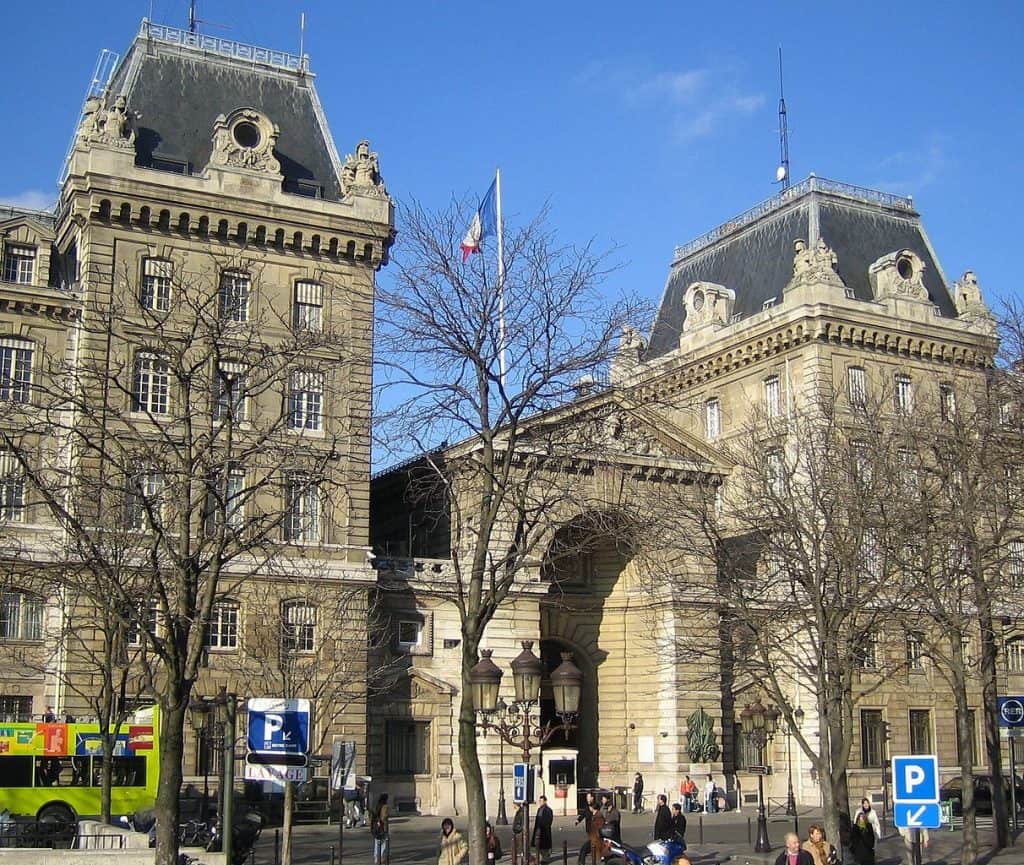
It faces Notre Dame directly and is easily accessible via the Cité stop on the Métro.  Bring water, snacks, a nice book to dig into, a charger for your phone, and block out your whole day for whenever your appointment is.  Some say mornings are better, others afternoons I only chose afternoons because I’m not a morning person and in both instances I “checked in” an hour before my appointment which allowed me to actually be seen only 30 minutes after my scheduled appointment time.  Be early or you may not even get seen that day.  I’m serious.

Paperwork you MUST have:

1.  A copy of your original titre de séjour as well as the passport which contains it.  This is the sticker you would have gotten on your follow-up visit when you first arrived in France.  For visitors your first year titre de séjour resides simply in your passport.  Come renewal time, you actually get issued a card.

2.  Your birth certificate.  You’ll need a certified French translation of it.  Mine was written in English by the Singaporean government and the French translation cost 72€.  If you need the translator’s contact info, simply send me an email.

So, about that birth certificate.  If you’re like me, you keep all your important documents in a folder somewhere.  The trouble was, up to the point when my eyes first looked upon these requirements, I thought I had brought them with me to France.  My birth certificate, immunization record, baptismal certificate, all that jazz.  After the search that starts with, “I’m sure it’s around here somewhere,” turned to, “Goodness, did I actually not bring it to France?” I ended with the eye-closed panic of, “Oh no, it must be with my stuff in storage.”

Before I went to the nuclear option of having to order new copies I called up reliable people in my life a business partner, a sister, and my mother: “Did I leave any documents with you or do you happen to have a copy of my birth certificate?”  They all replied in the negative.

The boxes of “stuff” that comprised my life when I had an enormous townhome in the United States were currently peacefully residing in the spare room of a dear friend in Kansas City.  It was already enough that he was storing these things for me at no charge.  I wasn’t going to ask him to do the dreaded task ahead: go through all the boxes looking for a manilla or green folder that has a bunch of important documents in it.

Who could I call?  My ex-girlfriend.  I know, this sounds odd, but hear me out.  She is one of the sweetest, best girls I’ve ever dated and she can tell you herself that the move to Paris was perhaps the biggest reason we broke up.  So, could she now assist me in helping to prolong said stay in Paris?  Yes, she’s actually that awesome.

After work one day she drove 30 minutes to my friend’s house and audibly inhaled when she saw the roughly 20 boxes and rubbermaid tubs she had committed to going through.  She called me.  “You’re kidding, right?”  Chagrined, I replied, “Look, if you find it, great.  If you don’t find it, I still owe you.”  Various words of affection were exchanged and she commenced.  Two hours later, no dice.  She hadn’t found it.  (Postscript to the story: when I visited last month to clear out those boxes I found the documents, in a green folder, in a box closest to the doorway.  It might have been in a state of fatigue that she missed the closest possible option.)

So I was officially out of luck, and given that I had only pulled up the requirements six weeks before renewal (how hard could it be, right?  Wrong!) I now had to convince either the American government or the Singaporean government to get me a certified copy of my birth certificate.  Why would both of them have one?  Well, I was born in Singapore, so that’s why the Singaporean government would have one.  But I was born as an American citizen abroad, by virtue of my father, so we had a Consular Report of Birth Abroad as well.  Either would suffice.  I decided to bet on both simultaneously.

I went to the American Embassy the Monday after Meghan’s unsuccessful search and got a notarization for a request for the certified copy of my consular report.  I enclosed an American check with the $14.95 overnight mailing fee.  The Singapore process was a little more complicated, but more automated.  I would have to request a copy of my birth extract, which would contain my birth certificate number.  Then I could use the birth certificate number in conjunction with other documents to request a certified copy of my birth certificate.

What had my failure to bring this single document to France with me cost, apart from the emotional distress of waiting?  Roughly 300USD.  So, don’t forget, kids.

Ultimately, Singapore won my bet.  A registered letter containing my birth certificate arrived the day before my appointment at the Prefecture.  The American one had arrived at my American post office box (I use US Global Mail to receive mail and packages while I’m in Europe) a day before but because it was around the Thanksgiving holiday I would not get it overnighted to Europe in time.  And you can’t ask them to ship your certificate outside the US.

3.  Three photos of standard size.  As I said in previous articles, you can find these literally all around Paris and even if you don’t, they have two machines out in the vestibule you can use.  Five euros gets you five photos.  Keep the photos.  You’ll need them for other documents and applications while here.

4.  If you are married or have children you will need proof of marriage as well as the birth certificates for your whole family.

5.  EDF or QDL.  EDF is short for “Électricité de France,” the monopoly state-run organization and one of the many providers who can give you an attestation you can use for pretty much EVERYTHING in France.  If you rent, like I do, you might not get an EDF, so you’ll bring an up-to-date Quittance de Loyer which is simply proof from your landlord that you are paying rent and have done so faithfully, etc.

So those are the basics for all visas.  Now, let’s look at page 2 and what we long-term visitors additionally need.

6.  Twelve months of bank statements.  I hope you saved yours or get them digitally.  These should come from a French bank account and you need to ensure that you are not receiving any income from any French companies.  Make sure any wire transfers that come in come from a corresponding account in your name.

Remember that you signed an attestation when you got your visa that you would not do work while here and the careless forgot that (or just stupidly got jobs) and the careful civil servant may look at your statements line-by-line.  All my paperwork had been in order up to this point so when my agent started flipping through my bank statements she looked up and asked, “Where do you get your money?”  “I tutor on the internet and I also write.”  She nodded, flipped through to October 2014, which was the last statement I could provide, and promptly turned them all over to her “done” pile.  If you don’t have sufficient cash flows in said bank account (they like to see a minimum of 1.5-2k € a month of revenue) you may have to produce other evidence of means be it a savings account, etc.  As I’ve written before, a simple letter from your bank will not be sufficient.  They will want statements.  (A previous version of this article implied that your foreign, i.e. non-French, account would be sufficient, but that is not the case anymore.  They want to see a French bank account for renewal.  If you have experienced otherwise for a renewal of this visa, please share with us in the comments.)

7.  Health Insurance.  When I was in America, it was okay to provide proof for this in English.  Not now.  You’re in France now, so just as my birth certificate needed an official translation, I needed one for my medical policy as well.  I had originally selected Cigna Global and while I only found out later that they did have French translations of all the relevant documents, the agent on the phone told me that the “front page” of declarations would be sufficient.  Unsurprisingly, it wasn’t.  The cost of translating my whole policy would have been more than simply buying a French policy of health insurance for foreigners.  So I did just that, and in my cancellation call with Cigna (with a very courteous and apologetic Irish girl) I was told that they did indeed have French docs.  Sorry, I told them.  Maybe next year.  If you want a French policy, I can put you in contact with my agent.  Great lady.

8.  Renter’s insurance for my apartment.  Ohhhhhh.  Well, despite the fact that my lease had stipulated that I carry this, I had simply forgotten.  This held me up at my first appointment and led to a “follow-up” at which time I would bring said documentation proving I did have it.  Rather than admit straight out that I didn’t have such insurance I simply said that I didn’t bring it, which was true I hadn’t. 🙂  We scheduled a time seven weeks out, when I would have been safely and actually back from my Stateside visit, and when I came back, having secured insurance (if you need that, my guy is great), I handed said docs to her.  She stamped a couple of things, had me sign the document for my new carte de séjour and the old printer started printing.

What was printing was my “récépissé.”  It was a “temporary ID” that was valid for two months.  In two months I could come back to the prefecture, drop 106 €, and pick up my permanent card (which I’ll have to renew again).  This was the final separation of my passport from the act of flashing “ID” when asked in France.  To be honest, my American driver’s license worked most times.  But if you’re writing a check, they will prefer a French ID, though some smiling and hand wringing will usually allow for the exceptional passport to be used as proof.

I was, of course, relieved.  I didn’t do this entirely by myself, though.  I consulted with someone who specializes in helping expats, Jean Taquet.  I first started speaking to him last year as part of a long-term strategy to build a business and stay in France.  If you want he will hold your hand every step of the way through the titre de séjour process, up to and including coming with you to the Prefecture.  It’s not free but I’ll leave it to you to discuss fees with him.  I’ll also talk more about Jean and his help for those who want to make a long-term living here in a future blog post.

As always remember that if you have your stuff in order and are polite you’ll have success.  Speak the French you’ve hopefully been learning all year with even a measured diffidence, and you’ll go further.

Photo is of the eastern-facing entrance to the Prefecture, which is where you will exit from whether your visit was successful or not.

Did you enjoy this article? TAIP is 100% reader-supported through tipping. If you want to leave us a tip of any amount it would be highly appreciated. These tips help support our efforts to keep TAIP an ad-free environment. Just as at a cafe, the tips are split evenly among the team.
Mailbag: Long Term Stay Visa Q&A

So as I was getting ready to go back to the States in December I started corresponding with a Lauren L. who had some visa questions for me which originated from this article.  Here were her questions:

 I have an appointment for the long stay visitor visa in New York in three weeks and I’m noticing differences in the requirements between the NY and Chicago consulates. Is this normal? NY seems to require fewer documents and doesn’t mention needing notarized statements or forms for my application.

This is totally possible.  There isn’t a uniformity of observing standards, even though there are universal standards.  If there are fewer documents, that’s great.  If you feel you need backup, there’s nothing wrong with having that with you as well.  Just don’t give stuff you’re not asked for.

 I’m only 24 and am coming to join my French boyfriend, travel around Europe, and improve my French. Is this going to be a red flag if I write this in my personal statement as I am still young? I worry they will have a hard time believing I won’t be working or trying to find work.

No, I think this is fine.  Remember you are applying as a visitor so they don’t necessarily expect you to be looking for a job.  Remember that it’s illegal for visitors to even think about getting a job so they take you at your word that you are “visiting,” which dovetails into your last question…

 My “means of income” will be coming from my parents, who are submitting three months of their bank statements along with letters stating their intent to fully support me financially while I am abroad. Is this enough proof?

This should be fine.  Those of us not in such a situation will generally want the funds to be in our own name, but I think for you this will work.

Lauren was actually visiting Paris in December but we weren’t able to meet before my vacation stateside.  I told her by email that based on what she told me she should be fine but here are the specific answers for anyone else who has the same concerns.  (And happy ending: Lauren got it!)

When I was already stateside I got this tweet.

I wrote her back and come to find out that she had some of her own visa travails and some of my articles helped out.  Part of why I wrote some of these articles was precisely to help others as I found the content out there not the most helpful or up-to-date.  It’s really neat to see some of those exact people thanking you for the advice.

Photo courtesy of m43photos, via creative commons.

Did you enjoy this article? TAIP is 100% reader-supported through tipping. If you want to leave us a tip of any amount it would be highly appreciated. These tips help support our efforts to keep TAIP an ad-free environment. Just as at a cafe, the tips are split evenly among the team.

Long Term Stay Visitor Visa, Part 2

Note from the editor: In light of new guidance on remote working in France as shared by the official French tax office in June 2025, we have also officially changed our stance on remote working for a US company while living in France under the visitor visa. Read more here, and contact us with any questions or concerns. We’re here to help! — MS

Despite the work it took to obtain my visa in the first place, my paperwork was not completed.  This is what happens when you get here.

I will admit, I was planning for a full-day affair on March 12th.  That was the 90-day mark of my arrival and OFII (Office Français de l’Immigration et de l’Intégration) wanted my bright shining face in the 10th arrondissement at 09h00.

I needed to bring the following with me:

1.  The letter which had been mailed (and emailed) to me providing proof of my appointment.  Easy enough.

2.  My passport.  Of course.

3.  My quittance de loyer or attestation d’hébergement.  Asked my landlord, piece of cake.

4.  A photo.  They have photomatons all over the city where you can step into a booth and knock this out.  5 euros for five pictures.  You can use them for all sorts of things.  Notice how happy I look!  But in all seriousness, you’re not allowed to smile.

5.  Fiscal stamps.  This was hilarious.  I needed to go to a Tabac a store that sells tobacco which is often a café and buy these.  You use them for all sorts of taxes and fees.  There were two and then soon ten anxious smokers behind me in line, as the lady kindly counted out 241 euros in fiscal stamps.  To be fair you can now, mirabile dictu, buy these online!

6.  A vaccination card. This was proof that I had gotten all the basic stuff.  The kind folks at Sunflower Medical Group faxed that to me the same day I requested it.

So I had a bit of work I had to do in the days leading up to my appointment.  Day of, I packed snacks, sandwiches, a book, my journal, etc.  I was ready to be there all day.  Boy was I wrong.

Perhaps it is the repetitive nature of what they do, but this group of French civil servants are among the most efficient I have seen in any country, ever.

I was checked in downstairs by a security guard, who sent me upstairs to my first waiting area.  I had arrived at 08h50, about 10 minutes before my appointment window.  I was seated for about three minutes before I was moved to another area.  Instead of the first room, which had 30 seats and only six people seated, this oval room had 40 seats and all but three were taken.  These were immediately taken by myself and the other two aliens/immigrants who had been walked down the hall from Room #1.

I got comfortable, got out my book (Msgr. Robert Hugh Benson’s Lord of the World, an excellent read, by the way, and free on your Kindle or Kindle app) and got ready to be there for a while.

After 20 minutes of reading I looked up to get used to the flow of traffic.  Immediately to my left there were nurse practitioners or equivalents calling out names.  After going into that room, you are a little later called into another room, then another, then you leave to go back to the front.

One of the interesting aspects of the morning was hearing the French try to pronounce non-French names.  “Stephen Heiner” comes out as “Steve-fen Eye-Nehr.”  I’ve often thought of creating a “stage name” during my time in France something like “Etienne Henry.”  Etienne is French for Stephen and Henry would just be an elision of Heiner.  Oh well, next time perhaps.  When I didn’t have to show documentation that I was someone else 🙂

I heard my name amid the buzzing French conversations and stood up and went into the first room.  I was asked to take off my coat and scarf and was weighed, measured, and given an eye test.  There didn’t seem to be any problems, and as a bonus I found I had dropped 5 kg, about 12 pounds, since I had been in France.  I could keep this up and be at my ideal weight after nine more months! 🙂

I should note here that I’ve very much taken on French rhythms and customs of eating, with a paleo twist.  I don’t snack in between meals, my portion sizes are sensible (read: not American), and I cook my own food most of the time.  My paleo twists are frequent use of butter and meats, and a reversal of my age-old practice of increasing meal size as the day goes on.  I now have a huge breakfast (when it isn’t Lent, of course), a medium-sized lunch, and a modest dinner, with the dinner taken before 19h00.  Of course, when I go out with friends for meals we usually don’t even get to the restaurant until 20h00.  But most days this is the regimen and that, combined with my having to walk and bike everywhere an average of 3 miles per day was probably the main reason I lost that winter weight that had been storing up during my car-dependent life in America.

I sat down after this felicitous weigh-in and dug back into my book.  09h45.

The next station was the radiologist.  There were three changing rooms we lined up outside of.  We would step in and lock the door, which would activate a light on the other side to let the radiologist know there was a new “customer” waiting.

We were to strip above the waist and wait patiently.  After a few minutes my door opened and I was walked to an x-ray machine.  The radiologist said “Breathe-in” in French and I took a deep breath and held it.

At around 10h30 I was called for my last stop in the oval room: the doctor.

She asked if I spoke French and I said that if she spoke slowly, please, I would be able to keep up.  Fluents, by nature, speak quickly.  I do so unconsciously in English all the time.

She laughed and obliged.  She looked over my files, asked for my vaccination card, and ticked off some other questions like was I taking any medications, etc.

She stamped and signed a sheet one for my records and one to hand to my final stop.

I was back in the room I started in.  I sat down just in time to watch the exchange between the woman in charge and another person, like me, getting ready to check out.

(In French)

“Your papers, please”

(girl hands them over)

“Photo, proof of residence, and fiscal stamps, please”

(girl hands them over)

Woman takes everything, then frowns and hands back a piece of paper.

“This is not sufficient.”

Now, the girl had handed her an SFR cell phone bill, which everyone knows isn’t good enough for anything.  The woman asked for a quittance de loyer or attestation d’hébergement, or the single most important piece of paper for your administrative life in France, an EDF (Électricité de France) bill.

(girl stammers back in halting French that she doesn’t have it)

Bien, revenir, alors,” the woman said, annoyed.

The girl stammered, in English, “I come back?”

Oui, oui, cet après-midi, demain, ce n’est pas grave.”  She was more annoyed now.

The girl made it into a statement, “I come back.”

The woman stared her into going away.

That girl left without the one thing we all were there for today: the sticker in the passport saying we were “legal.”  I was scared.  I triple-checked all my stuff.  But I had everything.  She smiled and handled my papers, put this all-important sticker in my passport, and stamped it.

She handed me a sheet of paper which instructed me to go to my police station in my prefecture, which is the final step in this process.  And she demonstrated what I’ve come to realize:  if you come prepared with all you need, the French are happy to help you on your way.

So, I’m not totally done, but mostly done, and the second step was a total breeze compared to the first.

Photo by Hush Naidoo Jade Photography on Unsplash

Did you enjoy this article? TAIP is 100% reader-supported through tipping. If you want to leave us a tip of any amount it would be highly appreciated. These tips help support our efforts to keep TAIP an ad-free environment. Just as at a cafe, the tips are split evenly among the team.

How to Get a French Long Term Stay Visitor Visa Part I: Learning to Love Bureaucracy

Note from the editor: In light of new guidance on remote working in France as shared by the official French tax office in June 2025, we have also officially changed our stance on remote working for a US company while living in France under the visitor visa. Read more here, and contact us with any questions or concerns. We’re here to help! — MS

Many things have changed since late 2013 when I authored this.  For a version of this article that takes into account VFS and Covid-19 click here.

You would think the fact that I’m conversational and literate in French, and that I’m a teacher, would alert me to the fact that as I went back and forth with the machinery of the French consulate, I would remember that the very etymology of bureaucracy traces to the French word for desk.

When I first started doing the research behind the visa I would need to live in Paris, I didn’t find much help.  About.com had a decent article, but it was from 2006, and who knew what had changed since then?  Here’s what I was able to glean from the web, before I made my way to the website for the French Consulate office for my region, which happened to be in Chicago:

  1. You cannot get a student visa unless you are going to school at least half-time.
  2. You cannot get an “au pair” visa where you trade out work around a home in exchange for rent – once you are over the age of 26.
  3. You cannot get a work visa without a sponsor in France who is guaranteeing your job.

The last option, you have to imagine, for someone who has spent the last decade building businesses, was the least viable.  And so, I had to look at the long-term-stay visitor visa.

I received a one-year stay visa just a few weeks ago so this is not just a chronicle of how I did it for the edification and amusement of my friends and family it’s also a how-to for those of you who are US citizens who want to follow in my footsteps to successfully obtain a visa and can’t get any of the visas I listed above.

Guiding principle when dealing with the French: be calm, polite, friendly, and prepared.  And never assume you will simply get the visa because you gave them the form and the money.

What You Need

  1. A filled out application form.  That link is for the English version.  I decided to kiss up and fill out mine in French (couldn’t hurt my chances, I thought).
  2. One passport-sized photo which will go onto the application form.  You need to make sure it’s against a white background, captures your full face, has no glasses or hat, and has your mouth closed.  Don’t smile!
  3. Your passport (you’re going to have to leave it with them) plus one copy of the identity pages.  I suggest you make a couple of copies so that you have some on file yourself should some mishap happen.  This might also be a good time to make sure you have a passport card so that if you need to travel to Canada or Mexico while your passport is with the consulate you will be able.  This is mutually exclusive, though the State Department will need your passport too in order to send you back your passport card so you would have to apply for it in plenty of time to get your passport back before your visit to the consulate.  Your passport must have been issued less than 10 years ago, must be valid for at least 3 months after your projected return to the US, and have at least 2 blank visa pages left.
  4. Status in the US.  A simple statement saying “I am a citizen of the United States.”
  5. Letter explaining what you intend on doing in France.  I wrote a one-paragraph statement that said I was planning to visit France and learn about it and perhaps write about it.
  6. Notarized Letter promising not to work in France.  I wrote a one-paragraph statement in which I stated that I would not be working for any French companies during my stay.
  7. Letter of Employment in the US stating occupation and earnings.  So here’s where it gets interesting.  It seems as though the French expect that you either have a job or are taking a leave from a job in order to come and they want certification.  They are even okay if you continue to draw pay from that employer.  As long as it’s not a French company (and hence, you are not depriving someone in France of a job they could have) they don’t care.
  8. Proof of means of income.  They will want at least your last 3 months of checking and savings accounts, if not more.  How much are you going to need?  Great question.  From what I could tell during my interview in Chicago, they want your rent + $800 per month for every month you are staying, minimum.  So, let’s say you have a very small place in the city, like my apartment in the 17th arrondissement, where you will pay at least $1000, add in $800, and that brings you to $1800/month.  If you want to stay for six months they will want to see that you either have that in savings or that you will earn enough (item #8) in combination with your savings to stay.
  9. Proof of medical insurance.  This one requires a bit more pirouetting.  You may not apply for a long-term stay visa until 90 days before your departure.  The company I use only sells annual policies.  However, the French are going to want to see full coverage during your time there.  I split the difference.  I got a policy that went into effect two weeks after my visit to the consulate, which was 86 days before my departure (I wasn’t taking any chances!), and when I sent the proof of insurance to the consulate I stated that the policy auto-renews at the end of one year.
  10. Marriage and/or birth certificates for the children.  I got to skip this one!
  11. Enrollment in school for your children.  I also skipped this.
  12. Proof of accommodation in France.  I initially presented them with an email from my landlady.  This would be rejected and a copy of her passport, as well as her utility bill, was asked for.  Have those on hand to skip my delay.
  13. The processing fee.  This will change so check here to see the latest cost.
  14. A self-addressed prepaid EXPRESS MAIL envelope.  Absolutely no UPS, FedEx, etc.  Good ol’ US MAIL.

Did you do all that?  Good.  You’re still not done.

Make an Appointment

Now you have to make an appointment in their system after you’ve gone through the France Visas visa wizard.  The French are not known for their amazing websites and often this link will not work, or be wonky.  Be patient.  Switch browsers.  Keep trying.  At some point, you will get to the appointment system.  Make an appointment.  Keeping in mind that processing time can take up to one month, I would recommend that you have your appointment no later than 60 days before departure.  Despite the fact that I submitted my application at perhaps the earliest possible date, I was still incredibly nervous and stressed as the back-and-forth commenced.  I wouldn’t wish it on you.

I had no other business in Chicago the weekend I planned for my visa so I simply scheduled a flight up for Friday morning (my appointment was at noon) and a flight back Sunday morning.  I got a rental car so that I would be in complete control of my destiny on Friday.  Didn’t want to take any chances.

I had all my paperwork together.  Now I had to have my in-person interview.  Don’t let the word “interview” fool you.  All you are doing is dropping off forms, giving them money, and smiling for the camera.  It’s all very routine.  I imagined I would be asked all kinds of questions about what I would do in France.  I wasn’t.

I got to Chicago around 9 am that Friday morning and drove immediately to the consulate.  It’s located in an office building but it’s accessible only by a secured elevator.  You can only enter the secured elevator with a sticker you’ll be given by the receptionist.  Half worried that for some reason my appointment wouldn’t show up in the system, waves of relief washed over me when the receptionist handed this to me.  I then went to have breakfast, came back, and dropped off my forms.

It couldn’t be 100% smooth sailing, for sure.  At the interview was where I was asked for proof of insurance I had simply provided them with a photocopy of my American insurance card.  I had also originally simply brought a letter from the President of my bank attesting to the readiness of my funds and my good record there.  They wanted statements.

As soon as I got back to Kansas City I got the insurance policy and the bank statements.  Not enough.  They wanted my savings account statements for the entire year.  Sent.  Now they wanted a photocopy of my landlady’s passport and her utility bill.  I reached out to her (Que Dieu vous bénisse, Carole!) and she was very quick at getting this to them.

The interval was total agony.  During the one month in which I was sending them (via email scans) all that they asked for, I kept thinking, “All of this to be denied?”  It was totally unpalatable.  Let me explain how this would go down if I got denied.

I would only be eligible for the standard tourist visa, which anyone entering France is usually eligible for.  You may stay in France or any of the 26 countries for three months, but then you have to leave the Schengen Zone (the European Union save for the UK) for at least 3 months before you can return to restart with another tourist visa.  This would kill my plans for travel, ruin my mobility, and most of all, have wasted all the time I spent applying for the long-term stay visa above.

The final week before I got my visa I was visibly stressed to my colleagues and friends.  I had made plans and already made major decisions (and the money that goes along with that) as part of the preparation process and the fact that I might be denied really weighed on me.  So my advice, dear readers don’t let it stress you out!  I had applied 90 days out and as much as the French like to take their time and make sure everything is just so, they didn’t want to hang on to my passport unnecessarily long, either.

One of my colleagues texted me when an Express Mail package arrived from the French Consulate.  I called immediately.  “Open it,” I told her breathlessly.  I just wanted to know, Yes or No.  I just wanted it to be over.

I heard the package rip.  She opened it up.  “There’s a visa in here, Stephen.”  Despite the fact that I have no problem screaming whenever my soccer team scores a goal, I was in a public place when I was on the call so all I could do was pump my fist in the air.  “Thank you thank you thank you,” I told her.  “I’ll be by soon.”  I said a brief prayer of thanksgiving and then headed into the office to see it myself.

Even now staring at it I get happy.  I think of all the documents and diplomas I’ve received in my life and they always seemed to be at the end of an arduous journey.  But this document, this was an authorization to change my life.  The difficulties and stress in obtaining it melted away in the endless possibilities the next year would present me with.

It’s said that the American Dream is owning your own home.  I’ve never understood how paying $100,000 in interest to a bank over 30 years on top of whatever you paid for a home was a dream.  My American Dream?  Living the life I want, on my terms.  This visa cleared any final obstacle to that beginning.

Photo by Wesley Tingey on Unsplash

Did you enjoy this article? TAIP is 100% reader-supported through tipping. If you want to leave us a tip of any amount it would be highly appreciated. These tips help support our efforts to keep TAIP an ad-free environment. Just as at a cafe, the tips are split evenly among the team.