OFII Visit for Long Stay Visitor Visa (2022 Update)

Note from the editor: In light of new guidance on remote working in France as shared by the official French tax office in June 2025, we have also officially changed our stance on remote working for a US company while living in France under the visitor visa. Read more here, and contact us with any questions or concerns. We’re here to help! — MS

So you have made it through the France-Visas & VFS Global maze, obtained your long-stay visiteur visa (in the form of a sticker pasted into your passport), and moved yourself to France. Congrats! But we are not quite finished with the intake process just yet, there remain a few steps to be completed in France to make ourselves official residents. Thankfully they are not at all difficult.

Stephen already wrote about his experiences and the two basic assignments remain the same now as when he went through them almost a decade ago we need to register our visa with OFII, and we need to complete a medical exam. The biggest change since Stephen’s time is that the registration portion is now done entirely online, and if that wasn’t great enough news, the process also involves fewer steps and requirements. It is completely painless (except for the 200 € fee) and can be completed in a few minutes.

The medical portion is also very straightforward, the only thing that requires forethought is that you will be asked to provide your vaccination records. Those will obviously be much easier to obtain when you are still in America so add that to your list of things to do before you leave.

OFII Registration

Registration with OFII (l’Office Français de l’Immigration et de l’Intégration) must be done within the first three months of your arrival in France. Since the process only takes a few minutes there’s no reason to put it off.

To start go to: https://administration-etrangers-en-france.interieur.gouv.fr/

If you prefer there is an option to set the website language to English though it might still leave you with some French phrases just to keep you on your toes! Several options are presented, we want of course: Je valide mon VLS-TS (Validate your VLS-TS long-stay visa).

You will be asked to enter various pieces of information that are shown on your visa sticker, including the “from” date (de), the “until” date (au), and the “on” or issue date (le). Remember that dates are entered with the day first, then the month and year.

Under remarques (remarks) we will specify our visa type, for us this will be Visiteur. You will also be asked to select a Référence réglementaire (regulatory reference) number from a drop-down list. I found this number in small print on my visa, but we have heard this may no longer always be the case.  Since sometime around the year 2022 the code for Visiteur visas is CESEDA R431-16 16°. “CESEDA” stands for “Code de l’entrée et du séjour des étrangers” or in other words “entry and residence code for foreigners.” The specific number refers to the paragraph in the legal code that references the given visa type; as this law is occasionally updated, the numbers are subsequently changed (prior to 2022 the Visiteur visa code was R311-3 5°).

You will need to provide various pieces of personal information; all of it is straightforward and self-explanatory. Finally you will need to pay a fee that will cover the expense of your upcoming medical appointment. The payment can be made online with a credit card, but it wouldn’t be France if the process weren’t slightly convoluted.

First you will be sent to a site to purchase a timbre fiscal électronique (electronic tax stamp), and then you will need to return to enter the 16-digit timbre code given on your receipt as proof of payment. But at least you did not have to wait in line at the tabac to buy your stamp! At the time of writing the fee was 200 €.

Having provided proof of payment you are now done. Your visa is now registered and you will be assigned an identifiant (personal ID number) and password which you can use to access your personal account. We will use this same website and account a year later if we wish to extend our stay, and this ID number we are told is our official ID as a foreign national residing in France and “will be used in all administrative procedures while you are in France.” So probably best not to misplace it.

OFII Medical Visit

At the time your visa is registered you will be informed about the upcoming medical requirement, but this is just to forewarn you. There is nothing to do until they assign you an appointment time and place, in my case it was a further five weeks before I received my Convocation Visite Médicale (medical visit summons) by email.

This summons informed me of the date and location of my OFII medical appointment. I was additionally instructed to get a radio pulmonaire (chest x-ray) at a separate medical office of their recommendation. I needed to make the x-ray appointment myself, and it had to be performed before my OFII medical visit, as I would need to bring the results with me.

I walked down to the indicated radiology center and was glad I brought a printed copy of my convocation letter because they wanted to see it. (Buying a printer has been the best purchase I’ve made so far in France and saved me countless hours of walking to, and dealing with, the print shop.) Although the radiology lab was not affiliated with OFII they were used to having OFII immigrants come through so they knew exactly what I needed. Of course this visit was not to have the x-ray performed, it was simply to make the appointment. As they were apparently quite booked, the soonest they could schedule me for the x-ray was the day before my OFII visit! This seemed like cutting it a bit close for comfort but it all worked out.

It is entirely likely that in the larger cities these two steps (the x-ray and the OFII medical) are combined into a single visit, the way it was for Stephen in Paris. But if you find yourself in my situation, I definitely recommend not delaying at all to schedule the x-ray appointment.

Day of the X-Ray

I arrived at the radiology center at the appointed hour (for some reason these things are always at the crack of dawn). Along with my passport, I had once again, and as instructed, brought my convocation letter. Even though the convocation is not for the x-ray, it lets them know why you’re there to get one. After being checked in I was sent to a waiting room. A few minutes later I was summoned by a nurse into a small changing room where I needed to remove all clothes from the waist up. I was led to the x-ray machine which looked basically like a wall of glass. I stood on a little pedestal and was instructed to stand with my chest firmly pressed against the glass. At her command I was to take a deep breath and hold it (inspirez et retenez votre soufflé) while the x-ray was performed.

This done I redonned my clothes and returned to the waiting room. Barely ten minutes later I was handed an envelope with the x-ray image as well as a letter with their official conclusion: image thoracique normale. It was signed by Docteur Cockenpot, which I’m pretty sure is a name I hadn’t seen in America.

I was free to go, and there was no charge for this visit. I had spent less than one hour from the time I left my apartment to the time I walked back in my own front door. There are advantages to living in a small town!

Day of the OFII Visit

These are the list of items I was asked to bring to the OFII medical exam:

– Passport
– Printout of my OFII Convocation (the summons letter I was emailed)
Radiologies pulmonaires récentes (chest x-ray and letter)
Carnet de vaccination (vaccination records)
Comptes rendus d’hospitalisation (hospitalization records)
Lunettes de vue (prescription eyeglasses)
Carnet de maternité le cas échéant (maternity booklet, if applicable)

This appointment was held at my local OFII facility and also went quickly. After verifying my identity I was brought in to see the doctor. He posed a variety of questions such as my age, existing health conditions and whether I took any medications, marital and work status, and whether my teeth were in good condition (he took my word for it). He took my weight and height which was the extent of any physical “examination.”

I wore my glasses and even also brought my current eyeglass prescription, however I was not asked to show these. I had no hospitalizations to report.

He asked for the results of the x-ray which I had just taken, which I handed over. He then asked about my vaccination records. Of course the vaccine most on everyone’s mind today is the Covid vaccine. The question was asked if I had received it, and if you have by all means bring the documentation for it. However at the time of writing (February 2022) it is not obligatory to have received the Covid vaccine for purposes of your long-stay visa. Now if you want to drink a coffee outside a café, that’s a different story. 🙂

As for “regular” vaccines which is what they really want to know about, I had searched in vain for a list of requirements. As of 2018 France requires a total of 11 vaccines for children to enroll in school, but nowhere did I see what the requirements were for adult immigrants and of course most of us were born long before 2018. Although childhood vaccines in America are largely similar to the ones given in France, actual policies vary by state as well by which decade you were born.

My parents incredibly still had my little booklet from childhood in which was scribbled by half a dozen doctors the multitude of vaccines I had been given as an infant. I brought this with me to the appointment but I had a feeling it might not be considered the best possible record.

In anticipation that a more official (and legible) transcript might be appreciated, I had contacted my state health department before leaving the US. Practices no doubt vary from state to state, but in Kansas I was told that records are destroyed after 10 years. Being quite a bit older than that I found their policy to be somewhat inconvenient. No problem, they said, you can easily obtain a copy of your vaccination records from your old high school. Who knew the American public education establishment was the true repository of our nation’s vaccine records! Not me, as I had been educated outside of formal public institutions, but I list it here as another avenue you can pursue if you are looking for your own records.

There is yet another option, and that is to take what is called an “antibody titer test.” I was able to get one at my doctor’s office in America without trouble. It is a simple blood draw, and afterwards they provided me a nice printout showing my antibody levels for measles, mumps, rubella, varicella (chicken pox), and hepatitis B. I’d received quite a few other vaccines as a child but my doctor told me these were the main ones they tested for and I accepted his word for it.

I was right that the French doctor at my OFII visit didn’t seem too interested in looking at my tattered childhood vaccine booklet, but he had no problem with my titer results and proclaimed them satisfactory. I still can not claim to know what official list they are looking for specifically, but I suppose in the worst case they could ask you to retake some.

This ended the “examination.” I was returned to the waiting room and after a few minutes an attendant brought me two copies of a short letter titled Certificat de Controle Medical (Certificate of Medical Inspection). Along with my information was the following simple statement followed by the doctor’s signature: Remplit les conditions sanitaires pour être autorisé à résider en France, or, “Meets the health requirements to be allowed to reside in France.”

The attendant explained to me that one copy was for my own records and the second would need to be given to the prefecture at the end of my first year in France, if I chose to extend my stay beyond that point. If so, I would need to start the renewal process between 4 and 2 months prior to the end of my visa validity, using the same website listed above.

I was asked if I had any questions, the only one I could think of was, “Is there anything else I need to do?” The answer was no — I was free to live my life as a legal French resident for the next year.

Once again this whole process went very quickly, I was in and out in less than an hour. My interview with the doctor was conducted in French but I suspect he could have spoken English if necessary, and the attendant who dealt with me before and after spoke English.

A Note About Visas and “Titres”

The type of long-stay visitor visa we have obtained, and which was pasted into our passports by the French embassy before we left America, is called VLS-TS, which stands for Visa de Long Séjour – valant Titre de Séjour.

Translated that means a “long-stay visa that is valid as a residence permit.”

Technically speaking it is not itself a residence permit (titre de séjour), it is a visa that is valid as a residence permit. With this visa we can reside in France for one year without needing to do anything at the Prefecture. If we want to stay beyond the one-year validity period of our visa, then between 4 and 2 months prior to its expiry we need to apply to the Prefecture to renew our immigration status. It is then that we will finally be asking for a titre de séjour and if granted they will give us a physical carte de séjour visiteur (visitor residence permit card). This card will from thenceforth replace the sticker in our passport as our official identification.

I mention this in the event, that like me, you found yourself early in your research with a great deal of confusion about cards and permits and visas and stickers and their French translations, as many of these terms are used interchangeably by various people on the internet, and of course the process has changed over time and some information becomes obsolete. When Stephen went through the OFII process he received an additional sticker in his passport at the conclusion of the process. That no longer occurs. For our first year in France we will get nothing in addition to that, though as described in this article, we do need to register this visa with OFII in order to make it official.

Did you enjoy this article?  TAIP is 100% reader-supported through tipping.  If you want to leave us a tip of any amount it would be highly appreciated.  These tips help support our efforts to keep TAIP an ad-free environment.  Just as at a cafe, the tips are split evenly among the team.
pastry

La Formation Civique or My Adventures in French Integration

I already wrote about signing a contrat d’intégration républicaine (CIR) and attending the first day of civics training, so I’ll continue my integration journey here by covering the remaining days.

Day 2

It’s hard for me to differentiate what was taught on Day 2 from Day 1 since so much of the information was facts I already knew, or were so straightforward that I had already assumed their existence. We were taught about freedom of speech and religion or the concept of laïcité which is a particularly French republican form of secularism. None of this was new information, and I would’ve been surprised to learn these concepts didn’t apply in France.

At the end of the day, what stuck out to me was somewhat random information, and laws I wasn’t sure existed in the United States. For example, we learned there is a minimum requirement for apartment size (in meters-squared) based on the number of occupants. While this might be the case in some cities, as far as I know, the US doesn’t have a national housing requirement. That said, I’ve never taken American civics training or classes.

At the end of Day 2 we also had to complete a chemin de route which listed three tasks we would complete by the following session. The tasks ranged from administrative (researching government procedures) to cultural (attending a museum). Since I’d been living in France long enough to have gotten, as well as established myself working remote, most of the tasks on the list didn’t apply to me. Most of the other attendees had been in France five to ten years, and I imagined that had already done these procedures as well. I’m not sure if it’s exclusively a vie privée et familial visa which requires a CIR, and I wondered if it was part of the renewal process for another visa as well.

Day 3

Much like Day 2, we spent the first part of class reviewing the subjects we’d already covered: The country of France, health, employment, parenthood, and housing.

When it came to French history, we studied a timeline of the country’s most important rulers and politicians, along with their corresponding monarchies, empires, and republics. As an American whose country’s constitution hasn’t changed in almost 250 years, it is hard to fathom that much political upheaval. France is now in their cinquieme république which began after World War II — in other words, this system of government has only been in place for seventy years.

Our teacher also had us go around as a group, share our chemin de route and give updates on the tasks. Most of the group had completed a few simple things, though again, I wondered about the timing of these courses since I’d opened a bank account and enrolled in the medical system years ago at this point.

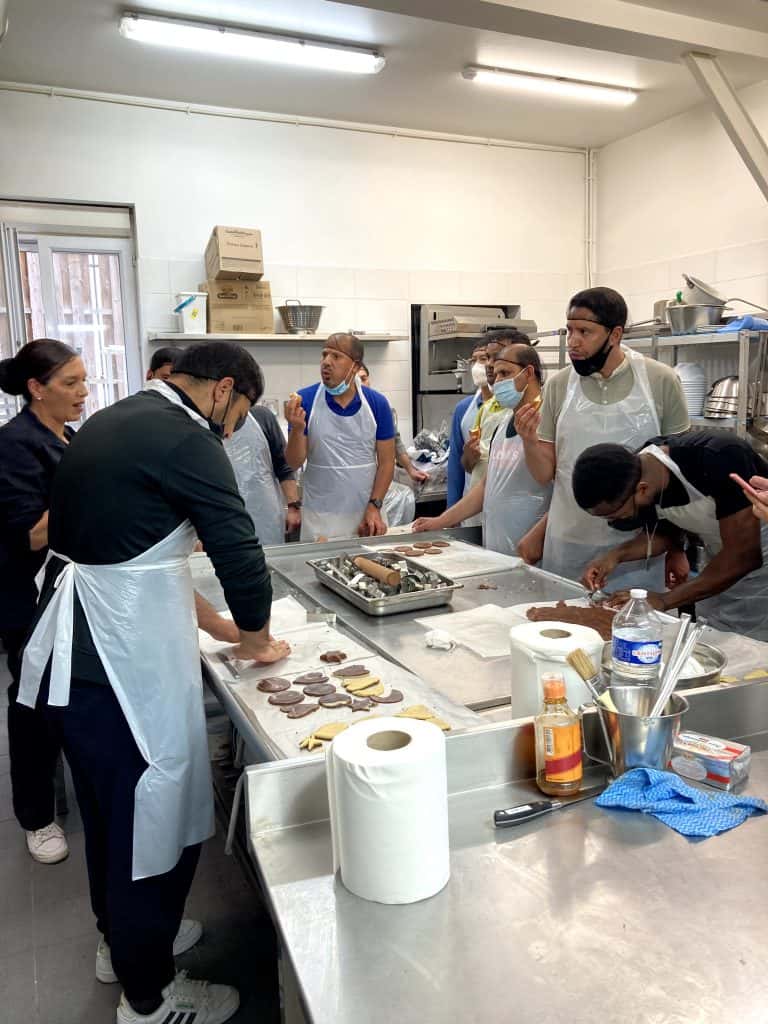
We also signed up for our Day 4 classes which would theoretically have been more active and in-the-field except that all cultural visits had stopped due to Covid and were now taking place in the OFII center. The only option left involved a pastry-making class in Clichy where we would also learn the history of pâte sablé. Even though I have celiac disease and am gluten-free, I signed up for this one since I couldn’t face another day of presentations.

Day 4

We started the day in a crowded classroom and the instructor has us introduce ourselves, say how long we’d been in France, and what country we were from. This was the first time this type of sharing or cross-cultural exchange had been instigated, and it was interesting to learn at least a bit about everyone else in the room. The instructor also established that quite a few immigrants spoke very little French and she paired them with those who spoke their language or English, which is always a common denominator (it hasn’t stopped surprising me how prevalent my native language is).

From there, we moved to an industrial kitchen where I worked with a man from Afghanistan to make pâte sablé. He ended up being very talented at crumbling the butter and flour together and must have had previous pastry experience. As soon as we established this, I let him handle the dough and focused on gathering the necessary ingredients and explaining the next steps.

The kitchen was crowded and hectic. There weren’t enough digital scales to go around, and the instructor oscillated between jovial and chastising how long we were taking. But amidst the clouds of flour, we were working together, explaining what to do next, and integrating in a way none of the other courses had achieved.

At the end of the day as we stood around munching cookies, another Afghani man about my age asked where I was from. “America,” I told him.

Do you know what’s happening in our country right now?” he asked with a mixture of contempt and disbelief.

I nodded apologetically and said yes, I was aware.

This was the realest moment in my many tedious hours of civic integration. Here we were in a foreign country — me by choice, him by necessity — as he questioned the American intervention which had ultimately left their country in shambles. Our paths would never have crossed if the French government hadn’t forced us together.

Closing Musings

While I can’t say I enjoyed or found the civics classes particularly useful, I do appreciate the fact that they were provided by the French government. (I can’t say they were offered, because they were mandated.) The experience would have been significantly less stressful had the scheduling system been online and not involved paper convocations for fixed dates months in advance. As I’ve mentioned before, I didn’t even know the word convocation existed before arriving in France.

I also wish there had been more emphasis on getting to know the other people in the courses, as we had on the last day. Although I understand the goal was to teach us about France, I think we were all interested in knowing why the other people were there and how we could help each other. There was at least one moment in each class where an immigrant mentioned an administrative problem and we all chimed in with how to handle that. What better way to make us feel comfortable in our new home than by supporting and learning from each other?

Photo was from our day making pastry.

Did you enjoy this article?  TAIP is 100% reader-supported through tipping.  If you want to leave us a tip of any amount it would be highly appreciated.  These tips help support our efforts to keep TAIP an ad-free environment.  Just like at a cafe, the tips are split evenly among the team. 

How to Become an Au Pair in France

How to Become an Au Pair in France

After I returned home to the United States after my semester abroad, I knew that I eventually wanted to go back to France. But, before I could do that I knew that I wanted to finish my undergrad degree. And so, in the way that life sometimes “happens,” I graduated, got a job in my field, and while I never really forgot about my goal to return to Paris, I will admit that it was put on the back burner as I did what most Americans are taught to do from a very early age: I started working. 

Fast forward about a year and a half and I was miserable at work. There was something missing and as I stared out the window, wishing I was anywhere but my hometown, it clicked: that something that was missing was Paris. I quickly logged into Facebook and started typing a message to a fellow study abroad-er who I knew had stayed in France after our semester and was working as a jeune fille au pair (a fancy French way to say a live-in nanny, usually between the ages of 18-25). 

I asked her how she did it. While I didn’t have dreams of being a live-in babysitter, I knew that it was a simple way for a non-European to get a visa to live in France. And, to be honest, I felt that I could use the break. Again, like most Americans, I had been working since I was 15. At the time I had just turned 22 and a year abroad with a low-stress gig sounded ideal!

In one of those pinch-me-I’m-dreaming moments, the person that I messaged for advice had plans to leave her au pair position at the end of the school year. I had plenty of babysitting experience under my belt, I was a native English speaker, and I was willing to put the rest of my life on hold for the time being so that I could return to my favorite city in the world. I had an interview with the family over Skype and the rest is history! 

I was really lucky in that I already knew someone who was living as an au pair in the Paris area. I could ask her advice, and in the end, she even hooked me up with a job. For those of you who don’t have those kinds of connections, I know that the search for a quality “au pair family” (sometimes called a host family) can be confusing and overwhelming.

If you’re interested in becoming an au pair in France and aren’t sure where to start, or how to find the perfect-for-you family, I created this step-by-step guide to help you along the way. 

Step 1: Determine where you’d like to live

It’s unfair to assume that everyone who wants to come to France wants to live in Paris, so I wanted to include that you can consider another town in France! Here are some of my personal recommendations:

  • Strasbourg: a mixture of French and German culture
  • Bordeaux: one of the most famous wine-growing regions in the world 
  • Marseille: if you want to live by the sea 

Step 2: Start looking for families

Before you start looking for your dream family, there are a few things that you’ll need to consider:

  • How many children do you want to look after? I looked after three children and things were hectic at times. But, if you come from a large family that might be a breeze for you!
  • How many hours per day/week do you want to work? Some families will require you in the morning and the afternoon, others just after school. I was happy to have my mornings off.
  • Do you want to live with the family or in a separate apartment? I lived in the home with the family and, to be honest, I would have preferred my own apartment for extra privacy. However, living with the family helped us become closer!
  • How long do you want to stay? Most au pair contracts are for one year — at least. I ended up extending my contract twice.
  • Do you want to speak in English or French? I was required to speak in English, but this will differ by family. If you want to learn the language, opt for a French-speaking family.
  • Do you want to be responsible for household chores as well as the children? I was responsible for making dinner and cleaning up after myself. I know some au pairs who had to do laundry and ironing (for the whole family) as well.

Each host family is different. I personally worked Monday-Friday, from 4 pm until whatever time the parents came home. I was required to speak only English with the children. I was responsible for: 

  • Picking the three children up from school 
  • Snacktime
  • Homework help
  • Dinner
  • Cleaning up the kitchen after dinner
  • Bathtime 
  • Bedtime

I know others who were required to wake up the children in the morning and take them to school as well as after-school care. Some others I know even had to give the kids their lunch (most French schools allow the children to go home to eat lunch). Legally, you are not allowed to work more than 30 hours per week.

Another important aspect to consider is your salary. I was given free room and board (I lived in a private part of the family’s home), a cell phone, unlimited access to public transportation, as well as 80 euros per week as “pocket money.” 80 euros per week, or 320 euros per month, is the minimum salary for au pairs, legally. 

Don’t be afraid to be selective and hold out for a family that fits your needs. I know many people who said “yes” to the first family that they found, no matter the working conditions, just because they wanted to come to France. There are hundreds if not thousands of families in France that are looking for an au pair — be picky!

Here are some websites where you can find au pair families:

Step 3: Apply for your visa

Now that you’ve found your perfect family, it’s time to get into the nitty-gritty of coming to France to be an au pair. 

All non-Europeans who want to be an au pair in France for longer than 90 days must obtain a visa in order to do so. You are required to apply for a specific visa just for au pairs. It’s called the stagiaire aide familial étranger et jeune au pair visa.

Here’s what you need to apply:

  • A valid passport
  • An authorized au pair contract (your host family is required to come up with a contract that must be approved by DIRECCTE (Direction Régionale des Entreprises, de la Concurrence, de la Consommation, du Travail et de l’Emploi))
  • A visa application form that you can find here
  • Clean criminal record (this technically isn’t required but many families request it)
  • High school diploma
  • Private health insurance that is valid in France
  • A cover letter explaining why you want to come to France specifically to be an au pair (it’s important to mention why you’d like to learn French)
  • Proof that you’ve signed up, have been accepted, and have paid for French language courses

Don’t be afraid to ask your host family for help when applying for your visa. 

Once you’ve found your family and your visa has been approved, it’s time to start preparing for your new adventure abroad! 

Molli offers private consultation services which range from help with visas and adjusting to life abroad to Paris travel itineraries. Fill out the contact form to learn more.

Photo by Sigmund on Unsplash

Did you enjoy this article?  TAIP is 100% reader-supported through tipping.  If you want to leave us a tip of any amount it would be highly appreciated.  These tips help support our efforts to keep TAIP an ad-free environment.  Just like at a cafe, the tips are split evenly among the team. 

What Is a Contrat d’intégration Républicaine (or CIR)?

As with many things involving French bureaucracy, when I received my vie privée et familial visa, the process was not truly over. In addition to coming back to pick up my titre de séjour, the administrator told me that I’d be summoned by OFII to sign a contrat d’intégration républicaine, have a language proficiency interview, and take four days of civic training.

What is a contrat d’intégration républicaine (CIR) you ask? I wondered the same thing even as I was waiting to sign it. A CIR is an agreement between any non-European foreigners who wish to live in France permanently and the French government –– you’re agreeing to attend the courses on French government, society, and culture, as well as attain an A1 proficiency (the lowest level) while they’re agreeing to provide you with language classes, as well as employment and other integration services. The concept of such an arrangement is very foreign to me, and I’m not sure if any such thing exists in the US.

The Process

The process of my CIR technically begin in October 2020 when I received my VPF visa, however, I wasn’t summoned by OFII until March 2021. Five months after the appointment, when I was in contact with the prefecture to pick up my new carte de séjour, I mentioned that I hadn’t received a date and they immediately sent one. Never trust French bureaucracy to function as they say it will — it’s always best to follow up since you’ll still be required to have the paperwork, even if they never sent it.

Once I had the interview scheduled with OFII, I knew there would also be four days of civic training where I learned about France.

There is also an exit interview which no one mentioned to me throughout the process, and I only discovered it when doing research for this article. Since the civic classes are typically scheduled a month apart, and the exit interview is done within three months of completing those, it’s best to assume the entire process will take 6-8 months.

OFII Visit

The OFII visit took place at their office in the 13ème, a different location from where I’d gone to have my medical exam for my first long-stay visa. No one gave us an official explanation of the afternoon’s agenda or why we’d been summoned, which made the experience even more Kafka-esque. After waiting for what felt like a long time, we were given a basic French proficiency exam which, along with the spoken interview, would assess if we were at least A1 French.

I couldn’t remember the last time I’d taken a written exam, so while it was very easy, it was also surreal. My French is fluent thanks to French classes from middle school through college, a study abroad semester, and my French friends and partner. That said, I don’t have any degrees to prove this (in France or the US) so the proficiency exam was both required and necessary for my visa. In fact, in order to have French citizenship, you must have passed a level B1.

After the test was over, we were called one by one for our language interviews. In a moment of foolhardy optimism, I’d left the apartment without a book. Thankfully, I still had a notebook and pen — the wait was so long I wrote my friend back home a letter. When the man who was interviewing me asked what I did, I told him about my writing and he pulled up my website. We talked about literature for quite a while, and he was clearly pleased to be having a fluent, interesting conversation. Before leaving, we scheduled my first two civic courses at OFII and he printed me convocations for two Fridays in May.

Day One

I arrived at the OFII office of the twentieth arrondissement. It was across the péripherique which I’d always thought meant the address would be outside of Paris and the arrondissement numbering. Enough of us were puzzled by this that we asked the teacher who explained that this street managed to make it “into” Paris while the next block hadn’t. Like French grammar, there are the rules and there are the exceptions.

The classroom was fluorescent, unpleasant, and had tightly sealed windows. None of the twenty-or-so other immigrants looked particularly thrilled to be there either. I’d been intrigued by what they’d serve us for lunch but it was a sandwich, apple sauce, and bottled water. I’m not sure why I thought it would be something more interesting.

The day’s lessons were divided into the following sections:

  • The Nation: General information about geography, population, economic standing, and government structure
  • Health: Emergency phone numbers, health insurance, mutuelles
  • Employment: Searching for jobs, national employment agency or pôle emploi, CVs and letter de motivation, starting your own business
  • Parenthood: Parental rights, protecting children, types of childcare
  • Housing: Types of housing, finding housing, requesting government housing

Since I’ve lived in France for over three years, most of this information was a review to me, though in each section, there was at least something I didn’t know. For example, I never learned any of the emergency numbers here. And whenever I saw the phrase “France mêtropole” I’d translate it to “French metropolitan” in my head without knowing its second definition as “parent state of a colony.”

Reflections

As tedious as these days of slideshows and infographics were, I’m grateful the French government offered them. Or rather, required them. Maybe I’m still used to the United States form of capitalism where nothing is free, especially in terms of services. The cynical part of me thinks these courses wouldn’t exist in the US because they focused in large part on government services, and we don’t have many of those.

Featured photo is of my contract: I can’t say I ever expected to have to sign a contract with France… 🙂

Did you enjoy this article?  TAIP is 100% reader-supported through tipping.  If you want to leave us a tip of any amount it would be highly appreciated.  These tips help support our efforts to keep TAIP an ad-free environment.  Just like at a cafe, the tips are split evenly among the team. 

How to Get a Long Term Stay Visitor Visa (VFS and Covid-19 edition)

Note from the editor: In light of new guidance on remote working in France as shared by the official French tax office in June 2025, we have also officially changed our stance on remote working for a US company while living in France under the visitor visa. Read more here, and contact us with any questions or concerns. We’re here to help! — MS

Those in our Facebook group know that for some time I have been seeking an updated version of my 2013 article on how I got my original visitor visa.  While that article was one of the cornerstones of this site and while certain principles of it still apply, since the advent of VFS taking over not just France’s, but other countries’ visa processes, and with Covid-19 limiting in-person meetings, I wanted an updated article from one of my visa clients who went through the process very recently, knowing that this would become an article that would be referenced for years to come.  Luke Middleton was kind enough to do just that for me and I enclose his very detailed story below.  For my video course that breaks down some of these steps in even more detail, click here.  If you’d like to read more of his writing you can do so here.

I also note that Luke got his visa while explicitly stating that he would be working his US job remotely, which once again undermines the misinformation peddled by Allison Lounes, that you cannot have a remote job on a visitor visa.  I stated as much when I applied (and renewed) such a visa almost a decade ago, long before remote work was something everyone knew about, and Luke has just done the same last month.  Alas, that means you don’t have to accept her narrative and drop $2000-$4000 using her services to get a Prof Lib visa, but I don’t suspect you’ll be upset about that.  -SH

How to Apply for a Long Stay Visitor Visa

After a long period of disruption due to Covid-19 the French authorities in the United States resumed processing all categories of visa applications in June 2021, including the visiteur category that Stephen has discussed so many times on this blog. 

The application process has changed from the one he encountered in 2013. Probably the biggest difference is that the French have now partnered with a third-party service provider which handles a portion of the application. While this arrangement may have streamlined things on the backend, some initial amount of confusion may result from having to interact with two completely different websites that have no evident connection to each other. And neither of these websites happens to be the website for a French consulate, which is where you might have started your Google search. In fact, there are nine consulates (and one embassy) in the US and each has its own page, presenting information in a slightly different way. All the information you need is ultimately out there but it certainly wasn’t as plainly presented as any might like. 

Let’s start with the two websites I mentioned earlier: 

The first is france-visas.gouv.fr (I will call it France-Visas going forward). This is where you will fill out and submit your visa application form. 

The second is VFS Global. (I will simply call it VFS after this).  This is the third-party provider with whom you will make an appointment to hand in your application form, passport, and other documents. Note that VFS handles visa applications to and from a wide variety of countries, not just for Americans going to France. So when you are on their website, make sure you are looking at the correct information. 

Here is the recommended order of steps as described by France-Visas: 

  1. Create an account at France-Visas.
  2. Fill out the online visa application form. Until you have “submitted” this form it can be saved and you are free to go back and edit it (well, you can edit some of it). You can even download a PDF version which will have a large “DRAFT” watermark on it. Once it has been submitted the DRAFT watermark will be removed and importantly at this point you are unable to edit, delete or recall the form. You are supposed to submit the form before proceeding to the next step, but I recommend you wait and will explain why shortly. 
  3. Next we need to go to the VFS website and book an appointment at one of the 9 VFS visa application centers. Here again they will ask in ALL CAPS if you have already submitted your form on France-Visas. I recommend you proceed with scheduling the appointment and only afterwards go back and submit your application at France-Visas.  
  4. Attend your VFS appointment where you will hand in your application form, various supporting documents as well as your passport, and have your biometrics taken. 
  5. After your appointment VFS will mail your documents and passport to the consulate in Washington DC (the only time the French authorities get involved). At this point your application is either approved or denied and your passport is mailed back to you. 

That is the recommended order and the one I followed but here is a potential problem: when you fill out the visa application form on the France-Visas website, you must specify which VFS application center you will be going to. I live in Kansas so I chose the center in Chicago since various internet searches told me that Chicago is the “consulate for my region” (in fact that is true, but it doesn’t matter as we will see).  Having completed the form on France-Visas I submitted it and only then went over to VFS to book my appointment. That is when I discovered to my dismay that the Chicago office had no openings available for as far forward as it would let me look. But once the application form on France-Visas has been submitted it can no longer be edited, and I had already told them I was going to Chicago! Also I wasn’t sure if I was even allowed to go to a different office. 

In the olden days, including when Stephen applied, you had to book an appointment at the French consulate for your region — you couldn’t just choose any one you felt like. But today we are not booking an appointment at the consulate, we are booking an appointment at a VFS Global Visa Application Center. These application centers just so happen to be located in the same cities as the French consulates (with the exception of New Orleans), but they are not the same thing! For example in Chicago the VFS center is about seven blocks away from the French consulate. 

With this change it no longer matters what VFS center you go to, you are free to choose whichever one you prefer. There are nine located in the following cities: Atlanta, Boston, Chicago, Houston, Los Angeles, Miami, New York, San Francisco, and Washington D.C.

Since you have to tell France-Visas which VFS center you are visiting, and you won’t know which ones have availability until you book an appointment, I recommend the following:

  1. Go ahead and fill out the application form on France-Visas so you are sure you are able to answer all the questions, but don’t submit it yet — just “save” it instead.
  2. Now go to the VFS site and book an appointment. 
  3. Then return to France-Visas and “submit” your form. If you had to select a different location, you will actually need to fill out a new form on France-Visas since it will not permit you to edit the location field. At least you will already know the answers to all the questions, and after you submit the correct form you can delete your earlier draft. 

This is not the recommended order but you will avoid what happened to me: since I couldn’t change my submitted application for Chicago, VFS instructed me to create and submit a second application. I managed to reserve an appointment in Houston and prayed I hadn’t hopelessly confused their computer system (it all worked out in the end). 

I am told that VFS posts new appointment availabilities on their website once a week, and they don’t open appointments more than a couple of months in advance. So if you really must go to a specific city you can also just keep checking back each week. 

Now let’s look at each step in more detail. 

Step 1: Begin the France-Visas Application Form

Create an account at France-Visas and start a new application. Most of the form is self-explanatory but I will highlight some important items here: 

  • Place of submission of application: for many TAIP readers, this is going to be the United States of America
  • City of submission of application: this is where you select one of the nine VFS cities, make sure you can get an appointment there first! 
  • Visa type requested: we are applying for Long-stay (1 Year+)
  • Your plans: this is actually where the visa type is specified. We want to select Visitor
  • Main purpose of stay: there are two options, Visitor (adult) or Visitor (minor). Most of us are presumably going to be adults, unless you are bringing your children with you in which case you will be creating a group application that includes forms for each person. 
  • Planned date of arrival in French territory: remember that you can not submit your application more than 3 months prior to your planned arrival date.  You don’t have to arrive in France on the day your visa begins, you simply can’t arrive before that day.

Further into the application you will be asked to give your Host person or organization. Since we are visiteurs, I selected the option to provide the Name of hotel or place of accommodation. And since my place of accommodation is an apartment I just typed in Appartement for the name, and then provided the address. If you don’t have a residence lined up yet enter the name of the hotel or other lodging you plan to stay at. 

Another section is titled Funding of travel costs. Once again we see various options that make more sense for visa types other than the one we are applying for, here are the ones most relevant for our purposes: 

  • Credit card
  • Cash
  • Other

I checked Credit Card, Cash, and for Other I put USA Employment Income since I am keeping my US job while living in France. There is also an option to give them the name of a French guarantor, which I suspect most of us will not have. 

Note: in several places you will need to provide a US address (for your current residence; where you were born; the address of your American employer if you have one, etc). Of course this form having been designed by the French you will only be given a City field, but not a State field. Type both the city and state in the City field. 

Another note: pay attention as well to date fields and remember that the French put the day first and then the month. I found that the VFS website also used this French convention. 

Ok, we’ve made it through the application form, but as discussed above let’s just “save” it and hold off on “submitting to the visa center” until we complete the next step. 

Step 2: Book an Appointment at a VFS Global Center

Next, create an account at VFS Global and schedule an appointment. Hopefully you created the account from the correct section of the site in which case you will be relieved to see that it knows you are an American applying for France, and not something else. During this process you will select which VFS city you want to go to. It will also ask you for your Appointment Category which in our case will be Long Stay Visitor

In general I found the VFS website to be unrefined and buggy. When it asked for my US location it forced me to select a city from a predetermined list which strangely did not include my actual city, the largest in the state. The list did however include several obscure towns out in the boonies that no one has ever been to (I just selected one at random, it doesn’t seem to have mattered in the end). Multiple times the site croaked, showed errors, or just directed me to blank pages (maybe this was to prepare me for French life?), and I had to fortify myself with whiskey before I could log back in. But persevere and eventually you should be able to make an appointment. 

Note: at the conclusion of this process VFS will provide you with an appointment receipt or “appointment letter” which will also be emailed to you. This letter will indicate the time and date of your appointment as well as the address of the VFS office. You need to print this letter and bring it with you to your appointment.

Step 3: Go Back and Submit Your France-Visas Application

Now that you know where you are going for your appointment, return to France-Visas and “submit” your application form for real. If you have to change your appointment city from what you originally specified, you will need to create an entirely new form. Save a PDF copy of your first draft so you have your prior answers, delete that application, use the draft to help you fill in the new one, and when done, submit it. 

Download the PDF of the final, submitted form and print it out (it should have no “DRAFT” watermark). This PDF will include three things — the completed application form, an application receipt, and a list of required documents to bring to the VFS appointment.

Note: depending on how you answered certain questions when filling out the application, there may be additional required documents not listed on the receipt, but which will be described nonchalantly in a wall of text on the confirmation page after you submit the application. So read that page well, because once you leave that screen you will never see it again.

If you, like me, answered “yes” to the question “Have you previously resided for more than three months in a row in France?” bring a copy of that previous visa.

Step 4: Show Up to Your VFS Appointment

Now you need to present yourself to the VFS office at the appointed hour, bringing with you all the supporting documents required. Don’t worry, this meeting will be in English and your documents can be in English as well.  As Stephen often reminds us, the visa interview is in the language of the country you are applying from.  They don’t assume you already speak French.

As already mentioned the required documents are listed in the same PDF as your France-Visas application form, but let’s go through them one by one: 

VFS Appointment Letter
This is not actually on the list, but I am repeating it here because you need to bring it.

Signed and dated application form
This is your France-Visas application. In my case the VFS person I dealt with already had a copy of this form on her computer and she preferred to use it instead of mine. All the same, bring your own copy since that’s what they tell you to do.

Receipt France-Visas
This is included in the same PDF file as your France-Visas application form, so you should already have printed it out. 

A travel document
The exact wording follows: “issued less than 10 years ago, containing at least two blank pages, with a period of validity at least 3 months longer than the date on which you intend to leave the Schengen Area or, in the case of a long stay, at least three months longer than the expiry date of the visa requested. Be sure to transmit (scan) ALL PAGES of your travel document containing visas, entry and exit stamps or any other inscription.” is included in the same PDF file as your France-Visas application form, so you should already have printed it out.” 

Clearly you need to bring your physical passport, which you will hand over to VFS and which will be returned to you later by mail. The language about transmit and scan I believe refers to the option to submit some documents electronically.

Although it is not explicitly stated, I remembered that Stephen was asked to bring a photocopy of his passport in addition to the original. Just to be safe I did the same thing (making copies of the title pages as well as all other pages with entries). The VFS lady took my copies without seeming to think that was unusual, so I would recommend you do the same. 

ID photograph
They are referring here to a passport photo. In my area of the country the usual place to get these are pharmacies. Your mileage may vary, but I went to two Walgreens stores and got terrible pictures both times (low resolution), but the ones from CVS were sharp and clear. White backgrounds are common so do not wear a white shirt or they may decline to take your picture as your head will appear to be floating in space.

As it turns out VFS will also be taking your photo as part of the biometric collection (in addition to your fingerprints). The photo that ended up on my visa is the one VFS took, not the one I provided. However it is listed as a requirement and they did ask me to hand it over, so whether they want to use it or not, bring one (I brought two but they only asked for one).

Letter from the employer or proof of business ownership/business license (if self-employed). If retired, pension certificate.
I am employed by an American company and I got my boss to sign a letter that made the following points:

  • so and so is indeed an employee at our company
  • we are aware that he is seeking French residency
  • he has our approval to do so
  • his relocation to France will not cause any change to his employment status since he is free to work remotely
  • his salary is $X which at the current exchange rate equals Y€ per month.

I had my boss sign multiple copies of these letters in case I need them for something else later, and gave VFS an original. I am less able to speak about the other cases, though presumably the student category should not apply to those of us applying for a visitor visa. What ramifications self-employment might have for the next item probably depends on what you do; if you need advice I would suggest posting your questions on the TAIP Facebook group.

Promise not to exercise any professional activity in France
I provided a signed letter declaring on my honor (as the French like to do) that I would “not exercise any paid professional activity in France.”  The fact that this follows directly after “letter from employer” means that the French do not consider your remote work “paid professional activity” for purposes of this visa.

Travel health insurance certificate
The text continues: “issued by the insurance company (covering any possible costs for medical repatriation, and emergency and/or hospital treatment, for a minimum amount of 30,000 €, valid in France for the whole stay. A copy of your American health insurance card is not acceptable proof of adequate coverage).”

For this requirement I chose to purchase an International Health Insurance plan from Cigna Global as Stephen did so many years ago.  This is a process in itself, but I will try to restrict my comments to the basics. They offer three levels of coverage which they call Silver, Gold, and Platinum. Even the lowest Silver level offers 800,000 € coverage for inpatient and emergency care, which is 30X above the French requirement. Gold and Platinum have increasingly higher coverage levels and also include maternity care. In addition to selecting the three coverage levels you also specify your desired deductible ($0-$10,000), percentage of cost share (0%-30%), and out-of-pocket maximums ($0-$5,000). Higher levels of these selections will reduce the price of your premium but will of course increase the sticker shock if you ever actually ever use the insurance. You can also choose to pay monthly, quarterly, or annually, with the latter two options offering a slight discount. Even without the discount it makes sense to buy a one-year policy since you need to show coverage for the full period of your visa.

After these selections you will be presented with various optional add-ons such as outpatient coverage, vision, and dental, etc. but don’t glaze over this section because you will absolutely need to purchase the “International Evacuation & Crisis Assistance Plus” add-on to meet the French requirement for medical repatriation coverage.

While the cost may vary based on your age, gender, and other factors, as a point of reference I chose the absolute cheapest Silver plan, maxed-out deductible, cost sharing, and out-of-pocket levels, with no other add-on except the international evacuation feature, and earned the discount for paying for an entire year upfront. My total came to $900. 

Several minor frustrations are encountered during this process. At the beginning of the insurance application they ask what country you will be living in, which is obviously France. Later you have to provide your mailing address and at this point the form will only accept a French address. Even if you know this address in advance (and some won’t), by definition we are not living in France yet and we may not want mail going there. However they do provide the option to receive communication electronically which solves the mail problem. If you don’t yet know your future French address you can just put down the address of your hotel.

A second frustration is that Cigna will not allow you to schedule your coverage start date more than 45 days into the future, but it is entirely possible you will need to buy it more than 45 days prior to your departure. This means your one-year policy period may not overlap exactly with your one-year visa; in my case it was off by about one month.  But ultimately that’s no big deal.  You may, like Stephen, end up ditching Cigna immediately and buying a much cheaper private French policy.

Finally after having forked over your money and waited several days for your Cigna account to populate, you will be able to download a one-page certificate of insurance. What concerned me is that this certificate does not explicitly describe the coverage levels: it showed that I had purchased the “Cigna Global Silver” plan, but who knows what “Silver” represents? I wrote several emails to Cigna asking if they could give me a more detailed cover letter, and never got a response. Afraid this would be a problem I printed off the entire 40-page Cigna Customer Guide and brought it to the appointment. I discussed the issue with the VFS representative and she thought the basic cover letter “should probably be enough.” My visa was approved so apparently it was. 

Proof of accommodation in France
The text continues: “property title deed, tenancy agreement or any other supporting document. Or proof that accommodation will be provided by a person residing in France, or if not, a document explaining the accommodation arrangements planned for France.

By various undeserved miracles I was fortunate enough to have an apartment lined up in advance and was therefore quite pleased with myself to be able to hand over a copy of my French contrat de location (rental contract). But my self-congratulation immediately ended with the next question: “Do you have a copy of your landlord’s identification?”

Uhm no, I did not. To my relief the lady once again said, “That’s ok, I think the contract will be sufficient.” And it was, but if this applies to you and you are able to obtain a copy of your landlord’s ID and electricity bill, it definitely won’t hurt.

If you don’t yet have housing arrangements made you will want to write a small letter explaining your plans to do so. 

Proof of enough resources to cover all expenses during trip
The requirement says bank statements and that is what I was asked for, so bring them whether they prove anything or not. Thankfully having now met the literal requirement I was permitted to provide other documentation as well; I gave them pay stubs from my employer and my savings account statement.  If you’re a pensioner that statement will come in handy.

If, like me, you decide you need to move funds around to present the best possible financial picture, make sure to plan ahead for the time it will take to make those transfers as well as for the statement to be produced from whatever account you move them to, since all of that will need to be done prior to your appointment.

After requesting each of these items in turn, my interviewer finished by asking “Do you have anything else you want to give me?” I did not. You don’t have to volunteer anything that is not requested, but by all means if there is something you think will help your case then provide it.  As Stephen often notes, have more documentation than you are asked for with you, but don’t hand it over unless they ask for it.  More does not necessarily equal better.

All that remains at this point is to pay for three things which will be combined into a single charge to your credit card (cash and checks not accepted): the visa application fee, a service fee to VFS, and the cost of overnight FedEx service to return your passport. Unlike in Stephen’s day you do not need to bring a pre-paid envelope with you, you will purchase it at the appointment. For me the total cost came to roughly $200 but no doubt this will fluctuate. 

Step 5: Wait for Your Passport to be Returned

At this point VFS will forward your application, passport, and documents to the French embassy in Washington DC where your case will be approved or denied. The VFS agent informed me at the time that they were currently very busy processing student visas (my appointment was in August) and she could neither guarantee nor estimate how long it would take to receive a response. She did say the consulate typically strives for a turnaround of two weeks. 

She also said that if the French authorities needed any more information they would contact me directly and if I didn’t want my application to end up in a forgotten pile somewhere I should respond as quickly as possible. 

In the end the French never asked for anything else and my approved visa was in my hands a mere seven days later. 

The visa appears as a large sticker on one of the pages of your passport. It will have a start date which in my case was two weeks earlier than the planned departure date I put down on my application.

Included in the envelope with my passport/visa were two miniscule slips of paper: 

  • The first informed me that upon arrival in France I would need to go online and register and validate my visa. This will be the subject of a future blog post
  • The second referred to current Covid travel regulations. Since these seem to change from week to week there is no point discussing them here, just check before you go and hope for the best. 

Whew! If you’ve made it this far and your visa was approved, congratulations — you’re going to France!

Final Thoughts

Start preparing early and try to think ahead as much as you can. Since you can’t submit the application more than three months prior to departure, and the recommendation is to schedule your VFS appointment at least 1 month prior to leaving, it can start to feel like a lot of activity is getting crammed into a very short period of time. Needless to say, these last few months are already going to be hectic with moving preparations. But there is nothing stopping you from starting to gather documents prior to the application process, and you will thank yourself for any groundwork you were able to do in advance. Bonne chance!

The process may be different now but the sticker in your passport will still look substantially similar to the featured photo above.

TAIP is 100% reader-supported through tipping. If you want to leave us a tip of any amount it would be highly appreciated. These tips help support our efforts to keep TAIP an ad-free environment. Just as at a cafe, the tips are split evenly among the team.

passeport talent

How to Apply for the Passeport Talent Visa

Americans have had the Profession Libérale and Long-term Stay Visitor statuses closed for application from the US for some time now due to Covid-19.  Other countries do have these options available and Americans who have had legal residence in other countries have successfully applied for and received these statuses from the embassies/consulates in those countries and have subsequently entered France.  One status has remained open to Americans applying from the US: Passeport Talent, a status I had helped clients within a limited capacity in previous years.  But a colleague of mine has watched many friends get it over the years and is now helping those who are stateside and do not want to wait for PL or Visitor to re-open (and who don’t fancy the student route) to get this visa.  I had her write this brief look at three of the 11 classifications available within Passeport Talent for this article.  I’ve added some editorial notes in italics but if you’d like help with this visa classification you can contact Molli at the link at the bottom of the article. – SH

For non-Europeans looking to come to France to live, your best bet has long been the student visa. Even for those who thought their student days were long behind them, traveling to France for some continued education is by far the easiest way. And, continued education doesn’t mean that you need to sign up to do another undergrad or Master’s degree. You can obtain a student visa if you take French classes or attend a cooking school, among other options.

But then 2020 arrived and our lives changed. Traveling wasn’t as easy as before (if it was even allowed) and moving to a foreign country became a distant memory of something that you may have considered. Even college students had to put their study abroad semesters on hold, and if you did manage to get a student visa for yourself, your spouse or children weren’t necessarily able to apply for their own visas through yours. 

But there’s always another way if you look hard enough. If you’re feeling frustrated and aren’t sure what to do, I’m glad you found this blog. Here’s how to apply for a different type of visa for France, the Passeport Talent. 

What is it?

Passeport Talent is a fancy French way of saying that if you’ve got talent, come and share your skills in France! It is a multi-year residence permit that was created to bring talented foreigners to France in order to develop the county’s “attractiveness.” As if France wasn’t attractive enough, right? Well, if you’ve got a special skill that you want to bring over to the Français, you can, thanks to the passeport talent

Who can apply?

You can apply if you’re planning on working and living in France for more than three months. You’ll remember that people from many non-European countries are allowed to visit and live in Europe without a visa for 90 days. The passeport talent ensures that you’re allowed to stay for much, much longer. This long-term visa (otherwise known as a residence permit) is issued for up to 4 years and is renewable.

In order to apply, you must be from a non-European country. 

How to do it

If you’re still in your home country, you’re required to apply at the nearest French consulate. If you’re already in France and are interested in changing your visa status, you’ll need to go to the closest prefecture. To start, you’ll have to provide these documents:

  • Your passport
  • Your birth certificate (translated into French by an officially licensed translator)
  • Your wedding certificate, if you are married (translated)
  • Your children’s birth certificates, if you have any (translated)
  • Proof of address
  • Three ID photos
  • Application (different according to your activity)
  • Official documents related to your activity.

It will cost you 269 € to get the final card.

So, who can receive the passeport talent? There are 11 different scenarios in which you could potentially get one, but for the sake of this article, I will briefly examine three of them. I encourage you to visit the official French website for this type of visa if you don’t see an option below that works for you. 

You want to create a business in France, or are taking control of one

(This is ideal if you have some money set aside for yourself and is essentially a more financially muscular Prof Lib – SH)

  • You’ll apply for “passeport talent — création d’entreprise.
  • You must prove that you have a serious plan to open a business in France. 
  • You’re required to invest at least 30,000€ in your project, have a degree that is equivalent to a Master’s degree (or are able to prove that you have five years of professional experience in your field)
  • You are also able to apply for the passeport talent — création d’entreprise if you are slated to take control of a French business.
  • You’ll need to show proof of the plans for your new business as well as proof of your investment, your diploma, that you’ll be earning at least the French minimum wage (roughly 1,500€ gross per month), and you must fill out this application.

You are an artist, a writer, or a performer

(This is perfect if you were already planning to come as a writer on Prof Lib – SH)

  • You’ll apply for “passeport talent — profession artistique et culturelle.
  • If you’re a singer, performer, author, or simply an artist, you must prove that you earn at least 1,064.85€ gross per month.
  • You’ll need to provide documents that prove that you are a professional artist, and if you are employed by a French company, you’ll need proof of that too. That being said, you can apply for this visa even if you are self-employed. You must fill out this application as well.

You are making a direct economic investment in France

(If you had dreams of opening a B&B or some other larger traditional business, this is a good route for you.  Simply buying a property is insufficient in and of itself.  The investment must create/save jobs. – SH)

  • You’ll apply for “passeport talent — investissement économique — toutes activités commerciales.
  • You must prove that you are investing at least 300,000€ in a French company that you own or through a company in which you hold at least a 30% share of the capital.
  • You must also prove that you will create or save jobs and you must have proof of your plans for your investment, and you must also be earning at least the French minimum wage (roughly 1,500€ gross per month). 

These are just three of the possible situations which would allow you to apply for the passport talent. Like all things in the French administration, the application process is long and very involved. We offer private consultation services which range from help with visas and adjusting to life abroad to Paris travel itineraries. Fill out the contact form to learn more.

Photo courtesy of Nick Youngson CC BY-SA 3.0 Alpha Stock Images

TAIP is 100% reader-supported through tipping. If you want to leave us a tip of any amount it would be highly appreciated. These tips help support our efforts to keep TAIP an ad-free environment. Just as at a cafe, the tips are split evenly among the team.

prefecture documents

How to Get a Vie Privée et Familiale (VPF) Visa

I first met Gracie over coffee at the end of 2018.  She had some minor questions about visa issues but seemed supremely in command of what she needed to do.  Turned out my impression was true.  Now it’s her turn to help others in this article about how to get a VPF visa. – SH

I’ll never forget the interview for my first long-term stay visitor visa. It was December 2017, and even though I’d quit my desk job and was preparing for the move, the visa was the first real step — it would give me the legal approval to embark on my Paris dreams.

The French Embassy in New York City is just off Central Park East on a block of regal brownstones. I biked there from Brooklyn and switched into low heels and a blazer on the sidewalk: if I was over-dressed at least I would match the buildings.

The last question the woman asked during my interview was if I’d return to the U.S. at the end of the year. “If I don’t meet a Frenchman,” flashed through my mind. But I was being quizzed and this was the final question, so I nodded politely and kept my hypothetical romances to myself.

My Frenchman, Frédéric, appeared four months into my first visa, and we were PACSed (PACS stands for pacte civil de solidarité and is judicially one step below marriage in France) a year-and-a-half later. With my third visitor visa expiring in February 2021, applying for a Vie Privée et Familiale (otherwise known as VPF) visa was the next step in my immigration journey.

A Bit of Background

The differences between the two visas are tied to the rights they give you: a VPF visa allows you to work, to receive a Carte Vitale, and to leave the country for one to four years (depending on the length of stay you’re granted). The long-term stay visitor visa allows you to spend a year in the country, and…that’s about it. It’s simple when you think about the names — the VPF visa proves you have a (private or familial) tie with the country while the visitor visa means, well, you’re a visitor.

Since Fred and I are PACSed, please keep in mind I’m writing from that perspective. (This visa is also available to married couples with slightly different requirements, which I’ll include where possible.) Since I knew getting PACSed allowed me to apply for this visa, when I was starting that process in June 2019, I was also taking steps for my future VPF visa application. This means I’d spent nineteen months getting ready.

Preparation: A Year Out

Check the visa requirements

In order to apply for a VPF visa, you must be married or PACSed.  If the former, you need to have proof of your marriage, as well as six months of residence if you didn’t arrive on a long-stay visitor visa.  If you did arrive on a visitor visa, there’s no waiting period.  For those who are PACSed, you have to, as you do with so many things in France, prove the validity of this relationship, and that you’ve lived together for at least a year (though you can begin the process before those 12 months are up). The list of documents the prefecture sends after you book your appointment is more arcane, while the government site simply asks for the following documents:

    1. Your long-stay visa or residence permit
    2. Your passport (with photocopies of the pages relating to civil status, validity dates, and entry stamps)
    3. Your birth certificate
    4. Three standard-sized photos
    5. Identity card or certificate of French nationality of your spouse/partner
    6. Marriage certificate or PACS agreement of fewer than 3 months (or certificate of PACS fewer than 3 months old if the PACS is older)
    7. Proof of community of life: joint declaration on the honor of the couple attesting to their common life and all documents allowing to establish the community of life (lease, EDF bill, bank statement, etc.) over at least one year

Get your documents in the right names

You’ll need to add both your names to the EDF bill, lease statement, and internet bill, as well as possibly open a joint bank account.  Whenever it’s possible, it’s best to have both your and your partner’s names on the document.

Note: This is not as easy as it sounds, and may take at least a month for everything to be in place. Be patient and steadfast in the daunting task of navigating French customer service.

Request birth certificate

You may already have one from a former visa or your PACS. If not, request it now since it needs to have an apostille which adds an additional step, depending on what state you were born in.

Note: If you don’t know about an apostille is, read more about them here. I naively thought they were unimportant only to have my birth certificate rejected when submitting the paperwork for my PACS.

Four Months Out

Make the appointment

Again, this might sound simple, but I spent two weeks in July 2020 calling the prefecture before getting through to a secretary.

(Note: If you’re switching visas, you’re required to make an appointment by phone.)

Wait times were abnormally high due to the backup caused by the confinement of March – May 2020. Regardless, the prefecture may be fully booked for appointments three-four months ahead, and with all things French government-related, it’s best to assume the worst-case scenario.

Note: Your spouse/partner must come to the appointment as well, so make sure it works with both of your schedules. Once you received your convocation, it’s difficult to change the time.

Review Prefecture List

You’ll receive your appointment confirmation via email, as well as the list of documents. In addition to the standard IDs listed above, here are the ones requested pertaining to my situation, which was “Proof of Personal and Family Ties in France”:

    • For the married: your marriage certificate
    • For those who are PACSed:
      • A copy of the PACS and certificate of non-dissolution of fewer than 3 months etc.
      • Proof of continuous relations with the members of the family living in France: cohabiting partner or civil partnership.
      • Justification by any means of the duration of continuous residence in France: visa, receipt of an application for the residence permit, documents from a public administration (prefecture, social service), documents from a private institution (medical certificate, bank statements), personal writings (letters, certificates from relatives).
      • Supporting documents on the applicant’s living conditions (income, salaries, bank statements, etc.).
      • Proof of its integration into French society (certificates from friendly circles, membership of associations, voluntary activity, participation in children’s school activities, etc.).

As you can see, the prefecture list is lengthier and less document-specific than the online list. My takeaways were:

    • The prefecture is still looking for proof of your and your partner’s shared life, as well as your commitment to your life in France.
    • The fact that I already had three years’ worth of visas, and was a member of two societies was in my favor.
    • I’d also need proof of my US income.
    • And, as always, for the French, the more documents, the better.

One Month Out

Request “Certificat de non-dissolution de PACS

This can be done via email (pacs.scec@diplomatie.gouv.fr): read more here. In the response to my request, the bureau said there was no record of our PACS, and I needed to have the mairie send a copy. At the mairie where we were PACSed, they found the certificate which had never actually been sent to Nantes. These bureaucratic mishaps are quite common, hence the generous timeline.

Submit Translations

Since I couldn’t legally work in France with my visitor visa, and am self-employed in the US, I had a recent freelance agreement and my book royalty contract translated from English. Whenever possible, the original documents must be submitted to the translator and stamped along with the translation. The Minister of Justice has a list of certified translators, and you’re expected to use one of them.

Note: If you’re getting a birth certificate, this must be translated as well.

Week Out

Print and organize all documents

I’m not exaggerating when I say this took hours, and I’m grateful I gave myself time to do it. In the end, I had four different folders sorted into:

  • personal ID documents
  • shared documents
  • personal financial documents
  • bonus documents.

Note: This level of organization calmed my visa anxiety, and might not be necessary if you’re less intimidated by the process.

Make sure you have photocopies

Whenever you know you’ll be keeping the original document (i.e. your passport), you’ll need to make a photocopy to give to the prefecture.

Note: Be sure to make copies of the front and back of any ID cards or other two-sided documents.

Appointment Day

Arrive at least a half hour early

This will give you time to go through security, find your appointment room, and wait. As always, I dress my best when the most is at stake, and wore a blazer and a button-up blouse to soothe my bureaucratic anxieties.

Bring those documents; this was my final list:

    1. Convocation with my appointment time
    2. List of documents
    3. Request for the Titre de Séjour (you’re usually given this form at the prefecture)
    4. My passport (which also contains my first visa, along with photocopies)
    5. Three standard-sized photos
    6. My current carte de séjour (plus photocopies)
    7. Photocopies of all my visas and récépissés
    8. My birth certificate (with apostille and translation, plus photocopy)
    9. Fred’s French passport (plus photocopy)
    10. PACS récépissé
    11. Attestation de non-dissolution de PACS
    12. Joint bank statements
    13. EDF Bills
    14. Personal French bank statements (with our shared address)
    15. US bank statements
    16. Translated US income documents
    17. Attestations from the two French societies where I’m a member
    18. Credit card statements with flights to the US and tires we’d bought for our van
    19. Letter from Fred’s business partners corroborating our relationship
    20. Letter from my former roommate corroborating my and Fred’s relationship and co-habitation

At the Appointment

The man was most interested in the “shared” documents we had proving our life together aka our vie commune. When I mentioned I had additional documents, he wasn’t interested and only asked for 12 items of the 20 I had with me:

    1. Request for the Titre de Séjour (you’re usually given this form at the prefecture)
    2. My passport (which also contains my first two visas, plus photocopies)
    3. Three standard-sized photos
    4. My current carte de séjour (plus photocopies)
    5. Photocopies of all my visas and récépissés
    6. My birth certificate (with apostille and translation, plus photocopy)
    7. Fred’s French passport (plus photocopy)
    8. PACS récépissé
    9. Attestation de non-dissolution de PACS
    10. Joint bank statements
    11. EDF bills
    12. Personal French bank statements (for both partners)

Since neither of the document lists mentioned #12, Fred didn’t bring anything besides his passport and a copy of his deed. But the man asked Fred for twelve months of bank statements: our joint bank account was less than twelve months old, and he wasn’t interested in the deed.

When we didn’t have them, the man said we could bring them back that afternoon, and wrote a note on my original convocation which let me re-enter the prefecture. After I came back with the statements and bypassed the line, he printed the récépissé for my new one-year VPF visa.

During the appointment, he also asked if I had a degree in French. Although I speak the language fluently, I’ve only studied it in America. When I went back, I asked him about this and he said if I had a degree or had taken the DELF (which Stephen has written about) I’d be eligible for a longer-term visa.

For all its horror stories, I’ve never had an unreasonably negative experience at the prefecture. That said, I’m also aggressively prepared and speak unfailingly courteous French. Though I wish I hadn’t wasted paper in printing those extra documents, I’d rather be over than under-prepared.

Government Stamped Dreams

Back in 2017, when I floated out of the French Embassy, New York City sparkled around me. I biked to Central Park, found a bench in the sun, and basked in the feeling of being closer to my goal. Leaving the prefecture this past October, I was no less ecstatic. Even if they involve months of planning and paperwork, for me, each visa is a new lease on life, a government-stamped document promising I can keep pursuing my dreams.

Gracie Bialecki is a writer and literary coach who lives in Paris, France. She is the co-founder of the storytelling series Thirst, a poetry editor at Paris Lit Up, and the author of the novel Purple Gold (ANTIBOOKCLUB).

Photo used with permission of the author.

TAIP is 100% reader-supported through tipping. If you want to leave us a tip of any amount it would be highly appreciated. These tips help support our efforts to keep TAIP an ad-free environment. Just as at a cafe, the tips are split evenly among the team.
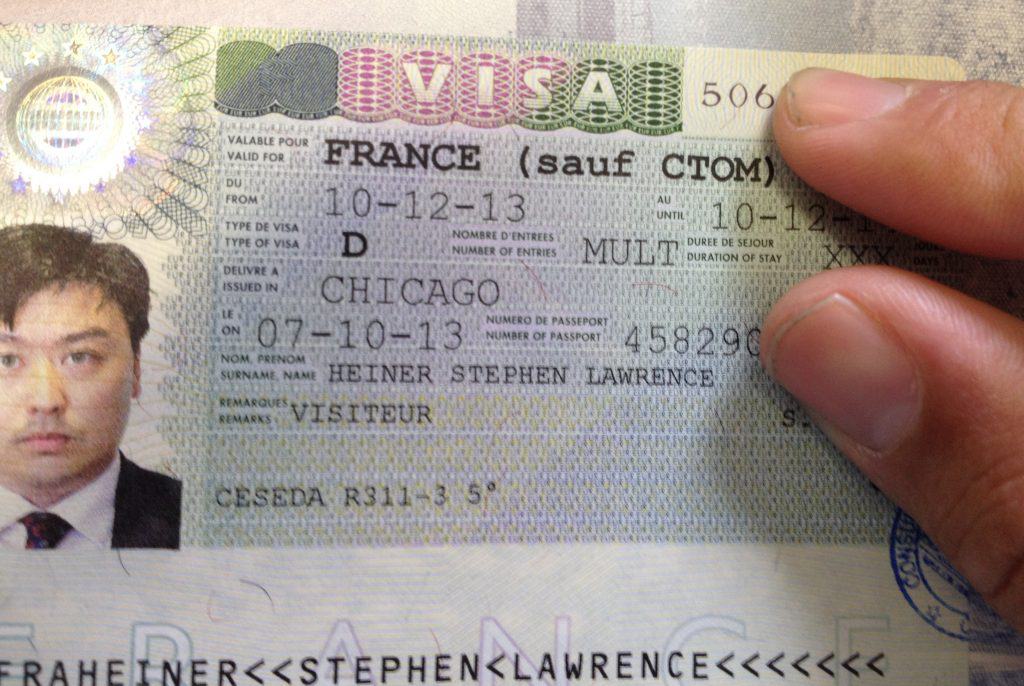
sale on courses

20% off Courses until the End of 2020

If you’ve been considering buying my courses on the Long Stay Visitor or Profession Libérale paths to living and building a life in France, I’ve created coupon codes that are good until December 31st, 2020.  Simply click one of the links in the previous sentence or use EOYSAVINGS20 when checking out.  These courses distill everything you need to know to successfully apply for those visas.

Tastefully understated photo by Karolina Grabowska from Pexels

TAIP is 100% reader-supported through tipping. If you want to leave us a tip of any amount it would be highly appreciated. These tips help support our efforts to keep TAIP an ad-free environment. Just as at a cafe, the tips are split evenly among the team.

Which Long Term Visa to Pursue: Visitor or Profession Libérale?

Note from the editor: In light of new guidance on remote working in France as shared by the official French tax office in June 2025, we have also officially changed our stance on remote working for a US company while living in France under the visitor visa. Read more here, and contact us with any questions or concerns. We’re here to help! — MS

Often when people schedule a consultation with me about the profession libérale visa, they do so convinced that this is the right path for them, but on more than one occasion, after asking the right questions, I’ve helped them understand that what they should probably do is obtain (or renew) a visitor visa instead.  This original misapprehension is due in part to an unclear understanding of immigration and the visa process in general, and other times it’s due to a lack of clarity as to the why and how of the client’s projected time and future in France.  So this article is a hopeful corrective to the confusion about which visa to get.

In brief, I characterize “visitor” status as easy, option-oriented, but repetitive, and “profession libérale” status as all-in, with a path to citizenship, but challenging, as it involves starting an actual business.

Visitor

People consider it a “hassle” to show up once a year with a predictable and easy list of paperwork so that you can continue to legally live in a country in which you have no citizenship.  But it’s not a hassle.  It’s pretty easy once you get used to it, and it becomes something seasonal, like putting up Christmas decorations.  It’s a chore, but you’re so happy when it’s done.

Visitor status does not provide a path to citizenship.

Visitor status requires you to file taxes, even though your visa status ensures you won’t be paying taxes.

Visitor status gives you access to the EU, as you are a French resident.  Technically you should be in France the majority of the calendar year, but the French have no real way to verify this, and don’t really care, as long as you fulfill your legal requirements.  I know of someone who lives in Malta most of the year, but for some reason has chosen to have French visitor status and flies in for his prefecture appointments.

Visitor status allows you, after the first renewal, to switch to another visa, at any time.  You’re not stuck with this status forever.  If at any point you want to wind things up, simply leave France.  No additional paperwork required: you’ll just expire out of the system.

Profession Libérale

Profession Libérale status (not to be confused with “auto-entrepreneur,” which is a tax classification, not an immigration status and hereafter PL) was a dream fit for me for a number of reasons: I’m a veteran business owner, I want French citizenship, and I wanted the possibility of a multi-year card.

People get very interested in this visa status because of the citizenship path but ignore or downplay that you have to start and validate a business.  This means you will enroll in a number of French agencies that will continue to bill you forever. This includes your social charges, health care charges, and your pension, to say nothing of taxes.  Visitor status is just about obtaining the right to live in France, whereas PL is about living AND working, and the paperwork is correspondingly more onerous, both in application, verification, and renewal.

If at any point you decide this (by “this” I mean France or running a business) isn’t for you, you’ll need to close your business, close down your bank account, and de-register at all the agencies you are registered at, which otherwise will continue to bill or charge you indefinitely.  It also means that your visa will expire at the end of your current term.  In that sense, it’s not as traumatic as a traditional work visa, in which you lose your residency rights within 60 days of losing your job, but it does mean that unlike a Visitor visa, a PL visa is connected with something other than your simple will and desire to live in France: it relies on your ability to maintain and keep a business, which is an entirely different set of skills from obtaining a basic visa or having a “regular job.”

Now, if you already have a successful or growing business/freelance career, you would simply start billing your clients through your French entity and such pressures are obviated.  Otherwise, if you are starting a business from scratch, you add the pressure of business startup to an immigration visa.

Whatever visa you decide to pursue, remember to banish panic and fear and replace it with knowledge and calm.  This process is only as scary as you let it be.

TAIP is 100% reader-supported through tipping. If you want to leave us a tip of any amount it would be highly appreciated. These tips help support our efforts to keep TAIP an ad-free environment. Just as at a cafe, the tips are split evenly among the team.
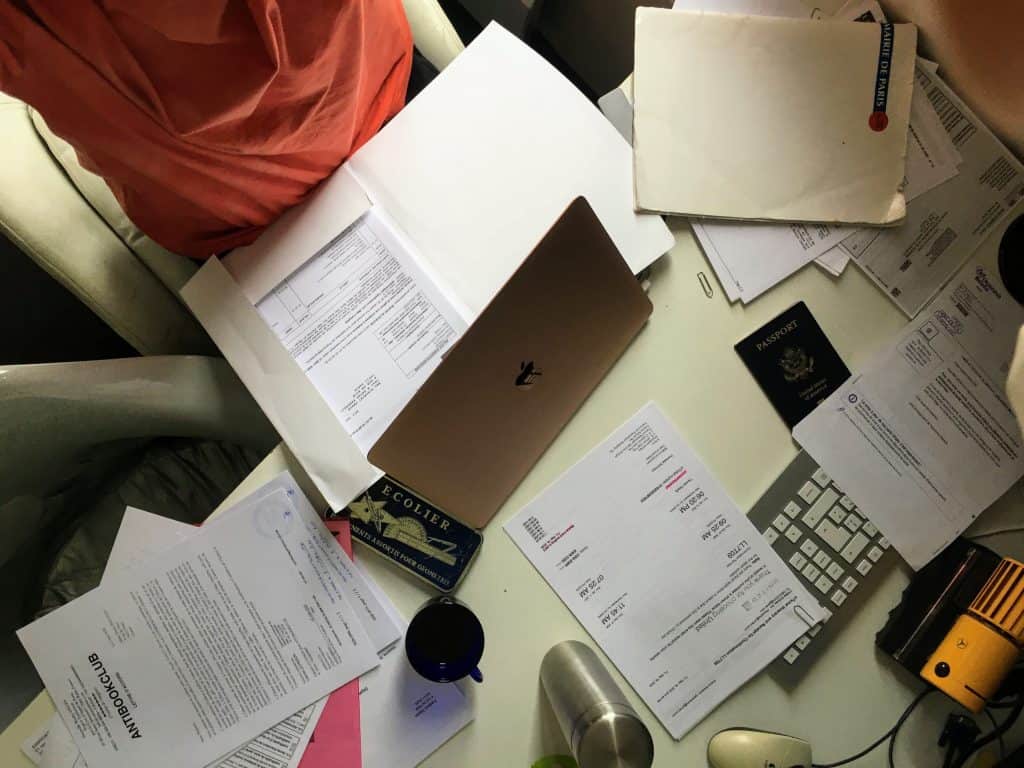
Troubleshooting: Récépissé for Visa Renewal

***Please note that practices have changed since Covid-19.  You may be able to get an electronic récépissé.  Check with your local prefectures.***

One of the things that keeps me really up-to-date in my immigration journey is the monthly newsletter of Jean Taquet.  If you don’t already get it, and you are planning to emigrate here, you’re doing it wrong.  In fact, if you haven’t subscribed to his newsletter, stop reading this article, click here, and subscribe (it’s on the right-hand side).  Then come back and finish this.  I’ll wait.

So one of the things that I got from Jean’s newsletter was that appointment times were going from their normal 2-3 month lead time to something like 5-6 months.  Sure enough, as I applied for the renewal of my visa which would expire on the 20th of April, the first date listed in the system was the 27th of June!  Keep in mind the date that I made this appointment was the 12th of January.  So the soonest I got an appointment was a little over 5 months from the date of request.

What that meant was I needed “legal coverage” from the date of the expiration of my visa (the 20th of April) until the date of my appointment (the 27th of June).  Otherwise I would be showing up to my appointment with an expired visa, which wouldn’t qualify me for a renewal, but would rather mean I would get to start the whole process all over again.  It also would mean I could be stopped and given a very hard time when coming in and out of Schengen during that time if I were asked for my CDS.

So, for those of us on the right bank, we have to head to the police station in the 17th, which specifically deals with issuing récépissés, among other things.  The address is 19-21 Rue Truffaut.

I just now returned from receiving the récépissé, and I blame myself for the two hours I waited from 14h00-16h00.  The reason being that my visa expires sometime next week, when I’ll be in Malta, where I obviously can’t get a récépissé, so I had to go today, which was the first day I had free to head over to the 17th to wait in line.  However, this next Monday is a public holiday, so that meant the line was extra special this Friday.

As you face the police station, you’ll want to go around to the left-hand side, where the entrance is for récépissés.  Most of the people seemed to know that the line would be bad and were pretty quiet about the wait, but even I was not prepared for the fact that the line effectively did not move for 90 minutes.  Then, bizarrely, at 15h30, they took almost all of us who were in line (about 30) and assigned us numbers.  Fifteen minutes after that, my number was called and I headed up to Guichet #8, where a nice gentleman speaking Russian-accented French helped me.

The problem was, as I mounted the stairs, I realized something dreadful.  I had forgotten my passport.  I had even laid it on my desk intentionally to bring with me, but I had that moment of realization even as I began to reach for my bag to search frantically that I had, indeed, forgotten it.

Cool.  Calm.  Collected.

I said these words to myself and kept walking up the stairs.

The gentleman greeted me and I returned the greeting.  The rest of the conversation proceeded in French:

I would like to obtain a récépissé for my visa appointment, please.”

No problem.”

I slid over my convocation, which showed the date of my appointment, as well as my Carte de Sejour.  He looked at both and started typing.  A minute later:

Your passport, please.”

Cool as a cucumber, I reach in to grab my passport card.  I had obtained that passport card last year during the process of getting a new passport early.  The passport card is a handy driver’s license size card that can fit in your wallet which is valid for travel to Canada, Mexico, and many of the Caribbean Islands.  I figured, just pretend like I planned it this way.

The gentleman squinted at my card.

They are making American passports like this now?

No, sir, this is just a passport card,” and I said it like everyone knows what a passport card is.

He continued typing, but at a certain point he came to a place where it asked for the number of the passport and the number on my passport card does not correspond to that number.  He got up.

I knew he was going to see his supervisor.

While waiting, I opened up a browser in my smartphone and went into my online cloud vault in which I keep images of all my important documents and found a digital scan of my passport and had it ready to show the gentleman when he inevitably would come back with a frowning supervisor.

They were back in two minutes.

What is the purpose of this card, sir?” she asked kindly.

Ah, it’s for travel in Canada, Mexico, and the Caribbean.”  I said it just like a helpful librarian would.

Yes, but your regular passport.”

I’m so very sorry, I seem to have forgotten it,” tapping on my bag for effect.

She paused one moment, then said, “We can make a single exception this time, but if you go to your appointment like that, you’ll get kicked out!

I smiled, nodded vigorously, made all the necessary groveling noises to indicate gratitude for this kindness, while asking myself how I could have been so silly to forget my passport.  This must be my seventh or eighth time in a French immigration office.

The Russian-accented gentleman made a few more key taps under the watchful eye of the supervisor, who then departed, smiling at me.

A photo, please,” he asked, betraying none of the fatigue that a full day of this, nonstop, must beset those in his line of work.

I handed him one of those terribly serious unsmiling photos we take for all our official documents in France.

Thank you.”

Tap, tap, tap.

Heavy old printer starts printing.  I walk out the door at just after 16h00.

So, three lessons today.

One, subscribe to Jean’s newsletter.  It’s fascinating and bailed me out of having had a very, very delayed renewal.

Two, do not be insouciant about any gap between the expiration of your visa and your date of renewal.

Three, please don’t forget your passport.

Oh, and bring a book.  I finished a short one while waiting in line, in the lovely sunshine.

The photo is by Ashley Batz, via CC-Attribution.

Did you enjoy this article? TAIP is 100% reader-supported through tipping. If you want to leave us a tip of any amount it would be highly appreciated. These tips help support our efforts to keep TAIP an ad-free environment. Just as at a cafe, the tips are split evenly among the team.