

Life in France with Dogs

Once you’ve figured out how to move to France with dogs, the real question begins: what is it actually like to live there with them? Beyond paperwork and logistics, living abroad with pets means navigating daily routines such as walking, transportation, vet visits, and finding care when you want to travel.

There are many similarities between owning a dog in France and in the US, but also a few important differences to understand before your move. Though, overall, the transition has been easier than we expected. 

Dog Sitting Options

One of the reasons I chose France was its central location within Europe. I was excited to explore nearby cities and countries while living here. As such, it was a big priority for me to find a safe place to leave my dogs while I was traveling. 

In France, there are essentially two categories when it comes to dog sitting: a private dog sitter or a professional dog boarding business. We looked at both options to find the perfect fit for us. Rover is a popular application in France that connects pet owners to local sitters. Pet owners can easily message potential dog sitters and read reviews from previous stays. I found that the cost of pet sitting is similar to US prices.

Professional dog boarding kennels can also be a great option depending on your dog’s specific needs. However, many professional boarding facilities require additional vaccines that are standard in France but less commonly given in the States, such as leptospirosis. For this reason, we chose a private sitter instead. It would be beneficial to research the vaccination requirements of any potential dog boarding facilities if you plan on using their services. These vaccines can be given by either an American or a French veterinarian. 

Food and Veterinary Care

Moving to another country can be a traumatizing experience for pets as it involves a lot of different changes all at once. It is recommended that you check if your current dog food can be bought in France. If not, it would be beneficial to transition to a dog food that can easily be found in France before the move. There are many boutique and large chain pet stores in every French city. It is also possible to purchase dog food from French veterinarian offices and in the large supermarkets. 

There are many veterinary offices available, just as there are in America. It is possible to find a vet that speaks English, especially in larger cities and expat-heavy areas. I do strongly encourage studying and trying to use the French language while in France whenever possible. However, having the option to communicate in English during a possibly stressful veterinarian visit can be beneficial.

Walking Etiquette and Off Leash Culture

France is a dog-friendly country. You will likely encounter multiple dogs every time you leave your accommodation. One noticeable difference from the US is the prevalence of off-leash dogs. Although often illegal in public spaces, many dog owners allow their dogs to walk freely without a leash. 

In my experience, French dogs are very calm and well-behaved. They will typically not interact with humans or other dogs and happily walk down the street next to their owners. Unfortunately, there are some exceptions and some are simply curious. This can be challenging if you have an anxious or reactive dog. If this applies to you, it may be better to walk your dogs at slower times of the day, including early mornings and late evenings. 

There are dog parks available within most cities in France that allow your dog the opportunity to run freely. In Nice, where I live, two beaches allow dogs, though access is seasonal. Dogs are generally permitted in winter, while specific beaches are designated during busier months.

Transportation with Dogs

Dogs are allowed on public transportation here in Nice. They can ride trains and trams while wearing a leash and muzzle. Although France is dog-friendly in general, rules may vary slightly by city and transport provider. It is best to check local regulations before attempting any travel with your pets.

A Few Extra Things to Know

  • Many cafes and restaurants allow dogs and you will often see them quietly sitting under tables
  • Dog waste bags are often provided in public spaces, parks, and along popular walking routes
  • Pet insurance is common and generally more affordable than in the United States
  • Dog grooming services are widely available and reasonably priced in most cities

Photo of my husband with our dogs in Nice

Did you enjoy this article? TAIP is 100% reader-supported through tipping. If you want to leave us a tip of any amount it would be highly appreciated.  These tips help support our efforts to keep TAIP an ad-free environment. Just like at a cafe, the tips are split evenly among the team.
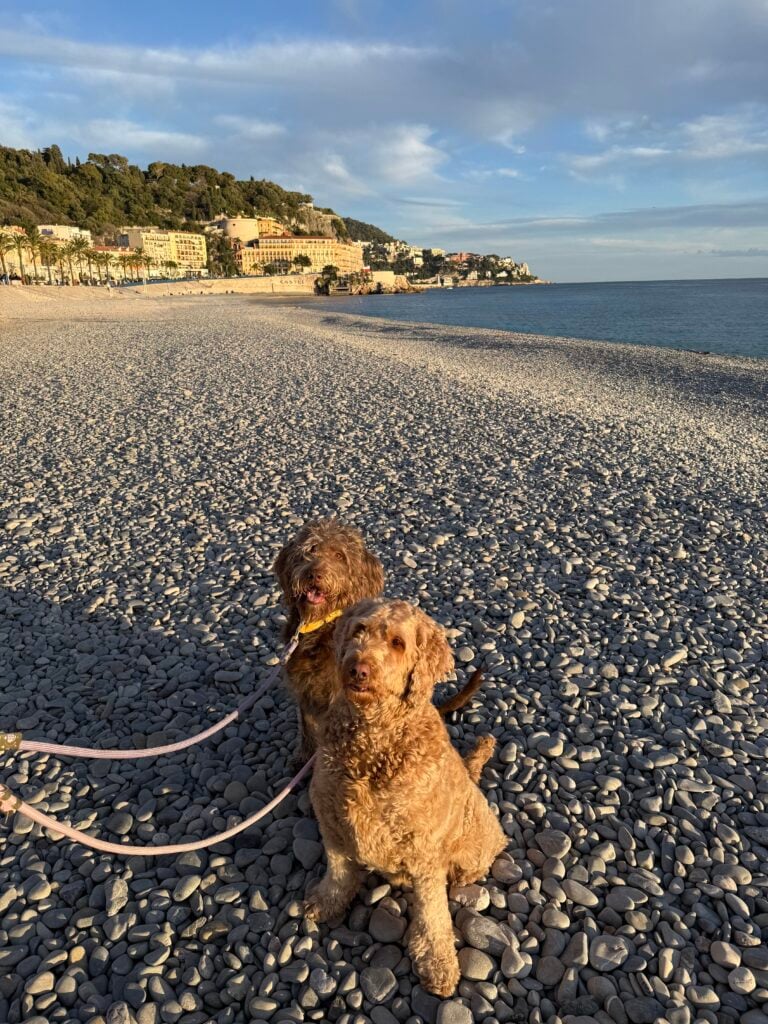
two dogs on a beach in Nice, France

Moving to France with Dogs: Finding a Dog-Friendly City and Apartment

About a year ago, my husband and I sat down at the dining room table and mapped out a checklist of the characteristics we wanted in our next city. “Dog-friendly city” was one of the first things we wrote down. We have two of our own and we felt it was essential that we move somewhere where they would be welcomed. 

We quickly Googled “most dog-friendly cities in Europe” and started checking out the various cities on the list. Nice, France was ranked number three and caught our attention as my husband has been studying French for many years. After lots of research, we felt confident that the atmosphere in Nice was perfect for us. 

Fast forward a year from that conversation and we are now living here with our two dogs. I would argue that Nice is the most dog-friendly city that I have ever experienced.

Dogs are welcome on public transportation, in restaurants, on the beach, and in many grocery stores. We have noticed a few grocery stores that discourage them in the store, but these places have a “dog garage,” which is essentially a designated area outside the store to hook up their leashes while you shop. Some well-manicured parks do not allow dogs, but these account for a relatively small percentage of the city’s available green space. Overall, they’re welcome in most public spaces around the city. The locals have also been very kind to our dogs, and it has been a great conversation starter when meeting new people in our area. 

Aside from Nice, France is known to be extremely dog-friendly as a whole. I remember visiting Paris many years ago and being surprised to see many dogs sitting outside a cafe while their owners enjoyed lunch. Americans love their dogs, but rarely do they bring them along on simple errands or outings. In contrast, the French seem to bring their dogs everywhere with them. We have only recently moved to France and have not had an opportunity to travel to many other cities with the dogs. However, I look forward to adventuring around the country with the dogs in the near future and I expect they will be embraced as they have been here. 

What French Law Says About Pets and Rentals

Apartment hunting is fun for a moment before it becomes daunting. The process is quickly complicated by looking for the perfect location, amenities, monthly payments, etc. The search becomes even more challenging when you remember that most landlords aren’t exactly fond of pets. We look at our dogs and think, “You are perfect, who couldn’t love that face?” A landlord looks at them and thinks, “ Stained carpets, scratched up walls, and dirt EVERYWHERE”. 

This is why many landlords in America include “NO DOGS, NO CATS” in their apartment listings. As pet owners, we simply have to frown at the listing and move on. However, this is not the case in France. It’s illegal in France for a landlord to forbid pets in a long-term rental. Some French listings may still include similar verbiage but the renter is not obligated to respect this clause thanks to French law. I am not encouraging you to sneak pets into your accommodations in France. However, it is known that many French citizens will simply not tell their landlord about their pets before moving in. Although French landlords can not forbid pets, it is important that the dogs do not cause damage or noise disturbances in the apartment. 

With all rules, there are exceptions. In this case, landlords do have the right to refuse dogs if they are either category 1 or category 2. These dogs are classified as “dangerous” under French law and include Stafford Terriers, American Staffordshire Terriers, Rottweilers, and Tosas.  

The French law is absolutely in your favor while searching for a long-term rental in France. Despite this, it is still extremely challenging for expats to secure a French apartment. Short-term “vacation” rentals are one of the options that I would personally recommend to anyone trying to start a new life in France. The eventual goal would be to find the perfect long-term rental, but it may take some time before everything falls into place.  

Start with a Short-Term Rental

Many people choose to start their French life on Airbnb for a multitude of reasons. The Airbnb website makes it very easy to browse accommodations, read reviews, and message owners. That said, Airbnb listings are considered “short-term” rentals, and therefore, the hosts can refuse to accept pets per French law. There is a feature of the Airbnb website to filter search by Airbnb hosts that allow dogs, but I would encourage you to look at all available listings. In my personal experience, I messaged an Airbnb host who did not allow dogs and asked them to make an exception. They accepted the rental offer with an agreement that I would hire their cleaner to clean the apartment every two weeks for a small fee. 

Life in France with Dogs

I am now sitting in my dog-friendly apartment in the dog-friendly city of Nice, France, writing this article. My dogs are napping, one on the couch and the other on the bed, without a care in the world. Getting to this point was not easy; it included hours of research and many moments of extreme frustration. However, it was 100% worth it, and I would do it again in a heartbeat. These moments are worth all the effort and more.

Photo of our adorable dogs on the beach in Nice

Did you enjoy this article? TAIP is 100% reader-supported through tipping. If you want to leave us a tip of any amount it would be highly appreciated.  These tips help support our efforts to keep TAIP an ad-free environment. Just like at a cafe, the tips are split evenly among the team.