mini eiffel tower on stone wall

A Page from 29 Days to France: Getting the Essentials Sorted

For those of us who have moved to France, we know there’s a moment that comes right after the dream becomes reality — when the plan lands, your feet finally hit French soil, and you realize… Okay, now what?

It’s where the idea of moving to France meets with the very real logistics of actually living in a foreign country. It’s also where a lot of people tend to freeze, and then the panic sets in. What comes first? What needs to be done? What’s “normal” in France compared to what you’re used to back home?

When we wrote 29 Days to France, we wanted to walk people through not just the big picture of immigration paperwork or visa timelines (which are also included, fear not😉), but also the smaller minutiae of getting settled into your new French life. Details like getting a cell phone. Setting up electricity. Opening a bank account.

Are they glamorous tasks? No. But they’re the foundation of pretty much everything else. So today, I wanted to share one full day from the book to give any of you preparing for a move to France a sneak peek at what’s inside. 

Day 13: Getting the Essentials Sorted

Congratulations, you’ve officially arrived in France! You’ve most likely spent the first few days soaking it all in: your new neighborhood, the sound of chattering French, and the smell of buttery croissants in the air. Now that you’ve touched ground and are ready to start your new French life, you need to take care of a few essentials.

What are the essentials? Your cell plan (and new French number), your electricity and gas (handled by the national carrier, EDF), and your French bank account (which will provide you with a debit card). This won’t be the most exciting part of getting settled, but it’s necessary.

Cell Phone Carrier

There are several French cell phone carriers to choose from, including Orange, SFR, Bouygues, and Free. If you’re coming from the United States, you’re in for a pleasant surprise. Cell phone plans in France are much less expensive. I personally have Free and I pay around 20 € per month for unlimited texts and calls within Europe, unlimited internet access, and 30 days of free calls and 25 GB of internet within the US, among other locations. You can sign up for most cell phone plans online, but you can also go to a store and practice your French, if you’d like.

Electricity & Gas

EDF, which stands for Electricité de France, is the leading supplier of electricity in the country. It is majority-owned by the state, which keeps prices affordable. You’ll want to set up your home’s electricity and gas directly with them.

Your landlord most likely will not arrange this for you, so you’ll have to make a few phone calls. Alternatively, you can sign up online, but you need to get used to making these kinds of calls in French so I suggest that you get all of the practice you can! Once you have your French cell phone sorted you can call EDF at 3004. Make sure you have your address on hand.

This is the single most important and reliable proof of residence in France: the attestation that you pay for electricity.

Bank Account

There are also several different French banks to choose from. I have Crédit Agricole and I am really happy with them. They are a smaller bank and I find that the fees are reasonable. To choose for yourself, you’ll need to think about your personal needs. Do you want a larger bank? One that’s foreigner-friendly? Or maybe a small, local bank?

If you want a bank with a reputation of friendliness to foreigners, go for BNP Paribas. Its headquarters are in Paris and it’s the largest bank in France. It’s also among the largest banks in Europe. BNP is used to working with foreigners and I know that they have several representatives who speak English well.

Exercise: Be aware of your needs and do your research, especially when it comes to what you’re looking for in a cell phone and bank account. Practice (write it down if you need to!) what you’ll need to say in French before you call EDF or head to the bank.

Questions to answer: What do I need in a cell phone plan? What do I need in a bank account?

Why This Page Matters

I chose to share this page because it’s such a real moment in the move-to-France journey — one that not many people online talk about. No matter what kind of visa you’re on, no matter your job, family status, or even the city where you live, everyone has to navigate these basics.

And if you’re feeling intimidated by the idea of making a phone call in French, or choosing between a dozen different banks, or not knowing whether you need to bring ID to the phone store (you do) — that’s normal!

The entire goal behind 29 Days to France is to make this process feel less overwhelming and more doable. Not perfect, and not even necessarily easy, but possible. One small, essential step at a time.

If you liked this little excerpt, the full book features 28 other mini-guides just like this one. Each is focused on a task, a mindset shift, or a key moment in the move-to-France journey.

As a special treat for our American in Paris readers, you can purchase the 29 Days to France ebook for just $10 with the coupon code TAIP. We wrote this book with all of you in mind, and hope you enjoy reading it as much as we did writing it 🙂

Photo by Kristina Tochilko on Unsplash

Did you enjoy this article? TAIP is 100% reader-supported through tipping. If you want to leave us a tip of any amount it would be highly appreciated.  These tips help support our efforts to keep TAIP an ad-free environment. Just like at a cafe, the tips are split evenly among the team.

book promotion

We Wrote a Book, Part III: Promotion (Help Us Get the Word Out!)

So now that you’ve had a chance to hear Molli and I opine on the book-writing experience for 29 Days to France, we are asking for your help as we get closer to the “big” launch of the book.

This isn’t to say the book isn’t launched. We had a pre-order period restricted to readers of the blog earlier in the year and then officially listed the book for sale with more publicity last month.

But it’s been a busy few months personally for the authors, with moves and vacations and weddings (no kidding, between the weddings that Molli and Gracie have been invited to, more than half a dozen!) so we had planned a more formal launch of the book for later this year, October 1st to be exact.

We have plans to appear on podcasts, do webinars, collaborate with YouTubers, and write guest blogs, but we need your help.

You may know content creators or websites we don’t know about.

You might have relationships with independent bookstores in America that would be open to carrying our book (and/or having one of us come to give a talk).

You might have groups to whom we could offer a webinar.

The ideas are endless, really, and there’s no such thing as a bad idea during this phase. We are in our final few weeks before starting this media blitz and would love to hear your ideas for ways to promote the book that we may not have thought of!

All decent ideas will be rewarded with an autoresponder version of the book, and the best ideas will receive a paperback edition mailed to them!

We think this book can be a catalyst for a major life change for so many people by giving them information that turns something that initially seemed scary and difficult into something believable and achievable. Will you help us change lives?

Photo by aboodi vesakaran on Pexels

TAIP is 100% reader-supported through tipping. If you want to leave us a tip of any amount it would be highly appreciated. These tips help support our efforts to keep TAIP an ad-free environment. Just as at a cafe, the tips are split evenly among the team.
We Wrote a Book, Part II: Publishing

When Stephen first asked me to come on board as a guest writer for The American in Paris I was thrilled — I had long wished for a space where I could speak about my experiences as an expat in France. 

I wrote my first few articles and the feedback we received helped us realize there was a need for more information on getting the student visa, au pair visa, and APS visa, all of which I’ve successfully applied for and received. 

The more we worked together the more we realized the need for a manual — or a guide, really — for Americans who were interested in moving to France from the United States. We did it ourselves (as did our other co-author Gracie Bialecki) and we wanted to help others with the process. Stephen mentioned it before and I’ll say it again: it’s the book that we wish we had at the start of our journeys

What started with an idea to create a 29-day email autoresponder morphed into something much larger: we decided to create an actual paperback book and ebook version to go along with it. We knew that it could potentially help a lot of people and were prepared for the amount of work it would take to get it published. 

Famous last words. At the beginning of our publishing journey, I did a quick Google search: how to self-publish. A slew of articles came up and I skimmed a few. All of them said how easy it would be. I quickly let Stephen and Gracie know that I would be happy to take care of the publishing process myself — I had just opened my native English creative boutique Plume and I was eager to get some publishing experience under my belt. I tend to be optimistic when starting a new project. My motto: How hard could it be?

Well, it turns out a lot harder than you would think! I want to preface this by saying that I am so grateful for the opportunity to be an actual published-in-print writer and I am thrilled with how everything came out. That said, something that I figured would take me ten hours tops ended up taking double, even triple the amount of time.

Figuring out margins, bleed, what quality printing we wanted to go with, page numbers, and crafting areas to take notes inside the book was a long and arduous process. I tried and tried and tried again, uploading manuscript after manuscript into the self-publishing platform we used. After over a dozen attempts, success! Our manuscript was accepted and under review.

With the paperback version taken care of, it was time to figure out the ebook. Because the paperback manuscript was done and dusted this part of the publishing undertaking was a lot easier. That’s not to say that I didn’t spend at least an hour lining up the bullet points. Again, I want to express my gratitude for this project but, phew, who knew publishing could be so complicated? (Anyone in publishing who is reading this article is likely chuckling to themselves).

At this point, the email autoresponder was a piece of cake. Unsurprisingly, it was the easiest part of the project. That’s not to say that I didn’t have to test it out with several different services before finally settling on one that I liked. But, en fin, our project was ready to launch!

And here we are today. Stay tuned for more updates on our book and if you purchase it, please do let us know what you think. We’re so happy and honored to be able to help so many others make their I-want-to-move-to-France dreams come true, as we did.

Molli offers private consultation services which range from help with visas and adjusting to life abroad to Paris travel itineraries. Fill out the contact form to learn more.

Photo taken outside San Francisco Book Company near the Luxembourg Gardens, after we (finally) got our approved proofs back!

Did you enjoy this article? TAIP is 100% reader-supported through tipping. If you want to leave us a tip of any amount it would be highly appreciated. These tips help support our efforts to keep TAIP an ad-free environment. Just as at a cafe, the tips are split evenly among the team.

We Wrote a Book, Part I: Brainstorming, Writing, and Editing

I’ve said more than once that I never expected TAIP to grow into the resource it has become. I simply wanted to help others who, like myself, wanted to move to France but didn’t know how.

After ten years of helping people who were trying to figure out how to get here, I used that experience to put together a book that goes through how to do to move to France as a non-citizen, step-by-step.

Rather than offer detailed explanations of how to fill out specific visa applications (which can periodically become outdated and which we’ve already offered for free on the site) we took a higher perspective from: once I know that I want to move to France, what are all the things I need to think through in order to make that happen?

We created a set of 29 “Days” which serve as prompts and exercises to prepare you to move to France, broken into three parts, to help get you organized

  • before you arrive
  • when you arrive
  • after you’ve been here for a while

This is the book that I wish I had when I was preparing to move to France.

I didn’t write it alone. TAIP correspondents Molli Sébrier and Gracie Bialecki shared the load.

The book comes in three forms:

  • A traditional paperback, which comes with original photos and two appendices featuring a resource list for Paris residents (doctors, plumbers, accountants, etc.). This purchase also gives access to the digital version, which will be updated annually, and the email autoresponder version, which sends you the book in email form over 29 emails.
  • A digital copy for whichever e-reader you prefer. This version does not include photos or the appendices.
  • An email autoresponder which sends you the content in email form, spaced out over 29 consecutive days.

I’ve worked on publishing projects before, but only as a proofreader or as someone helping behind the scenes to get the project to press. This was my first time as an author, and even there I had help in the form of two co-authors.

There’s such a big gap between “I’d like to write a book” and “I wrote a book” and it’s not just work that fills that gap.

It’s the original brainstorming of what people really need to know before they get here, when they get here, and after they’ve been here a while.

It’s endless proofreading. For those of you who’ve edited work, you know the feeling of finding a typo (“another one?”) on what feels like the 27th pass of a text.

It’s sending galley copies out to reviewers (of which we had half a dozen from the TAIP audience step up and volunteer to help).

It’s personal events and travel that are also jockeying for attention (e.g. Molli left to get married the day after she sent a batch of edits to the publisher, then came right back to that text a couple of weeks later to finish up).

We also wanted to make the information useful but not overwhelmingly so, which led us to create single-page days with specific exercises at the end of each one.

We’ll be sharing more information on this book each month for the rest of the year. For now, I am very happy to have completed the project and am excited to get this book into the hands of those seriously considering a move here. It’s going to make the process so much more enjoyable, fun, and reflective.

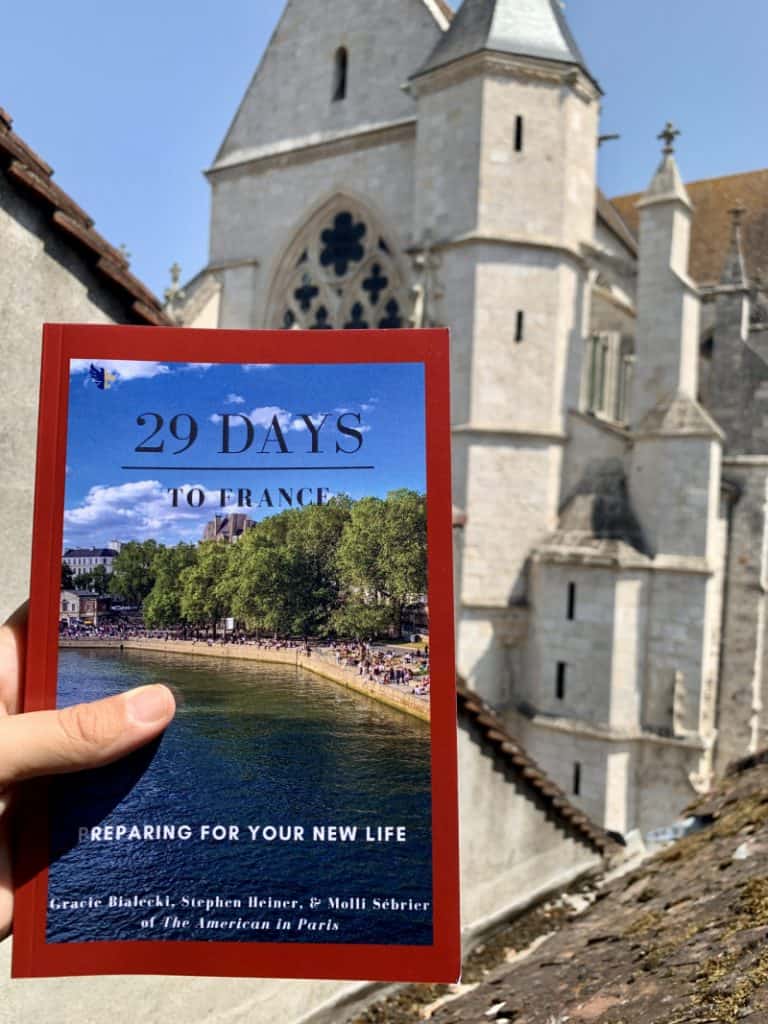
Photo taken outside one of the windows of my apartment in Moret, where almost all my chapters of the book were written.

Did you enjoy this article? TAIP is 100% reader-supported through tipping. If you want to leave us a tip of any amount it would be highly appreciated. These tips help support our efforts to keep TAIP an ad-free environment. Just as at a cafe, the tips are split evenly among the team.