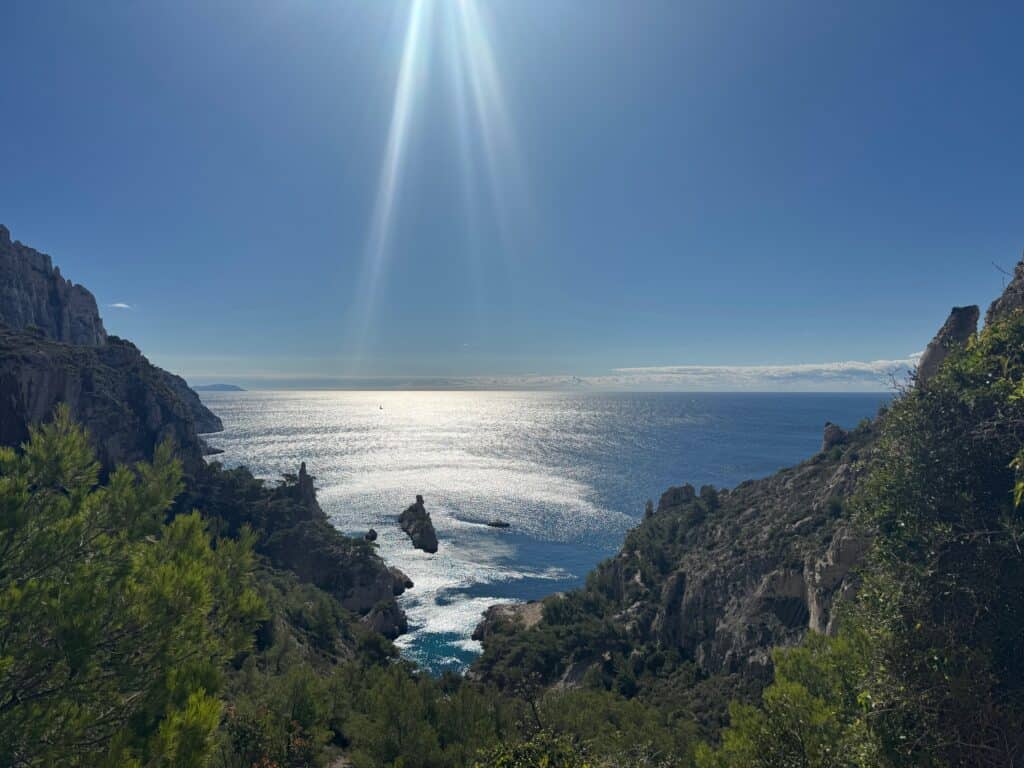
The Most Beautiful Place in France

I know the title may be a contestable claim, and so I will add a tiny disclaimer. The Calanque de Sugiton is the most beautiful nature reserve in France that I have seen with my own eyes.

What is a calanque anyway? It is a geologic formation of a steep valley, submerged in part by the ocean. The Calanque de Sugiton is about a 45-minute drive southeast of the Marseille Saint-Charles train station, positioned on the Mediterranean Sea. 

Of the many calanques found in this region, my local friends advised that I see this one in particular for a few reasons. The first being its beauty. Secondly, as I did not have a car during my stay, it is reachable by public transit (and a bit of willpower). Apart from their advice and a pin on Google Maps, I did no research on where to go once I arrived at my final bus stop. This was admittedly very outside my type-A tendencies. In this guide, I will recount the roundabout way I eventually got where I was trying to go and hopefully provide a clearer path for those looking to explore this magnificent nature preserve.

Getting to the Water

When I got off the B1 bus at the stop “Luminy – Parc National des Calanques,” thankfully, I was not alone. On a Thursday morning at 11 am there were about 15 people headed into the park. We were all equipped with our hiking gear, a backpack of snacks, and water for the journey. Although Google insisted that I stay on the road to arrive at the head of the path, I followed the crowd uphill on the sidewalk to a foot path that was marked with a map of the calanques. At this point, I knew I was in the right place. The wide path continued straight ahead, and so did I. 

About a 30-minute walk through the shaded forest led me to a gravel lot with three options of where to go. To my right led a lookout over the calanque. I was anxious to get down to the water and eat my picnic, so I saved the lookout for later and headed left. I chose a path that was marked for pedestrians only. I figured this must be the way to go. The descent led me around an opening in the cliffs. The view was spectacular in the truest sense. Eventually, I reached another fork in the road. To the right was a steep rocky path that offered a shorter descent to the western beach. However, to the left was a slightly longer path to what was marked as the eastern beach. I figured a longer distance would mean fewer people, and so I continued east on the less steep road. 

My instinct was right; there were fewer people, but the smooth descent soon turned into a tricky maneuver along the cliff and over an unwelcoming patch of rocks. My climbing skills were tested and a friendly older woman, who clearly knew her way around, showed me how to get down onto the farther beach. She continued on her way, and I had the rocks and the ocean to myself — for a moment. 

Since it was a little after noon, I started to eat my salad on the shore. I was a few bites in when I noticed a man coming around the rocks I had just come from. A moment later he emerged from around a carving in the shore, now completely naked, to inform me that I was at the nudist beach. He was nice enough to leave me laughing to myself as I packed up my lunch and headed back to the rocky path. I remember thinking, “That’s what I get for not doing my research!”

I retraced my steps and found my way to a shaded overlook above what I could see was the western beach. I sat on the rocks, finished my lunch, and took in the magnificent scenery. When I finally had the courage to continue my search for the right path, I made my way to the last fork in the road that I remembered was labeled with the path to the west. I found a steep rocky way up that rejoined with the road. When I arrived at the road, I turned around to see that the path I had come from was explicitly labeled for the beach I was looking for. Confused, I asked for directions from some fellow hikers beginning their descent. They said that I had come from the correct path, but to hug the right as I made my way down. 

This time I noticed a red marking on the rocks that indicated a steeper descent. Just when I thought I was going too far right and surely going off the path, I happened upon a set of cement stairs that led the way down securely. Finally, this was promising! My hopes were not disappointed and in no time I was at the calm waters, with many a happy pilgrim that had beat me there. I scoped out a spot to leave my things and got in the water as fast as I could. 

When to Go

Being the middle of September, the water was particularly cold, but the sun remained strong enough to encourage me to dive in. I enjoyed a swim around the rocks in the cleanest water I have ever been in. When I made it back to the shore, I warmed up in the sun with a book. At this point I was surrounded by people of all tongues and cultures, fellow explorers and locals alike. It’s hard to keep beauty a secret. I was thankful that it was during the week and off-season. I learned later on that if I had come in summer or even the weekend before, I would have needed to make a reservation. 

After enjoying a few hours by the water, I packed up my things, said goodbye to my moment in paradise, and made my final ascent. After the 30-minute hike uphill, I opted to detour to the lookout that I skipped at the beginning. It was a stunning view and well worth the 40 minutes it took me to get out and back. It was about 4pm by the time I returned to the gravel lot, ready to make the final 30-minute stroll through the forest to return to the bus stop. I arrived with just a 10-minute wait to catch a ride back into town. 

Words of Wisdom

For those willing and able, the Calanque de Sugiton is a generous reward for a day’s hike. The challenge of arriving there revived my spirit of adventure, and I reckon it has done likewise for many. There is no cell signal once the descent begins, so I’d recommend turning your phone to airplane mode and planning a truly unplugged afternoon. If public transit is your chosen method, I’d also advise reviewing bus times in advance to ensure a smooth return.

Have you been to the calanques in Southern France? Has your experience come with other insights? Better yet, do you have another hike in France you recommend? I’d love to hear in the comments below. 

Photo by yours truly, taken before my descent to the water.

Did you enjoy this article? TAIP is 100% reader-supported through tipping. If you want to leave us a tip of any amount it would be highly appreciated.  These tips help support our efforts to keep TAIP an ad-free environment. Just like at a cafe, the tips are split evenly among the team.

The Secret of the South: Le Puy-en-Velay

“Le Puy-en-what?” This is often the response I receive when asked where I am living in France. Even many of my French friends from other regions of the country are unfamiliar with it.

As I write during my return flight to the US for the summer, I can tell you that just this morning a French travel inspector in Paris asked me what I had been doing in France and where I was going. I explained that I had been teaching English in a town called Le Puy-en-Velay. She seemed convinced I made it up, until I explained where it is on a map. 

Two hours south of Clermont-Ferrand and two hours west of Lyon, you could say it is in the middle of nowhere. I fell in love with Le Puy-en-Velay on my arrival, but what I didn’t realize then is that I was far from the first to be taken by the charm of this little village in the valley. While visiting the Orsay Museum in Paris last year, I stumbled across not one but two different works of art depicting scenes from my new town. After stumbling across the second, I remember thinking, “Okay, maybe I’m not crazy for loving this place.” 

Decidedly picturesque, Le Puy (as it is called for short) is riddled with impressive monuments and little alleys. Tucked in the heart of the French countryside, this medieval starting place for the Camino de Santiago has attracted artists and pilgrims seeking respite for centuries. This peaceful region, once dominated by volcanic activity, is now a haven of striking rock formations and ancient history. 

If it’s So Great, Why is it Still a Secret? 

Le Puy is not well connected by public transit. It’s relatively far from bigger cities, and even trains to Clermont and Lyon are not direct. Most locals have cars and visitors would be most comfortable renting one for an extended stay. The perk of this inconvenience is that the town has remained quiet and protected from the casual passerby. 

But as you may note by the grandeur of its Cathedral or its medieval architecture, there was a time this quiet town wasn’t so quiet. 

What to See

Notre Dame de France

When coming into Le Puy, the statue of Our Lady of France may just catch your eye. She’s situated on the center peak of town, and at night she casts a glow over the whole city. Made with the metal of 213 cannons taken from the Russians during the Crimean War, the statue was gifted to the city of Le Puy en Velay by Napoleon III in 1860. It was the tallest statue in the world until it was surpassed by the Statue of Liberty. I’ll remind you that it was a gift to the US from France. 

Cathedral du Puy

A famous site for pilgrimage since the 400s, its varied architecture reveals a history of construction over the centuries. Even Charlemagne made multiple visits to the Cathedral in the 8th century, and Isabelle Romée (the mother of Joan of Arc) made an appearance in 1429. Every morning from April to October, the Cathedral offers a send-off blessing for those embarking on the Camino de Santiago. I don’t want to give too much away, but I will say the “trap door” opening at the end is impressive. 

St. Michel’s Rock & Chapel

Come for the views, stay for the culture. The construction of this chapel in the sky was approved by Bishop Godesclac, the first person to walk to Santiago from outside of Spain in 961. A stone staircase of 268 steps brings you from the access road to its Romanesque entrance. A small museum kept by Le Puy’s office of tourism recounts the geographic anomaly of the mountain before you make your way up. 

St. Joseph of Good Hope Sanctuary

Built on the site of a chateau fortress in 1910, this Basilica provides a magnificent panoramic view of the valley (as pictured). Inside the church, a colorful tapestry behind the altar depicts the life of this remarkable saint. Pilgrims can visit a cave chapel beneath the statue, or even step inside the statue itself as of its reopening in 2025. 

Enjoy Nature

Surrounded by rich landscapes, Le Puy-en-Velay offers no shortage of excursions for nature lovers. Picture perfect lakes, off-the-path waterfalls, colorful mountains and a suspended forest bridge are all within an hour’s drive away. I’ll leave a list of recommendations here. 

When to Come

I may have lived here through the winter, but I can vouch that Le Puy shines in the summer. Literally, the whole town is illuminated at night from July to September. With a higher elevation, the region can see snowfall from late fall to early spring. Most of the tourist sites close or have very limited hours from October to March, so I would recommend coming outside of this window. Thanks to the market in the town center, Saturday mornings have become my favorite moment of the week. If you can swing being here during a weekend, you may have more fun.

Now, if you’re looking to celebrate with the locals, every year the town hosts a candlelit procession to the Cathedral on August 15th. This holiday in the French calendar marks the Assumption of Mary into heaven. Though I haven’t had the privilege of witnessing the celebration myself, many have told me this is a sight to see. 

Ever dreamed of living in the middle ages, or wondered what that would be like? Le Puy has hosted a renaissance festival called the Roi de l’Oiseau for over 40 years. The third weekend of September, the town transforms into a medieval village. My first week in town happened to land at this time and the spirit of imagination in the air was mesmerizing. Hotels and hostels fill up, so be sure to book early. 

Every November Le Puy hosts a weekend of hot air balloon lift-offs. This is not a cheap way to see the city, but I’ve heard it is magnificent. The town becomes magical as colorful spots fill the sky. My jaw dropped on the sidewalk when I stepped out of work and saw this surprise last year.

Should I Visit?

Now I’m not saying Le Puy should be your first place to visit in France, maybe not even your fifth. It’s pretty hard to get here, so you’ll likely have to stop at a few other cities on the way. However, if you’re looking to explore the countryside and can swing a central France getaway, I’m glad that this little gem is now on your radar. 

Learn more about Le Puy’s history and upcoming events at its official tourism website.

Photo of Le Puy-en-Velay taken on film from the viewpoint of St. Joseph’s Sanctuary

Did you enjoy this article? TAIP is 100% reader-supported through tipping. If you want to leave us a tip of any amount it would be highly appreciated.  These tips help support our efforts to keep TAIP an ad-free environment. Just like at a cafe, the tips are split evenly among the team. 

How to Spend a Day in Lyon

Only a 2-hour train ride from Paris, Lyon is a great city for exploring the southeastern side of France. With an accessible airport, well-connected train stations, and an exceptional metro, I’d argue that it is the most visitor-friendly city in the country. 

Living in the South myself, I’m grateful to have this beacon of civilization within arm’s reach. In the past six months alone, I’ve had the opportunity to meet up with three friends passing through Lyon, each on separate occasions.

The first person to show me around the city was a true Lyonnais. I’ve used his blueprint of how to spend a day there on multiple occasions, with little tweaks and variations along the way. If you haven’t explored this ancient city yet, let this be your sign; now is the time.

How to Get Around

You don’t need to wait in line for a metro pass, hassle with an app, or keep track of tickets. Simply scan your touchless payment method (card or phone) at the entry of any public transport and you’re good to go. This applies to all busses, lifts, undergrounds, and trams. It is by far my favorite part about Lyon’s transportation system.

Start at Place Belle-Cœur

In the heart of the city, this square offers a variety of shops and an impressive view of the Fourvière Basilica to the west (your next stop). Surrounded by shops and alleys to get lost in, this uptown center puts its best foot forward. During my most recent trip, I was introduced to La Procure St. Paul, an enchanting bookstore in the plaza with an impressive selection of philosophy and children’s literature. 

Begin the Ascent

After a little browsing, make your way out of the square and across the Saône River on the Bonaparte Bridge. Take in the view on your way. Continue straight to the entrance for the funiculaire. This metropolitan lift offers a direct ride to the foot of the Fourvière Basilica. Scan your touchless payment method at the entrance and be on your way up. 

The Basilique Notre-Dame de Fourvière

Spectacular in every sense, this basilica is sure to take your breath away. But before entering, follow along the left side to take a look out at the entire city. The two rivers that divide it, the Saône and the Rhône, can be seen from this vantage point. You’ll also notice the sea of red rooftops, a hallmark of Lyon.

Return to the front to enter the Basilica and brace yourself for more beauty. While inside, don’t miss the crypt entrance inside of the church on the right. 

The Gallo Roman Theatre

When you’re ready to move, take a five-minute walk to the neighboring Roman ruins. This open-air theater is free to explorers. Make your way down from top to bottom. For true history enthusiasts, the Lugdunum Museum offers more on its archeological findings.

Ready to head back down the hill, I’d suggest taking another ride on the funicular. The F1 line, just next to the theater, will take you directly to the Vieux Lyon (old town). On exiting the metro, turn left.

Cathédrale Saint-Jean-Baptiste

While in old town, a stop inside the Cathedral of St. John the Baptist is indispensable. This magnificent building is home to an astronomical clock, at the end of the left wing. Tracking not only the time, but the years, the days, and the moon, it is a work of art in and of itself. I recommend landing there on the hour, to have the privilege of its full display.

Continuing straight through the square will take you down to the center of the old city.

Old Lyon

This cobblestoned corner is designed for the pedestrian. Riddled with restaurants and shops, Vieux Lyon is an excellent area for getting lunch and spending an afternoon. Cultural references to the city’s history are around every turn — marionette puppets, Lyon’s own Antoine of Saint-Exupéry’s Le Petit Prince, and odes to cinema, to name a few. 

With the invention of the Lumière cinematograph in 1885, Lyon was ground zero for the reproduction of moving images and the movie industry as we know it today. The Cinema and Miniature Museum, as well as the Lumière Museum, offer cinematic histories to true movie fans.

Having walked the breadth of old town, you can cross back to the city’s center on the Feuillée Bridge. This road will lead you directly to Lyon’s city hall. 

Hôtel de Ville and the National Opera of Lyon

Lyon’s city hall is an iconic spot, surrounded by cafés and restaurants centered around the celebrated Bartholdi Fountain. Just around the corner lies the National Opera. For the more courageous, head to its panoramic terrace for a drink — no reservations needed.

Let the Adventure Continue

In a city as vibrant and expansive as Lyon, this proposed itinerary just barely touches the surface of all there is to see and do. There are many theaters, experiences, and museums to explore that I have not had the pleasure of visiting. There’s even a zoo! Don’t be afraid to follow your nose and forge your own path around this lively metropolis.

Photo from my first proper trip to Lyon in 2024. 

Did you enjoy this article? TAIP is 100% reader-supported through tipping. If you want to leave us a tip of any amount it would be highly appreciated.  These tips help support our efforts to keep TAIP an ad-free environment. Just like at a cafe, the tips are split evenly among the team.