people waving french flags outside the louvre

Can I Move to France Without a Job?

With so many articles on visas, which one to choose, how to apply, how to renew, etc., we often get asked: but, can I move to France without a job?

The short answer is, no, you don’t need a job to move to France, but you do need to prove you can support yourself.

Good news for those who dream of moving here but assume that without a job offer, it’s impossible. While some visas do require employers’ sponsorship, there are many other paths for those without traditional employment.

Even more good news for retirees, freelancers, or someone with independent income.

Let’s dive into the key things to consider when moving to France without a job offer.

Do You Need a Job to Move to France?

Now that you know you don’t, it’s important to note that you must show the French authorities that you have some sort of financial stability before even stepping foot across the border. It makes sense: it may be a socialist country, but les français want reassurance that you won’t become a strain on the state when living here.

In fact, France’s immigration prioritizes financial stability more and more, whether through savings, passive income, or self-employment. If you can meet the financial and legal requirements, you can move to France without an employer sponsoring your stay.

Now, of course, some visa categories (such as employer-sponsored ones) do require a job offer. However, there are several other options available for those willing to plan ahead.

Visa Options for Moving to France Without a Job

1. Visitor Visa (Visa de Long Séjour – Visiteur)

Best for: Retirees, remote workers, individuals with passive income.

Requirements:

Key Consideration: This visa does not allow you to work in France, so you must have enough savings or remote income from outside the country. Contrary to popular belief, as an American, you can work remotely for a US employer while in France on the visitor visa 🙂

2. Profession Libérale Visa (Self-Employed Visa)

Best for: Freelancers, consultants, and business owners.

Requirements:

  • A detailed business plan demonstrating financial viability.
  • Proof of professional activity (e.g., contracts, invoices, website, portfolio).
  • Registration with URSSAF (the French social security system for self-employed workers).

Key Consideration: You must show that your business can generate enough income to support yourself over time, especially if you hope to renew and eventually apply for naturalization.

3. Student Visa

Best for: Those looking to study in France while exploring long-term residency options, those without access to a large amount of financial support and who are willing to go back to school, or folks who simply want to learn French in France.

Requirements:

Key Perk: This visa allows part-time work as well (up to 964 hours per year, around 20 hours per week), making it easier to support yourself while living in France.

4. Talent Passport (Passeport Talent)

Best for: Entrepreneurs, artists, researchers, and highly skilled professionals.

Requirements:

  • Proof of expertise or a recognized contribution in your field.
  • Financial stability and a viable business or research project.

Key Consideration: This visa is more selective — perhaps one of the most selective — but if you can land it, it offers one of the stronger paths to long-term residency and eventually citizenship.

How to Support Yourself in France Without a Job

While the cost of living in France is much lower than in the US, if you plan to move here without employment you’ll still need a reliable source of income — yes, in order to get your visa, but also to find a place to live and support yourself throughout your stay. You can’t forget about all of the travel and exploring you’ll want to do when you get here too.

If you plan to move to France without employment, here are some options that come to mind as well as the visas to go with them:

  • Savings: Many who aren’t too fussed about obtaining nationality one day choose the visitor visa, and a chunky savings account is the easiest way to prove financial means. Be prepared to share bank statements at your visa application appointment if you do go this route.
  • Freelancing or remote work: Consider finding a remote job in the US that is willing to allow you to live in France. Then, have your employer write a letter indicating you will not be working with French clients. Or, apply for the profession libérale visa if you’d prefer to have French and European clients.
  • Start a business: One of the more expensive and complicated ways to move to France. That said, if you have an entrepreneurial mindset you could come up with a plan to build a business in France and come over under the passeport talent.
  • Part-time work: Remember that student visa holders can work up to 20 hours per week, which can help supplement savings or support from family.

Whatever direction you choose, planning ahead is key. Again, you will be required to prove your financial situation at your visa interview, but beyond that, you want to be able to enjoy your séjour en France without having to stress about cash.

And if you need help coming up with a plan, please get in touch!

Photo by Alice Triquet on Unsplash

Did you enjoy this article? TAIP is 100% reader-supported through tipping. If you want to leave us a tip of any amount it would be highly appreciated. These tips help support our efforts to keep TAIP an ad-free environment. Just as at a cafe, the tips are split evenly among the team.

​​How to Get the APS (Autorisation Provisioire de Séjour) Visa in France

When I first came to live in France in 2014, I originally planned on staying for one year as an au pair. One year quickly turned into 2.5 years with the same family, which turned into three more years at a French university. The first was an intensive 20-hour per week program to learn French, and the last two years were to complete my master’s degree

At that point, I knew that I wanted to stay in France for the long haul, but I was at a loss as to how to do so legally. I didn’t want to be a student anymore, but I also didn’t have any major job opportunities lined up yet, at least, not with a company willing to sponsor a work visa for me.

Enter: the Autorisation Provisioire de Séjour (APS) visa. This type of visa is basically an extension of a student visa after obtaining a higher education diploma. In other words, the perfect visa for someone like me! 

Requirements to obtain an APS visa

The APS visa allows foreign students in France to stay in the country for one year after they graduate for a variety of different reasons. If you’re granted the visa, you have all of the rights that you had as a student, which means you can keep that student job of yours in the meantime as well!

Here are the requirements to obtain an APS visa:

  • Graduated with a licence professionelle (an undergraduate degree)
  • Graduated with a master’s degree, or equivalent. This can include an engineering, political science, or accounting degree
  • Graduated with an undergraduate or master’s degree with the desire to open your own company in France

How to apply for an APS visa

There are two situations in which you can apply for an APS visa:

  • You need an extension on your student visa to finish your final exams
  • You need an extension on your student visa after you have already passed your final exams

You can apply for an APS visa with your local prefecture. As usual, you’ll have to come prepared with a pile of paperwork. 

If you need an extension to finish your final exams, get in touch with the prefecture at least 15 days before your visa expires. This type of extension is free. You’ll need to physically go to the prefecture with the following documents (don’t forget to make copies, too):

  • Official letter from your university stating the date of your final exams
  • Your passport
  • Your residence permit (carte de séjour — étudiant)
  • Proof of address less than three months old

If all goes well you’ll receive a récépissé de prolongation de droit au séjour en qualité d’étudiant, which will give you the right to stay in France until you’ve finished your exams. As a note, if you want to stay even longer once you’ve obtained your degree, you’ll have to follow the procedure below.

If you need an extension to look for a job after you’ve obtained your degree OR you want to open your own company in France, you also need to physically go to the prefecture before your visa expires. This type of extension costs 75 € in “timbres fiscaux.” You know what that is if you already have a visa to be in France. Bring the following documents (and those copies!):

  • Your passport 
  • Your residence permit (carte de séjour — étudiant)
  • Proof of address less than three months old
  • 3 photos
  • Your diploma
  • Proof of health insurance
  • If you hope to open a company in France, a business plan

If you have all of the correct documents, you’ll receive a récépissé while the prefecture goes over your application. If you’re approved, you’ll be called back to the prefecture to pick up your new APS visa!

What to do when your APS visa expires

When your APS visa expires and you’ve either obtained a job or created a French company, you’ll have to change your status and ask for a new residence permit. Here is what you’ll need to have accomplished in order to change your status and stay in France for even longer:

  • If you’ve landed a CDD (a contract for a set amount of time, for example, six months or one year) or CDI (a contract for an indefinite amount of time, also known as the Holy Grail in France), it must be validated by the DIRECCTE (Direction régionale des Entreprises, de la Concurrence, de la Consommation, du Travail et de l’Emploi Regional Department of Competition, Consumption, Work, and Employment). You also must earn 1.5 times the minimum wage per month. If you meet these requirements you can apply for a “temporary employee” resident permit.
  • If you’ve created your company and can prove its viability, you can apply for a “temporary freelance entrepreneur” residence permit or a multi-year “freelance entrepreneur talent passport” resident permit.
  • If you are a researcher and have landed a research gig, you can apply for a multi-year “researcher talent passport” resident permit.

It’s important to note that if you do land a job or your company takes off that you change your status as soon as possible. Don’t wait until your APS visa expires! And, of course, if you haven’t obtained a job or opened your would-be company, you must leave France. 

As for me, I was lucky in that I met my now-husband by the time my APS visa ran out and I was able to change my status thanks to my relationship with a French person. I didn’t find a job with the requirements above, but I did open my own small business in France and officially became an auto-entrepreneur. I’m not sure what I would have done if I hadn’t met my husband in the meantime, but believe me, I’m glad I did. The moral of the story is that if you have a desire to stay in France legally do some serious digging well before your current visa expires. There is usually a way to do so if you go through the correct processes and have a passion for paperwork.

Molli offers private consultation services which range from help with visas and adjusting to life abroad to Paris travel itineraries. Fill out the contact form to learn more.

Photo by Seyi Ariyo on Unsplash

Did you enjoy this article?  TAIP is 100% reader-supported through tipping.  If you want to leave us a tip of any amount it would be highly appreciated.  These tips help support our efforts to keep TAIP an ad-free environment.  Just as at a cafe, the tips are split evenly among the team.

prefecture documents

How to Get a Vie Privée et Familiale (VPF) Visa

I first met Gracie over coffee at the end of 2018.  She had some minor questions about visa issues but seemed supremely in command of what she needed to do.  Turned out my impression was true.  Now it’s her turn to help others in this article about how to get a VPF visa. – SH

I’ll never forget the interview for my first long-term stay visitor visa. It was December 2017, and even though I’d quit my desk job and was preparing for the move, the visa was the first real step — it would give me the legal approval to embark on my Paris dreams.

The French Embassy in New York City is just off Central Park East on a block of regal brownstones. I biked there from Brooklyn and switched into low heels and a blazer on the sidewalk: if I was over-dressed at least I would match the buildings.

The last question the woman asked during my interview was if I’d return to the U.S. at the end of the year. “If I don’t meet a Frenchman,” flashed through my mind. But I was being quizzed and this was the final question, so I nodded politely and kept my hypothetical romances to myself.

My Frenchman, Frédéric, appeared four months into my first visa, and we were PACSed (PACS stands for pacte civil de solidarité and is judicially one step below marriage in France) a year-and-a-half later. With my third visitor visa expiring in February 2021, applying for a Vie Privée et Familiale (otherwise known as VPF) visa was the next step in my immigration journey.

A Bit of Background

The differences between the two visas are tied to the rights they give you: a VPF visa allows you to work, to receive a Carte Vitale, and to leave the country for one to four years (depending on the length of stay you’re granted). The long-term stay visitor visa allows you to spend a year in the country, and…that’s about it. It’s simple when you think about the names — the VPF visa proves you have a (private or familial) tie with the country while the visitor visa means, well, you’re a visitor.

Since Fred and I are PACSed, please keep in mind I’m writing from that perspective. (This visa is also available to married couples with slightly different requirements, which I’ll include where possible.) Since I knew getting PACSed allowed me to apply for this visa, when I was starting that process in June 2019, I was also taking steps for my future VPF visa application. This means I’d spent nineteen months getting ready.

Preparation: A Year Out

Check the visa requirements

In order to apply for a VPF visa, you must be married or PACSed.  If the former, you need to have proof of your marriage, as well as six months of residence if you didn’t arrive on a long-stay visitor visa.  If you did arrive on a visitor visa, there’s no waiting period.  For those who are PACSed, you have to, as you do with so many things in France, prove the validity of this relationship, and that you’ve lived together for at least a year (though you can begin the process before those 12 months are up). The list of documents the prefecture sends after you book your appointment is more arcane, while the government site simply asks for the following documents:

    1. Your long-stay visa or residence permit
    2. Your passport (with photocopies of the pages relating to civil status, validity dates, and entry stamps)
    3. Your birth certificate
    4. Three standard-sized photos
    5. Identity card or certificate of French nationality of your spouse/partner
    6. Marriage certificate or PACS agreement of fewer than 3 months (or certificate of PACS fewer than 3 months old if the PACS is older)
    7. Proof of community of life: joint declaration on the honor of the couple attesting to their common life and all documents allowing to establish the community of life (lease, EDF bill, bank statement, etc.) over at least one year

Get your documents in the right names

You’ll need to add both your names to the EDF bill, lease statement, and internet bill, as well as possibly open a joint bank account.  Whenever it’s possible, it’s best to have both your and your partner’s names on the document.

Note: This is not as easy as it sounds, and may take at least a month for everything to be in place. Be patient and steadfast in the daunting task of navigating French customer service.

Request birth certificate

You may already have one from a former visa or your PACS. If not, request it now since it needs to have an apostille which adds an additional step, depending on what state you were born in.

Note: If you don’t know about an apostille is, read more about them here. I naively thought they were unimportant only to have my birth certificate rejected when submitting the paperwork for my PACS.

Four Months Out

Make the appointment

Again, this might sound simple, but I spent two weeks in July 2020 calling the prefecture before getting through to a secretary.

(Note: If you’re switching visas, you’re required to make an appointment by phone.)

Wait times were abnormally high due to the backup caused by the confinement of March – May 2020. Regardless, the prefecture may be fully booked for appointments three-four months ahead, and with all things French government-related, it’s best to assume the worst-case scenario.

Note: Your spouse/partner must come to the appointment as well, so make sure it works with both of your schedules. Once you received your convocation, it’s difficult to change the time.

Review Prefecture List

You’ll receive your appointment confirmation via email, as well as the list of documents. In addition to the standard IDs listed above, here are the ones requested pertaining to my situation, which was “Proof of Personal and Family Ties in France”:

    • For the married: your marriage certificate
    • For those who are PACSed:
      • A copy of the PACS and certificate of non-dissolution of fewer than 3 months etc.
      • Proof of continuous relations with the members of the family living in France: cohabiting partner or civil partnership.
      • Justification by any means of the duration of continuous residence in France: visa, receipt of an application for the residence permit, documents from a public administration (prefecture, social service), documents from a private institution (medical certificate, bank statements), personal writings (letters, certificates from relatives).
      • Supporting documents on the applicant’s living conditions (income, salaries, bank statements, etc.).
      • Proof of its integration into French society (certificates from friendly circles, membership of associations, voluntary activity, participation in children’s school activities, etc.).

As you can see, the prefecture list is lengthier and less document-specific than the online list. My takeaways were:

    • The prefecture is still looking for proof of your and your partner’s shared life, as well as your commitment to your life in France.
    • The fact that I already had three years’ worth of visas, and was a member of two societies was in my favor.
    • I’d also need proof of my US income.
    • And, as always, for the French, the more documents, the better.

One Month Out

Request “Certificat de non-dissolution de PACS

This can be done via email (pacs.scec@diplomatie.gouv.fr): read more here. In the response to my request, the bureau said there was no record of our PACS, and I needed to have the mairie send a copy. At the mairie where we were PACSed, they found the certificate which had never actually been sent to Nantes. These bureaucratic mishaps are quite common, hence the generous timeline.

Submit Translations

Since I couldn’t legally work in France with my visitor visa, and am self-employed in the US, I had a recent freelance agreement and my book royalty contract translated from English. Whenever possible, the original documents must be submitted to the translator and stamped along with the translation. The Minister of Justice has a list of certified translators, and you’re expected to use one of them.

Note: If you’re getting a birth certificate, this must be translated as well.

Week Out

Print and organize all documents

I’m not exaggerating when I say this took hours, and I’m grateful I gave myself time to do it. In the end, I had four different folders sorted into:

  • personal ID documents
  • shared documents
  • personal financial documents
  • bonus documents.

Note: This level of organization calmed my visa anxiety, and might not be necessary if you’re less intimidated by the process.

Make sure you have photocopies

Whenever you know you’ll be keeping the original document (i.e. your passport), you’ll need to make a photocopy to give to the prefecture.

Note: Be sure to make copies of the front and back of any ID cards or other two-sided documents.

Appointment Day

Arrive at least a half hour early

This will give you time to go through security, find your appointment room, and wait. As always, I dress my best when the most is at stake, and wore a blazer and a button-up blouse to soothe my bureaucratic anxieties.

Bring those documents; this was my final list:

    1. Convocation with my appointment time
    2. List of documents
    3. Request for the Titre de Séjour (you’re usually given this form at the prefecture)
    4. My passport (which also contains my first visa, along with photocopies)
    5. Three standard-sized photos
    6. My current carte de séjour (plus photocopies)
    7. Photocopies of all my visas and récépissés
    8. My birth certificate (with apostille and translation, plus photocopy)
    9. Fred’s French passport (plus photocopy)
    10. PACS récépissé
    11. Attestation de non-dissolution de PACS
    12. Joint bank statements
    13. EDF Bills
    14. Personal French bank statements (with our shared address)
    15. US bank statements
    16. Translated US income documents
    17. Attestations from the two French societies where I’m a member
    18. Credit card statements with flights to the US and tires we’d bought for our van
    19. Letter from Fred’s business partners corroborating our relationship
    20. Letter from my former roommate corroborating my and Fred’s relationship and co-habitation

At the Appointment

The man was most interested in the “shared” documents we had proving our life together aka our vie commune. When I mentioned I had additional documents, he wasn’t interested and only asked for 12 items of the 20 I had with me:

    1. Request for the Titre de Séjour (you’re usually given this form at the prefecture)
    2. My passport (which also contains my first two visas, plus photocopies)
    3. Three standard-sized photos
    4. My current carte de séjour (plus photocopies)
    5. Photocopies of all my visas and récépissés
    6. My birth certificate (with apostille and translation, plus photocopy)
    7. Fred’s French passport (plus photocopy)
    8. PACS récépissé
    9. Attestation de non-dissolution de PACS
    10. Joint bank statements
    11. EDF bills
    12. Personal French bank statements (for both partners)

Since neither of the document lists mentioned #12, Fred didn’t bring anything besides his passport and a copy of his deed. But the man asked Fred for twelve months of bank statements: our joint bank account was less than twelve months old, and he wasn’t interested in the deed.

When we didn’t have them, the man said we could bring them back that afternoon, and wrote a note on my original convocation which let me re-enter the prefecture. After I came back with the statements and bypassed the line, he printed the récépissé for my new one-year VPF visa.

During the appointment, he also asked if I had a degree in French. Although I speak the language fluently, I’ve only studied it in America. When I went back, I asked him about this and he said if I had a degree or had taken the DELF (which Stephen has written about) I’d be eligible for a longer-term visa.

For all its horror stories, I’ve never had an unreasonably negative experience at the prefecture. That said, I’m also aggressively prepared and speak unfailingly courteous French. Though I wish I hadn’t wasted paper in printing those extra documents, I’d rather be over than under-prepared.

Government Stamped Dreams

Back in 2017, when I floated out of the French Embassy, New York City sparkled around me. I biked to Central Park, found a bench in the sun, and basked in the feeling of being closer to my goal. Leaving the prefecture this past October, I was no less ecstatic. Even if they involve months of planning and paperwork, for me, each visa is a new lease on life, a government-stamped document promising I can keep pursuing my dreams.

Gracie Bialecki is a writer and literary coach who lives in Paris, France. She is the co-founder of the storytelling series Thirst, a poetry editor at Paris Lit Up, and the author of the novel Purple Gold (ANTIBOOKCLUB).

Photo used with permission of the author.

TAIP is 100% reader-supported through tipping. If you want to leave us a tip of any amount it would be highly appreciated. These tips help support our efforts to keep TAIP an ad-free environment. Just as at a cafe, the tips are split evenly among the team.
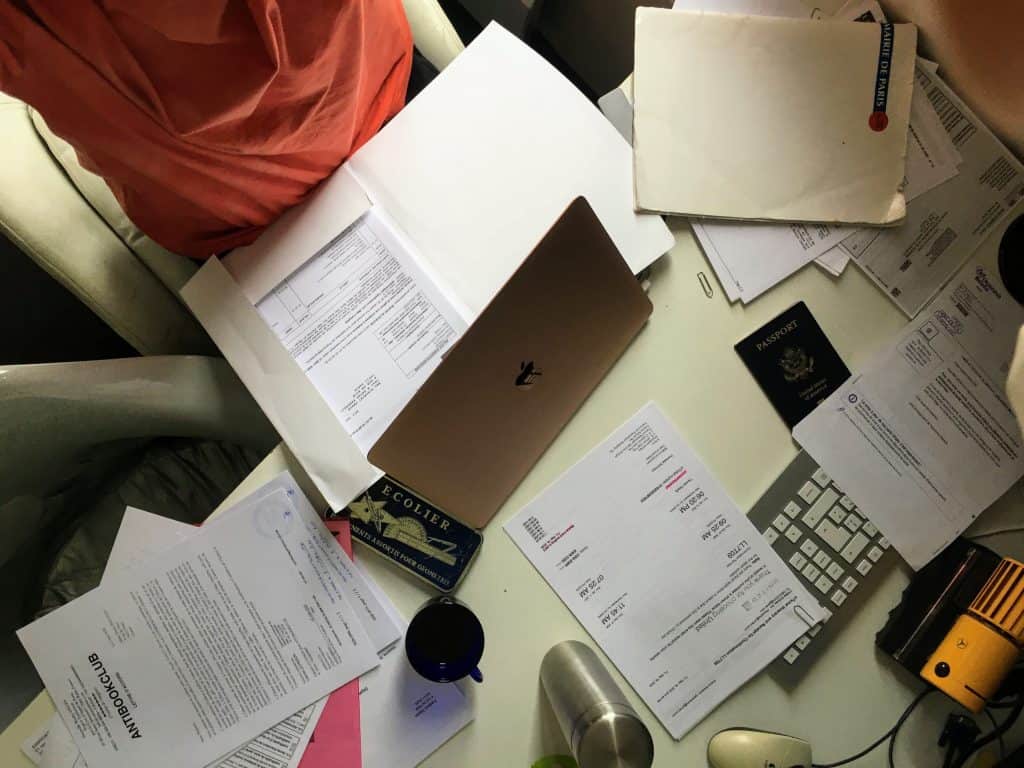
Mailbag: Passport Pages, Transferring Your Visa, and Taxes

It’s been a while since I’ve done one of these, but it’s often helpful for me to share some of these answers to questions I get in email so that others who are also wondering might have their questions answered as well.

How does adding passport pages to my (US) passport or renewal of it affect my visa?

Well, this is a two-parter.  As of December 31st, 2015, the US Embassy in France is no longer adding pages to your passport.  What that means (and I confirmed this in person at the Embassy) is that you will have to apply for an early renewal of your passport, as US citizens living abroad are not permitted to mail their passport back to the US for pages to be added there.  For my battle-worn blue book, that renewal ends up being roughly 3 years early.  But given that I’m down to room for exactly 5 more stamps, it’ll have to do, especially since I have a lot of travel later this year.

As to how it affects your visa: it doesn’t.  If you’re in the first year of your long-term stay visa, your carte de séjour exists in the form of the sticker that OFII put in your passport roughly 90 days after you arrived during your follow-up visit.  If you add pages/renew your passport you will get your cancelled passport back and still show that sticker, if you need to.

If you’re in your second year and beyond, you will be issued an actual carte de séjour after your renewal, which effectively functions both as your ID and your visa.  Those stickers in your passport from years ago are then like the rest of the stamps in your passport memories but nothing legally important.

You said recently that you had to file taxes?  How did that go?

Great question!  Funnily enough, despite sending them a properly filled-out French tax return appropriate for a foreign filer, in which I indicated that my income had not been derived from French companies, they still sent me a bill for 1781 euros.  After some laughter with my accountant and attorney, an email was dispatched to the relevant department:

réf de l’avis:15 75 XXXXXXX XX
Nº fiscal déclarant: 30 25 XXX XXX XXX X

Messieurs,

Je reçois cet avis d’imposition dont je conteste le fondement. En effet, l’assiette de la CSG et de la CRDS est l’ensemble des revenus français quelque soit leur nature et montant.

La totalité des revenus composant l’assiette de cette imposition a été d’origine américaine, perçue et imposée aux USA conformément au traité fiscal franco-américain.

En conséquence, de par la définition même de cette double imposition CSG – CRDS, l’assiette de cette imposition ici présente est non conforme. Je demande donc son annulation immédiate et sans condition.  

Cordialement,

Stephen HEINER

The next day, which is essentially light speed by French standards, had this response in my inbox:

Monsieur,

Votre demande a bien été prise en compte. Vous allez bientôt recevoir un avis de dégrèvement.

Salutations.

Translation: You’re right.  You don’t owe any money.

Stephen: Gee, thanks. 🙂

Did you enjoy this article? TAIP is 100% reader-supported through tipping. If you want to leave us a tip of any amount it would be highly appreciated. These tips help support our efforts to keep TAIP an ad-free environment. Just as at a cafe, the tips are split evenly among the team.