
a field of purple flowers

On Living Two Lives

I’ve heard of people going back home after living abroad for a while and feeling self-conscious, out of place. As if they can no longer relate to the people from their hometown. It’s isolating, I imagine, to feel disconnected from the people and the place that witnessed their formative years.

For me, going back home for the first time since expatriating was disorienting, but I had a different experience.

Stepping back onto the soil I knew so well — the smells of Texas, the long stretches of overpasses that led to shopping plazas or nothing at all, and that heat, my God, that heat — transported me back to my adolescence. 

This was the town I hit puberty in. The town where I first learned what it was to like someone so much it hurts. The town where I spent almost all my weekends at the age of fourteen at the roller rink. The same town that I knew like the back of my hand — I could still drive the same mindless routes to the superstores that my friends and I wandered around in when we had nothing better to do (and in the suburbs we almost never had anything better to do). 

This was the town that I hated, that I so badly wanted to flee from, the town I associated with boredom, ignorance, bigotry. I remember so vividly feeling like an alien on my home planet.

But also, it was the town that raised me. I thought I always knew there was life outside of Katy, Texas but I didn’t really get to experience it and truly understand everything that it encompassed until I left for a while.

When I came back home for the first time I was awoken, rather briskly, by the realization that there was this other person inside of me, one that walked with her chin held high and in a confident posture. I felt unafraid of the world. 

Because in Texas, I have no shame. These people don’t impress me. They don’t intimidate me. I know them for who they are — so easily placeable in a tight, little box. Film bro, sorority girl, liberal, conservative, someone who gets me, someone who doesn’t. 

I’m the funniest when I’m at home. The most reckless. I have no care in the world. I’m happy, I’m generous, I speak up for myself effortlessly. 

In Paris, another less familiar, less well-acquainted side comes out. I’m shy. My self-advocacy is easily thrown out the door. It’s something I have to think about. Put energy into. Relearn every day.

I’m drawn into myself. I’m self-conscious. I can come off as mean. I like to think it’s because I’m protecting myself, but really, it’s because of all my nerves and how scared I am. How hard it all is.

So at first, I was shocked and also liberated to come home and release this lighter, funnier, kinder version of myself into the spotlight again. I exhaled, so incredibly relieved. I am layered. I am complex. I am not this way, or that. No one can fit me in a box because I’ve moved away from that possibility of being stuck there for too long. 

And finally it all starts to make sense — I am nice, I am adventurous, I am brave — moving to Paris, becoming an expat has made me believe I was one way, it hardened me, convinced me I’d be like this forever, but my life here is just starting out. Of course I’m acting like this. Of course all I can think about are the differences between home and here. There’s still so much room for my life to change. 

I feel immensely fortunate to have been struck by this sense of duality. While I know fear and anxiety well, I also know assurance, confidence, comfortability. Not everyone gets to feel these things. I am so lucky to have two lives, one that can nourish the other while in pain. One that discovers something that helps revitalize the broken side of myself. Not everyone has this same experience being an expatriate and I will always count my lucky stars for this.

And I’m not saying I felt this ease and comfort right after I stepped off the eleven-hour plane ride. I remember initially wincing at the loudness of public spaces. The airport, coffee shops, malls. I’d cover my ears and buckle down — bracing myself for all that noise. It was the first time I truly recognized how loud Americans tended to be. 

But eventually I embraced it. I rejoiced in it. These are my people. My silly, ignorant, superficially sweet people. 

I learned to collect the noise, open my heart up to it, and embrace that cafe culture in America wasn’t just about working on your laptop. It was also about eavesdropping too.

I learned to feel completely and utterly at peace. Despite all the noise. Because while I know people can sometimes feel lost going back home, I felt revitalized.

Photo by Roberta Guillen on Unsplash

Did you enjoy this article? TAIP is 100% reader-supported through tipping. If you want to leave us a tip of any amount it would be highly appreciated.  These tips help support our efforts to keep TAIP an ad-free environment. Just like at a cafe, the tips are split evenly among the team.

people walking past paintings in the Louvre, Paris

You Have to Make Your Life

Having to stand up for myself in a country where I’m trying to establish the rest of my life has been no easy feat. 

A thin layer of perspiration has formed and now permanently coats my face simply because I’m trying to work up the nerve to ask a follow-up question. 

Standing up for myself takes everything out of me. It takes all my guts. 

And yet, I still decide to get up every morning and do it again. And again. And again. 

When I’m lying on my bed at night, thinking about what little ground I’ve covered, yet how much energy I’ve used to defend my honor, I’m struck, asking myself the question: When does one learn to do this? When does one learn how to stand up for themselves? Because I think I might’ve missed the memo.

As children, it’s our parents’ job to be our biggest advocate. Defend our rights. Speak to our needs.

During adolescence, we often wade in a state of constant humiliation, so much so that it feels like we’re drowning in it. We’re barely hanging on. Dogging-paddling to stay afloat. We couldn’t care less about fighting for our rights, what we deserve, we’re living day-by-day and our friends are our safety floats.

Then one day we wake up and come to the jarring realization that we’re the adults now. It seems as if we’ve just been living as passerbys to our own lives until suddenly we’re thrown into the wild, taught to fight it out, and see if we come out alive. 

In adulthood we’re confronted with the desire to carve out a life of our own. And if you want to do that — to make your own life — it means getting used to confrontation and passive-aggressive responses and learning to be your biggest protector. 

When I moved to Paris in my early twenties, my question changed in accordance with my new context. Having to deal with bureaucracy, confrontations on the street, and landlords all in a foreign language on a foreign land, I wondered, “But who stands up for us?” I felt that someone should. 

Sticking up for myself within a new identity became an even bigger challenge, yet increasingly vital. 

Initially, I relied on handling administrative tasks in a group effort, surrounded by my closest expat friends. This way, if we worked together, chainlinked our arms around one another’s, no one could take us down. 

One thing led to another and the group eventually did collapse. 

Someone would ask for a raincheck the day we planned to meet up and check things off our to-do lists, so we’d take it as a sign to put our tasks off for another week. Another would fill our souls with hope by promising to look into something for the group and relay their findings. In the end, they’d never get around to it.

Relying on others to help cushion the embarrassment by being there with you when you fall from grace is undeniably nice, but it also tends to be a huge waste of time.

I even tried relying on my boyfriend for this sort of support, telling myself that once he got home from work he would sit by my side and help me as I called CAF. When he would come home, we’d make dinner while listening to music or turn on the TV in the guise of just wanting to watch the news for a few minutes, then like magic, a movie would switch on and we’d get sucked in. 

We always told each other tomorrow. Tomorrow is when we’ll spend countless hours on hold together. 

The thing is, time moves slowly when you’re always waiting on others. 

I watched as people made their own lives around me. Big things were happening to people. Law school. Jobs in fields that nourished them and some that even paid them well. Marriage. An evolving social status.

It felt like nothing was happening to me. People were moving around me, things were moving around me, but I wasn’t. I was stuck in the middle of a whirlwind. 

I was with one of my expat friends at the Musée de l’Orangerie, wandering around the Berthe Weill exhibit and reading about her legacy and the kind of life she led in Paris. I remember feeling low at the time. Bad news kept toppling onto my lap. Yet again, I was passing nights lying on my bed, questioning everything. The central one being: why am I here? Every bright light at the end of the tunnel seemed to be misleading. Caveats adorned everything I pursued, ultimately preventing me from simply living in the city where I wished to be. I couldn’t feel any relief. But then I saw this quote plastered above some of Weill’s collection and a smile couldn’t help but creep upon my face. My stomach felt warm. My giddiness started to rise. 

“I started out with just 50 francs in hand and went into debt to pay the costs involved in opening a shop. Obviously, the situation wasn’t ideal, but I couldn’t back out now. Besides, what was the worst that could happen? Not being able to hang on? I WILL HANG ON!” – Berthe Weill

Be brave. Do the thing. Bear the challenge. If anything, it won’t wear you down; you’ll wear it.

In the end, I sucked it up. I put on my big girl pants, and I learned how to fight for my life and how to find pride in saying that I made it my own. Learning to stick up for yourself in a “ce n’est pas possible” culture is not my kind of fun. In fact, I used to take offense to it. With nearly every interaction, I have to fight for what I want. As an American, having arguments, even little ones, doesn’t just brush off my back. I don’t call that an interaction. I call that a dispute, and it makes me feel icky. They stick with me. I feel ashamed, or if I’m lucky, I learn to think of the other person as evil. 

Here, it’s almost like a game. Oh, you want something? You’re gonna have to beg me for it. 

I now treat it as such. Once I crack the code and win the game, receiving what is rightfully mine, I become overjoyed. It’s made the reward feel even better. It’s turned it into a testament to my wit, my charm, my insatiable persistence. 

Still, I find it demanding to stick up for myself and fight for what is rightfully mine, but I’m happy to say that I try to take it less seriously these days. Laughing more about it helps. What do you mean it’s not possible to do something that is very clearly possible? 

In doing the hard work, I’ve felt a strange conglomeration of feelings: being absolutely on my own, yet feeling powerful because of it. I’ve learned, reluctantly, that I can’t wait and sit back and watch how my other expat friends have done it or wait till my French boyfriend can help me.

If I want things to happen for myself, I need to make them happen. And in the meantime, regardless of what will happen with my life, I WILL HANG ON!

Photo by Diogo Fagundes on Unsplash

Did you enjoy this article? TAIP is 100% reader-supported through tipping. If you want to leave us a tip of any amount it would be highly appreciated.  These tips help support our efforts to keep TAIP an ad-free environment. Just like at a cafe, the tips are split evenly among the team.
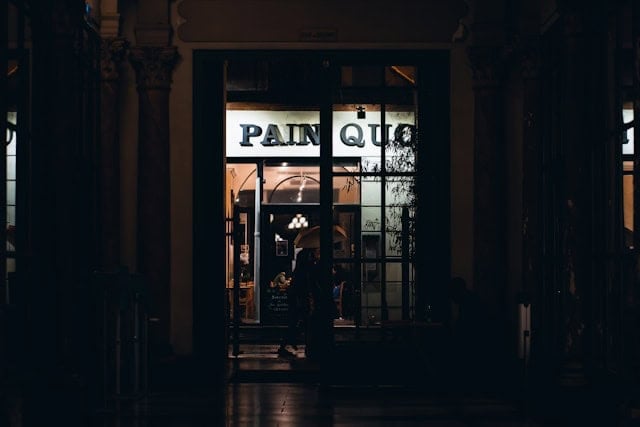
people walking in front of a restaurant at night in Paris

Paris is Still Just a City

In my final year at university, amidst the chaos of final exams, graduation, and a future being all mine for choosing, moving to Paris was all I could really think about. I didn’t care about making a name for myself or carving out a place in the land of interns, waiting eagerly to climb the corporate ladder. All I cared about was getting out of Texas, seeing something new.

I dreamt of the days I studied abroad here, drinking absurdly cheap wine, eating fresh pastries, discounts at the cinema, free entries to museums. I dreamt of a life Paris had afforded me when I was younger. One that was reckless, one where I had no responsibility besides to fall in love with the city, new friends, even a cute boy. 

When I graduated, I remember the world seeming so big, and I felt so lucky to have all these possibilities laid out in front of me. I had a degree now, even though I could hardly remember how I got it, and I naively believed that things would continue just as smoothly for me as they had been, given my life thus far. So, I took the leap, did the big, courageous thing it was for a well-off girl like me to do, and I made the big move to Europe. 

I emerged from the metro at Place d’Italie on a busy Sunday afternoon, with a suitcase in my hand, and an overstuffed backpack hanging from my shoulders. Police sirens rushed past, pedestrians made way for themselves regardless of others, and there stood directly in my line of vision, a big, metallic, soulless shopping mall that was the point of reference for my new neighborhood. Some residents have the Eiffel Tower. I had Italie Deux. 

I looked down at my jean shorts and sneakers, then up at the Parisians sporting black slacks and light summer jackets. An elderly lady came up to me, asking for directions. For a while, I tried to help. I looked at where she wanted to go on my phone and attempted to explain directions in French. She appeared frustrated, not being able to understand me, and gave a look like I was wasting her time. She walked off and demanded the next stranger for help.

I was breathless after having dragged my suitcase up several flights of stairs to my new apartment. After having unlocked the door with my comically long skeleton key, I immediately sank to the wood-paneled floor. I sat there, looking up at the crown molding on the ceiling and felt completely happy. A wave of warmth rushed over me. This is what I wanted, I thought. Crown molding, how lucky am I? Sure, there was an unbelievable amount of dust and mold bordering the windows, and the previous tenants had left a bunch of clutter, but here I was finally in my new place in the city I’ve been dreaming about ever since I left.

Weeks passed and I put off essential errands that would make my life feel more real and viable here. I needed a bank account, a social security number, a phone number, WiFi. But I was scared. 

Hidden within my fear were my memories, and suddenly, they all came flooding back. My face felt hot. I suddenly remembered what I was so quick to forget: how humiliated I felt when I was studying here, trying to disguise my Americanness yet it was inescapable. How I was still incapable of mastering the language. How it felt like anxiety was always trailing me, hiding behind every corner ready to pop out and remind me that this was not my home, things work differently here, and they don’t really work for you. 

I broke out into a cold sweat. What was I doing? I came over signed to a nannying agency, meanwhile I had spent the majority of my life working with kids and after finally having a college degree, I was longing to do something else. What was I doing? I was wasting time while everybody was back home applying for jobs that they could actually get. 

My panic broke me. I applied to so many jobs and internships, all of which were hindered by the fact that I wasn’t yet bilingual, nor was I enrolled in higher education. I felt trapped. I felt trapped in this undeniably beautiful, bustling, and some might say, I know I sure did, magical city. 

I remember looking for signs to bring me back to America. A cop out. A scapegoat. I began applying to these outrageously prestigious Master’s programs in America whose acceptance rates were laughable and exclusively marketed for geniuses. I convinced myself into believing they were targeted at me. I told myself, if I get into one, then it’s destiny. Then I’m going home and never looking back. They need me. America needs me.

The advertisements that fluttered the walls in metro stations began speaking to me. Women and men, children and the elderly, all those whose faces were plastered on these posters, urged me, begged me to come back. “You’ll be safe there,” they teased. “Life will be easier. You’ll get a nice job, one that fulfills you.” I ran to catch the stalled train before the doors shut, wanting to give in but also not wanting to give up. Making that decision to move back home would feel like both.

The image I held in my head of my study abroad days no longer held up. The lights dwindled, the magic faded. Paris is beautiful, yes, but there’s a lot of dog poop smeared across the sidewalks. And cigarette butts. And trash. There’s almost no relief from the heat in the summer, so it’s best to get away, if you can afford it. People can be mean and creepy. All of these things are not just exclusive to American cities — they are caveats of every major metropolitan area, including Paris. 

It took me two years. Two years of indecisiveness, of failed dreams and miraculous resurrections, to realize that fighting to live in Paris is worth it. 

I can’t exactly say what the catalyst was to deciding that I was going to stay, that I’ll fight to carve out a life for myself here. Maybe it was the political climate in America, making my idealization of the country come to a screeching halt. Maybe it was the realization that nostalgia is often manipulating, a poison for the brain to make the past seem so alluring when that’s exactly what it’s meant to be: something that builds our story, but remains there, stuck. 

Maybe it was the realization that the job market is incredibly difficult everywhere right now. Maybe it was (it definitely was) that the cute boy and I started to become even more serious in wanting to integrate our lives with each other’s. 

It was probably all of those things that made me decide to stay, despite the hardships, despite the seeming impossibility of it all, despite the all-consuming nostalgia, and, at times, maddening cultural differences. I was overly confident two years ago, I have to admit. I thought I was ready to move my life abroad back then, but in fact it took me two years of living here to confirm exactly that. 

Paris has been a city that I hate(d), that I love(d), that I couldn’t/can’t seem to get over. Paris is still just a city, with all its flaws and glamour. But now, it’s my city.

Photo by Elric Pxl on Unsplash

Did you enjoy this article? TAIP is 100% reader-supported through tipping. If you want to leave us a tip of any amount it would be highly appreciated.  These tips help support our efforts to keep TAIP an ad-free environment. Just like at a cafe, the tips are split evenly among the team.

The Week Before I Move to France

I’ve got my visa, a year’s supply of my favorite deodorant, and a one-way ticket to France. The countdown to my departure began when I returned to Texas from France four months ago, but I’m still struggling to fathom how those 120 days are now in the single digits. 

Last year, I worked as an English teaching assistant in this quaint town on the south side of the country. This year, I’m returning to the same program, the same lodging situation, and the same community I grew to love. It’s crazy to think that this time last year, I was preparing to live in a city where I didn’t know a soul! 

Round two of working in France has a lot fewer questions on the outset, or at least the questions have changed form. 

“Where will I live?” has become, “What will it look like to live with different people in the same place?” 

“How will I teach?” has become, “How will I serve my new co-workers and students?”

“Who will my community be?” has become, “How will my relationships grow in the months ahead?”

Now being more accustomed to the different language, culture, and daily rhythms of living abroad, I have noticed that my goals have also moved from the category of surviving to thriving. Last year, I learned how to get around using public transportation and my own two feet. This year, my goal is to trade in my US driver’s license for a French driver’s permit. Last year, I learned what a month’s worth of expenses could look like in France. This year, my goal is to live in awareness of my budget instead of relying on additional savings to pick up my slack. Last year, my goal was to keep my head above water and this year, I want to be a well of reassurance and knowledge for the new language assistants coming to my town from around the world.

So now that I’ve talked through the theoretical, let me share a bit of the practical. Here is my to-do list one week before I (re)move to France. 

  • Fill out as much of the paperwork as possible for my request for CAF lodging assistance
  • Purchase a professional translation of my driver’s license and driving record
  • Send in my rolls of film from this summer to be developed and returned to me digitally 
  • Buy a pair of jeans; mine are wearing out and there is nothing quite like American jeans
  • Finish one of the books I’m reading so I don’t have to travel with it; books weigh more than you think
  • Make a final trip to the pharmacy to stock up on my American medical needs
  • Buy a train ticket from Paris to Lyon
  • Plan my arrival
  • Start packing 

Knowing it will be a minute before I see my friends and family on this side of the world again, the logistics are balanced by the weighty work of being present to my community.  I’ve made plans with friends for our final lunch and dinner dates of 2025. Just the other day, I realized that my mom has never been to my favorite park, which is a 20-minute drive from her home. Naturally, we’ve chosen an evening to go together before I hop the pond. Making time for these shared moments is something I know I won’t regret down the line when being together in the flesh is simply not an option. Prioritizing relationships this month has meant pulling back from work projects and letting go of goals I had for this season stateside, but I’m learning that is okay. Choosing personal well-being over professional security, dare I say, even feels a little French. 

Starting a new chapter inevitably means finishing another, and so in this moment of turning the page, I’m also choosing to take the time to reflect. What have I learned from this time in the States? What am I grateful for? What do I want to take with me? What do I want to leave behind? These questions stand up against the metaphorical and the physical. Remember, packing is still on my to-do list. Though sometimes I wish my mind and heart had no luggage fee or weight limit, the reality is they do. The more I process and let go of here, the lighter I will go into the season that awaits me. And as I preach to my fellow travelers, and often stand in need of a reminder myself, “The lighter you are, the happier you will be.”

Cheers to taking flight and traveling light.

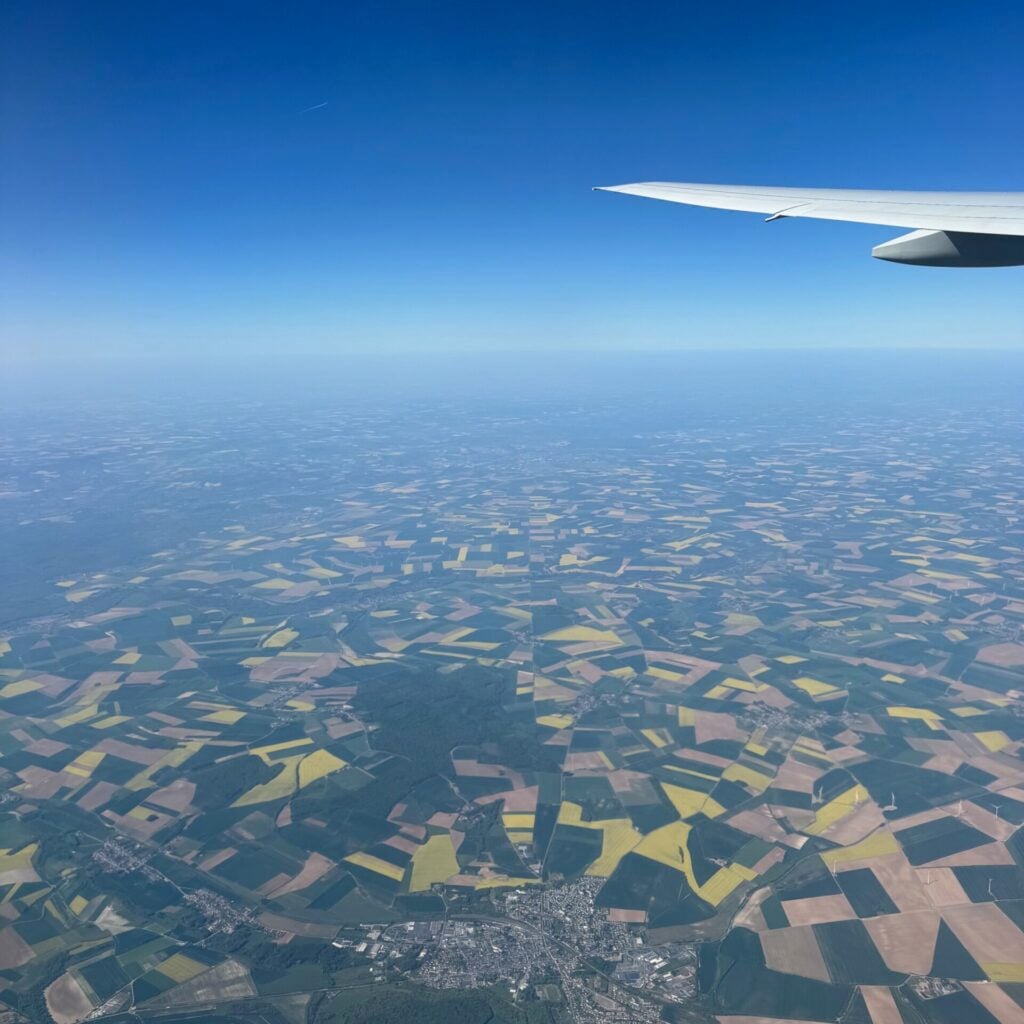
Photo from my last flight over France.

Did you enjoy this article? TAIP is 100% reader-supported through tipping. If you want to leave us a tip of any amount it would be highly appreciated.  These tips help support our efforts to keep TAIP an ad-free environment. Just like at a cafe, the tips are split evenly among the team.