transferwise

Taxes and Wise

I recently had the opportunity to meet with one of the readers of the blog over lunch.  We discussed some of his strategies for staying in France but since he had just recently arrived I asked him to check with some of his connections (he had done work at an accounting/consulting firm) about getting taxes filed.  That’s right as an American, even if you’re here on a visitor visa and prevented by the terms of your visa from working for a French company in France, the French government requires you to file a tax return.

You read that correctly.  Now, despite the fact that you don’t owe any taxes, you still have to prepare the taxes, in French, according to French accounting laws.  If you don’t have these intersecting skill sets, let me know and I can connect you with an amazing firm that did this for me for the 2014 tax year.  If this has slipped through the cracks for you, let me know ASAP and I will try and connect you there’s no fine and no fee to pay (as ostensibly, you don’t have taxes to pay) but you don’t want the French government catching you doing something you are supposed to do.  Better late than forgetting altogether.

2015 will be the last year that I will be considered a “non-fiscal” resident as part of the path to citizenship (which involves my new visa) is paying taxes.  If you aren’t married to a French person, and don’t pay taxes for five consecutive years, you aren’t on the path to citizenship.  I still can’t say I “look forward” to paying taxes, but I do look forward to “being on the path.” 🙂

* * *

Early on in this blog’s life I talked about getting a French bank account.  It’s honestly something you’re going to need to do if you plan to stay here for longer than 6 months.  However, again pursuant to your visa status, you really only want wire transfers coming in from yourself, not from employers even if those employers are outside France this will just cause questions at the Prefecture should they look closely at your bank accounts when you come for your appointment.

Wire transfers are “old-fashioned” in our modern age and carry old-fashioned fees.  The originating bank charges the sender (i.e. YOU sending to yourself), the receiving bank charges the receiver (again, YOU), and then there are currency exchange fees.  However, this system is in the midst of being disrupted by a company started by the guys who built Skype and bankrolled by the likes of Sir Richard Branson.  It’s called Wise.  If you click this link your first transfer is free so you can try it for yourself with no risk.  To learn more about how they do this, and circumvent the wire transfer system, watch this funny video.

Hope you enjoy the service as much as I do.  I’m an unabashed user, though I can’t imagine my US or French banks have been happy to miss out on all those fees I used to pay them 🙂

Did you enjoy this article? TAIP is 100% reader-supported through tipping. If you want to leave us a tip of any amount it would be highly appreciated. These tips help support our efforts to keep TAIP an ad-free environment. Just as at a cafe, the tips are split evenly among the team.

You Can(‘t) Go Home Again

“What do you miss the most?”  My friends smile, anticipating a favorite dish, a favorite place, or a particular time of year.  “Well, you guys, of course,” I say quickly, hoping to deflect the question from my true answer: “Nothing.”

Of course there are things that are wonderful that one could miss but I “miss” them in the same way that I “miss” anything from a place I have been to like missing dim sum in Hong Kong or missing walking the beaches of Sydney.  But I don’t miss anything in the “think about it all the time” way that I think they probably mean.  But in fairness to a country that played host to many happy years of my life, I miss walks in the Huntington Gardens in California.  Food trucks in Austin.  Baseball in Saint Louis.  Hot chicken in Nashville.  The squares of Savannah.  BYOB restaurants in Montreal.  Autumn in New Hampshire.

Next month will mark the beginning of my third year in Paris and I’m “in between.”  America is no longer “home” for many reasons but I still can’t believe I really get to call this place home.  I’m Parisian in my bones in a way I always have been and I marvel every day that I get to live in my dream city.  I’ve often been alone on a quiet street and stifled a laugh as I took in that crooked winding view of centuries.  Two years on, I still have “pinch me” moments.

Going to the United States has become a rather elaborate production.  As part of my visa requirements, I have to spend at least 270 days a year in France, so you can’t go back for too long but if you’re going to cross an ocean, it’s 3 weeks’ minimum for me.  I’ve also hit upon the strategy of visiting my friends and family during “non-holiday” periods so I don’t have to share them with other commitments they have.  I’ve also found this makes for finding absurdly cheap flights (I just booked the cheapest Europe-America flight of my life recently).

I haven’t yet chosen to ditch seven years of medical/dental/accounting services and technology and occasional travel stateside means I don’t have to.  The PPO (insurance plan) I once had in the United States cost $135/month and covered me for pretty much everything for years.  The “affordable care act” in America has not only cancelled that plan, but the closest current equivalent costs $570/month.  So I just pay cash to see my old doctors for my annual checkup, etc.

Dental insurance remains extremely reasonable ($35/month in my case) so it’s cheaper to retain it solely for your cleanings twice a year.  Just those two cleanings will cost more in cash than the entire annual premium for your insurance and that’s assuming you have no other problems.  Do the math.

I couldn’t help but laugh at the times I would put a car into park and then stare mutely at the dashboard, wondering if I hadn’t forgotten to do something.  Not driving for months and months makes you a bit cagey when you do finally slip behind the wheel again.

***

The more assertive variation on the question “What do you miss?” is “When are you coming back?”  This led to a very long and fruitful exchange with a close friend in which I enunciated advantages I have now that effectively prevent me from returning to the United States for the foreseeable future.

  1. Physical health I finally gave in and got a Fitbit to document what I’ve always suspected: I walk a moving average of 10 km/day.  I do this at various speeds, up and down stairs, on cobblestones or grass, all around this city.  Not only did this regime of walking contribute to my losing 30 lbs/13 kg when I moved here, but it has established a new weight standard which would be impossible for me to retain in most American cities.  During my recent visit to Kansas City, I experimented by refusing to take and elevators, and as often as I could remember I parked my vehicle as far away from a store entrance as possible.  I even tried not to use carts to carry my purchases.  With these “extreme” measures I couldn’t even get close to 4km/day as an average.  I’m simply healthier here in Europe.
  2. Access to Europe I used to treasure an annual trip to Europe to see places new and old.  But now that I live here, all of Europe is at my doorstep, for pennies, either by flight, train, bus, or ridesharing (think uber but for long distances).  When living in America I experienced a variation on these sorts of fun possibilities only during my two years in New Hampshire, when Boston, Philly, NYC, and even Montreal were just road trips away, and in some cases, by train or bus too!  On this recent trip I had some business up by Chicago and elected to take the train (Amtrak) but perhaps had forgotten that there’s only one departure a day and when it gets delayed, it really gets delayed.  An engine on the train coming to Kansas City blew up in Arizona and they had to run another engine out there from California.  It delayed my journey by 7 hours and Amtrak had to pay to transport me to and from a hotel and put me up in it so I could connect to the bus to Rockford in the morning.  Not too shabby a recovery from the taxpayer-supported Amtrak, but a far cry from the dozens of departures and arrivals all around Europe every day.
  3. Constant challenge of language Every day I make progress in French, but my work and life brings me into contact with the whole world.  During the summer I had a date with a Brazilian girl who didn’t speak English and we laughed our way through our makeshift Spanish and an occasional assist from Google Translate.  Expressing yourself in a foreign language is one of the most difficult, fun, rewarding, humbling, and interesting experiences in life.  You get opportunities like that every day here.
  4. A built life Next year I transition from my visitor visa to one that puts me on the path to citizenship.  I continue to maintain that the EU passport is simply the most valuable passport obtainable by the average person in the world.  The only ones more valuable are the Vatican and Swiss passports and they are very, very difficult to obtain for various reasons (as an aside I was recently asked at a dinner party what I liked most about having an American passport and I replied that it was the knowledge that Navy Seals will come for me if Somali pirates ever commandeer a vessel I’m on.  I’m sorry, no country can top that!).  I’ve started something wonderful here, and it would be nuts to leave it especially when I’ve gone through all the hard stuff.  Indeed, as I looked over the list of requirements for my dossier for my new visa which will be far more difficult to obtain than the visitor one I said to a friend, “Is this it?”  The list had 28 requirements.  I realized after 2 years I am simply unfazed by the French government.

So my answer to my friend was, “Why would I come back?  I’m healthier and happier than I have been for many years, possibly more than I have ever been in my life.”

The caveat is, of course, family.  My nieces and nephews continue to grow by leaps and bounds and I measure their skill in their improvements in art and coloring, Parcheesi, and sports.

On more than one occasion I’ve heard someone say, “I have to live here, because I love my family.”  I get that, I truly do.  But ultimately I moved because I placed my happiness first.  Of course I’m happy when I am with my family but I know that part of the reason I get to contribute to their lives, bring them presents from all around the world, and share great stories with them, is precisely because I’ve built and chosen an intentional path for my life that doesn’t defer a dream life to some unknown future that no one has guaranteed that I will live to obtain.

There’s no right answer here and I’m not proposing that I have the right one.  I can only say that I can spend more quality time with my family now and treasure it more deeply because I know our opportunities are so precious and limited and because I am well and truly happy, and that speaks volumes to children.

***

There’s nothing more satisfying than waking up every day knowing in your bones that you are on the right path.  And while two years isn’t yet enough for me to claim “Parisian” status yet, it does feel like home.

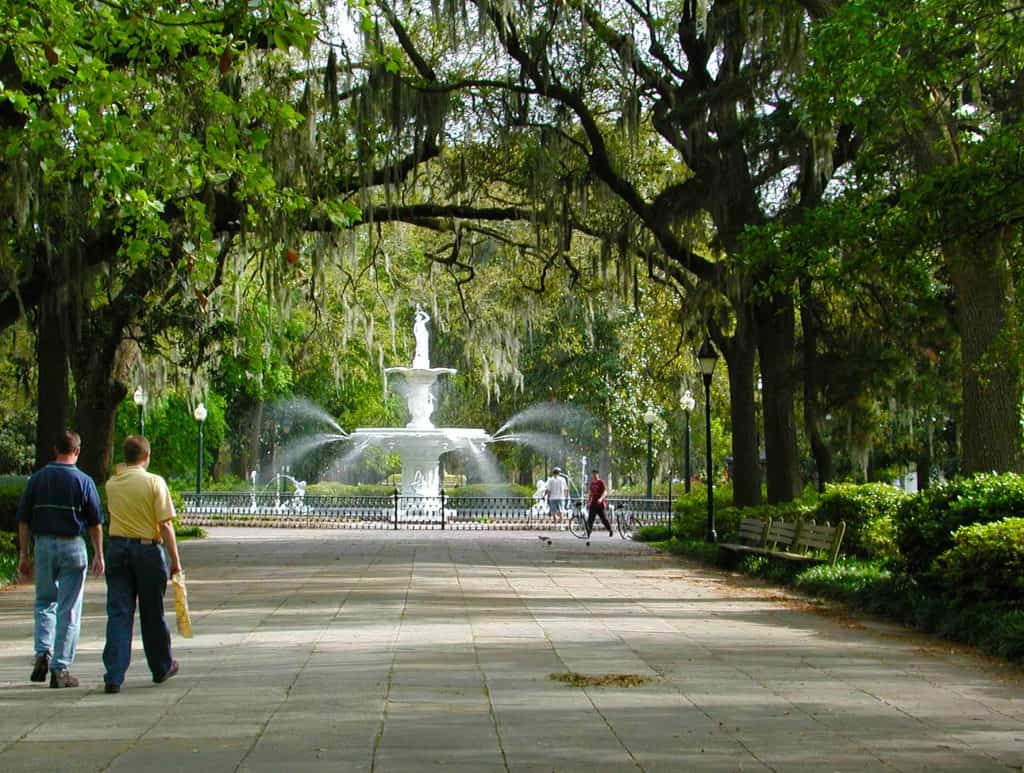
The picture is of one of the fountains in one of the many lovely squares of Savannah, Georgia.

Did you enjoy this article? TAIP is 100% reader-supported through tipping. If you want to leave us a tip of any amount it would be highly appreciated. These tips help support our efforts to keep TAIP an ad-free environment. Just as at a cafe, the tips are split evenly among the team.

A Trip to the Police Station

I apologize for the very long break from the blog.  It was an amazing summer my second spent working in the spectacular beauty of Switzerland (here’s one of my favorite images from that time).  I kept a journal, but didn’t have Parisian reflections to share with you.  But I am back in my beloved city and regular programming will resume 🙂

On my travels I was stupid to lose my wallet, which contained things that were by and large replaceable, but which contained my French identity card, which allows me to travel passport-free inside the Schengen area.  For those who face the calamity of losing a wallet, in addition to shutting down all your cards and getting new ones you need to go to the main Police station of the arrondissement you live in ideally this address should match the one on file with OFII.  I have said this before but do everything you can to maintain a consistent address throughout the immigration process you’ll be surprised that many gardiennes are willing to keep your mail for you even after you’ve moved out if, of course, you maintained a positive relationship with him/her (who am I kidding, there’s no such thing as a male gardienne in Paris!).

Once you’ve identified which station is yours, bring your passport and/or another form of ID (remember the rule of always overwhelming the French with documentation, thereby removing their ability to intimidate you).  If you show up around 15h00 on a Friday (as I did last week), the whole process should take about 5 minutes.  You will need to clarify whether you lost it or it was stolen.  If it’s the latter, be prepared for a lot more in terms of questions (where did you lose it, what else did you lose, etc?).

You will then obtain a “récépissé de déclaration” which will allow you to apply for a new identity card.  Since I’m only 2 months away from renewal I’m not going to drop the 100 some euros to get a replacement but will simply wait to get a new one when I get my new visa.

What would you like me to write about this next year?  #YearThree in Paris begins December 11th.  I have so much to share with you but am also happy to write about your thoughts/questions/concerns.

Featured photo comes from Daxis on Flickr.  Labeled for reuse.

Did you enjoy this article? TAIP is 100% reader-supported through tipping. If you want to leave us a tip of any amount it would be highly appreciated. These tips help support our efforts to keep TAIP an ad-free environment. Just as at a cafe, the tips are split evenly among the team.
friend turnover

The Friend Turnover

I’m midway through my second year in Paris and I’ve begun to experience something I rarely did during my time in the States: losing people to moves.  When I was younger this was because I was always the one on the move, either due to my family’s movements or my own moves for work or school.  As I got older, I lived among more stable populations and hence rarely attended “going away” parties because no one was going anywhere.

Before I moved to Paris I spent seven years in Kansas City, which straddles the large Midwestern American states of Kansas and Missouri.  It is a wonderful place to live and raise a family, and consequently, most everyone stays.  In my time there I don’t think I knew one person who moved away.  And yet I’ve already lost a friend to Nice just this month, and between now and September I expect to lose four more.  Some have work assignments ending or visas that expire and they have not begun the work to try to stay.  Others are just choosing to move on.  No matter the reason, it hurts to lose friends to moves.

There are dozens of reasons, always particular to the individual.  I don’t expect everyone in fact I don’t expect many to move to Paris with the deep-in-the-bones conviction that they will live there forever.  Since so many come for work it is rare to find that happy coincidence of dream city and fulfilling work (which is why I advocate moving to your dream city and creating your own work) and hence if a more alluring city or job presents itself, Paris can be left behind.

I’m willing to admit that while everyone’s decision to leave Paris can be attributed to individual circumstances, there are recurring themes which I can share with you.  I’ll also try to suggest remedies when it makes sense.

Distance from the City

My friend Anaïs, who left for the south of France last week, has sworn off ever again living in the suburbs.  “I could never do anything at night in Paris,” she opined at lunch.  Since she lived 20 minutes outside Paris she was limited by whenever the final train for her stop left in the evenings, typically sometime before midnight.  People can get twice the space for the same price, but it’s not Paris.  I don’t see how one can fall in love with this city when you don’t live inside it, and when you don’t love something, it’s easy to leave it.

Cost of Living

I always gamely smile when I hear this, in part because it’s really only the rents that are expensive in Paris, and even then it lags far behind Tokyo, Hong Kong, NYC, and San Francisco.  Super high-speed internet?  15€/month.  Fresh baguette? 1€.  Freshly-pulled espresso at the bar? 1,50€.  1 L of organic milk? 2,50€.  Three-course meal at an authentic French restaurant?  24€.  Unlimited travel on the metro, buses, and trains, and 45 minutes per day on the city bikes?  70€/month.  Those are just a few of the things in Paris that are cheaper than what I paid in the States, and specifically in regards to the transport issue, entire costs I used to have are simply gone now, like car insurance, oil changes, gasoline, and the occasional car wash.  Yes, Paris has its expensive sides, but if you are willing to try new/challenging/different living situations you can not only survive, but thrive here.

The Rush

I’ve addressed this in a previous piece.  If you work in one of these nonstop jobs and you aren’t planning and saving for a great escape or a new life, either leave Paris or quit your job, but don’t keep doing what you’re doing.  You’re making yourself miserable and while only the Japanese currently have a word for “death by overwork” (karoshi) it doesn’t mean you are immune to the condition.

Time for a Change

This has to be the most valid reason to leave, if you’re really feeling it.  I’ve heard it said that if you’re always dreaming of your next vacation, perhaps you need to change where you live, since you keep wishing to leave it.  I firmly believe that once you are in a place you truly want to be, you’ll find yourself exploring it endlessly, and won’t have to look exteriorly for fulfillment and joy.  This doesn’t mean you’ll cut travel out entirely, but I’ve observed within myself a huge slowdown in travel, and I think this is because I’m settled and happy here.

Everyone is Leaving!

Well, I suppose this presumes a greater existential question of “What is a Parisian?”  I know at least six people who have lived in Paris their entire lives and half of them don’t really know or love this city at all.  There are “permanents” in Paris (I aspire to be one) but a lot of us came here because we were inspired by what we thought Paris might be like as a residence, not just enamored of what we had experienced in Paris as breathless tourists.

The remedy for this objection is something I am prescribing for myself as well: not so much to close yourself off to new friendships, but covet, guard and develop those more closely that are with those who you suspect are here for the long term.  You can’t escape the pain of losing special people as they move, but you’ll have the consolation of adding friends from all around the world who you might visit on your travels, and you’ll know that when you see them again you’ll be able to pick up on something you’ll always have in common: Paris.

Photo by Jan Tinneberg on Unsplash

Did you enjoy this article? TAIP is 100% reader-supported through tipping. If you want to leave us a tip of any amount it would be highly appreciated. These tips help support our efforts to keep TAIP an ad-free environment. Just as at a cafe, the tips are split evenly among the team.
The Guy Who Stole My iPad

He hangs out at night on my street with three or four of his friends. They smoke, drink, and talk about nothing, as 25-35 year-olds are wont to do. Whenever I pass him, and we manage to make eye contact, I smile, wave, and cry out, “Mon petit voleur!” I call him a thief because last November he stole an iPad out of my bag.

* * *

It was my last trip of the night. After one year I had “graduated” from my 8 square meter closet in the sky, towering above the rooftops of the 17th arrondissement, to the 39 square meter reality of a 2nd arrondissement apartment with a kitchen I couldn’t reach from my bed/couch. The day had been filled with those joys of Paris moves: large bags and luggage going down one set of stairs and then up another (in my case down eight flights of stairs and up five; no elevators), with the steps and passages of the Métro in between (some can afford moving trucks I couldn’t at the time). It was 00h30 and I had the last few things with me: two bags slung over my shoulder one of which was an open sack that contained my laptop and iPad. As I exited the metro I pushed the office chair that I had also brought down the platform. A young man and three of his friends came down the stairs. The one I would focus on (from here on “MPV” for “mon petit voleur”) started to mock dance with my chair. Tired but amused, I didn’t even take the headphones still blaring Chris Martin and Coldplay out of my ear. I simply hauled the chair up and over my head to carry it up the stairway and as I turned away from the group one of them must have reached into my bag and taken my iPad. I didn’t think to check my bag until I had reached the top of the stairs. In a panic, I stashed my office chair and bag someplace by a building and dashed back to confront my thief. The adrenaline had dumped into my bloodstream (I could feel the rush) and I didn’t think clearly enough to go back to the same “inbound” platform I had just departed but instead went to the “outbound” one. I stood on the platform crazed and breathless, and then, just as the train on the opposite platform started to creak forward, I made eye contact with MPV. If I hadn’t been incredulous, I might have shouted expletives. As it was, all I could summon was a measured but incensed, “Hey!” He laughed, smiled, and blew me a kiss. The train slid out of the station.

* * *

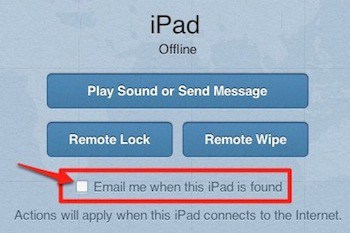
I didn’t stay to watch it disappear into the darkness. That would have been pointless. I was going to activate the app which Apple had made famous: Find My iPhone. I almost ran up the staircase with my remaining luggage, kept going to my apartment, ran up those stairs as well, with my office chair no less, and hurriedly opened the door to my new apartment. I dropped everything on the floor and activated “lost mode” on the iPad. It showed up almost immediately. The pinging blue dot was at République, four metro stops away on Line 3, and was moving slowly towards Canal St. Martin.

As I look back on it now and reflect on the actions which followed, I think of it as calculated irrationality. At the time my French was still more elementary, I was alone, and I didn’t actually know how many friends he had in his posse. But I had been stolen from, and the salve to cool the white-hot burning humiliation and anger (which, interestingly, is not unlike the embarrassment a nine-year-old child might feel upon being slapped in public by his mother) was the feeling I hoped I would experience upon tracking this guy down.

* * *

I came out of the main entrance of République, without even noticing the statue, the one I so despise, that sits in the middle of the square. I focused on the radiating blue dot on my iPhone, the blue dot which had not moved since I started tracking it. I had sent a message in French to display on the iPad that essentially said I would take the iPad back for 50€ without involving the police, with my phone number appended. Unsurprisingly, given (as I learned later) what he could get for taking it to one of these chop shops in town that wipes them and sends them to Morocco to get sold, he didn’t respond.

Within minutes I was standing directly in front of the café the blue dot indicated my iPad was in. I spotted him. I was breathless and angry, so I started shouting at him in English. I pushed him. I called him names. People came to intervene. I pulled out my phone to take a picture of him and he threw a punch at me as I took it, obscuring the picture. The remaining adrenaline had been dumped into my system. I wasn’t thinking about his friends or the possibility of knives. In reality, any of them could have had their way with me because I was fixated on his visage: he was the only one I had identified from the moment of the theft. My stupidity and carelessness aside, I manage to pat him down (an iPad is a hard thing to conceal) and found nothing.

At this point some of you might be shouting for me to activate the “alert” sound which would have made it easy to find the iPad. Instead I fixated on this guy, who when I realized didn’t have the iPad, started to walk off. I stayed with the geolocation that the iPhone was giving me. The blue dot wasn’t moving despite the fact that he was now a block away. This could only mean that one of his friends (who had scattered and none of whom I would recognize anyway) had it. I stayed there for a few more minutes, speaking in broken, angry French to anyone who would hear me. Then the dot started to move rapidly in the opposite direction from which MPV had walked off. It was in a vehicle of some kind. I started running after it.

* * *

It was 01h32. I remember a gentle rain falling. It was the kind you could possibly enjoy not the spitting type that so often annoys. My phone’s battery, taxed with the exertions of tracking and GPS duties for 60 continuous minutes, was down significantly. The adrenaline had been spent and outside of the fight or flight context I had been in just a while ago, my body assumed the facts of the day: fatigue from a full day’s move, frustration at the poor moves and decisions made in the last hour, and the dawning of the next stage in the seven that comprise grief: acceptance.

“Say it,” I said to myself. “Say it so we can go home.” I looked up, looked around, and with chagrin that no one saw, said at a volume that no one could hear, “I’ve been robbed.” I slowly exhaled and walked to the Métro. After some more anguished reflection, I fell asleep for the first time in my new apartment.

* * *

If I had originally encountered this man in my neighborhood, then surely, I reasoned, he might be a regular (Parisians get into patterns with their nightspots and hangouts). “Perhaps I’ll see him again,” I thought to myself. It’s a small enough Paris to have chance encounters with friends. Surely I could manage a chance encounter with an enemy?

I didn’t have to wait long. I went to the US in the month of December for personal and business reasons and when I returned in January I saw him. I was so shocked to see him that I didn’t make eye contact and hurried past.

He lived on or near my street, I realized.

The occasions repeated, but now I would smile and call him “my little thief” as I walked by. He smiled and waved. It was this acknowledged reality: “Yeah, I stole from you, but come on, look at me.” I didn’t have any recourse that wouldn’t take an extraordinary amount of time and would ultimately be fruitless. I let it be.

Instead, I’m finally sharing this account with you, writing in the café I was in when I first saw him emerge from an adjoining building with a cute little child. A daughter? Niece? I didn’t know. Part of me wanted to go up to her and tell her in my now-much-improved French, “Hey, do you know this man is a thief?”

But almost immediately, I laughed at my first-world problem (and apparent grief). The guy with a Macbook Air and an iPhone was going to be aggrieved about a stolen iPad (which he had bought a replacement for in December) when there were people who didn’t have clean water to drink or food to eat? Non. And for once, I thought I might try “forgive and forget,” even in the absence of an apology or demonstrated remorse. If I buy this guy a drink one day, I might not only forgive, but begin to forget. And if I can do that for a stranger who had wronged me in such an unwarranted manner, might I not see a way back to forgetting all the wrongs that had been done to me over the years, by friends close and distant? But then this would be the thief who gave something to me instead of just taking something, n’est ce-pas?

Did you enjoy this article? TAIP is 100% reader-supported through tipping. If you want to leave us a tip of any amount it would be highly appreciated. These tips help support our efforts to keep TAIP an ad-free environment. Just as at a cafe, the tips are split evenly among the team.

starbucks

Starbucks in Europe

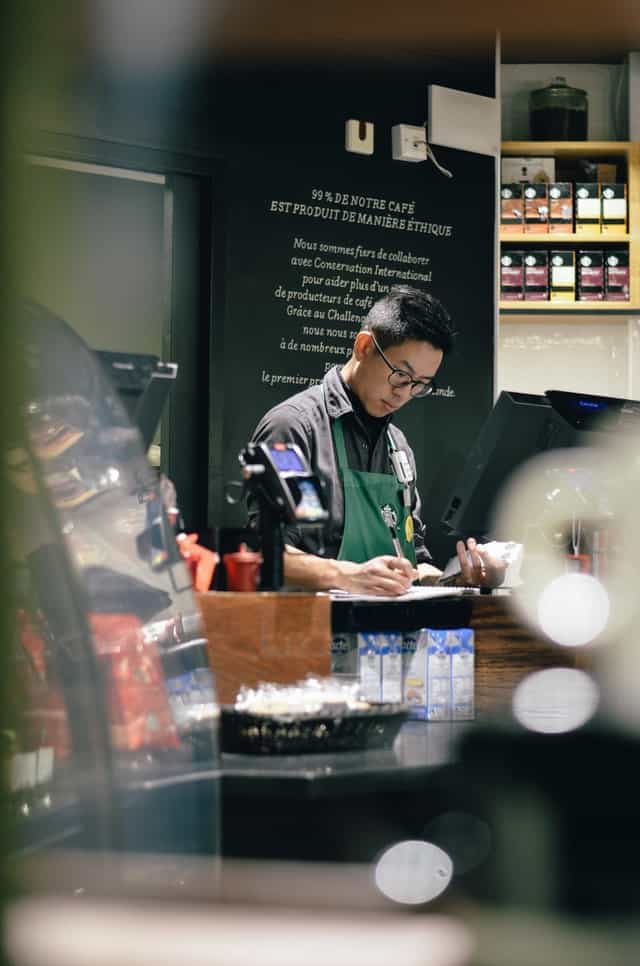
Americans take it for granted that they can sit in most coffee shops or Panera-like establishments and work for hours, after buying one token item of food or drink.  If the place is busy enough or you don’t plan to be there very long, you don’t even have to buy anything.

Starbucks staff, I feel, are trained not to come up and accost customers who haven’t purchased.  This is probably due in part to Howard Schulz’s “third place” philosophy, in which he aims to create an additional place of comfort that isn’t work or home that people wish to go to in order to relax, meet friends, or work (for more on Schulz and his underrated ways of thinking or management, read the worth-your-time Pour Your Heart Into It).

Why is Starbucks a valuable resource for the practical European traveler (who doesn’t carry the angst characterized by “I would never go into a Starbucks in any country” hubris of the wannabee coffee snob or aspiring hipster)?  Three simple reasons:

1)  They are everywhere.  You’ll find them in Berne, Switzerland, a little gem of a town, or in the heart of bustling Paris.

2)  They will let you sit down, charge your devices, use the wifi, and go to the bathroom, all without necessarily making a purchase.  The last particular point in a city famous for its lack of available toilets is an “amenity” truly worth the price of admission.

3)  You can sit and work, or chat with friends, uninterrupted, for as long as you need.  This has been a big part of why my Paris Chess Meetup meets at Starbucks (and why I have a book club event there next month).  Sometimes the staff comes over to watch us play, even, but we are always made to feel welcome.  The majority of us buy food and drink, of course, but that’s more about wanting to, not feeling obliged to.

This is to say nothing of the dozens of students that camp out at the huge Bux locations on Rue de Rivoli or near St. Paul in the Marais.  Laptops and books splayed out among study groups these students are doing what they CAN’T do in a traditional Parisian cafe: study and work together.  Parisian cafes are great for writing (I’m writing this piece in one of my favorite ones right now, Le Poncelet in the 17th), but for student work and collaboration, when you likely live in a closet like my first apartments in Paris, you really can’t beat the Bux.

Every now and then the New World teaches the Old World a thing or two.  Even if the Old World doesn’t listen, or as in the famous case of the Montmartre Starbucks, fights back, it doesn’t mean you can’t leverage the secret.

Photo by Dmitriy Nushtaev on Unsplash

Did you enjoy this article? TAIP is 100% reader-supported through tipping. If you want to leave us a tip of any amount it would be highly appreciated. These tips help support our efforts to keep TAIP an ad-free environment. Just as at a cafe, the tips are split evenly among the team.
I Live in a Different Paris Than You Do…

And you know, Paris is all metro and work and the run-around.”

He used the famous idiom “Metro-boulot-dodo” which is a colloquialism that is literally “subway-work-sleep” that indicates the grind of life for many in the City of Light.  We were high in the French Alps, not far from the Italian border, but quite a distance away from home, and yet the complaint was similar: “I used to think Paris was magic, but now it’s just a place I work and pay bills.”

I tried to hide my dismay at hearing this, because no one should live in a place that one doesn’t love, if it can be avoided.  It’s socially acceptable to tell people you moved to a dreadful city for a job but it’s some revolutionary concept to tell people you moved someplace for the city and who cared about the job?  It would come.

Now, I’m not pretending that everyone can have a great amount of time wealth/lifestyle in the world’s finest cities, but if you are going to bother to live there, to “put up” with the cost of living, it’s surely a great shame if you can never enjoy it.

Now, the first time I heard this complaint was from a lady who attended my Paris Culture Lovers meetup who rather sourly complained about her schedule as I described my own, which included grocery shopping, visiting parks and museums, and riding a Vélib during “off hours” when everyone was at work from 9-5.  While I was a bit taken aback at her tirade, even though I’ve become very used to the French complaining (it’s a national art and sport), especially since she chose to move to Paris 15 years ago for work I avoided what would have been a typical American retort: “Well why don’t you do something about it instead of just complaining to 10 near-strangers about it?”  I said it another way to my friend Julia last month: “The French as a people would rather complain about what they don’t have than take responsibility for building their dreams.”  Instead, I just managed to stutter, “I guess…I guess I just live in a different Paris than you do.”

Since my current conversant was French I decided to take a different tack and asked him how he planned to break the cycle.  He shared some great ideas, but unsurprisingly, had not done any real research into those ideas.

***

Okay, Stephen, so people quit their miserable city jobs, then what?  Look, I don’t know.  I’m not advocating that everyone quit his/her respective jobs.  I’m just asking the serious and adult series of questions: what is the life you want for yourself?  Are you living it now?  If not, why not?  Do you have any plan or timeline in which you will be living the life you want?  Does it solely hinge on money?  Have you rethought that?

Surely life is more than paying rent or a mortgage.  Our time on this magnificent planet is too short and brief to spend focusing on the life you don’t have.  Start creating the life you desire and marvel at how much the journey alone will prepare you to enjoy what awaits your sacrifices.  I’m reminded of the words of Marcus Aurelius:

The impediment to action advances action. What stands in the way becomes the way.

The obstacle is the way.

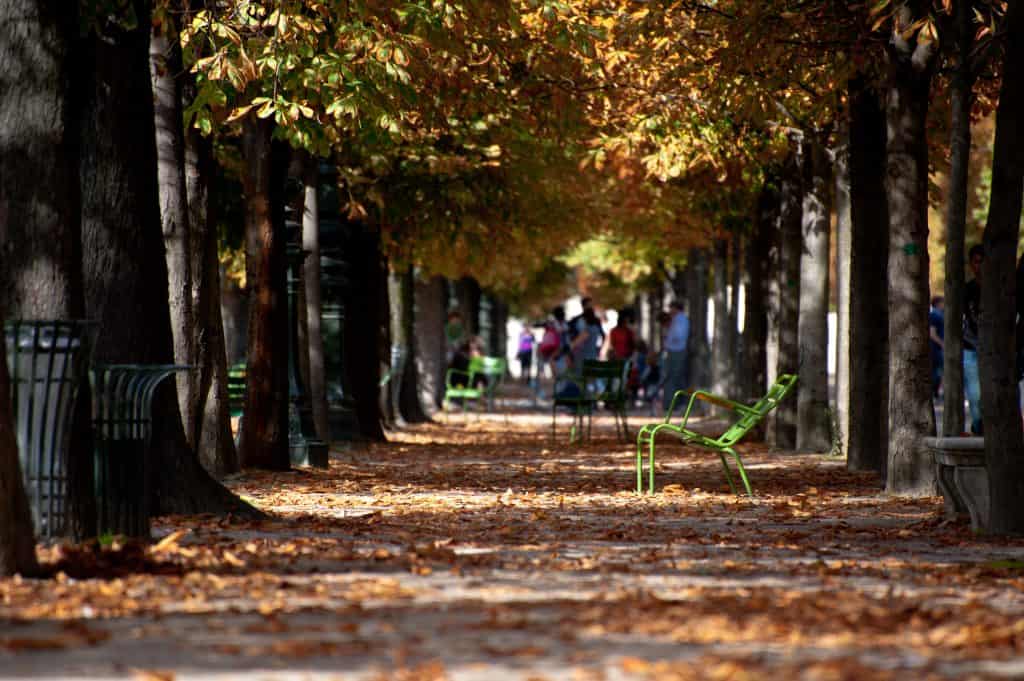
I took the featured photo in the Tuileries when Spring had definitely arrived this year after a very long stay by Old Man Winter.

Did you enjoy this article? TAIP is 100% reader-supported through tipping. If you want to leave us a tip of any amount it would be highly appreciated. These tips help support our efforts to keep TAIP an ad-free environment. Just as at a cafe, the tips are split evenly among the team.
Learn French in France? Not So Fast!

I often tell people that I studied French prior to coming here but I truly learned French whenever, over the years, I was in an immersive French environment (as in during my teenage visits to Montreal).  For those who think simply being here will make you fluent in French, I need to warn you: it won’t.

Apart from what fluency really means, there is the issue that language studies take five ingredients to make strong and serious progress.  If any of these ingredients are missing, your progress will be slowed considerably.

The first ingredient is perhaps the most obvious: money.  Whether you choose the path of a private tutor (25-40€/hour) or a large class at a school like Alliance Française (11-20€/hour) you will need thousands of euros to progress to any level of satisfaction in this language.  You can go to all the free language meetups or do all the Duolingo you please (I know, I’ve done both) but they are night and day from serious study of this language.

The second thing you need is time, and its handmaid, patience.  Just as Europe can’t really be seen in the madcap 30-countries-in-14-days dash that Americans are so infamous for putting themselves through when not better advised, French is not a language that can be “hacked.”  The pronunciation, exceptions, and nuances of the language demand more, even from English speakers who speak a tongue which is heavily influenced by French.

Finally, you will need practice and its champion, perseverance.  If you work in and speak English all day on a daily basis (as I do) you simply have less time to practice.  It also means you should do as much as you can in French be it making your grocery list in the language, or speaking with your French friends in it, who will be anxious to speak to you in English and help you as you struggle (classic example this weekend I was trying to deconstruct a very funny expression with my friends the French equivalent to “when pigs fly” is “when chickens have teeth” but the verb used was in the subjunctive, which I still haven’t learned, so we were discussing the change in stem and the various endings).

I have run into people who have lived and worked in France for 3-5 years who have a low level of competence and a horrible accent in the language (think “merci” pronounced “mercy”).  I used to despise them but as time has gone on and as I’ve faced my own roadblocks in the last 16 months (I was low on money, I was impatient, I didn’t make time to practice) I’ve come to accept that language studies, when not required for a job, are not persevered in without an overwhelming passion for the language in question.  In the United States, Spanish is universally the “practical” language to study in school but only a small handful of my friends, even the AP Spanish ones, have pursued their studies more seriously than being able to get around Mexico or South America.  The common denominator?  They all genuinely enjoyed speaking Spanish and connecting to that marvelous world.

I told you in another piece that the visa process weeds out many who just consider France a romantic possibility but don’t have the bottle to get through the hard work.  The reality of studies beyond, “Comment t’appelles-tu?” is a language rich in exceptions and irregular forms.  You’re going to have to love it.  Thankfully, j’adore le français.

* * *

One of the distinct advantages of being immersed in French is having pronunciation modeled for you 24/7.  All my friends tell me that my pronunciation now is night and day from this time last year.  But you also hear things in oral situations that you have to unpack later.  Three examples:

1.  “Voici.”  It is customary to say goodbye when leaving a café or store be it an “au revoir” or “bon week-end” or “bon après-midi,” etc.  People would occasionally call out what I heard as “voici” (pronounced vwas-ee) after me.  After some time  thinking on it I realized they meant “a vous aussi,” “to you as well.”  Parisian speech is traditionally fast, even among the French, and the French love to shorten things so no surprise that “a vous aussi” elided to something that sounds like “voici,” at least for some people.

2.  “Chef.”  I’ve encountered this before in varied situations, but usually from strangers around sporting events.  We don’t have an exact equivalent in English, but it is akin to someone young saying “sir” to someone else their age or younger, either as an artifact of their speech (as some 20-somethings are wont to drop putain into their syntax just as a placeholder) or because they want something from you and calling you “chief” is part of the “flatterie.”

3.  The disappearance of “ne” from negative statements.  In French you need to put a “ne” in front of the verb and a “pas” after it.  Since almost medieval times the French have been dropping letters from their text and speech and I happen to be living in an era when “ne” is disappearing in speech.  Since my tutor assigns me written homework my written French has to be “by the book” so this was a perfect example for me to learn by recognizing the difference.

Proper French: “je n’ai pas d’argent.” (“I don’t have any money.”)

Colloquial spoken French:  “j’ai pas d’argent.”  (“I don’t have any money.”)

As I queried my French friends about this they explained that it was similar to the English tendencies of using “gonna” as an elision of “going to” and “gimme” as an elision of “give me.”  It has that “slangy” sound to it when it’s used, but no one properly educated would think it would be correct to write using that format.

This tendency is a cause for alarm among the chattering classes that favor the (very reasonable) power of the Académie Française.  For the person in immersion, it’s reassuring proof that, more and more, you are “getting” the nuances of this lovely and storied tongue.

Did you enjoy this article? TAIP is 100% reader-supported through tipping. If you want to leave us a tip of any amount it would be highly appreciated. These tips help support our efforts to keep TAIP an ad-free environment. Just as at a cafe, the tips are split evenly among the team.

Forgetting My Passport

A huge pit formed at the very bottom of my stomach.  A hot flash of embarrassment started at my chin, ducked below my eyes, and lurched forward onto my forehead, spilling down my cheeks.  These physical reactions usually accompany the realization I have done something catastrophically wrong.  I said the words to myself, just for effect:

I forgot my passport.

I rehearsed quickly what I would tell my French cab driver, which would start with an apology and a request that he immediately turn around.

But my brain had already run ahead of me (as it is wont to do), presenting two factuals:

1)  If you turn around now, you will certainly miss your flight.

2)  On several occasions you have flown within the Schengen zone and not been asked for your passport.

This stood against the conditional:

1)  How do you know they will ask for your passport?

Since turning around to get my passport offered the same risk as trying to board my scheduled flight and being turned away (missing my flight), I decided to proceed.  My brain asked the conditional “But what about returning” question but answered it within seconds saying: “Let’s worry about this first.”

If the driver had looked back during the two-minute colloquy that had begun with that flush of embarrassment, he might have seen my furrowed brow accompanying my eyes glancing out the back window, moving side-to-side in a slow calculus, because surely part of me was wishing I took a short international flight more seriously than a bus ride.

Worse I still didn’t have my permanent carte de séjour I wouldn’t have it until April.  All I had was my temporary récépissé, which simply indicated that I would get an ID.

I showed up at Paris’ southern airport, Orly, about 30 minutes before boarding time.  It was a 07h20 flight to Rome.  It was my grad school friend Donald’s birthday, and he was due to be in Italy for a few days, so I thought to join him for dinner before coming back to Paris the next day.

As I passed through security the only thing they asked for was my boarding pass, which I was carrying electronically in Passbook.  I cleared security with a little bit of private nervous laughter.  As I moved towards the front of the boarding queue, I unfolded my récépissé and steeled myself with a confident insouciance (imagine a “What, I need a passport?” type of look).  The gate staff were really only looking to see that my name matched the one on the ticket so I’m not certain she even realized what class of ID I was presenting.  I shook my head after I passed through and wondered why I had been conditioned to think that in a 1st world country it was vitally important to always show ID.  Grateful for the nonchalance of the gate agents I started planning for hitting the ground in Italy.

Donald had booked a cooking class beginning at 10h00.  Since I was due to land a bit before 09h00 I knew I would have to take a cab.  Traffic cooperated and I arrived there and had a 6-hour culinary experience of learning, prepping, cooking, and eating.  It was lovely.

Since the theme of this blog has always been focused on Paris and France, I’ll perhaps share the details of the Rome trip at another time and in another place.  For now, know that I am writing this to you somewhere over northern Italy.  On my return to France the Italian gate agent had taken exception to my récépissé, but fortunately two (quite lovely) Russian ladies who also did not bring their passports had already been asked to stand aside while a supervisor was called.  I was asked to stand with them and we started speaking in French about the Schengen area.  “I didn’t forget,” said the older one, “I simply didn’t bring it.  You don’t need it in Europe.”  I shared that I had needed it in Romania, Poland, and Croatia, but then added, “but I’m not an EU citizen, you know, so I never go in your line.”  “Ah yes, she nodded.”  The gate agent returned and waved us through.

This time the cool wave of relief started at the top of my forehead and slid slowly and luxuriously down my head, cascading over my shoulders, and down the rest of my body.  I flipped to “music” on my iPhone, tabbed to David Gray, put on Shine, and slipped my noise-cancelling headphones on.

***

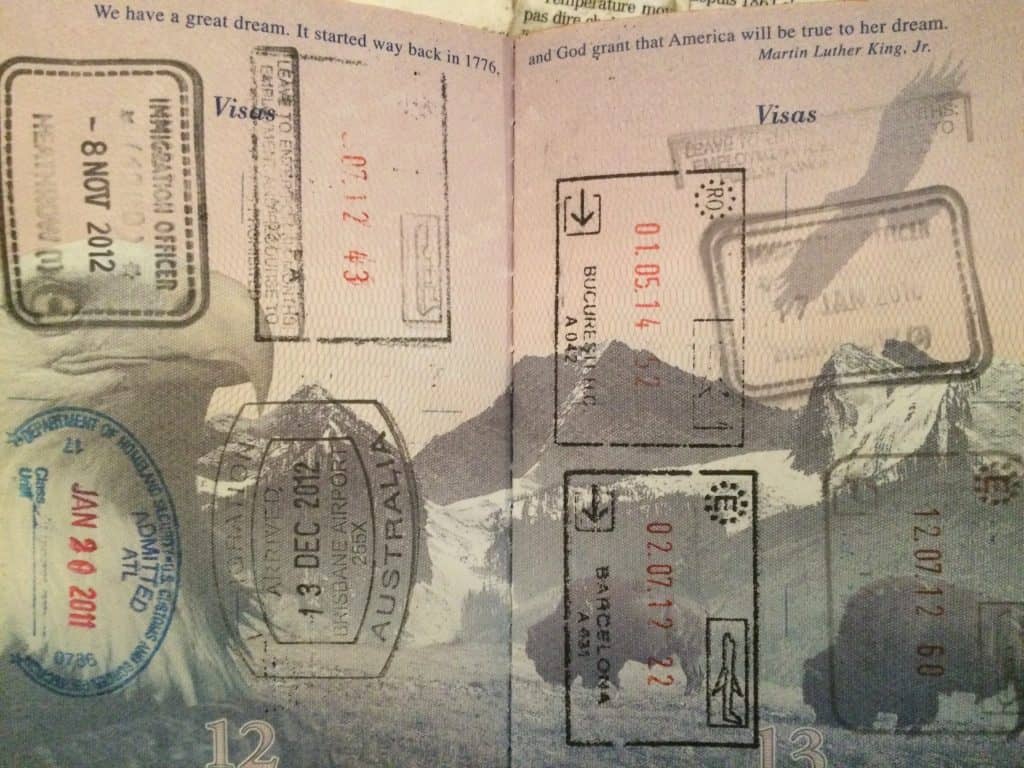
Moral of the story: write a huge note to yourself of DON’T FORGET YOUR PASSPORT YOU NON-EU CITIZEN and put it on your computer monitor the night before any international flight, Schengen or not.

Photo taken of some of the pages in my passport.

Did you enjoy this article? TAIP is 100% reader-supported through tipping. If you want to leave us a tip of any amount it would be highly appreciated. These tips help support our efforts to keep TAIP an ad-free environment. Just as at a cafe, the tips are split evenly among the team.
Little Entrepreneurs and a Sunday Stroll

I’ve often said that Paris is built for walkers.  The subtext there is that it’s a dream for wanderers.  Have some free time and nothing on your agenda?  Just take a stroll.  If it’s a particularly cold day, you might hit a string of Passages.  Historically these were just places where the bourgeois could shop, free from the threat of the elements.  Now tourists (and locals) mug in, enjoying the ongoing “show” that is the endless corridors of glass shop windows.  Today my target was a string of them, starting in my neighborhood, the 2nd, at the Cadet Metro station and working my way south towards Bourse.

Because my French is still a work in progress, I will often buy used children’s books as a means of improving (so I read like a French 10-year-old, so what? 🙂 ).  If they are used and on offer for 1 or 2 euros, that’s ideal.  These young entrepreneurs had set up in front of a beautiful art store that was conveniently closed.  People might crowd around looking into the store at curios and hey there are some kids selling books right here let’s take a look.

Where had these children (they couldn’t have been older than 10) gotten these books?  Had maman insisted on a cleanout of the rooms?  Had they found them by the trash somewhere and decided to be enterprising?  I stopped asking myself questions and started looking for my friends Babar, Madeleine, Tintin, and Asterix.

I spotted what I wanted a picture book on St. Bernadette, and inquired of one of the young ones “how much?” in French.  She told me to wait one moment and she asked her brother.  He told her, “Whatever you think.”  She paused, hand firmly under chin, mulled it over, and said “deux cinquante.”  I shrugged and nodded and reached into my pocket and pulled out a grip of coins.  Seeing my “riches” she quickly amended: “Trois.”  I laughed.  How do you say no to a kid selling books on the sidewalk on a Sunday?

I happily paid the spontaneous 20% upcharge and walked away with my new treasure, grateful to witness yet another facet of life in this amazing city.  Entrepreneur might be a French word, after all 🙂

Photo of said entrepreneurs in the Galerie des Panoramas.

Did you enjoy this article? TAIP is 100% reader-supported through tipping. If you want to leave us a tip of any amount it would be highly appreciated. These tips help support our efforts to keep TAIP an ad-free environment. Just as at a cafe, the tips are split evenly among the team.