
french uber riot

Paris: Frontline of Airbnb and Uber’s Wars

As a resident of France I appreciate that the French hold on to their traditions and ways of life and are generally skeptical of change.  Unmoderated and unguarded acceptance of change isn’t always the best thing.  Nowhere is this more a topic of conversation these days than with Airbnb and Uber.

These two American juggernauts have seized upon a simple idea and commercialized it: there is spare space in your home or car if someone wants to rent that space for some period of time, and you are willing to allow them to rent it you can complete an exchange of commerce.  Furthermore, in many cases, the necessary taxes are paid by the company, the provider, the end-user, or all three.  So what’s the problem?

In France?  “Les acquis.”  This term refers to the amorphous set of benefits and “rights” that the French feel broadly entitled to, and are willing to march in the streets to protect.  Not only (in their mind) are these rights guaranteed forever, but in all likelihood, these rights will only get better and sweeter with time.  I’m not going to talk about this concept for the moment.  I only want to use it as a reference point to help you understand why the hotels and taxi companies are absolutely livid about these two unicorns.

In a universe of acquis you have jobs and economic systems for life.  No pesky disruptions.  Year after year your universe is set and perfect.  Taxi-driving schools collect millions of euros in tuition and hotels collect hundreds of millions of euros in bookings. Never mind that both taxi companies and hotels employ tens of thousands of foreign workers and hence this can’t be argued to be about “French jobs.”

Indeed, it is a question of secrets.  In his book Zero to One Peter Thiel talks about the discovery of secrets as key to billion-dollar businesses.  The discovery of sharing unused space was a secret.  Overnight it created, in essence, the largest room-provider and largest transportation companies in the world.  Not by a massive capital spend, but by really intuitive software that could connect the provider and the end-user.  This massively democratizes micro-entrepreneurship by lowering barriers to entry.  You would think this would be welcome in a country that carves “liberté, égalité, fraternité” into the stonework of its buildings.

And yet, the French, used to the idea that anything you do with your time for money has to come with an enormous raft of benefits, including two years of unemployment pay, burn and flip cars and raid apartments in protest.  Who are they hurting?  Uber and Airbnb have more money, time, focus, and brains to devote to winning this matter legally or they will simply pick up and leave.  In the meantime, people who own cars or apartments in Paris who are simply making some money to defray their costs of ownership, as well as everyday commuters and travelers looking to save money, are the ones actually penalized.

Despite the fact that “entrepreneur” is a French word, fundamental disconnects like this happen.  Entrepreneurs don’t get acquis.  We build our own acquis over time, with hard work, perseverance, and a tremendous amount of sacrifice.  No one forces us to do it.  We provide willing services to those willing to pay us we’re even happy to pay taxes…to a point.

It is the convergence of these two attitudes the inbuilt idea of acquis and a population that prefers guaranteed jobs for life to entrepreneurship (because they are fundamentally risk-averse) that leads to such a strong pushback against these services in this country.

And yet, it seems to be politically motivated.  Many of the people my age (and younger) actively use Airbnb and Uber here in Paris.  We know what hotels are and we know what taxis are.  We have used them, many times.  We also know that Airbnbs and Ubers are neither hotels nor taxis, and come with their own risks (as if hotels and taxis are risk-free!).  But we understand that it’s important for people to have lots of choices.  Transportation-wise, that’s what makes getting around easier: buses, metros, taxis, Ubers, bikes, scooters, and yes, walking.  Indeed, UberPool is even an innovation among taxis using intelligent software and GPS to save everyone time and money.

And yet, despite a multi-million euro settlement with Airbnb last year, the City of Paris is being pressed by the hotel lobby for more raids.  And the ride-sharing industry is under pressure after a recent taxi strike.

In English we say, “the cat is out of the bag” to say what has happened has happened, and that you can’t go back.  Parisians have discovered that they can make money renting out their homes and cars.  Hotels and taxi companies have discovered that their guaranteed monopolies are over.  The City of Paris is caught in between them.  But the secret is out, and the hotels and taxis are in for a very rude awakening should any real move be made to ban Airbnb and Uber in Paris.

Photo used via Creative Commons from R Street.

This article was also published on Medium and LinkedIn.

Did you enjoy this article? TAIP is 100% reader-supported through tipping. If you want to leave us a tip of any amount it would be highly appreciated. These tips help support our efforts to keep TAIP an ad-free environment. Just as at a cafe, the tips are split evenly among the team.

The Path to French Citizenship Begins, or “Visitor No More”

Note from the editor: In light of new guidance on remote working in France as shared by the official French tax office in June 2025, we have also officially changed our stance on remote working for a US company while living in France under the visitor visa. Read more here, and contact us with any questions or concerns. We’re here to help! — MS

I saw her place the green and white paper on top of my file.  It was the paper used to print a récipissé (the temporary document one uses for identification while waiting to get a permanent identity card).  Externally I remained stoic.  Internally my jaw dropped and I wanted to shout out.  That enormous dossier that I had handed over 15 minutes earlier had worked.  Not only had I successfully jumped the track from the hamster-wheel of visitorhood to the track to an EU and French citizenship, but this had been the shortest prefecture visit since I moved to France in 2013.  From start to finish it had been thirty minutes.  I had felt supremely confident in my dossier but this was France, after all.  There could always be something objectionable.

Still dumbstruck, I silently handed over my photos.  As the big printer hummed, she clipped out one of them, handed the rest back to me, then dutifully affixed it to my récipissé.  She then gave it all the stamps and signatures it needed after I had verified all the information and signed it myself.

Today is eight days after I successfully changed to a Profession Libérale visa.  As long as I earn a certain income over the next five years and pay the requisite taxes, I’ll be eligible to apply for French citizenship (note: that does not mean I’ll get it).  I’m officially allowed to work in France, now.  I had to go to URSSAF yesterday to do more paperwork, and I need to come back in 90 days to give the prefecture that paperwork, but that’s literally paper pushing, rather than the complex compilation of a dossier.

Could I have taken this path immediately in 2013 instead of taking the visitor route?  Yes.  Indeed, if there are any of you out there interested in taking this path, I can help consult you through this process as someone who has successfully completed it and has a winning template.

And yet, the answer for me is also No.  I could not have taken this route myself, knowing as little as I did about France in 2013.  I didn’t even know what I didn’t know, and my plans and ideas about my time in France were so inchoate when I landed here.  Yes, eight days ago I took a bulletproof dossier to the Prefecture…but I knew it was bulletproof because of my last two visits there and what I had learned about the French and their expectations in the last three years.

It’s also been marvelous to hear from people I’ve met because of this blog not just those who needed help regarding the visitor visa but those who have started to meet with me to strategize about what I’ve just successfully done: a transition to the citizenship route.  A few of their testimonials are here.

Thanks for continuing this journey with me.  Last Thursday was the end of the beginning.


Did you enjoy this article? TAIP is 100% reader-supported through tipping. If you want to leave us a tip of any amount it would be highly appreciated. These tips help support our efforts to keep TAIP an ad-free environment. Just as at a cafe, the tips are split evenly among the team.

The Clothing Inventory: How I Escaped the French Sales Season

The “official sales dates” in France are roughly January 6-February 16 and June 22-August 2.

SOLDES!  The all caps scream out at you from all the shops in Paris then there’s the deuxième démarque, and the dernier…at each stage the frantic pace increases, and stores get progressively messier as the “regular” sizes sell out.

Paris will up your fashion IQ even if you never planned for it.  Scarves, shoes, jackets…I had definitely upgraded since moving, and there’s always something you can add…or is there?

I wrote some time ago about forced decluttering and about how a small Paris apartment forces you to be thoughtful about your “stuff.”  Combine that with a recent shine I’ve taken to the Minimalists and their ideas, and I was doing my best to resist…must not buy…clothes on sale…I tried to remind myself that he/she saves the most when nothing is spent.

But willpower wasn’t enough.  I took a clothing inventory.  Apart from socks/underwear I simply counted every piece of clothing I had.  Every scarf, tie, shirt, shoe, jacket, etc.  I typed it all up and printed out the 2-page document and looked it over.  There were no spots I needed to fill.  I had a great wardrobe.  Indeed, I realized that still some might go away via the 90-day rule I’ve observed since 2010 if it’s in season (ex: sweaters in winter) and I haven’t worn it in 90 days, it has to be given to someone else who will use it better than I will, or to a place that takes clothing donations.  So, instead of getting sucked into the sales season I took an opportunity to remind myself that I might be getting rid of some clothes as we move from Winter to Spring.

If making the clothing inventory isn’t enough print it out and carry it with you so that every time you want to make a purchase during the sales season you can pull it out and check yourself. 🙂

“Soldes” photo from pterjan.  Creative Commons.

Did you enjoy this article? TAIP is 100% reader-supported through tipping. If you want to leave us a tip of any amount it would be highly appreciated. These tips help support our efforts to keep TAIP an ad-free environment. Just as at a cafe, the tips are split evenly among the team.
French for “Customer Service”

“It’s not my problem”

accompanied by a shrug, said by almost every French person ever to a customer in need of help.

The quote above is a caricature, surely, but my French friends will admit it’s pretty close to the truth.  It’s my third year here in Paris, and when your expectations are so very low, when you get surprised, you want to share it.  So, here are two such stories.

Groupama

Groupama provides my renter’s insurance, something that is helpful in itself, but is also a requirement of most of my visa visits, including my recent one to move away from visitor status to a path to citizenship.

However, they, like many French insurers, make it impossible to cancel a policy online.  You have to go in person and provide a signed état de lieu as proof you have moved out.  Your word is not enough (same thing happens at the bank when you try to change your address).  Do you have proof?

In any event I had moved out of this place roughly 6 months before I managed to get to my insurer.  I took the blame, as other things always seemed to take priority.  Not only was the cancellation smooth, only taking a few minutes, but the agent marked the cancellation to the end of the lease, and credited my account with 6 months of premiums!

As the French write: “Waoh!

Decathlon

The next mission was already impossible in my mind before I attempted it, but in the spirit of “try everything once” I took back two inflatable mattresses to Decathlon.  I had purchased the first one for guests who might stay at my apartment and it worked fine for months.  Until it started to slowly deflate.  I spent some time trying to find the slow leak so I could patch it, but no dice.  It was only 15 € and I hadn’t kept the receipt.  I bought another.  This one started deflating almost immediately.

I called it a day on the inflatable mattress plan and bought a Japanese-style fold-out bed at Castorama.  No deflation possible!  But I still had two non-functional inflatable mattresses.

I suggested to a couple of French friends that I would try to return the beds without a receipt (I had idiotically not kept the second one, either).  They laughed derisively.

“I’ll just play the dumb American,” I said.  “Plus, I’m willing to accept store credit.”  Turns out I didn’t have to.

I arrived at the enormous subterranean Decathlon near the Madeleine (Americans, think Dick’s Sporting Goods or Sports Chalet) and got into the returns line.  When it got to be my turn I explained that I didn’t want an exchange, but that I wanted to return these mattresses for store credit.  The young girl called a colleague over, who then walked with me to the camping department, where the inflatable mattresses lived, in order to observe the malfunction.  And to my dismay, the same thing happened as whenever I brought an Apple device to an Apple store for troubleshooting: nothing.  I almost wonder if the Apple Store is a stern father figure for my Apple devices and they suddenly “behave” when they are at home.

I watched, bemused, as the inflated mattress which had deflated over and over in my home held the air intact.  We even tried sitting on it to force the leak.  Not a peep.  Resolute as Churchill on the beaches.

The kid read my incredulous expression.  “Don’t worry,” he said in French.  He walked me to the counter, got me a gift card for the value of both mattresses, and as I walked out of the store and held the gift card in my hand, contemplating the imposing facade of the Madeleine, I smiled.

Maybe there is a French word for “customer service” after all.

P.S.  Don’t worry, I have a horror story to share in the future for those who wish to further the paradigm of “the French just don’t care about customer service.” 🙂

Did you enjoy this article? TAIP is 100% reader-supported through tipping. If you want to leave us a tip of any amount it would be highly appreciated. These tips help support our efforts to keep TAIP an ad-free environment. Just as at a cafe, the tips are split evenly among the team.


Ars et Metiers Museum Paris

Making the most of Free Museum Sundays

A large number of museums in Paris are free on the first Sunday of the month.  Some budget-minded travelers know this and schedule a visit to Paris around such a date to knock out some museums for free.  Is this a good strategy?  Yes and No.

I’ve done over 20 Free Museum Sundays (as I call them) since I arrived in Paris, and I’ve come to the conclusion that whether you’re a local or a tourist, this day is great to use for short, targeted visits to the little-known museums that go under the radar for people on a Museum Pass rampage, and also don’t draw big crowds on the 1st Sunday of the month. Don’t use it to go to the Orsay or the Louvre.  Trust me on this.

You can find the list of the dozens of museums that are free here, but here are three suggestions that I can make for you that would be good uses of your time.

The Gustave Moreau Museum

Moreau was born in 1826 and lived during a period of great change in France following the 1st Napoleonic era.  His art draws on too many influences to neatly fit into a school that you might know, and as such is singular in appearance.  As I think upon his body of work now, some pieces are too unfinished to even be “impressionistic,” and yet some, like his Orpheus, which often hangs on the first floor of the Orsay (when it’s not out on loan) recalls the Academic style so favored by the Salon.

This marvelous 3-story house, with a lovely and elegant preserved staircase to take you to the top floor, is the perfect showcase for this unique artist.  Even a gentle wander should run you at least 30 minutes.  A true visit should run you 60-90 minutes.

The Eugene Delacroix House

Delacroix is probably best known for his Liberty Leading the People, an image that hangs in a gallery in the Louvre roughly 30 meters from a beautiful painting of St. Joan of Arc at the coronation of the Dauphin.  I point out to my guests that this is an example of a contradiction the French are comfortable with: two women of power one supporting the monarchy, another leading the French over the bodies of the defenders of the monarchy.  The two Frances (one Catholic and royalist, the other anticlerical and republican) are on display for you in that gallery, if you just give yourself some time to make the connection.

But even royalists like myself can appreciate Delacroix, especially for his famous Dante and Virgil in Hell (which also hangs in the same aforementioned gallery in the Louvre, not far from Gericault’s Raft of the Medusa) and also for the ongoing transformation and maturation in his work and technique.  This museum is much smaller than the Moreau museum, but features a lovely garden to rest in.  A quick run can be done in 30 minutes, but no need to rush.

Arts et Metiers

This museum is the largest of the three I’m recommending today, and will take at least 2 hours of your time to see properly.  I call it the “Nerds’ Museum” because it has all sorts of wonderful inventions and gadgets from many different eras in it (think everything from the first barometer to a Cray supercomputer), including the highlight: Foucault’s Pendulum.  In 1851 Foucault used this device to prove that the Earth rotates.  Additional good news?  Every Thursday the museum is also free from 18h00-21h30.  So you don’t even have to wait for the first of the month.

Paris has over 50 museums.  No better time than the beginning of a new year to start seeing some of them.

Did you enjoy this article? TAIP is 100% reader-supported through tipping. If you want to leave us a tip of any amount it would be highly appreciated. These tips help support our efforts to keep TAIP an ad-free environment. Just as at a cafe, the tips are split evenly among the team.
Mailbag: Passport Pages, Transferring Your Visa, and Taxes

It’s been a while since I’ve done one of these, but it’s often helpful for me to share some of these answers to questions I get in email so that others who are also wondering might have their questions answered as well.

How does adding passport pages to my (US) passport or renewal of it affect my visa?

Well, this is a two-parter.  As of December 31st, 2015, the US Embassy in France is no longer adding pages to your passport.  What that means (and I confirmed this in person at the Embassy) is that you will have to apply for an early renewal of your passport, as US citizens living abroad are not permitted to mail their passport back to the US for pages to be added there.  For my battle-worn blue book, that renewal ends up being roughly 3 years early.  But given that I’m down to room for exactly 5 more stamps, it’ll have to do, especially since I have a lot of travel later this year.

As to how it affects your visa: it doesn’t.  If you’re in the first year of your long-term stay visa, your carte de séjour exists in the form of the sticker that OFII put in your passport roughly 90 days after you arrived during your follow-up visit.  If you add pages/renew your passport you will get your cancelled passport back and still show that sticker, if you need to.

If you’re in your second year and beyond, you will be issued an actual carte de séjour after your renewal, which effectively functions both as your ID and your visa.  Those stickers in your passport from years ago are then like the rest of the stamps in your passport memories but nothing legally important.

You said recently that you had to file taxes?  How did that go?

Great question!  Funnily enough, despite sending them a properly filled-out French tax return appropriate for a foreign filer, in which I indicated that my income had not been derived from French companies, they still sent me a bill for 1781 euros.  After some laughter with my accountant and attorney, an email was dispatched to the relevant department:

réf de l’avis:15 75 XXXXXXX XX
Nº fiscal déclarant: 30 25 XXX XXX XXX X

Messieurs,

Je reçois cet avis d’imposition dont je conteste le fondement. En effet, l’assiette de la CSG et de la CRDS est l’ensemble des revenus français quelque soit leur nature et montant.

La totalité des revenus composant l’assiette de cette imposition a été d’origine américaine, perçue et imposée aux USA conformément au traité fiscal franco-américain.

En conséquence, de par la définition même de cette double imposition CSG – CRDS, l’assiette de cette imposition ici présente est non conforme. Je demande donc son annulation immédiate et sans condition.  

Cordialement,

Stephen HEINER

The next day, which is essentially light speed by French standards, had this response in my inbox:

Monsieur,

Votre demande a bien été prise en compte. Vous allez bientôt recevoir un avis de dégrèvement.

Salutations.

Translation: You’re right.  You don’t owe any money.

Stephen: Gee, thanks. 🙂

Did you enjoy this article? TAIP is 100% reader-supported through tipping. If you want to leave us a tip of any amount it would be highly appreciated. These tips help support our efforts to keep TAIP an ad-free environment. Just as at a cafe, the tips are split evenly among the team.

travel

Don’t Use Opodo

When I lived in the United States I unfailingly used the (now defunct) Hipmunk to search for flights.  They use an “agony index” which scores layovers, price, etc. to give you the best option for your journey, not necessarily just the best price (you can always click “sort by price” if you want).  They also have a simple and beautiful design interface that makes reading and understanding the fares simple.  Odd inclusion these days?  Amtrak.  Expected exclusion?  Southwest.  But you can always search Southwest in a separate tab.

Hipmunk simply doesn’t work in the European market as well as Skyscanner, which is the go-to travel website over here.  Skyscanner searches an absurd number of airlines you’ve never heard of, and then proposes all kinds of itineraries that don’t take into account any manner of logic.  Oh, you want to go to Budapest?  You probably want to stop in Dusseldorf for four hours on your way there.  No I don’t…wait, I mean, I’ve never been to Dusseldorf…and it looks like the direct flight is 100 € more.  Hmm.  Maybe I could go to Dusseldorf… (not a random example I did do this last year, and Dusseldorf is definitely worth a few hours of your time, at least).  Alternatively, you’ll also want to check out Kiwi, which dynamically shows cheap flights in real time geographically.

I was headed to Romania to see some friends recently and had difficulty finding direct flights to Bucharest, Romania’s only airport, at reasonable prices.  It was short notice and it was December, so I understood.  I spun the Skyscanner bottle and landed on…Munich or Frankfurt for 8 hours on the way.  I polled my friends in a large Facebook travel group and the vote was unanimously Munich.  Done.

I booked the ticket through Opodo for seats on Lufthansa.  Wait, what?  Why didn’t you go to Lufthansa?  Well I would have, but it wasn’t an option at that price point.  Skyscanner lists a number of resellers of varying levels of excellence which have bought seats in advance for the express purpose of reselling them.

Some you will recognize Expedia, for example.  Others, you will never have heard of, but like most Americans, will cautiously use because no one ever cheats you on the internet for flights, right?  I had used Opodo before, I think, with no serious issue.  I can also vouch for TravelGenio/Travel2Be, though they look shady and my bank initially denied my purchase due to “high fraud with that site” they told me later.

Anyway, I paid for the flight through Opodo, got a confirmation number via Lufthansa, and even went into Lufthansa’s system with the confirmation that showed that yes, indeed, I had a flight to and from Bucharest from Roissy (Paris CDG).

Until I didn’t.

I was in my online banking website, preparing for a meeting with my accountant when I noticed that Opodo had refunded all but $5 of my ticket.  Hmmm.  I called Lufthansa after a login to their system revealed my return flight still, but no outbound flight.  In its place was an ominous error message: there has been a change in your reservation.  I explained all this to the bemused customer service agent, who, after conferring with her supervisor, informed me that the reservation number was simply a hold.  No ticket number had been issued.

I checked my email and nothing had been sent to me from Lufthansa or Opodo.  Four days before my flight and I had been dropped without notice not even an email and I only noticed because I was, by chance, looking at one of my accounts in online banking.

Opodo which seems to be run like a vending machine great when it works, but useless when it doesn’t at the time simply had an FAQ page where there should have been a “contact us.”  As of January 2016 they’ve added an actual phone number on the site.  That’s at least some progress.

I didn’t want to bother over an issue of $5, which they had effectively stolen.  I did another search on Skyscanner, but this time I did a quick cross-check in my travel email for an aggregator that I had successfully used in the past TravelGenio won that lottery and I booked my ticket.  Again.

And now I’m telling you this story over dessert in a café in Munich.

I should note I’ve successfully used Opodo at least twice in the past, but such a catastrophic letdown, which led to me re-buying the exact same ticket I had bought originally, but this time for 50€ more, is a dealbreaker…and I didn’t want any of you to make the same mistake when you take your casual trips around the continent.  And trust me, mine isn’t an isolated tale.  These guys are muppets.

If you have any resellers you really like or have good experiences with, please share them with us in the comments.

Photo by Priscilla Du Preez on Unsplash

Did you enjoy this article? TAIP is 100% reader-supported through tipping. If you want to leave us a tip of any amount it would be highly appreciated. These tips help support our efforts to keep TAIP an ad-free environment. Just as at a cafe, the tips are split evenly among the team.

Picard France

Picard: a Dirty Little Secret of the French

So before we arrive in La France, we non-French perhaps imagine that all French people have an advanced knowledge of wines and cheeses, and while we don’t expect the full Julia Child/Jacques Pepin experience, we expect that most native French should be able to make a few classic French dishes from scratch, from maman‘s recipes or perhaps from grand-mère.  This is not an unreasonable expectation.

What you don’t expect, what you can’t possibly believe, is that a store like Picard exists.

It only sells frozen food.  To be warmed up in an oven or microwave.  No, this isn’t some monstrosity dreamed up by an American.  This. Is. In. France.  And it’s wildly popular.

“I, I just can’t believe Picard exists,” I sputter to my French friends.  A slow smile often creeps into their mien but Stephen, it has good food, bio (organic), you know I wave my hand dismissively.  “Do you realize your word for kitchen (cuisine) means, essentially, thoughtful or good food in my language?  And then I find out that you guys are warming up premade food?”

“Oh, but Stephen, you know, no time, metro, boulot, dodo, etc.”

“In the land of the 35-hour work week?” I ask plaintively.

Now, I’m being a bit unfair about that 35-hour work week as I’ll explain in a future article about the work lives of the French.  Suffice to say I have more than one French or expat friend who works until 20h00 on weeknights, so I fully understand and believe the, “I’m too tired to cook” response.  I know, because I’ve been there.  I’ve come home later than 22h00 many nights when I lived in America.

But when life becomes a succession of warming up food (or buying takeaway), what is the point of living here, or anywhere, for that matter?  One of the things I enjoy so much about France is the superabundance of fresh food and produce; butchers, fishmongers, cheesemongers, produce sellers, bakers: they are out at all hours, replicating what has been done for centuries, giving you the key ingredients to make food for yourself.

The thirty minutes you spend warming up some second-rate boxed lasagna, organic or not, could be spent making an omelette or a salad.  Or pasta.  Or grilling some veal, or rabbit, or lamb, while boiling some potatoes or steaming some veg for garnish.  In fact, 30 minutes would be long for “end of workday” versions of any of those suggestions.

I don’t expect all to take as much pleasure as I do in buying food, making my mise-en-place, and delighting in the cooking process, down to the colors of my food in correspondence and interplay with whatever season we find ourselves in.  But I do expect those who inhabit a country conscious enough of their own pride in everything to put a cock on the crest of the national sports teams to live up to the inheritance, the patrimony, they have been bequeathed, and has been bequeathed to the whole world.  The whole world looks to France as a (perhaps the) standard of cooking.

Which means Picard is simply not good enough.  Ever.  Generations who worked in the fields and offices long before Picard existed managed to cook and eat well.  You should too…whatever country or galaxy you live in.

PS: I should note that it’s simply more expensive to eat processed food, both in terms of financial cost and health cost.  However, I tend to see these as “last ditch” arguments.  People should accept the premise that cooking their own food is a good to be desired in and of itself.

An even more fun PS: my evolution on Picard, five years after I first wrote this article.

Photo from the still-running cooking. eating. carousing. blog

Did you enjoy this article? TAIP is 100% reader-supported through tipping. If you want to leave us a tip of any amount it would be highly appreciated. These tips help support our efforts to keep TAIP an ad-free environment. Just as at a cafe, the tips are split evenly among the team.

Unexpected Consequences of an International Move: Instant & Ongoing Decluttering

I’ve mentioned before on this blog that the Four Hour Work Week is a major influence on my life and was a big part of the “how” portion of the massive quality of life upgrade that was my move from America to Europe.  In the book Tim puts forth a notion called “mini retirements” in which instead of working and saving until some mythical age to sell everything and move to Thailand (for example) why not do that now for a few weeks and see if you actually like it.  There are other reasons to take mini-retirements, including not assuming you’re in control of your health or when you die, but what I want to focus on is Tim’s insistence that you dump pretty much everything.

Stuff.  It can define us.  And Americans in particular have so much room that nothing stops us from buying more.  We even define our “national holidays” by sales of stuff.  We even have a very healthy business category of self-storage, which is an embodiment of our hoarding mentality.  Alas, that industry is now kicking off in Paris (and probably greater France as well).

Tim’s points were simple: get rid of everything that doesn’t have a particular or sentimental value.  You can always buy another couch, or plates, but maybe you can’t buy that one pan Grandma taught you to cook with.  Dump the other stuff, keep that.

I decided pretty quickly that my “must keeps” consisted of roughly 100 framed prints that had mostly been painstakingly transported from Europe over the years and adorned all the spaces of my then-home in America, as well as the 4000 books that I had collected over many stops of library book sales and used and new bookstores over the years.  I spoke to a friend in Canada who had a large amount of space in a new home he had recently moved into, and who also happens to homeschool his kids.  He would get a teaching and parenting resource for free, as well as for his own enjoyment, and I would have free and safe storage of my treasures.  We agreed on a 5-year term, after which time we could discuss what was to follow.  I knew after 5 years in Europe (I’m 2 in now) I would either have a place to ship the books or have a long-term plan about what to do with them.

So books and art sorted.  I rented a large truck about 6 months before I left the USA and drove the books to Canada.  As a note, if you do this, the Canadians will ask you for a value, so they can tax you…on stuff you already own…because hey, you might choose to sell it!  So, cynically (and in keeping with American, and what I would find out, French traditions), I assessed the 4000 books at a value of $.01 each and the art at $1.00 each, to a value of roughly $200, which I still had to pay tax on.  Small price to pay honestly, but it does add an extra 30-45 minutes to your border crossing.

I then proceeded to dump all the furniture I had painstakingly picked out during my “I’m a grown-up now with a real salary” phase when my college furniture found the curb.  These were the delicious dark wood headboards, the plush suede couches, the tasteful (and useful) ottomans.  I even had a lovely Victorian double-sided desk.  All gone: happily mostly sold to friends and friends of friends, and what was still left over went onto Craigslist.  For the very last items (what was I doing with my own power drill?), I left them with my sisters to sell on their own or keep.

That left me with roughly 20 resealable tubs into which I mostly, but not exclusively, put items of real sentimental value.  Stuffed animals I had as a child which I kept in really great condition and which I wished to pass on to my children or to my nieces and nephews.  A report on birds I wrote as a ten-year-old.  A drawing my sister made for me.  That kind of stuff.  Some dear friends have been kind enough to keep those tubs in a spare room in their home.  I plan to keep reducing the quantity of tubs in that room every time I visit, loaded with goodies from Europe for my gracious caretakers.  And each year that passes that I don’t miss the stuff in those tubs, it makes it that much easier to get rid of when I do see it again.

In truth, limiting myself to the four full-sized pieces of luggage I ended up bringing to France was an enormous task that I totally underestimated.  I flew American Airlines to France in December 2013 and at that time the policy was: 1st bag free, 2nd bag $100, and bags 3-10, $289 each.  Hard to believe, but this is actually the cheapest and fastest way to move your stuff.  I checked into freight, believe me, and either my calls weren’t returned, or my emails weren’t returned, or it was prohibitively expensive when I did manage to get a price sheet.  Same for UPS, sea-freight even.  And then you have to go to Le Havre to pick it up.  Yeah, skip that.  Pack it with you.  It’s really cheap, comparatively.

Now, when you’re bringing that much stuff (my aforementioned four pieces of luggage…I won’t even share the absurd limits of carry-on that I stretched), you find a way to bring too much, so I want to encourage you to spend one month packing these 4 pieces (or fewer).  You’ll take more stuff out as you work on it every day and keep asking “Do I have to have this?”  I know when I showed up at the airport that I was at least five pounds over on each bag.  But I knew how to get around this: the skycap.

This profession doesn’t exist in Europe, oddly, though it is exactly the sort of profession you expect to exist there.  They are (for my Euro friends who might be reading) men and women who stand on the curbside to help those who wish to “skip the line” get boarding passes and check bags there instead.  For this “convenience” you are expected to tip anywhere from $5-$25/bag.

That morning that I left Kansas City the skycap picked up all 4 of my bags and gave a slight grunt for the last one, the heaviest.  “Where ya goin’?”  “Paris.”  His eyes widened as he looked back over the bags, quickly calculating how much it was going to cost me.  “I’m moving.”  “Ah.”  He started weighing the bags, and I watched each bag on the digital readout.

53 lbs

57 lbs

52 lbs

61 lbs

“They are all over.”  He was reminding me of the 50-pound weight limit I was already aware of.  Overweight would add $150 to each bag.  I nodded, putting on a guilty and downtrodden look.  I wanted my silence to speak.

“I can take care of this for you, if you make it worth my while,” he said after a beat or two.  I tried not to beam and high-five myself, as this was the exact response I was banking on.  I took out my last bit of American currency I was carrying, a $50 bill, and put it on the counter.  I still said nothing.

Given that he was about to save me $600, he was expecting more, I’m sure, but he probably realized that $50 was good pay for 5 minutes and a few key strokes that indicated that yes, these bags weighed no more than 50 pounds.

We were operating in that shadow economy, and little did I know that this was precisely the kind of hustle I needed to survive and thrive in my new country.

So, to sum up:

  1. Get rid of mostly everything.  Try to come up with creative, trade-based, non-recurring monthly cash flow ways of storing the rest.  You need to spend as little as necessary in your new country when you first get there.
  2. Take a long time to pack what you are bringing, in order to have a critical instead of a stressed and harried eye to look it over with.
  3. Don’t hesitate to leverage American idiosyncrasies to bring what you want.
  4. However, do be pragmatic and take the time necessary to figure out what you really need vs. what you can buy when you get there.

A giant move out of the country can be the impetus for that Spring Cleaning you always aspire to do (and which my sister Clare does roughly every 3 months) but never get around to.  Which is yet another reason to move abroad.

And when you do get here, the housing in Paris is small enough to prevent you from restarting that life of stuff you left behind.  When you shop, you constantly ask yourself, “where would I put that?” which is a practical question that you don’t have to answer in always too-big America.

* * *

For a great video to share with kids or anyone who cares about our planet and the absurd and unsustainable way of life in the First World, check out the work that these guys have been doing.

Photo from jsmjr.  Labeled for reuse.  What a cute dog.

Did you enjoy this article? TAIP is 100% reader-supported through tipping. If you want to leave us a tip of any amount it would be highly appreciated. These tips help support our efforts to keep TAIP an ad-free environment. Just as at a cafe, the tips are split evenly among the team.
Meetup: a Great Way to Build a Core of Diverse Friends

This summer I went to the Fête de la Musique with a large group of friends.  Though it originally started in France it’s now a worldwide annual event.  As the evening closed out at our fourth musical venue out of hundreds we could have chosen, I took a moment to be thankful for a platform that has connected me with so many wonderful people.

Meetup is a company that started in NYC in mid-2001, but really gained traction after 9/11 as New Yorkers tried to connect with people who wanted to talk and process the disaster that had befallen their city, their nation, and the world.  It has grown quickly in the US, and as a result it can cost north of $100USD/year to start a group.

For those who aren’t familiar with the concept, Meetup is a “just add internet” for any type of group.  Want to “jog on Wednesdays” or “knit on Tuesdays” or “club on Saturdays”?  There’s a group for you to join.  Can’t find the group you want?  Start your own.

For the casual browser it’s a dazzling arena of fun activities with strangers who might become friends.  For the organizer type (comme moi) at only 12€/year to start up to three groups, it’s a bargain that pays back massive dividends.

I created a group called Paris Culture Lovers as a way to find people like me who love art, film, books, conversation, food, and day trips.  We are closing in on our first year as a group and have done almost 90 events, some of which were among my most treasured memories of 2015.

So what’s the bad news?

  1. Many groups are ephemeral.  People get enthusiastic, start a group, never do an event or do one and give up.  That’s okay.  It happens.
  2. Because Meetup has created a “buffet” culture, and because society worldwide becoming less accountable about events and invitations, many people feel they can no-call and no-show an event they have RSVPed for, or cancel hours or minutes before an event, for frivolous reasons or for no reasons whatsoever.  You might not do that to friends but you may be inclined to do that to strangers (At PCL we have invented a ranking system that measures and ranks you by the number of events attended and gives senior members priority for events).

But neither of these things are dealbreakers and as this year ends, a group of the core of Paris Culture Lovers has become good friends and strong acquaintances, which means a lot to a stranger in a strange land even more so to the type like me, who isn’t seeking to surround himself with expats to build an anglo island in France.  There are meetup groups for that…if that’s what you want.  But when I want to feel like America or be with Americans…I visit that country.

* * *

P.S. I should note that I had two Meetups fail due to lack of interest a casual kick-around soccer group and a chess players group.  But you have to try in order to see what works 🙂

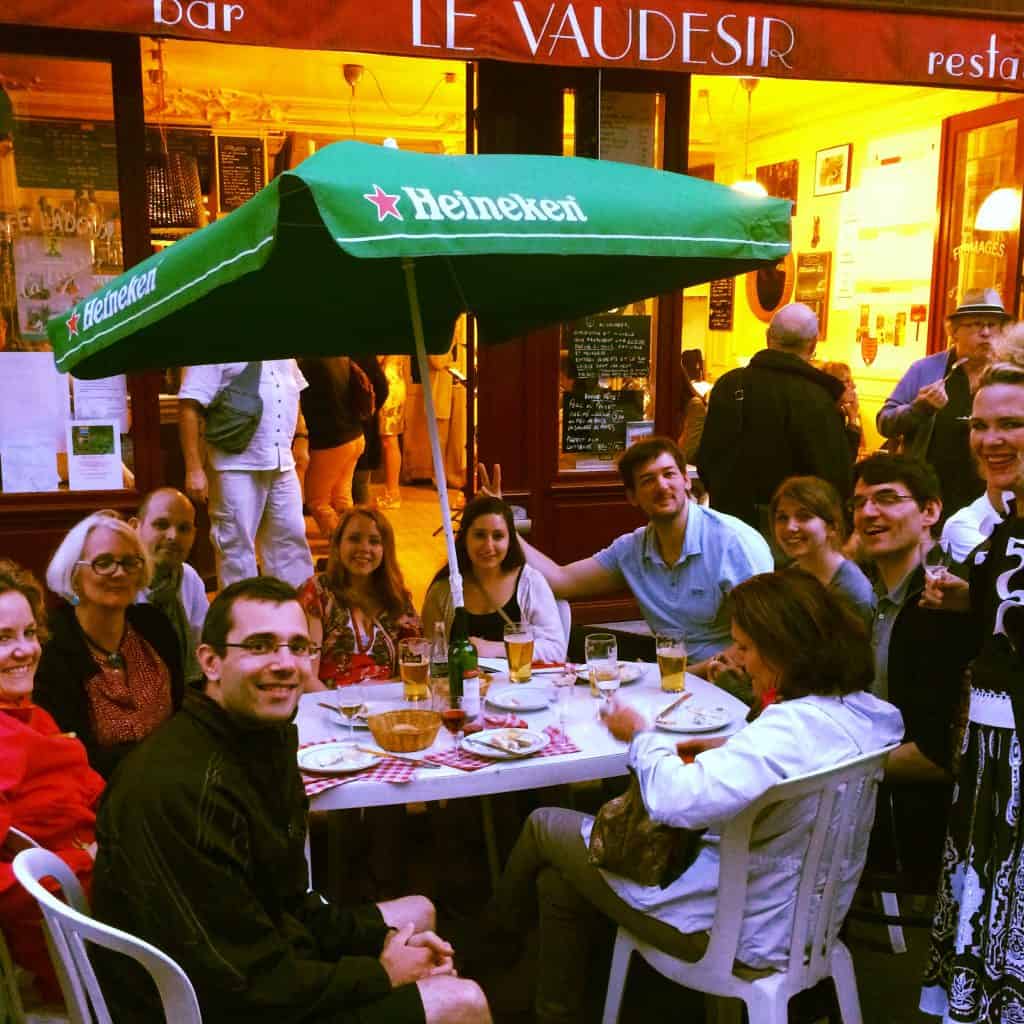
Photo was a crew of friends at the end of a fun and rambling Fête de la Musique.

Did you enjoy this article? TAIP is 100% reader-supported through tipping. If you want to leave us a tip of any amount it would be highly appreciated. These tips help support our efforts to keep TAIP an ad-free environment. Just as at a cafe, the tips are split evenly among the team.