Christmas Markets in Paris

We rarely touch on “things to do in Paris” beyond our neighborhood guide series as this blog is mainly for expats who live in Paris or people who hope to one day become an expat who lives in Paris. 

You don’t really need a list of things to do when you’re in a city long term — you hear about them from your friends, signage in the métro, social media, and the like. Most Parisians aren’t looking for advice on the best places to go. They go where their friends are and would never think twice about meandering through throngs of tourists to see the Eiffel Tower, etc.

But, when the Christmas season rolls around even the grouchiest Parisians like to peruse the stalls of a good market while enjoying a vin chaud. There are quite a few to choose from. Here are our favorites.

Village de Noël de Saint-Germain-des-Prés

This is one of my personal favorites as I love the Saint-Germain-des-Prés neighborhood. In fact, I used to live there when I was studying in Paris for my semester abroad. I think that’s why I like the area so much — it reminds me of my earliest days in the city when I was only 20 years old and had never lived away from my hometown.

Here you’ll find around 15 different vendors selling their wares, which range from gourmet food products to handmade decor, clothing, and jewelry. 

When you’re done browsing, pop into Café Flore or Deux Magots and pretend like you’re a tourist. Try not to balk at the price of a café au lait.

Where? Boulevard Saint-Germain

When? Monday-Friday 11am-9pm, Saturday-Sunday 10am-9pm until January 1

Marché de Noël des Tuileries

If you come to Paris during the winter months you’ve likely already visited this Christmas market. It’s one of the most popular and has been around for decades. 

In addition to the 80 vendors selling French foods from every region, artisanal creations, and plenty of hot wine, there are also other attractions. Amusement park rides, an ice skating rink, and games for children are just a few. Go in the evening and make a night out of it, just remember to dress warm.

Where? Jardin des Tuileries 

When? Everyday 11am-11:45pm until January 7

Village de Noël de Paris La Défense

If you’re willing to ride Line 1 until its terminus at La Défense, a financial district located just beyond Paris’ borders, you’ll find the largest Christmas market in the city. Okay, it’s not technically in Paris, but La Défense is a part of the “Grand Paris” you may have heard of (another article for another day!).

Here there are 150 vendors, including individuals who sell nativity scenes from Provence, fois gras, cheese, and honey, as well as products from Savoy, Alsace, and beyond. If you have children, there’s a petting zoo, puppet shows, and Santa Claus.

La Défense isn’t my favorite part of Paris — I once had a French course there and I really disliked making the trip — but even I have to admit that the Christmas Market there is one of the best, especially for kids.

Where? Paris La Défense

When? Monday-Thursday 11am-9pm, Friday 11am-10pm, Saturday 10am-10pm, Sunday 11am-9pm until December 27

Marché de Noël Alsacien

Alsace, a northeastern region of France, is known as being a winter wonderland in and of itself so it’s not surprising that there is an Alsatian Christmas Market in Paris. Strasbourg, one of the major cities in the region, has an incredible market throughout the holiday season — if you can’t make it there, this is a good substitute.

The stands sell Kougelhopf, a traditional Alsatian cake, gingerbread, brioche, potato pancakes, and Munster cheese, among other regional delights. This Christmas market is quite shorter than the others, so you may want to head here first. 

Where? In front of Gare de l’Est

When? Monday-Saturday 9am-7:30pm, Sunday 10am-7pm until December 18

Le marché de Noël de Notre-Dame

While the Notre-Dame may still be closed to the public (it makes me wonder if it really will open in time for the Olympics next year!), you can still visit the Christmas market that’s set up in the small park that is located just across the street from the cathedral. If you’ve already visited the infamous bookstore Shakespeare and Company, it’s practically next door.

There are 30 vendors, each selling their unique wares. I suggest you go at night so that you can see the Notre-Dame lit up in splendor.

Where? Square René Viviani

When? Monday-Thursday 10am-8pm, Friday-Sunday 10am-9pm until December 25

Photo by Dmitrii Eliuseev on Unsplash

Did you enjoy this article? TAIP is 100% reader-supported through tipping. If you want to leave us a tip of any amount it would be highly appreciated. These tips help support our efforts to keep TAIP an ad-free environment. Just as at a cafe, the tips are split evenly among the team.

Paris museum line

Free Cultural Activities in Paris

Are you new in Paris and wanting to visit its cultural heritages and emblematic places but are tight on a budget?

Don’t worry, we’ve got you covered.

Firstly, we recommend that you visit regularly the website of the Parisian Tourism Office which offers regular updates of the free cultural event agenda for Paris.

1. Free Museums and Monuments

Paris has many freely accessible museums and monuments. Many museums are also free every first Sunday of the month, which is quite amazing.

There is also a list of museums and collections that are accessible for free all year round. Below you can find a list of permanent free collections displayed in museums with their addresses and closest subway stations.

11 avenue du Président Wilson, Paris 16e — Métro Iéna

  • Maison de Balzac (gratuité des collections hors période d’exposition temporaire)

47 rue Raynouard, Paris 16e — Métro Passy

  • Musée Bourdelle (gratuité des collections seulement en partie en temps d’exposition)

16 rue Antoine Bourdelle, Paris 15e — Métro Montparnasse – Bienvenüe

23 rue de Sévigné, Paris 3e — Métro Saint-Paul Chemin Vert

7 avenue Velasquez, Paris 8e — Métro Villiers

  • Musée Cognacq-Jay (gratuité des collections seulement en partie en temps d’exposition)

Hôtel Donon – 8 rue Elzévir, Paris 3e — Métro Saint-Paul

Avenue Winston Churchill, Paris 8e — Métro Champs-Elysées – Clemenceau

Hôtel de Rohan-Guéménée — 6 place des Vosges, Paris 4e – Métro Bastille

16 rue Chaptal, Paris 9e — Métro Pigalle

You may find the list of museums which are free all year round below :

2 rue de la Légion d’honneur, Paris 7e — Métro Solférino

10 rue Mabillon, Paris 6e — Métro Saint-Germain-des-Prés

11 rue Pierre et Marie Curie, Paris 5e — Métro Cardinal Lemoine / Place Monge

3-5 square de l’Opéra Louis-Jouvet, Paris 9e — Métro Opéra

Hôtel de Police du Ve arrondissement – 4 rue de la Montagne Sainte-Geneviève, Paris 5e — Métro Maubert – Mutualité

47 rue Monge, Paris 5e — Métro Cardinal Lemoine

Place Georges Pompidou / Rue Saint Martin, Paris 4e — Métro Rambuteau

142 avenue des Champs-Élysées – 2ème étage, Paris 8e — Métro Charles de Gaulle – Etoile

Place Hannah Arendt, angle des rues des Alouettes et Carducci, Paris 19e — Métro Buttes-Chaumont Jourdain

  • Musée Zadkine (gratuité des collections hors période d’exposition temporaire)

100 bis rue d’Assas, Paris 6e — Métro Notre-Dame-des-Champs

17 rue Geoffroy l’Asnier, Paris 4e — Métro Saint-Paul

59 avenue Foch, Paris 16e — Metro Porte Dauphine

2. Free Cinemas and Open Air Cinemas

Next, if you are a movie lover, there are cinemas that display movies for free and every summer there is the open air cinema located in the 19th district, at Paris la Villette that displays a collection of classic and iconic movies.

There are also free movie festivals organized each year:

Earlier this month, associations in the Ménilmontant neighbourhood organized the Festival des canotiers. The programme includes film screenings, concerts and exhibitions, mainly on the Place Maurice Chevalier, in the 20th arrondissement.

The Silhouette festival takes over the Butte-du-Chapeau-Rouge square in the 19th arrondissement and other locations every year at the end of August and beginning of September and screens short films there. Here’s the information on this year’s program.

To see the best of the world’s short films, go to the Nuits en or: during three evenings in June, the UGC Odéon cinema shows the short films that have won awards at the various international film academies. A must!

The Cinéma du réel festival, which takes place every year in spring in various Parisian cinemas, offers a few free screenings. The programme includes international feature-length and short documentaries and retrospectives of great directors.

3. Free Guided Visits in Paris and Ballads

The Parisian City Hall offers several walking guides to discover the different districts of the city, and Balades Paris Durable, which offers almost twenty walking routes to discover the capital in a different way, encouraging sustainability and favoring the environment. They even have an app!

For lovers of the 7th art (seventh art = septième art in French refers to cinema and film making), the Paris City Council’s Cinema Routes invite you to discover famous, unusual or historic Parisian neighbourhoods based on films shot in the capital: Chocolat, La Môme, Ratatouille, Le Petit Nicolas, Le Diable s’habille en Prada

You can also discover the Tuileries Gardens with a free tour, accompanied by reception staff. From April to the end of October, meet on Saturdays, Sundays and public holidays at 3.30 pm at the foot of the triumphal arch of the Carrousel du Louvre.

Finally, there are all sorts of free cultural activities in Paris, including free exercise sessions. To find out more about the open air free gym sessions, you can also be on the lookout on the Paris Info website or follow the exosport page on Instagram for daily updates.

Finally, one more way to find out about free cultural activities is to go to the city hall of Paris in the 1st district (Hôtel de Ville metro station), where you can find flyers about new activities in Paris!

Free cultural activities are a great way to discover the city and even make new friends so we definitely encourage you to hop on this adventure and get out of your comfort zone!

Did you enjoy this article? TAIP is 100% reader-supported through tipping. If you want to leave us a tip of any amount it would be highly appreciated. These tips help support our efforts to keep TAIP an ad-free environment. Just as at a cafe, the tips are split evenly among the team.

montmartre

Why I Love Living in Montmartre

I’ve lived in several different places in the Greater Paris Area since I began my French séjour. After close to eight years abroad, I’ve moved five times. Before that, when I was still living in the US I moved six times in just four years — blame it on student housing and summer rentals in a small village by the sea.

When I was an au pair I lived in the chic suburb of Les Vesinet. Then I finally broke the pérephérique (the pseudo freeway-cum-border that surrounds Paris) and moved to the 16th arrondissement. From there, I headed back out to the suburbs to Nogent-sur-Marne where my in-laws live. Next, Montreuil, the up-and-coming suburb that also has access to the métro.

Suffice it to say, I’m tired of moving and I hope to never do it again (kidding, but not really). Luckily, I now live in what I consider to be the best neighborhood in Paris: Montmartre in the 18th arrondissement.

The Architecture

I walk out of my door and take a quick left to climb the hill to head to the Sacré-Cœur Basilica, which just happens to be a few minutes’ walk from my place. On my way, I decide to take the Rue Caulaincourt to get there. It’s springtime so the wide avenue is shaded by lush trees that I take a moment to look up at as I pass by. Something so simple as watching the leaves blow in the trees instantly becomes special when you’re walking through Paris, doesn’t it?

The buildings in the area are a mixture — the 18th 19th, 20th, and 21st centuries come together to form the hodgepodge that is Montmartre. My building was built in 1881. The Lapin Agile, a bar where Picasso used to hang, is just around the corner and was built in 1795. The Sacré-Cœur? Construction finished in 1891. 

There are cafés on every corner (obviously, it’s Paris) and each one is just as unique on the outside as it is on the inside. Okay, I’m exaggerating a bit but I’ve personally never met a Parisian café I didn’t like. Even if it did look the same as the one next door.

The Food

Speaking of cafés, there is no shortage of restaurants to try in the 18th. My local hangout is Georgia Love on Rue Caulaincourt. You’ll catch me and my husband on their terrasse 1-2 times per week.

A little further down the hill is the Boulangerie du Square, where I pick up my daily baguette fix — if there isn’t an insane line at Maison Landemaine, I’ll pick up a sandwich there. For my fresh fruits and veg, Rue du Poteau has several outdoor markets to explore, as well as a cheese shop aptly called La Fromagerie de Montmartre. There are also several butchers, and a Monoprix in case I need other essentials.

If you climb back up the hill to the Sacré-Cœur, there are even more eateries to try. For an authentic French experience, head to Le Miroir on Rue des Martyrs. If you’re craving good Italian (yes, it’s possible in Paris), visit Constantia Martyrs, also on Rue des Martyrs. For the best Mexican I’ve ever tasted in France, ACÀ on Boulevard de Clichy is always a good idea.

The Vibe

The mood, the atmosphere, the vibe. Different words for the same thing: The feeling that I get when I’m wandering the streets of Montmartre is unlike anything I’ve ever felt elsewhere. From the first moment I visited the area, something just seemed right. I was home. 

Considering my background, it makes sense. Montmartre was once (and some argue, still is) the artists’ quarter of Paris. Along with Montparnasse, the best and the brightest once lived here. Picasso, van Gogh, Verlaine, Renoir, Modigliani…I could go on and on. 

It makes sense. I’m a writer at heart and that heart seeks out places where those who came before me once lived. The reason why I feel so at home here is because it’s the perfect place to sit with myself and create. The architecture and food help, but the vibe is what makes it so unique. That ephemeral, impossible-to-articulate sensation that I feel as I climb the winding streets up to one of the highest points in the city is so difficult to communicate that I can only say this: You have to experience it yourself to understand. 

And I sincerely hope that each and every one of you does, one day.

Photo by Bastien Nvs on Unsplash

Did you enjoy this article? TAIP is 100% reader-supported through tipping. If you want to leave us a tip of any amount it would be highly appreciated. These tips help support our efforts to keep TAIP an ad-free environment. Just as at a cafe, the tips are split evenly among the team.

real estate in Paris

Finding Your Dream Home in Paris Part II: Financing and Signing for Your Property

If you’ve decided to stay in Paris long term, you may become interested in owning rather than renting. In Part One of this two-part series, I outlined how to find your ideal property. 

Now, as you follow your dream of owning a piece of Paris, the next step is to start thinking about financing your new home as well as how to legally sign for it.

Step One: Choose Your Bank

Check out different banks as to their lending rates. You will want to look at their TAEG (Taux annuel effectif global) which includes various fees above and beyond the interest rate and spread over the time of the loan. Sometimes banks announce a low lending rate but then the fees bring up the cost and the TAEG. Have them print out a proposal for a repayment schedule (échéance de prêt) and simply compare the monthly mortgage offers. Remember, only a couple of tens of euros per month can bring up the total cost of the loan into the thousands.

Also, see how comfortable you are working with a particular bank. The bank will ask you to open an account with them and transfer all your banking needs to that account, i.e., income and all regular transfers. For my last acquisition, I was looking into three banks, including BanquePostale. BanquePostale had the best rate. But, when they became very picayunish as to more document demands, I decided I did not want to spend fifteen years of my financial life with them. However, I was able to use their offer to more strongly negotiate with another bank and then got a good deal from a bank I have been happy to work with since then.

Get a potential agreement from a bank(s) to know where they stand on your real-estate project. They will not sign for a loan until you come to them with a notarized pre-sales agreement. However once that is done, you will only have a short time to get the loan processed. The final negotiations with these banks, and your choice of bank, will take place typically within a month after this agreement is in hand.

Banks can be difficult in awarding loans. The budget question concerns not only how much money you already possess, but how much the banks will be willing to lend. There is a law to protect people against accumulating too much debt (loi surendettement). They must check whether you might be overextending yourself and make sure that you do not. If they do not carry out this role, they can become responsible for your loan. The rule of thumb is that the banks will only lend an amount whereby the monthly payments will not go over 30% of your income, preferably salary.

They do not want to lend to those whose incomes are unsure. They are particularly happy to loan to civil servants, as the latter cannot lose their jobs and therefore can necessarily pay off their loan as planned. They also offer loans to those who have a CDI (Contrat de duréee indeterminée, long-term, unending contract), as such a contract means the person is most likely not to lose their job. On the other hand, if you are neither a civil servant nor have a CDI, but only have a CDD (Contrat à durée déterminée, a fixed term contract) or even worse, you have a freelance job, they may not want to lend to you as they fear you might lose your job and then default. These eventualities must be worked out with the bank.

As a case in point, after three years of legal work to get permission to enlarge my house, I lost my job. Among the answers I got to queries for a bank loan, was the memorable, “Madame, come back to us when you find a job.”

Banks get cold feet and do not want to bother with repossessing your property, no matter its worth, no matter the collateral you offer. They would much rather you just pay and not make waves. It might be mentioned, too, that the law of repossession here is different from in the US. If you walk away from a loan, the bank will sell off your property. If they sell it for more than you owe, they will give you the difference. If, on the other hand, they sell it for less, you remain liable for the difference.

Another French banking difficulty is age. I have just learned that banks will only lend up to the time you are 75 years of age. This means, for example, if you need to borrow 100 000€ at age 65, you must be able to pay back the loan within ten years. Considering interest, insurance, bank fees, mortgage fees… etc. I will ballpark a figure of being capable of paying 1000€/month, and this with an income of a minimum of 3000€/month.

The bank will also try to force you into having your loan insured by them, typically at a rather high cost. Legally you can look for other insurance companies to insure your loan. If you feel the bank will refuse the loan if you do not accept their insurance policy, you might want to accept it just to be able to close, and then change your policy after a year. The law protects this right, but the banks do whatever they can to make it difficult.

Step Two: Make Sure The Bank Likes Foreigners

For Americans who might be buying with money being brought over from the United States, it would be good to discuss the question with a financial advisor, both in the US and France. By law, banks report all cash transactions that exceed $10,000 — the international money transfer reporting limit set by the IRS. This means you need to report any large sum you are bringing over both to the IRS and to the French finance ministry.

The question of foreign transfers gets even thornier in the case where the down payment might be a gift from a US parent. For example, a mother might want to gift her only son $100,000. Under US law she is allowed to gift him $15,000 tax-free per year. After that, a tax applies. 

Under French law, she can gift her son up to 100 000 € every fifteen years. In this case, although he must report this gift to the French Finance Ministry, or his tax office, there should be no French tax on the amount. Before transferring any large amount of money from one country to another be sure to get advice from a professional.

If you want a list of banks that like dealing with Americans, the comments section on this article we wrote is constantly being updated with names of banks.

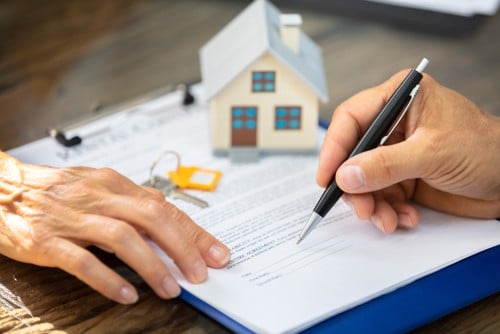
Step Three: Work With a Notaire to Sign Your Real Estate Sales Acquisition

A real-estate sales acquisition must necessarily take place through the services of a notaire (real estate-inheritance lawyer). You must calculate in your budget the sum over and above the price of the property that must be paid in government taxes and notaire’s fees which are commonly combined and called frais de notaire. A good rule of thumb is to count ten percent, although it usually comes to a bit less.

Once you and the seller have agreed to the sale, the first step is to go to a notaire to sign a promesse de vente (pre-sales agreement). Once the purchase is concluded, the buyer becomes tied to the notaire until the property is no longer theirs. For this reason, it is the buyer who chooses the notaire. Get a recommendation; some do their work better than others and there is relatively little difference in the price. Remember this is a relationship that will last for better or for worse until you sell the property or your children inherit.

This agreement will include the agreed-upon price as well as the time-lapse (typically a month) that is allowed for the purchaser to get (or not) a bank loan. It will also state when the sale is to be signed. Make sure there is a clause that states that if no bank offers a loan, the sale is off at no cost to the purchaser. 

When signing the sales agreement the purchaser will leave a down payment for the seller, but the sum will stay in the hands of the notaire until the final sale is signed. The notaire will also issue you a special document to use whereby should you change your mind within seven days, you will not lose your down payment.

Step Four: Finalize The Negotiations

It is now that you will finalize the negotiations with all those banks you had talked with and make your final decision as to whom you will sign with. On my last purchase, I signed the agreement on a Friday, saw one bank that evening, another the next morning, and left for Chicago on Monday. The rest of the negotiations took place by phone (whereby I got one bright, cheerful call at 3am Chicago time!) and email. I made my final decision on my return three weeks later.

While you are getting your loan in order, the seller will be getting a diagnosis of the property including an ecological report, the final number of square meters and a geological report including whether there is/was a quarry under your building or an underground river bed, whether there are termites, various types of pollution, energy efficiency…

Other things to keep in mind as you prepare to buy: 

  • Are you buying alone? 
  • If there are two of you, are you both signing 50/50 or will the condo belong to only one of you? 
  • Who is paying, or are you both paying? 
  • What is the percentage each one is contributing to the purchase? Remember, in case of any separation the condo will be divided according to each person’s contribution as stated in the deed.

It is possible to make the purchase as an inheritance hedge. For example, you can buy in the form of what is called indivision whereby one person, typically a parent or spouse, will have exclusive use of the property (usufruit) and the other will have ownership. In this case, when the usufruitier passes away, the heir will have untaxed, complete ownership of the property.

Finally, with the bank’s agreement, you can set an appointment and return to the notaire’s for the final signature. The notaire will read aloud every bit of information they have gathered including the date of birth of the previous owner, their profession, how they got the condo, e.g. who they bought from, inherited from, or their loan. On my last acquisition, I was stupefied to learn that the owner had only had a seven-year loan to pay for the property. Those were the days!

Step Five: Pay Attention

Be sure you listen attentively to every word, as boring as it might be. There will be the yearly real estate taxes to be divided up. Now that the living tax (taxe d’habitation) has been more or less phased out, there remains taxe foncier. Normally this will be divided on a pro-rata basis, that each owner will pay the percentage of the part of that year that they owned the property. 

At my last signature, in a second week of September, the owner gracefully said she would fully pay for the taxe d’habitation of that year. I accepted the taxe foncier as of the first week of September, although we only signed on the second week, allowing for a simple division of three quarters and one quarter. It was a very pleasant signature process. The surprised notaire told us the story whereby the buyer and seller negotiated the taxes down to exact pennies.

Make sure everything that was said to be included is indeed included in the deed. For example, my ground-floor neighbor in the main building of my condo gets full use of the garden attached to the building up to the fence where my garden begins. Her exclusive use of the garden was not included in what the notaire read out, and she refused to sign until it was added. In another case, there was a mix-up of storage lockers, and the notaire held back 10 000 € until the right locker was emptied and ready for use for the new owners. Know what you are getting into. You can still refuse to sign if there is a problem that you had not been made aware of.

And now, assuming all has gone well and all the parties concerned have signed all the documents, you will simply leave the notaire’s office, keys in hand, the happy owner of a Paris property. And the rest of the story is yours.

Did you enjoy this article? TAIP is 100% reader-supported through tipping. If you want to leave us a tip of any amount it would be highly appreciated. These tips help support our efforts to keep TAIP an ad-free environment. Just as at a cafe, the tips are split evenly among the team.
your home in Paris

Finding Your Dream Home in Paris Part I: Location, Location, Location

If you’ve made the decision to stay for the long haul in Paris, you should be thinking about purchasing your primary residence. As a friend once said to me, paying rent is money thrown away. In spite of rent control, rents do keep increasing. And your landlord/lady can always ask you to leave should they want to sell the condo, house a family member, or move into the condo themselves.

Of course, finding and buying real estate in Paris is easier said than done.

Step One: Determine Your Budget

The first step of your search-and-purchase is setting a budget and deciding on an area. The latter often depends on the former, which implies possible trade-offs in comfort and size for location and price.

The size of the condo will be expressed in square meters (mètres carrés), rather than by its number of bedrooms, all rooms being considered equal. You can thus find a single-room studio condo of 30 square meters, (for a ballpark figure, I tend to multiply by ten to get the number of square feet, thus 300 square feet more or less) just as the same size condo can be divided into 2 rooms. Various sites will inform you of the average price of a square meter in the twenty arrondissements of Paris. You can start by looking here and here.

How these square meters are calculated has been regulated by the loi Carrez which was passed in 1996. It legally defines the living area (surface habitable) of a condominium apartment and must appear in the deed of sale (acte de vente). 

However, the “real” living area may be greater than the living area as defined by the loi Carrez, as it does not include any floor space under 1m80. This means, for example, any sloping roof area in a top-floor apartment, does not count until it reaches 1m80, nor does the area under a staircase until it reaches a height of 1m80. Balconies are not included in this calculation, although they do bring up the price (per square meter) as they make the property more attractive. Also, as another example, my finished basement cannot be considered in the calculation of my house’s liveable surface as the ceiling is at 1m78.

You will thus find announcements that give both loi Carrez (official) living space size and general floor space which might differ, especially for condos on the top floor. The advantage in purchasing a property with such differences is that you can find a nice condo on a top floor, for example, at a lower cost per square meter as it has a sloping ceiling. 

A friend of mine has a wonderful, bright, single-room studio with few square meters according to the loi Carrez, but in fact, has a second floor with a sloping ceiling which serves as a bedroom and bathroom making it into a quasi two-room apartment.

There are, of course, disadvantages. If you ever want to rent out the condo, it is only the square meters according to the loi Carrez that can be taken into account for the Paris rent-control price. Also, you cannot rent out a condo that is smaller than nine square meters according to the loi Carrez, no matter how much floor space there is.

It is to be noted, too, that normally a surveyor has calculated the exact number of square meters in a given condo and this number will be transcribed in the sales deed. You can, once you move in, call in your own surveyor if you believe there is an error in the calculation. If it is found that the condo is more than five percent smaller than the declared surface on the sales deed, you can ask to get a refund for the difference.

Step Two: Determine Where You Want To Live

Check out the average price/square meter in the area you are looking to know in advance if your budget is realistic for the size of the apartment you are looking for. If not, which is more important, location or size? A two-room apartment (i.e. one-bedroom) in the center of Paris, or a three-room apartment in the much less trendy east? Who inhabits the area? Will you be comfortable there? 

An area can differ from one street to another. I was looking for a studio in the 2nd arrondissement and got a call from an agency. He asked if I knew the rue Blondel. No, I didn’t. “There are prostitutes plying their trade there; is that OK with you?” “No thanks, I won’t visit,” even though the price was right. I’m not particularly bothered by prostitutes, but the johns and pimps that accompany them make me uncomfortable.

Visit all the real estate agencies in the area. Get on their lists to be called when something that responds to your criteria comes in. Check online. Agencies advertise on SeLoger, Logic-Immo, and others.

Particulier à Particulier is a site where owners put up their real estate for sale without going through an agency. This is how I found my last purchase, un perle rare (a rare pearl), a French expression for something exceptional: a large studio at a price much lower than the average market price per square meter for the area located in the 100-meter long street that I’d fallen in love with. I badgered the poor seller every evening to get her to let me visit as soon as possible and got myself first in line. After a year of real-estate hunting (the average search time), I knew the prices, knew what I wanted, and neither hesitated nor negotiated and said I’d take it!

Step Three: Get Specific

To save time in your search, when you visit an agency or get a call, ask basic questions beyond the price: 

  • How many square meters is the apartment? Divide the price by the number of square meters and you will get the price/square meter. 
  • What floor is it on? 
  • Is there a lift? 
  • What’s the height of the ceiling? Some ceilings are particularly low; others might be comfortably high. The average is about 2m50. 
  • Is the toilet electric or not? Non-electric toilets are called sani-broyeur. Some toilets have been added to apartments where there are no special toilet pipes and therefore whatever goes in must be ground down. Such a toilet is fragile and always needs changing sooner or later and becomes costly in the long run.

There are various differences in condos to keep in mind. The idea of a “penthouse” is inexistent in Paris. The étage noble (the grand floor, the most opulent of old buildings) is usually the first floor (the one above the ground floor, the second floor in the US) with higher ceilings than the rest of the building, but also more expensive. Top floors, in fact, can be very hot in summer and cold in winter, and usually have sloping ceilings. Ground floors are easy for robbers to get into, tend to be noisier and dirtier from the street, but again, cheaper.

Lift or no lift? It depends on how high your floor is. 5th-floor walk-ups are not uncommon, but less expensive than other floors or apartments that have an elevator. No matter what floor you live on, later you will pay co-owners dues on the lift if there is one.

It is always recommended to ask to see the minutes of the last meeting of the co-owners association (procès-verbal d’assemblée générale) and a copy of the last year’s fees (appels de fonds et de charges). The latter documents will inform you of the approximate yearly cost you will have to pay once you acquire the property. The former will inform you if there are any difficulties within the co-owners association, whether the co-owner selling the property is up to date on their dues, and whether there are any works that have been voted on that you will have to pay for once the property is yours. 

Not looking over these documents may mean you are in for some bad surprises, e.g., animosities among the co-owners making it difficult to get important works done and then paying for them. After moving in I found a wall of my house was separating from the rest of the construction and I had to take both the co-owners association and the contractors next door to court (a two-year process which I won and got everything fixed and all has been well ever since). 

Friends have found an electricity bill that was never paid whereby the new owners cannot get electricity until they can come to an agreement with the utility company. Check, too, the cost of yearly real-estate tax, (taxe fonciere) which you will probably find surprisingly low as compared to US real estate taxes. As a comparison, I pay about 10% of the real estate tax for a similar property in the Chicago area. In fact, Paris real estate taxes tend to be lower than those in other parts of France, as companies pay a good proportion of Paris’ real estate tax. However, our present mayor, Anne Hidalgo has been overspending and this reflects in a yearly rise in the Paris tax bill.

On the other hand, if you find what you believe is your dream property that many others are clamoring for, it can be worth taking the chance (cf. above, my last acquisition) of not looking into these financial questions. I have friends who had seen a condo, checked all the papers, negotiated the price and just before signing the pre-sales agreement, the owner found another purchaser. They finally did buy another condo, but continued to regret the one that got away.

“Seek and Ye Shall Find”

Searching for just the right place to call your own can be exciting, frustrating, long, and time-consuming. But think of it as an adventure as you learn about all the unbelievably different types of living spaces that can be found in Paris. And until you find THE one, consider it a way of learning about this city that you have elected to become home.

In the next article we’ll discuss the financial paperwork necessary to close your real estate deal.

Photo by Isaiah Bekkers on Unsplash

Did you enjoy this article? TAIP is 100% reader-supported through tipping. If you want to leave us a tip of any amount it would be highly appreciated. These tips help support our efforts to keep TAIP an ad-free environment. Just as at a cafe, the tips are split evenly among the team.
What It’s Like Living In The “Worst” Part Of Paris

It’s no secret that finding an apartment is difficult in Paris. People don’t realize how small this city is. For comparison, London is 600 square miles while Paris is 40 square miles. Consider this, and then remember how much space is used for parks, hotels, shops, etc. There’s limited space, so when it’s time to search for a place to live, there are limited options. This is the reality, so have reasonable expectations when getting on your feet here.

The Dossier

If you’re unfamiliar, the French require a dossier (and a weighty one at that) for every apartment you apply for. To put into context the peculiarity of the French dossier, the first application I submitted was rejected because of the kind of work contract I have, which is a freelance contract. My employer even called the agent to explain and verify my contract, but it was to no avail. It stated indefinite work and my salary, but simply because it wasn’t a CDI, they found it “too complicated” to accept my file.

In brief, a dossier contains:

1) valid ID

2) visa

3) the last year’s tax documents (the more taxes you pay, the more money you make)

4) work contract

5) last three months of payslips

6) a garant

7) last three quittances de loyer

8) RIB of your French bank account

My Lack Thereof

I knew that my situation on paper wasn’t as strong as others applying for the same apartments. Landlords (understandably) favor French citizens over foreigners, and at the time, I didn’t even have a French bank account.

Basically, I was working with:

1) valid ID

2) visa

3) work contract (remember, freelance!)

4) tax documents from a year when I was hardly working

5) three months of payslips when I was, again, hardly working

I was missing integral parts of my file like a RIB, a guarantor, and proof of income. My options were even more limited than the average flat seeker.

Desperate Times Call For Desperate Measures

After some weeks went by without success on PAP.fr, I asked a friend if she knew anyone who had an apartment to rent. This question can seem nervy to some, but if you’re familiar with the “Aladdin Factor,” you can’t get what you don’t ask for. To my surprise, she actually did know someone, and I called that person up the moment her contact was sent to me. She happened to be a realtor who works for an agency that specializes in renting apartments to foreigners. It turned out the apartment in question was her own, thus allowing us to forgo agency fees and conclude a private contract.

I should mention that her willingness to rent to me came from the fact that she herself was once a foreigner getting on her feet in this city. The day we met, she was explaining how hard it was to get all the paperwork in order for a proper dossier when she first moved here. She was kind and understanding of my situation because of our shared experience. Once we signed the contract, I was then given the keys and promptly sent her my deposit. It was an accomplishment for someone in my shoes.

Wonderful, But Weird

The apartment is bright and clean and in a building with kind neighbors. I usually have plans in the evenings, but they frequently have apéros which I’m always welcome to join. They even included me in their building group chat when I first moved in.

When I began telling my friends and colleagues about the apartment, they were happy for me, until I told them which métro stop I lived on. My boss told me, “I have one rule for myself. I never go to La Chappelle or Goutte D’Or. You can’t move there.” I have a good friend who grew up in Montmartre, which is not far from me at all, who explained there are a few good streets and my apartment just so happened to be on one of them. The area is “un quartier populaire” which frankly I haven’t found a good translation for. It’s been described to me as a neighborhood mixed with working class, upper class, and immigrants. Some French speakers who use this term, however, might just be trying to be polite in calling your neighborhood the ghetto (and it isn’t always warranted).

You have to be careful wherever you are, and this place is no different. I personally haven’t been put in any situation in my neighborhood that made me feel in danger. I don’t feel more unsafe here than anywhere else.

The Pros

There’s a market along Rue de L’Olive which has fruits, vegetables, cheese, butter, flowers, etc. Chez Meunier is at the Marx Dormoy metro station on your immediate left. Lomi is down the street across the bridge heading to Montmartre. Lest we not forget the one and only Bob’s Bakehouse. There are other great spots nearby, I’m only listing a few. The intensely bad reputation that Marx Dormoy has is mostly outdated. As one would anywhere else, be aware of your surroundings and you’ll be fine.

As a single woman who often gets home after midnight, I haven’t been followed or harrassed. From what I’ve gathered by talking with people who have lived here much longer than me, the area has been cleaned up from what it once was. It’s still in the process of getting better. All this is to say, Paris as a whole is pretty safe. I feel more uncomfortable on the East Coast of the US in New York or in Philadelphia where I grew up.

I don’t live in a glamorous neighborhood, but I don’t fear for my life. Living in Marx Dormoy for me has its functional benefits. It’s less expensive than other areas and the apartments are a comfortable size. I’ve been inside a few, and I only have praise for the ones I’ve seen. They’re clean and spacious. For example on the main street there’s an apartment building with a shared garden, it’s shockingly quiet and smells amazing because of the flowers.

The Cons

The area isn’t as built up as other parts. It isn’t as beautiful or trendy. There’s underutilized space that people take advantage of for the wrong reason. It’s crowded with people either begging or selling cigarettes right outside of the métro. There’s a whole area along the main street which would be perfect for outdoor seating if it could be cleaned up. Along one of the streets heading to my apartment men at night like to sit along the fence, drink, and sometimes leave their trash behind.

It’s not central by any means. In my case this doesn’t pose too many issues since I mostly travel to central areas. When it’s time to go to places like Bastille, that’s where it gets a little annoying. Once I rode my bike to Supersonic and had to leave it there for a few days because of a flat tire. I eventually walked it back, but it was about an hour on foot.

In Conclusion

The worst part of Paris may be my next-door neighbor, but Paris is still Paris. As long as you’re careful then you should be fine. “Area” doesn’t always determine if you’re in danger or not. There are reports everywhere of pickpockets and people getting mugged, even in Bibliothèque François-Mitterrand.

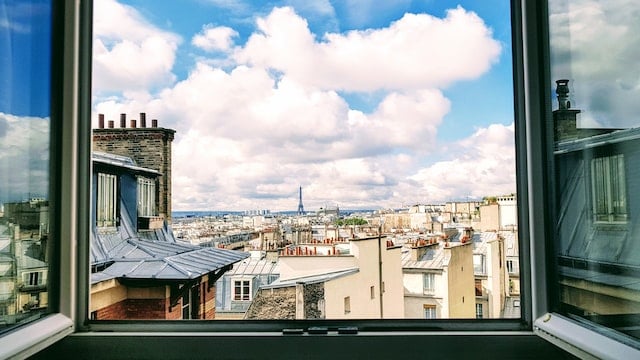
Photo was taken near Rue de La Chapelle while heading to the Marx Dormoy metro.

Did you enjoy this article? TAIP is 100% reader-supported through tipping. If you want to leave us a tip of any amount it would be highly appreciated. These tips help support our efforts to keep TAIP an ad-free environment. Just as at a cafe, the tips are split evenly among the team.

Paris apartment photo

Getting a Paris Apartment: My Story

Stephanie shows by this article that you don’t always have to have your plans figured out before you get here, as long as you’re willing to hustle a bit. 🙂 -SH

The many expats I’ve met in Paris all seem to have organized their move to France with precise detail, preparing months and months in advance. TAIP’s upcoming book is an example of that.

My experience was a little different.

I pretty much threw things together, gave myself just over a month to prepare (from applying for the visa to hopping on the plane), and left everything in my NYC apartment just in case my big Paris move did not go as planned.

Fortunately, everything worked out, with a few bumps here and there.

Pivoting to Paris

My decision to move to France came about after experiencing the sudden loss of a close member of my family. I was absolutely devastated and a tsunami of grief consumed my mind and soul.

I needed to get away from NYC. I needed to heal. Paris was the place I wanted to be.

Returning to live in France had been on my bucket list ever since spending a few years in Bordeaux right after college. The dream had remained on the back burner for years until the family crisis put everything into perspective.

France healed me many moons ago and I knew it could heal me now. And it was imperative to make things happen quickly before my logical brain tried to convince me to stay put.

While the move might have looked risky to those around me, it really wasn’t. My business is portable and I had tried on the digital nomad lifestyle the year before. It worked then and I knew it could work in Paris now.

After a helpful phone consult with the TAIP team, I moved full speed ahead with the visa paperwork and a little over a month later arrived in Paris with a reservation for a two-week stay in an Airbnb in the 2nd arrondissement, one large suitcase in hand and the goal to get an apartment of my own.

Because I spoke the language and had a good sense of the culture, I thought I could roll into Paris and things would come together quickly.

Nope.

In retrospect, things ended up coming together pretty quickly, but at the time, it was stressful with a lot of uncertainty and bumps along the way. It’s clear I underestimated what was entailed.

One Step At A Time

Almost immediately after landing in Paris, I began looking for permanent digs. My goal was a furnished one-bedroom apartment in central Paris, i.e. a single-digit arrondissement.

Coming from NYC, the land of small and expensive apartments, I found that rents in Paris were less than what I would expect to pay back home. Newcomers from less-pricey locales may experience sticker shock or surprise at the size of the average Parisian rental.

A friend who had lived in Paris suggested looking at the English-language site Fusac. Fusac is an online ad space with varied listings including rental apartments and sublets.

With Fusac, it’s a bit catch-as-catch-can. Listings are not extensive but one in the Marais (3rdarrondissement) caught my eye.

While the place turned out to only be available for a short-term sublet, it was perfect as a stop-gap as it allowed me to stop paying nightly Airbnb rates should the search drag on.

The owner’s son was able to show me the apartment right away; it turned out to be spacious, charming, and well-located. The Belgian owner lived in Bali, and rented his place out for a few months at a time at a nightly rate that was much less than what I was paying at the Airbnb.

I grabbed it right away as a short-term solution while I continued to look. No papers were signed on either side nor was a security deposit requested. I simply wired the money for the first month and picked up keys from the neighbor. Sending money without a written agreement might have seemed risky at the time — and I would certainly never recommend it — but it felt right and everything turned out great.

Having a reasonable place to stay for two months was a Godsend. I now had some breathing room while I continued to search for a permanent place.

Apps, Listings, and Unresponsive Brokers, Oh My!

Paris has a number of apartment listing apps where you can set up alerts with your desired criteria: neighborhood(s), apartment size, rent range, elevator or walk-up, furnished, etc. Some of the ones I used are seloger.com, pap.fr, nestoria.fr, and jinka.fr.

Pap is short for particulier à particulier, person to person, with the big bonus of no agency fees though there is a heightened risk of being scammed.

The other sites mainly have agency listings.

What’s terrific about Paris is the surfeit of furnished listings. And when I say furnished, we’re not just talking furniture. In the case of the apartment I eventually rented, it came with everything, including sheets, towels, pillows, and bedding, a fully-equipped kitchen with plates, glasses, and silverware, even an umbrella, iron, coat hangers, and cleaning supplies. It feels like an Airbnb where you roll up with your suitcase and you’re ready to go.

As a foreigner arriving in Paris with just a suitcase, furnished apartments are a godsend.

The one drawback is that the landlord can (but doesn’t always) ask for two months of security deposit for a furnished apartment as opposed to one month for a non-furnished apartment, but that seemed like a fair exchange compared to the savings in time, energy and money outfitting an apartment.

Upping My Chances

To rent an apartment in Paris, the barrier to entry is high, and not being French makes things harder. The market is competitive and because renters’ rights are very strong in France and it’s hard to kick out non-paying tenants, landlords are risk averse.

As a self-employed American without a CDI which proves that the person has a permanent job and a regular paycheck, I needed a guarantor to co-sign the lease alongside me, guaranteeing the rent would be covered if I stopped paying. French friends could have done this for me, but it seemed like too much of an ask to have them submit a ton of financial paperwork, so I went with the private guarantor service garantme.

The garantme process involved submitting a bunch of financial paperwork (tax returns, bank statements, and a letter from my accountant), but within about 24 hours I was approved and received a Certificate of Eligibility which stated that I was good to pay up to X amount per month. I then submitted the certificate number as part of my dossier for any apartment I was interested in.

Garantme does not come cheap. The tenant pays Garantme 3.5% of the annual rent including charges and this is for every year of the lease. The landlord pays nothing. There is no upfront fee with garantme; the fee is paid only at lease signing.

The Search Unfolds

The alerts I had set up were working and I was getting pinged several times a day with new listings. Some looked decent; some not so much.

Initially, I sent out messages and…crickets.

Things changed for the better once I had the garantme certificate in hand, which I made sure to mention in my outgoing messages to agents. Finally, some responses.

Eventually some apartments actually started being offered to me: through Fusac, a six-floor walk-up on the Left bank that was only available as a long-term sublet, and a duplex apartment in the Marais which looked amazing on video but could only be viewed via video, not in person.

Neither felt quite right and I wasn’t desperate yet thanks to the breathing room my two-month sublet gave me. I declined both.

Then through seloger came a listing for a super cute one-bedroom in the Marais just down the street from my sublet. It ticked all the boxes: great neighborhood, cute design, elevator, bike storage, and air conditioning. The biggest plus was that the agent actually responded to my message. A visit was set up.

The place was better than many I’d seen and by this point the search was wearing on me. I talked up the garantme certificate to the agent and he told me that there were three other interested parties. I just wanted to be done. I needed to get settled and start my business back up. To sweeten the deal, in typical NYC closer fashion I offered up an additional 100 euros a month beyond the advertised rent.

The landlord was making her decision later in a week.

In the interim, another option came in through PAP. Located in a landmark building in the heart of the Marais, the apartment was impeccable and could have easily appeared in a designer mag. It had everything I could have wanted and I would have given anything to live there. I sent the landlord a heartfelt note about why I would be an amazing tenant, but alas, she went with another applicant.

She had made it clear she was looking for a stable tenant who would stay for the long term, and in retrospect as a self-employed American having just arrived in Paris, I don’t think I quite fit the profile she was looking for.

Eureka!

Back to Plan A. The super cute Marais one bedroom was offered to me, and it was an immediate yes on my part. The idea of getting the apartment search off my to-do list was pure relief.

The next steps involved paying garantme, signing the lease, paying the security deposit, and then obtaining renters’ insurance, which my landlord required. The real estate agent connected me with a company that assisted with getting the electrical bill switched to my name and setting up wifi.

Having a signed lease in hand became the golden ticket allowing me to open a French bank account, which up to that point had been a time-consuming and fruitless quest.

At move-in I paid the agency fee and the first month’s rent.

Between all the fees and the two months of security, getting my Paris pad has required me to pony up quite a bit upfront. And it was practically a full-time endeavor when I was in the thick of it. But hearing about other expat’s nightmare stories of schlepping from one Airbnb or sublet to the next because they cannot get a landlord to rent to them, I consider myself lucky.  It’s been three months since move-in and now that the stress of the search is over, I couldn’t be happier with my new home.

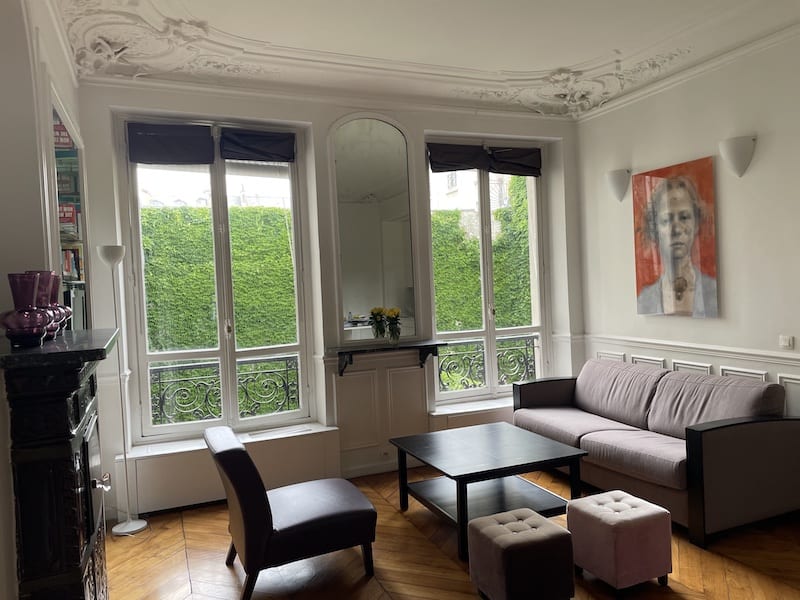
Photo is of my new place!

Did you enjoy this article? TAIP is 100% reader-supported through tipping. If you want to leave us a tip of any amount it would be highly appreciated. These tips help support our efforts to keep TAIP an ad-free environment. Just as at a cafe, the tips are split evenly among the team.
Why I Left Paris

It’s coming up on a year since I moved out of my favorite city and enough time has passed to share my perspective on the move publicly.

If you had told me in March 2020 that I would ever, ever leave Paris, I would have laughed.  I was one step away from buying a burial plot.  But the world, and Paris changed.

Lockdowns

Most especially, I truly failed to realize what an integrated and essential part of our lives restaurants and cafés are, not just in France generally, but in Paris especially.  Our restaurants were closed for six months and so much happened as a result.

Social routines were interrupted.

Books that had been waiting to be read got read (and even more the following year).

Cash normally spent was saved.

Patterns of thought were broken.

Those of us who live in “world cities” like Paris, London, NYC, Singapore, etc. know and accept that we pay significantly more to live in those cities for the culinary and cultural access they offer, to say nothing of the fact that so many interesting people in those places.  It’s worth paying more to live there.

Until it isn’t.

I thought I was unique in making the decision to leave Paris after multiple lockdowns, but as I caught up with friends late last year, I had several, “oh you moved too?” conversations.  We shared a similar line of thinking: if we are ever going to be locked down in our apartments again, we would prefer to do it closer to nature.

It’s estimated that a third of Paris left for second homes during the lockdowns and some decided to make those second homes the now-primary ones, especially with the never-could-have-predicted dawn of teletravailler, remote working, in France.  What was once the domain of the French tech startup scene has become normative, even for workers in the we-haven’t-changed-procedures-since-the-days-of-the-monarchy French administration.

Remote work + lockdowns = life changes.

Moret-sur-Loing

In 2016 I was taking day trips with friends to various spots in Île-de-France that the guidebooks said were worth seeing, like Provins, Senlis, Fontainebleau, etc.  One of those spots was the medieval town of Moret-sur-Loing.  It borders both the Loing River and the forest of Fontainebleau and is connected to Paris by a high-speed 45-minute TER with connections every 30 minutes from 5 something in the morning to just after midnight most days.  If you have a monthly/annual Navigo, your travel there is covered.

I and my other Paris friends said the same thing on that (and subsequent visits): “What a charming little town!

We all thought, but didn’t verbalize, “But I could never live out in the countryside!

We lived in Paris for a reason.

In early 2021 I considered the previously unthinkable, moving out of Paris, for the reasons listed above.  My mind went to the memories of Moret, and I thought, if I was going to leave Paris, it wouldn’t be for a large roomy apartment in the suburbs, but it would be for an entirely different experience.

Getting an apartment in Moret (and moving in the middle of an official lockdown) was a new experience which I’ll share in a future article, but for now I’ll say I managed to be very fortunate in both my apartment and landlord.  And everything is significantly cheaper, from the rent to the bread to the meat to the eggs.  I absolutely love living in Moret, which has a twice-a-week farmer’s market about 100m from my apartment.

Routines are a bit different for me now.  Thanks to the ever-expanding bike infrastructure in the capital, now when my train pulls into Gare de Lyon, I unhook my electric bike and stay on the roads instead of using the Métro that I know and love.  It does mean that when it rains, I have to don my Aigle wellies and raincoat, but it also means that I get places faster, and see more of the city at street level than I used to.

As for TAIP, not to worry, I am still very much an American in Paris 2-3 times a week, seeing friends, chatting about books, running errands, attending Mass, and yeah, catching up in cafés with friends.  There is also a growing team of writers here who are resident in Paris who will continue to share their experiences which will blend in with those of us who now, like me, are now on a different road of their French experience, one that doesn’t include living in the City of Light.

I still consider my time in Paris as the greatest period of my life to date, particularly my three years in the 2nd arrondissement, in the beating center of the city.  But perhaps an even greater period is beckoning.  Time will tell.

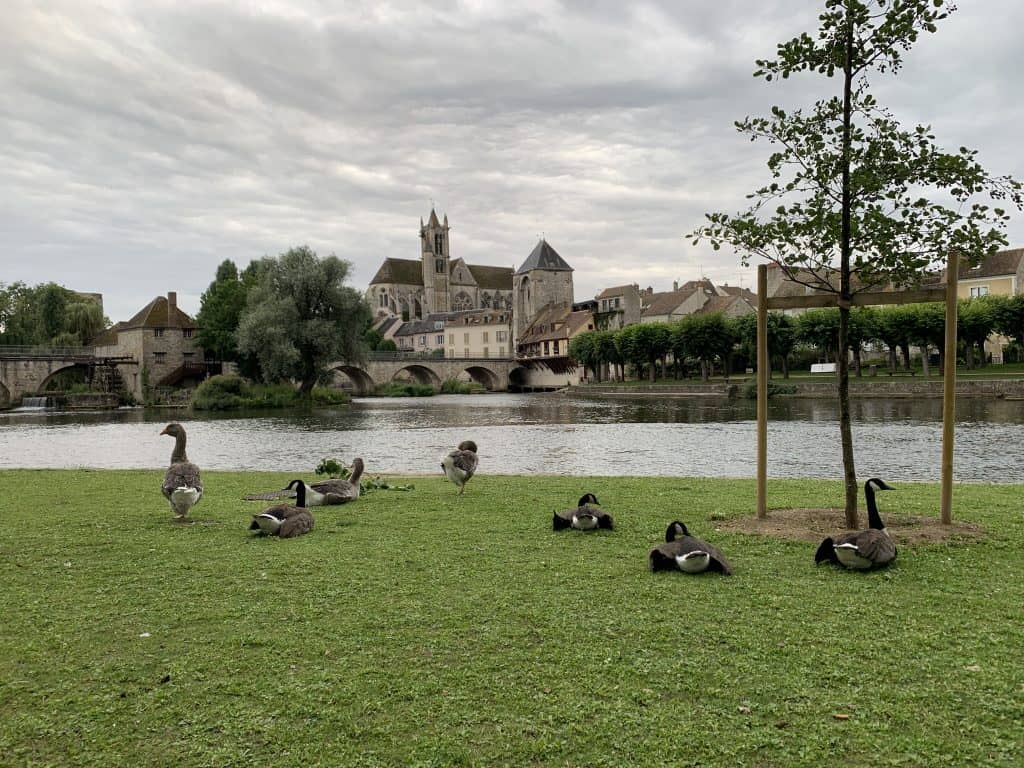
The photo gives one perspective of the medieval town of 4,000 I live in now.  My apartment is across the street from Notre Dame de la Nativité, which you can see in the center.

Did you enjoy this article? TAIP is 100% reader-supported through tipping. If you want to leave us a tip of any amount it would be highly appreciated. These tips help support our efforts to keep TAIP an ad-free environment. Just as at a cafe, the tips are split evenly among the team.
bikes in Paris

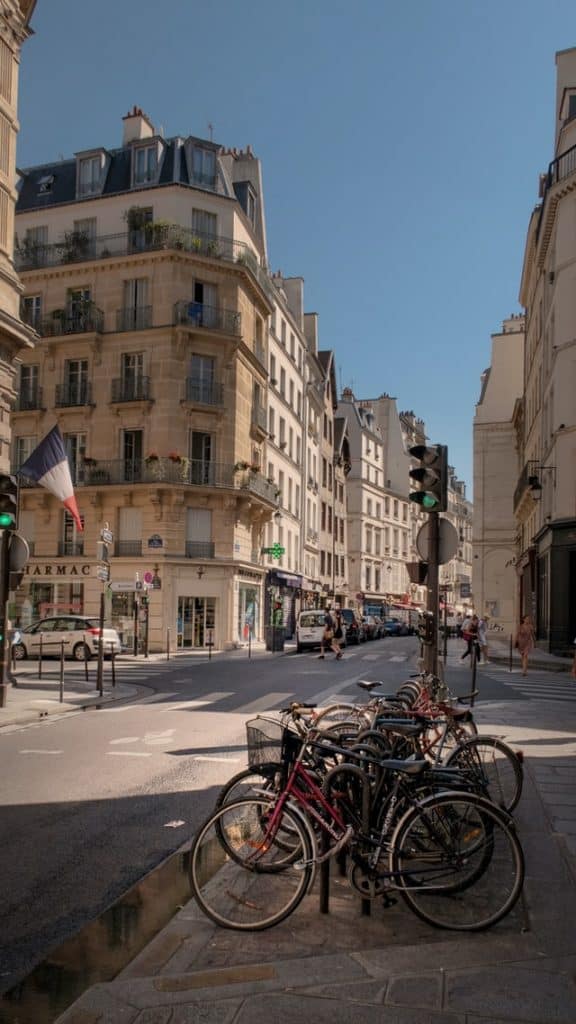
How Paris Quietly Became a Bike City

When I moved to Paris in 2013 one of the first things I did was obtain a Navigo card and after a couple of months of buying monthly passes manually via machines I switched to an annual pass and have not had to think about topping up again.  The métro was the way I moved about Paris.

But after getting to know the Métro fairly well you realize that it’s often just as easy to walk to a certain location and you start making choices about what form of transportation makes the most sense given the weather, your mood, what you’re carrying, and what else you still need to accomplish.  Vélib was already around when I arrived in 2013 and the shared bike boom followed by the rise in trottinette usage meant that options for transport have only multiplied since then.  The one form of transport that has received an explosive infusion of support from local government is bicycles.

Infrastructure

Now that bike lanes are so well-established in Paris, I wonder how so many of us were brave enough to ride with vehicle traffic for many years prior.  Cars and their drivers, convinced that everyone but them were simply “intruding” on their entitled space, didn’t make life easy for those of us on bicycles, but we figured that was simply the way it would be.  I mean, this wasn’t Amsterdam after all.  But little did most of us know that the Dutch model was exactly what Mayor Anne Hidalgo had in mind to transform Paris from the ground up.

Plan Vélo

Back in 2015, a year after Hidalgo’s first term began, the city started a project called Plan Vélo.  This was a big play to make it significantly easier for bicyclists to navigate the city by creating north-south and east-west réseaux express vélos (REVes), or “bike express lanes.”  Similar to what you are going to see on almost every street in the Netherlands, this is a protected bike lane that not only provides bidirectional traffic but also allows bikes to continue moving when their right-of-way is not impeded by traffic.  If you haven’t ridden in one of these before, you can’t possibly know how transformative it is.  It changes the experience of bicycling in the city from one analogous to driving a car, i.e. having to always pay attention while being subject to a lot of traffic and stoplights, to one of breezy insouciance: these north-south and east-west corridors make point-to-point travel significantly faster, safer, and more pleasant.

Plan Vélo has paid off in numerous ways, not least of which was featuring as the centerpiece of Hidalgo’s successful re-election bid as Mayor.  Paris jumped up into the top ten of bicycle-friendly cities in the world during her first term.  The infrastructure in place during the late 2019 transportation strike also allowed for an overnight 54% jump in bicycle use among Parisians, many of whom did not go back to the Metro even after the strike ceased.

Hidalgo also seized on Danton’s (in)famous notion of audacité during the early days of Covid-19 and took back Rue de Rivoli, the longest street in Paris, and limited it to one lane for buses and taxis.  She also created a number of “coronapistes” which created new protected bike lanes via removable plastic cones.  The reasoning given was that fewer cars were on the road because of lockdown and some people weren’t comfortable traveling in the confined spaces of the Métro.  But, just as with the accompanying “extended terrasse” permissions given to the restaurants, rights ceded were not going to simply be given back, and now Plan Velo 2 has arrived.

Plan Vélo, Acte 2

Part of the infrastructure changes needed to pérennisée both the so-called coronapistes and the extended restaurant outdoor terraces was the removal of the largest enemy of vibrant life in any city: cars.  Cars need a “home” in the form of parking places and 70% of the existing on-street parking spots designated for cars are being removed.

Hidalgo is running for President on the slimmest of chances and Plan Vélo Acte 2, released last month (two days before her announcement to run for President), has to be seen as part of her case for progressive measures to form economic and social life at a granular level.  The benefit is enormous for those of us who live in the city (Paris as 100% cyclable by 2026, it promises), but it’s doubtful that people outside of Paris really care, as life in the French countryside, like life almost everywhere in America, is unimaginable without cars.  Indeed, such denizens would snort at her proposed 2030 gas-powered car ban, which seems quite reasonable to those of us who live in the capital, but might seem very odd to those who don’t.

That said, this plan involves investing 250M euros to make the entire city bikeable by adding another 180km of dedicated two-way cycling paths in addition to making permanent the 52km Hidalgo and her team snuck in via the coronapistes last year (to put that in perspective, at the moment we already have more than 1,000 km of bike paths, quite a few snaking into the suburbs).  There’s also a budget for more passenger and cargo bike parking spots and cleaning and trash removal for cycling paths.

In addition there will be programs to teach children to ride bikes in schools, repair workshops in each arrondissement, and a cycling tourism push.

Mindset Shift

But having the infrastructure in place is only one part of the problem.  The second is getting Parisians to realize they are now living in a bike city and to make the changes in their behavior necessary.

In my early years of living in Europe I often said that the Netherlands was the only place in the world in which I was terrified of bikes.  The “ding ding” I heard struck fear into my heart as I wondered if I was standing in the wrong place, completely oblivious to my pending death at the hands of some kind person mounted on one of the country’s 23M bikes who would mutter “wat jammer” before moving my body to the side of the road and making a call to the relevant authorities to take care of my remains.

Often I was standing “in the wrong place” and quickly moved to avoid being mowed down.  Sometimes I wasn’t and it was someone else who was needing to be “dinged.”  The reason I was “terrified of bikes” in the Netherlands was because I didn’t have the right mindset.  After my first visit to what the French call the “low country” I flicked on a mental orange switch every time I came to the country (more than half a dozen times since 2014) that I was in a place where bikes, not cars, ruled.  I even, like a new car driver, ventured into the bike lanes on a borrowed bicycle and realized just how different the bicycling experience was when it was treated as a legitimate source of transportation.

Now that 95% of my trips in the city are on a bicycle (which Anne Hidalgo and her team helped pay for) I’m very aware that there are many Parisians who continue to remain as I was on my first trip to the Netherlands and thus have failed to install that mental switch.  This leads to near-misses with pedestrians including one time that I braked hard enough to simply gently bump into an instantly apologetic female pedestrian.

The lack of mindset shift is the same for Parisian bicyclists.  Many of them, like me, are new and don’t even use the proper hand signals for turning, thinking that a left turn means just putting your left hand out the way you do with your right hand to indicate a right-hand turn, or never thinking to signal for an unexpected stop.

This all leads to a sometimes dangerous mix of cars, pedestrians, and cyclists who are getting used to a new way of living with each other which leads to situations like the one well-captured in the tweet below at Bastille.

One of the reasons that bicycling is so safe in the Netherlands is that every single car driver is a bicyclist as well.  That leads to an awareness that is now normative in the entire country.

While I don’t expect the unbelievable growth in bicycles here in the capital to lead to changes everywhere in France, it’s clear to me that cities that protect bicycles necessarily change the mindsets of the pedestrians and the car drivers.  It only takes one near miss by a careless pedestrian in the bike lane to suddenly render visible to that pedestrian what was previously an “invisible” bike lane.

It’s also clear that whatever will happen to her presidential ambitions, Hidalgo’s mayoral legacy is assured, if only for the transformation she has achieved for bicycles in the City of Light, a transformation that she persevered in against the noisy protests of car owners and their lobbyists, who seem to have forgotten that Paris and the rest of the world managed to exist, and exist quite well, thank you very much, without personal cars, for centuries.  For her work on this issue, Hidalgo deserves every Parisian’s gratitude.

This change to our city will take time.  In the meantime I’m enjoying all the benefits that come with riding a bicycle in Paris: a different perspective, speed of transportation (I regularly beat friends who take the Métro and leave at the same time I do for a shared destination), and thanks to the aforementioned Plans Vélos, more protected infrastructure.

Ding ding.

Photo by Svetlana Gumerova on Unsplash

Did you enjoy this article?  TAIP is 100% reader-supported through tipping.  If you want to leave us a tip of any amount it would be highly appreciated.  These tips help support our efforts to keep TAIP an ad-free environment.  Just like at a cafe, the tips are split evenly among the team.
This article also appeared on Medium.

scooters in Paris

The Trottinette Life in Paris

I first looked into a trottinette (what the French call the platform-with-wheels-and-a-stick electric scooters) in January 2020, in the throes of yet another transportation strike (oh, for those good old days when strikes were our big problems!).  I wasn’t alone.  Many people were tired of the CGT and the disruptions and as such a first big move in Paris towards using bicycles and trottinettes began.  With many people choosing these new options, the shared biking system (Vélib) and the various shared scooters (Lime, Dott, etc.) were strained.  They simply couldn’t keep up with the new demand and those who were trying to get away from the frustrations of the transportation strike didn’t want to leap into another frustrating situation (no bikes or scooters available) and so they opted to buy their own bikes and scooters.

It was sometime in Spring 2020 when I bought what is the most popular model of trottinette in Paris, the Xiaomi Pro.  While this model is inexpensive (new for about 400 €, used for around half that) the key feature that has made many go for it is its foldability.  This means that users can take them on the metro with them, an option not available to most on bikes, as the majority of Parisian bicyclists do not have the folding Brompton ones.

This form of “multimodal” transport, in which someone walks, takes a métro/bus, then finishes the “last mile” of the journey on a trottinette, is a dream of transportation experts.  However, some studies point out (rightfully) that those riding trottinettes are not people who would otherwise have driven cars.  They are usually pedestrians who don’t want to walk anymore or just want to get somewhere faster.  There’s nothing wrong with that, and it is good to pull some pedestrians out and put them into the ever-expanding bike lane system in Paris.  But it cannot be argued that trottinettes do anything to ease vehicle congestion in the city.

Not Such a Deal

The thing is, the cobbled streets of Paris are tough on the small-wheeled trottinettes.  And the Xiaomi Pro, as I found out, is not the most stable and strong scooter platform you can buy.  So I’ve had numerous repairs to pay for in the last 18 months.

The first was a new tire tube after some stray glass had flattened the existing one.  Broken glass is an issue that you have to deal with even as a pedestrian, but the consequences are more significant for those who are rolling along on rubber tires.  When I got a second flat, the repairman suggested a tubeless tire.  “What, a tire that can’t deflate?  What’s the catch?”  The smoothness of the ride.  By having a very hard, reinforced tire that doesn’t inflate (or deflate) and can take as many nails or pieces of glass you throw at it, you necessarily have a ride that now treats you to every bump and curve of the road.  This isn’t a problem when you’re on a flat, well-paved, perfect road.  Those are not the majority of the roads in Paris, particularly in the center, though the bike lanes which I alluded to above very often are and that network seems to get bigger every single day.

I had only gotten a tubeless tire on the back tire and the ride still felt pretty smooth in general, but after my third flat, I had enough and made the front tire tubeless as well.  The cost of two tubeless tires and the original flat + installation = 225 €, which is more than I had paid for my used trottinette (150 €), but no matter, I thought.  No more flats (just intolerably bumpy rides when you hit cobbles).

But there were other costs.  A small part in the front broke (59 €) as did another piece (59 €) and at one point I had to get the battery replaced (200 €).

This is when I decided to get my electric bike: I was motivated by the subsidies on offer, but I also liked the idea of being outside in Paris without a mask (this was permitted to anyone on a bike during the old days of an external mask mandate).  My trottinette, which had accompanied me in all sorts of weather and traffic situations, and up and down countless metro stations, is soon to go on Le Bon Coin (the French Craigslist) and hopefully give someone else some good use, as I’m done with the money pit the Xiaomi platform became.  Once you’ve gotten used to riding your bike in Paris, you can go as fast as these scooters and get the exercise your body needs too.

Alternatives

You could choose to get an unlock pass for one of the floating shared trottinettes.  I periodically get a pass for the Dott platform which is around 5 € and that gives you unlimited free “unlocks” for 90 days.  The cost of a ride is usually a 1 € unlock fee and then 20 cents for each minute you are on the trottinette.  I am now very rarely out in Paris without my bicycle but if I do need to use one of these Dott scooters I’m usually on for under ten minutes, which means 2 € for the ride, and even three times a week, every week, that would be 24 €/month or 288 €/year.  That’s definitely the route I would recommend for the more casual user.  While the theory of “having your own” trottinette in Paris is plausible, much depends on the quality of the platform you choose, and by delaying an immediate purchase you can give yourself time to shop around and figure out what you like, using a shared system in the meantime.

If you are committed to buying your own, knowing what I know now, I would recommend a brand new Wegoboard trottinette.  I’ve been to their store in the 11th a couple of times and the scooters are made in France, are much sturdier and stabler than the Xiaomi, and come with a two-year guarantee.  If you’re stuck with a Xiaomi, the fastest/best repairs are going to be up in the 18th at Smartinette.

Photo by Jonas Jacobsson on Unsplash

Did you enjoy this article?  TAIP is 100% reader-supported through tipping.  If you want to leave us a tip of any amount it would be highly appreciated.  These tips help support our efforts to keep TAIP an ad-free environment.  Just like at a cafe, the tips are split evenly among the team.