The State of Coffee in Paris (and what is Cafe Richard, anyway?)

So anyway, that’s part of why I think France has more of a cafe culture than a coffee culture,” I concluded, having just explained how much I appreciated the growth of specialty coffee in Paris.

We were dining outside of the cathedral at Chartres and I was enduring the prison coffee so often served in many otherwise lovely restaurants in France. One of the Baby Boomers in the party heartily disagreed with my sentiment. “I think this is very good coffee,” he sniffed. I wasn’t sure why he felt the need to defend the general state of coffee in France, but I certainly feel no such need, despite loving life here.

The General State of Coffee in France

The coffee in France in general and in Paris in particular is, at best, average. At worst, it’s dire, reminiscent of the strange brew you would find inside a Shell gas station in America in the late 1980s. No love, no care, just some grounds and hot water. And why have the French been okay with this? Because, as I contend, coffee in this country is, like a cigarette, more of a ritual. It’s about what is going on when you have a coffee, not the quality of the coffee itself. This isn’t to say that the French don’t know good coffee when they taste it. They just aren’t going to go out of their way to find it.

The Coffee Ritual

Coffee ticks so many boxes in France. Many Parisians push a button on their Nespresso machines every morning before going to work. That first sip of the hot, dark beverage helps to wake them, and if they are so disposed, to enlighten them about the possibilities of the day. At 10h00 and 14h00, coffee is often taken with colleagues: outside if the weather is nice, in a lounge area if not. Here the coffee is a lubricant for the conversation. It allows the French to hold something hot and comforting in their hands while they share the difficulties of their jobs. If you’re out during the day to meet with a friend, that coffee is a shared understanding — we’re here to talk about important details of our lives, and coffee often accompanies those conversations, whether those details be light or grave. After a coursed meal, coffee helps to summarize a culinary experience, and perhaps give you just what you need in stimulus to make it home on the métro before collapsing into a (lovely) food coma. In none of these circumstances is good coffee required, and hence, the French have never really asked for it.

Here you might reasonably argue, “Why are you being such a snob, Stephen…not everyone needs a V60 or a particular type of bean from Ethiopia.” It’s not about that. We have never had access to so much good coffee from around the world and so more and more people are getting to taste this good coffee and when they go back to the prison swill we so often experience (even in our favorite restaurants) the difference is palpable.

Add in the ever-growing number of places in Paris that care about coffee, and often, there’s no going back to the bad stuff, often made from robusta (instead of Arabica) beans. You’d rather just have a chocolat chaud or nothing.

What is Café Richard?

I’m sure I had my very first Café Richard coffee somewhere in Montmartre in 2009, when I first visited Paris as a tourist. I was starry-eyed, and at the time, not that interested in coffee, so I was enjoying the ritual of sitting on a Parisian terrasse, taking in the crowds, and feeling like everything was right in the world. That’s where Cafés Richard (pluriel for the corporate name) comes in.

This (still) family-owned business was founded in 1892 and is probably the single largest supplier of coffee in Paris. The thing is, they don’t just supply the coffee, they supply the whole infrastructure to deliver it.

There’s the machine. The cups. The saucers. The tools and implements. The beans. And if the machine breaks, they have someone who can come out right away to fix it.

Do you know how much that would cost if you had to cover it all yourself? As if starting a cafe or restaurant wasn’t already expensive enough? Cafés Richard knows, and they are very happy to solve this problem for you by letting you lease their machines and everything that goes with them. No upfront cost in tens of thousands of euros, no big bill when the machine goes bust. You pay one fee each month which correlates to all the services you might ask for.

Many a restaurateur gladly takes on this arrangement. Most French don’t care about good coffee and Cafés Richard has nourished a good reputation over the years such that the name is recognizable all throughout Paris. And, since the French don’t really care about the quality of the coffee, can we blame Cafés Richard for delivering a mediocre product? Non. They deliver a product and services that both restaurateurs and guests appreciate. Who am I to interfere?

The Particular State of Coffee in Paris

I first moved to Paris in 2013 and the specialty coffee scene was still quite new. All coffee lovers in Paris will know that many specialty coffee roads here in the capital lead back to le Cafeotheque near Notre-Dame and that many of the people who have continued on in coffee in Paris first got their start there. Here is a very short (not exhaustive) list of places (which reflects my unapologetic rive droite bias) where you can get excellent coffee in Paris. Please feel free to add more in the comments section.

  • 1er Kitsune — right by Palais Royale if I want to take a cup “to go” and sit by the fountain there.
  • 1er Kawa — if you want to feel totally out of your depth, surrounded by people very knowledgeable about coffee, and are willing to learn and try something you have likely never tried before, come to Kawa.
  • 3eme Maison Plisson — come for the amazing cheese and lovely comestibles, stay for the coffee and pastries? 🙂
  • 3eme Fringe — if you’re wandering around the Marais and need your coffee fix, duck into this lovely spot.
  • 4eme la Cafeotheque — does it get any more serious than this place for coffee in Paris? Not sure. 🙂
  • 4eme le Peloton — not too far from la Cafeotheque is the Peloton Cafe, which often has delicious baked goods for the sweet of tooth.
  • 5eme Shakespeare and Co Cafe — don’t let the swarm of tourists scare you off: the coffee is good and the view of Notre Dame is probably the best of any public cafe in the city.
  • 7eme Coutume — I know they have lots of locations, licensed and otherwise, in the city. I happen to like this (relatively) quieter location on rue Babylone.
  • 9eme KB — amazing coffee + lovely neighborhood = can’t miss (they also operate Back in Black just a few steps from Bastille, I think).
  • 10eme Holybelly — Craig Carlson (owner of Breakfast in America) and I were at some expat meetup years ago and someone complained to us about the lines outside Holybelly. “I enjoy eating at Craig’s,” I said, “but Holybelly might be the best breakfast in Paris.” Craig humbly nodded his assent. They make good coffee too. (fair disclosure: I’ve worked for Holybelly in the past)
  • 10eme Ten Belles — it’s a location that’s so cute some may squeak when they see it for the first time.
  • 11eme Passager — when I want a breakfast bagel sandwich and a V60 and people-watching on a quiet weekday, I come here. Too busy on the weekends.
  • 11eme The Hood — there’s so much I love about this place (and, fair disclosure, I’ve worked for them in the past as well) but apart from getting exposed to some foods you may have never tried before, you’re always going to get good coffee, made with love, here.
  • 14eme Hexagone — look, I’m never, ever, down this far south, but if I happen to be, I’ll be here.
  • 18eme Hardware Societe — you’re probably coming here for the food first, but if it’s a less busy time, stop in for the coffee.
  • 18eme Cafe Lomi — brightly lit, filled with friendly staff and attractive patrons, and so much good coffee.
  • 18eme la REcyclerie — I love this place for many reasons not just related to coffee, but they also offer a menu item that allows you to anonymously buy a coffee for someone in financial need (note that they are only open Fri-Sun).

Well, what if you’re not a coffee person? There are plenty of other options, and perhaps that’s an article for another time (and another writer). For now, I’ll just leave you with Plaq, on Rue du Nil (my favorite food street in Paris), which is a bean-to-bar chocolate shop that has some of the best chocolat chaud in the city (pace Angelina, which is an experience on its own).

Photo on Rue Reaumur near my old apartment in the 2nd.

Did you enjoy this article? TAIP is 100% reader-supported through tipping. If you want to leave us a tip of any amount it would be highly appreciated. These tips help support our efforts to keep TAIP an ad-free environment. Just as at a cafe, the tips are split evenly among the team.

Bir-Hakeim Bridge in Paris

Paris and its Bridges: A Story

Note from the editor: While not an American in Paris, guest writer and photographer Tayeb Bouzid lives in the French capital and is part of the Paris Greeters, which offers free tours of Paris in English and other languages. After he spent his youth in Algeria and 15 years in the Marseille area, he came to Paris in June 1988 for a 3-month-long job and is still here after 36 years. Passionate about photography, architecture, and Paris, here, Tayeb provides his expertise on one of the more fascinating parts of the City of Light: the bridges that cross the Seine, connecting two sides of the city to form one. Enjoy. — MS

Paris would not be Paris without its bridges, and there are 336! That many? Yes! But only 37 of them are along the Seine. The others are for pedestrians, trains, the métro, or to connect other streets.

Below we’ll look at some of those 37 spread over the 8 or so miles of the Parisian Seine. They’re real links between its banks, inhabitants, and historical monuments. Enjoy this non-exhaustive guide to Paris and its bridges, from the longest to the most graceful, the most revolutionary to the most futuristic. You may discover an anecdote or an unusual detail you’ve never seen before.

The Most Sumptuous 

Decorated with candelabra, street lamps, and copper and bronze sculptures, the Alexander III bridge majestically straddles the Seine between the 7th and 8th arrondissements. 

Born during the 1900 World’s Fair, at the time it also represented the new Franco-Russian alliance. On October 7, 1896, Tsar Nicholas II laid the first stone in the presence of the President of the Republic, Félix Faure. Boxed by monumental pylons ornamented at the top of a pegasus of gilded bronze, the metalwork draws a royal road to the Grand and Petit Palais. 

Classified as a historical monument, it’s often seen in films of famous directors (Michel Audiard, Woody Allen, and Luc Besson, to name a few).

The Most Filmed 

The Bir-Hakeim Bridge is also in great demand for commercials, television series, and films. 

Jutting out from both sides of the Île aux Cygnes, this metallic structure, designed shortly after the World’s Fair of 1900, connects the 15th and 16 arrondissements. It’s made up of two floors — the upper one is for the metro, and underneath is designated for cars, pedestrians, and bicycles.

The Most Famous 

Its name may be misleading, but the Pont-Neuf, or “new bridge,” in the 6th arrondissement is actually the oldest in Paris. 

Also classified as a historical monument, it’s famous for its medieval design that looks almost like a castle. On May 31, 1578, Henry III laid the first stone, finally connecting the two shores of the Seine. The first bridge in Paris made of stone and not wood, Pont-Neuf also once supported homes and other dwellings, as was customary at the time. Paris was already overcrowded, so they needed all the space they could find. 

Pont-Neuf is also the first bridge to be decorated with turrets. Its 384 macarons adorn its cornices, and an equestrian statue of Henri IV can be found in the center of the bridge.

The Most Graceful

Reserved for so-called “soft” transport (such as pedestrians and bicycles), the Simone de Beauvoir bridge is the 37th bridge in Paris. Completed by the Austrian architect Dietmar Feichtinger and inaugurated in 2006, its graceful steel and wooden structure uses the most advanced construction techniques. Composed of two curves that intersect, it connects the François-Mitterrand library in the 13th arrondissement to Bercy Park in the 12th.

The Most Revolutionary 

The Pont de la Concorde was built between 1787 and 1791 in the middle of the French Revolution. Even more revolutionary, it was built with some of the stones of the old Bastille prison that was destroyed during the insurrection of July 14, 1789. 

It allowed Parisians to walk over a symbol of the fallen royalty, as they crossed the Seine from the Place de la Concorde (formally named for Louis XV) to the National Assembly. Another interesting particularity: unlike the other bridges in Paris, it does not have ring moorings so as not to bring to mind the poor prisons who were chained to the wall of the Bastille.

The Most Futuristic 

Designed and built between 1993 and 1996 by architects Arretche and Karasinsky, the Charles de Gaulle Bridge is the most recent road bridge in Paris. With an elegant appearance of a white steel aircraft wing, it fits perfectly in the modern district of Bercy and the Bibliothèque nationale.

The Most Poetic 

The Mirabeau Bridge was immortalized by Guillaume Apollinaire (1880-1918) in his famous poem “The Mirabeau Bridge” published in 1913.

“Under the bridge Mirabeau flows the Seine (Sous le pont Mirabeau, coule la Seine)
And our loves (et nos amours)
Should he ask me? (Faut-il qu’il m’en souvienne ?)
Joy always came after sorrow… (La joie venait toujours après la peine…)”

Another bridge classified as a historical monument, the Mirabeau was built by engineers Jean Résal, Rabel, and Alby at the very end of the 19th century to connect the André-Citroen quai on the left bank to the Louis-Blériot quai on the right bank. 

The beautiful metallic masterpiece offers wonderful views of the City of Light. It’s adorned with four bronze sculptures made by the sculptor Jean-Antoine Injalbert, representing the City of Paris, Commerce, Navigation, and Abundance.

The Longest 

Spanning a little over 1,025 feet, the Aval Bridge is strictly for cars and is part of the highway that circles Paris, also known as the Boulevard périphérique. Inaugurated in 1968, it’s the longest bridge in Paris (the shortest being the Petit-Pont-Cardinal Lustiger, close to 105 feet long). 

Located between the 15th and 16th arrondissements, it doesn’t have an official name. Many do refer to it as the Pont aval (downstream bridge) as I do here, as it is the last downstream bridge you can take to cross the Seine and circle the west of the capital.

The Most Beautiful Metro Viaduct

Finally, the Austerlitz Viaduct is a railway bridge used by line 5 of the metro, connecting the Austerlitz and Quai de la Rapée stations. It’s a curved artwork in and of itself, measuring 246 feet wide and 360 feet long.

Construction took place between 1903 and 1904 and at the time, it was the longest Parisian bridge. Its design was entrusted to Jean Camille Formigé, who also designed parts of the métro. It features various marine-focused symbols, like fish, oars, anchors, and tridents, and the arms of Paris can also be seen at the bottom of the arches. It was listed as a historical monument on June 12, 1986.

Photo of the Bir-Hakeim Bridge taken by Tayeb.

Did you enjoy this article? TAIP is 100% reader-supported through tipping. If you want to leave us a tip of any amount it would be highly appreciated. These tips help support our efforts to keep TAIP an ad-free environment. Just as at a cafe, the tips are split evenly among the team.

a bicycle basket full of letters

When the Police Seize Your Bicycle: Part 2

What to do to avoid wasting time and energy if and when…


In April, five months after the police had seized my bicycle and broken my locks, I was “regretfully” informed that they found they were in no way responsible for this (costly for me) degradation of my property as the act was carried out in the name of security (which gives them any-and-every right to do whatever they want?). Originally, I gave up my quest for reimbursement figuring it was too hard to fight City Hall.

However, City Hall did not stop there and for some reason, the machine continued to churn. This prompted me to take up arms again and I can now share my learning experience of how to go about getting compensation for damage to property due to police action. 

At the end of May I got a letter from the Ministère de l’Intérieur et des Outre-Mer. In fact, while the Secretariat général pour l’administration Service des affaires juridiques et du contentieux had refused my quest, it was in fact the Préfecture de police de Paris – Dirction des usagers et des polices administratives – Bureau de la réglementation et de la gestion de l’espace public- Pôle réglementation et affaires juridiques to whom I should have sent my file. I was then invited to write to them.

I had let this sit a while. Just as I was going to address the question, about two months later, I got another letter from the Secretariat général pour l’administration at the Préfecture de Police inviting me to appeal the rejection within two months.

This got my dander up and I started to prepare a file to do so. I called the legal aid number attached to a magazine subscription I have and had a long talk with her. She found that the State was responsible for all damage to my property and suggested I even call the legal aid that comes with my house insurance. I decided to work on it myself for a while and looked up how to write letters of appeal online and found help here and here.

Then lo and behold, a week later I got a letter from the Secrétariat général pour l’administration offering me compensation, the sum of which was equivalent to the price of my two new locks. 

Getting Your Bike Back and Reimbursed for Damages

When police seize your bike for whatever reason, it will be brought to the commissariat of the arrondissement where it had been picked up. The only solution is to go there.

Once there, take pictures of proof of any damage, e.g. broken locks. Then go in to pick up the bicycle. You will be asked to sign the register. Insist, however, to draw up an état des lieux, or a description of the damages. You may have to insist very heavily, and even receive a rejection. Do not leave the commissariat without some written proof of their taking your bike. Refusing to leave, I finally got  a very ambiguous Mention de Service which did not recognize the damages, but could get nothing better (at approximately 10pm). It stated that “supposedly” (selon ses dires) three locks had been broken. Nobody was going to go out with me to check, although it would have been preferable to get a written statement of the damages. 

The next step is to collect every type of proof to defend the fact that you have been mistreated by the French administration, and to what measure: pictures, receipts for damages, proof of the seizure…

Then, take your file to the police department to lodge a complaint. It is illegal for the police to refuse a person’s complaint. If, like for me, they do refuse (I did not know that this was illegal), take a shot at another commissariat, for example the one your home address depends on, and try again.

Once you have established a nice, thick file, send your file registered mail with acknowledgement of receipt, along with a clear, polite explanatory letter of the circumstances, your grievances and a request for compensation to the Préfecture de Police, Service des Affaires Juridiques et du Ceontencieux, Bureau de Contencieux de la Résponsabilité  of the département where the bicycle was seized. If picked up in Paris, the address is 1 bis rue de Lutèce, 75195 Paris Cedex 04. 

Keep the tracking number, watch your mailbox for the acknowledgement receipt, hold on to it very carefully… and wait.

Obviously, in the simple Manichean universe of French administration there are only two possibilities: either they will offer you compensation, or they will refuse.

In the case of a refusal, you will be given two months to appeal. It will be best to get some competent French advice on how to phrase the responsibility of the administration not to damage private property. And again, the full file of documents should be sent along with your request to review the case again.

Should you be lucky and be offered compensation, bravo! This, of course, is not automatic. Be sure to read both sides of the letter and fulfil the requirements scrupulously. This includes signing two copies of an accord indemnitaire to be sent along with bank details and a copy of an ID card. 

Send in all the requested documents, with a polite message that you are responding to their letter. Again, post it registered mail with acknowledgement of receipt.

And I did all that. A little over a week later, I got another letter from the Préfecture de Police. Was this finally my check, although they had asked for bank identification? Of course not. It was one of the copies of my signed agreement to the compensation offered, this time with the signature of the Préfecture. Obviously what they had sent me previously was an unsigned form; the police don’t sign it until after they have our signature, never first. And still I waited for my money. 

Finally, the money arrived in my account a week later. For a process that began in November, a happy ending ten months later in September of the following year.

Of course, the best solution is to avoid having your bicycle seized at all. When I arrive somewhere, I might go all around the block to look for official bicycle racks to attach my bike these days. No lampposts or other railings for me.  

And, what the heck? I have chalked up this traumatic event to another learning experience in France.

Photo of said seized bike and some of the correspondence I’ve received about it.

Did you enjoy this article? TAIP is 100% reader-supported through tipping. If you want to leave us a tip of any amount it would be highly appreciated. These tips help support our efforts to keep TAIP an ad-free environment. Just as at a cafe, the tips are split evenly among the team.

photography gallery in Paris

Seeing Fine Art Photography in Paris

Photography is the process of making pictures by means of the action of light.” Clearly defined as a technique, how then should it be typecast: reporting, remembrancer, art … ? 

While her work may be exhibited implicitly as art, the photographer,  Tina Modotti, explicitly rejects the designation as an artist, and is “considerably affected” should the words “art” and “artistic” be applied to her work:  “I consider myself a photographer, nothing more. If my photographs differ from that which is usually done in this field, it is precisely because I try to produce not art but honest photographs…” (1929). On the other hand, the impact of documentary photography is dependent upon its aesthetic value. 

So when does photography become art? And if photography is to be considered an art, where then does it stand in a classification of the arts? 

In the 19th century, Hegel defined five arts: architecture as the first, sculpture as the second, painting as the third, music as the fourth, and poetry as the fifth. By the 20th century in the European-centered art world, it was considered that there were ten arts:

  • Architecture
  • Sculpture
  • Painting/Visual Arts
  • Music
  • Literature
  • Performing Arts
  • Film and Cinema
  • Media
  • Comics
  • Digital art forms in general

This is open to debate and there is still no consensus on the possibility of more classes to include culinary art, fashion … Interestingly, at a meeting of photography aficionados, no one knew which ordinal had been applied to photography. And this is for a very good reason: in fact, while cinema/film-making gets its own ordinal as the seventh art (as defined by the French Ministry of Culture), photography might be subsumed under media or visual arts, depending. Under United States copyright law, photography is specifically included as a work of visual art.

In fact with so much that can be done with photographs today — they can be painted or embroidered on, be multiply exposed, colored, incorporated into mixed media artworks, lens-based or not — it would seem that photography merits an ordinal of its own.

Lydia Melamed Johnson, Executive Director of the 2023 Photography Show in New York “believes the best days of photography have yet to come.” And Anna Planas, artistic director of ParisPhoto considers that “Whether a reflection of reality or a product of imagination, photography has certainly established itself as one of the most opened (sic) medium onto the world, in direct and frontal contact with the author’s environment, be it true or staged…It is the material element that enables communication between its different actors: namely, the subject, the photographer, and the beholder. It is through this trio that the image fundamentally exists.”

The French, as a group, have always been particularly interested in photography well in advance of other cultural groups. In fact, the French Ministry of Culture takes photography very much to heart by promoting photographic creation and its dissemination through its support of photo fairs and institutions that sustain photographic art collections. It even has a specific delegué assigned to photography. Curiously it has not assigned a specific ordinal to photography. Might it be because photography would be forced too far down the list?

Museums

Today, “the art gallery context [for photography] looms larger and larger as the site where image-making is taken seriously and can take on serious value.” (Ben Davis 2024)

Maison Européene de la Photographie & Jeu de Paume

The Maison Européene de la Photographie (MEP) and the Jeu de Paume are the two main photography museums in Paris offering temporary exhibits. The MEP was the first institution in France to be fully devoted to photography and features contemporary, usually living, artists. On the other hand, the Jeu de Paume will show any important photographic art ranging from the nineteenth century to the present day.

Centre Pompidou

The Centre Pompidou devotes a room on its lower floor to small temporary photo exhibits which are free to the public at all times. It has also had a few large photography exhibitions on its main temporary exhibition sixth floor requiring an entrance fee.

Le Bal

Le Bal is a nonprofit organization that focuses on the eighth art of media and spotlights documentary photography, video, and film.

Henri Cartier-Bresson Foundation & Maison Doisneau

There exist two private museums within Paris devoted to specific artists: the Henri Cartier-Bresson Foundation and the Maison Doisneau. Both museums showcase their eponymous photographers but also present exhibitions of contemporary photographers. The HCB Foundation offers an exceptional type of book event more or less monthly called “feuilletage,” roughly translated as “leafing” in the sense of leafing through a book. This is a presentation by a contemporary photographer of his or her book whereby they leaf through a book of theirs commenting on the context of the photographs therein. The audience is shown each picture directly through the use of an overhead projector. And if you are willing to go just a little farther afield, there is the la Maison Doisneau in Gentilly, just outside Paris which can be reached by the RER B (a suburban subway line).

La FAB

La FAB (Fondation Agnès B),  displays works from Agnes B’s personal art collection of which photographs comprise 60%. Thus, at any time there are always photographs on show, and oftentimes an exhibit devoted to photography, such as the extraordinary “histoire” de la photographie that I had the chance to see.

Albert Kahn Museum

The Albert Kahn Museum is free every first Sunday of the month (reservation recommended). Its “Archives of the Planet” presents “a kind of photographic inventory of the surface of the globe, occupied and organized by man, such as it presents itself at the beginning of the 20th century.” Come to see what photographs are on view; stay to wander through the extensive botanic gardens, and maybe find an art exhibition therein.

Photo Fairs

In November the Paris art world goes all out for photography. It’s the Month of Photography in France with the photography trade fair, ParisPhoto, as its heart. As one of the most important photography art fairs in the world, it endeavors to present a broad spectrum of the most significant photography to be had. Its innumerable participating galleries offer an array of photographic art ranging from that by the foremost classic photographers ever, to today’s emerging artists working in all forms of the medium using all types of supports. Here can be found traditional gelatin silver prints and digitally printed photos, photographic works with or without a camera, reworked numeric photography, and video art. In fact, so much is on offer here that it can be overwhelming.

Its free satellite fair, Photo Discovery, in a smaller space with table-top stands, puts the visitor in more convivial contact with its dealers who are happy to discuss the photos on offer.

During this time, many galleries, not necessarily specialized in photography, give way to photography exhibits. Photo St Germain is a walking, free photography festival where many of the galleries throughout the area opt into the art flavor of the month. The Photo St Germain organization puts up a daily program online, and during the month offers free guided tours of chosen galleries exhibiting photography in the area. Often, when such a group arrives, the gallerist will take a moment to present the photography on view. Probably the highlight of this open-air fair is a visit to the hotel, La Louisiane, which reserves its third-floor rooms for photographers to show their work, one photographer per room. Beds might be removed to create a gallery-type space, remain as a horizontal showcase, or even be used as part of an installation. It is as much fun to visit the exhibition for the photography as to meet with the artists or just to see the rooms of this famous hotel.

Auction houses, too, may have a special photography sale during this month. 

As the name implies, Biennale de la Photographie du 13e is a photography fair that is hosted by the town hall of the 13th arrondissement of Paris every two years. It aims to exhibit together photographs by well-known photographers, those by young professionals at the beginning of their careers, and others by amateurs all following a given theme. In their program, they offer guided tours of the exhibit and various workshops in photography. 

Galleries

Paris, where photography was born, boasts more and more galleries specializing in photography scattered throughout the city. As photography becomes more and more prevalent as collectors’ art, such galleries have become fixtures of the art scene with some located in the heart of the gallery districts and others independent of of Paris’ art nexus.

Camera Makers

The makers of photographic materials have gallery spaces featuring photographers using their material — of course. These include Leica in the chic rue Boissy d’Anglas, Nikon Plaza on the Boulevard Raspail, and Pentax in the 10th arrondissement with its photo galleries. There can be found Les Douches la Galerie, created above a former public shower. The exhibitions are of top quality and worth the visit and you can count on being seriously ignored if you are not there as a purchaser. So enjoy the photography! Smaller but much more friendly is the stimulating Miranda gallery. 

Magnum

The renowned Magnum photographer collective and agency, founded in Paris and New York in 1947 on the heels of the horrors of World War II, has opened a gallery in the 11th arrondissement of Paris. There it hosts four to five temporary exhibits of vintage prints and/or photographs of younger members in a modular, industrial décor.  In a well-lit corner visitors can comfortably read or browse the books, and then buy some should they so desire. Thus we might say here can be found a library/librairie. Once a year it holds a square-print sale of moderately-priced, 6 x 6” original, signed prints readily available for purchase. Although somewhat off the beaten path of art galleries (as are most specialist photo galleries), it is still located in the heart of Paris and a must for any photography enthusiast.

Galérie l’Embrasser & Galérie Clémentine de la Ferronnière

Very centrally located on the Ile St Louis and situated on the same street, St Louis en Ile, are Galérie l’Embrasser and the Galérie Clémentine de la Ferronnière.  The former, whose exhibitions are mostly of young emerging photographers is easily accessible to walk in. It also doubles as a tea shop. The latter, supporting its photographers on a long-term basis, is well worth the effort to find and visit. To enter, go through the porte-cochère where on the right is the intercom. Scroll to the “gallery,” ring and you will be let in. The gallery is all the way through to the second courtyard (an interesting site in itself), where the photographs on display can already be seen through the large bay windows. Feel free to go ahead in and look around. 

Roger-Viollet

The Roger-Viollet agency, situated on the rue de Seine, almost in front of the river itself, has existed in its present premises since 1936. The walls are lined with labeled green boxes from floor to ceiling. Signs are posted asking visitors to please not open the boxes. Temporary exhibits according to given themes follow one after another. Reprints of the exhibited photographs, or for that matter of any of the six million photographs that make up its archives (i.e. what is in the green boxes), are available for purchase for a nominal sum on request. 

Polka

Polka Gallery, well-known by the eponymous photography magazine, is mainly devoted to traditional photography by well-known photographers. There, crowds descend on opening night for the art, the animated exchanges among photographers, and the beer. 

Speaking of magazines, it’s important to mention the free magazine The Classic. As the name implies, it runs particularly interesting articles on classic photography, exhibiting galleries, museums, and fairs, and comes out twice a year. It is published by Bruno Tartarin of Photo Discovery, The Place, a space located in the 2nd arrondissement and where hard copies can be picked up. 

Galérie Thomas Zander & GalleryC

The small Zander Gallery in the 6th arrondissement always has a photography-related exhibit on show that is worth the detour. GalleryC which has a number of contemporary artistic photographers on its roster is well worth a visit where Tom will be glad to discuss the works being shown and the artists behind it.

Galérie 291

The tiny but exceptional Galérie 291 in the 14th district specializes in pictorialist photographs. At a time when photography was in its infancy photographers were dabbling in all kinds of chemical processes to develop their photographs. The aesthetic philosophy of this school of photography which had its heyday from the 19th to the beginning of the 20th century,  was based on the idea that a photograph should incite an emotional reaction. The gallerist will kindly explain and present the beautiful photos of this period that he has in this tiny shop.

Fluctuart Urban Art Gallery

The Fluctuart urban art gallery which is located on a riverboat near the Invalides now has a sister ship with a photography gallery up the Seine from the Austerlitz train station, Quai de la photo – Centre d’art photographique. While upstairs can be found a café where you can contemplate the boats going by,  downstairs is where the temporary photography exhibitions will be found. 

PhotoHouseParis

And a very confidential photography space is PhotoHouseParis located in a beautiful house in a courtyard in the sixth arrondissement of Paris. A space well worth the visit if you can get an invitation there.

Street Exhibitions

In recent years the various protective railings surrounding monuments of Paris have become the support of street exhibitions, there for the unexpected pleasure of unwary passers-by or for intentional visits. The first ever of these monumental outdoor photography exhibits was Arthus’ “Earth from Above,” where photographs of 2×3 meters were mounted on the railing around the Luxembourg Park from the St. Michel gate to the Odéon gate. This exhibit created an enormous buzz, and many exhibits have followed. The powers that be in charge of other monuments then followed suit including the Hotel de Ville which hangs exhibitions on its fence along the rue de Rivoli.  Among other important “railing exhibitions”  is Unesco’s which can be found along the rue Suffren up to its visitors’ entrance. 

It is also a welcome surprise to come upon the photography exhibitions to be found on the walls along the metro platform at Hotel de Ville on Line One of the métro. Sometimes they concern an important exhibition taking place in a Paris museum, such as the Vivien Maier exhibition that took place in the Luxembourg museum. Other times, galleries arrange such exhibitions for their artists, as was the case for the amazing exhibition of Patty Carroll’s satirical photographic works of women overwhelmed.

So take a metro ride, take a walk, and discover why the French are considered the photo aficionados of the world.

Photo taken by me while admiring photography in Paris.

Did you enjoy this article? TAIP is 100% reader-supported through tipping. If you want to leave us a tip of any amount it would be highly appreciated. These tips help support our efforts to keep TAIP an ad-free environment. Just as at a cafe, the tips are split evenly among the team.

How Living in Paris Turned Me into a Bike Convert

How Living in Paris Turned Me into a Bike Convert

The Motorcycle

Long, long ago in the early 1980’s I had a car that broke down. As, at the time, I often had to go way out to the suburbs, I wondered how I was going to get out there where the transportation was complicated, to say the least. It was then that a friend suggested I get a motorcycle. At the time, the law was that if you had a valid driver’s license, you could drive a motorcycle up to 125 cc without taking a special exam.

So I took some lessons, bought a second-hand motorcycle, and learned that motorcycling was not just a means of transportation but fun in itself. So next step was to get a license, and to move up to bigger and bigger bikes. My last love was an 800cc BMW twin. I drove it everywhere in Paris and France, on vacation, with motorcycle clubs.

A Car & Public Transportation

And then I got pregnant and had a son. Motorcycling was not the best way to get around with a baby. I joined the millions of Parisians on public transportation and in the most typical American tradition I decided that with a baby I needed a car. My criteria? Small enough to park in Paris, comfortable enough to travel in, and automatic. The managing director’s chauffeur of the company where I was working recommended I get a Peugeot 205, a national favorite at the time. So I followed his advice and have been very happy with the choice.

But parking has always been a headache. Public transportation became my main means of travel in the city. My car was used less and less. I would do my food shopping typically on Friday afternoon, knowing that there would be street parking when I got back as everyone left in their cars for the weekend. I never took the car after 3pm on Sunday to be sure it was parked before everyone got back from their weekend. 

After about 12 years of cat-and-mouse parking, they knocked down a small factory across the street and started to build an apartment building in its stead — with parking spaces! The workers were still putting nails in the sign when I called the builders to inquire about buying a parking space. I was quickly informed that they were not selling parking spaces, but condominiums with the possibility of buying a parking space with it. Within the time of a single breath, I decided to sign for a condo. The smallest in the residence, but still I got a parking space. While a friend remarked that it was a particularly expensive parking space, it turned out to be a good investment.

It has been nice to jump into a car parked just across the street if I did not want to take the metro for an evening outing or go food shopping, or pick up or deliver something cumbersome or heavy. Public transportation remained my main means of transport in the city.

The Paris Mayor and Her Crack-Down on Cars

Then our supposedly ecology-minded mayor (perhaps in cahoots with the automobile industry) created a policy of dividing cars into 5 ecological categories to determine whether or not the car could be driven in Paris. Studies have shown that the most ecological use of a car is to keep it as long as possible until it gives up the ghost. Notwithstanding, the law was based on age, the older the car, the less it could be legally driven in Paris on weekdays or high pollution days. Thus a new, large gas-guzzling diesel-run car was free to be driven in Paris, while a small, less-polluting, gasoline-run car, albeit old, could not. CO2 statistics did not enter into the new law.

But my car ran beautifully, had little mileage, and I did not need a car sufficiently to buy a new one. And, 30-plus years after the original purchase, the baby has got much bigger, the driving in Paris has got more and more difficult (not to mention parking!), and I have needed to cross the “périphérique” less and less; thus my use of a car has dwindled. 

Lucky for me is the loophole in the law whereby after 30 years a car can be declared a collector’s item and can be driven anytime, anywhere. So I picked up the end of France’s red tape and with a good amount of yanking turned the jalopy into a collector’s car

Meanwhile, our mayor has continued on her warpath against gas-powered vehicles (and cars in general) in Paris. Traffic has become horrendous with more and more draconian road policies for cars, thereby creating worse and worse traffic and — as an obvious result — more and more pollution from stagnant cars.

Bicycles in Paris: The Good, the Bad, and the In-Between 

On the other hand, Madame la maire has aggressively been installing bicycle paths. Perhaps she imagines Paris as a little Amsterdam

I had often thought of acquiring a bicycle, but I was too familiar with the hard ride up the Père Lachaise hill which I had been navigating for the past 20 years on the way back from the Friday night then Sunday organized skate tours of Paris. By the end of my roller-blading days, I would skate from bench to bench up the hill with a stop at each bench on the way up to catch my breath.

In a win-win solution, a friend who had moved to the far suburbs had bought an electric bicycle to get to the train station and then around Paris. His very legitimate fear was of having the bicycle stolen when he was away traveling.

The solution? He parked the bike in my inner courtyard garden and it was mine for the taking as long as it was there. So off and on for a year, I became a happy bicycle rider in Paris.

I rode through all the new street works as bicycle paths were slowly constructed, observed the growing traffic jams, and enjoyed viewing Paris above ground. I also became adept at watching out for thoughtless scooters,  pedestrians on their phones, and other bicyclists going through red lights. The upshot of the experience was that I got hooked on bicycling in Paris. So when my friend informed me he was leaving Paris for good for the U.S. and selling the bike that I was beginning to think of as my own, I jumped at the chance to really make it mine.

On a beautiful day, what a pleasure to pedal around Paris, and no worries about hills with an electric motor assist. On the other hand, having put up with rain in Paris for months, the metro is often to be preferred. And yet, if the walk from a station is to be long, and the ride otherwise short, I might just get the rain gear on and face the elements. It is good to have a choice.

With the new and many bicycle lanes, riders are relatively protected from automobile traffic, which is quite comfortable for us. The difficulty comes when cars need to turn right across the bike lane or as bicyclists we have to turn out of the lane and cross traffic. Too, cars tend to try to go through a crossing at the end of a light and we find them sitting on the bike lanes making it difficult to cross or even move into the pedestrian crossing. I have found a particularly dangerous spot at Place Gambetta where cars come careening off the roundabout, shooting toward the pedestrian crossing where they aim to stop short; unfortunately, the bicycle crossing that comes before is more often than not overlooked. These are examples of tricky situations.

Additionally, there are the incoherences of the lanes. For example, as I wheeled around the Place d’Italie, I somehow lost the path in front of the Galaxy shopping center. And there stood the police seemingly waiting to inform me that I had in some way ridden onto a pedestrian area where I could be fined 135€. I, of course, excused myself and explained that I had somehow lost the bicycle lane. They pointed to where it was (not too clearly marked), had me get off and walk the bike, and in parting, suggested that if I was having difficulties I should go to Amsterdam. 

One of the worst lane tracings can be found on the Boulevard des Maréchaux. For a quarter tour of Paris, from Porte de Bagnolet to Cité Universitaire there must be at least 10 crossings from the outer cycling rim to the inner rim. I cannot say how many times I have lost the path only to notice it has meandered off to the other side of the four car lanes and two tram lines. This means a number of riders (myself included) sometimes just stay on one side knowing we will be in the right lane soon enough. On the other hand, we find ourselves facing oncoming bicycles in a narrow single-bicycle lane or oblivious pedestrians.

Then, of course, there is parking. Now that so many Parisians have turned to bicycles it has become difficult to park, sometimes almost as difficult as to park as a car. Having had my bicycle seized by the police for attaching it to a mundane fence, I do not wish to leave it anywhere but in bicycle racks which are not always nearby or with free spaces. On the other hand, a friend always avoids racks as many cyclists pay no attention to other mounts when getting their own bike in or out of the rack, thus damaging nearby bikes. To each their own parking traumatism and parking choice.

But all in all, having learned to deal with the difficulties, I can only appreciate the freedom of bicycling in the city. It is always quicker than walking and often faster than the metro depending on the necessity of changing lines. And with Olympic fever, the metro has become a hassle with many closed stations and fewer trains in accordance with the summer season.

It is interesting to think that when we were kids in the U.S. we could not wait to get our driver’s license, give up the bicycles of childhood, and get a car, one of the first badges of adulthood. Now, at least in Paris, more and more adults are giving up their cars for the simplicity of a bicycle. 

With the city bicycle-renting possibilities (which I have never tried), it is worth giving this above-ground, Paris-friendly means of transportation a shot. Because, when we think about it, viewing the city is why we are here.  

Photo taken in front of the Comédie Française.

Did you enjoy this article? TAIP is 100% reader-supported through tipping. If you want to leave us a tip of any amount it would be highly appreciated. These tips help support our efforts to keep TAIP an ad-free environment. Just as at a cafe, the tips are split evenly among the team.

a dining table with glasses and plates

Navigating a Parisian Dinner Invitation

Note from the editor: Parisian for more than a decade, ex-chef turned food tour guide Chef Tris shares his passion for French food and life in Paris on his blog Eat Like the French. Tris has recently joined the TAIP team with the hope of guiding us through the culinary minefields of Paris to ensure you always eat like a local in France. — MS

“I’m never inviting young Americans to my house ever again,” said my wife, her voice tinged with exasperation, as our two new American friends left our Parisian flat. The evening, which began with excitement over a Dungeons and Dragons game, had devolved into a lesson in cultural missteps. This stark declaration was a wake-up call — a reminder that French dining etiquette is an art form, one that demands respect and understanding. I love sharing my passion for French food and the art de la table, and was delighted to write a blog post for TAIP to act as your guide to navigating a Parisian dinner invitation with grace and charm.

The Invitation

It is rare to be invited to a Parisian’s flat for dinner. Some think it’s due to the size of the apartments, while others claim it’s because Parisians much prefer to eat in the plethora of restaurants and bars that the city has to offer. If you’re lucky enough to receive an invitation to a Parisian’s home, the first rule is to RSVP promptly. A swift response shows respect for your host’s planning and reflects your appreciation for the invite.

Punctuality in Paris isn’t the same as in the US. Aim to arrive 10 to 20 minutes after the appointed time — this is known as the petit quart d’heure de politesse, a little buffer to allow your host those final moments of preparation.

Prepping for the Visit

Choosing the right outfit is crucial. Parisians have an innate sense of style — think smart-casual but with a touch of chic. And don’t forget a gift! While flowers are lovely, wine or beer is the norm. If wine seems daunting, especially in a country where it’s an art form, visit an independent caviste. Tell them your budget and trust their expertise to select a bottle that will impress. Champagne is always a hit if you’re unsure, although we prefer pét-nat or crémant for more bang for your buck. Rely on the expertise of your caviste; they all speak English and will offer excellent and honest advice. If children are present, bring something delightful for them — sweets or chocolates, or a unique treat from your home country. My daughter was over the moon with a box of Fruit Loops, a sugary cereal delight from America that struck fear into my wife’s heart.

Whatever you bring will be opened and eaten in front of you because the French think that’s the polite way to do it.

The Arrival

Walking into a Parisian home is an exercise in social grace. The moment you cross the threshold, greet everyone with a warm “bonsoir” and the customary bise — two cheek kisses. This isn’t just a formality; it’s a way to break the ice and show respect. Your host will likely take your coat and offer you a drink. Engage in small talk, and make it a point to remember names. An easy icebreaker is to ask, “How do you know our host?” Avoid the banality of questions about work, as the French work to live, not the other way around.

Dining Etiquette

Dinner in Paris is a dance of manners and tradition. Your host will indicate where to sit, so wait for their cue. Keep your hands visible on the table, but never your elbows. When it comes to serving yourself, take modest portions. It’s polite to leave a bit on the serving plate in front of you, signaling that you’re satisfied but respectful of the host’s effort.

The table may be set with many glasses and different types of cutlery; do not be scared to ask questions if you do not know. My wife’s eyebrows hit the ceiling on seeing one of our guests pour wine into a water glass. What ensued was a long conversation about the glassware and which you should use for what.

Do not be scared to ask questions. If there is one thing every French person I know loves to talk about, it is the food and the traditions around it. Teaching you how to act at a dinner table is something they love, and they will always be happy to educate you.

The highlight of the meal is often the cheese course. In France, cheese isn’t just food; it’s a cultural icon. Treat it with reverence. Take small portions from the cheese board onto your plate using the cheese knife provided, and then put more cheese onto a tiny piece of bread so that the bread acts as a vessel for the cheese, not the other way around.

Never mix different types of drinks in the same glass, especially not wine. If in doubt, don’t hesitate to ask your host for guidance.

The Conversation

Parisians value authenticity and depth in conversation. Be prepared for directness. Parisians will always avoid superficial topics and will always tell you what they are thinking. Engage genuinely, listen attentively, and don’t shy away from intellectual discussions. They can spot insincerity from a mile away, so it’s best to be yourself.

The Departure

When the evening winds down, thank your host sincerely. While a Parisian will never request for you to leave, and an evening at a Parisian’s house may last into the early hours, pay attention to the stifled yawn or the question of how you are planning to get home. The metro rules the transport roof in Paris, so if in doubt, explain you must get the last metro home and ask for advice on how to get there. Before you leave, offer to clean the table or carry a few dishes to the kitchen. A follow-up message the next day expressing your gratitude will leave a lasting positive impression.

Being invited to a Parisian home is more than a social event — it’s an immersion into French culture. With these tips, you can navigate the evening with confidence, leaving your hosts impressed by your respect and understanding of their customs.

Photo by Nils Stahl on Unsplash

Did you enjoy this article? TAIP is 100% reader-supported through tipping. If you want to leave us a tip of any amount it would be highly appreciated. These tips help support our efforts to keep TAIP an ad-free environment. Just as at a cafe, the tips are split evenly among the team.

Sotheby April 2024 evening sale

Art Fairs and Auctions to Explore in Paris

If you are thinking of collecting art, much thought should go into your choices before purchasing. First, you need to know what you like, what moves you. Visit galleries, go to art exhibitions and fairs. Discuss art with friends; define your tastes. Then you can follow artists that interest you. 

Trade Fairs

Fairs are a concentrated marketplace for art. The visitor can see much of what is currently occurring internationally within a given time and place. 

Paris hosts a number of art trade fairs during the year where booths are set up for galleries to display their wares.  The major fairs typically occupy the Grand Palais during their short tenure, although between 2021 and April 2024, while the Grand Palais underwent massive renovations, they relocated to the Grand Palais Ephémère. Other regular fair sites include the Carreau du Temple and the Carrousel du Louvre

As a rule, many fairs will take place at the same time, organized as satellites around a renowned central fair, thus creating an “art week” with its overwhelming offer of fairs, exhibitions, and events throughout the city. If you are lucky enough to find a way to beg, borrow, or steal a VIP pass to the main fair, you will also be invited to free museum entrances, private visits to artists’ studios, museum exhibitions, and various openings. Even without the coveted pass, art weeks can become quite an overwhelming whirlwind of art with all that is happening during the same short week.

There are two major art weeks in Paris: the first built around Paris+ by Art Basel which takes place in October, and the second around ArtParis which occurs at the beginning of April. 

Of the two, Paris+ is THE major art fair in France with the world’s most high-flying galleries participating. While this very exclusive fair is particularly parsimonious with its invitations (even a reporter friend was not let in free of charge), there are enough satellite events to keep the most hyperactive of art lovers sufficiently busy.

For example, in 2023 satellite fairs (some of which are free) included Moderne Art Fair, AsiaNow (at the Monnaie museum), Paris Internationale (free), AKAA (Also Known as Africa), Offscreen (free — mainly showing video art and situated interestingly in a garage with the advantage of having no stairs but ramps up to the various floors of the “showroom”), and Art Shopping (free with invitation on its internet site). Traditionally during the Paris+ art week Palais d’Iena (free) offers an exhibition of renowned artists, the Tuilleries (free, outdoor) is turned into a contemporary sculpture park and galleries show off the best of their blue-chip artists.

Art fairs covering specific art media are Salon du Dessin and ParisPhoto, each with their satellite exhibitions, some free some for a fee. Salon de Dessin is the central exhibition with Drawing Now as the secondary one. During drawing week (La semaine du dessin), free visits are offered for the general public in various museums and institutions if you sign up quickly enough after they are announced. Orbiting around ParisPhoto is the gallery fair, Photo St. Germain where many galleries give their space over to photo exhibitions. Another is the Urban Art Fair, with no satellites (to my knowledge) although many galleries will give themselves over to urban art at the time of the fair.

The historical Salon de Paris and the Salon des Independants seem to have receded into a more general contemporary art fair known as Art Capital, which is subdivided into four constituent art fairs. For the most part at each of these fairs’ works are arranged according to various themes, and only a few pieces of any given artist will be found. Such an agglomeration of so many little-related artists can be quite mind-boggling.

While most fairs are more often than not an aggregate of galleries, the atmosphere at a fair is generally more hard-sell than at the galleries’ premises. Prices are rarely posted, but there is always a sheet nearby with a price list or the gallery’s representatives have a crib sheet of prices on hand. And whether you are a purchaser or not, it is a great pleasure to see all the art concentrated in a single, limited space. Of all the thousands of works on view, see what styles, palettes, strokes, forms, lines, and movements grab you — and which do not. They are a great place to clarify your personal taste.

Auctions

Auctions are the number crunchers of the art world. They are the reference point of the value of an artist’s work which is calculated according to the latest prices paid for pieces created by that artist. Auctions are the kings of the secondary art market, i.e. when works are not sold directly by an artist or their gallery, but by previous owners of the work in question whether they had bought it at a gallery or through auction.

Visit a pre-exhibition of an auction and the plate describing the work will typically offer an estimation of its value in the form of a price bracket. This valuation is typically set on the suggestion of the auction house’s expert as compared to other works by the same artist previously sold at auction.  Bidders, then, are the final decision-makers concerning the value of an artwork.

There are a number of auction houses in Paris. The big names include Sotheby’s, Cristie’s, Artcurial, Piasa, Tajan, Bonhams, and Aguttes. All of these have their own premises to exhibit and auction off art. These auction houses will announce the type of art they will be selling, e.g. Modern and Contemporary, Works on paper, Urban art, and 17th-19th-century art. Often a sale may consist of a given individual’s complete collection. Depending on your interests, these exhibits are well worth visiting for your viewing pleasure.

Of particular interest to everyone, whether a potential purchaser or not, there are times when an auction house hosts the sale of a single artist’s work. The exhibit before this type of sale can be especially enticing as it is equivalent to a museum’s temporary exhibition of the artist. I will never forget Artcurial’s sale of Utrillo — three floors of nothing but this artist’s works, none of which I could afford, but a wonderful exhibit all the same.

And just like for trade fairs, if you can get on to a big auction house’s VIP list, there are invitations to openings of a sale’s exhibit, whereby a pleasant visit of the works can be enjoyed, full champagne glass in hand. 

Hotel Drouot, often considered a monolithic auction house, is in fact a building consisting of 16 rooms where 70 independent auction firms affiliated with the Hotel Drouot exhibit and hold their auctions. They maintain offices elsewhere, for the most part, nearby. Thus there is a large turnover as to who will be occupying the various rooms in the building on any given day. One might pop in to see particular works that have been advertised, or just to take a look around at whatever might be on sale. I once went for just a look around and ended up bidding on and winning a beautiful Christian Lacroix set of dishes for twelve, which I set out every Thanksgiving and for other special occasions. 

Auctions are not the place to start collecting. Once you have an idea of those artists you would like to collect you can register on the Drouot site and ask to be alerted to sales of those artists. A myriad of auction houses throughout Europe have enrolled with Drouot and register their upcoming catalogs with them. The site scans all the artwork for sale and sends out alerts when the work of an artist or category of art you have subscribed to comes up for sale. 

Bidding at auction can be done in person, by phone, or online. Concerning auctions, it is recommended to see the work before it goes up for bidding. Check for flaws — ask to pick up a piece or to see the back of a work which will often have information about galleries from which it was sold, or even other auction sales. Think ahead on your ceiling price keeping in mind the added fees which will include tax and commission, typically 30% above the hammer price. During the auction, you will need to make up your mind very quickly, within seconds, as concerns the price — raise or drop out? It is hard to resist the temptation from within and from the auctioneer to go higher than the maximum you have set. On the other hand, I have mourned years for some works I have let get away.  

And of course, be careful. I have just heard from a friend who was watching an auction online at Christie’s, and it seems that just as he was cleaning his touch-screen, he found himself the top bidder for a work he did not particularly want. He is now figuring out what he wants to do with the work. Personally, I like it, and he got it (albeit unwillingly) under the low estimate. He might have made the right purchase for the wrong reason, but that waits to be seen.

Sometimes the lower estimate acts as the reserve price, the price below which the consignor will not sell. While sometimes the reserve is even less than this estimate, the reserve cannot, by law, be higher. 

One interesting possibility, on the other hand, is not to take part in the auction at all, but to wait to see if the work sells. If it does not reach its reserve price, it is considered unsold. In this case, you can contact the auction house and make an offer within a few days; this is called an after-sale offer. The auction house will contact the consignor to see if they accept. One reasonable offer is the low estimate commission included, which means 30% lower than if you’d taken part in the bidding war. A friend often offers 50% of the lower estimate, plus commission. It’s for you to decide on an acceptable price for you and for the consignor to accept or not.

When considering the secondary market, some ask, “Which is better, buying at auction or from galleries?” As a friend once said, “In an auction, the price only goes up; in galleries, you can negotiate down.” True, but… galleries sometimes put prices up higher than an auction estimate. On the other hand, galleries sometimes let you pay over time, or even trade from your collection to offset the price of a work. Also, you can take time to think. Auction houses demand full payment within a few weeks, as they need to pay the consignor. Obviously, this all depends on how much you want a work, and how much you can afford.

Investing in art is a bit like the stock market: works can go up or down in price. But contrary to cold numbers you get the pleasure of living with a work that speaks to you. 

And remember, too, should you be stirred by art (purchaser or not) and thirsty to learn more, art fairs and auctions, while they exist for selling, are also great places to see art that will soon be outside the public domain. Take advantage of these possibilities, and enjoy!

Photo taken at Sotheby’s April 2024 evening sale.

Did you enjoy this article? TAIP is 100% reader-supported through tipping. If you want to leave us a tip of any amount it would be highly appreciated. These tips help support our efforts to keep TAIP an ad-free environment. Just as at a cafe, the tips are split evenly among the team.

When the Police Seize Your Bicycle

It was a great evening, an invitation to the opening night of the Fine Arts Biennale at the Grand Palais Ephemère. The works for sale were museum-grade (with prices to go with them!) and champagne was being served to one and all. There is no better way to enjoy fine art than with a bottomless glass of champagne in hand!

But then, a whole section was cordoned off and an enormous crowd had formed; Macron had arrived. No sweat. I had visited the whole fair and was about to leave. When I finally retrieved my things from the cloakroom and got outside, there was the first hint of trouble. Macron was leaving with his eight-car cavalcade (we, the taxpayers, pay for all these cars, gas, and people for a single person to visit the fair) and we could not cross the driveway where his car and his court of cars were about to leave the underground parking lot. And my bicycle was just on the other side of that driveway.

And even worse, my electric bicycle was no longer attached to the railing I had locked it onto. What to do? The police informed me that the bicycles in the area had been taken away (in case of a riot, someone could take off a front tire and throw it at the president was the reasoning). I would find the bike at the Commissariat de Police of the 7th arrondissement, a 20-minute walk away or two metro stops and a walk. And all I had wanted to do was to get home and nurse my champagne high.

A cold walk in the dark later, there I recognized my bike chained up outside the commissariat. I was received inside by a young, indifferent police officer, who wanted nothing better than to see my back. But I wanted proof that the police had taken my bike for I wanted someone to pay for my broken locks. I was told to go the next day to the Town Hall of the 7th arrondissement and ask for the Contencieux. Fully aware of the need for proof for any administrative undertaking, I insisted on getting an official paper stating that the police had taken my bike. The officer handed over the night’s register of events and told me to take a photo which I duly did. But not finding it official enough (Hey! What’s a telephone photo worth? Although, in fact, later I learned that it was so official that it was illegal for me to have a copy!) I persisted in demanding a signed document asserting that the bike had been taken by the police and the locks broken. This I got, in the form of a letterhead document in administrative ambiguity.

When I finally got my bike unchained and started off, I found the front brake did not work at all. So I tried to get back into the commissariat, only to be told to come back the next day to file a complaint. Thus, home I pedaled with a simple back brake should I need to stop, the champagne euphoria of the evening long gone from my system. 

The next day armed with copies of the register, my receipts for the locks, the “main” document, and pictures of the broken locks in the bike basket in front of the police station, I left my far-flung home in the 20th arrondissement to cross Paris back to the chic 7th arrondissement town hall.

“No, Madame, there is nothing we can do for you. We do not handle such problems. You must telephone the Contencieux and explain the matter.” 

Putting the next turn of my administrative peregrination on hold for another day, I decided that while I was in the 7th arrondissement I might as well return to the police station to file my complaint against the police. 

At the entrance to the police station, I was questioned as to my reason for being there. The statement that I wanted to lodge a complaint against the police did not go over well with them. Unwilling to allow me into the station, they asked for proof concerning my bike’s removal, and at the shock of seeing my copy of the night’s register, which should in no way be in the hands of unauthorized individuals, they accompanied me to the information desk and duly confiscated the paper. 

At the information desk, I was greeted with disdain and a refusal. I was, of course, not in the right place, but in fact had to go to the “Contencieux.” As one person was trying to find where, in fact, I should address my complaint, I insisted with another that the night police shouldn’t be sending law-abiding citizens all over Paris to the wrong places and that we should be informed correctly, I was given all the reasons no fault could be found on their part which freed them not to take action: “It has nothing to do with us.” “They have their “chef” who should take care of them.” “We don’t see them as we don’t work at the same time….” To get me gone, they printed out an information sheet with whom I should contact.

Intrepid, the next day I took the risk and bicycled to the Musée d’Orsay. But not totally unconscious of possible peril, I stopped on my way home at my favorite bicycle repair shop to get the brakes taken care of. Obviously, the bike had been badly manhandled; the cable had been totally detached from the front brake. They fixed it in a jiffy while I aired my discontent with Macron and the police.

However, it seems that my administrative scavenger hunt was not over. While they sent me to call the préfecture, which I did, and after following all the six steps of pressing at least one of two numbers to choose from, none of them corresponded to the Contentieux. So I simply pressed for the switchboard. Surprisingly, they answered within seconds, put me through to someone who had nothing to do with the Contencieux, who then, finally put me through to someone who was well-informed on how to go about getting my dégradations de véhicule reimbursed. It had, like everything else, nothing to do with the telephone numbers I had originally been given. As at the commissariat, I mentioned that everyone should be informed correctly as to the procedure. He answered that they had been, but the recipients did not seem to have paid any attention to the information. It was then his turn to complain, that he was tired of getting phone calls like mine and having to waste his time which could be better spent. I commiserated profoundly and he gave me the correct e-mail address (no telephone) at, in fact, the service des affaires juridiques et du contentieux

I immediately got to work on the email explanation of the case complete with receipts, pictures, and official documents. An hour later I sent it off to my son to correct the French: no errors allowed in any official correspondence if we want to be taken seriously.

Three weeks later, no response. So I sent the email again asking for a confirmation that it had been received; a notification came back immediately that it had gone through. 

Tonight, five months later, to my great surprise I have received a reply. In predictable bureaucratese, they are sorry to inform me that “the outcome of the investigation in accordance with the elements which have been communicated by the judiciary authorities whereby the removal of [my] bicycle had been carried out by police services to ensure security near this sensitive site … that [they] cannot reserve a favorable follow-up of my application to be compensated, since no heavy fault by the public services of justice has been characterized” (my word-for-word translation). And if I disagree with this outcome, I can take them to court.

But we all know what happens when we try to fight city hall. Thus, a sad end to a story whose moral is: keep yourself and your bicycle as far away from Macron as possible, and don’t park any place near where he might want to drive by.

Photo is the picture of my bike the police kindly asked me to take the night it was damaged.

Contemporary Art in Paris: Galleries

The association of art and Paris is well deserved. Beyond its exceptional art museums, Paris is teeming with a plethora of galleries. 

Any type of art can be seen in Paris’ galleries, from ancient Greek statues through renaissance works to the latest contemporary performances and installations.

Contemporary art galleries serve a double function in the art world. Art dealers scout young talent whose work they feel is worthy. If they decide to represent an artist they will take on all kinds of responsibilities to help the artist grow in the art market. They will incubate these artists, support them in many ways, promote them and get their work shown and out into the public eye. They act as a middle figure between artist and collector. This approach is referred to as the primary art market, i.e. the purchaser of such a piece is the first ever owner of that piece. Often, promising artists owe their coming out thanks to some gallery. Galleries are considered to be the “primary market,” where work that is on sale comes directly from the artist. It has been said that when buying a work on the primary market the purchaser creates a relationship with artist. When buying on the secondary market (i.e. from a previous purchaser,  someone other that the artist or their gallery) the purchaser acquires an object.

Galleries are open to the public, to purchasers and visitors alike.  While, of course, catering to collectors, they also welcome visitors who are interested in taking the pulse of the status quo of art and trying to snuff out the direction the art world is headed without necessarily looking to purchase. 

It has been said that Paris’ galleries might be intimidating. Many are uncomfortable opening the door. One gallery owner on the rue Quincampoix that I spoke with after I dropped in by chance informed me that his American customers complained about (un)welcoming gallery personnel. He, of course, was the opposite: as soon as I stepped in he came over to ask me what I knew about the art and the artist, and as I knew nothing, he immediately offered to explain her technique. This is obviously a best case scenario, and in fact the most pleasant stop on my route that day. 

Some galleries cannot even be seen from the street; they might be in a courtyard such as Perrotin, Templon, Mitterand, Aline Reche … or even upstairs like Putnam. Most visitors either know what particular big-league gallery is behind what door or they have read recommendations to see the artwork and learned the address. You may even have to ring a bell to have the gallerist ring you in to the gallery or to get into a building and find your way to the gallery. Obviously it does take some art world self-assurance to ring that bell if you are not really on a buying trip, knowing that the gallerist will be paying special attention to your presence.

So what can happen when you open the door of a gallery? Dealers know that most of those who come in are not purchasers but art enthusiasts. Clearly not many people can or are willing to pay, 50 000€ (or more) for a painting, 10 000€ for a small sculpture in plastic or even 2500€ for a small work.  The basic assumption is that if you have entered, you are interested in the art and might simply be curious. Therefore, they leave you alone unless you open the conversation with a comment or a question. While all galleries exist to sell the art, they are well aware of their role to make the art they show available to be appreciated by the general public. The bigger, more important and international the gallery, the less they will notice who enters. So do step in. 

While one can always find a gallery or two in any area of the city, there are three main areas in Paris where galleries are concentrated and a fourth on the rise: the Marais (and the new Haut-Marais near the Place de la République), St Germain, Avenue Matignon and surrounding streets the east of Paris is slowly evolving. This loosely bound zone includes the Belleville area and extends beyond the ring road to Romainville and Pantin. Around Belleville the galleries are young and recently set up, showing emerging artists. Romainville presents a sort of art campus in a quadrangle with four galleries along one side, the FRAC reserve on another. The area is earmarked to become an art center. In nearby Pantin a few galleries have opened, spearheaded by the internationally famous Ropac Gallery. 

While some galleries have closed their physical space to go digital, such as the urban art gallery Sakura, and the iconic Galerie Denise Renée where kinetic art got its lift into art history, others are moving in. And, as City Hall makes parking and driving in the Marais more and more difficult, some of the largest, international galleries originally established in the Marais have opened a (or another) site around Matignon catering to collectors who want to drive to their art spree expedition and park nearby. 

Also, since Brexit, London is gradually yielding its position as the art center of Europe to Paris. Many internationally known galleries who have heretofore had bases in London, are now also opening shop in Paris. And besides these, new, emerging galleries are blooming in the city. 

It is always a pleasure to stroll in any one of these areas and to pop into the galleries to feel invigorated by communicating with the art of the day. Slash is the perfect site to help plan such a walk. The home page will offer suggestions of galleries to visit and if something strikes your fancy, check out what else there is to visit in the area and go take a turn there. Even better, look up the openings that will take place. These are typically held on Thursday evening and sometimes on Saturday afternoon. Thursday evenings can range from a crowded celebration with drinks and even sometimes nibbles, to a quiet display undistinguished from any other day.

The traditional art nexus of the Marais, near the Centre Pompidou is particularly lively where crowds throng to its cafés, restaurants, trendy shops and, of course, its eclectic mix of galleries that can be large or small,  unrenowned or prominent, French or international.  Almost all the artwork being shown is by living, sometimes well-established (or not) artists using a multitude of techniques, with highly diverse materials and in wide-ranging styles. 

The crescent-shaped Rue Debellyme has a particularly high number of galleries in a short distance including the particularly friendly Galerie Pierre-Alain Challier, the international Thaddeus Ropac and Galerie Karston Grève which has two separate spaces side by side. The small Rue Chapon is lined with many small galleries.   On the Rue de Turenne are situated some of the largest international galleries such as Perrotin and Almine Rech with David Zwirner just off on the rue Vielle du Temple. 

The international Galerie Continua, decorated in modern industrial style on Rue du Temple, is a bit of a labyrinthine affair with rooms going round and back on the ground floor and upper floor and sometimes the basement. It has a number of highly visible, internationally known artists on its roster.  Strangely, and singularly, it even boasts a small café and ice cream parlor (an easy place on your itinerary to take a pit stop) which from the front windows overshadows the fact that this is indeed an art gallery.  And the gallery continues and greatly expands its show space way out in the French countryside on two different former industrial sites in Les Moulins and Sainte-Marie. Unique in its business plan, once a year it offers a free bus excursion for an opening out to its two provincial galleries. Of a Sunday morning art enthusiasts are bussed out to Les Moulins, then around lunch time bussed from there to the Sainte-Marie site where they are served a picnic lunch. After lunch they have a couple of hours to visit the artwork and then get on a bus back to Paris. Follow the gallery on eventbrite to know of future events of this type.

Further north is what is now called the Upper Marais, a much trendier designation than “République area”, allowing galleries to psychologically annexe their location to the more fashionable Marais district. Here, an increasing number of emerging galleries are setting up shop where they can have more space at a lower rent with the advantage of a shopfront right at street level. The main streets for art exploration are the rue Béranger and rue Notre Dame de Nazareth. Also in this area, just behind the 3rd district town hall is the exhibition hall, Carreau du Temple, a complete transformation from what was once a leather goods market.  

The galleries in the St Germain area tend to be small each with its own speciality: antiques, modern, contemporary, primary … Rue de Seine has become virtually generic to refer to this gallery area. The other most gallery-laden streets of this quarter are rue des Beaux Arts, rue Guénégaud and rue Mazarine. 

Off the beaten path, and surprisingly so, but still in the sixth district, is the high-end, luxury department store, Bon Marché, which invites renowned artists to create works filling the height of its atrium space above and beyond the central escalators. The windows will also display works of the chosen artist. Artists who have exhibited in situ in this unusual space include, Ai Weiwei, Joanna Vasconcelos  Suboth Gupta, Daniel Buren… These temporary exhibits are well worth the visit to the department store, where you can also shop for (expensive) items to take back home.

The highest end of the gallery quarters is on and around the Avenue Matignon, a short walk or even just across from the Elysées Palace where the president resides. Get off the metro at Miromesnil and start down Rue Déclassé and you nave entered the golden triangle of art galleries of Paris. Galleries line the street on the left side as you head toward the Champs Elysées. One of the first is Galerie Slato-Parra which specializes in Latin American artists and is run by a very knowledgeable Venezuelan. Don’t miss her openings with the pleasure of drinks in the back courtyard on a lovely summer’s evening. The side-streets toward the left: rue Mirosmenil,  rue Penthievre, also boast numerous galleries. Most important is the Rue Faubourg St Honoré, on which is located the entrance to the Elysées Palace, with Sotheby’s right across from it. But if you are not side-tracked,  Rue Déclassé turns into Avenue Matignon with some of the  most prestigious international galleries coming to Perrotin’s three-floor gallery as you almost reach the Champs Elysées. And just before the Rond-Point is Strouk, which, although not a heavy-weight internationally, has some wonderful exhibitions. Immediately on the other side of the street is Christie’s auction house and Gagosian just around the corner on rue Ponthieu. 

The galleries in the east are far-between, and more suitable to a hike than to a short walk. But when you reach Pantin, there is a nice stroll to take along the canal on a lovely, summer day.

Most galleries have,  lying around somewhere (e.g. window-sill, floor, shelf, desk …), a free Paris Gallery Guide, which comes out four times a year and lists virtually every gallery in the main gallery areas, the artists on view, openings that are coming up and a relatively clear, colorful, coded map to find them.

So choose a gallery and an area, pick up a Gallery Guide, and enjoy  “a pleasant walk, a pleasant talk” into Paris’ gallery culture.

Photo of a Gallery Guide.

Did you enjoy this article? TAIP is 100% reader-supported through tipping. If you want to leave us a tip of any amount it would be highly appreciated. These tips help support our efforts to keep TAIP an ad-free environment. Just as at a cafe, the tips are split evenly among the team.
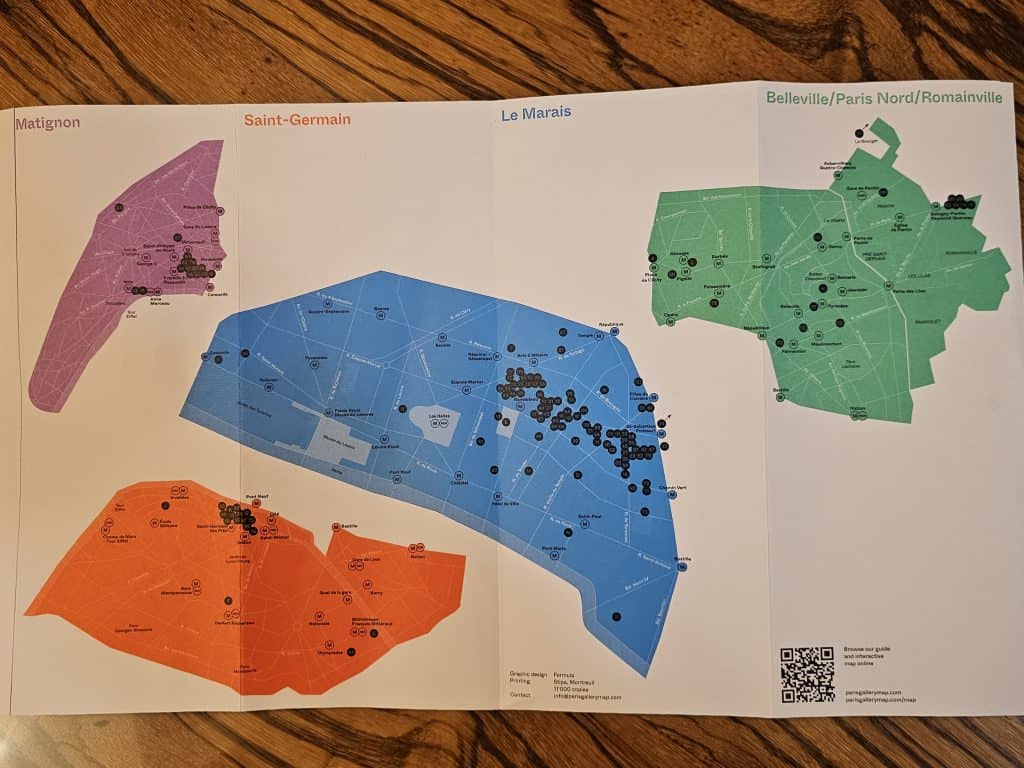
Contemporary Art in Paris: Institutions

Once, when I had been asked to pick up the artist wife of a film-maker for “Festival America” (a biennial fair in American literature where numerous writers are invited to present their books and literary subjects in general), she asked me about where to see contemporary art. At the time I had to think a bit and did not get back to her until a few days later. Unfortunately she no longer had time to visit. Today, some years later, I have a plethora of recommendations, because, on the one hand I have been thinking about and following contemporary art, and on the other, because there are now so many venues that cater to contemporary art today. Beginning with Paris’ contemporary art museum, Palais de Tokyo and the regional contemporary art museum, Mac/Val, there are also a number of fondations, privately owned museums and museum-like galleries as well as various structures set up to encourage talented young artists.

Palais de Tokyo, Europe’s Largest Center for Contemporary Art Today

One of the three 1937 Universal Exhibition edifices built for posterity, the Palais de Tokyo is so called because it was constructed on the then “Quai de Tokyo.” While the street is now called “Avenue de New York,” the edifice has kept its original name. 

Originally slated to become a national art museum, the Palais has, during its turbulent history, also served as the Nazi’s collection point for looted art to be stored and inventoried before its transfer to Germany. 

After the war, it finally came into its own as a national museum of modern art until 1976 at which time the art it held was removed to the new Centre National d’Art et de Culture Georges-Pompidou. Employed for various purposes then, it fell into neglect until it became earmarked in 1999 as a contemporary art museum. The architects, Anne Lacaton and Jean-Philippe Vassal gutted the site down to its bare-bones cement structure, which is how we encounter the institution today.

Palais de Tokyo is devoted to exhibiting established contemporary artists, or those who are on the cusp of becoming so. Contemporary art being what it is today, I have seen extraordinary exhibitions of artists such as Le Parc, and Saraceno, Theaster Gates…a number of forgettables, and controversial others such as Miriam Cahn’s recent exhibition with her painting, Fuck Abstraction. Typically a number of artists will be exhibited at any one time and in the basement there is an area dedicated to video art. The museum also boasts a restaurant and a bookshop. 

The museum has also been used as a discotheque and for rave parties. Thus, locked under normal conditions, can be found walls and staircases covered with fantastic spontaneously-created art. These areas can only be visited on a specially organized guided tour.

A good place to go after other museums have closed, it can be visited until late at night (22h) and even later for evenings when an exhibition first opens. An added bonus for vernissage nights is that museum entry is free and therefore should be watched for.

Another important contemporary art museum, this one outside Paris, is MAC/VAL located in Vitry-sur-Seine. While a bit way out (approximately an hour by public transportation), this relatively new building houses a very good collection of specifically French contemporary art and presents two temporary exhibits per year. If time is not of a premium, this museum (free to the public), of very high caliber, is well worth a visit.

Establishments Exhibiting Contemporary Art

There exist both public and private organizations whose objective is to exhibit the work of living artists. 

In 1982 Jack Lang, the then-Minister of Culture, set up a network of institutions, named FRAC (Fonds Régionaux d’Art Contemporain) to encourage the collection and showing of contemporary art in all of France’s regions.  The FRAC of Ile de France is located at 22 rue des Alouettes, 75019.  Admission is free and it typically offers exhibits of living, contemporary artists, both French and international. It has a second location in the new, contemporary art center in Romainville. This extension is known as “Les réserves.” Although slightly outside Paris, it can be reached by metro line 5. 

The Cent-quatre-Paris is a multipurpose art space offering contemporary art exhibits (ticket fees apply) as one of many other activities. The center includes an auditorium for lectures and performances, various restaurants, a book exchange, activities for children…and a large central space where visitors can see various groups practicing their hip-hop dance moves and sequences. 

The beautiful 13th century College des Bernardins often provides a venue for artists to create and set up installations adapting and highlighting its Cistercian architecture. Whatever the exhibition, the sheer beauty of its rows of stone pillars and gothic arches offer the visitor a moment of tranquillity and spirituality. 

To create a marketable aura and gain a reputation as a patron of the arts, various private corporations have created exhibition spaces which can be as grand as a quasi museum. The largest and most famous of these have been created by France’s art-collecting billionaires: Bernard Arnaud who heads LVMH and François Pinault.  

The former had the architect, Frank Gehry, build an architecturally fantastic structure in the likeness of a ship in Neuilly, a near-western suburb of Paris. Visiting exhibits at the Fondation Louis Vuitton means following a bit of a labyrinthine course, but the tour offers artistic and architectural wonders around every corner. When there is no special temporary exhibit on show, the walls will be hung with Arnaud’s own collection of modern and contemporary art. This Fondation is also known for its blockbuster temporary exhibits, which are a must for any art lover.

The latter renovated the former Bourse de Commerce (Paris’ old stock market building) to create a center for exhibiting contemporary art, much of which is from his personal collection. Temporary exhibits may change every quarter or semester. Here can be seen the most well-known artists of today’s contemporary art scene. Constructed in a circle around a central atrium, this building is also well worth a visit for its architecture as well as for the art. For those on a tight art budget (and who isn’t?), it is important to note that the museum is free the first Saturday evening of every month where explainers are available to offer (sometimes very necessary) insights into the exhibitions. Be sure to reserve a time slot as early as possible for these tickets go quickly.

The Cartier Foundation for Contemporary Art hosts temporary exhibits of contemporary art both on the ground floor of Jean Nouvel’s modern, light-filled, high-ceilinged rooms on its ground floor and in a more muted locale in the basement. Artists are typically already well-known internationally, such as Damien Hirst, Ron Mueck, Fabrice Hyber … Out back, there is also a lovely garden with a cafe which is a great place to spend some time on a sunny afternoon and discuss the current exhibition with friends.

Galéries Lafayette has taken over a building in the Marais to produce ever-changing temporary exhibitions in its contemporary art space, Lafayette Anticipations. Each exhibit is typically devoted to a single artist. No reservations are needed, except for their guided tours every day (except Tuesday when it is closed) at five in the afternoon; these are well-worth signing up for. 

Fondation Pernod-Ricard has moved its small art quarters near the Concorde to a spacious new building just behind the Gare St Lazare. Here they offer free entrance to temporary exhibitions of hand-picked contemporary artists. Vernissages, which are always of particular interest, are indeed open to all where Ricard cocktails flow free and freely to celebrate the event.

With an aim to promote their culture, a number of countries have reserved a space for art exhibitions in their embassies or cultural centers. Thus without leaving the city, any art enthusiast can feel the pulse of artistic creation in various nations around the world. Countries particularly engaged in presenting their contemporary art include ItalyCzech Republic, Canada, Australia, Korea

Artists’ Compounds

Then there are artists’ residences, where young artists are given a studio to work in and create. They also offer venues for these young artists to exhibit. 

In the center of Paris right on the Seine is the Cité des Arts, a complex where promising young artists have won a residency. Every Wednesday is open house from 6pm to 9pm when the general public can visit artists in their studios and see their work in progress. Every so often exhibitions are staged to display the residents’ works. In the lower level, there is a small auditorium, which offers conferences and concerts. Attached to this residence is a second compound of studios overlooking gardens located way up on Montmartre.

And far off the beaten track, in Clichy, as part of Greater Paris, an industrial site has recently been repurposed into a new artists’ residence.  Entitled Poush, it also offers visits and exhibitions to the general public, promoting the artists who are living and working there.

Les Frigos (the refrigerators) was once just that, a refrigerating edifice on the left bank of the Seine to store perishable foodstuffs until they were brought to Paris’ central market, Les Halles. Each distributor had its own refrigerator in the building. When the market was moved out of Paris to Rungis the building was abandoned no longer serving a purpose. It was then that the artists moved in, created windows, dismantled the refrigerator doors, installed plumbing and in a word, undertook all the installations necessary to make the various rooms viable and to set up work studios.  Once or twice a year Les Frigos are opened to the public to visit the studios housed behind each disabled refrigerator door.  A curious and totally unconventional art scene not to be missed.

Then there are the various open house days set up independently in different sectors of Paris and its suburbs where artists might have studios. These include, among others, areas such as Belleville, Père Lachaise, Ménilmontant, Montmartre, Glacière … most of the districts of Paris and suburbs such as Montreuil. Each neighborhood is free to decide on the dates for this type of event although typically they occur during the Spring months.

While what has become a plethora of institutions and venues offering exhibits of contemporary art, the above-mentioned list, as daunting as it might seem, is certainly not exhaustive.  It is only the beginning for a foray into the present day’s contemporary art, both French and international.

Photo taken outside the Palais de Tokyo/ Modern Art Museum in Paris.

Did you enjoy this article? TAIP is 100% reader-supported through tipping. If you want to leave us a tip of any amount it would be highly appreciated. These tips help support our efforts to keep TAIP an ad-free environment. Just as at a cafe, the tips are split evenly among the team.