pastry

La Formation Civique or My Adventures in French Integration

I already wrote about signing a contrat d’intégration républicaine (CIR) and attending the first day of civics training, so I’ll continue my integration journey here by covering the remaining days.

Day 2

It’s hard for me to differentiate what was taught on Day 2 from Day 1 since so much of the information was facts I already knew, or were so straightforward that I had already assumed their existence. We were taught about freedom of speech and religion or the concept of laïcité which is a particularly French republican form of secularism. None of this was new information, and I would’ve been surprised to learn these concepts didn’t apply in France.

At the end of the day, what stuck out to me was somewhat random information, and laws I wasn’t sure existed in the United States. For example, we learned there is a minimum requirement for apartment size (in meters-squared) based on the number of occupants. While this might be the case in some cities, as far as I know, the US doesn’t have a national housing requirement. That said, I’ve never taken American civics training or classes.

At the end of Day 2 we also had to complete a chemin de route which listed three tasks we would complete by the following session. The tasks ranged from administrative (researching government procedures) to cultural (attending a museum). Since I’d been living in France long enough to have gotten, as well as established myself working remote, most of the tasks on the list didn’t apply to me. Most of the other attendees had been in France five to ten years, and I imagined that had already done these procedures as well. I’m not sure if it’s exclusively a vie privée et familial visa which requires a CIR, and I wondered if it was part of the renewal process for another visa as well.

Day 3

Much like Day 2, we spent the first part of class reviewing the subjects we’d already covered: The country of France, health, employment, parenthood, and housing.

When it came to French history, we studied a timeline of the country’s most important rulers and politicians, along with their corresponding monarchies, empires, and republics. As an American whose country’s constitution hasn’t changed in almost 250 years, it is hard to fathom that much political upheaval. France is now in their cinquieme république which began after World War II — in other words, this system of government has only been in place for seventy years.

Our teacher also had us go around as a group, share our chemin de route and give updates on the tasks. Most of the group had completed a few simple things, though again, I wondered about the timing of these courses since I’d opened a bank account and enrolled in the medical system years ago at this point.

We also signed up for our Day 4 classes which would theoretically have been more active and in-the-field except that all cultural visits had stopped due to Covid and were now taking place in the OFII center. The only option left involved a pastry-making class in Clichy where we would also learn the history of pâte sablé. Even though I have celiac disease and am gluten-free, I signed up for this one since I couldn’t face another day of presentations.

Day 4

We started the day in a crowded classroom and the instructor has us introduce ourselves, say how long we’d been in France, and what country we were from. This was the first time this type of sharing or cross-cultural exchange had been instigated, and it was interesting to learn at least a bit about everyone else in the room. The instructor also established that quite a few immigrants spoke very little French and she paired them with those who spoke their language or English, which is always a common denominator (it hasn’t stopped surprising me how prevalent my native language is).

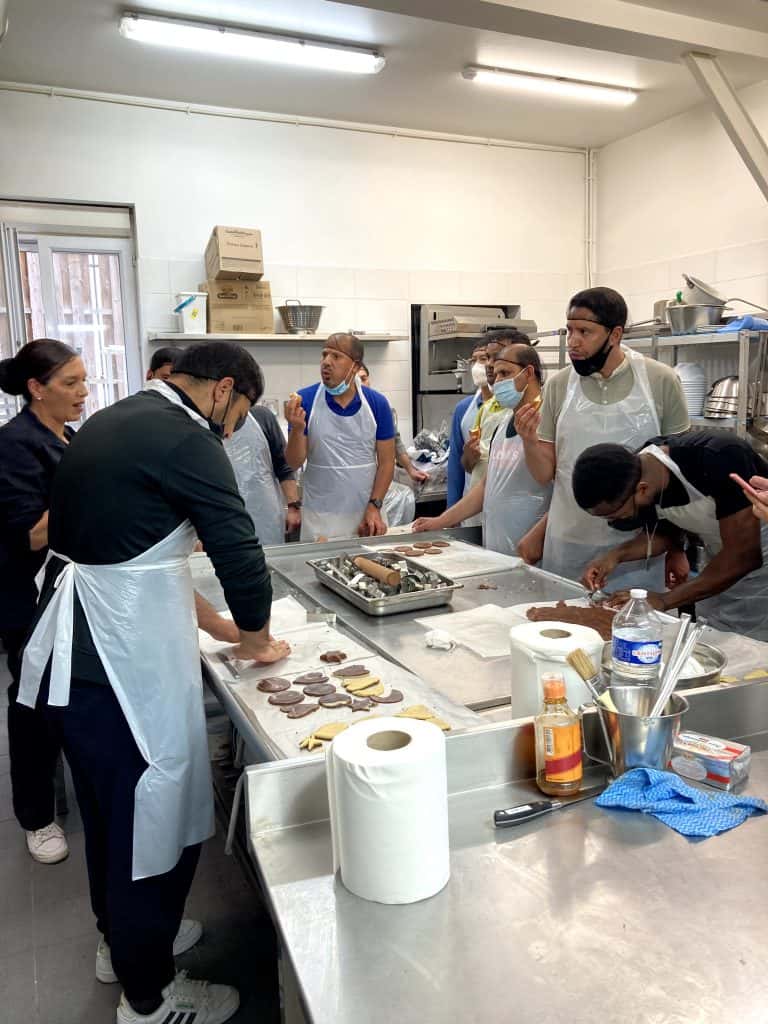
From there, we moved to an industrial kitchen where I worked with a man from Afghanistan to make pâte sablé. He ended up being very talented at crumbling the butter and flour together and must have had previous pastry experience. As soon as we established this, I let him handle the dough and focused on gathering the necessary ingredients and explaining the next steps.

The kitchen was crowded and hectic. There weren’t enough digital scales to go around, and the instructor oscillated between jovial and chastising how long we were taking. But amidst the clouds of flour, we were working together, explaining what to do next, and integrating in a way none of the other courses had achieved.

At the end of the day as we stood around munching cookies, another Afghani man about my age asked where I was from. “America,” I told him.

Do you know what’s happening in our country right now?” he asked with a mixture of contempt and disbelief.

I nodded apologetically and said yes, I was aware.

This was the realest moment in my many tedious hours of civic integration. Here we were in a foreign country — me by choice, him by necessity — as he questioned the American intervention which had ultimately left their country in shambles. Our paths would never have crossed if the French government hadn’t forced us together.

Closing Musings

While I can’t say I enjoyed or found the civics classes particularly useful, I do appreciate the fact that they were provided by the French government. (I can’t say they were offered, because they were mandated.) The experience would have been significantly less stressful had the scheduling system been online and not involved paper convocations for fixed dates months in advance. As I’ve mentioned before, I didn’t even know the word convocation existed before arriving in France.

I also wish there had been more emphasis on getting to know the other people in the courses, as we had on the last day. Although I understand the goal was to teach us about France, I think we were all interested in knowing why the other people were there and how we could help each other. There was at least one moment in each class where an immigrant mentioned an administrative problem and we all chimed in with how to handle that. What better way to make us feel comfortable in our new home than by supporting and learning from each other?

Photo was from our day making pastry.

Did you enjoy this article?  TAIP is 100% reader-supported through tipping.  If you want to leave us a tip of any amount it would be highly appreciated.  These tips help support our efforts to keep TAIP an ad-free environment.  Just like at a cafe, the tips are split evenly among the team. 

How to Go to University in France as a Foreigner

When I graduated with my bachelor’s degree I was one of those “I’m free!” people. I was so happy to have finally wrapped up my schooling after what seemed like 16 long years. I truly never thought I would go back to school.

Fast forward to 2017 and I found myself in the admissions office of Université de Nanterre in a suburb just outside of Paris. I had already spent one year here studying French in order to a) be able to carry on a conversation instead of just responding with “oui” or “non” and hoping for the best, and b) to obtain the B2 level of French that I need to get into the master’s program I had my eye on.

Say what? The girl who basically ran off stage after she was handed her bachelor’s degree now had grand plans to get her master’s degree? In a foreign country? Guilty.

Why I Made the Decision to go to University in France 

Let me back up a little. When I first arrived in France I was an au pair for a Franco-American family. I was required to speak in English with the children which was both a blessing and a curse. A blessing because I knew next to no French, and a curse because I was able to stay in what I like to call my “English bubble” for too long. 

I was speaking in English with the children, the American mom, and even with the French dad because he wanted to practice. My friend group included other Americans, an Irish girl, and several Australian girls. We spent our time together and we often went to English and Irish pubs with other Anglophones.

In some ways, it was a relief to be able to speak my own language in the midst of a foreign country. Moving abroad is filled with ups and downs, and it can be lonely. Plus, all of the sudden change is…intense, to say the least. My English bubble was comforting and so I stayed there for two and a half years.

After those years of nannying, I decided that I wanted to move on, but that didn’t mean moving back to the US. I wanted to stay in my newfound country but I knew at this point that I needed to start speaking the language, not to mention think about what I wanted to do with my life. I realized that I couldn’t be a nanny or live in my English bubble anymore.

And so I started the process of determining how I could legally stay in France. I found out that if I had a valid visa, I could go back to school for the same price as a European. 

This has now, unfortunately, changed. In 2018, the government announced that foreigners would need to pay 2,770 euros for an undergraduate degree and 3,770 euros for a master’s degree. Most universities disagree with the new rule and refuse to comply, other universities have gone forward with it. Before you decide on which university you’d like to go to, make sure you’re aware of the admission fees for foreigners! However, the new admissions fee for foreigners is still a fraction of what I would have paid in the US.

Things to Consider Before you go to University in France

I started thinking about what I wanted to do for work, as I had lost all interest in the field in which I got my undergrad degree in. I finally settled on becoming a writer (how do you think I’m doing?), and so I started looking into master’s programs in French literature. At almost the same exact moment, I realized that I not only needed to prove that I had a B2 level in French, but I would be completely lost at university if I didn’t have at least that. 

I recalibrated my search for a program that would help me learn French as well as give me a diploma with my new French level on it. In Paris, there are two well-regarded programs: one at La Sorbonne and the other at Nanterre. I settled on Nanterre because I had already missed the deadline to apply for La Sorbonne.

I ended up having an amazing year at Nanterre in their FETE program, which I recommend to anyone looking to up their French skills. Not only was I on a university campus (which just made it feel more legitimate), the teachers are qualified and helpful and the curriculum is interesting and relevant. 

I finished the year with my B2 in French and decided that I wanted to stay at Nanterre for my master’s for a few different reasons. I enjoyed my time there, I understood how their administrative procedures worked, and I knew that the admission process would be easier seeing as though I was already in their system.

I headed to the literature department to speak to an advisor to make sure that I had the right requirements. We got to talking, and she asked me about my plans, she looked at my resume, and she also asked me about my interests. She told me that although I had the correct level of French to enroll, I would probably have a hard time with the course material. Did I know that the school had an English Studies department? That offered a bilingual literature program?

My eyes lit up — that sounded right up my alley. 

Ultimately, I’m so happy that I decided to speak with that advisor before I enrolled in the French literature program and that she was so honest with me. I would be able to handle the course material now, but that’s because I have four more years of speaking and reading French under my belt. 

Although I technically had the correct level to enter into the program, I did not have the brain capacity or level of vocabulary to seriously study, analyze, and write French texts. And, because I decided to go for the bilingual English/French program, I was able to write my 80-page thesis in English (what a relief!).

I ended up thriving in the English Studies program and I finished my degree with a mention très bien. I also scored because my program was truly bilingual and most of the English or bilingual master’s programs in Paris are at private universities — which come with a much higher price tag. 

So, what should you consider before you go to university in France?

  • Why you want to go to university — if it’s to simply obtain a student visa there are other options, like the intensive French course that I took
  • Your level of French — be brutally honest with yourself
  • How much you want to pay — private is much more expensive than public (don’t forget to be sure of the admission fee for foreigners at whichever institution you decide on!)
  • What you want to study — again, be honest with yourself!
  • Whether you want to go for a license (bachelor’s) or master (master’s)

Tick off these boxes before you start looking into French universities and you’ll set yourself up for success. 

Molli offers private consultation services which range from help with visas and adjusting to life abroad to Paris travel itineraries. Fill out the contact form to learn more.

Photo by Edwin Andrade on Unsplash

Did you enjoy this article?  TAIP is 100% reader-supported through tipping.  If you want to leave us a tip of any amount it would be highly appreciated.  These tips help support our efforts to keep TAIP an ad-free environment.  Just like at a cafe, the tips are split evenly among the team.