paris

My 35th.

We can only be said to be alive in those moments when our hearts are conscious of our treasures.

-Thornton Wilder

I was born at 4:04am Singapore time on March 28th, 1979, nearly two weeks past my original due date.  That meant that around 21h00 on the 27th, Paris time, my 35th year had commenced.  I wanted to give you a 24-hour snapshot of the day, which was not really different from many Fridays in Paris, except for the fact that I had completed most of my work projects for the week and had no students to tutor.

***

21h00

It was the end of the month so I was sending emails to my staff at Word Works, as well as to some vendors and one follow-up with a potential new client.

I tidied up some things, checked my watch again, and decided to be early for my movie at UGC George V on the Champs Élyseés.  It would also allow a leisurely walk and I sometimes left too late.  I took a small volume of Robert Frost’s poetry in tribute to the bit of Winter that had stubbornly stayed on these last few days.  I also brought my language journal.  The Grand Budapest Hotel would be subtitled in French, and I would be able to jot down a few new words as they flashed across the screen.

It was quiet as I stepped onto my street.  Paris is, in many places, quiet after 20h00.  Even more so in my neighborhood, the 17th arrondissement.  I was equidistant between Wagram and Monceau, but Line 2 and Monceau suited me well for my destination.

I clicked along in my high-top black leather shoes that told of my approach along the old cobblestones.  I had the beginnings of a smile on my lips for any stranger who might make eye contact with me.  I hadn’t become Parisian enough yet to completely avoid eye contact!

I was carrying a water bottle with me.  I had brought it with me from the States.  People use them all the time there but here very few people carried such bottles around externally.  I had to remember not to set it down, lest I forget to pick it up.

I clicked down the steps to my side of the metro station.  The timers read 04 and 10.  Four minutes to the next train, ten minutes to the one after that.  I adore the Paris Métro.  I often feel that it’s faster and better than a private driver.  Well…almost.

I sat down on a seat and cracked open my Frost.  Many American schoolchildren know “The Road Not Taken” but my real love for his poetry began in 1998 when I studied his work in his beloved New Hampshire at Thomas More College.  Poetry can be read in a thousand different ways.  Tonight I flipped through somewhat indifferently.  I was looking for resonance so I could stop reading and reflect.  I found it here.

Caught up in my thoughts I automatically rose to get onto my train, then alight at Étoile, and then out onto the Champs, and almost carelessly walked past this, which I always try to stop and admire.  After a moment or two I did an about-face and walked to the theater.  I chuckled to myself as I had once remarked that only people in San Francisco read while walking, but I realized, nose in my book, that lots of people in dense urban settings do that.

I retrieved my ticket using my UGC card and descended into the lobby to wait for my showtime.  It was Lent and I had already had my two collations and main meal for the day.  I just tried to keep my eyes on Frost instead of the candy palace before me.

An efficient young man came up some time later and asked me in French what movie I was waiting for.  “L’hôtel grand de Budapest.”  “Vous pouvez aller maintenant.”  “Merci.

22h00

I chose “orchestra” seating.  In some of the theaters in France, as in Singapore, where I first watched movies, they had “balcony” and “orchestra” seating.  For most of my life I’ve preferred orchestra.

I settled into my seat.  As I’ve grown older I’ve tried to avoid the rush and crowds of a theater by carefully selecting a showtime guaranteed to be less crowded.

The movie was typical Wes Anderson.  Fun and detailed backgrounds, signage, and models (Darjeeling Limited).  Some foreign language usage but no subtitles (Life Aquatic).  Cheekiness (Rushmore).  Relationships (Bottle Rocket).  Family (Royal Tannenbaums).

I walked home slowly and deliberately, almost as if in the opposite of a race.  In the hustle and bustle of the day you can’t always enjoy a walk and now as I had the streets to myself, my clicking footsteps slowed.

As I came out of the Metro and turned towards the treasure that is Parc Monceau I saw the sweep of a spotlight in the sky.  It was coming from the Eiffel Tower, of course.  In the evening a giant floodlight rotates at the top of that thing, imitating a lighthouse.

Look, I can’t get as excited about the Tour Eiffel as the newbie visitor might.  For many who have never been or will never go to Paris, it is the source and summit of their Parisian dreamings, if they have any.  My thrill comes when I show first-time visitors or my friends and watch their reaction.  Enjoyable, to say the least.

What’s Paris to me?  Square John XXIII.  Place des Vosges.  Petit Palais.  The Diana Statue in the Louvre and at the Jardin du Luxembourg.  Kids and boats.  Any cafe.  St. Francis Xavier.  St. Etienne du Mont.  Notre Dame de Lorette.  The Orsay Clocks.  Alexandre Dumas.  Molière.  Pastries.  Canards.  Notre-Dame, original edition.  Père Lachaise.  Sunsets on the steps of Sacré-Cœur.  Music on the Seine.

The sensory overload can cause some to switch off.  They go about their day oblivious.  And believe me this can happen as easily in Paris as in any other city.  But when you let Paris speak to you she’ll disclose wonders.

00h20

As I was almost to my apartment I got a text from a colleague who was hosting a podcast.  His show had started and his call screener had no-showed.  I sprinted up the seven flights of stairs (when you walk it multiple times a day it isn’t as bad as it sounds) and called into the studio and screened his calls for about 30 minutes as I got ready for bed.

I thought I would be tired as I tucked in some time later.  I had said my prayers and had been texting with a few friends.  I put on the beginning of the anticipated Nick Clegg/Nigel Farage debate and fell asleep (not because I wasn’t interested but because I finally let myself go).

***

10h00

The morning provided a slow wakeup.  I had forgotten to turn on my space heater so I drew my blankets in closer to myself to stay warm.  Fridays were typically days off, anyway, so I was content to sleep in.  I flipped over, pulled up The Guardian’s Politics Weekly podcast, and heard what the Left had to say about Nigel vs. Nick.

One of the criticisms that crept into my don’t-want-to-get-up-yet ear was that “He (Nigel) clearly can get flustered and he made that crazy statement about the EU having blood on its hands over the Ukraine.”  The conversation proceeded apace, and Farage’s foil was the nearly professorial Clegg, who as a “professional member of the political class,” as Nigel is wont to call most MPs, was unflappable as he dodged parry after parry from the UKIP Leader.

“That’s because he’s a normal person,” I thought aloud, to no one in particular.  I was much like Nigel a big idea person content to leave details to those smarter than myself confident in my ability to rather lead, motivate, and inspire.

11h00

I finally roused myself.  I made a petit déjeuner and sat in front of my computer to pay the regular end of the month bills.  Funnily enough, my landlady prefers to be paid via PayPal, which makes paying rent a breeze.

I also ran down my budget vs. expenditures spreadsheet, now well into Month 5.  It was the first month my projections had actually hit their targets.  At some point I’ll write a post about the cost of living here.  In some ways, it’s expensive, sure, but in many ways having a constrained budget helps you realize just how little one needs to survive in a modern society.

I then turned to some personal and business correspondence, and made out my to-do list for the day.  It’s a simple system that works for me.  I make a list of 10 things that have to get done by the end of the day and what doesn’t make it goes into the “extra” list.  Whatever doesn’t get done that day, together with the extras, helps comprise the next day’s list.  Conversely, if I’m ahead of schedule I can pick off some items from the “extra” list.

12h00

My friend Justin FaceTimed me.  We would not change to Daylight Savings here in France until Sunday, so he was only 5 hours behind me in Florida.  It was 07h00 for him and as a coffee lover he was moving past the stupor which first light brings to lovers of the bean.

He’s a business partner and we discussed some matters while I packed up my messenger bag for the day.  Books, journals, iPhone/iPad charger, iPad mini.  We switched to the telephone as he began his commute and I got ready to go out.

It was a truly beautiful morning.  I have a really helpful list of cafes that purports to offer expressos for 1 euro or less.  This is generally reliable.  Indeed at Le Trois Pieces the other day I got a café crème (French for latte) and half a baguette for 3 euros 20.  But that’s to be expected deep in the 17th, where no English speakers or tourists lurk.  Here the locals will complain about high prices.  But hey, if you want to pay eight euros for a coffee to get no better view than many other places in Paris, head to Saint-Germain-des-Prés.  There you can sit at Deux Magots and Café Flore and many other places famous for being famous, which specialize in parting tourists from their money.  For me, I’m done standing outside in a line to get into a club: paying to sit in a cafe that offered nothing spectacular, something quite similar, did not make my list.

I set out, to-do list in hand.  My chosen cafe today was not far from my front door.

As always, I was treated to sites like this one.  But there’s ugly architecture in Paris too, pictured below it, just a block away.

As I headed down the street it turned into a “market” street.  This is great for people-watching, but terrible for reading and writing, which were my intended activities for the afternoon.

So I turned around from that market street view, looked at the cafe behind me, and spotted that open table at the end, under the red awning.  You have to confidently walk up and grab your spot in a cafe.  I lowered my bag and the waiter asked if I was going to eat.  No, “un petit café seulement” which is French for “I just want to order a coffee  and sit here for as long as possible.”  He apologized and told me that only the interior was available.

13h00

My timing was off.  It was lunchtime.  Of course they needed the tables.  I couldn’t go to my first or second choice cafe, so I was going to engage in flânerie now.  I wandered.  I still kept an eye out for a possible spot.  Everywhere was packed, however, and they don’t really even want to spare an interior spot at lunchtime unless you’re eating.  Totally understandable.

I walked into a café and gestured to an empty two-top.  “C’est libre?”  The lady sized me up: “Oui, pour le déjeuner.”  “Non, je voudrais un café, seulement.”  She gestured to the bar and I was content to stand there, drink, and perhaps read for a bit.  As she began to pull the espresso she asked, “Voulez-vous installer sur la terrasse?” “Bien sûr.

I wrote and read for a couple of hours.  People would stare at me writing just as I would stare at their chiens.  Parisians love their dogs.

At some point a French girl in her mid-20s, in all black, sat down next to me.  She ordered a soda and started smoking American Spirits.  Smoking is under attack in France (just as e-cigarettes are on a meteoric rise) but don’t doubt that it’s still very much the national pastime.  If you do doubt it, sit outside at a café.  Smoke will find you as you will the ash which now fluttered onto the pages of my journal.

She struck the typical pose cigarette carelessly held between the index and middle fingers of her left hand.  Sunglasses.  No frown but certainly no smile.  She was thinking not really observing much.  I was positioned to observe without being obvious.

After smoking three cigarettes and downing her diet coke, she abruptly got up and crossed the street, off to her next destination.  She had paid for her drink when it was delivered, which is often the custom when you sit outdoors.

I checked my watch.  I had a podcast I was hosting at 16h00 and it was 15h00.  I wrapped up my work and walked out.  Among the sites I saw on the way was this.  Great advertising.

15h15

My sister messaged me saying the children wanted to wish me a happy birthday.  Sure.

FaceTime gave me a moment with her and two of the cuties in my life.  I got a happy birthday song and caught up a bit.

“What are you getting for yourself?” she asked.  I was looking for a scarf, I thought.  Scarves really are everything in this town and finding the right one, and tying it the right way, does matter.

I didn’t want her to buy me anything, so I told her instead, “Clare, I’m living in Paris.  That is my gift.”

So it was.  My last birthday in Europe had been 14 years ago, in 2000.  Despite the fact that we had been able to drink for months my friends insisted it was “legal in America” night and I made it home that night, despite the tricky cobblestones in Trastevere, thanks to the sturdy left shoulder of my college sweetheart.

16h00

The podcast had a few technical glitches but we got them handled.  I then had a call with a new hire for one of my businesses, firmed up some weekend plans with friends the new Captain America was coming out a week earlier here in France and I planned to take advantage.

I got dressed for dinner at a great Indian restaurant (Vallée du Kashmir, in case you’re wondering).  And just like that, my first 24 hours of my 35th year lapsed.

Some years ago the Lees Summit Chamber of Commerce conference room contained 20 of us who were sitting in a meeting room trying to organize a “young person’s” group.  One of the first questions the group posed was “How old is young?”  A couple of eminences grises had tentatively asked, “25 to 45?”

An attractive girl I had been flirting with snickered, and I raised my hand to speak.  At 28 I was less diplomatic than I should have been, and blurted out, “I mean honestly, who considers 40 young?”  The 20-somethings in the room nodded their heads and the few 40-somethings in the room wilted.

It’s an unfortunate American trait that considers youth the greatest time of life and seeks to chase it indefinitely.  At dinner this night I would hear the phrase “James Dean” float over from an adjoining table (in an Indian restaurant, in a Muslim neighborhood, in France) and as I recounted this anecdote to my friend I was told the French have this problem as well.

Whatever happened to aging gracefully?  For my part the oldest person is always the coolest person in the room.  They have great stories and so much more experience.

At 35 I suppose some would still consider me young – and since I had done so much (I had hoped) to disprove George Bernard Shaw’s (oft correct) “It is too bad that youth was wasted on the young,” it didn’t matter what you called me.  I still thought it was a laugh that anyone in their 40s would call themselves young, but I did feel truly blessed that, whatever age I had lived to, I woke up this morning in Paris, having accomplished almost everything I’ve ever dreamed of.

Time for some new dreams.

I want to thank my parents, who gave me life, God who gave me my soul, and my family and friends who give me so much love and encouragement every single day.

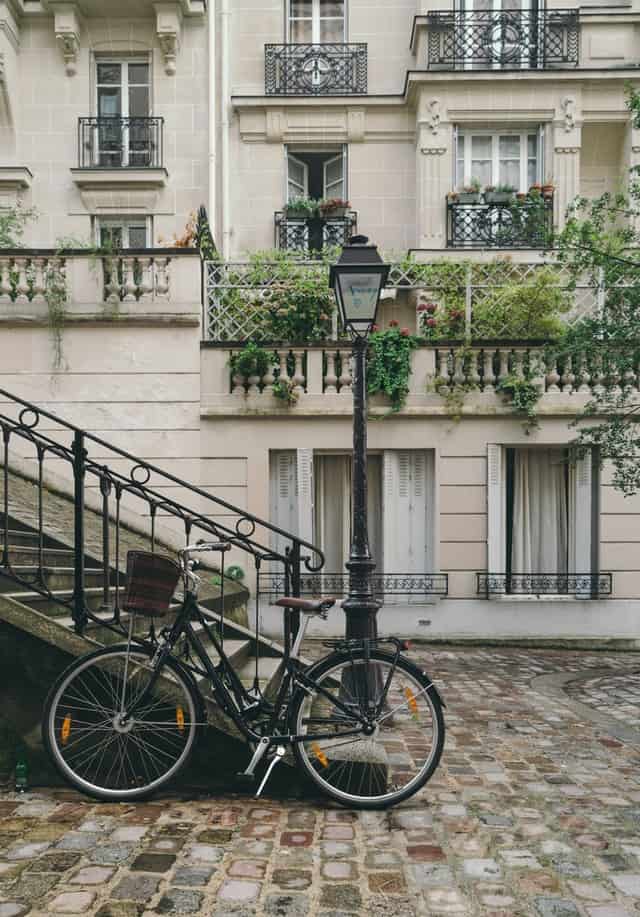
Photo by JOHN TOWNER on Unsplash

Did you enjoy this article? TAIP is 100% reader-supported through tipping. If you want to leave us a tip of any amount it would be highly appreciated. These tips help support our efforts to keep TAIP an ad-free environment. Just as at a cafe, the tips are split evenly among the team.
My Worst Week in Paris

This is the “Part II” to my “finding an apartment in Paris” article, though it’s really more of an appendix.  Future parts will discuss what to bring with you when moving here.

They say that whether you are a native of France or a lovestruck visitor of Paris (comme moi) your first apartment in the City of Light will always be the worst.  It gets better from there.  There are a number of reasons why.  You don’t know the arrondissements.  You don’t know how you will feel about your commute.  You won’t know how you feel about your space.

One thing I did know, three months into my stay, as my landlady tried to charge me more for my already too-small space, was that I was done paying 800 euros a month for a studio (between $1000-$1100, depending on the state of the world economy at any given time).  In a week I had settled on a very cool art studio to which the resident artist had added a number of bedrooms.  It was very cool and the price 650 euros was great.

She, Sophie, my new potential landlord, was a bit flaky in setting up the appointment to see the place but I chalked it up to the “artiste” in her.  A writer and teacher at heart, I’m able to shush my inner businessman who (rightfully) whispers “accountability!” at necessary times.  But we got along okay at the first meeting and we shook hands on a move.

It was 30 days before my move when I gave notice to my then-current landlady.  I didn’t tell her all my grievances.  They had been kind and I was determined to leave on good terms. I found out, in drips and drabs, just how much had been missed in the handshake agreement that had sealed the deal.  Each new discovery, via email or text, was not in itself a dealbreaker but cumulatively it worried me a lot.  I think I was too excited about moving to the 11th and so close to Père Lachaise, as well as saving almost $225 a month, so I didn’t really blink as I discovered:

1) I would need a security deposit equal to one month’s rent (pretty standard here).

2) I would need to do one hour of chores per week or pay the cleaning lady 15 euros each week (no big).

3) I was not allowed to receive bills or bank statements what???  So I could get personal mail but not bills?  This would also complicate the immigration process but the concierge of my current place agreed to for 30 days collect my mail while I figured out an alternative.

4) I was to sign a contract and agreement, seven pages long, all in French.  I figured I would just have to hash that out with her after moving in.  I wasn’t going to pay for a translation nor was I going to sign something without fully understanding it. But all of these (what should have been blatantly waving red flags) paled in comparison to what I dealt with on February 28th, my worst day in Paris and the beginning of a tough week.  Please keep in mind that I use “worst” and “tough” purely in the First World sense.  At no time was I without the basic necessities of life nor was I being waterboarded, and incidents like these do great wonders for one’s sense of gratefulness.

I had asked two friends to help me.  I had four suitcases and two backpacks to take literally across town (17th to the 11th).  We would be able to stay on the (mostly for locals) Line 3 and just have one change at the very end.  Additionally, the metro stations at the starts and ends of the journey were roughly 500 meters or less from where we needed to be and all the bags had roller wheels.

The day started auspiciously enough.  I had woken up on time and lugged the bags down to the fourth floor where my landlady generously allowed me to use the building’s elevator to get down the final four floors.  My friends arrived on time and were treated to some excellent pastries and coffee from my soon-to-be-former landlord.  We made our way in and out of the Métro up and down quite a few steps huffing and puffing and laughing and grateful for the assistance of the (always polite) Parisians around us.

We arrived at my new place-to-be.  One of Sophie’s employees answered the door and she came out.  She had a look of surprise on her face.  “Well, you come tomorrow!” she said.  It was February 28th.  “Well, that’s fine,” I said.  “I’m not going to sleep here tonight, I just need to drop off these bags.  I’ll come back tomorrow.”  “Non, non, it’s just not possible,” she replied with the typical French shrug which said, “I don’t care” about your situation.

I kept my composure.  My colleagues very astutely just kept silent.  She was going to be a landlady for at least the next 6 months, so handle this well, I thought to myself.  I explained that we had come across town that these bags were not light that my friends were able to help me today and not necessarily tomorrow and that I was due to be out of my old apartment first thing tomorrow morning.  I also referenced a text I sent her last week saying I was coming Friday.  To my chagrin she pulled it up and pointed out that I said I was coming to drop off money on Friday, not drop bags.

Now, as an American I would have proffered one of two responses, in my experience as an erstwhile landlord:

a) Okay, you’re here a day early, but you’re going to be here the next six months and you’ve got 1300 euros in your pocket, so I can do a favor for you this one time.

OR

b) If your stuff is here I must charge you rent for today, pro-rated.  Is that okay?

Either of these would have been acceptable, but instead I got the French “sorry, I cannot do anything.”  She said she was in the middle of a photo shoot, she had no room, people always take advantage of her, etc.  But what you need to understand is that I picked this place precisely because it was ENORMOUS by Parisian standards.  If she had room in one place, surely it was in my room which anyone could reasonably expect was cleared out less than 24 hours before my arrival.  It was unoccupied when I had previously seen it. After 5 minutes of fruitless back-and-forth we agreed I would arrive at 09h00 the next day.  The door closed and the man not usually at a loss for words was.

Josh immediately and kindly offered storage at her place, about 14 blocks away.  A wheel had kindly broken off on one of the pieces cobblestones are murder on cheap luggage, and while I did have three Samsonites, that was not one of them which made the trudge just a bit more challenging.  Two of the three in our party were American and while we tried not to see this incident through the “customer is always right” lens, I was still shocked at such unaccommodating behavior.  “I’m not,” said Danyell, who was married to a Frenchman.  “My mother-in-law is the same.  Typical French.”

We agreed, in between huffs, puffs, and stops, that if I could not even leave my luggage there the day before I moved in that all that awaited me was more unpleasant surprises.  We got to Josh’s, where four more stories and the corresponding stairs awaited us.  I laughed bitterly as I lugged the luggage up those flights, marveling that what I imagined would be such an easy day instead had gone wrong in every conceivable way.

Danyell had to run off to another job, so I didn’t get to take her to lunch for all her troubles.  We parted and Josh and I grabbed some lunch and discussed the problem further.  She had some room and very kindly consented to let me leave my luggage there for a week while I scrambled to find a new place. I swung into action and had a place the following morning, for one week.

It was in Le Pré San Gervais, which is at the very edge of the 19th Arrondissement.  When I say edge, I mean outside of.  It was outside Paris city limits by about one km.  Good, I thought.  Let me find out what it’s like to live in the burbs for a week.  Gk, who owned the room, wanted 700 euros per month for a very sunny and lovely room but for someone living and working in Paris it wasn’t tenable, by my standards, for a long stay.  I paid for one week. It was at the edge of Paris transport, and door-to-door, with Vélib, bus, and metro, it would take at least 30 minutes to get to one of the “center” stations of Paris, like Châtelet, Opéra, or République (see, even right there in my list I can see how Right-Bank biased I am).

I loved the size of the room and the quiet of the building, as well as being on the 1st, not the 7th, floor, but I wasn’t going to pay that much and not even live inside Paris proper. Still, in my week “in exile” I came to appreciate just how spoiled I had become (and would remain my new apartment was in the same neighborhood as my old one 20 minutes by foot, or ten minutes by Vélib, or five minutes by Métro to the Arc de Triomphe, a beating heart of the city).

The happy ending to my alleged “worst week”?  I picked up my keys that Thursday and moved in over the next three days.  I had plenty of time to adjust to my new views.  Danyell and Josh valiantly joined me to “finish what they had started” a week ago.  I avoided moving into a place that had featured numerous warning signs and a disastrous move-in day.  I found out I had friends who were more kind and generous than I could have imagined or even deserve.  But most importantly, I had upgraded my housing while decreasing my cost of living which is a feat in any city, not just this one.

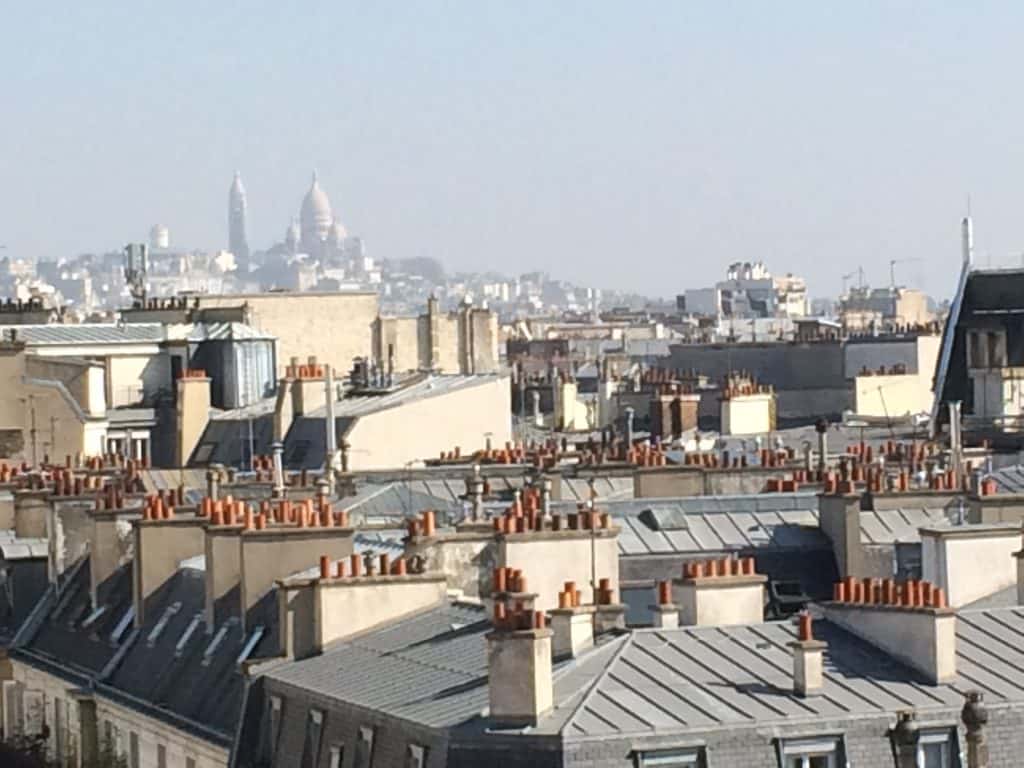
The photo is a view from the northeastern edge of Paris.

Did you enjoy this article? TAIP is 100% reader-supported through tipping. If you want to leave us a tip of any amount it would be highly appreciated. These tips help support our efforts to keep TAIP an ad-free environment. Just as at a cafe, the tips are split evenly among the team.
Finding an Apartment in Paris, Part I: Before You Get Here

Keep in mind that there is a reason the word “bureaucracy” has a French etymology.  The French love their paperwork.  Efficiency is not a vice, per se, but why be efficient when you can cloak yourself in the warmth of saying “non” to people, just because you feel like it? When I first started researching a move to Paris, in August 2012, my eyes glazed over at the stories I read: “Must provide paycheck stubs” (I’m an entrepreneur, so my cash flows don’t always come that way), “must sign a 6-12 month lease,” (I needed to maintain flexibility, especially if I didn’t like a place).  There had to be a good way to get an apartment in a foreign country before you got there.  There was.  Enter Airbnb.

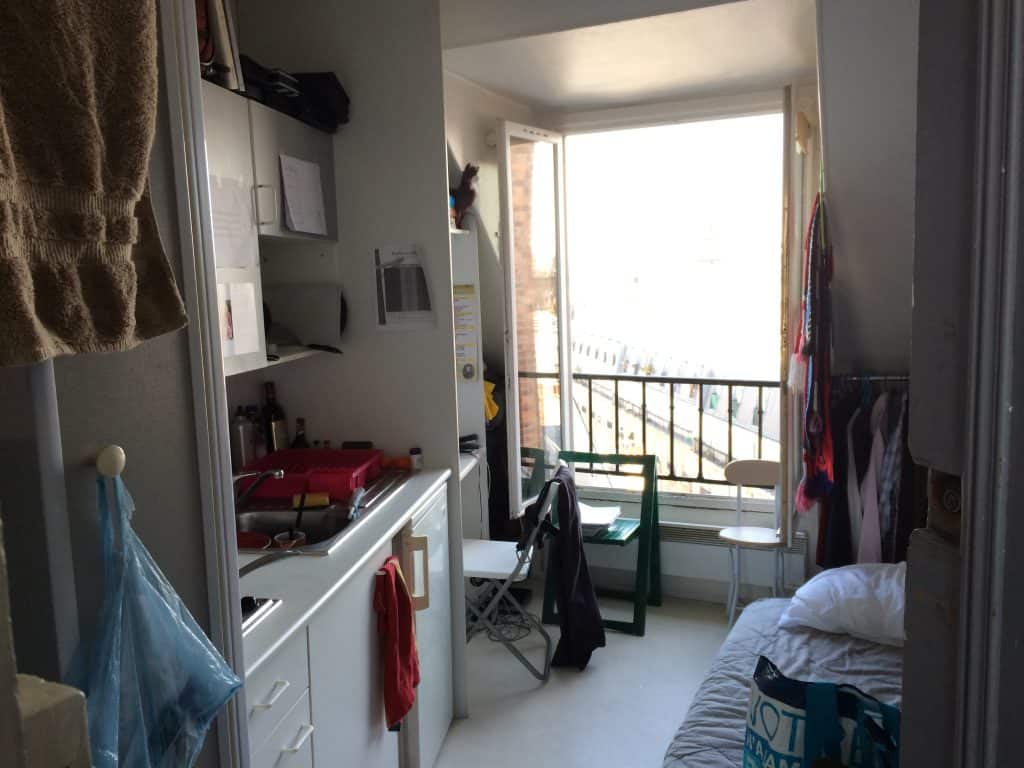
I was an early adopter of this service, staying at my first place in 2011 when I visited Austin.  I love the service and have used it frequently ever since.  I figured Paris would have a lot of options, and indeed, there were, but there was a reluctance on the part of many of the owners to take on a long-term renter, as there seemed to them to be less trouble and more money in the short-term renters.  After inquiries and searching, I settled on an 8×8 foot shoebox in the 17th arrondissement that would cost me 800 euros per month and would be all-inclusive (water, internet, gas, trash, electricity).  The toilet, a squat one, was down the hall but I did have my own shower and kitchenette, etc.  My host was used to a bevy of weekly guests so she took some time before assenting to my proposal to stay six months or maybe longer. I visited in November 2012 while on vacation in Europe and moved in over a year later, in December 2013.  It was as I had remembered perhaps a little smaller ;-).  I lasted a little under 3 months.

It wasn’t hell, by any means.  I came to realize that I was paying a high rate for the amount of space I had (24 square meters).  I also realized it was incredibly central (perfect for my day job) but also very quiet (not “hopping” as far as nightlife goes).  There was a nagging problem with the plumbing and backflow from my sink going into my shower.  Six weeks in I had had enough and started looking for other accommodations, again on Airbnb.

Why did I pick that site?  Less risk: Airbnb had insurance, and direct links to these people’s bank accounts so people were disincentivized to do you wrong.  Often times I also had access to testimonials from others and plenty of good photos.  I was also going to have something furnished and all-inclusive.  My second situation did not work out as planned (stay tuned for Part II, a harrowing but hilarious account of my worst week in Paris) but I am very pleased with where I am now.

I found the listing for my current place on, of all sites, Craigslist, which is nowhere near as popula(i)r(e) as its French equivalent, Le Bon Coin.  The apartment costs 690 euros, all-inclusive, and unbeknownst to me, had great views of Sacré-Cœur and The Eiffel Tower.  The listing led me to a service that caters to English-speaking expats.  They know our pain.  This place would be bigger AND cheaper than my last place.  Parfait.

I was able to see, decide, and pick up my keys for the place all within the space of six days.  It could have been sooner had I not had a request of the owner which was generously granted, and if I had not already paid for a week’s accommodations on the other side of town.

Here’s what you should expect (and Paris is a fairly stable market) as of March 2014. Outside the city, all-inclusive, 10×10 (29 square meters), with a minimum 30-minute commute by TRAIN (RER) not Metro, 500 euros. Inside the city (in one of the 20 arrondissements), 750 euros. Inside the city, with a private bathroom and a “living room” area, 1100 euros. Should you wish to have a roommate obviously all these prices come down, but then the paycheck stubs and all that come into play, which are not easy to produce for those of us here on non-working visas.

I’ll cover “cost of living” in another article but expect to pay a security deposit as well as an agency fee (be it through AirBNB or ParisExpat or any other service) equivalent to 5-10% of your entire lease.  You’ll need a good chunk of change in your pocket come moving day.  And some smiling faces and helping hands to help you up all those flights of stairs.  More on that, next time.

The photo: it’s not the biggest place, but it’s home.

Did you enjoy this article? TAIP is 100% reader-supported through tipping. If you want to leave us a tip of any amount it would be highly appreciated. These tips help support our efforts to keep TAIP an ad-free environment. Just as at a cafe, the tips are split evenly among the team.
Laundry in Paris: Sorted!

Sometime back my landlady had offered to do my laundry…for a fee, of course.  I’ve been doing my own laundry for many years now but usually at my own home using my own machines.  I never had any mental measurement other than “large” or “small” load.  Even during my last foray into city living, when I lived in Lafayette Square in Saint Louis, I had washers and dryers in the basement of the 100-year-old Victorian I made my home.

“How many kilos?” She asked in her native-Parisian accent.  I laughed.  I thought about my sack of laundry upstairs.  “What would that weigh,” I asked myself.  I figured 8-16 lbs, which came out as…”Je pense…quatre kilos.”  She took a minute to do the math, add on her service charge and told me “25 euros.”

It’s not polite to haggle in residential situations here even less polite to imply that you are being ripped off but let’s say conservatively I would be talking about $30 (she was asking for more) and let’s say I had proposed ten lbs (which ended up being about right I should go into mental clothing-weighing!) that’s about $3/lb.  Was that expensive, I wondered?

Since I was in a situation in which I should simply say, “oui,” I did so and trudged upstairs to my apartment to grab the bag of laundry.  Was that a lot?  We as Americans often overlook sunk costs machines had always made sense for me not just because the hookups were there and used washing machines can be had for a song (some guy nabbed my washer and dryer when I moved for $150 not bad when you consider I had bought them two years earlier for $200), but also because I invariably rented to tenants, who saw a washer and dryer as an awesome amenity.

By the time I handed the laundry bag to her I had done the math: $360/year, assuming a ten-pound load/month.  That didn’t seem so bad, I thought, but surely I could do better (as a postscript my landlady brought my bag of laundry to my apartment, not realizing it hadn’t been folded.  I was surprised to find it rumpled but I wasn’t going to take it back downstairs and demand it be folded.  I happily folded it myself and she was so embarrassed to find out later via the cleaning lady, who was quite upset about it that she didn’t charge me.  So this comparison is now officially just academic.).

It would be six weeks before I would need to do laundry again.  Bachelors inevitably mark laundry as the day before we run out of underwear.  This time I had a number of scarves that I needed to go in the delicates so I broke my laundry into two machines.  Again with the kilos.  The instructions were fairly straightforward.  I bundled up what needed to go and I brought my 11kg over 20 pounds to the laverie about 1000m from my house (I know, stay here long enough and you even start using Celsius to talk about temperature).  It was found with a bit of work as neither yelp nor google places responded well to lavanderie or lavérie (well, I did get one search result nearly a mile away.  Nope).  Google asked if I meant “lavanderia.”  Sure, maybe it’s Spanish day.  I clicked on the link and got…nada.

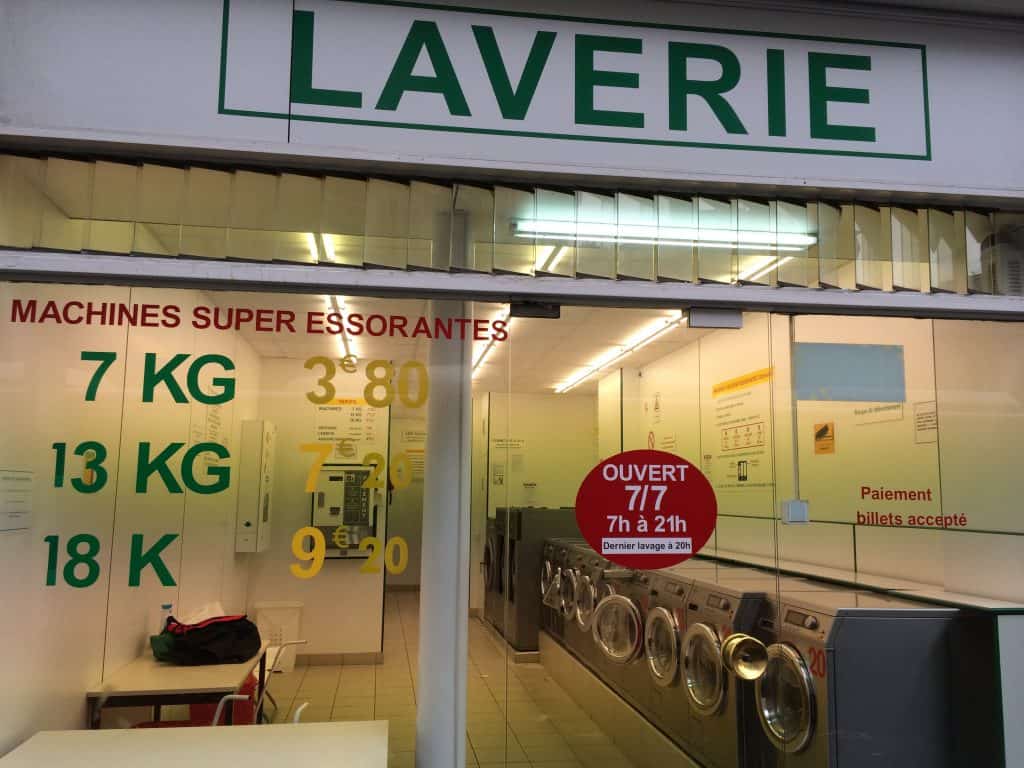
As you can see the instructions were fairly straightforward.  You need to make sure you put your detergent into the wash (lavage) not the pre-wash (prélavage).  I paid 7€20 for the 13kg machine (most of my stuff) and 3€80 for the 7kg machine (scarves and stuff).  11 euros all together.  Then, when they were done I dried both loads together for 30 minutes (the dryers are HUGE and efficient) another 4€50.  Let’s say 16 euros in total to do it myself.  In opposition to the rate my landlady proposed (why didn’t she just let me do it myself, I wondered) I had done twice as much laundry for 1/2 the price.

But I still hadn’t figured out whether this was “expensive.”  Yes, I didn’t have the sunk cost of a washer and dryer, nor the utilities that went with it.  17 euros for let’s say 14kg was a little over 1 euro/kg, plus detergent (7 euros for a bottle that would last me over a year).  $1.30/2.2 lbs?  Or 65 cents/pound.  Yeah, it was cheap.  There are expenses to living in any big city including Paris but laundry wasn’t going to be one of my big ones.

The photo is of the laverie where I had my first Paris laundry experience.

Did you enjoy this article? TAIP is 100% reader-supported through tipping. If you want to leave us a tip of any amount it would be highly appreciated. These tips help support our efforts to keep TAIP an ad-free environment. Just as at a cafe, the tips are split evenly among the team.
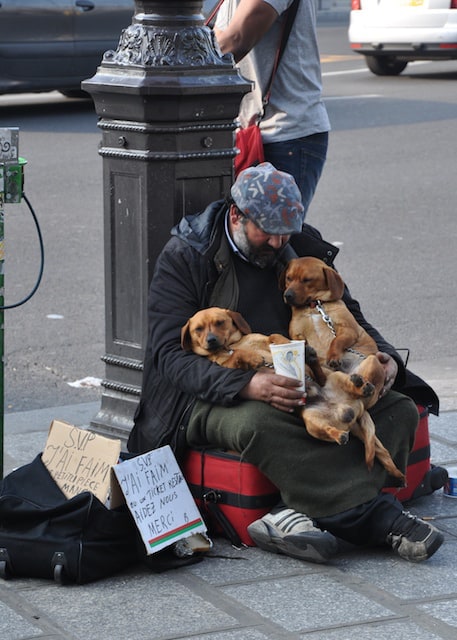
Homelessness in Paris

Homelessness is an issue in any big city, but it’s an absolute epidemic here in Paris.  The local phrase translates into English as “sleeping rough,” and from what I can tell by conversing with fellow Parisians, it’s only been on the rise as of late.  Yet, in that recognition, there is a sense that it’s an accepted way of life rather than a problem that will be eradicated anytime soon.

A socialist way of thinking in France ensures a high level of tolerance for homelessness.  People set up tents on frequently traveled streets.  People sleep in store doorways after those stores close, in subterranean car parks when it’s cold (those places are quite warm), and in the metro (all the time).

The homeless themselves have their own routine.  You can catch them hanging out, reading, or holding puppies, which leads to a 500% increase in the level of donation.  “Oh, you have puppies, so you must need more money,” not, “You’re homeless, why the hell do you have a dog?”

At least once a day someone will get on the metro and make a speech.  They’ll cite children, or being out of work, or some other malady.  They then walk through the car, cup or hand extended.  People will donate mostly on your appearance.  Avuncular and kindly-looking types clean up.  Young and unkempt routinely get nada.  Women are 50/50.  Once they’ve gone through your carriage, at the next stop, they go to the next carriage and repeat the routine.

Buskers (people playing music) get donations purely based on their quality.  There is a guy at Opéra who is at the change to the 8 Line every Sunday (that’s the station I change at to go to Mass) who plays his accordion with an amp which distorts the sound and gives nobody any peace for the 3-4 minutes we are waiting on the platform for our train.  I’m too annoyed to donate.  But last week there were these two guys playing acoustic guitar who TOTALLY cleaned up.  This wasn’t just because they were handsome guys playing guitar (surely some scribbled phone numbers were mixed in with those euros), but also because they happened to be GOOD.  They had decent voices and were playing the strummy catchy music you wouldn’t mind hearing on your metro trip.  There IS money to be made in the metro we always have spare change in our pockets and unlike in the US where coins are mostly denominated under $1, in Europe, those coins can be 1 or 2 euros and what can look like a jumble of coins is probably close to (as it looked to be on this night) close to $100, ostensibly just in this carriage on this particular ride.

Just last night I witnessed two young lads do a satiric song-and-dance striptease (down to a shirt and briefs from shirt, suit, and tie) about ticket inspectors on the Métro.  I might have been the only one who did not contribute just about everyone else in the carriage did.  Want to make some money on the Métro?  All you need to do is strip in front of the French.  They find it tres amusant, apparently.  The américain was not.

Yet, for all the antics puppies, begging on trains, etc., the fact that I’ve seen more than one homeless person reading is impressive to me.  It reinforces the notion that maybe this is a “regular person” who is just down on his/her luck, or if not, proof that being homeless doesn’t need to lead to despair.  It might just be another way to be happy with what you have.

Featured photo is from Nando Prudhomme’s site and is used with his permission.  You can find Nando on Twitter and at http://www.cyanskies.com/.

Did you enjoy this article? TAIP is 100% reader-supported through tipping. If you want to leave us a tip of any amount it would be highly appreciated. These tips help support our efforts to keep TAIP an ad-free environment. Just as at a cafe, the tips are split evenly among the team.

paris at night

Answering “Why Paris” Before I Ever Arrived

Once people get past the shock of my moving to Paris, the usual next question is, “Why?”  Perfectly reasonable question.

When I first started answering this question, I responded with, “If you’ve been there, you know why, if you haven’t, when you come you will understand.”  But in a country populated by fellow Americans, that answer didn’t fly.  I had to remember that I couldn’t assume everyone had a good experience in the city of my dreams.  In fact, the default expectation, over time, came to be that they had not.

One of the things I’ve tried to do when I educate people about Paris is try to point out that some of the things they try to put on the French or Parisians are neither “French” nor “Parisian.”  They are simply “city” things.

Take, for example, the sidewalk.  In a city like Paris, where walking is the norm and cars are the exception, there are certain lanes and flows.  There is a “fast-moving” lane in which people who know where they are going and are going there with a purpose and speed are walking.  There’s a medium lane where people know where they are going but aren’t in a hurry.  Then there’s the tourist lane.  Maps out, smartphones in hand, with the pace of a turtle.  Hey, we’ve all been there.  No harm in it.  Just don’t be upset when people bump into you because you stopped in the middle of a sidewalk.  It’s not your yard or a garden.  It’s a sidewalk.  And you would get bumped into in New York or Chicago just as easily as you would in Paris.

I’ve also been told about how many people are there.  No argument.  Almost 30 million people visit the City of Light every year, on top of the millions of French (plus one more American, soon!) who make that city their home.  But that’s part of city travel.  You’re not going to really understand how and why people live in the chaotic and yet ordered mess ANY city is unless you’re willing to lay aside some of your (unreasonable) prejudices and (reasonable) discomfort to simply move forward and embrace the experience.

Another is the language barrier.  Yes, sure there are French who genuinely don’t speak more than a few words of English.  But many French people do.  Americans often don’t understand what pride the French take in their culture, nation, and language.  But this is because France (for now) is both a nation and a people.  America is barely a nation and was never really a people.  From the beginning America has been a mix of Natives, French, Spanish, English, and later, Africans.  If you can understand that deep LOVE for a language (which English speakers, who rarely take pride in their language nor study its beautiful prose and poetry which can go head-to-head with any other language in quality, in my opinion) then you can and should understand that the BEST way to encounter the French is always to ask, in French, if they speak English.  “S’il vous, plait, parlez-vous Anglais?”  Phonetically this renders as “see voo play, pahr-lay voo ahn-glay?”  If they say no, try someone else.  If you just go up to them, speaking your language, assuming they too speak it, it’s not just rude, it’s disrespectful.  This is part of cultural exchange.  Americans are so used to everything being done in, around, and for them.  Going to other countries implicitly asks you to realize that they don’t necessarily go in for that (and why should they?).

But here I’ve been going on about answering objections to why people don’t want to go to Paris, and I’m missing the chance to tell you why I want to live there.

The food, of course.  The French take eating, mealtimes, and food very seriously.  It’s impossible to fathom the idea of eating at your desk, in your car, or from a drive-thru.  I look forward to breaking myself of those habits.

Seeing things that are hundreds, sometimes thousands of years old, staring back at you, with the detail and symmetry of a human hand unguided by computers.  And seeing stuff like this almost everywhere you turn.

And seeing it at night.

I can’t wait.

Photo by Robin Ooode on Unsplash

Did you enjoy this article? TAIP is 100% reader-supported through tipping. If you want to leave us a tip of any amount it would be highly appreciated. These tips help support our efforts to keep TAIP an ad-free environment. Just as at a cafe, the tips are split evenly among the team.
begin

Begin at the Beginning

So when people first find out I’m moving to Paris, there are usually looks and sounds of astonishment.  And it’s only now, when I’m about 60 days out from beginning my journey, that I truly understand that astonishment, because I’ve felt the full effects of just how hard it has been to pull this off.

Let me explain.  I’m a choleric.  An ENTJ.  People think of my personality as “ready, fire, aim.”  When I made the decision to move to Paris I bought a one-way ticket and started all my preparations.  But, as I was soon to discover (the “aim” part), the science of picking up and moving when you are in your mid-30s and fairly well-established, with numerous possessions, is one that requires a lot of patience and fortitude.  And now, when I’m so close, I finally have the mental real estate to start getting excited.

My love affair with France and the French language started eons ago.  My sisters and family seem very surprised to hear about it now, but the signs were all there.  When I was 15 I delivered an entire speech dressed as Louis XIV in French (I was coached by a good friend on the pronunciation).  I bought a French course on cassette tape when I was 18.  And the first time I returned to Europe since my study abroad, I went to Paris.

I can’t tell you when I first heard French spoken.  I’m sure you’d want me to name the day, time, and hour, but I honestly can’t remember.  I just remember being elevated by the way it sounded, and I was desperate to one day be educated enough to speak it myself.

I have a picture of the first time I stood under the Eiffel Tower.  You can see some flashing white spots on it.  This is the time of day when the lights come on the Tower and so for a period of time it flashes while it’s lighting up.  I just remember being incredibly entranced and happy.  I had wanted to come to this city for so long and I had worried that I had built it up too much in my head.

I hadn’t.  Paris was everything I thought it would be, and more.

There’s plenty more I’ll write over the next year, but I suppose I should end this first post at the beginning of this journey, which is what the title of this article promised anyway.

For those of you who haven’t read The Four Hour Work Week by Timothy Ferriss, stop reading this article right now, go buy it, read it, and then come back and finish reading my article.  For those of you who have (or who are unmoved by my hyperbole), the author lays out a number of thoughtful and stunning premises throughout the book.  The one I will share with you goes under the heading of “lifestyle design.”

The clue is in the name.  Instead of getting a good job or starting a business and then designing your life around that, Ferriss argues that the very FIRST questions you need to ask yourself are: What kind of life do I want to live?  What do I want to do with this life?  What will my legacy be when I leave this earth?  Once you’ve taken the time to answer these questions, then (and only then), do you get to figure out how you will make money.  The making money thing is secondary IF you are living the life you want to live.  Conversely, if you’re making all the money you want and you aren’t living the life you desire, what is the point?

So, at the end of one month off, which I used to spend traveling all around the lovely country of Australia, I had the answer to my question: I wanted to spend more time seeing Europe.  I didn’t want to have regrets later in my life that I didn’t take the time to see a part of the world I loved so much when I was still young (I figure you don’t get to call yourself that anymore when you hit 40, so I’ve still got a solid 6 years!).  I came home in mid-January, told everyone about my decision (nothing like telling everyone to paint yourself into a corner so that you HAVE to do something), and started my preparation.  I’ll tell you more about that preparation next time.

Photo by Brett Jordan on Unsplash

Did you enjoy this article? TAIP is 100% reader-supported through tipping. If you want to leave us a tip of any amount it would be highly appreciated. These tips help support our efforts to keep TAIP an ad-free environment. Just as at a cafe, the tips are split evenly among the team.