walking in paris

Meet Your Paris Greeters

Every now and then my readers tell me about something interesting that I feel needs to be better known and I’ll often ask them to write about it themselves.  Craig Ziegler was actually kind enough to follow through.  Enjoy!

Before my last visit to Paris I learned of the International Greeters Association, a network of organizations around the world whose mission is to introduce visitors to volunteers who will take them on guided walks, at no charge, through their areas and give them a first-hand look at the places they call home. I was surprised to see how many cities had a Greeters organization and pleased to see that Paris had Paris Greeters.
Paris Greeters works like this: once you register with the website, you can request a walk (they don’t call them tours) with a volunteer. After taking into account your interests, language preference, mobility, the date of your availability, etc., a coordinator will assign you to a volunteer who will take you on a walk through his/her neighborhood in Paris. You don’t get to choose your walk; they choose it for you!
I signed up and received an offer of a guided walk through the Bastille quartier with Françoise. Even though I had walked through this area many times over my 15 years of visiting Paris, I accepted the assignment just for the experience. I couldn’t be happier with how it turned out.
I met Françoise at the Ledru-Rollin Metro stop at 10h00 on a Thursday. She was a wonderful walking companion and her English was excellent. Over the next 2 1/2 hours of strolling through the eastern Bastille area, she showed me beautiful courtyards that I had never seen, as well as artisan areas that dated back to the Revolution.  She was so knowledgeable about her neighborhood and she had access to all the private properties. We walked past a historic dance hall on rue de Lappe, the Balajo, that was closed that morning, but she unexpectedly talked the custodian into letting us go inside for a look around at this wonderful slice of Parisian life.
We ended our walk at the Marché d’Aligre, a historic, multi-cultural, covered market in the 12th arrondissement with an extensive flea market outside. She ended the walk there by telling me how proud she was that so many cultures lived together in Paris in peace. She believed that the market area demonstrated this better than her words could explain it.  Paris Greeters do not charge for these walks with visitors, but a visitor can make a contribution to the organization if one would like. I donated 20 € and received an email receipt from the organization shortly afterward.

My walk with Françoise was a wonderful experience and I will surely arrange another such walk in some quartier of Paris when I return this year.

Postscript: This walk occurred eight days before the attacks of November 13. I wanted to contact Françoise after the attacks to get her perspective; the Bataclan is only 2.5 kilometers from her Marché d’Aligre. I didn’t have the heart to call, but I know she was devastated.
Photo by Jeff Frenette on Unsplash
Did you enjoy this article? TAIP is 100% reader-supported through tipping. If you want to leave us a tip of any amount it would be highly appreciated. These tips help support our efforts to keep TAIP an ad-free environment. Just as at a cafe, the tips are split evenly among the team.

The Kind of Afternoon You Want to Lose

Matt was standing outside about to message me but I spotted him through the window.  I was working at Le Poncelet, my favorite cafe in the 17th, the arrondissement I spent my first year in Paris in.  I waved him in.

Le Poncelet for me is a perfect modern Parisian cafe.  It has trouble-free wifi, a great lunchtime special, usually around 12€ (and is sold out of by 13h00), and an unhurried manner that never makes me feel guilty when I sit and work there for hours on end.

Matt and I met for coffee at 10h00.  At 11h45 he signaled for another coffee and Anne-Sophie (one of the four waitstaff, who, in addition to the owner, I’ve come to know by name) politely told him in French that they were going to need our table for lunch.  Understandable: Paris cafes are a sort of no-go zone for the casual coffee drinker between the hours of 11h30-13h30 for the simple reason that the cafe wants to maximize dining revenue by using every available table.  You can always sit or stand at the bar during this time period the prices are cheaper anyway remember that an espresso at the bar might cost you 1€ whereas the exact same one sitting down might run you 2€.

Matt and I had separate plans to go elsewhere and simply work digitally after our coffee.  I needed to continue to move closer to the Louvre, as I was giving four guests a private tour there that night.  We were not far from the Champs and I picked a zany and open Starbucks location there where we might chat in peace and not be pressured into more coffee.

I ordered an Uber for us.  It came 2 minutes later.  I raved about how great the service is in Paris, and he reflected that his terrible experiences on Uber in our city may have been a result of always needing to order a van (he is married with three daughters).

We kept chatting at our new location where we watched a professional panhandler do laps among the crowd, all with a fake crutch.  He occasionally helped himself to abandoned muffins and juice.  Finally a Starbucks employee chased him out.

Matt and I were continuing our conversation we had long ago left visas and expat topics, which was probably the original premise of the coffee (I love to meet my readers in person).  We were now into the area of monarchy (I’m a royalist) vs. anarchy (Matt is an anarchist) and I was making the case that both of these systems depended heavily on personal responsibility.

We had almost finished solving the problems of the world when I suggested we move one more time.  Again to a Starbucks (I’ve explained before how useful they are as lily pads), but this time close to the central tourism office near the Garnier Opera so I could buy the Louvre tickets I would need for my guests.

We commandeered two seats upstairs (where we had this view), and got to work.  Matt got the coffee, as I had gotten another Uber to catapult us here.

Ultimately, I wish that kind of luxury that Matt and I had that afternoon for all of you.  Yes, we had work to do, but, yes, it could wait.  We were having that kind of conversation the kind that many of us associate with a fireplace or a holiday or preceded by a number of adult beverages.  We were stone cold sober, in the middle of a beautiful Parisian afternoon.  We were Americans far from our old homes, who had intentionally created lifestyles that meant we could have this kind of rich and thoughtful conversation on a random weekday a true sharing of ideas, not in which either of us attempted to “convert” the other on particular issues but in which we basked in the challenge of seeing things from another point of view.

When was the last time you had that kind of conversation?  I reckon you’re overdue.

Image from pixabay.com

Did you enjoy this article? TAIP is 100% reader-supported through tipping. If you want to leave us a tip of any amount it would be highly appreciated. These tips help support our efforts to keep TAIP an ad-free environment. Just as at a cafe, the tips are split evenly among the team.

friend turnover

The Friend Turnover

I’m midway through my second year in Paris and I’ve begun to experience something I rarely did during my time in the States: losing people to moves.  When I was younger this was because I was always the one on the move, either due to my family’s movements or my own moves for work or school.  As I got older, I lived among more stable populations and hence rarely attended “going away” parties because no one was going anywhere.

Before I moved to Paris I spent seven years in Kansas City, which straddles the large Midwestern American states of Kansas and Missouri.  It is a wonderful place to live and raise a family, and consequently, most everyone stays.  In my time there I don’t think I knew one person who moved away.  And yet I’ve already lost a friend to Nice just this month, and between now and September I expect to lose four more.  Some have work assignments ending or visas that expire and they have not begun the work to try to stay.  Others are just choosing to move on.  No matter the reason, it hurts to lose friends to moves.

There are dozens of reasons, always particular to the individual.  I don’t expect everyone in fact I don’t expect many to move to Paris with the deep-in-the-bones conviction that they will live there forever.  Since so many come for work it is rare to find that happy coincidence of dream city and fulfilling work (which is why I advocate moving to your dream city and creating your own work) and hence if a more alluring city or job presents itself, Paris can be left behind.

I’m willing to admit that while everyone’s decision to leave Paris can be attributed to individual circumstances, there are recurring themes which I can share with you.  I’ll also try to suggest remedies when it makes sense.

Distance from the City

My friend Anaïs, who left for the south of France last week, has sworn off ever again living in the suburbs.  “I could never do anything at night in Paris,” she opined at lunch.  Since she lived 20 minutes outside Paris she was limited by whenever the final train for her stop left in the evenings, typically sometime before midnight.  People can get twice the space for the same price, but it’s not Paris.  I don’t see how one can fall in love with this city when you don’t live inside it, and when you don’t love something, it’s easy to leave it.

Cost of Living

I always gamely smile when I hear this, in part because it’s really only the rents that are expensive in Paris, and even then it lags far behind Tokyo, Hong Kong, NYC, and San Francisco.  Super high-speed internet?  15€/month.  Fresh baguette? 1€.  Freshly-pulled espresso at the bar? 1,50€.  1 L of organic milk? 2,50€.  Three-course meal at an authentic French restaurant?  24€.  Unlimited travel on the metro, buses, and trains, and 45 minutes per day on the city bikes?  70€/month.  Those are just a few of the things in Paris that are cheaper than what I paid in the States, and specifically in regards to the transport issue, entire costs I used to have are simply gone now, like car insurance, oil changes, gasoline, and the occasional car wash.  Yes, Paris has its expensive sides, but if you are willing to try new/challenging/different living situations you can not only survive, but thrive here.

The Rush

I’ve addressed this in a previous piece.  If you work in one of these nonstop jobs and you aren’t planning and saving for a great escape or a new life, either leave Paris or quit your job, but don’t keep doing what you’re doing.  You’re making yourself miserable and while only the Japanese currently have a word for “death by overwork” (karoshi) it doesn’t mean you are immune to the condition.

Time for a Change

This has to be the most valid reason to leave, if you’re really feeling it.  I’ve heard it said that if you’re always dreaming of your next vacation, perhaps you need to change where you live, since you keep wishing to leave it.  I firmly believe that once you are in a place you truly want to be, you’ll find yourself exploring it endlessly, and won’t have to look exteriorly for fulfillment and joy.  This doesn’t mean you’ll cut travel out entirely, but I’ve observed within myself a huge slowdown in travel, and I think this is because I’m settled and happy here.

Everyone is Leaving!

Well, I suppose this presumes a greater existential question of “What is a Parisian?”  I know at least six people who have lived in Paris their entire lives and half of them don’t really know or love this city at all.  There are “permanents” in Paris (I aspire to be one) but a lot of us came here because we were inspired by what we thought Paris might be like as a residence, not just enamored of what we had experienced in Paris as breathless tourists.

The remedy for this objection is something I am prescribing for myself as well: not so much to close yourself off to new friendships, but covet, guard and develop those more closely that are with those who you suspect are here for the long term.  You can’t escape the pain of losing special people as they move, but you’ll have the consolation of adding friends from all around the world who you might visit on your travels, and you’ll know that when you see them again you’ll be able to pick up on something you’ll always have in common: Paris.

Photo by Jan Tinneberg on Unsplash

Did you enjoy this article? TAIP is 100% reader-supported through tipping. If you want to leave us a tip of any amount it would be highly appreciated. These tips help support our efforts to keep TAIP an ad-free environment. Just as at a cafe, the tips are split evenly among the team.

The Guy Who Stole My iPad

He hangs out at night on my street with three or four of his friends. They smoke, drink, and talk about nothing, as 25-35 year-olds are wont to do. Whenever I pass him, and we manage to make eye contact, I smile, wave, and cry out, “Mon petit voleur!” I call him a thief because last November he stole an iPad out of my bag.

* * *

It was my last trip of the night. After one year I had “graduated” from my 8 square meter closet in the sky, towering above the rooftops of the 17th arrondissement, to the 39 square meter reality of a 2nd arrondissement apartment with a kitchen I couldn’t reach from my bed/couch. The day had been filled with those joys of Paris moves: large bags and luggage going down one set of stairs and then up another (in my case down eight flights of stairs and up five; no elevators), with the steps and passages of the Métro in between (some can afford moving trucks I couldn’t at the time). It was 00h30 and I had the last few things with me: two bags slung over my shoulder one of which was an open sack that contained my laptop and iPad. As I exited the metro I pushed the office chair that I had also brought down the platform. A young man and three of his friends came down the stairs. The one I would focus on (from here on “MPV” for “mon petit voleur”) started to mock dance with my chair. Tired but amused, I didn’t even take the headphones still blaring Chris Martin and Coldplay out of my ear. I simply hauled the chair up and over my head to carry it up the stairway and as I turned away from the group one of them must have reached into my bag and taken my iPad. I didn’t think to check my bag until I had reached the top of the stairs. In a panic, I stashed my office chair and bag someplace by a building and dashed back to confront my thief. The adrenaline had dumped into my bloodstream (I could feel the rush) and I didn’t think clearly enough to go back to the same “inbound” platform I had just departed but instead went to the “outbound” one. I stood on the platform crazed and breathless, and then, just as the train on the opposite platform started to creak forward, I made eye contact with MPV. If I hadn’t been incredulous, I might have shouted expletives. As it was, all I could summon was a measured but incensed, “Hey!” He laughed, smiled, and blew me a kiss. The train slid out of the station.

* * *

I didn’t stay to watch it disappear into the darkness. That would have been pointless. I was going to activate the app which Apple had made famous: Find My iPhone. I almost ran up the staircase with my remaining luggage, kept going to my apartment, ran up those stairs as well, with my office chair no less, and hurriedly opened the door to my new apartment. I dropped everything on the floor and activated “lost mode” on the iPad. It showed up almost immediately. The pinging blue dot was at République, four metro stops away on Line 3, and was moving slowly towards Canal St. Martin.

As I look back on it now and reflect on the actions which followed, I think of it as calculated irrationality. At the time my French was still more elementary, I was alone, and I didn’t actually know how many friends he had in his posse. But I had been stolen from, and the salve to cool the white-hot burning humiliation and anger (which, interestingly, is not unlike the embarrassment a nine-year-old child might feel upon being slapped in public by his mother) was the feeling I hoped I would experience upon tracking this guy down.

* * *

I came out of the main entrance of République, without even noticing the statue, the one I so despise, that sits in the middle of the square. I focused on the radiating blue dot on my iPhone, the blue dot which had not moved since I started tracking it. I had sent a message in French to display on the iPad that essentially said I would take the iPad back for 50€ without involving the police, with my phone number appended. Unsurprisingly, given (as I learned later) what he could get for taking it to one of these chop shops in town that wipes them and sends them to Morocco to get sold, he didn’t respond.

Within minutes I was standing directly in front of the café the blue dot indicated my iPad was in. I spotted him. I was breathless and angry, so I started shouting at him in English. I pushed him. I called him names. People came to intervene. I pulled out my phone to take a picture of him and he threw a punch at me as I took it, obscuring the picture. The remaining adrenaline had been dumped into my system. I wasn’t thinking about his friends or the possibility of knives. In reality, any of them could have had their way with me because I was fixated on his visage: he was the only one I had identified from the moment of the theft. My stupidity and carelessness aside, I manage to pat him down (an iPad is a hard thing to conceal) and found nothing.

At this point some of you might be shouting for me to activate the “alert” sound which would have made it easy to find the iPad. Instead I fixated on this guy, who when I realized didn’t have the iPad, started to walk off. I stayed with the geolocation that the iPhone was giving me. The blue dot wasn’t moving despite the fact that he was now a block away. This could only mean that one of his friends (who had scattered and none of whom I would recognize anyway) had it. I stayed there for a few more minutes, speaking in broken, angry French to anyone who would hear me. Then the dot started to move rapidly in the opposite direction from which MPV had walked off. It was in a vehicle of some kind. I started running after it.

* * *

It was 01h32. I remember a gentle rain falling. It was the kind you could possibly enjoy not the spitting type that so often annoys. My phone’s battery, taxed with the exertions of tracking and GPS duties for 60 continuous minutes, was down significantly. The adrenaline had been spent and outside of the fight or flight context I had been in just a while ago, my body assumed the facts of the day: fatigue from a full day’s move, frustration at the poor moves and decisions made in the last hour, and the dawning of the next stage in the seven that comprise grief: acceptance.

“Say it,” I said to myself. “Say it so we can go home.” I looked up, looked around, and with chagrin that no one saw, said at a volume that no one could hear, “I’ve been robbed.” I slowly exhaled and walked to the Métro. After some more anguished reflection, I fell asleep for the first time in my new apartment.

* * *

If I had originally encountered this man in my neighborhood, then surely, I reasoned, he might be a regular (Parisians get into patterns with their nightspots and hangouts). “Perhaps I’ll see him again,” I thought to myself. It’s a small enough Paris to have chance encounters with friends. Surely I could manage a chance encounter with an enemy?

I didn’t have to wait long. I went to the US in the month of December for personal and business reasons and when I returned in January I saw him. I was so shocked to see him that I didn’t make eye contact and hurried past.

He lived on or near my street, I realized.

The occasions repeated, but now I would smile and call him “my little thief” as I walked by. He smiled and waved. It was this acknowledged reality: “Yeah, I stole from you, but come on, look at me.” I didn’t have any recourse that wouldn’t take an extraordinary amount of time and would ultimately be fruitless. I let it be.

Instead, I’m finally sharing this account with you, writing in the café I was in when I first saw him emerge from an adjoining building with a cute little child. A daughter? Niece? I didn’t know. Part of me wanted to go up to her and tell her in my now-much-improved French, “Hey, do you know this man is a thief?”

But almost immediately, I laughed at my first-world problem (and apparent grief). The guy with a Macbook Air and an iPhone was going to be aggrieved about a stolen iPad (which he had bought a replacement for in December) when there were people who didn’t have clean water to drink or food to eat? Non. And for once, I thought I might try “forgive and forget,” even in the absence of an apology or demonstrated remorse. If I buy this guy a drink one day, I might not only forgive, but begin to forget. And if I can do that for a stranger who had wronged me in such an unwarranted manner, might I not see a way back to forgetting all the wrongs that had been done to me over the years, by friends close and distant? But then this would be the thief who gave something to me instead of just taking something, n’est ce-pas?

Did you enjoy this article? TAIP is 100% reader-supported through tipping. If you want to leave us a tip of any amount it would be highly appreciated. These tips help support our efforts to keep TAIP an ad-free environment. Just as at a cafe, the tips are split evenly among the team.
I Live in a Different Paris Than You Do…

And you know, Paris is all metro and work and the run-around.”

He used the famous idiom “Metro-boulot-dodo” which is a colloquialism that is literally “subway-work-sleep” that indicates the grind of life for many in the City of Light.  We were high in the French Alps, not far from the Italian border, but quite a distance away from home, and yet the complaint was similar: “I used to think Paris was magic, but now it’s just a place I work and pay bills.”

I tried to hide my dismay at hearing this, because no one should live in a place that one doesn’t love, if it can be avoided.  It’s socially acceptable to tell people you moved to a dreadful city for a job but it’s some revolutionary concept to tell people you moved someplace for the city and who cared about the job?  It would come.

Now, I’m not pretending that everyone can have a great amount of time wealth/lifestyle in the world’s finest cities, but if you are going to bother to live there, to “put up” with the cost of living, it’s surely a great shame if you can never enjoy it.

Now, the first time I heard this complaint was from a lady who attended my Paris Culture Lovers meetup who rather sourly complained about her schedule as I described my own, which included grocery shopping, visiting parks and museums, and riding a Vélib during “off hours” when everyone was at work from 9-5.  While I was a bit taken aback at her tirade, even though I’ve become very used to the French complaining (it’s a national art and sport), especially since she chose to move to Paris 15 years ago for work I avoided what would have been a typical American retort: “Well why don’t you do something about it instead of just complaining to 10 near-strangers about it?”  I said it another way to my friend Julia last month: “The French as a people would rather complain about what they don’t have than take responsibility for building their dreams.”  Instead, I just managed to stutter, “I guess…I guess I just live in a different Paris than you do.”

Since my current conversant was French I decided to take a different tack and asked him how he planned to break the cycle.  He shared some great ideas, but unsurprisingly, had not done any real research into those ideas.

***

Okay, Stephen, so people quit their miserable city jobs, then what?  Look, I don’t know.  I’m not advocating that everyone quit his/her respective jobs.  I’m just asking the serious and adult series of questions: what is the life you want for yourself?  Are you living it now?  If not, why not?  Do you have any plan or timeline in which you will be living the life you want?  Does it solely hinge on money?  Have you rethought that?

Surely life is more than paying rent or a mortgage.  Our time on this magnificent planet is too short and brief to spend focusing on the life you don’t have.  Start creating the life you desire and marvel at how much the journey alone will prepare you to enjoy what awaits your sacrifices.  I’m reminded of the words of Marcus Aurelius:

The impediment to action advances action. What stands in the way becomes the way.

The obstacle is the way.

I took the featured photo in the Tuileries when Spring had definitely arrived this year after a very long stay by Old Man Winter.

Did you enjoy this article? TAIP is 100% reader-supported through tipping. If you want to leave us a tip of any amount it would be highly appreciated. These tips help support our efforts to keep TAIP an ad-free environment. Just as at a cafe, the tips are split evenly among the team.

Little Entrepreneurs and a Sunday Stroll

I’ve often said that Paris is built for walkers.  The subtext there is that it’s a dream for wanderers.  Have some free time and nothing on your agenda?  Just take a stroll.  If it’s a particularly cold day, you might hit a string of Passages.  Historically these were just places where the bourgeois could shop, free from the threat of the elements.  Now tourists (and locals) mug in, enjoying the ongoing “show” that is the endless corridors of glass shop windows.  Today my target was a string of them, starting in my neighborhood, the 2nd, at the Cadet Metro station and working my way south towards Bourse.

Because my French is still a work in progress, I will often buy used children’s books as a means of improving (so I read like a French 10-year-old, so what? 🙂 ).  If they are used and on offer for 1 or 2 euros, that’s ideal.  These young entrepreneurs had set up in front of a beautiful art store that was conveniently closed.  People might crowd around looking into the store at curios and hey there are some kids selling books right here let’s take a look.

Where had these children (they couldn’t have been older than 10) gotten these books?  Had maman insisted on a cleanout of the rooms?  Had they found them by the trash somewhere and decided to be enterprising?  I stopped asking myself questions and started looking for my friends Babar, Madeleine, Tintin, and Asterix.

I spotted what I wanted a picture book on St. Bernadette, and inquired of one of the young ones “how much?” in French.  She told me to wait one moment and she asked her brother.  He told her, “Whatever you think.”  She paused, hand firmly under chin, mulled it over, and said “deux cinquante.”  I shrugged and nodded and reached into my pocket and pulled out a grip of coins.  Seeing my “riches” she quickly amended: “Trois.”  I laughed.  How do you say no to a kid selling books on the sidewalk on a Sunday?

I happily paid the spontaneous 20% upcharge and walked away with my new treasure, grateful to witness yet another facet of life in this amazing city.  Entrepreneur might be a French word, after all 🙂

Photo of said entrepreneurs in the Galerie des Panoramas.

Did you enjoy this article? TAIP is 100% reader-supported through tipping. If you want to leave us a tip of any amount it would be highly appreciated. These tips help support our efforts to keep TAIP an ad-free environment. Just as at a cafe, the tips are split evenly among the team.

Work — Life — Space

I think work/life balance is a lie modern man talks about because he has lost his way.  He thinks that if work and life is strictly separated, and then “balanced,” that all will be well.

What should be our mission and goal is not only to see work as a positive good and normal part of our existence as humans, but also to see all of our existence as life, pure and simple, and try to grapple and take hold of it.

I run several businesses, none of which require me to be inside, so it’s easy to be outside in the lingering remains of a Parisian summer.

The cafe is a classic place to work.  Pay a couple euros, stay as long as you want, and if you know your wifi spots or if your data plan is good, you’re set up.

I choose some quieter places, as the day and inclination invite me.

How about an out-of-the-way hidden neighborhood garden?  Quiet.  Flowers to inspire you.  A bench to yourself.

Perhaps a more crowded park?  Hang with the ducks?  Watch people feed them.

Or my personal favorite: a lesser-known, beautiful church.  You have room and quiet.  You have unmatched views.

Want something really unconventional?  A cemetery.

A workspace can’t and shouldn’t be a sanitized “clean space” where you have no distractions.  You should bring discipline and purpose to your work and choose a workspace that will invite the brightest distractions and recollections, whenever you need to take a break from your work life.

I was asked to write this for WeWork.com and their recent “Where do you work?” campaign.

Photo by Antoine Similon on Unsplash

Did you enjoy this article? TAIP is 100% reader-supported through tipping. If you want to leave us a tip of any amount it would be highly appreciated. These tips help support our efforts to keep TAIP an ad-free environment. Just as at a cafe, the tips are split evenly among the team.

high line NYC

NYC: Parisians’ Delight

I’m always curious to know what fellow Parisians think of their visits to my beloved United States.  Often they have been to America, and usually, they have been to New York.  Now, when most people tell me they’ve visited New York, I tend to ask, “where” because I don’t assume they mean NYC.  And I certainly don’t mean what Parisians mean, which is Midtown Manhattan.

While Midtown has its own striking features, it’s hardly “New York” and worse, it’s hardly worthy of the answer to my follow-up question of “Why do you like it?” which is “Because it’s the most European city in America.”

The one time I was eating when someone said this to me I almost choked.  That statement is so untrue on a number of levels, and I usually have to ask a number of follow-up questions to clarify why my acquaintance or friend has come to such a strange point of view.  Some commonalities:

1.  NYC is the only American city he/she has visited

2.  While there, he/she never visited Brooklyn, Queens, or the other boroughs.

3.  He/she was there for a week or less

These circumstances, combined with an ignorance about what other American cities have to offer, or worse, an ignorance about European cities, inevitably lead some of these Parisians to an idolization of NYC which is unwarranted.

Don’t get me wrong.  I love the Cloisters.  And the High Line.  And Brooklyn.  The Park.  Washington Square.  The MET and all the things that make NYC great.  But it’s not our finest city.  That title firmly belongs in the hands of San Francisco (but that article is for another time).  For now I’ll confine my remarks to NYC.

The Cityscape Itself

NYC is part of an elite group of skyscraper cities, which includes Tokyo, Shanghai, Singapore, and the like.  There is nothing European about streetscapes and cityscapes of massively tall buildings that create wind tunnels.  Indeed, in Paris all such buildings are clustered outside the city limits, at La Defense, as if to say build these if you must, but please don’t invade our living space.

I’m not arguing that skylines need to look like Florence’s, where the majestic Duomo and the competing Medici Tower dominate and all other buildings rise to about the same level, significantly below both those buildings.  But NYC’s cityscape matches none in Europe.

The Melting Pot

On this point it’s important to note that London and Paris, like NYC, fall into the category of “international cities.”  Surely you will learn about England and France, respectively, upon visiting those cities, but if you want to really know Britain, you need to go out into the shires.  Or to neighboring countries within the United Kingdom, like Wales.  If you would know France you should visit Bordeaux.  Or Bayeux.  Or Grenoble.  Or Strasbourg.  Those are all “European cities.”  But they are not multi-cultural melting pots.

London and Paris are playgrounds for those of us who love to learn about other cultures, but as “European cities” they are outliers.  Most European cities have a dominant language, ethnic majority, cuisine, and culture.  And at least, at the end of the day, London and Paris can claim their own culture too.  But what is NYC, but the cathedral of change and the bastion of commercialism and the consumer culture?  NYC is in its own way, a celebration of no identity and no heritage and no culture because of the mistaken belief that since all cultures are “equal” (whatever that means) that a melange of all is a culture in and of itself.  It’s not, and the banal and ubiquitous “I love NY” shirts is perhaps representative of what NYC can be at times: tourist hype.

The Cost of Living

One of the magical things about Wimbledon is that it’s still one of the major sporting events that you can buy tickets for the day of, at face value.  You’ve got to queue, but that’s really a minor inconvenience. 🙂  It allows the groundlings to mix with the elite who never needed to queue to have an assured place.

A European city still has a place for the least affluent in our society (and I’m not talking about the homeless here: they manage to find spots all over the world).  Paris is on the margins of affordability, but NYC is in another solar system by comparison.

This is all to say that my fellow Parisians might look for some treasures off the beaten path the next time they decide to visit the US.  This HuffPo list might be the place to start.

NYC: hardly the most European city in America.  It’s not even the most American city in America. 🙂

Photo by Elizabeth Villalta on Unsplash

Did you enjoy this article? TAIP is 100% reader-supported through tipping. If you want to leave us a tip of any amount it would be highly appreciated. These tips help support our efforts to keep TAIP an ad-free environment. Just as at a cafe, the tips are split evenly among the team.

Paris: The Most Beautiful City in the World

I understand that in a world that thrives on relativity (“everyone’s opinion is equal,” and other such tripe) such a declarative statement as the title of this essay makes may rankle.  Let’s start at the outset by admitting that the world is full of beautiful cities.  But before you get upset, let me make my case.  Save your furrowed brows for after you’ve read my piece.

I have been deeply blessed to have been to many capitals all over the world.  The capital of any country is a place where the country may, like a peacock, strut with feathers in full view.  There may be monuments to national moments and heroes, and churches where many gathered for centuries, and streets with countless stories.  Paris is one of those capitals, and yet for all the vaunted pride of the French, Paris never struts, as it is supremely confident in itself.

When people ask me why I think Paris is the most beautiful city in the world, I always start by talking about the beaver dam.  The beaver dam is an artificial construct made by animals within a natural environment.  The beaver dam is useful, aesthetically pleasing, and sustainable.  When viewed in nature it does stand out and yet it is harmonious.  When it is at its best, the human city is much like the beaver dam.

It’s Beautiful

Beauty isn’t uniformity or conformity.  It’s the respect paid by those creating to those who will view it, throughout all time.  In the construct of a city, this means sidewalks that invite and welcome walking, paths for bikes to buffer those pedestrians, and limited access to cars.  Cars cannot be allowed to be the defining principle of city planning and growth.  It’s not that cars are ugly it’s that in being overly accommodating to them we impinge on everyone else and part of beauty in a cityscape is balance.  Despite being built long before the automobile’s ascendancy, Paris does an excellent job of giving cars freedom to roam without allowing them to own the road.

It’s Accessible

A beautiful city can’t be unreachable.  It has to be accessible to all.  Paris has every mode of transportation imaginable, at reasonable prices (for the resident it can be a bit pricey for tourists) and with a high level of reliability.  If you can’t afford these modes of travel, the city is built for you to walk;  businesses, diffuse in their location and variety, are everywhere to accommodate you.

It’s Not Sprawling

Still-intact medieval cities like Toledo in Spain give us a good idea of what “size” should mean in relation to the human scale of cities.  Some cities, like Portland, Oregon, are experimenting with this in our modern milieu.  Whether they can be successful in the era of speculative real estate is less relevant than the effort itself.  A city like Paris which is relatively small (I’m only examining the 20 arrondissements that properly comprise the city) allows you to get to know your neighbors and run into people all the time.  Those sorts of occurrences build that social fabric that makes a civitas, not just a group of people living in proximity to each other.

It Lets Nature In

Paris has trees down nearly every boulevard and more parks than you can shake a fallen tree branch at.  Nature is seen as a harmonious and necessary part of the city not something you keep on the outskirts or in the countryside.

It Melds Old and New

As much as I may dislike the Georges Pompidou or Bibliotheque Francois Mitterand, they, and other structures like them remind us that the human project is never finished.  Some periods are clearly better than others (you’re never going to get me to like the Rococo or Mannerist periods) but yet all of it still, in its own way, works.

It Has Water

An homage to an era before we could steal water from far away places and create cities that should not exist (Las Vegas), a river reminds us of the reason why humans came together to live in the first place to be near a resource so integral to our daily lives.  Now, I should admit that the dirtiness of the Seine is a disgrace and has a number of not-easily-resolvable causes, but the way the river and its constant traffic both on it and along its banks, winds through the city is fundamentally arterial, and, if it were removed, its loss would completely change the character and city for the worse.

Public Spaces Play Host to Private Pride

Many homes in Paris are small and are not built for large-scale entertaining.  As such, many parts of the city are de facto extensions of the home.  Those public spaces are more beautiful than even the most extravagant private places might be, and so you can take a stroll through what were once the private demesne of the king and his family, and see how staggering such beauty, kept to oneself, might have been like.  You live within a small home because what is outside and available to you for free is so priceless.

It Has an Identity

It’s only a virtue to be an “international city” if you have your own clear identity.  If you walk away and know what the identity of the city is what it has left within you.  Paris is the most visited city in the world for a number of reasons, but I suspect that part of it has to do with the fact that not only does Paris promise so much to those who learn of it, but it so overwhelmingly delivers that we lovers of it are forever haunted by its soul, even if circumstances do not allow us to make a permanent home here.

Many cities are beautiful in their own way.  But Paris, for all these reasons and more, is the world’s most beautiful.

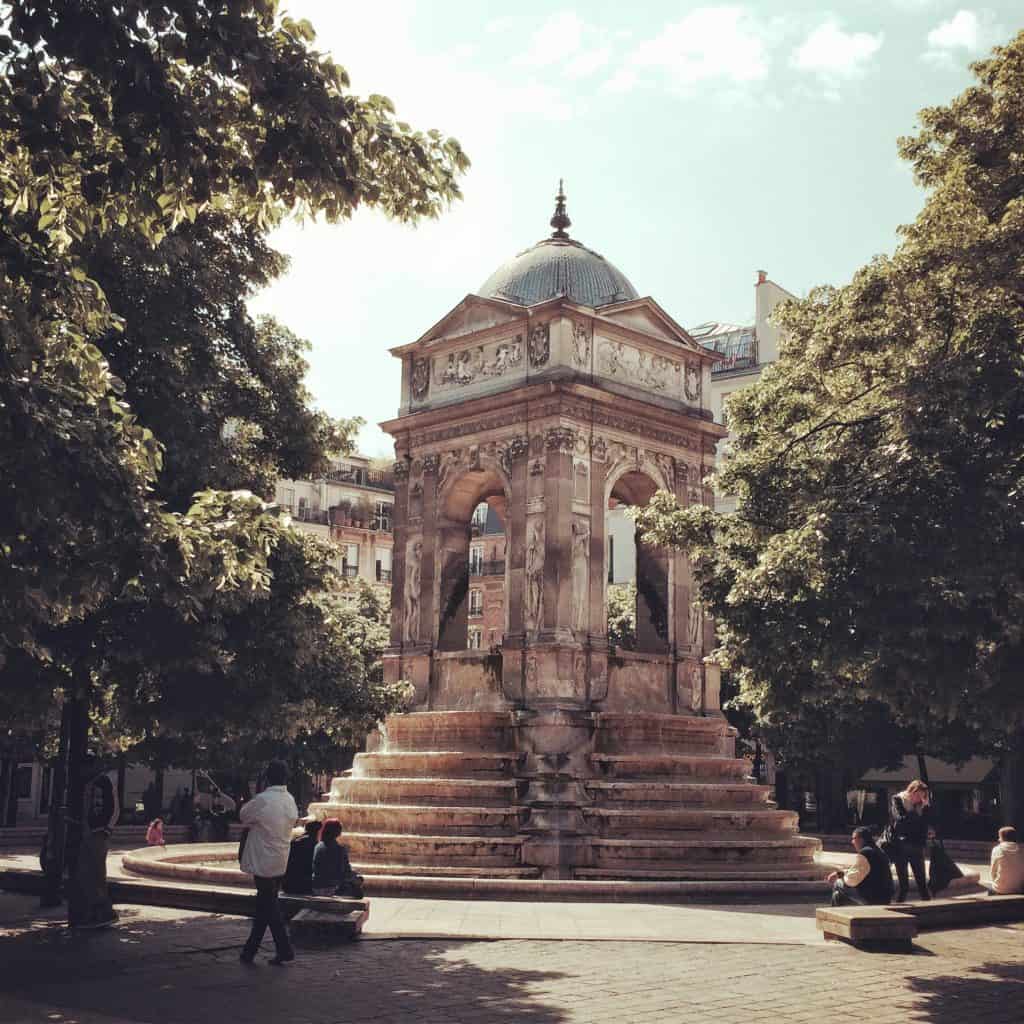
A summer photo of the Fontaine des Innocents, about a ten-minute walk south of my apartment in the 2nd.

Did you enjoy this article? TAIP is 100% reader-supported through tipping. If you want to leave us a tip of any amount it would be highly appreciated. These tips help support our efforts to keep TAIP an ad-free environment. Just as at a cafe, the tips are split evenly among the team.

Death in the Afternoon, or Sunday Chess in the Jardin du Luxembourg

Meetup is a great website.  If you don’t know it, it is a site that allows you to create a group based around a particular love or passion.  Want to play bridge?  Or go hiking?  How about practicing your English and French?  All you want, and then some.

The burden is on the organizer.  He/she pay$ to start the group and is responsible for its ups and downs.  The better the organizer, the better the group.  I’ve started two groups here.  One for soccer inside the city (there are a couple of excellent groups that play in the big parks just outside the city…I can play soccer in a big field anywhere in the world.  But in front of Les Invalides?  Not too often.).  The other one is for chess, and has been pretty successful in its early days.  Our first get-together found 8 strangers from all over the world drawn together by a common love for the game of black and white squares, and the pieces that inhabit them.

That first meeting was at Anti-Cafe, a “co-working” space.  More on that another time.  A great time was had by all and we played timed and untimed games.  We also took time to school a novice on the rules and some basic strategy.

Chess is fascinating on many levels, and during the year I lived in Saint Louis I was a member of the Saint Louis Chess Club, which hosts the US Championship every year and where you can get tutored by grandmasters.

Basic principles beyond the names and movement of pieces are manifold, but here are three that I share with any fellow novice:

1.  Try to capture/attack the center of the board

2.  Try to develop your pieces (move back-rank players forward)

3.  Try to consider each move through the two-fold criteria of what is this piece attacking and how is it attacked

These principles were on my mind last Sunday, during our latest meetup our first outdoors at the Jardin du Luxembourg.  After three successful meetups, where we had built up a strong core, I thought a fun tournament, with some euros on the line, might be fun.  5 euro buy-in.  We would see who would show up.

As a group becomes more carefully curated over time (again, depending on the organizer), the percentage of who signs up for an event vs who shows up may improve; my basic rule was 50%.  That is, if eight people said they were coming, then four people, at best, would be actually coming.

Today was a bit better.  Ten committed, including myself.  We had five plus myself actually show up.  There was an alleged “beginner” but as we played a quick game it became obvious he was just being modest.  I drew up a quick series of brackets that ensured everyone would play at least three games before we got to the final “money” matches.  It was imperfect for sure.  I had always played in well-organized round robins but as the sole organizer unsure of the number of attendees I hadn’t troubled too much with an elaborate schedule of matches.

Indeed, my focus (perhaps wrongly!) had been on bringing terrine, crackers, oranges, and vin rouge.  Who can play chess without drinking, surely?  But that is the least of the tournament transgressions we committed.

No one else had brought clocks so I loaned out my iPad and iPhone, both of which had chess clock apps.  The iPhone sadly gave up the ghost midway through the 3rd match, though the iPad lasted longer.  Some couldn’t play a timed match due to the paucity of clocks.

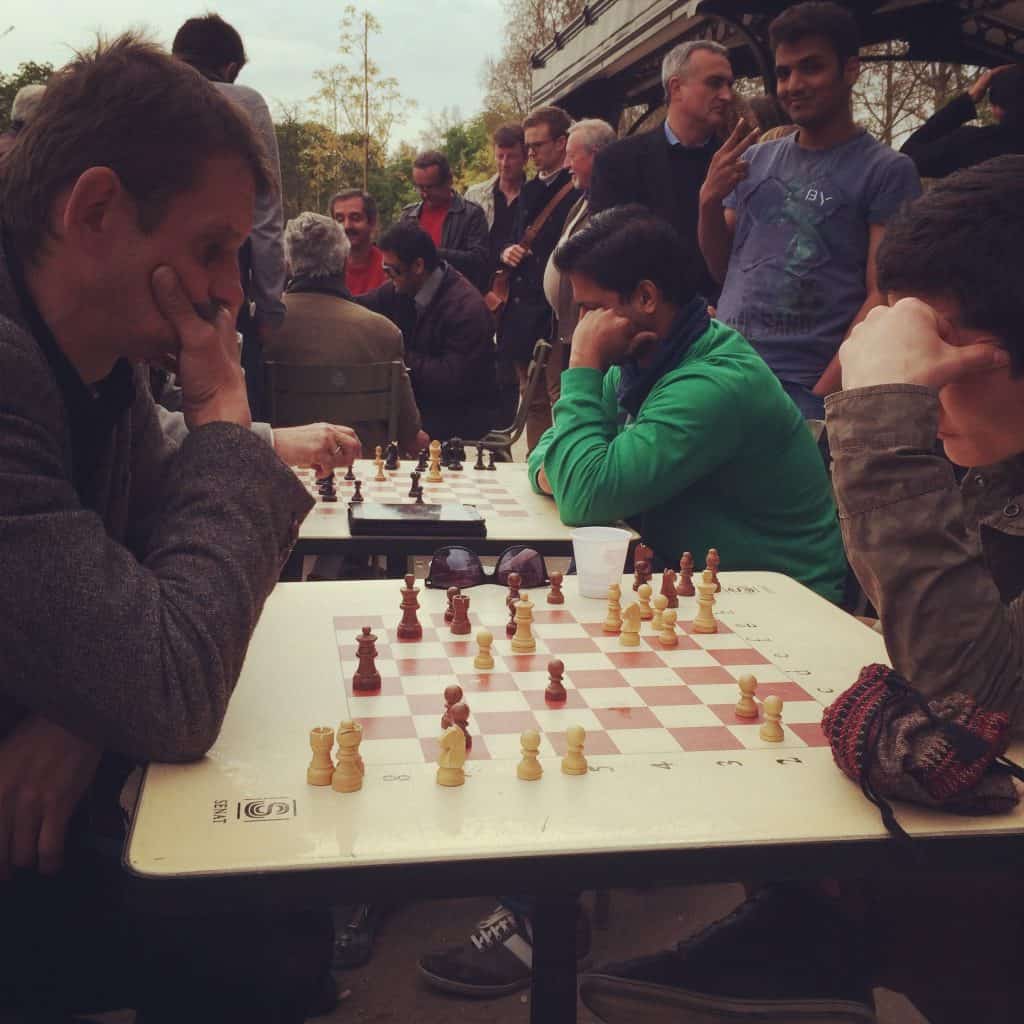
You also shouldn’t talk during tournaments, but the French are quite disposed to comment on everything, whether they know you or not, much less chess.  We were just a few feet away from the most popular players in the Jardin.  One of them was an old man with a grizzled salt-and-pepper beard.  The other was a man with palsy.

They played 3-5 minute blitz games, where moves were almost instinctive.  Winner stayed, loser walked.  Occasionally bets would be taken.  A group of 15 always surrounded whomever was playing a variation on a nerd cage-fight.

Everyone was commenting on the game: some jeering, some offering officious (or kind) advice.  Players got into it also: “Allez, putain!”  I laughed heartily and leaned across to my adversary, “Les français sont très polis, non?”  He laughed also.

Tourists, taking in what had started as a beautiful day, continued to mill by even as it got overcast and slightly chilly.  I heard the snap and click of cameras and I wondered how my horrible losing positions might look on someone’s Facebook, captioned, as, “what a moron: mate in 7!”

I had placed four of the six players in “advanced” brackets.  Yves, the self-proclaimed beginner, and I, occupied the “knockout” brackets, where we would play each other and the losers of the upper brackets (As an aside, I love names like Yves and Ombeline that we just don’t have in English).

Some played faster than others and in between Yves and I’s second matches, some parents cooed their precocious children our way.  The children looked reluctant and somewhat embarrassés about their French “tiger mom” who would take them to the tables of the Jardin to make them play chess with adults.

We looked friendly enough, as usual my goofy American smile was the “over here” beacon that allowed a French parent to come over and ask, “peut-il jouer avec vous?

Oui.”  Chess keeps you humble, I thought to myself as I reached out to sake the paw of the (I guessed) 10-year-old, also remembering to switch all my you-singulars to the familiar.  Children and animals get the “tu” treatment automatically.  “Tu” though he might be I figured that no kid who was going to come play with adults was a slouch.  I expected to lose.  I’m only in the mid-hundreds in USCF ratings, after returning to the game in 2011 after a nearly 2-decade absence.

“He’s terribly aggressive,” I thought to myself as he brought out his Queen in move 8.  Yes, I had people asking me questions, people wanted to know who played next, my own vin to pour, bien sûr, but all credit to the kid, he beat me handily, in fewer than 20 moves (I wasn’t notating, but that’s a fair guess).  I was a bit distracted but he beat me fair and square!

His sister was playing a slower, less aggressive game against Prem.  “Be careful, ah?” I said with a smile.  “He beat you?” Prem asked, almost astonished.  “Oui.”

An English father came up and asked in halting French if his kid who looked 8 could play.  After a bit of discussion, I let the battle of les enfants terribles commence and I chatted with the parents.

From London, and Arsenal fans, even better!  The kid was rated 1700, with the father in the 2000s.  Even mom was an 1100.

“We don’t have anything like this in London.”  “Yes, it’s wonderful, isn’t it?  Put some beautiful boards down and people will come.”

There was a bocce ball “field” right by a park in my arrondissement at the Square de Batignolles.  It was often occupied by Italian expats who took their native game quite seriously, grazie mille.  Angry Italian spewed out whenever a teammate was supposed to have made a poor throw.  No angry Italian, or angry any language here, really.

We laughed and looked back at the game at hand.  “Your son’s quite deliberative.”  “Yes, well, I blame his coach.”  “You, no doubt,” I surmised.  He didn’t say anything.  He was analyzing his son’s current position.  The mother was being indulgent.  She wanted to move on after the first game but we encouraged them to play one more.

To keep her amused I switched into tour guide mode and told her a bit about the garden itself, its founding, and recent history.  “You love this place,” she remarked.  “It’s my favorite big park in the city, yes,” I replied.

The kids wrapped up, I wished them well, and I notified all my players of the final matchups, collecting the euros and placing them under the clocks of the respective games: 15 euros for the top winner, 10 euros for the next bracket, and 5 euros for the final bracket.

Aranya (giving the peace sign here) actually won the final between him and an elderly gentleman who went by the Meetup handle of “Whynot.”  Instead of taking the money and running, they went for 2 out of 3 and Aranya conceded the next two matches, and the 15 euros.  Why not stop? 🙂

Erkhem, who had only been knocked into the second bracket by one loss, took a bit longer to take out Prem.  They too played at least one more game, but Erkhem had the sense to confirm his winning after the first game.

Much of the food and drink I brought was uneaten (note for next time: food not so important for chess nerds) and as we shook hands almost four hours after we started, I promised more meetings for the months ahead.

Did you enjoy this article? TAIP is 100% reader-supported through tipping. If you want to leave us a tip of any amount it would be highly appreciated. These tips help support our efforts to keep TAIP an ad-free environment. Just as at a cafe, the tips are split evenly among the team.