French pastries

The Life of a French Pastry Chef

If you’ve been following my life here on TAIP, you know that I got married last year not once, not twice, but a whopping three times (you can read about the first two times here and here). Yes, all to the same person. Who happens to be French. Who also happens to be a professionally trained pastry chef. 

The typical reaction I get when I tell someone what he does is, “Wow! You’re so lucky to get homemade French pastries at home!” I don’t have much of a sweet tooth (pass me a plate of fries over a plate of cookies any day, thank you) but I have to admit I do enjoy having access to homemade croissants, macarons, chouquettes, and more whenever the mood strikes.

The life of a French pastry chef is not for the faint of heart — something I witness on a daily basis because I live with one. What kind of training do you need, you may be wondering? Is it as glamorous as it seems? Is it hard waking up at 1am to go to work every day? Is it worth it?

Let’s find out.

A Baker Does Not A French Pastry Chef Make

I was originally going to call this article The Life of a French Baker but my husband stopped me before I even started. “Je suis pas un boulanger,” he told me. I am not a baker

In France, a baker and a pastry chef aren’t one and the same. The baker bakes the bread and the pastry chef makes the pastries. There’s even a third person you have likely never heard of who is in charge of viennoiseriecroissants, pain au chocolat, etc. — called a tourier

Of course, there are bakeries in France that don’t have all three experts on staff. My husband says that lots of bakers and pastry chefs know how to make viennoiserie, and many touriers can bake bread. Are you still with me?

As you’ll discover if you ever learn the French language, this is a country full of contradictions and exceptions.

Training, Degrees, and Certifications

Like all French people our age, my husband had to have an idea of what he wanted to do as a career by age 15. It’s a bit different these days, but at the time, he had to decide whether to continue on to high school or start a trade school.

He decided to go to Centre d’Excellence des Professions Culinaires (CEPROC) in the 19th arrondissement in Paris to study pastry. At the time, he worked toward le Brevet d’études professionnelles (BEP), a three-year diploma that required him to split his time between classes at school and a job in a local bakery. 

Today, aspiring French pastry chefs have the choice between a certificat d’aptitude professionnelle (CAP) or a baccalauréat professionnel (BAC pro). The former is a degree program like my husband did — he bypassed high school and went straight into culinary school — but that also means he does not have a high school diploma. You have to go to high school if you hope to be accepted into a BAC pro program. 

There are several other certifications you can get as a pastry chef. Le Brevet de Maîtrise Pâtisserie, for example, is the highest diploma a French pastry chef can obtain. 

You could also become specialized in different aspects of pastry. Chocolate, ice cream, and 5-star restaurant-quality desserts are just a few areas you could go into.

All of this being said, you don’t technically need a degree, certificate, or special training to be a pastry chef. Many begin at a very young age and learn as they go. 

The (not so) Glamorous Lifestyle

You may imagine the life of the French pastry chef to be filled with sweet aromas, sneaky taste tests, and constant praise and accolades. It’s not. 

My husband often has to be up at 1am to be out the door at 2am. That means that he has to go to bed around 7pm. Not ideal when you live in a tiny studio in Paris. I don’t have to (or want to) go to bed before the sun goes down so I either need to make myself scarce (and be quiet when I come home) or hunker down in the kitchen so as not to bother my very own sleeping beauty. 

Fortunately, we no longer live in such a small space so this is no longer an issue. At the time I couldn’t help but feel a bit grouchy when everyone told me how “lucky” I was to live with a pastry chef. Don’t get me wrong, I feel very lucky to be with my husband, but living on totally opposite schedules does have its challenges.

Another thing to note is that most French pastry chefs work in local bakeries, not five-star restaurants and hotels. Their salaries are average at best, and seeing as though there is a bakery on nearly every street corner in this country, most French people aren’t super impressed. 

Conversely, every time my husband meets an American they shower him with compliments. They want — need — to know everything about his job. To the outsider and the foreigner, a French pastry chef must live a glamorous lifestyle. They must!

As you can imagine the hubs would prefer to create pastries for people who appreciate it for the art form that it is. For that reason he once worked in a cooking school that catered to English-speaking tourists who are looking to learn more about French cuisine. It was a breath of fresh air. 

So, is it worth it? In true French fashion, my husband says, “mouais” (mmm, yeah). He goes on to say that if you love the craft, then yes it’s worth it. But, there has to be some sort of passion there to make it through all the hard work. 

The next time you’re in a bakery in France, take a few extra moments to appreciate the craftsmanship of what you’re about to eat before you gobble it down. Pay a compliment to the chef — you never know just how much they may appreciate it.

Photo by Valeriano G on Unsplash

Did you enjoy this article? TAIP is 100% reader-supported through tipping. If you want to leave us a tip of any amount it would be highly appreciated. These tips help support our efforts to keep TAIP an ad-free environment. Just as at a cafe, the tips are split evenly among the team.

students in a classroom

France’s Education Nationale

If I told a French person I would try to explain France’s Education Nationale to foreigners, they would probably reply “C’est tout un programme!” (That’s an all-out program!)  

But I will begin with a disclaimer concerning my subjectivity. With my American background and French citizenship, I obtained the much sought-after position as Maitre de Conférences (approximately associate professor) in the French university system as a teacher-trainer in English for both primary and secondary teaching. This means I was fully involved in the training system with French-born trainers and that I was among the few allowed into French classrooms to observe the teaching.

The following, then, is a contrast (not a comparison) of the two types of schooling based on my own observations of the French classroom, given my American upbringing and differences in teaching, which would seem to arise from a dissimilitude in culture.

Begin at the End

Probably, the most noticeable divergence is that the French system counts grades backwards. Middle school begins in sixième (sixth grade) and children move up to cinqième (fifth grade) quatrième (fourth grade) and so on to première (first grade) and terminal (senior year). There are three grades in kindergarten beginning age 3, petite (small), moyenne (middle) and grande (big) section, and 5 grades of primary school: CP, cours préparatoire, CE (Cours élémentaire) 1 and 2, CM 1 and 2 (Cours moyen). For much more detail on the subject of the system, there are some very good sites on internet beginning with the official French governmental site, The French Education System: Welcome to France, and many others: e.g., The French school system explained, The French Education System: A guide for expat parents, The French school system explained: 3-18 years old, just to get you started.

About three decades ago, I attended a presentation concerning education by a representative of the American Embassy. He claimed that the best American schools are better than the best French schools. However, the worst American schools are worse than the worst French schools. And I totally agree.

Curriculum Rules

Probably the reason for this is that the French system is national, whereby the American system is local. In France, the powers that be write up the national curriculum for every subject at every level that is to be taught in the schools from kindergarten (école maternelle starting at age 3) to senior year in high school (terminal). This is published every year in a journal, the Bulletin Officiel (B.O. for short). Teachers are then expected to totally follow and fulfill the directives therein. It was once said that if a child moved from Paris to Nice over the weekend, he or she when entering class on Monday would be picking up exactly where he or she had left off on Friday. The truth of this theory is, of course, open to question, but it is anchored in the French belief system about its schools.

That some states in the U.S. can decide to teach creationism rather than the theory of Darwinian evolution could never happen in France. On the other hand, teachers have their eyes on the curriculum rather than the children’s learning as they are expected to teach all and every point that might be mentioned in a particular subject, whether all the children can keep up or not. 

Emphasis in class, especially as concerns middle and high school, is subject-oriented, rather than learner-oriented. This means that children’s needs are secondary to the necessity of approaching a subject in accordance with the pedagogical material as presented in books that have been written and published in France and which religiously follow the B.O. 

The notion of learning styles and teaching styles is almost non-existent. Every subject is to be taught in a given way to everyone. And take heed, the teacher who strays from the path of prescribed teaching methods!  When the inspector comes to visit and grade the teacher in class, any deviation will be noted and cause for criticism and a bad report. 

In a course I once gave on good performance during oral exams, a student in philosophy presented an excerpt of a text by Alain concerning education. I was stunned by Alain’s notion that teachers should not attempt to make lessons amusing; the learning itself should purely be its own reward.

Brutal Learning

French schools tend to be very hard on their kids.

In another class, I asked student teachers to finish the sentence, “If you praise a child’s work, they will…” my expectation was something like “apply themselves more,” “develop self esteem,” etc. In fact, the majority of the class came up with endings of the type, “stop working.” 

Grading is based on a twenty-point system from a theoretical zero to twenty where a grade of ten is passing and anything below ten is a fail.  However the full system is not employed. Grading is not according to specific criteria, but according to an underlying social theory. No child can get a twenty, as this represents perfection, and nobody is perfect. 19 is not utilized, as this represents the teacher’s ability, and no child is ever as good as the teacher. This is how, bilingual English-French children only get 18 in English, as teachers cannot admit the children speak better than they do. 

An example of the epitome of this system was when my son was in fifth grade. The criteria for the subject of English was to be able to say things like: “It’s a book,” “It’s green, ” “My name is,” etc. He could, of course, carry on conversations with native speakers on any subject that would come up. But he only received a 19.5 for the course. This grade speaks more about the teacher than about the student.

American Discount

As another example, for a written paper my son only received a twelve, but his classmate, whose English was much less good, got a 14. When he asked the teacher why this was, she replied, “You got a twelve for being an American.” The grading system can unexpectedly become skewed to make sure students’ grades can be kept down. 

On the other hand, the grades 0, 1 and 2 are never used, as no one can be all bad.

Thus a 20-point system is reduced to 16 possibilities, emphasizing to children that they can never reach the top.

“Grading on a curve” has no translation in French and the notion is foreign and unheard of. It is not unusual for the average grade on a test to be below 10, in which the majority of the class fails the exam. Teachers take points off for any mistake, sometimes heavily, and what is left after subtraction is the student’s grade on a given test or work. Even with a high number of failures, there is no question of whether the test was too hard, or that the teacher had not sufficiently worked on the subject being tested. The test represents an ideal, and if the students do not reach this ideal, it can only be due to their inadequacy.

Brutal for Teachers and Students

Typically French teachers (and parents) go heavy on correction and negative reinforcement (in class sometimes to the extent of humiliation) and shun positive reinforcement. Very early on, children develop defense mechanisms against disapproval which makes it hard to accept correction or criticism, and they do not learn to accept compliments either, which are often considered as not possibly true.

Once, after a student teacher had given a class, I complimented her on her relationship with the children which came across as warm and benevolent. To my surprise, she burst into tears saying, “That’s the first compliment I’ve received in my full two years at the teachers college.”

Much about the system is dysfunctional. For example, teachers are supposed to have 2 years of training: the first year is to prepare them to take the licensing exam, (professor des écoles for primary school, CAPES or Agrégation for middle and high school).  The test is considered to be a “contest” (concours), where only a given number of students pass, the number to be decided upon by the needs of the school system in the given year. Everyone is ranked. Those who rank within the number of new teachers to be taken into the system will be trained the following year. Ranking then continues for those who were not accepted; this is called the liste complementaire, a sort of waiting list. It is from this waiting list, in order of rank, that substitute teachers will be taken: should a classroom teacher fall ill, one of those not good enough to be taken immediately into the system will be put in front of a class overnight to teach for the rest of the year. They will then have gained the right to be trained the year after. The pupils, however, will finish their year with an untrained substitute body in front of the class, who is doing the best they can, in a best-case scenario. 

Teachers are given tenure after a single year of internship. After that, no one can be let go, whether or not they become good teachers, not even if they become alcoholic. For 40 years, 30 students might pass through the classes of an inept teacher and it is considered that “nothing can be done.”

Promotion or movement in the system comes through a point-system, mostly based on seniority and very little on merit. Even the choice of primary school teachers who might want to specialize in English teaching and go from school-to-school rather than having a class of their own, is based on points earned, not on best competence in English. 

For all these reasons, children who have begun growing up in an American or British system will have great difficulty adapting to the strict French system of education. Even French parents, when they come back to France after bringing children up in another education system need to be aware of this and plan for their children’s support.

For those who like to think that Europe has everything figured out and America is hopelessly backward, on this particular issue they are in for a rude awakening.

Did you enjoy this article? TAIP is 100% reader-supported through tipping. If you want to leave us a tip of any amount it would be highly appreciated. These tips help support our efforts to keep TAIP an ad-free environment. Just as at a cafe, the tips are split evenly among the team.
the 10th arrondissement

Paris Neighborhood Guide: the 10th Arrondissement

Ah, le dixième. One of my favorite Parisian neighborhoods (after my beloved Montmartre, of course), you’ll often find me there on a given weekend. It’s one of the least “touristy” areas in the city — I lived in Paris for a full six months as a student back in 2012 and never even knew it existed — and I love spending time in these small pockets of unspoiled places in Paris. Well, maybe not completely unspoiled but you get the idea.

And while I’d love to keep the 10th arrondissement all to myself, I’m no gatekeeper. For those of you coming to Paris to visit, or maybe Paris residents who, like me in 2012, never ventured up to the tenth, here are some spots to add to your to-see lists.

Les Gares

The Gare du Nord and Gare de l’Est aren’t necessarily “sights to see,” but they are in the 10th arrondissement and you’ll likely need to access them at some point if you plan on doing some traveling. 

Both are known as being on the “sketchy” side but I have never personally had any issues there. Pay attention and keep your belongings close and you shouldn’t have a problem. Gare du Nord will get you to places in northern Europe (as well as merry old England) and Gare de L’Est will get you to places in eastern Europe (and beyond), respectfully. 

Le Canal Saint Martin

If you have spent time in the 10th arrondissement, I’m willing to bet it was along the Canal Saint Martin. This little waterway that flows from Bastille all the way up to La Villette in the 19th arrondissement has often been a sanctuary for me, particularly on those sweltering August nights, as the leaves begin to fall in autumn, and even during a drizzle in the colder months. 

When the weather cooperates, there are plenty of places to sit down next to the canal with a good book. If you don’t feel the need to be directly on the canal, there’s a lovely park called the Jardin Villemin with lots of grass to sit on. 

My yoga studio is along the canal (Jivamukti Yoga Paris if you’re interested), and I will often make the 40-minute walk from my place in the 18th arrondissement to get there. 

The bar Le Comptoir Général is a vibe and is my go-to when I want to impress friends in town visiting. Chez Prune is a bit more on the casual side (and more authentically French, in my opinion), and I’ve shared many a glass of wine/charcuterie board there over the years. Ten Belles for coffee, always, and Maria Belza for tapas. Trust me.

For those who love a good story, the Canal was also where Earful Tower host Oliver Gee heard the story that led to his first children’s book, Kylie the Crocodile in Paris. It makes a fun gift for kids who might be interested in the City of Light.

Le Marché Saint-Quentin

There are a myriad of marchés (markets) to be found in Paris — some are static, like the rue Mouffetard or le marché des Enfants-Rouges, while others set up shop just a few times a week.

Like le marché des Enfants-Rouges, le marché Saint-Quentin is a covered market. It’s one of the largest and oldest markets of its kind in the city (first built in 1835, destroyed in 1852, and rebuilt in 1866), and is home to produce sellers, butchers, florists, fishmongers, cheesemongers…there are even places to buy beer and wine. 

While this isn’t my favorite marché in the city (I have a penchant for rue Mouffetard myself), it’s worth a visit if you get there early enough to beat the crowds. Doors open at 8am every day.

Cour des Petites Écuries

The 10th arrondissement is not short on nightlife. I like places that are cool and cozy with a big enough terrasse to fit me and all of my friends. I first started hanging out on the cour des Petites Écuries because a friend of mine worked at a small bar there. That was about five years ago and I often find myself returning on a Thursday or Friday evening.

The street is tiny, only about 850 feet long. Nestled along the cobblestones are about a dozen cafés, bars, and restaurants to discover. And, if you venture off the street you’ll find dozens more. It’s a good option if you like to bar-hop and wander. Most places are very affordable if you’re on a budget. 

Like most Parisian neighborhoods, the 10th arrondissement is also a wonderful place for a stroll. Use the places I mentioned above as a jumping-off point and then explore on your own. You just may get lost for a few hours, but that’s never a bad thing in Paris.

Photo by Florencia Potter on Pexels

Did you enjoy this article? TAIP is 100% reader-supported through tipping. If you want to leave us a tip of any amount it would be highly appreciated. These tips help support our efforts to keep TAIP an ad-free environment. Just as at a cafe, the tips are split evenly among the team.

France and the US

In Between Two Cultures: My Life as an American in France

There are those who expatriate for a determined amount of time for their work. Others decide to definitively expatriate for various reasons of their own.  And others just drift into expatriation. Some expats return to their original country; others stay on, and so on. Expatriation is not lived as a fixed state of mind. Attitudes will change as the out-of-original-country time period lengthens. 

Once upon a time, more than half a century ago, I came to France on a whim. No expectations, just a quest for a change in experience. Pete Seeger’s “Little Boxes” was not for me. Then, somehow I did not make it back to the USA for more than occasional visits from one side of the year 2000 to the other.  Given such a stretch of time, my expat experience could only evolve. 

At first, there was no question of being an expat; I was just here. And I always felt that if things got rough, I could always go back. Little did I know about the point of no-return.

In my family if you don’t know what to do with your life, you study. So I got a DEUG (the title of a 2-year degree at the time). Of course, as my stay in France lengthened, my parents wanted me back in the US. They resorted to the tough love approach of cutting me off financially. So I had to find a job. At the time, all the language schools were vying for native speakers as English teachers and I easily got jobs, even with little experience. As I finished my DEUG and still did not know what to do, I studied for a License, then a Master’s and a Doctorate. 

By this time I had developed a career as an English teacher and had slid into “expathood.” Going to the States was no longer a re-turn, but a turn. I had somehow unknowingly passed that point of no-return. Leaving France for the US or anywhere else presented the same difficulties: I would have to start a new life, make friends, find a job, housing…culture-shock in a new country, or return culture shock to an old one would be in the works.

It was too hard to go back, and not worth the bother. I was too lazy to go off to another country; I stayed on in France and made my life as an expat, but, staying in France for the duration necessarily involves adapting to different habits, attitudes, thinking. This begins by learning the language with its specific concepts of the world, e.g. the difficulty of translating the difference between gourmet and gourmand into English, and how it carves up the reality of the world, e.g. where in French an “armchair” (fauteuil) is not categorized as a “chair” (chaise). And more hazy rules and customs concerning personal space, time, body language…

Long-term living in another country necessarily changes one’s point of view and thinking about what had been culturally invisible (cf. Raymonde Carroll Cultural Misunderstandings translated from the original French Evidence Invisibles.) Knowing only one culture is like being a fish in water: it does not know it is surrounded by water. To analyze one’s own culture there must be a point of comparison/contrast with another. 

An expat comes to metaphorically sit up high on a theoretical fence looking down, where one’s original culture is on one side and the adopted culture on the other, espying the differences.

Leaving one’s country of origin for another brings up the questions of “home” and of identity. Tony Morrison’s book, Home treats the question of defining “home.” Is it a geographical location? if so, where? Is it where one has grown up, but a place that has been taken over by others where one cannot go back? Is it another place where one has been? Is it people? Is it a question of belonging?

These are the same questions an expat needs to answer to define “home.” Is it where one was brought up or where one is living at the moment? And how long has the moment lasted? Where is this person referring to when s/he says, ‘I’m going home.” 

As to the question of “identity” how does the expat identify his/herself? 

Interestingly, I still identify mainly as American, except when I am in the US! In fact, I identify by difference from whichever of the two countries I happen to be situated in at a specific moment. On the other hand, I identify with either culture when I am neither in the US or France, depending on mood, feeling, or convenience. For example, when in the Casbah of Istanbul, I was asked where I was from and answered, “France.” The merchant heard my accent, took one look at me and answered, “You’re French the same way I’m French!” I laughed in agreement and acquiesced.

In fact, the United States is my reference, but no longer my home. When someone in France speaks about walking dogs, customer service, schools, etc…I often answer with, “But in America …”

And then, if one has lived in a “new” country long enough to become a citizen of that country, can this person still be called an “expat”? They are living in the country of (one of) their citizenship(s). And if they have children born in this country, the children might have double nationality, but they are certainly not expats.  It would seem by this time the expat is no longer, but is rather a former expat gone native. I prefer the term bi-cultural.

What does it mean to be bi-cultural? What does it mean for a child to be brought up bi-culturally?  This makes for some interesting encounters, for example, in a restaurant when a waiter, wanting to be friendly and hearing my son & I speaking in English asks where WE are from. Mother & son are not FROM the same place. I’m American, but he’s French-born.

A bi-cultural is no longer either/or, but a mixture of both. How much of one, and how much of the other depends on how attached one is feeling toward one culture or the other.

After a recent long and arduous trip back to the suburbs of Chicago for a funeral, as we got close to my parents’ home, my son suddenly turned to me saying, “Mom, I’m confused.” In no state to respond, I asked, “What are you confused about?” And he replied, “When I am in France people say I’m American. When I’m in America, people say I am French. I don’t know what I am.” My immediate reply was that no one decides who you are. You decide for yourself. Secondly, it does not need to be all or nothing. It can be 50/50, 60/40, 70/30…and as I think about it now, it can even change over time.

The bi-cultural is aware of differences between their cultures and can conform with one or the other depending on where they are and who they are with. They perceive the best and the worst, as well as what is in-between, and in the end, they identify with both, to some extent. 

Thus, over time, the expat assimilates customs and mores of the second culture, metamorphosing into a bi-cultural butterfly.

Did you enjoy this article? TAIP is 100% reader-supported through tipping. If you want to leave us a tip of any amount it would be highly appreciated. These tips help support our efforts to keep TAIP an ad-free environment. Just as at a cafe, the tips are split evenly among the team.

French scams

How To Avoid Scams in France and the Most Common Techniques Used by Fraudsters

When you move to a foreign country, all you can think about is the excitement and the joy of starting a new chapter of your life.

There are those that have the American dream and there are those that have the French dream, which might be to come and live in a traditional Haussmanian building, go down for a croissant for breakfast, and read a book by the Seine. How lovely, right?

Overwhelmed by the joyful emotions of moving to France, you may tend to forget that France, like any other country, has its fraudsters, and their scams may be different than any other scams you’ve seen in the U.S.

While in in a foreign country, and unfamiliar with the scams and overwhelmed with the panic of doing something wrong in a foreign country, you might easily push you in the fraudsters’ trap.

But do not worry, at The American in Paris, we’ve got you covered! Below are a few of the most common scams in France and how to avoid them.

1. The ANTAI Scam : Overdue Parking Ticket Scam

This is one of the most familiar scams, in which you will receive an email or SMS from what appears to be the official government service dedicated to the treatment of parking tickets.

They will say that you have an overdue parking ticket that wasn’t paid and for which you have a penalty.

While scammers are getting better and better at replicating official emails, the first step is to click on the sender email address and if it doesn’t end with .gouv.fr then you can report it as spam immediately.

Second of all, the ANTAI service never sends citizens or residents emails to mention that a parking ticket payment is long overdue.

The only means of communication is via mail to your home address only.

So when you receive an email or sms from ANTAI, do not worry, it is probably a scam.

If you think you may actually have an unpaid parking ticket, the safest way is to contact 08 06 20 30 40 where an official government operator will give you all the information you need.

2. The Social Security Scam : the Ameli Fraud to Steal Your Personal Data

When you move to France, you will likely subscribe to the Social Security and Health service, Ameli.

Once you are well settled, they will provide you with a carte vitale which is a health insurance card that you can use when you go to your doctors’ appointments to be reimbursed a percentage of the fee, which is paid for by the French government (powered by your taxes, hence it’s not now and never will be “free”).

Your social security number is unique and it is a way to identify you. Never ever communicate this number to anyone unless it’s your doctor or your employer.

Sometimes, you may receive text messages or emails from what appears to be the Ameli service, saying that you are about to receive reimbursement for medical fees following a doctor’s appointment.

Even if you relate to this because you have indeed been to the doctor’s recently, never click on the link because it will lead to a page intended to steal your personal data.

In any case, if you have been to the doctor and you are waiting for a reimbursement, it will automatically take place on your bank account and you will see a statement of account in your personal space on the Ameli website, in the documents tab.

3. The Smoke Detector Scam or the Garbage Collector Scam

Sometimes, you may have people ring your door bell and pretend they are official workers at the national electricity provider or working as garbage collectors, to access your building.

The only way to know if these people are official is if they wear uniforms, provide a badge with their credentials or if an “avis de passage” is left in the hallway of your building prior to their visit or in your mailbox, where the electricity provider or the city hall announce you that they need access to your building or your apartment.

There are many bank holidays in France approaching summer and during the month of August, everyone goes on holiday so cities like Paris are empty.

This is the perfect occasion for scammers to visit buildings and identify potential apartments where they can break in and commit burglaries.

The best advice we can give if someone rings the bell and pretends to be from Electricité de France or a garbage collector, is to ask for their credentials if you have never received an avis de passage.

However, beware because they may be able to provide a fake badge or fake credentials to lead you into error.

The safest way to know if this is a legitimate visit is whether you have been alerted by your neighbors or if you have received a letter beforehand.

Official agents never show up unannounced. This is France, after all. 🙂

4. CPF Credits : the « Compte Personnel de Formation » Scam

In France, under some conditions and provided you have done part of your upper education in France, the government gives you credits that you can use to take courses in a specific field and to educate yourself.

This scam can take place via phone, email or text message, where a fake agent will contact you and tell you that you have many credits left in your account to sign up for courses.

They will push you to click on a link where you can provide your bank credentials to “claim your credits.”

Never provide your bank credentials and information to anyone.

5. The Petition Scam While Walking French Streets

In very touristy neighborhoods, you may be approached by people claiming they work for an association and that they need your name, signature and address to have your support for a specific cause.

They insist a lot and sometimes are very persuasive which can easily make you fall in the trap, especially if you grant importance to the cause they pretend to defend.

NEVER provide your information since they will use it to steal your identity or find your address and potentially rob your home.

The only official associations always wear uniforms (RED CROSS, Médecins du monde for example…) and they always have a badge and official credentials.

6. The Gold Ring Scam

In very touristy places as well, sometimes you may have a woman come up to you and say she found a gold ring or bracelet on the floor and asking whether it is yours.

While you will obviously refuse because you do not recognize the jewel,  they will attempt to sell it you at a high price.

It is probably a fake piece of jewelry that they acquired for a bargain price so do not fall in the trap of buying it from them at an exaggerated price.

8. The Sacré Coeur Bracelet Scam

In Paris, there is a very famous basilica in the 18th District, called Sacré Coeur.

There, you have some groups of men that do a bracelet scam. One of them will come up to you and show you that he can braid a bracelet on your hand, without mentioning a price or anything.

Do not give up and fall in the trap and move along. Once they finish the bracelet which is braided on your hand, they will announce you a very high price. When you refuse to pay the price, they will call the other men in the group which will harass you until you pay or even worse, attack you or rob you if you refuse.

9. The Tuk Tuk Scam

In touristy crowded places, there are drivers in tuk tuk cars similar to those you see in Vietnam that propose you to take a tour in the most emblematic places of the city.

They have some cheap prices such as 10-15 euros per ride displayed on the windshield of their truck to lure you in their truck.

Once you finish the ride, they will charge an exaggerated amount of 50 euros. If you dispute this and say it does not align with the amount on the windshield, they will show you the paper where you can find the highly exaggerated amounts written in very small font, invisible to the human eye or on the back of the paper.

Be careful since they can get very aggressive if you refuse to pay.

The safest way to visit the city is by the big city bus if you seek a guided tour or by regular public transportation where the ticket costs two euros only.

The best advice we can give you is to not talk to anyone in very crowded areas and also to be very safe in the subway since there are many robberies of cellphones if you do not pay attention.

10. The Postage/UPS scam

If you get an SMS telling you that you need to pick up a package or pay for customs duties on a package, it’s probably a scam.

You will almost always get an email from UPS when duties have to be paid and you go to the UPS website to handle that.

As for La Poste, if there are duties to be paid, you will settle those at your post office, not via SMS.

There are probably other scams but these are the most widespread ones. And while this might be discouraging, remember that tens of millions of people visit France every year, and these bad actors are attracted to the least careful of those visitors. Instead of lamenting human nature, simply be more vigilant, particularly in crowded situations.

If you think you may be a victim of a scam but you are unsure of it, do not hesitate to refer to the official website of the French government where they have a list of all the scams and even a service where you can report a scam.

Be safe and in any case, bienvenue en France dear friends!

Paris museum line

Free Cultural Activities in Paris

Are you new in Paris and wanting to visit its cultural heritages and emblematic places but are tight on a budget?

Don’t worry, we’ve got you covered.

Firstly, we recommend that you visit regularly the website of the Parisian Tourism Office which offers regular updates of the free cultural event agenda for Paris.

1. Free Museums and Monuments

Paris has many freely accessible museums and monuments. Many museums are also free every first Sunday of the month, which is quite amazing.

There is also a list of museums and collections that are accessible for free all year round. Below you can find a list of permanent free collections displayed in museums with their addresses and closest subway stations.

11 avenue du Président Wilson, Paris 16e — Métro Iéna

  • Maison de Balzac (gratuité des collections hors période d’exposition temporaire)

47 rue Raynouard, Paris 16e — Métro Passy

  • Musée Bourdelle (gratuité des collections seulement en partie en temps d’exposition)

16 rue Antoine Bourdelle, Paris 15e — Métro Montparnasse – Bienvenüe

23 rue de Sévigné, Paris 3e — Métro Saint-Paul Chemin Vert

7 avenue Velasquez, Paris 8e — Métro Villiers

  • Musée Cognacq-Jay (gratuité des collections seulement en partie en temps d’exposition)

Hôtel Donon – 8 rue Elzévir, Paris 3e — Métro Saint-Paul

Avenue Winston Churchill, Paris 8e — Métro Champs-Elysées – Clemenceau

Hôtel de Rohan-Guéménée — 6 place des Vosges, Paris 4e – Métro Bastille

16 rue Chaptal, Paris 9e — Métro Pigalle

You may find the list of museums which are free all year round below :

2 rue de la Légion d’honneur, Paris 7e — Métro Solférino

10 rue Mabillon, Paris 6e — Métro Saint-Germain-des-Prés

11 rue Pierre et Marie Curie, Paris 5e — Métro Cardinal Lemoine / Place Monge

3-5 square de l’Opéra Louis-Jouvet, Paris 9e — Métro Opéra

Hôtel de Police du Ve arrondissement – 4 rue de la Montagne Sainte-Geneviève, Paris 5e — Métro Maubert – Mutualité

47 rue Monge, Paris 5e — Métro Cardinal Lemoine

Place Georges Pompidou / Rue Saint Martin, Paris 4e — Métro Rambuteau

142 avenue des Champs-Élysées – 2ème étage, Paris 8e — Métro Charles de Gaulle – Etoile

Place Hannah Arendt, angle des rues des Alouettes et Carducci, Paris 19e — Métro Buttes-Chaumont Jourdain

  • Musée Zadkine (gratuité des collections hors période d’exposition temporaire)

100 bis rue d’Assas, Paris 6e — Métro Notre-Dame-des-Champs

17 rue Geoffroy l’Asnier, Paris 4e — Métro Saint-Paul

59 avenue Foch, Paris 16e — Metro Porte Dauphine

2. Free Cinemas and Open Air Cinemas

Next, if you are a movie lover, there are cinemas that display movies for free and every summer there is the open air cinema located in the 19th district, at Paris la Villette that displays a collection of classic and iconic movies.

There are also free movie festivals organized each year:

Earlier this month, associations in the Ménilmontant neighbourhood organized the Festival des canotiers. The programme includes film screenings, concerts and exhibitions, mainly on the Place Maurice Chevalier, in the 20th arrondissement.

The Silhouette festival takes over the Butte-du-Chapeau-Rouge square in the 19th arrondissement and other locations every year at the end of August and beginning of September and screens short films there. Here’s the information on this year’s program.

To see the best of the world’s short films, go to the Nuits en or: during three evenings in June, the UGC Odéon cinema shows the short films that have won awards at the various international film academies. A must!

The Cinéma du réel festival, which takes place every year in spring in various Parisian cinemas, offers a few free screenings. The programme includes international feature-length and short documentaries and retrospectives of great directors.

3. Free Guided Visits in Paris and Ballads

The Parisian City Hall offers several walking guides to discover the different districts of the city, and Balades Paris Durable, which offers almost twenty walking routes to discover the capital in a different way, encouraging sustainability and favoring the environment. They even have an app!

For lovers of the 7th art (seventh art = septième art in French refers to cinema and film making), the Paris City Council’s Cinema Routes invite you to discover famous, unusual or historic Parisian neighbourhoods based on films shot in the capital: Chocolat, La Môme, Ratatouille, Le Petit Nicolas, Le Diable s’habille en Prada

You can also discover the Tuileries Gardens with a free tour, accompanied by reception staff. From April to the end of October, meet on Saturdays, Sundays and public holidays at 3.30 pm at the foot of the triumphal arch of the Carrousel du Louvre.

Finally, there are all sorts of free cultural activities in Paris, including free exercise sessions. To find out more about the open air free gym sessions, you can also be on the lookout on the Paris Info website or follow the exosport page on Instagram for daily updates.

Finally, one more way to find out about free cultural activities is to go to the city hall of Paris in the 1st district (Hôtel de Ville metro station), where you can find flyers about new activities in Paris!

Free cultural activities are a great way to discover the city and even make new friends so we definitely encourage you to hop on this adventure and get out of your comfort zone!

Did you enjoy this article? TAIP is 100% reader-supported through tipping. If you want to leave us a tip of any amount it would be highly appreciated. These tips help support our efforts to keep TAIP an ad-free environment. Just as at a cafe, the tips are split evenly among the team.

montmartre

Why I Love Living in Montmartre

I’ve lived in several different places in the Greater Paris Area since I began my French séjour. After close to eight years abroad, I’ve moved five times. Before that, when I was still living in the US I moved six times in just four years — blame it on student housing and summer rentals in a small village by the sea.

When I was an au pair I lived in the chic suburb of Les Vesinet. Then I finally broke the pérephérique (the pseudo freeway-cum-border that surrounds Paris) and moved to the 16th arrondissement. From there, I headed back out to the suburbs to Nogent-sur-Marne where my in-laws live. Next, Montreuil, the up-and-coming suburb that also has access to the métro.

Suffice it to say, I’m tired of moving and I hope to never do it again (kidding, but not really). Luckily, I now live in what I consider to be the best neighborhood in Paris: Montmartre in the 18th arrondissement.

The Architecture

I walk out of my door and take a quick left to climb the hill to head to the Sacré-Cœur Basilica, which just happens to be a few minutes’ walk from my place. On my way, I decide to take the Rue Caulaincourt to get there. It’s springtime so the wide avenue is shaded by lush trees that I take a moment to look up at as I pass by. Something so simple as watching the leaves blow in the trees instantly becomes special when you’re walking through Paris, doesn’t it?

The buildings in the area are a mixture — the 18th 19th, 20th, and 21st centuries come together to form the hodgepodge that is Montmartre. My building was built in 1881. The Lapin Agile, a bar where Picasso used to hang, is just around the corner and was built in 1795. The Sacré-Cœur? Construction finished in 1891. 

There are cafés on every corner (obviously, it’s Paris) and each one is just as unique on the outside as it is on the inside. Okay, I’m exaggerating a bit but I’ve personally never met a Parisian café I didn’t like. Even if it did look the same as the one next door.

The Food

Speaking of cafés, there is no shortage of restaurants to try in the 18th. My local hangout is Georgia Love on Rue Caulaincourt. You’ll catch me and my husband on their terrasse 1-2 times per week.

A little further down the hill is the Boulangerie du Square, where I pick up my daily baguette fix — if there isn’t an insane line at Maison Landemaine, I’ll pick up a sandwich there. For my fresh fruits and veg, Rue du Poteau has several outdoor markets to explore, as well as a cheese shop aptly called La Fromagerie de Montmartre. There are also several butchers, and a Monoprix in case I need other essentials.

If you climb back up the hill to the Sacré-Cœur, there are even more eateries to try. For an authentic French experience, head to Le Miroir on Rue des Martyrs. If you’re craving good Italian (yes, it’s possible in Paris), visit Constantia Martyrs, also on Rue des Martyrs. For the best Mexican I’ve ever tasted in France, ACÀ on Boulevard de Clichy is always a good idea.

The Vibe

The mood, the atmosphere, the vibe. Different words for the same thing: The feeling that I get when I’m wandering the streets of Montmartre is unlike anything I’ve ever felt elsewhere. From the first moment I visited the area, something just seemed right. I was home. 

Considering my background, it makes sense. Montmartre was once (and some argue, still is) the artists’ quarter of Paris. Along with Montparnasse, the best and the brightest once lived here. Picasso, van Gogh, Verlaine, Renoir, Modigliani…I could go on and on. 

It makes sense. I’m a writer at heart and that heart seeks out places where those who came before me once lived. The reason why I feel so at home here is because it’s the perfect place to sit with myself and create. The architecture and food help, but the vibe is what makes it so unique. That ephemeral, impossible-to-articulate sensation that I feel as I climb the winding streets up to one of the highest points in the city is so difficult to communicate that I can only say this: You have to experience it yourself to understand. 

And I sincerely hope that each and every one of you does, one day.

Photo by Bastien Nvs on Unsplash

Did you enjoy this article? TAIP is 100% reader-supported through tipping. If you want to leave us a tip of any amount it would be highly appreciated. These tips help support our efforts to keep TAIP an ad-free environment. Just as at a cafe, the tips are split evenly among the team.

France riots 2023

Is it Safe to Visit Paris?

Some months ago, at the height of the transportation strikes, several well-meaning acquaintances messaged me with concern or asked on behalf of friends who were considering travel plans whether it was indeed safe to visit Paris.

These people didn’t need a speech from me, I thought. My safest answer was, “Yes; don’t believe everything you hear from the mainstream media, whose business is built on chaos.”

But by the third time I was asked, I blurted out, “The people asking this live in the country which must be the most dangerous one for children in the entire developed world.” My fellow Americans, blissfully self-absorbed and aloof from the world, wonder if it’s safe to travel to Paris, which was dealing with strikes and riots (nothing new, something I’ve experienced regularly since moving to France). Yet in America, children are regularly gunned down in classrooms and people are choked to death on subways or on routine traffic stops. Those things don’t happen in France.

My unsafe answer concluded, “It’s certainly safer to visit France than an American elementary school.”

Do the trite words of “Thoughts and prayers,” which automatically and thoughtlessly escape the lips of many of my fellow countrymen after every tragedy simultaneously obliterate their common sense to such a degree that they consider the glossy camera-ready images of protestors lighting trash on fire to be a real threat? Was a single person reported killed as a result of these riots? Does it deter them from going to Target to buy their seed oil and GMO-infested food in military-sized vehicles after the latest murderous rampage of a public shooter, himself almost always medicated on selective serotonin reuptake inhibitors?

Indeed, if travel is meant to be something other than the tropical stay-in-a-resort-and-drink experience so many Americans know well, perhaps the occurrence of riots and strikes is the perfect time to visit France. You might learn about why the locals are angry (they’ll be willing to tell you). I’ve shared that I have no sympathy for the math-optional entitlement that some of the rioters have, but I do understand the underlying instinctive rejection of weaponized globalism, which demands that our entire human experience become essentially economic: we are here to be cogs in the machines constructed and maintained by BlackRock and Goldman Sachs, whose risks and losses are subsidized by the American taxpayer.

Perhaps as Americans visit and are shocked by trash sitting in the streets because garbage men are striking in solidarity with transportation workers, the dawning of “why” might begin to light in a corner of their minds.

If they follow that light with a humility that assumes that we might have something to learn, they may see a truth Europeans have known through centuries of Christendom: life is not about work or earning money. It is about discovering your purpose for living. When you know that, all else falls into place. If you don’t know it, your entire life is a charade.

Is it safe to visit Paris? Not for those open to questioning the narratives of their lives. But our greatest growth in life rarely comes in moments of comfortable safety. Danger, even only the imagined type in faraway foreign lands, might perhaps alert us to the dangers at home, around the corner, in our elementary schools and in the moral sickness killing Americans every single day.

Did you enjoy this article? TAIP is 100% reader-supported through tipping. If you want to leave us a tip of any amount it would be highly appreciated. These tips help support our efforts to keep TAIP an ad-free environment. Just as at a cafe, the tips are split evenly among the team.
retirement in France

Retirement, Strikes, and Spring in France

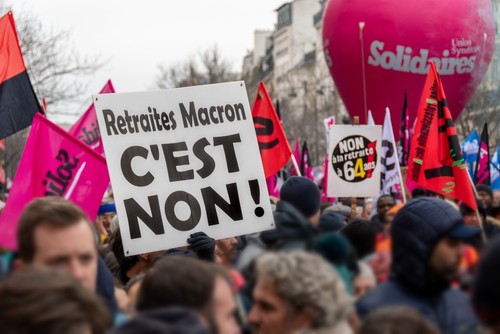
Well, to understand these protests, you have to understand how the French see their life and work narrative,” I told a client last week. “They go to school, get a degree or certification, work until they are 62, and then expect to get paid out for the rest of their lives. This is a ‘right’ that they imply is part of French life, but in truth, is younger than their grandparents.” I went on to discuss a bit more about how the French hire vendors and protect workers from being fired, giving greater context to how retirement fits into the French world of work. These protests are not entirely understandable to those of us in the Anglo-Saxon world.

A soundbite that has made its way onto both French and English-speaking media came from a worker who said something along the lines of these protests being about “Wanting to enjoy our lives, not just work” as if the French wait until 62 to enjoy their lives. The French have a 35-hour work week, generous days off and significant vacation, and some of the most unbelievable work benefits you’ll see in the developed world. They are not “waiting until 62” to “enjoy their lives.” They might be waiting until 62 to voluntarily stop working, but that’s a truly novel concept.

In fact, the more I examine the pension programs of many so-called democracies, the more I’m confused as to why people expect consistency or accountability for what is essentially a legalized and government-backed Ponzi scheme.

In my country of citizenship, the US, our “Social Security Trust Fund” is non-existent. It was raided so many times by improvident legislators that all we have now in America is a pass-through system. What money is paid into the system by current workers every week (some of whom, by the way, are also receiving Social Security benefits) goes right out the door to retirees that same week. Social Security, set up as a way to give dignity to impoverished elderly citizens, is now a de facto retirement plan for hundreds of millions of Americans. It was never meant to be that and the strains on the system only underline that every day.

While France’s welfare promises lies don’t date back to the 1930s, but only to the establishment of the Fifth Republic, which is younger than my mother, the French seem to have it firmly in their mind that they are entitled to a retirement, and at an age relatively younger than almost every country around them in Europe. The same problems with this narrative exist in the US:

  • The entire Ponzi scheme depends on a steady stream of workers, ideally, an increasing number, but the US and French birthrates are indicating an aging population, which means that the financial problems are only going to get worse sooner and faster.
  • “Retirement” in which you get paid close to what you earned during your productive years, during which the state pays you to be non-productive, is an ahistorical fantasy with no real track record of success. Indeed, all we see now are countries scrambling to keep the promises they originally made by raising the retirement age. We can expect that age to be moved upwards again when reality and mathematics catches up to a given calendar year.
  • Aging populations, the apparently “responsible” and “hard-working” generations that raised us, provided zero leadership to deal with this train wreck in the making, and are now simply insisting that they get what they paid for (never mind that their contributions never come close, even with theoretical interest, to their withdrawals) and damn the generations to come.

Somehow in my ten years in France I’ve only ever skirted on the edges of protests. I was out of town when the Yellow Vests kicked off, and even during the last big transportation strikes, in 2019, I was only around for a week or so of what was a month of misery for many of my fellow Parisians. Indeed, the biggest effect of the transportation strikes in 2019 for me and many other Parisians was a significant movement towards bikes, both shared and private ones. However, this time, with rolling strikes over the last weeks, I’ve been seriously affected, sometimes cancelling trips to Paris due to logistical nightmares. Some larger context first.

Now that I live in Moret I regularly take the RER to get into Paris. It’s an easy 45 minutes on a fast train, when all things are normal. When they aren’t, and the twice-ever-hour, four-times-during-peak-hours trains are reduced by a third or more in frequency, enormous queues pile up from commuters anxious to make sure they get on a train and don’t have to wait hours for the next one.

To offer a personal insight into this I can share what happened a few Saturdays ago as I prepared to head into Paris to discuss King Lear with some fellow Shakespeare lovers. I was going to leave around 12h25 to get in to meet some other friends at 14h00 before the discussion at 16h00. But since I’m the opposite of tuned-in to the news, I found out about the strike when I rolled into the station at 12h00, about 20 minutes before the train I thought I would take.

As I scrolled through my options on Citymapper (the station window was closed — they were on strike too) I saw I could head further away from Paris and then catch another inbound RER which was running on time. The alternatives were to take replacement buses, which were not only significantly slower but would slightly complicate bringing along my bike which I had with me. Knowing that I had no idea what could happen, I locked up my bike at the station in Moret and took the chance on going further out to come back in. I messaged my friends that I wouldn’t be able to see them but I felt confident I could still make it in time for 16h00 and Lear. It was noon after all.

Or so I thought.

Twenty minutes later I found myself at Montereau, where the train that I would take to Sens, then change platforms and take directly to Paris with no stops, would leave from. In the meantime I sat in the sunshine and read a book. An hour later I casually made my way to the platform where the display indicated the on-time arrival of the train I wanted. Until it started showing delays.

When it first started showing a five minute delay, I shrugged it off as no problem, because I had 25 some minutes to change trains in Sens. Then the delays started stacking until it showed more than 35 minutes. I realized Plan A was not going to work.

I looked at the monitors and saw a train that would come to Montereau by 15h13, but that would mean it would be 16h30 at the earliest that I could meet my group, especially since I would need to rely on the Metro instead of my bike.

That train was on time and by 16h10 or so I was in the Metro system of Paris, trying to navigate to the cafe I was meeting everyone at. Thankfully, someone who was already going to help me moderate the discussion had committed to starting it without me, helping me avoid the horror of making everyone wait while I moved in slow motion through my transportation nightmare.

As I stepped onto my Line 8 change at Bastille, I heard the announcement say as the Metro doors were closing (too late!) that because of the street protests that were running down that street towards Republique that all the stations between there and Strasbourg-Saint Denis were closed. I shrugged, realizing that at least I was in Paris and not stuck waiting for a train. About 50 yards from the Strasbourg-Saint Denis stop, our metro stopped, waiting for more distance from the train just now leaving the platform. Our driver had neglected to lock the doors and a homeless man decided he wasn’t going to wait, opened the doors, and casually walked down the track.

A huge collective groan came from our car as we realized the entire train would be “locked down” until the man could be positively identified as being out of harm’s way. A French person explained the situation to a tourist rather humorously, “Even the homeless here in Paris are in a hurry.”

Thankfully, though, it seemed as though positive identification was relayed that the man was spotted coming out of the tunnel and leaving the station so, a few minutes later we were cleared to proceed further. That meant that I could then exit the station, rent an e-scooter, and head towards Maison Plisson, where everyone had already been talking, over coffee, wine, and cocktails, about one of Shakespeare’s more difficult plays for the last hour.

I joined the discussion, doing my best not to think about the fact that I had started a journey at 12h00 and it was now 17h15. I wanted to focus on whether we found Regan and Goneril’s poor treatment of their father justified or if Cordelia was lying when she said, “No cause, no cause” in Act V instead of wondering what the CGT and other unions hoped to get from me by destroying my Saturday plans.

Do they think I’m going to call the government now and say, ‘Please give in to their demands?’” I asked a French friend the week after. “No, Stephen,” she responded. “The idea is that the French presidents usually don’t do well with civil discontent or unrest, and the government will make a U-turn.” A lot of hay has also been made of the specific article of the constitution that was used to push the legislation through, but anyone paying the slightest bit of attention knows that this procedure has been used almost 100 times since the inauguration of the Fifth Republic. Not exactly breaking news.

Yet strangely, this make-him-u-turn strategy was a plausible one with this president, as he’s rarely put forward a policy that he hasn’t immediately U-turned on, all the way back to the Yellow Vests’ dramatic first protest over the rise in fuel duties. And yet, a president who has accomplished close to nothing in his 6+ years in office has decided that the one thing he isn’t going to U-turn on is this issue. Strange indeed.

You have to give credit where credit is due. It’s unsurprising that a trained banker like Macron is going to ignore grim financial reports, though, given the recent bank failures in America and Switzerland, perhaps that’s precisely what trained (and untrained) bankers do. Macron is insisting that the French accept that the Fifth Republic made a promise that it couldn’t possibly keep, because everyone is ignoring a major premise it was based on: a growing native population. To cope with crashing birth rates Europe has decided to import that growth through immigration, causing understandable frictions as those non-native populations fail (or refuse to) assimilate to their new cultures.

As for what the locals are doing and saying, I’ve seen graffiti in Paris saying “vive la commune” and road signs by the freeway in Burgundy saying “retraite a 60” (talk about doubling-down!). It is true that there is general discontent but discontent is not itself righteous. Indeed, what we are seeing is collective delusion among the French who have a good life and think the party will go on forever, despite the laws of mathematics.

After Mass this last Sunday some of us mulled over our plans for week ahead, as sunny skies heralded a change in season. We knew that the unrest among the people would continue for a while longer, perhaps scuttling some of those plans. But never underestimate the ability of the weather to weaken the French “resolve” on this (and any) issue. Yes, they are discontented, but more than once I’ve watched “protests” melt away as the weather has improved.

The French, after all, prefer to enjoy that weather on a terrace with friends or at a picnic in the park than spend it en marche. They want to “enjoy their lives” after all, and don’t let anyone in the media make you believe they have to wait until 64 to do so.

Photo by user HJBC on Shutterstock.

Did you enjoy this article? TAIP is 100% reader-supported through tipping. If you want to leave us a tip of any amount it would be highly appreciated. These tips help support our efforts to keep TAIP an ad-free environment. Just as at a cafe, the tips are split evenly among the team.

legal help in France

How to Get Free Legal Help in France

Being in a foreign country and having some sort of civil or criminal issue and not knowing who to reach out to for help is truly overwhelming. Not being able to afford the help is even worse.

Luckily, France is a country that is highly conscious of the difficulties some people may encounter, whether they are French nationals or foreign residents.

There are many ways to get free legal help, whether specialized or on more generic and standard issues.

There is a higher focus on issues relating to “criminal” affairs, so whether you are a victim of a criminal offence or a foreigner having immigration related issues, you can turn to the service called “Avocats au service des victimes” with the Parisian Regional Council of Access to Law available for Monday to Friday until noon or by telephone at 01 44 32 49 95.

Criminal and immigration affairs are often linked together due to their sensitivity, so many criminal lawyers also specialise in immigration law.

Secondly, if you live in Paris and for any issue requiring professional legal advice, you can turn to the following services:

1. Les Points d’accès au Droit de la Ville de Paris

These are places representing the city hall of Paris and organising permanent sessions all year.

There are five centres in Paris, located in the 13th, 15th, 18th, 19th, and 20th districts.

You can mainly go to these centres if you have issues in your daily life:

  • work-related (work contracts, unlawful termination…)
  • home-related (rent, condominium owners, expulsion, issues with your landlord…)
  • family-related, such as marriage, PACS, divorce, inheritance, child custody
  • foreigners and immigration law, and access to the French nationality, or requests for titre de séjour renewals
  • consumer contracts (bank, insurance, and other contracts)
  • social protection (retirement, disability, financial aid)
  • violence towards women, discrimination, proceedings involving a French administration or organism

You can contact them on the official website of the city Hall via telephone and report your issue. They will then accordingly propose a meeting with a specialised attorney.

2. PAD Jeunes

Located at QJ, 4 place du Louvre in the first district of Paris, this organization is open every day from Tuesday to Friday from 2pm to 5pm.

You will be received by an official delegate of the rights defender.

3. Houses of Justice and Law

Les Maisons de Justice et du Droit are handled directly by the Ministry of Justice, allowing you to better understand your daily rights.

There are three located in Pars, in the 10th, 15th, and 17th districts. The meetings with these organizations are free, anonymous, and confidential.

There is a specific division handling victims of criminal offences.

4. The Paris Bar Association

Lawyers of the Paris Bar Association, on a pro bono and entirely volunteer basis, make themselves available in the city halls of each district.

There are also lawyers available to answer specific questions directly in the Judiciary Tribunal of Paris from Monday to Friday, 9:30am to 12:30pm.

You can present yourself at the general information reception, and they will guide you to the more specific divisions of your issue: family law, criminal law, employment law, and immigration law.

On the official website of the Paris Bar Association or the bar of any city, you can find a tab for free consultations.

Generally, the free consultations are only about an hour, which is enough for you to report your issue and your worries and to receive a response and guidance from the lawyers.

The Judiciary Tribunal of Paris is located at the subway station Porte de Clichy, accessible on lines 13 and 14.

5. Les Relais d’accès au Droit

Finally, these centres organize free, anonymous, and confidential sessions for any legal issues you may encounter.

There are more than 60 of them in Paris alone.

You will be received by a lawyer or attorney, and they will take the lead on your issue to guide you in the right direction.

They are established generally in institutional or associative social structures such as social centres.

You can find the official list on the website of the city hall of your city.

In all these five places, there are many legal professionals who will receive you to hear your questions: lawyers, attorneys at law, notaries, human rights defenders, justice conciliators or mediators, justice commissary.

You can find testimonies from people who have consulted these free legal advice centres, available on the official website of the city hall of Paris.

While it may be easier to find legal advice for free in Paris, there are also many centres in other cities.

Since COVID, the advantage is that you can live in another city and still contact Parisian legal advice centres by telephone or organize meetings via Zoom or Teams, should you be deprived of access to Paris

These free sessions are organised by professionals with many years of experience who are warm-hearted individuals willing to dedicate time pro bono to any person encountering difficulties and who may be in need of legal help.

In any case, if you seek legal advice for free, there are many places you can turn to for help in France, to at least have an answer to your legal issue or guidance in your legal proceedings.

This is highly reassuring!

What is also reassuring is that the French bar associations never cease to evolve, so there will be many other alternatives in the future to deal with such issues.

Photo by Tingey Injury Law Firm on Unsplash

Did you enjoy this article? TAIP is 100% reader-supported through tipping. If you want to leave us a tip of any amount it would be highly appreciated. These tips help support our efforts to keep TAIP an ad-free environment. Just as at a cafe, the tips are split evenly among the team.