
Lifestyle Design: My Own Case Study

The Four Hour Work Week has been out for many years now and in fact, the author, Tim Ferriss, has gone on to author the Four Hour Body, Four Hour Chef, etc.  Of course “four hour” is not literal.  It’s about a mentality.

While Ferriss presents a number of interesting assertions in the book, a number of which I disagree with, I accept the central premise on which the entire book is based: lifestyle design.  The upshot of the idea is that you control what kind of life you want to live through your own choices.  So design that life along with a  means to make an income that fits into that lifestyle.  Such a concept doesn’t just turn traditional 9-5 on its head, it throws it out the window after lighting it on fire.  It discards the idea of having a “good job” or “good business” as a priori considerations.

What do you want to do with your life?

How do you want to live it?

Ferriss says that only after you answer these questions have you earned the right to then ask yourself how you’re going to make a living.  Indeed, these questions are deeply revelatory, and I’m always surprised to share this concept with people older than myself who cannot answer these questions (or worse, have never asked themselves anything remotely close).  They’ve just taken to living their life perhaps very successful lives in many measures but there’s not an intentionality behind those lives.  Lifestyle Design demands that intentionality (and accountability).

As I said, I reject several of Ferriss’ assertions, such as the idea that the truth of a religion cannot be known or some of the gimmicky advice he gives regarding automating a certain type of internet business.  The meta with Ferriss is what matters.  There are dozens hundreds dare I say thousands of ways to make a living.  Be bold and fearless and you will reap the rewards. And even failure will teach you so much more than conventional success will.  Ask for safety and 3-4-5 weeks of vacation a year and you may – or may not – get it.  And even if you get it you may lose it.  The days of 20 years at one company may be gone but there have never been more fun and innovative places to do something you’re passionate about or more cool opportunities to start your own thing.

Ferris encourages, as a starter plan, making a low to median First World income and then living in Second World situations (Thailand, for some reason, is a popular pick, which is odd as I’ve always considered it to fit well within the “nice to visit” oeuvre), using time differences to your advantage and the saved income as arbitrage towards your next venture.

Ferris holds this out to the everyman, just as the excitable Amway dupe does when he draws circles for you on a flip chart in someone’s home. But lifestyle design, much like entrepreneurship, is not for everyone nor can it be accomplished by everyone.

There are dozens of inspiring case studies (even for my married-with-kids friends who would call this impossible), none of which I can say I’ve ever read – mostly because I didn’t need proof to believe that this would work.

***

In October 2012 I sold a business.  It was not the first I had built or said goodbye to, either at a profit or at a loss, but it was the largest profit I had ever made, and after such a long and hard push (6 years) I took some time off.  Starting in November I went to Grand Cayman, London, and then Paris.  In December I arrived in Australia for a 34-day, 5-state, 2-territory trip of a lifetime.

As I stood on top of Mount Wellington in Tasmania, at the very bottom of the world, in the opening days of 2013, I was overcome with emotion at how deeply God has seen fit to bless someone so unworthy.  I resolved to continue to try to be worthy every single day.

Throughout all these trips I had the opportunity to be deeply grateful, meet amazing new friends, and think about my life up to this point, and reflect on what was ahead.

Rather impetuously in January, while still in Oz, I had settled on a move to Paris.  It had been a city of my dreams for so long.  If not now, when, I mused.

It took one full year (all of 2013) and all of my effort, concentration, and focus to pull it off.  And I submit that had I not bought a one-way ticket in January of that year I might not have actually done it.  More than once last summer I thought if only I could delay this a few more months…  Living in America, as an American citizen, is desperately easy and cheap.  As articles on this blog have pointed out and continue to do so: life in France is “harder” and more expensive in many ways most Americans would find unacceptable and intolerable.

There is also the issue of a built life. It is no accomplishment for the unattached, still-keep-stuff-at-my-parents 20-something to quit a job and see the world.  But someone in his/her 30s, with big boy/girl furniture not self-assembled, with a deep and rich social network, memberships to art museums, subscriptions to the ballet and symphony, etc. would find it hard to leave all these things behind.

This is to say nothing of the fact that you may have young ones in your life, like this cutie, who would miss you.  I’m unmarried and have no children but those nieces and nephews are the closest things and it’s tough not to be there as they grow up so much more quickly than you thought they would.

There’s also the perception, for the first few months, that you’re just on some kind of vacation.  People don’t realize you’ve moved and that you have to work in order to pay for your new life.  At times it will be as basic as “What are you doing working you are in Paris!!”  Other times I laugh myself at what would be outrageous dream material for an American girl: dinner in Paris followed by a walk on the Seine in the shadow of Notre Dame.  It’s just a typical weeknight date with a French girl here (I confessed as much the last time such an incident occurred with said French girl.  “I’ll never take this for granted,” I said in French while standing on Pont Neuf.  She made the typical expressive pout-cum-eyebrow-raise that parsed the attitude of “is that cute or just annoying?”).

It’s now over three months into my adventure and I’ve loved every minute even the alleged “hard days.”  It’s also the first time in my life that I have been out of my home country for a period longer than 90 days (my Rome study abroad semester came with a visa that was good for exactly 90 days and no longer).  I cannot begin to tell you the questions you will ask yourself when you are completely immersed in an alien culture and language even one you may love and be conversational in.  You find yourself re-examining basic questions, like, “What do I actually like to eat?” or “What do I do for leisure?” or “What do I want out of my life and work?” not because you are unhappy with the answers you’ve always known but because you’re completely out of context here (well, except, happily, for access to the Traditional Latin Mass which will always make you feel at home anywhere in the world).  You also experience this cheek-by-jowl with whatever businesses you are owning and running.

The final consideration that an American so used to freedom of movement must keep in mind, no matter where you are thinking of relocating to, is immigration policy.  I managed to obtain a long-term-stay visa which is not at all easy to get.  My renewal is by no means assured and I’m not even allowed to apply for it until 60 days before my current one expires.  I had read and understood, through various sources, before my visit, that it was easier for someone already here to stay, but your own thought process has to tie into the state of the businesses you are running.  Will I get to be in Paris long-term?  Only the immigration authorities know. 🙂

What I do know is that this was one of the five most significant choices of my adult life, and I couldn’t be happier that I made it.

In future articles on this theme I’ll talk about what it took to get here in terms of breaking up my life in America.

Photo was taken as I stood on the top of Mount Wellington, looking down on Hobart, Tasmania.

Did you enjoy this article? TAIP is 100% reader-supported through tipping. If you want to leave us a tip of any amount it would be highly appreciated. These tips help support our efforts to keep TAIP an ad-free environment. Just as at a cafe, the tips are split evenly among the team.

Getting a Bank Debit Card in France

It’s actually not that hard to get a bank account in France.  What’s hard is getting your debit card.  To open an account, stop in at your local bank of choice (I chose Société Générale because it was and is close to my place) with your passport, some money, and proof of residence (this will be a quittance de loyer or attéstation de hébergement).

To get a debit card you will need to transfer a substantial sum of money into your account.  They will ask for 1000 euros I talked them down to 500 which will have the excitement of your American bank charging you for a wire transfer, your French bank account charging you for your own wire transfer, and the transaction fee of converting dollars into euros.  My personal expat experience has allowed me to conduct most of my life using American bank accounts, allowing my French bank account to deal with minor day-to-day expenses which would help me avoid carrying cash around all the time (like the UGC Pass Illimité, which occasioned my getting an account in the first place, something I originally resisted.  More about the Pass in a future piece.).  Unless you have a phenomenal bank in America (like mine) you’re going to get killed in foreign transaction fees, so beware.

Only after I got a wire transfer in did I get my debit card with a pre-assigned PIN.  That PIN, by the way, can’t be changed unless you want to pay to change it.  Brilliant or cruel?  You decide.

My account came standard with a ton of limits that a regular bank account in America wouldn’t correspondingly have.  I could only withdraw 50 euros at a time from an ATM, up to 100 euros a day.  I could only charge so much on my debit card every seven days, etc.

Even when you want to change your address you have to show proof.  In America I would call and change it, end of.  Not here.  The French love their paperwork.  Don’t you forget it!

If you are here for any period over three months, get a French bank account.  It will be a bit of trouble, but well worth it!

Did you enjoy this article? TAIP is 100% reader-supported through tipping. If you want to leave us a tip of any amount it would be highly appreciated. These tips help support our efforts to keep TAIP an ad-free environment. Just as at a cafe, the tips are split evenly among the team.
My Worst Week in Paris

This is the “Part II” to my “finding an apartment in Paris” article, though it’s really more of an appendix.  Future parts will discuss what to bring with you when moving here.

They say that whether you are a native of France or a lovestruck visitor of Paris (comme moi) your first apartment in the City of Light will always be the worst.  It gets better from there.  There are a number of reasons why.  You don’t know the arrondissements.  You don’t know how you will feel about your commute.  You won’t know how you feel about your space.

One thing I did know, three months into my stay, as my landlady tried to charge me more for my already too-small space, was that I was done paying 800 euros a month for a studio (between $1000-$1100, depending on the state of the world economy at any given time).  In a week I had settled on a very cool art studio to which the resident artist had added a number of bedrooms.  It was very cool and the price 650 euros was great.

She, Sophie, my new potential landlord, was a bit flaky in setting up the appointment to see the place but I chalked it up to the “artiste” in her.  A writer and teacher at heart, I’m able to shush my inner businessman who (rightfully) whispers “accountability!” at necessary times.  But we got along okay at the first meeting and we shook hands on a move.

It was 30 days before my move when I gave notice to my then-current landlady.  I didn’t tell her all my grievances.  They had been kind and I was determined to leave on good terms. I found out, in drips and drabs, just how much had been missed in the handshake agreement that had sealed the deal.  Each new discovery, via email or text, was not in itself a dealbreaker but cumulatively it worried me a lot.  I think I was too excited about moving to the 11th and so close to Père Lachaise, as well as saving almost $225 a month, so I didn’t really blink as I discovered:

1) I would need a security deposit equal to one month’s rent (pretty standard here).

2) I would need to do one hour of chores per week or pay the cleaning lady 15 euros each week (no big).

3) I was not allowed to receive bills or bank statements what???  So I could get personal mail but not bills?  This would also complicate the immigration process but the concierge of my current place agreed to for 30 days collect my mail while I figured out an alternative.

4) I was to sign a contract and agreement, seven pages long, all in French.  I figured I would just have to hash that out with her after moving in.  I wasn’t going to pay for a translation nor was I going to sign something without fully understanding it. But all of these (what should have been blatantly waving red flags) paled in comparison to what I dealt with on February 28th, my worst day in Paris and the beginning of a tough week.  Please keep in mind that I use “worst” and “tough” purely in the First World sense.  At no time was I without the basic necessities of life nor was I being waterboarded, and incidents like these do great wonders for one’s sense of gratefulness.

I had asked two friends to help me.  I had four suitcases and two backpacks to take literally across town (17th to the 11th).  We would be able to stay on the (mostly for locals) Line 3 and just have one change at the very end.  Additionally, the metro stations at the starts and ends of the journey were roughly 500 meters or less from where we needed to be and all the bags had roller wheels.

The day started auspiciously enough.  I had woken up on time and lugged the bags down to the fourth floor where my landlady generously allowed me to use the building’s elevator to get down the final four floors.  My friends arrived on time and were treated to some excellent pastries and coffee from my soon-to-be-former landlord.  We made our way in and out of the Métro up and down quite a few steps huffing and puffing and laughing and grateful for the assistance of the (always polite) Parisians around us.

We arrived at my new place-to-be.  One of Sophie’s employees answered the door and she came out.  She had a look of surprise on her face.  “Well, you come tomorrow!” she said.  It was February 28th.  “Well, that’s fine,” I said.  “I’m not going to sleep here tonight, I just need to drop off these bags.  I’ll come back tomorrow.”  “Non, non, it’s just not possible,” she replied with the typical French shrug which said, “I don’t care” about your situation.

I kept my composure.  My colleagues very astutely just kept silent.  She was going to be a landlady for at least the next 6 months, so handle this well, I thought to myself.  I explained that we had come across town that these bags were not light that my friends were able to help me today and not necessarily tomorrow and that I was due to be out of my old apartment first thing tomorrow morning.  I also referenced a text I sent her last week saying I was coming Friday.  To my chagrin she pulled it up and pointed out that I said I was coming to drop off money on Friday, not drop bags.

Now, as an American I would have proffered one of two responses, in my experience as an erstwhile landlord:

a) Okay, you’re here a day early, but you’re going to be here the next six months and you’ve got 1300 euros in your pocket, so I can do a favor for you this one time.

OR

b) If your stuff is here I must charge you rent for today, pro-rated.  Is that okay?

Either of these would have been acceptable, but instead I got the French “sorry, I cannot do anything.”  She said she was in the middle of a photo shoot, she had no room, people always take advantage of her, etc.  But what you need to understand is that I picked this place precisely because it was ENORMOUS by Parisian standards.  If she had room in one place, surely it was in my room which anyone could reasonably expect was cleared out less than 24 hours before my arrival.  It was unoccupied when I had previously seen it. After 5 minutes of fruitless back-and-forth we agreed I would arrive at 09h00 the next day.  The door closed and the man not usually at a loss for words was.

Josh immediately and kindly offered storage at her place, about 14 blocks away.  A wheel had kindly broken off on one of the pieces cobblestones are murder on cheap luggage, and while I did have three Samsonites, that was not one of them which made the trudge just a bit more challenging.  Two of the three in our party were American and while we tried not to see this incident through the “customer is always right” lens, I was still shocked at such unaccommodating behavior.  “I’m not,” said Danyell, who was married to a Frenchman.  “My mother-in-law is the same.  Typical French.”

We agreed, in between huffs, puffs, and stops, that if I could not even leave my luggage there the day before I moved in that all that awaited me was more unpleasant surprises.  We got to Josh’s, where four more stories and the corresponding stairs awaited us.  I laughed bitterly as I lugged the luggage up those flights, marveling that what I imagined would be such an easy day instead had gone wrong in every conceivable way.

Danyell had to run off to another job, so I didn’t get to take her to lunch for all her troubles.  We parted and Josh and I grabbed some lunch and discussed the problem further.  She had some room and very kindly consented to let me leave my luggage there for a week while I scrambled to find a new place. I swung into action and had a place the following morning, for one week.

It was in Le Pré San Gervais, which is at the very edge of the 19th Arrondissement.  When I say edge, I mean outside of.  It was outside Paris city limits by about one km.  Good, I thought.  Let me find out what it’s like to live in the burbs for a week.  Gk, who owned the room, wanted 700 euros per month for a very sunny and lovely room but for someone living and working in Paris it wasn’t tenable, by my standards, for a long stay.  I paid for one week. It was at the edge of Paris transport, and door-to-door, with Vélib, bus, and metro, it would take at least 30 minutes to get to one of the “center” stations of Paris, like Châtelet, Opéra, or République (see, even right there in my list I can see how Right-Bank biased I am).

I loved the size of the room and the quiet of the building, as well as being on the 1st, not the 7th, floor, but I wasn’t going to pay that much and not even live inside Paris proper. Still, in my week “in exile” I came to appreciate just how spoiled I had become (and would remain my new apartment was in the same neighborhood as my old one 20 minutes by foot, or ten minutes by Vélib, or five minutes by Métro to the Arc de Triomphe, a beating heart of the city).

The happy ending to my alleged “worst week”?  I picked up my keys that Thursday and moved in over the next three days.  I had plenty of time to adjust to my new views.  Danyell and Josh valiantly joined me to “finish what they had started” a week ago.  I avoided moving into a place that had featured numerous warning signs and a disastrous move-in day.  I found out I had friends who were more kind and generous than I could have imagined or even deserve.  But most importantly, I had upgraded my housing while decreasing my cost of living which is a feat in any city, not just this one.

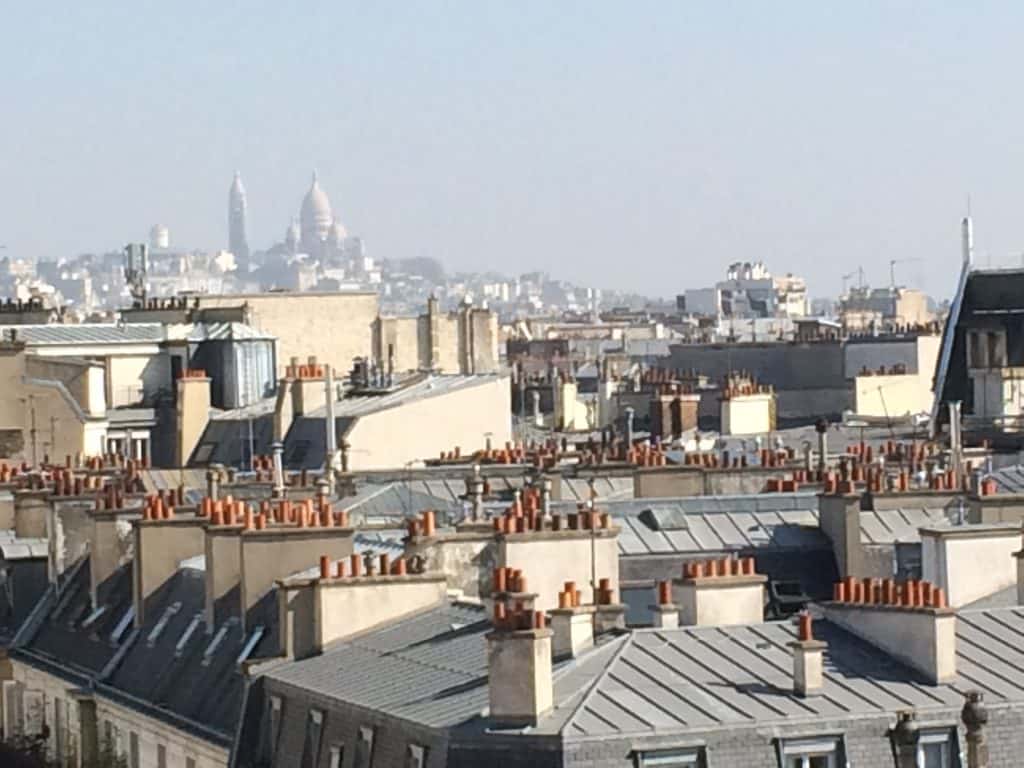
The photo is a view from the northeastern edge of Paris.

Did you enjoy this article? TAIP is 100% reader-supported through tipping. If you want to leave us a tip of any amount it would be highly appreciated. These tips help support our efforts to keep TAIP an ad-free environment. Just as at a cafe, the tips are split evenly among the team.
Finding an Apartment in Paris, Part I: Before You Get Here

Keep in mind that there is a reason the word “bureaucracy” has a French etymology.  The French love their paperwork.  Efficiency is not a vice, per se, but why be efficient when you can cloak yourself in the warmth of saying “non” to people, just because you feel like it? When I first started researching a move to Paris, in August 2012, my eyes glazed over at the stories I read: “Must provide paycheck stubs” (I’m an entrepreneur, so my cash flows don’t always come that way), “must sign a 6-12 month lease,” (I needed to maintain flexibility, especially if I didn’t like a place).  There had to be a good way to get an apartment in a foreign country before you got there.  There was.  Enter Airbnb.

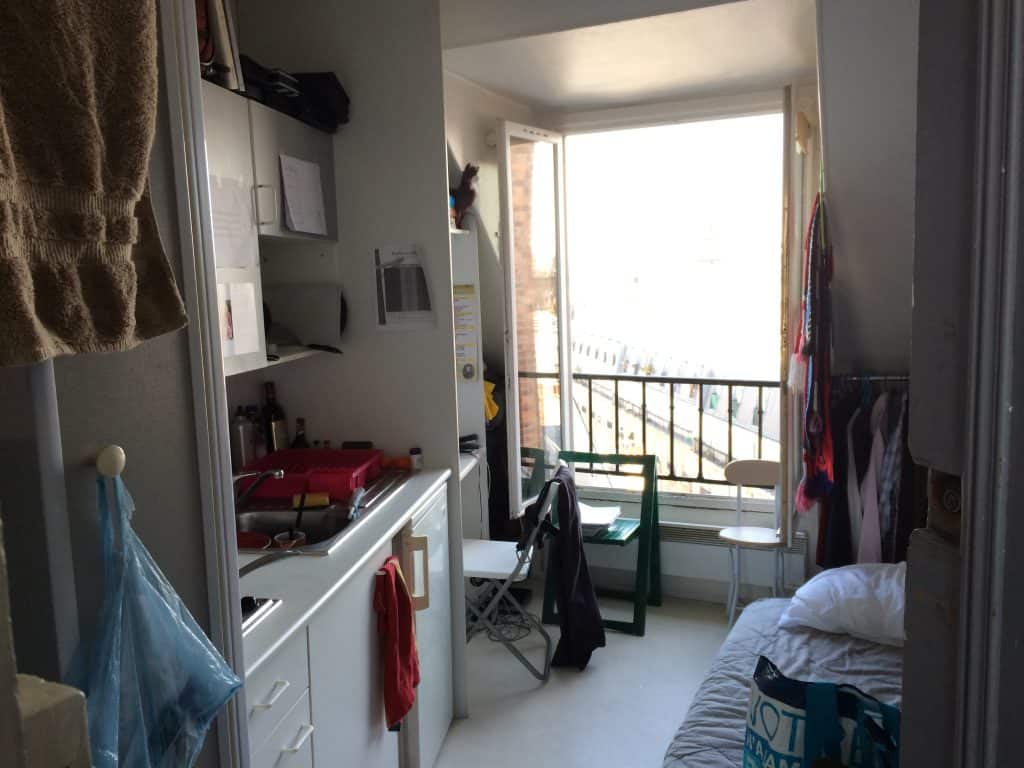
I was an early adopter of this service, staying at my first place in 2011 when I visited Austin.  I love the service and have used it frequently ever since.  I figured Paris would have a lot of options, and indeed, there were, but there was a reluctance on the part of many of the owners to take on a long-term renter, as there seemed to them to be less trouble and more money in the short-term renters.  After inquiries and searching, I settled on an 8×8 foot shoebox in the 17th arrondissement that would cost me 800 euros per month and would be all-inclusive (water, internet, gas, trash, electricity).  The toilet, a squat one, was down the hall but I did have my own shower and kitchenette, etc.  My host was used to a bevy of weekly guests so she took some time before assenting to my proposal to stay six months or maybe longer. I visited in November 2012 while on vacation in Europe and moved in over a year later, in December 2013.  It was as I had remembered perhaps a little smaller ;-).  I lasted a little under 3 months.

It wasn’t hell, by any means.  I came to realize that I was paying a high rate for the amount of space I had (24 square meters).  I also realized it was incredibly central (perfect for my day job) but also very quiet (not “hopping” as far as nightlife goes).  There was a nagging problem with the plumbing and backflow from my sink going into my shower.  Six weeks in I had had enough and started looking for other accommodations, again on Airbnb.

Why did I pick that site?  Less risk: Airbnb had insurance, and direct links to these people’s bank accounts so people were disincentivized to do you wrong.  Often times I also had access to testimonials from others and plenty of good photos.  I was also going to have something furnished and all-inclusive.  My second situation did not work out as planned (stay tuned for Part II, a harrowing but hilarious account of my worst week in Paris) but I am very pleased with where I am now.

I found the listing for my current place on, of all sites, Craigslist, which is nowhere near as popula(i)r(e) as its French equivalent, Le Bon Coin.  The apartment costs 690 euros, all-inclusive, and unbeknownst to me, had great views of Sacré-Cœur and The Eiffel Tower.  The listing led me to a service that caters to English-speaking expats.  They know our pain.  This place would be bigger AND cheaper than my last place.  Parfait.

I was able to see, decide, and pick up my keys for the place all within the space of six days.  It could have been sooner had I not had a request of the owner which was generously granted, and if I had not already paid for a week’s accommodations on the other side of town.

Here’s what you should expect (and Paris is a fairly stable market) as of March 2014. Outside the city, all-inclusive, 10×10 (29 square meters), with a minimum 30-minute commute by TRAIN (RER) not Metro, 500 euros. Inside the city (in one of the 20 arrondissements), 750 euros. Inside the city, with a private bathroom and a “living room” area, 1100 euros. Should you wish to have a roommate obviously all these prices come down, but then the paycheck stubs and all that come into play, which are not easy to produce for those of us here on non-working visas.

I’ll cover “cost of living” in another article but expect to pay a security deposit as well as an agency fee (be it through AirBNB or ParisExpat or any other service) equivalent to 5-10% of your entire lease.  You’ll need a good chunk of change in your pocket come moving day.  And some smiling faces and helping hands to help you up all those flights of stairs.  More on that, next time.

The photo: it’s not the biggest place, but it’s home.

Did you enjoy this article? TAIP is 100% reader-supported through tipping. If you want to leave us a tip of any amount it would be highly appreciated. These tips help support our efforts to keep TAIP an ad-free environment. Just as at a cafe, the tips are split evenly among the team.
The Myth of “Fluency”

Americans abroad sometimes beat ourselves up often on behalf of our fellow countrymen other times because of our own perceived shortcomings.  One of these is the famous lie: “Well everyone in Europe speaks at least 2-3 languages fluently.”  I’ve found this to be mostly a myth, for any number of reasons.

It is true that Europeans take up a 2nd and sometimes even a 3rd language outside of the language that they speak at home.  But Europeans are humans, like the rest of us, and fluency is like anything once attained, it must be maintained.

On the ferry from Morocco back to Spain some years ago I struck up a conversation with a Danish family.  We talked about socialized health care (Obamacare was much in the news at the time) and came on to education.  “What is she learning as her third language?” I queried.  “German.”  I was surprised I know they are geographically proximate but German is really only spoken in a couple of countries.  I didn’t want to ask why so I simply asked how she was doing.  “Ask her,” the father smiled.

“How’s your German?” I asked the 11-year-old.  She answered haltingly in her 2nd tongue, English: “I…it’s okay.”  “Do you practice with your friends who are also learning German?”  “No,” she admitted honestly, making a face that betrayed only slight shame, almost as if to say that practicing a non-native tongue with friends learning that same non-native tongue would be unusual.

Fluency, strictly speaking, is the ability to converse quickly and at a high level, within a language.  Fluency comprehends a large vocabulary, appreciates and can deliver puns, and has fun with wordplay.  It also has the ability to engage in high-level discussions say about the existence of God or the start of the universe.  I would never call someone fluent in a language who kept asking me the word for “planet” or “cosmos” or “uncaused cause.”

I might call them conversational those who can express themselves enough to order food, ask for directions or talk about basics about themselves.  Sometimes this brings with it a semi-literacy an ability to read signs and some announcements, but not enough to read an editorial in the local newspaper.

My most recent trip to Vienna left me with a few new friends, one of which was now a teacher in Vienna who confessed to me during our 30 km bike tour of the city that he had learned Italian and English in school but had lost them both.  I told him quite emphatically that his English was very impressive despite his not being a regular speaker.

While a big part of my mission during my time in France has been to attain fluency in this language, I have over the years come to appreciate even knowing a few words in any language.  The doors to another culture can open themselves so widely in just a few words.  We talked about the fact that the ß (eszett) in German is not often used.  “Indeed,” he replied, “the Swiss use a double s in its place.”  This is true, the Swiss are quite practical.  They use septante and huitante and nonante to denote 70, 80, and 90, respectively.  What do the French use?  soixante-dix (60 and 10, literally), quatre-vingt (four twentys, seriously), and quatre-vingt-dix (yup, four 20s and a 10, like you’re counting out change).

What I mean to get at is if you cannot attain fluency in a second language (or a third, etc.), don’t beat yourself up.  Many claim fluency in a second language, but what they mean is that they are conversational.  Someone who can seamlessly transition from language to language, preserving an accent native to that language, is rare.  And they are probably in diplomatic work.  The rest of us make do with “comment dit-ton” until we can get there.  And hey what’s the harm in working on fluency in your native tongue?  I daresay we’d see better grammar and spelling in our business and personal emails if we put that effort in! 🙂

Did you enjoy this article? TAIP is 100% reader-supported through tipping. If you want to leave us a tip of any amount it would be highly appreciated. These tips help support our efforts to keep TAIP an ad-free environment. Just as at a cafe, the tips are split evenly among the team.
Laundry in Paris: Sorted!

Sometime back my landlady had offered to do my laundry…for a fee, of course.  I’ve been doing my own laundry for many years now but usually at my own home using my own machines.  I never had any mental measurement other than “large” or “small” load.  Even during my last foray into city living, when I lived in Lafayette Square in Saint Louis, I had washers and dryers in the basement of the 100-year-old Victorian I made my home.

“How many kilos?” She asked in her native-Parisian accent.  I laughed.  I thought about my sack of laundry upstairs.  “What would that weigh,” I asked myself.  I figured 8-16 lbs, which came out as…”Je pense…quatre kilos.”  She took a minute to do the math, add on her service charge and told me “25 euros.”

It’s not polite to haggle in residential situations here even less polite to imply that you are being ripped off but let’s say conservatively I would be talking about $30 (she was asking for more) and let’s say I had proposed ten lbs (which ended up being about right I should go into mental clothing-weighing!) that’s about $3/lb.  Was that expensive, I wondered?

Since I was in a situation in which I should simply say, “oui,” I did so and trudged upstairs to my apartment to grab the bag of laundry.  Was that a lot?  We as Americans often overlook sunk costs machines had always made sense for me not just because the hookups were there and used washing machines can be had for a song (some guy nabbed my washer and dryer when I moved for $150 not bad when you consider I had bought them two years earlier for $200), but also because I invariably rented to tenants, who saw a washer and dryer as an awesome amenity.

By the time I handed the laundry bag to her I had done the math: $360/year, assuming a ten-pound load/month.  That didn’t seem so bad, I thought, but surely I could do better (as a postscript my landlady brought my bag of laundry to my apartment, not realizing it hadn’t been folded.  I was surprised to find it rumpled but I wasn’t going to take it back downstairs and demand it be folded.  I happily folded it myself and she was so embarrassed to find out later via the cleaning lady, who was quite upset about it that she didn’t charge me.  So this comparison is now officially just academic.).

It would be six weeks before I would need to do laundry again.  Bachelors inevitably mark laundry as the day before we run out of underwear.  This time I had a number of scarves that I needed to go in the delicates so I broke my laundry into two machines.  Again with the kilos.  The instructions were fairly straightforward.  I bundled up what needed to go and I brought my 11kg over 20 pounds to the laverie about 1000m from my house (I know, stay here long enough and you even start using Celsius to talk about temperature).  It was found with a bit of work as neither yelp nor google places responded well to lavanderie or lavérie (well, I did get one search result nearly a mile away.  Nope).  Google asked if I meant “lavanderia.”  Sure, maybe it’s Spanish day.  I clicked on the link and got…nada.

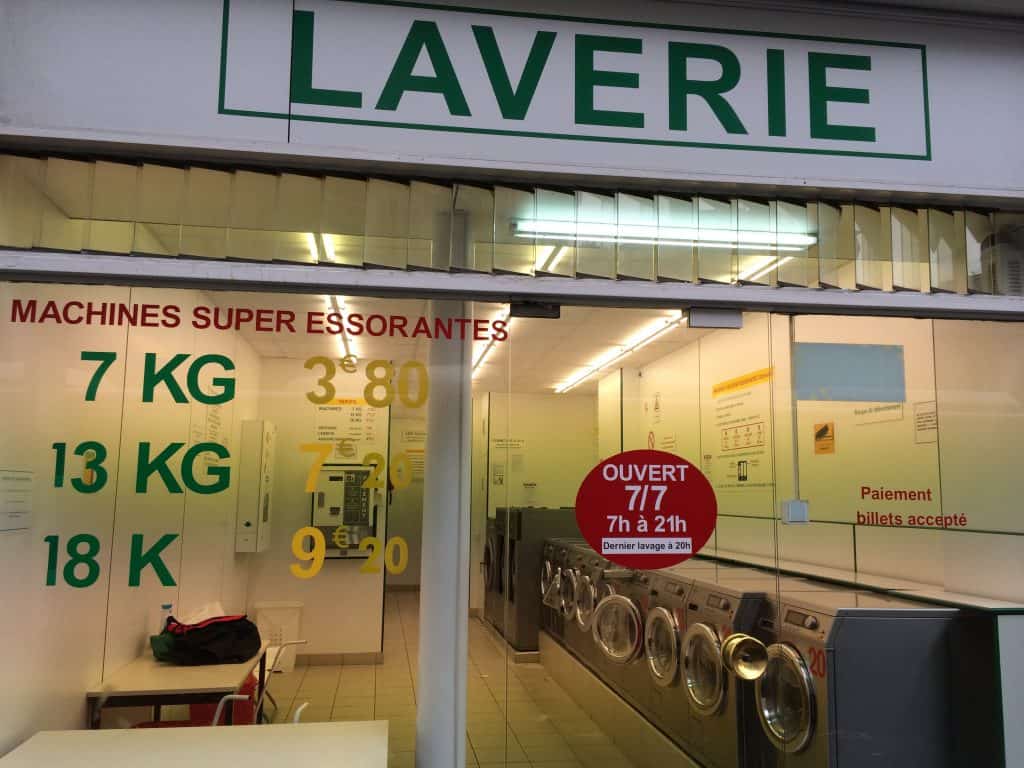
As you can see the instructions were fairly straightforward.  You need to make sure you put your detergent into the wash (lavage) not the pre-wash (prélavage).  I paid 7€20 for the 13kg machine (most of my stuff) and 3€80 for the 7kg machine (scarves and stuff).  11 euros all together.  Then, when they were done I dried both loads together for 30 minutes (the dryers are HUGE and efficient) another 4€50.  Let’s say 16 euros in total to do it myself.  In opposition to the rate my landlady proposed (why didn’t she just let me do it myself, I wondered) I had done twice as much laundry for 1/2 the price.

But I still hadn’t figured out whether this was “expensive.”  Yes, I didn’t have the sunk cost of a washer and dryer, nor the utilities that went with it.  17 euros for let’s say 14kg was a little over 1 euro/kg, plus detergent (7 euros for a bottle that would last me over a year).  $1.30/2.2 lbs?  Or 65 cents/pound.  Yeah, it was cheap.  There are expenses to living in any big city including Paris but laundry wasn’t going to be one of my big ones.

The photo is of the laverie where I had my first Paris laundry experience.

Did you enjoy this article? TAIP is 100% reader-supported through tipping. If you want to leave us a tip of any amount it would be highly appreciated. These tips help support our efforts to keep TAIP an ad-free environment. Just as at a cafe, the tips are split evenly among the team.

French iTunes

My mobile phone carrier here in France is SFR.  One of the incentives offered on my calling plan is CanalPlay+, which is a Netflixesque service (because Netflix n’éxiste pas en France).  I got a text message a few days later from SFR encouraging me to download the app.  I dutifully clicked and a few screen flips later link to browser to iTunes store to…nothing.

I kept trying to research but couldn’t really find anything on forums regarding this issue…because I was looking for problems with the app…not a problem with American iTunes.

Apple has iTunes stores for different countries.  That’s how they can charge more for a song in Australia (they routinely pay around $2 for what Americans normally pay $1 for).  But it’s not just a smart move by Apple to put some price controls in an otherwise free market.  It’s also something that unwittingly prevents access to country-specific apps.

In my case, CanalPlay+ and even SFR Mon Compte (a little app that would let me monitor my data usage in real-time) were only available in the French iTunes store.  So, why don’t you just switch over to French iTunes, Stephen?

Well, you see, there’s not really any fun way to try to get these apps.  I could create a separate iTunes account and then log in, download those two apps, sign back out and then sign back into my American iTunes library.  I have iTunes Match on my account, which is a service that keeps my over 6,000 legal songs in the cloud accessible anywhere, anytime.  Having it means I can’t just switch regions with iTunes and then switch back.  I’d have to cancel the service.

Long story short, I’m too happy with my current iTunes shop to risk it all just to grab two nice-to-have-but-not-necessary apps.  CanalPlay+ would be parfait for my ongoing French learning, as I could continue my intake of French movies.  To speed my uptake of new vocabulary I’ve been French subtitling the movies I already know well, notebook in hand to catch the nouveau vocabulaire.

So as a note to those users of American iTunes you don’t know how good and cheap you have it.  And as long as you don’t have iTunes Match, you can just switch over to another country store, grab an app, and switch back.  Just remember you’re walled out of future updates on that plan.

Did you enjoy this article? TAIP is 100% reader-supported through tipping. If you want to leave us a tip of any amount it would be highly appreciated. These tips help support our efforts to keep TAIP an ad-free environment. Just as at a cafe, the tips are split evenly among the team.
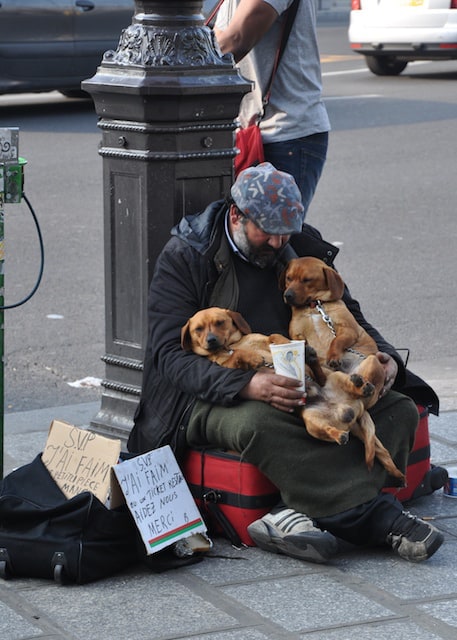
Homelessness in Paris

Homelessness is an issue in any big city, but it’s an absolute epidemic here in Paris.  The local phrase translates into English as “sleeping rough,” and from what I can tell by conversing with fellow Parisians, it’s only been on the rise as of late.  Yet, in that recognition, there is a sense that it’s an accepted way of life rather than a problem that will be eradicated anytime soon.

A socialist way of thinking in France ensures a high level of tolerance for homelessness.  People set up tents on frequently traveled streets.  People sleep in store doorways after those stores close, in subterranean car parks when it’s cold (those places are quite warm), and in the metro (all the time).

The homeless themselves have their own routine.  You can catch them hanging out, reading, or holding puppies, which leads to a 500% increase in the level of donation.  “Oh, you have puppies, so you must need more money,” not, “You’re homeless, why the hell do you have a dog?”

At least once a day someone will get on the metro and make a speech.  They’ll cite children, or being out of work, or some other malady.  They then walk through the car, cup or hand extended.  People will donate mostly on your appearance.  Avuncular and kindly-looking types clean up.  Young and unkempt routinely get nada.  Women are 50/50.  Once they’ve gone through your carriage, at the next stop, they go to the next carriage and repeat the routine.

Buskers (people playing music) get donations purely based on their quality.  There is a guy at Opéra who is at the change to the 8 Line every Sunday (that’s the station I change at to go to Mass) who plays his accordion with an amp which distorts the sound and gives nobody any peace for the 3-4 minutes we are waiting on the platform for our train.  I’m too annoyed to donate.  But last week there were these two guys playing acoustic guitar who TOTALLY cleaned up.  This wasn’t just because they were handsome guys playing guitar (surely some scribbled phone numbers were mixed in with those euros), but also because they happened to be GOOD.  They had decent voices and were playing the strummy catchy music you wouldn’t mind hearing on your metro trip.  There IS money to be made in the metro we always have spare change in our pockets and unlike in the US where coins are mostly denominated under $1, in Europe, those coins can be 1 or 2 euros and what can look like a jumble of coins is probably close to (as it looked to be on this night) close to $100, ostensibly just in this carriage on this particular ride.

Just last night I witnessed two young lads do a satiric song-and-dance striptease (down to a shirt and briefs from shirt, suit, and tie) about ticket inspectors on the Métro.  I might have been the only one who did not contribute just about everyone else in the carriage did.  Want to make some money on the Métro?  All you need to do is strip in front of the French.  They find it tres amusant, apparently.  The américain was not.

Yet, for all the antics puppies, begging on trains, etc., the fact that I’ve seen more than one homeless person reading is impressive to me.  It reinforces the notion that maybe this is a “regular person” who is just down on his/her luck, or if not, proof that being homeless doesn’t need to lead to despair.  It might just be another way to be happy with what you have.

Featured photo is from Nando Prudhomme’s site and is used with his permission.  You can find Nando on Twitter and at http://www.cyanskies.com/.

Did you enjoy this article? TAIP is 100% reader-supported through tipping. If you want to leave us a tip of any amount it would be highly appreciated. These tips help support our efforts to keep TAIP an ad-free environment. Just as at a cafe, the tips are split evenly among the team.
paris arrondissements

Three Big Changes (A Month In to My Life in France)

This particular move features three major changes for me: a different country, a different language, and a different environment.  I’ll start with the last one first.

The City

I was born into one of the densest cities in the modern world: Singapore.  This tiny nation-state has 5.4 million people packed into 276 square miles (Americans might consider that 8.5 million people inhabit the five boroughs that comprise NYC, which sits on 303 square miles).  Singapore taught me at an early age that a city can be a safe place for a kid.  As a six-year-old, I excitedly rode the MRT (subway system) by myself on Mondays when I had altar boy duties at our parish across town.  I heard different languages (Malay, Chinese, Tagalog) swirl around me.  I saw every color of person imaginable.  And the food.  Well, let’s just say that in 2009, my first visit back to the island since I was 11, I gained ten pounds in three weeks.  I firmly believe Singapore has the best food in the world, and still do, despite living in the country that literally gave the world the word cuisine.  However, for all my love of cities, most of my life has been spent in suburban settings.

Because America west of the Mississippi was imagined and built around the car, my stints in Texas (Dallas), California (Los Angeles, Orange County), Kansas (Overland Park), and Missouri (St. Louis) all accepted as prima facie access to a vehicle.  Access to this vehicle not only defined your everyday schedule but by and large, your entire lifestyle.  This lifestyle, the suburban lifestyle, while comfortable, safe, and warm is a novelty in human affairs and is premised upon the lie of ongoing, infinite access to cheap and easy oil.

The rural life has some splendid isolation and the city is a collective of the culture of a society but the lukewarm suburbs are no real part of either.  James Howard Kuntsler, in a myriad of jeremiads against the “noplace” that is suburbia, has made this case numerous times far more eloquently than I can.  Take a read through his Home from Nowhere if you want to be confronted with the (un)reality of the modern suburb.

This is all to say that city living is radically different from suburban living, in so many ways.  We can start with one of the costs of living: housing.  It’s almost always more expensive to live in a city.  A 10×10 room in Paris (I’m talking feet, not meters), as in NYC, will cost you at least $1,000 per month, and that is with no promise of either a shower or toilet ensuite.  Unless you share a home or apartment, you will also be lugging your laundry to a laundromat.

But after you’ve exhaled, realize the disappearance, or the decrease, at least, of another cost of living: transportation.  I save roughly $120 (accounting for exchange rates) by not owning a car in Paris.  I owned my last car free and clear so I didn’t have a monthly car payment, but I still paid $125/month in car insurance and at least $75/month in gas.  This is to say nothing of car washes, oil changes, tire changes, routine maintenance, and of course, annual registration.  I am now in possession of a monthly Metro pass which allows me to go anywhere that matters in Paris by train, tram, or bus.  For an additional 29 euros per year, I’m also allowed to use the bikes all over the city for the first 30 minutes of my journey for free (the locations can easily be found on Velib, a smartphone app).  I have never waited more than six minutes for a metro anywhere in the city, and because Paris is such an old city, it is eminently walkable (for an intact example of a medieval city, visit Assisi in Italy or Toledo in Spain, both of which can be traversed from one end to another in 20 minutes).  Because of its layout you often won’t realize that you’re covering 3-4 miles per day on foot (though, if you’re not used to those distances, don’t worry: your body will inform you very shortly!).

This foot-driven travel forces you to meet your fellow city-dwellers.  Americans prefer the quiet isolation of their cars.  They have their own agendas and itineraries that are subject to no one else.  City living doesn’t allow you that choice (well not without the hassle of traffic and not-free parking).  You have to deal with the homeless, the musicians, the weirdos, the deviants, the children, the elderly, and all the fascinating tapestry of humanity that comprises any big city.

What makes Paris, and some big cities, special, is the architecture and history all around you.  Architecture inspires and uplifts.  It’s difficult to walk by things like the Arc de Triomphe or Notre Dame, or inside any number of the hundreds of churches in Paris, and not feel inspired (well, unless you’re already dead inside – but even then these can provide powerful return-from-death shots).  The magnificence and beauty in those structures remind the ordered mind that building things that are worthwhile in this passing world is perhaps the most relevant harbinger of the eternity that is ahead for all of us.

The last opportunity I had to live in a city environment was during the year I finished my MBA in Saint Louis.  I was in the Lou Monday-Friday and in Kansas City on the weekends (I drove the dreadful I-70 stretch twice a week.  I know.  Ugh.).  In Saint Louis I lived in Lafayette Square, near the oldest park west of the Mississippi, in the largest collection of Victorian homes in the country.  I loved it, and have always dreamed of a return to St. Louis since my 2011 departure (on a separate note, while beautiful churches are on the mind, I believe that the Cathedral Basilica of St. Louis is the most beautiful church in the United States.  Check it out sometime).

It is perhaps the parks that are omnipresent in any well-planned city that are the greatest consolation for nature lovers.  There is no shortage of places of quiet contemplation amidst the city that accepts 27 million visitors per year.  Perhaps the reason this change has not been so drastic for me is that I’ve always despised suburban life, despite having existed in it most of my life.  Humans have a remarkable capability to thrive even in the most spiritually impoverished environments.

The Language

The #1 stated reason for my move to France is and always has been to acquire an extremely high level of fluency in the language.  I never thought this could be done outside of an immersive environment.  I took a short holiday in London about 10 days after my move to France and I remember sharing with some friends that my French had advanced more during my ten days immersed in Paris than in my four previous trips to Paris and my five previous visits to Montreal (all of which were fewer than five days in duration).  French, particularly for English speakers, has the double challenge of masculine/feminine words and unusual sounds.  Too often those of us trying to speak the language fall into the trap of simply trying to mimic a sound we hear instead of accepting that sound on its own terms (my classic example is the word “un,” which means “one” in French.  I don’t hesitate with the pronunciation now but I always did in the past.).

Perhaps even more fun than the disorientation of transitioning from being a native speaker of a language to being the primary school étudiant in another is the cultural exchange that happens as you explain idioms to new friends.  These expressions don’t just define a way of thinking, but also can, in some ways, define a people.  Speaking another language also helps you realize how grateful you are for the fun you can have as a native speaker with wordplay, puns, and literary allusions.

The Country

It would take too long to talk about all the misconceptions the French have about Americans and vice versa.  That’s something I hope to cover in a future article.  For now, I’ll leave you with two important facts: 1) the first treaty ever signed by the US government was with the France of King Louis XVI, without whose naval and military assistance the United States would quite possibly have never come into existence; 2) in the 1990s, Ambassador Walter Curley, perhaps on behalf of all Americans who have taken the time to study history, laid a wreath on the tomb of King Louis XVI in tribute of all he did for America.

While it is true that I love France it is perhaps more true to say that I love the France of old.  As a monarchist, I am drawn to the history of the kings in France while being simultaneously repulsed by the unmitigated horror show that was (and is) the French Revolution, with its disgusting tri-color flag, its monuments to murder, and its national anthem celebrating revolution and all the blood that flowed from it.  Even though France is now in its 5th Republic (apparently the kings weren’t entirely clueless) the French remain a people and a country unable to fully accept the Revolution in all its implications.  Over a million marched here in Paris just last year in protest against homosexual “marriage,” and a law just passed that outlawed “free shipping” of books in France.

Both of these events can help instruct those who are not familiar with the concepts of the two Frances: the two countries created within the minds of the French when Louis XVI’s head was separated from his body on that mournful day in 1793.  There is the notion of the “real” France, which is Catholic and royalist, and the “legal” France, which is anticlerical and republican (this distinction does not exist in Anglo countries, due to Henry VIII’s dramatic unification of the church and state within his person – and the subsequent irrelevancy of the former during the ascendancy of the latter: by the time it came to the founding of America the masonic dream had been realized.  America was a country founded on the absurd notion that God and His laws were a matter of taste, not fact).  While since the 1960s the “legal” country has gained a decisive upper hand, the “real” France still manifests itself in conscious and subconscious ways.  The march on behalf of traditional marriage is an obvious example of a conscious manifestation.  As for the free shipping thing, we have to go further back in history, and we’ll also have to cut through the lies you were told about guilds and protectionism.

“Protectionism” as it might be understood broadly, accepts the fundamental premise that those who are close to you whether they are family or simply your fellow citizens are more important than foreigners or strangers.  The subsequent principle that also follows is that money the most important value in the modern world can never trump that sensibility.  Guilds were a medieval expression of those principles within the marketplace.  Guilds helped to control prices in a particular trade or craft so that no one newcomer could come and destabilize the entire industry through disruption.  Innovations were shared so that the entire industry moved forward together (we see this in contemporary Japanese patent practice all patents are published 6 months before the patent is put in place, which means all the competitors can adapt.  The patent filing is hence more an object of pride that makes the entire industry move up together rather than the ossifying force it can be in US markets).  People could come and apprentice in an industry (think internships, except you got paid and actually did work).  They would, after a period of time, produce a “master-piece” (yes, that’s where the word comes from) which, if judged worthy, would launch their own independent career separate from the Master who apprenticed them.  This also provided exit strategies for Masters to retire (there was a stream of capable people you had personal knowledge of who could buy your business or help you expand it).  It also provided protection for those within the guild.  If you became sick, injured, or God forbid, died in an untimely fashion, the guild would take care of your wife and children monetarily.  After hundreds of years of this kind of thinking you can well imagine that the French, despite being a host country of the European Union, find it difficult to shake off the protectionist streak within themselves.  Indeed, that is why Pandora, Netflix, and now Amazon’s free shipping, are outlawed.

France is trying to protect its market from foreign innovations.  But coupled with a largely socialist mentality of the past decades one arrives at a swamp of indifference and inertia.  The EU, a worldwide leader in free trade and open borders, is continuously pushing universalization “in diversity.”  The French fancy themselves part of this as well, but their protectionist practices in the environment of hold-your-hand socialism provides an environment in which the young French are happy to enjoy every American innovation while not having any hunger to start their own copycats, even.  The “anti-Amazon law,” as the French newspapers call it, is coming into existence to protect Frances’ many (and lovely) independent bookstores, bookstores which are considered part of the country’s “cultural heritage.”  Free shipping from Amazon, coupled with the legally-mandated 5% maximum discount on book prices, gave Amazon an unfair competitive advantage.  And this was unacceptable (although don’t doubt for a second that there wasn’t some political payback involved).  But the reality of being unable to escape the French subconscious (sustainable and protectionist) traps the French in a self-satisfied dream of the past.

As with all rich and colorful dreams, the memories linger.  Effects of the French domination of culture through its cuisine, language, art, and literature, still linger worldwide.  But as the French celebrate the remnants of their past successes the world moves inexorably forward, led for better or worse by the country that France helped birth: Les Etats-Unis.

It is these three changes the city of Paris itself, its language, and its history within France that will linger with me long after I return to the New World.  For now they are the changes I most celebrate and subsume myself in, because to understand the future we have to know the past.

Photo by Oksana Gogu on Unsplash

Did you enjoy this article? TAIP is 100% reader-supported through tipping. If you want to leave us a tip of any amount it would be highly appreciated. These tips help support our efforts to keep TAIP an ad-free environment. Just as at a cafe, the tips are split evenly among the team.

paris metro

The Paris Metro: 6 Things To Keep In Mind

In any city in which there is a well-established mass-transit system there will be an enormous group of people going about their daily lives without clogging the streets with extra vehicles.  This makes sense for our planet, for their pocketbooks, and for our traffic sanity.

Paris has an excellent system of buses, trams, and trains when the dear people who operate them aren’t on strike.  Now, mind you, they are not often on strike, but that kind of interruption, along with train breakdowns, station closures, or just plain crowded carriages are things that you need to factor in when planning your travel in Paris.  There are a few other things you should keep in mind as well.

1.  Don’t overly rely on the Metro

Paris, after all, is a city that deserves to be walked.  The sights, sounds, and smells good and bad inform your experience, and sometimes tourists develop a point-to-point mentality of the Metro so that they get to know the cavernous (and not particularly attractive) underground of Paris and miss the lovely passages (alleys), rues (streets), and boulevards.  Don’t be overly reliant on it.

2.  Don’t expect lots of elevators and escalators

“Step-free access,” as it’s known, is still developing in the metro system, though it gets better and better every day.  The vast majority of stations have neither an elevator nor an escalator for your ascents or descents.  As stations get upgraded these are become less of a rarity, much to everyone’s relief, particularly parents with strollers or those in wheelchairs.

3.  Be aware of peak times

Some people say to completely avoid the Metro from 08h00-10h00 and from 16h00-19h00 and I understand why.  But if you’re visiting Paris it doesn’t make sense to force yourself to avoid the rhythms of our daily life here.  Make your plans and simply deal with the crowds if you need to be on the metro during those times.  You will get some appreciation for what we experience as Parisians and you will definitely be “immersed” in the Paris experience.  You’ll also push (or learn) your boundaries of comfort, and that’s always worth doing.

4.  Ask the staff

Don’t be afraid to ask the kind person at the desk for help.  Remember to always say, “S’il vous plait, parlez-vous anglais?”  They will usually say at least “a little” and you don’t need a discourse to get your answer, usually.  If the answer is “Non” try to explain using a metro map (always free) and using gestures.  You didn’t play all those games of Charade for nothing!

5.  Be yourself, but be watchful

You don’t need to turn into a paranoid person because of fear of pickpockets.  I remember my first visit to Barcelona, where I had been told that Las Ramblas was essentially a den of thieves.  After being ultra-paranoid my first day, because of this advice, hardly enjoying myself as I took in that walk down one of the quintessential streets of Barcelona, I remembered that my relevant documents and devices were not in places where they could be snatched off my person in broad daylight.

Instead of paranoia, opt for awareness.  We have thieves here, as does any major city, but you’re generally safe in most parts of Paris.  If you are keeping valuable items in your pockets, keep your hands in them at all times and try to stand in a place in which you have your back to the wall or a door so that no one can reach behind you without your seeing it.

6.  Get a good app

Paris is one of the cities featured in the amazing and free Citymapper app (available on iOS and Android), so use it instead of Google Maps to get many more options of travel, not just in the metro, but across multiple modes, like shared bikes, scooters, and rideshares.  If you are walking or biking you can also opt for “quiet/regular/fast” routes to adapt your journey to your mood and schedule.

Enjoy the convenience of the Metro which will whisk you around the City of Light significantly cheaper (and often faster) than private transport could ever dream of.  While our system is not as clean as Singapore’s nor are our trains as modern as London’s, the Paris Metro is a world-class system with almost smothering coverage of all 20 arrondissements. It is easily one of the best in the world for utility and price.

Photo by Anastasia Zhenina on Unsplash

Did you enjoy this article? TAIP is 100% reader-supported through tipping. If you want to leave us a tip of any amount it would be highly appreciated. These tips help support our efforts to keep TAIP an ad-free environment. Just as at a cafe, the tips are split evenly among the team.