France 365

In December 2020 I took a business trip to Eindhoven to check in with the editors of Dispatches Europe, which syndicates some of our content here at TAIP.  In November 2021 I took a two-week business trip to Hungary.  That means this week I hit 365 days in France out of the last 380 or so days, a feat I haven’t come remotely close to touching in my near-decade living in France.  As this milestone loomed, an uninterrupted period of time in France with almost no international travel, I was struck by a surprising idea: I didn’t miss it.

Let me give a bit of context first.

I am not a newshound.  I cultivate deliberate ignorance about current events and I do not seek to be “informed” about the “news.”  I have plenty to keep track of with my businesses and my own passions and pursuits without being told about issues that have nothing to do with me and which I can do nothing about.  I’ve only doubled down on that since March 2020.  That has allowed me to use the last two years to focus on what truly mattered to me, and one of those happened to be reading.  Last year I got to read around 150 books.  This year I’ll hit 200.

With that many books comes a flood of inspiration for personal and professional projects, none of which have required me to travel.  So, there’s been nothing to miss on that front.  A lot of time I used to spend traveling went right into reading.

I also did a lot of traveling here in Europe, from the very first month I landed in Paris.  I took my first international trip (to London, my favorite European city outside Paris) within two weeks of moving to Paris and my travels only expanded from there.   The twelve months leading up to March 2020 were the busiest travel period of my entire life, which included trips to Australia, New Zealand, Singapore, and the United States.  I have not been idle with the opportunity to travel in the past decade.  I’ve even used that experience to create a course teaching others how to travel cheaper, better, and longer.

Travel means many things to many people, but for me travel is first and foremost an opportunity to learn about cultures, other people, and myself.  I’ve taken the time I used to spend traveling and spent it working on personal projects, one of which has been a four-year project to read and discuss every Shakespeare play with a group in Paris.  I have been “traveling” with this group since January 2020, and we’ve learned so much together.

So why don’t I miss international travel?  Because I’ve got a lot of great stuff going on in my life, and I’m happy with who I am and where I am going.

A quote I often share is that you should “build the kind of life you don’t need to take a vacation from.”  Unfortunately, for a lot of people, travel represents what they imagine as their “real lives.”  While traveling they get to be who they want to be, do what they want to do, live where they want to live.  After this burst of exhilaration, they return to a life they don’t want, and start planning their next escape.

But if you are living the life you want to live and living where you want to live, what’s the rush to leave it?

Do I miss the opportunity to learn more about other cultures, other peoples, and about myself?  Sure.  But international travel is only one means to obtain those ends, and for most of my time here in Europe has been a very easy way to do so.  But the last two years have reminded me that there are many other such ways to learn, almost none of which involve scanning governmental and news websites for ever-changing rules or lining up to, for perhaps the only time in your life, get medically tested for something you are almost 100% certain that you don’t have.

That isn’t to say I didn’t continue to discover France this year.  I finally made it down to Montpellier after hearing people rave about it for years.  I was not disappointed.  I also got to explore Brittany more, including Vannes, the Gulf of Morbihan, and the dramatic seascape at Le Yaudet, just to name a few places I got to see for the first time.

Remember that wherever you travel to in the world, you’ll be bringing yourself, and if you’re not at peace with the person you are and are becoming, that should be the first order of business, not the wonderful sights and sounds that this world has to offer.  They’ll all be there waiting for you when you’re ready.

My best wishes for the next 365 days, wherever you are.

Photo by Pedro Lastra on Unsplash

Did you enjoy this article?  TAIP is 100% reader-supported through tipping.  If you want to leave us a tip of any amount it would be highly appreciated.  These tips help support our efforts to keep TAIP an ad-free environment.  Just like at a cafe, the tips are split evenly among the team.
chocolatine

Boulangerie Basics

I can’t speak for every foreigner, but I can describe the feeling that most Americans have the first time we enter a French boulangerie of any size or reputation.

Wow.

Followed closely by that feeling of awe is the complete ignorance you feel about what to order.  Everyone in line with you seems to be on a mission.  The staff are patient, but not so patient for you to simply stare open-jawed indefinitely.  Where will I learn what to do and what to say?

Turns out, imitation works as a start.

It was maybe my second day in France as I stood in line and tentatively ordered, “une baguette, SVP.”  “Ça sera tout?” is the reply that is repeated, verbatim, by every person who works in any boulangerie in France.  I used to automatically answer “oui” but came to realize as years wore on that the French are giving you permission to change your mind.

Perhaps you only came in here to get a baguette or a pastry, but now confronted with the reality of the situation, you might add on another pastry, or another loaf, or perhaps another treat for later, for a friend of course.  Sometimes after this second or third choice there will be silence as they watch your eyes, which are in turn looking at choices.  Then an internal timer dings in their head and they repeat their default saying, “ça sera tout?”  If there are other staff they will already be helping the people behind you in line.

The imitation game picks up tricks rapidly.  You hear someone ask for a “demi-baguette” and watch one of the staff deftly slice one of the baguettes in half to what is a perfect size for a single person’s dinner accompaniment.  “une demi-baguette, SVP,” I say as if I’ve said that countless times in my life, and hand over exactly half the cost of the regular-priced baguette.  Baguettes were even price-controlled until 1986.  Much like rice in Asia, baguettes in France are still seen as a basic “right” of sorts and if prices rise they will usually be on other types of bread before hitting the rates for the baguette.

More imitation: I hear a gentleman ask for a baguette “bien cuite” and ask myself “a well-done baguette?”  I watch the lady shuffle through the baguettes on the shelf and pick one, holding it for inspection.  The gentleman wants a different one.  She finds one in the back and there it is: a well-done baguette means a bit more cooked, hence a bit darker on the outside and crunchier to the mouth.  You can go the opposite way too, by asking for a “blanche” baguette, though I’d never heard this ordered before I ordered one for a friend who I knew preferred them that way.

More imitation: Someone asks for a “tradition” and the lady reaches for something that looks like a baguette but has a slightly different shape and size.  I then order one and inspect and taste for differences.  They have pointier ends and are hand-formed and baked on premises.  By a 1993 law, a “baguette tradition” can only contain flour, leavening, water, and salt.  The “levain” is something like a sourdough starter but that sourdough taste doesn’t come through as strongly as Americans would expect from anything that has “sourdough” attached to it.

How many different ways can the French deliver such a great product, I thought as my imitation game became a knowledge game and I started to share with friends my fascination about how bakeries worked and how I was having to learn as an adult all the things French children know by the age of six.

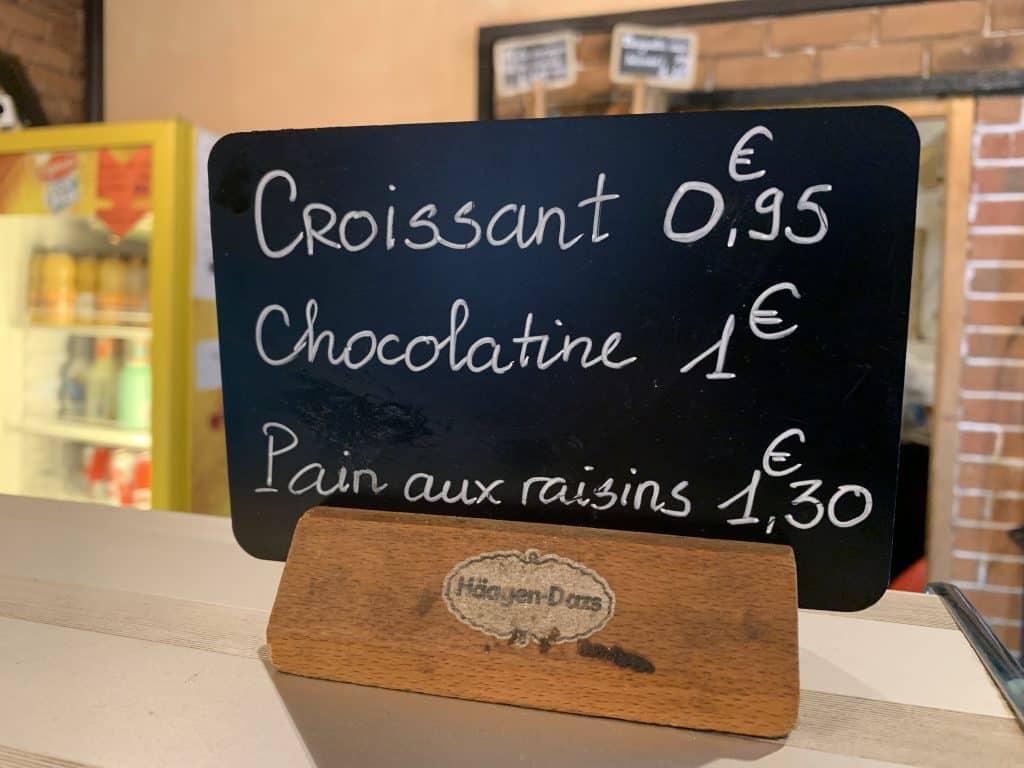
There’s also the pain au chocolat/chocolatine “controversy,” if it can even be called that.  Anglophiles might be familiar with the differences between how Devon and Cornwall take their cream tea.  In Cornwall, you put jam on your scone first and follow with a spoonful of cream.  In Devon, on the other hand, cream goes on first, then a bit of jam on top.  It’s always amusing to watch English people argue about this difference as if there’s something genuinely at stake.  So too I’ve been amused to watch “chocolatine/pain au chocolat” square-offs.  The last time I witnessed one was near Montparnasse with a fiercely traditional Breton acquaintance, who rolled her eyes at the chocolatine “advocates” and even more so at the peacemaker who proposed “pain au chocolatine” as the compromise.  The divide can be seen down south at large chains like Paul which use “pain au chocolat” in areas where around them all the independent shops use “chocolatine.”  “It does sound a bit more ‘French,'” I noted to the opinionated Bretonne.  “What do you know?” she said in a (mostly friendly) huff.

What is more wonderful is to see the centuries-old tradition of baking and running a bakery at work in the present day.  Nothing is wasted.  The pastries that weren’t sold yesterday are sold at half price in groups of usually half a dozen.  Look for the plastic bags with pastries inside or ask if they are any “viennoiseries à l’ancienne.”  Any bread that is not sold and is on the way to going stale is then sliced up and put back into the oven to shrink into “biscotte” which are sold for (at the most) 75 centimes a bag and are a great accompaniment to soup or can be broken up to serve as croutons for soup or salad.  I’m certain there’s also a fair amount of trade in breadcrumbs to nearby restaurants that might need them.  There is waste that used to go to the poor or to the pigs in the old days, and some of that still goes to them, but with computers and spreadsheets showing historical demand, I think today’s boulangers have the opportunity to make less waste (and more profit) than their ancestors.  Whether they do or not can also depend on how seriously they take their craft.

When you’ve had hundreds of baguettes you finally start to know instinctively what the French know from their early childhood: the difference between real bakery bread and what is warmed up from frozen prep.  The shocking thing is in Paris quite a lot of baguettes are made from frozen, but that’s because the French people know it’s the lowest denominator of bread and in part are okay with that.  Unlike the “tradition” which is regulated by law as to ingredients and prep, baguettes are not and as such are just there at the very base of the bread pyramid, in a way.

This also means you can taste French supermarket bread for what it is: sad, tasteless, industrial lumps of sadness that would have blown your mind had it been served to you when you still lived in America and didn’t know what real bread could be like (that said, I know a lot of places in America are becoming real havens of true baking skills, but the reality in the heartland is still mostly inedible).

Does that mean you should always order a “tradition“?  It totally depends on you.  When you fall into the rhythms of your neighborhood and your own shopping routine, you will notice that people may skip the bakery next to their house and walk 200-300m to another bakery.  Why?  Perhaps they have a good relationship with the owner.  Perhaps that bakery makes the type of crust they really go for.  Or, in my case, they also make kouign-amanns on a regular basis (worth another article in itself!).

There’s even an importance to what time of the day you go to the bakery.  While Americans might balk at standing in line just to buy bread (even though they’ll happily sit in a drive-thru line for junk food), a line is indicative of usually the best time to get it before all you are left with is slim pickings.  The earlier you go, the better, though there’s a window around 16h00, known as “goûter,” when French kids might get a snack on the way home and fresh bread and pastries come out.  When you come late, you might have the “agony” of what happened to me the other night when the gentleman in front of me ordered the last “pavé,” (country white bread that is so called because it’s shaped like a paving stone) which is my personal favorite for my daily bread, and I had to pretend not to be disappointed as I ordered the sole remaining charpentier, but that’s the joke: a “disappointment” in a French bakery means instead of getting my preferred type of bread, I get another amazing type of loaf.  A charpentier has a beautiful color with a wonderful crust and is just as enjoyable as my usual pavé.

So, those are the basics.  First, start with the imitation game.  Listen to those ahead of you in line and order what they order.  When you get to the front of the queue everyone is going to be patient with you: don’t feel like you need to be in a rush.  Just make it clear that you are studying items rather than just staring off into space with no idea.  During this stage you’ve got nothing to lose since you know nothing and tasting is the best way to teach your palette.  Then as your imitation game becomes a knowledge game, actively try different items and different bakeries to expose yourself to everything your neighborhood has on offer.  Finally, resist routine.  All French people fall into this, but should you wish to be a lifelong learner of the absolute gift to civilization that French bread is, you need to keep trying different things and different bakeries.  You are going to turn into a bread snob, but what did you expect when you moved to France?

I took the photo in Toulouse in late 2020 when I excitedly ordered a “chocolatine” for the first time in my life. 🙂

Did you enjoy this article?  TAIP is 100% reader-supported through tipping.  If you want to leave us a tip of any amount it would be highly appreciated.  These tips help support our efforts to keep TAIP an ad-free environment.  Just like at a cafe, the tips are split evenly among the team.

How to Become an Auto-Entrepreneur in France

Many people dream of living and working in France, and while I was right there with you when I first got here, I know that I had a tendency to put the logistical side of everything on the back burner. Thinking about taxes and the like just didn’t fit into my Midnight in Paris vision of what I wanted my life to be like here. 

I was soon brought back down to reality when I finally got settled into my new post-master’s-degree life. I had already been in France for some time at that point, but I worked as an au pair (the family I worked for paid taxes on me), and after I was a full-time student (I traded English lessons for my apartment and took other odd jobs to make a little cash on the side). I knew I wanted to pursue freelance writing as a career, but I was unsure how to do so legally (plus how to get the benefits that I knew came from paying taxes here). 

I was soon introduced to the concept of the auto-entrepreneur. There is no literal translation for the term, but it should be understood as a one-person business. If you’ve also seen the term micro-entrepreneur floating around, it’s because in 2016 the French government officially changed the term from “auto” to micro-entrepreneur. However, although it’s been officially changed for five years now, most people continue to call it the latter and even the website you’ll use to open your business and pay your social charges features the word auto-entrepreneur. That’s France for you!

Similar to the 1040 freelancer tax status in the United States, opening your own one-person business is a great way to freelance legally in France. If you have a valid residence permit that permits you to work in France (sorry Visitor visa holders!), you’re eligible. When I got started myself, I found the process confusing and so I created this guide to help anyone else who may be in the same position.

Registering as an Auto-entrepreneur

I want to clarify one more time that the terms auto-entreprise and micro-entreprise are one and the same, and both signify a one-person business in France. Once you open your business, you become an auto, or micro, entrepreneur. There are a few different ways to open your business:

  • In-person, at the Centre de Formalités des Entreprises (CFE) closest to your residence (a quick Google search will help you determine which one).
  • By mail, but filling out the form on this website (click on accéder au formulaire) and sending it to the correct CFE.
  • Online, by visiting this website.

I recommend you do the online option unless you’re eager to practice your French or use your printer and pay for postage. Once you visit the website, follow these instructions:

  1. The first question is asking if you are already an “independent worker,” which is yet another term for auto-entrepreneur. You are allowed to have up to two small businesses, but if you’re reading this how-to article I’m assuming you don’t have one already! Check the box that says “non.” Then, click the button that says “déclarer mon auto-entreprise.” 
  2. You’ll be asked to create an account, which you’ll need to pay your social charges, and to have access to any sort of information related to your new small business. Fill in your personal information and then click on “créer mon compte.” You’ll have to confirm your email address and then sign in to your new account before you can move on to the next step.
  3. Once you’ve signed in, you’ll see a message at the top of the page asking you to complete the process to create your small business (Pour effectuer votre formalité…). Click on it.
  4. You can now finally get down to business. Fill in the necessary information, including what you plan on doing, when you want to start, and some other questions. The nice thing about the process (which didn’t exist when I opened my small business) is the small question marks next to each step that you can click on if you’re confused. 
  5. Below is a screenshot for reference, of what I would put if I were to sign up for a small business for freelance writing:
  6. Click on “Suivant.” Here, you’ll be required to fill in your personal information like your address, date of birth, and the like. You’ll also need to put your nationality, and here you’ll be prompted to put in your residency permit number.
  7. Click on “Suivant.” This next section has to do with your marital status and your monthly social charges. If you already have a social security number you can put it here, otherwise, click on the box that says “Ce numéro ne m’a jamais été attribué.” You’ll be able to choose the frequency of your social charge payments. I personally prefer monthly payments, but you can also opt to pay each trimester. There is also the option to pay your yearly taxes at the same time as your monthly social charges. Again, this is all preference! If you’d like to separate yourself legally from your business (similar to an LLC in the US), check “oui” next to the option to become an EIRL. 
  8. Click on “Suivant.” You’ll want to check “non” for the first question as you’re creating the business for yourself. Check “oui” for the second question, you’ll need the SIRENE for your future business dealings!
  9. Click on “Suivant.” You’ll be brought to a summary of all of the information that you’ve filled in so far. Review it and edit if necessary. 
  10. Click on “Suivant.” Here you’ll be required to upload a copy of your ID and your valid residency permit. This next part is a bit tedious, but you’ll have to scan and print out your documents and sign with the words, “J’atteste sur l’honneur que cette pièce d’identité est conforme à l’original,” Plus, “Fait à … le …” with your location as well as the date. Then, re-scan this document and upload it onto the site. Make sure you click on “Joindre le fichier” after you’ve selected the document from your computer. You should then see it below like this:
  11. Click on “Suivant.” You’ll be taken to a confirmation page with the option of downloading your application and I recommend that you do so for your own records! If you followed the steps above, you should receive a confirmation letter from INSEE, the institute responsible for managing all small businesses in France. In the letter is your SIRET, which is the ID number assigned to your business. You’ll be required to put that number on any invoices you send to your future clients!

Paying Your Social Charges as an Auto-entrepreneur

Now that you’ve set up your new small business in France the next step is to start working! I wanted to include a note on paying your charges. Whether you opt for monthly payments or each trimester, you need to stay on top of them to avoid paying late fees. You can use the same website that you used to create your business to tell the French government how much money you made and to pay the social charges based on how much you earned. 

  1. Sign in to your account. You’ll be brought to the homepage:
  2. Under “Déclarer et payer” click on “mes échéances en cours.” You’ll see a red “1” if you haven’t filled yours out yet (like me, as of writing this article!). Click on the month that you need to pay. Here you’ll fill out your earnings. There are different categories depending on what your small business does. If you offer a service, such as writing, put your income in the first box. If you make things, like pastries, for example, put how much you took in as a salary in the second box, and in the third box how much money you made from actually selling the pastries. 
  3. Click on “Suivant.” You’ll see here how much you owe the government. As a small business owner in France, you’re required to pay about 23% of your income to social charges. This is the price of advantages like low-cost health care and other such benefits. Click on “Valider” to confirm that you agree with the amount.
  4. Here you can enter your bank information if you haven’t already. I usually click on “Payer via ce mandat” right away so that it’s taken care of. You won’t see it deducted from your account until the beginning of the next month.

Congratulations, you’re officially a small business owner in France!

Molli offers private consultation services which range from help with visas and adjusting to life abroad to Paris travel itineraries. Fill out the contact form to learn more.

Did you enjoy this article? TAIP is 100% reader-supported through tipping. If you want to leave us a tip of any amount it would be highly appreciated. These tips help support our efforts to keep TAIP an ad-free environment. Just as at a cafe, the tips are split evenly among the team.

Making Friends With The French

Making Friends With The French

One of the things that I was happiest to leave behind in the US is the idea that there’s something wrong with you if you’re not an outgoing extrovert. Throughout my childhood, teenage years, and even into young adulthood I was constantly called shy. My closest friends always laughed at comments like that because I’m a very talkative person once you get to know me. That’s the difference between being reserved and shy, and so you can imagine my frustration at being falsely labeled for most of my life.

Then I showed up in France and, spoiler alert, I’ve never been called shy here. France is the place where being discreet is the penultimate. Consider this: have you ever been on the métro in Paris? Have you noticed that most of the time, you could hear a pin drop? Take a moment to really think about it. 

Now, have you ever been on the subway in New York City? I’ll admit that there’s an energy there that you’ll never find in Paris, but one thing that sticks out the most in my mind is the noise. Once, I landed at JFK and had to take the subway out to Brooklyn to meet the friend I was staying with. The shock of just how loud the subway was hit me like a ton of bricks. My jetlag probably didn’t help, but I think you get the idea. 

So in France I feel more at home than I ever have because the fact that I’m reserved is not only accepted here but sought after. When I first got here, I lived with a Franco-American family out in the Parisian suburbs. Almost immediately after I arrived, I got on Meetup and Facebook and got out there to meet people. I was lucky in that I was an au pair, and similarly to international students, au pairs flock together. Just two weeks after stepping foot on French territory, I had found a group of girls with whom I really bonded.

But (le sigh), we were all American. I started meeting more people and they were, second spoiler alert, more English speakers. Australian, Irish, English, and even some German people, but all Anglophones. In some way, it felt good to be surrounded by this comfort of a shared language because I was so far from home. But I couldn’t shake the feeling that this wasn’t what I came here to do. I came here to learn new things, meet new (French) people, and, to be honest, I was struggling to do so.

Fast forward to my second year as an au pair. At this point, my group of friends had dwindled down to a solid six people, all English speakers. Once you start living the life of an expat, you realize that other foreigners come and go and you have to be ready to adapt and make new friends at all times. The group that I became close with was also interested in sticking around for the long haul, which is why we gravitated toward each other. And, we were all frustrated that we hadn’t made any solid French friends yet.

After 2.5 years as an au pair, I was ready to make a change and yet not at all ready to go back to the United States. I still couldn’t speak French at this point and so I decided to take the plunge and go back to school — in French. Before I could do that I needed to seriously step my French skills up, so I enrolled in an intensive year-long program that promised to get me to the level that I would need to go on and apply for a master’s program. 

So, I moved into my apartment in the sky, otherwise known as an under 100-square-foot shoebox on the seventh floor of a Parisian apartment building, and started trading English lessons for free rent (another story for another day!) so that I could focus all of my attention on finally learning French and hopefully making French friends. The learning French thing happened fairly quickly, as it turned out I just needed a little encouragement, a lot of practice, and to be in a classroom where I was the only English speaker. The French friends took much longer.

As it turns out, there aren’t many French people who take intensive French classes (read: none). So while I was happy to have new friends that I could practice my French with, I still ached to truly integrate into French life, and for me, that meant a shiny new group of French friends. I finally got my chance through my best friend here, who is English. She started dating a guy and a few months in, wanted me to meet his group of (French!) friends. 

And so I got ready to meet a bunch of new people, took a deep breath, walked down my seven flights of stairs, and started to walk to the club we were supposed to meet at. I had a great night, was finally able to meet a group of Parisians with whom I could connect and speak in French, and no one called me shy. It was also the first time I met my now-husband

The French are notorious for being hard to connect with and well, I used to agree. But, I also think of it like this: when you’re out with your friends, are you on the lookout to meet new people? Probably not. You’re probably just enjoying being with your people and this was a realization that I came to the hard way. I’m also grateful for my experience because it served as another helpful reminder that the world doesn’t revolve around me or my needs. 

Don’t feel discouraged if you’re a fellow expat reading this article. You don’t need to wait three years to learn French and meet French friends. I will say it’s a lot easier if you have an in with at least one French person. If you hit it off, they’ll likely introduce you to the rest of their friends. Once you do have that in, the French are kind and welcoming, and will most likely cook you delicious meals as well as teach you how to pick out a good bottle of wine. And, when you think about it, finding just one French friend is a lot less intimidating than finding a whole group of them, isn’t it?

Molli offers private consultation services which range from help with visas and adjusting to life abroad to Paris travel itineraries. Fill out the contact form to learn more.

Photo by Steven Lasry on Unsplash

Did you enjoy this article?  TAIP is 100% reader-supported through tipping.  If you want to leave us a tip of any amount it would be highly appreciated.  These tips help support our efforts to keep TAIP an ad-free environment.  Just like at a cafe, the tips are split evenly among the team. 

euros

How to Get Free Money for Your New Electric Bike in France

One of the aspects of life in French that is perhaps underappreciated by its citizens is the number of benefits on offer at any given time.  Sure, the French will brag to you about all that’s available, but often, they are conquered by the paperwork before they ever begin.  I alluded to that in my article about free money for French classes some time ago.  The hundreds of euros I recently got rebated from various agencies to cover the purchase of my new electric bike only underlined the lesson: if you are willing to do the paperwork correctly, you’re usually going to get what you want in France.

Start with Your City

So I know that there are other municipalities that offer money towards your electric bike purchase, and even though I’m writing this as a Paris resident, the same principles I’ve outlined here are applicable to other areas of France.  That first principle is that all other reimbursement programs for an electric bike purchase look to how your municipality of residence dealt with your purchase.

Parisians start here.  You’re going to create an account.  Before you start excitedly filling out the application, make sure you have digital copies of the following:

  • a receipt with your name and address on it (I bought my bike at Decathlon and they are familiar with this process; once you finish checking out you can go with your receipt to the customer service window and have them print a formal receipt for you which has your name and address remember to bring something that proves that address)
  • a certificate from the place that you bought the bike certifying that this model meets the EU standards for electric bikes (you can see the one I used for my bike model here)
  • your electricity bill or attestation de hébergement (this proves your residency)
  • your ID (either passport or carte de séjour; no preference)
  • your RIB (reimbursements are, presumably, only to French bank accounts: one more reason you should get one)

It took me half an hour to fill out the paperwork for the City of Paris.  You have to keep in mind that this isn’t entirely “free money.”  Paris wants a lot of data from the people they are giving money to, specifically, data about your mobility habits.  They are wondering how often you take public transportation and how getting this bike is going to affect that, and whether you will be riding the bike in all types of weather or just on the weekends, etc.  They also ask whether you would have bought a new bike if this subsidy program did not exist.  I checked “no,” as I would have bought a used electric bike at half the price rather than a brand new one.

They also ask for a full itemization of your purchase.  I knew that the program offered reimbursements up to 500 € in total so I decided to max that out by also buying a helmet, basket, and lock, all of which are included in the programs.

The bike itself had cost 799 €, so when you add 56 € for the lock (one of the most expensive I could find), 35 € for the helmet, and 52 € for the saddlebags and basket, the total was 942 €.

I submitted on March 17th and got a response on April 23rd: 219.72 €.  They didn’t give any reasoning for the calculus.  While the email told me the money would hit my account within a maximum of two months, it ended up hitting within two weeks.

Also, I didn’t idly wait for the City to rule on my dossier.  I waited a month before sending a follow-up via the electronic system and Twitter.  Whoever is running the City’s social media account is paying attention and made sure that my request got answered more quickly and that’s why I think I got my response in five weeks instead of the six to eight you might read about online.  Use social media to your advantage!

Then Try Your Public Transportation Provider

After I submitted my dossier to the City of Paris, I started a simultaneous dossier with IDF Mobilités, which is the agency that is in charge of all the public transportation in the Île de France region (start here).  While you cannot get a final decision from them until you include the decision from your municipality, you can do every other step of the process in the meantime and submit an incomplete dossier.  Your dossier will then get flagged up for missing this documentation, but hopefully by that time you will have the decision from your municipality and can respond to the flag with the documentation.

While I had correctly done everything else, I had incorrectly submitted my RIB.  I had typed in my personal bank account information but had inexplicably submitted the electronic RIB for my business bank account.  Instead of letting me resubmit, they just trashed my dossier because the numbers didn’t match and made me start over.

So I started the process over with IDF Mobilités on May 10th.  The process and dossier are almost identical to the one for the City of Paris.  The second time I applied I was able to submit proof of the aid I had already received from the City of Paris, which was simply an email informing me of the decision.  While that didn’t strike me as “official” enough, I submitted it anyway.  I didn’t get immediate pushback.

Since I had already submitted before, I knew the time to a decision, once they had a complete dossier, was 17 calendar days.  Judging by the file number from my original application in comparison to my second one I calculated that they are getting 300+ applications per day.  That sounds like a lot, until you realize there are 12M people in the region, and not all those dossiers are complete or acceptable.  I submitted on May 18th and hadn’t heard by June 4th and so I sent a gently-worded tweet to their official account.  Three days later I got a decision: 251.28 €.  The notifying email gives an even longer lag time for the funds to hit your account: four months.  But again, that was just to give them a wide margin of error.  The money hit within 12 business days.  471 € towards my purchase meant that thanks to these two agencies, exactly half of my bike had been paid for.

When some people (who don’t pay taxes here) expressed dismay at these programs, I noted that not only am I an annual Navigo holder at IDF Mobilités, paying north of 700 € each year for my pass, I also pay various types of taxes to the City of Paris.  I saw these funds as customer/tax rebates for myself which, all told, only took a couple of hours of my time, including the actual purchase of the bike in the first place.

But Wait, There’s More!

There’s also a program called Bonus Vélo that operates at a national level (but you apply within your specific region: Paris is “Grand Est”) and, unlike the previous two programs I mentioned, is means-tested.  If your French income was below 13,489 € in the previous year, you can qualify.  You must also apply for the program within six months of the original purchase.  I happen to know someone who had applied for this program and asked him for the scoop.

Unlike the other programs, which are entirely online, this one operated in the old-fashioned way: a printed dossier sent by registered mail.  You will need all the same information that you did for the other two dossiers, along with a copy of your previous year’s tax return, but note that the email that you receive from the City of Paris informing you of a favorable decision isn’t considered sufficient “proof” by this agency.  That’s fine.  If you email the City and let them know you need proof for the Bonus Velo program they will send you a more “official” document than an email that conforms to what the Bonus Vélo program demands.  You will then have to print that up and include it with your dossier.

This process seems to be faster because if you have a completed dossier you will get a decision within one month of mailing it in.  The person who applied for this program also went through a similar process with the other two agencies (for the same model bike!) and got 200 €.  The money arrived within two weeks.

That meant he got 671 € of an original 942 € reimbursed, bringing his effective total for his brand new electric bike, helmet, lock, saddlebags, and basket to 271 €.  Not bad!  This is a perfect example of taking advantage of programs that many French people don’t even know about, much less apply for.  The processes just take a bit of time, but immigrants are so used to having to do paperwork just to legally stay in France, that doing paperwork to get money is almost fun, especially when you’ve come to understand how French bureaucracy works at every level.

There are several reasons why I got an electric bike in the first place (although, as I noted, the incentive to get a new one was the free money) even though I’ve been almost exclusively a métro rider and walker in the City for years now.  But I’ll talk about that more in another article.

Photo by Christian Dubovan on Unsplash

This article also appeared on Dispatches Europe.

TAIP is 100% reader-supported through tipping. If you want to leave us a tip of any amount it would be highly appreciated. These tips help support our efforts to keep TAIP an ad-free environment. Just as at a cafe, the tips are split evenly among the team.

free mobile

Firing SFR Mobile

This is the unwitting third in a series of “firing” articles.  Once you realize that it’s definitely more difficult and hence, more satisfying, to fire service providers in France, you are far more willing to do so.  Some time ago I shared the experience of firing Société Générale, my very first bank in Paris, but a luxury afforded me because I already had a business account at BNP Paribas.  A telemarketing experience late last year gave me the opportunity to much more easily fire EDF in favor of Engie.  When I saw that cost savings in banking and electricity, I wondered where else I might trim the fat.

SFR

I walked into SFR within 24 hours of arriving in France in 2013.  My French was impossibly lacking in confidence and vocabulary.  Thankfully, two of the staff there spoke English fairly well and gave me a list of the documents I would need to get a mobile phone line.  One of those was the banking details (what is known here as a RIB relevé identité bancaire) of my not-yet-in-existence French bank account.  Thankfully, I was able to get a bank account set up the following day, and bank details in hand, I made my way to the SFR store once again.

I knew that I would be calling the United States and I didn’t want to have to switch to Skype all the time to make those calls.  But, unlike cell phone plans in America, cell phone plans in Europe are not only fairly inexpensive with large data packages, but those plans include international calling.

The plan I originally signed up for offered hours and hours of free calls to the US as well as dozens of gigabytes of data.  I was also allowed to roam around the EU on that data.  Total cost?  60 €/month.

Over the years the plan continued to upgrade and/or I would upgrade when I saw new features available.  The plan I ended up abandoning recently had unlimited data and calling to the US and Canada and the EU.  It also meant that whether I was physically in the United States or here in Europe, I really had no worry about getting additional charges, as that roaming was included.  I would only get charged if I made calls to countries not designated in my plan, or traveled to places outside of my plan and wanted data.

Unfortunately, SFR’s data packages in Asia, South America, Africa, Australia, and New Zealand were always prohibitively high, so I ended up getting a local SIM when I traveled to those places and put that SIM inside an unlocked mini wifi device, which then allowed me to tether multiple devices, including my French phone.

Free

Xavier Niel, who has an estimated net worth of $9.3B USD, is the founder of many businesses, including the ISP and mobile phone provider Free.  A year before I arrived in France, in 2012, he created Free Mobile, which was offering unlimited text, voice, and data for 19,99 €/month.  Over the years this plan continued to upgrade until it essentially matched my SFR plan.  The highest tier plan didn’t offer unlimited data, but 150 gigs of domestic data and 25 gigs of foreign data per month was going to be more than I would use.  When I discovered this plan I checked with a friend who had Free to ask about the service.  She said that in the city and in the United States it had been fine.  The only times it had been iffy was in some parts of rural France, but that made sense, given that the company wasn’t even ten years old and was still building out its infrastructure.

Still, it seemed to be too good to be true!  In addition to use in France and the EU, the Free plan gave me use of my phone and data plan in Australia and New Zealand, places where I normally spend at least $100-$200/month on data.  But who was I to argue with what would be a 600 € savings a year from what was at that point a 70 €/month charge (the price had risen slightly over the years) from SFR?  I checked with SFR to make sure that I didn’t have a contract in place, then picked a day to go to Free.

I brought all the items I needed to open an account at SFR: passport, electricity bill, RIB.  The woman who helped me smiled and said that I wouldn’t need any of that: just my debit card.  The way number portability works in France is simple.  You call 3179 from your phone.  You will hear a recording that reads a number to you.  That is the RIO (relevé d’identité operateur).  The recording also states whether your number is free of a contract (and if not, what you will have to pay if you choose to port your number anyway).  You receive a corresponding text message with all that information.

The person helping me at Free typed in my mobile number and then this RIO.  She then asked whether I preferred to be billed on the 1st or the 15th (I chose the latter).  Then she scanned a card that held a nano-SIM and handed it to me.  She told me that I would get a text from SFR sometime in the coming days telling me precisely when my number would be ported.

The Switch

Sure enough, about a week later, SFR notified me that my number would be ported on the 26th of the month between 11h-15h00.  I thought that I would see the coverage drop at some point during that window and when it did I swapped SIMs, changed my voicemail recording, and went on with my day.  A couple weeks later, SFR refunded me for the portion of the month that was unused due to my cancellation.

I’ve now had Free for almost two months and heartily endorse it.  I’ve not noticed a change in my service quality but have certainly noticed the change in charges to my bank account each month!  That’s to say nothing of the growing confidence that comes with choosing your service providers based on price and quality, not by default and laziness, which is something that is instinctive in America, but not-so-normal here in France.

TAIP is 100% reader-supported through tipping. If you want to leave us a tip of any amount it would be highly appreciated. These tips help support our efforts to keep TAIP an ad-free environment. Just as at a cafe, the tips are split evenly among the team.

My Change of Heart on Picard

In December 2015 I authored a (perhaps too indignant) piece slamming the frozen food chain Picard (and even questioning its raison d’etre).  It’s Spring 2021 and I have to take back at least some of my words due to a series of events that led to my first (and second, third, and fourth) visit to the chain.

Mailers

Picard regularly drops mailers into just about every mailbox in France.  I have had a habit over the years of using any sale flyers, be they from grocery stores or sports shops like Decathlon or Go Sport, as free language learning supplementation.  I will leaf through them, looking for words or phrases I don’t know.  If I see anything interesting, I’ll tear that sheet out and add it to my “look at later” pile.  Then I’ll message my French friends and clarify things (an example from the past: “You guys call any sports shoe baskets, even if they are for tennis?”)  In early March of this year a mailer landed with the title Hello America featuring a number of “limited-time” special items.

Hmm, what do the French consider quintessentially American,” I thought to myself, and started leafing through the mailer with a smile on my face.  The cover had a “Big Fried Chicken Burger” for 4€50 as well as a banana bread cupcake for 2 €.  The next page featured something called “American box” which gave you 11 pieces each of mac and cheese bites, mozzarella sticks, and pulled pork bites: 33 in total.  That was 8€95 and thousands of calories.

There were also the 3€50 “Tex-mex burrito” and 2€95 “Hot-dog à la New-Yorkaise.”  They even had bottles of Sam Adams beer for 2€50 each.  But the one that caught my eye was on page 3 of this version: 400g of “American chicken wings” for 5€40.

Chicken

Those who know me well know that I am a great lover of chicken in general and even more so of chicken wings.  It’s traditionally classified in the “American food” category for me (even though people all over the world enjoy chicken wings in their own style and cuisine) which I generally stay away from while here in France to make the visits to my family that much more enjoyable: combining people I miss with food I don’t often eat.  But when this mailer landed in my mailbox it was the middle of Lent and I had been fasting from meat for some weeks.  I also considered that I wasn’t heading back to the States anytime soon and that given that these were frozen wings, they could be broken out on Sundays or after Lent was finished.  “Well, for scientific purposes,” I reasoned, “I should really check out these Picard chicken wings and make sure they are good.”

I can’t say I eat frozen chicken wings regularly (or ever, that I can remember) but these were really good!  Could Picard have other frozen food that is good?  Again, in the name of science, I decided to find out.

Subsequent Visits

The Paris stores aren’t very large.  You just have large freezers everywhere and some cardboard boxes in the front you can help yourself to if you don’t have one of your own “keep cold” bags.  The other limitation Parisians often deal with is freezer space.  Most of us in the city have smaller fridges with limited freezer space.  I could pick maybe 3-5 items to bring home, assuming that I had an empty freezer at home.

I pretended that I knew what I was doing, but having never really been inside one of these before, I slowly went by every single freezer, making mental notes on what they had.  I even picked up a few things on those subsequent visits, including:

  • a 20-pack of breaded Alaskan pollock filets (really good)
  • some snack-size ham and cheese calzones (decent)
  • the aforementioned “American box” (honestly, not bad but only meant to be consumed in one sitting if you want a food coma: I’ve been away from the States too long to take down so many calories at once so I took it in parts)

In my eighth year in France, I still love to cook multiple times each day (more than ever, actually) and I still find it unacceptable that many people choose to make Picard a regular part of their lives rather than just an occasional one.  But, almost six years after I penned my last article on Picard, I’m happy to admit that I understand a bit better why the French might choose it: there are some quality flash-frozen fruits and vegetables in addition to the pre-made food I treated myself to, all at reasonable prices.  There’s even the bakery section where someone can grab frozen pain au chocolats that they can warm up in their own oven and make-believe they put the effort in to make them.

While it’s not very French of me to admit that I was wrong, perhaps that’s why the Hello America campaign so brilliantly ensnared me.  Bonjour, Picard.  You got me. 🙂

Photo from the Facebook page of Picard.

TAIP is 100% reader-supported through tipping. If you want to leave us a tip of any amount it would be highly appreciated. These tips help support our efforts to keep TAIP an ad-free environment. Just as at a cafe, the tips are split evenly among the team.
euros

An Introduction to CAF (Caisses d’Allocations Familiales)

A friend of a friend told me that Shelby would be studying in Paris some time ago and we met and took a walk around Paris and hit it off.  She ended up doing some work for me as well before finishing her studies and heading back to the States.  In my quest to continue to try to fill in some blanks for those coming to France, she’s been kind enough to pen this brief essay on CAF, a benefit available to foreigners.

What is CAF

Caisses d’Allocations Familiales (CAF) is a housing subsidy available for students of French institutions.

How Do You Get It

In order to get CAF, you must be a student living in student housing (e.g. Cité Université and CROUS), an apartment, a furnished rental, a studio, or a flatshare, and have a rental agreement in your name (not a sub-let). For private accommodation, your landlord will need to sign the application, which they might refuse to do given possible tax scrutiny by CAF. During your housing search, make sure the potential landlord will accept CAF. This is especially important if you are looking at a flatshare on Appartager or Le Bon Coin. However, if your apartment is eligible and you have roommates, they can (and should) also apply for CAF. 

Living in Cité Université or CROUS housing as an international student will make your visa and CAF processes much easier as they are designated specifically for international students and often will help you prepare the forms. Cité Université even has its own visa and CAF office and can be very helpful if your French isn’t great yet.  

The Application

The website to apply for CAF is entirely in French. 

In order to apply for CAF you’ll need to have the following documents available: 

  • Photocopy of your passport
  • Photocopy of Birth certificate (and translation — you should have it as part of your Student Visa) 
  • French bank account details (RIB) 
  • A document that proves your tenancy (an attestation de hébergement, electric bill, phone bill with your address. A rental agreement will not work)
  • Completed OFII or proof of school enrollment and a copy of your EHIC (European Health Insurance card)

In the application, you will need to have to declare your total income for the last two years and it will be helpful to have your home country tax returns.

How Much Do You Usually Get?

You will start receiving CAF the month after your lease begins (e.g. move in on the 1st of August, you’re CAF-eligible on the 1st of September). Importantly, you can get CAF retroactively, so if you don’t finish your application until two or three months after you start your lease, you can still get CAF for those months as long as you start your application the first month. 

Generally, students receive around 200 euros per month from CAF, but it scales based on your income (less CAF for higher income). You can also complete this simulation to see how much money you might receive. This money goes directly to your bank account which means you don’t necessarily have to use it for rent. It is likely that you will not receive payments right away as the French bureaucracy needs time to process your paperwork, but you will still receive payments for the entirety of the year, sometimes in the form of a lump sum. 

Shelby completed her Masters of Public Health at the École des hautes études en santé publique in Paris. During her time in Paris she lived in the 18ème, 17ème, 19ème, and 2ème and still, like Stephen, sees very little reason to go to the Left Bank, unless it’s for a party (and even then…). She works now as a public health strategy consultant at a boutique firm in New York City, but is looking forward to taking advantage of the new work from “home” policies created by Covid. She currently lives in the Upper West Side of New York City with her orange cat, Mauvo.

Photo by Christian Dubovan on Unsplash

TAIP is 100% reader-supported through tipping. If you want to leave us a tip of any amount it would be highly appreciated. These tips help support our efforts to keep TAIP an ad-free environment. Just as at a cafe, the tips are split evenly among the team.

electricity in France

A French Telemarketing Experience

During my time in France I’ve gotten a few telemarketing calls.  Once, my internet company SFR called offering a slightly better version of the home internet plan I already had.  The call lasted maybe 15 minutes in total and I saved a few euros per month with no real additional work on my part.

Earlier this year, fresh off a score of 94/100 on a DELF exam, I confidently decided to say, “Okay,” when a friendly voice asked in French if I was willing to explore saving some money on my electricity bill.

I’ve written an article before explaining that in France electricity is deregulated and as such there are lots of different providers for electricity and gas.  I didn’t really hunt for the cheapest providers when I moved into my current apartment because I had a lot of other things to attend to.  But now that I had had EDF as my electricity provider since 2018 and knew exactly what I paid each month, I felt in control of the technical aspect of the conversation in addition to feeling there was no way he was going to ask me anything in French I would not understand.

My interlocutor was calm, with the perfect soothing voice all of us want to hear from someone trying to sell us something.  I happen to have smart meters for both electricity and gas so he asked me to read the meter numbers to him, which I did.

In France it’s typical to read sequences of numbers in twos, so you would read the number 273629 as vingt-sept, trente-six, vingt-neuf (I’ve always been grateful that my telephone number has no combinations over 60, as I would have struggled in my earliest days here with the funny way of counting the French use between 70 and 99).  Americans in general just tend to read the numbers in sequence, which the French will still understand, but such an action will immediately spotlight you as a foreigner.

I heard a keyboard pattering away along with the hum of his colleagues.  He gently asked for my patience while he looked some things up.  No doubt, due to deregulation, all of the providers have access to common information.  “How much do you pay now?” he asked.  I told him around 100 euros a month for gas and electricity together.  He asked a bit more about my usage of gas vs. electricity and about the square meterage of the apartment.  A few minutes later he came back with a quote for 25 euros less a month, with that rate guaranteed for at least two years.  300 euros saved in about 30 minutes?  Sure!

The rest was fairly simple.  He sent a set of disclosures as well as a contract for me to sign by email.  He waited on the line while I checked my email and digitally signed off on the documents.  He cheerfully told me everything was taken care of and that they would disconnect with EDF for me.  I wouldn’t have to do anything on that end (this is a key feature for the French: their attitude towards bureaucracy is to stay with bad service because it’s “too hard” to change)  In the meantime, if I wanted to sign on to my account on Engie (my new provider) I could set up autopay and paperless billing, etc.

I don’t think I’ve ever hung up happier from a telephone solicitation call.  Of course I had saved some money, but I had managed to conduct the entire call in French and managed to be understood and to understand, even using some technical language that I had picked up over the years.  And, some weeks later, all happened as promised: my old electricity provider, EDF, was kicked to the curb, and I made my first new payment to Engie via the autopay I had set up right after the original call.

In general in France you have to “opt-in” in order to get calls like this, but despite the fact that I studiously avoid opting in whenever I give my personal information, I still get at least 5-6 calls a year.  Most of the time they will be pretty friendly if you tell them you are not interested.  The worst will be if you tell them you will hear them out, but just at another time.  Then they will just call you forever.  That’s just another reminder that in France, as in life, a firm “no” can save you a lot of time and trouble. 🙂

TAIP is 100% reader-supported through tipping. If you want to leave us a tip of any amount it would be highly appreciated. These tips help support our efforts to keep TAIP an ad-free environment. Just as at a cafe, the tips are split evenly among the team.
Five Must-Subscribe Newsletters for Your life in Paris and France

A big part of how I keep up with all the latest developments in my adopted country is, of course, living here.  I organize almost a dozen monthly business and social events and am always learning how to integrate more deeply into my life here.  I suspect I’ll always be learning, even as the end of my sixth year in France approaches.

But another part of how I learn about France in general and Paris in particular is through great email newsletters.  Now, I am a person who hits “unsubscribe” pretty regularly, so I’m not idly sending you these recommendations.  These are newsletters I read regularly and tell people about who want consistent sources of valuable information.  I don’t think you’ll be unsubscribing to any of them soon, and like me, you’ll probably tell others about them.

Jean Taquet

I’ve mentioned his name numerous times on this site and he’s permanently featured in my sidebar.  Jean has been a mentor and friend in my immigration journey and I would not be here without him.  But before I ever met him in person I started reading his newsletter about a year after I arrived.  It comes out once a month and is primarily oriented to those who are seeking to immigrate or maintain a life in France, but is also full of insights into how the French think, work, and relax and is almost always headlined by a musical song Jean uses as his muse for that particular issue.  You can find many archives as well as subscribe to the newsletter by going to his website.

Heather Stimmler

Heather runs the very well-known (but now ironically named) Secrets of Paris newsletter.  I say ironically because it’s no secret to those in the know that Heather saves us a lot of time.  She keeps up on the latest cultural news, but also the “oh this just opened” happenings.  A perfect example?  The newly opened “Liberation of Paris” Museum, which she visited, gave useful tips for, and documented for us here.  You can subscribe to her newsletter and get these and other treasures each month.

Adrian Leeds

If Jean Taquet shares some of his personal life, and Heather Stimmler a few more details, Adrian Leeds shares everything with you.  Adrian’s style is not for everyone, but when it comes to property and property trends in Paris, she’s really made a name for herself and has been very helpful in helping me understand leases, rights, and the rental market here in Paris.  I told her the last time we corresponded that the best piece she shared with us last year was a précis of an insightful presentation she was asked to give to the Ministry of Foreign Affairs on the subject of making Americans feel more welcome at the 2024 Olympics.  Adrian has not one, but two newsletters, and you can find them on her home page under “publications.”

Parisian Fields

As someone who will often mention “architecture” as one of the reasons I love living here (something at least partially attributable to studying abroad in Rome as an undergrad), Parisian Fields is an absolute jewel of leisurely long-form writing.  It features photos and commentary from Philippa Campsie, and is a no-holds-barred deep dive into urban design, history, and life here and now in Paris.  Check out this recent article which talks all about the different styles of benches we have in the city and how they evolved in relation to gardens in France.  Or how about this one, which as you can tell by its title, sheds no tears about the loss of the Trocadero Palace many years ago.  She’s only recently back after a hiatus from blogging, so become a (free) subscriber and encourage her to keep at it!

The Local

I saved The Local for last because I thought…doesn’t everyone know about The Local?  They do an excellent job of promoting their pieces through social media, but in case you don’t know, they also have a newsletter.  The Local is all about providing “on the ground” news and information by scanning the French magazines and newspapers and providing what is relevant to English speakers who cannot easily do the same, be it through time or language barriers.  Subscribe to their newsletter here.

Any favorites of yours that should have made this list?  Please share in the comments!

Photo courtesy of Webaroo

TAIP is 100% reader-supported through tipping. If you want to leave us a tip of any amount it would be highly appreciated. These tips help support our efforts to keep TAIP an ad-free environment. Just as at a cafe, the tips are split evenly among the team.