Reflections after 7 years

Reflections After More Than 7 Years in France

Sometimes it’s still hard for me to believe that I have lived abroad for so long. If you’ve read any of my other articles for The American in Paris, you know that my journey to France never involved years of dreaming or yearning to live in a different country. I’m from southern Rhode Island, which is filled with small beach towns and people who rarely leave. I was content with this idea until the first time I left the United States.

I found myself in France for the first time in early 2012 when I came here for my semester abroad. If you would have asked me in September 2011 if I thought I would ever travel internationally, never mind live abroad, I would have laughed and said no way. To put things into perspective, I had never left the country before (no, not even to go to Canada or Mexico), I didn’t have a passport, and I thought the life I was starting to build was too important to ever even consider leaving, even if for a few months. 

And yet.

Something was pulling me in the direction of France and I couldn’t really shake it. A study abroad advisor at my university very easily convinced me to come to Paris for six months. I loved my time abroad and when I got home I became that girl, starting all of my stories with “This one time in Paris,” but at the same time, I didn’t believe that I would come back to live here. I thought it may be nice, but that life that I had started to build in 2011 kept sneaking back up on me: it was way too important to ever leave long-term. 

And yet.

I found myself yet again in France in 2014 and this time it stuck. I’ve been here ever since and now have a master’s degree from a French university under my belt as well as a French husband. Lately, I’ve been reflecting on the past seven years more and more. 

What I don’t miss

I don’t miss the fast-paced American life.

I don’t miss 60-hour work weeks and I definitely don’t miss the standard two weeks a year off (and being expected to be happy with/grateful for that).

I don’t miss the materialism and capitalism and consumerism and all of those other -isms that seem to be such essential parts of American life.

I don’t miss the competitiveness that spills over and swells through every facet of that life.

I don’t own a car or a home and I don’t feel judged for it.

I don’t miss being bombarded with advertisements everywhere I look.

I don’t miss hearing “Ask your doctor if this pill/cream/potion is right for you” on television.

I don’t miss worrying about what I would have to pay if I end up in the hospital, and I feel fortunate that I was able to continue my education without thinking about the price tag.

I don’t miss being chased out of restaurants the moment I put my fork down on an empty plate.

I take long lunch breaks. I walk everywhere and I enjoy a glass of wine after a day at work. I like to spend hours at a time in cafés, people-watching, reading, and chatting with other café-goers around me.

What I miss the most

I do miss my family and my friends.

I do miss being able to call my mom whenever I want without having to calculate the time difference.

I do miss going to dinner at my dad’s house on Wednesdays and eating dinner with him on his deck.

I do miss having a backyard.

I do miss the beach, the ocean, the pier, New England, and I miss having access to so much natural beauty at all times.

Sometimes I do miss driving, although I don’t miss owning a car.

I do miss the wide-open spaces that the United States is so famous for.

I do miss paying less in taxes.

I do miss good, quality coffee and inexpensive beer.

I do miss breakfast and hot sauce and good Mexican food. 

I have missed seeing some of my closest friends get married, buy a house, and get pregnant. I can’t get any of those moments back.

A different kind of homesickness

These days, newly married to a French guy who my parents have only met a handful of times, I’ve been considering what it would be like to go back home for a year or two. Between my selfish decision to spend 2019 in Europe to “Not spend all of my money and time on a trip home,” and the pandemic of 2020-2021, I haven’t stepped foot on US soil since the summer of 2018. 

Enter what I’ve been calling, a different kind of homesickness. I have, like any expat, of course, felt homesick before. It was the worst when I first arrived in France for the long haul in 2014, and I remember it getting bad again 9 or so months in. That kind of homesickness was pretty standard: I missed my family and friends and I ached to be in the place where I grew up and everyone knew my name (cue the Cheers theme song).

The homesickness I’ve been feeling recently goes a lot deeper and is even harder to describe. On one hand, I love my life in Paris and I feel like I’ve started to hit my stride here. I’m married, have a great group of friends, and I consider myself bilingual. When I walk through my neighborhood I see people who I know and say hello to. I know how to get around the city and I rarely find myself confused or disoriented. I have mastered the métro and even know how to rent a bike using my Navigo.

No, this homesickness goes beyond all of that. I am fully integrated into French culture and yet so far from it at the same time. I get frustrated when I don’t understand certain types of slang or cultural references. Much of this comes down to the simple fact that I am American. I grew up in the United States. In the same way that most of my French friends wouldn’t understand some of the vernacular that I use with my friends back home, or won’t know the obscure reference to some YouTube video that went viral in high school, sometimes I can feel lost. I feel misunderstood, simply because I am not French and I will never be.

It’s been hard but I’ve also started to realize, is it so bad that I will never be French? I have been striving, working, climbing, and scratching to be more French, but I can’t turn back time and change the fact that I wasn’t born here. And I’m becoming more and more okay with the fact that I am and may always be, an American in Paris.

Molli offers private consultation services which range from help with visas and adjusting to life abroad to Paris travel itineraries. Fill out the contact form to learn more.

Photo by Rafael Garcin on Unsplash

Did you enjoy this article?  TAIP is 100% reader-supported through tipping.  If you want to leave us a tip of any amount it would be highly appreciated.  These tips help support our efforts to keep TAIP an ad-free environment.  Just like at a cafe, the tips are split evenly among the team.

usps delays

USPS to France? Be Prepared to Wait

Covid-19 has shaped many parts of our lives in the last 12 months.  One way that wasn’t entirely expected (at least not by me) was the performance of the United States Postal Service.

While the USPS has never been a world-beater, throughout my years abroad I’ve come to expect a fairly reasonable level of service.  If a package was sent to me from the US I could sometimes get it as early as a week, but more often than not it took two weeks.  Not anymore.

I still maintain a US address for various administrative reasons and every now and then I have some of that mail forwarded.  Sometimes it’s routine stuff like a new credit card to replace one that has hit its expiry date.  Other times there are some important bits of paperwork I need to deal with.  In 2020, I also got “free” money from the US government in the mail.

In late October 2020 I had a package put together with some of these important items as well as a couple Christmas gifts I wanted to give to friends in Paris.  Not only did the package never arrive, but it was returned to sender in late January of this year.

The USPS does provide tracking, but there was no update for that number beyond its first original scans.  According to the website, it didn’t appear to have ever left the state of origin.

I wondered if it had been delivered and my local post office had simply forgotten to give me a delivery notice, as the box would not have fit in my mailbox.  I showed the tracking number to a clerk at La Poste.  A few taps later he told me in French, “It’s in customs in Chicago.”  Of course the French knew where my package was, but the USPS seemingly didn’t.

It was late December by that time, so I was able to file a claim for the package, but I had given it up as lost.  I pictured it somewhere in the warehouse you see at the end of Raiders of the Lost Ark.  But just when I had given up hope, I found out it had been returned to sender.  On cue, the USPS called me to follow up on my claim three days later.

The woman on the phone sounded so kindly I had no heart to turn on my customer-service indignation of the US variety.  Indeed, I was so relieved to not have lost the contents of that package (which included a ring I had resized) that I just thanked her for following up and verified that I would get a refund given that I never actually got the package.  “Yes, no problem,” she said.

When a friend went to get the refund the clerk blamed the French.  “It was delivered,” he insisted.  True enough, the package did look like it got stamped/stickered through customs.  But somehow or another it never got to my post office.  It came to France, hung out, then was returned.

I didn’t want to take any chances on the next package so I stripped out everything that wasn’t critical (I’ll get those things some other time, I figured) and focused on only sending something business envelope-sized.  That envelope was sent on February 9th and I’m happy to say it arrived just before the end of February.  “It’s a Christmas miracle,” I typed to my friend as I sent a photo of the envelope in my hands.

Three months for a non-delivery.  Almost three weeks for something the size of an envelope.  Thanks to the tracking I was also able to see that of the 17 days it spent in transit, 12 of them were in the United States, and 11 of those days were spent getting from the origin, in the middle of the country, to New York.

What is going on?” I asked a friend of mine who I suspected might occasionally mail herself things from the US.  She didn’t have a ready answer, but did tell me that her mother had attempted to send her Halloween candy both in 2020 and 2019.  Both times the package never arrived: once it was returned to sender and the other time it disappeared.

The USPS has been underfunded for a long time and unlike what I’ve experienced in Europe and Asia, routinely undercharges for both domestic and international packages (while managing to charge a FORTUNE to ship to Canada, which is closer to 48 of our states than Hawaii or Alaska).  It seems to have caught its own strain of Covid-19 and is, for the moment, not to be relied on for timely package deliveries.

For comparison: a book I ordered from the UK on Tuesday arrived on Thursday of the same week, which is even faster than I’m used to receiving packages from across the Channel.  Clearly not everyone has the same Covid problems.

Over the years I’ve often sent small packages to friends who were flying into Paris.  This allowed, in some years, for nearly half a dozen “courier” deliveries that I paid off with bottles of champagne.  That means is currently not as available.

So, if you’re in France and awaiting packages from the US, adjust your expectations, file claims, and be prepared to wait.  It is, after all, a First World problem.

Photo by Pope Moysuh on Unsplash

TAIP is 100% reader-supported through tipping. If you want to leave us a tip of any amount it would be highly appreciated. These tips help support our efforts to keep TAIP an ad-free environment. Just as at a cafe, the tips are split evenly among the team.

bourbon in America

A Few Things I Love about America

I am now, and always will be, an American.  Yes, I’m pursuing French citizenship, but getting that citizenship won’t make me French any more than it would unmake me an American.  I know I will always be a strange creature of these two worlds, with vestigial influences from the country of my birth, Singapore.

In my travels as this strange creature, I discuss the land where I spent more than two decades of my life with fellow travelers and these days I often find myself focusing on its positives, rather than negatives. And truly, there are things I feel America has in exceptional quality and quantity.

National Parks

The concept of National Parks is one we take for granted worldwide now, but most don’t know it was something truly popularized by the United States, something historian Ken Burns calls “America’s best idea.”  America’s first “public park or pleasuring ground for the benefit and enjoyment of the people” was established in Yellowstone in 1872.  The early advocates of this idea in America noted that Europe had cathedrals and castles, but America had remarkable natural beauty, still unspoilt in many places, and that those places needed protection and promotion.

President Theodore Roosevelt gave the movement (and the Park Service) a grand push during his two terms in office: 5 new national parks, 18 national monuments, and over 100 million acres of national forest, just to name a few initiatives.  Today there are 392 National Parks, monuments, battlefields, seashores, etc.  This idea hopped across the pond to Europe and before long there were legislative protections in place for what had existed under the law of common sense for centuries.

Can-Do Spirit

“You can be or do anything you want!” is the quote that so many Europeans have given me, in one form or another, when I’ve asked why they immigrated (or at least attempted to immigrate) to America.

To understand the attractiveness of this idea, you have to understand the “good enough” life so available in the most prosperous countries of Europe: single-payer health care, 30 days of vacation, and unbelievable benefits even for entry-level jobs complemented by a comprehensive social safety net should you find yourself unemployed.  Life is truly “good enough” in so many ways.  Yet, what America promises, to those who hear that siren call, is “more.”

Conversely, in America, a country built by immigrants from so many nations, the rags-to-riches story born of “not good enough” is commonplace and highly coveted.  Almost all Americans, at every socioeconomic level, know stories of those who have started with nothing or less than nothing rising to a life of power and privilege.  It is assumed and repeated in America: you can do anything you put your mind to, if you work hard enough.  The Europeans, in possession of elements of the good life for so many centuries, never conceived of “hustle” in its Gary Vaynerchukian incarnation.

This optimism is still alive and well in America, and is radiant enough to be seen and felt oceans away.  It’s a spirit that led me to build the businesses I did that allowed me to finally make it to France.  I believe in the can-do spirit of America and the promise of results awaiting your hard work, because I experienced it myself.  America does not have a monopoly on this spirit, but it does have it in abundance, almost as a natural resource.

Regional Cuisines and Spirits

One of the classroom exercises we had one day in French class was to discuss, in detail, how to prepare cuisines from our country.  My teacher rolled her eyes and good-naturedly prepped the class for “here iz how you make a burger!”  But I surprised everyone, walking them step-by-step through the minimum 3-4 hours necessary to make authentic Louisiana gumbo, with all the ingredients and care such a dish needs.  I love Cajun cuisine (and the accent!) and can think of so many other regional American foods I enjoy: fried chicken in Mississippi, shrimp and grits in the Carolinas, Key Lime pie in Florida, barbecue in Kansas City and Texas, cornbread in Nashville, deep-dish pizza in Chicago, street hot dogs in NYC, lobster rolls in Maine, clam chowder in Boston, and those fish tacos of San Diego, just to name a few.  These are truly munchables of my heart, to say nothing of the pleasures of bourbon, a quintessentially American spirit that has its name from the French royal family that gave assistance during the Revolutionary War.

The cliche of “burgers, pizzas, and hot dogs” is not untrue: there’s a lot of bad food in America.  But if you take even a brief moment to look, especially these days, you’ll find local food made and sourced with love and care, and you’ll find these dishes not just memorable in their flavors but delightful in their simplicity.

Photo by Daniel Norris on Unsplash

TAIP is 100% reader-supported through tipping. If you want to leave us a tip of any amount it would be highly appreciated. These tips help support our efforts to keep TAIP an ad-free environment. Just as at a cafe, the tips are split evenly among the team.
Three Years On, Part IV: Where Is Home for the Immigrant?

A few days ago I began my fourth year in Paris.  I wanted to use the milestone to share some reflections on how I have changed and ongoing tips on how to make the move yourself.  This is the final article in a series of four.  Here are the first, second, and third.  

“It will be nice to be home for a month, right?”  My friend smiled, expecting an affirmative rejoinder.  I smiled too, as I knew what he meant, but I gently replied, “The US is home for my family, but Paris is my home now.”  He nodded, though his countenance said, “I want to talk to you more about that sometime,” and I’m sure my smile betokened a willingness to do so.  But I haven’t fully articulated those thoughts, even mentally, until recently.

My recent month Stateside was full of activity one sister got married at the start of it and another one had a baby at the end of it and all the while I carried on running my businesses while catching up with old friends.

Home.  In the seven years I lived in Kansas City it wasn’t long before I felt that warm sensation upon returning there from a trip.  Home was near family.  Home was where my friends lived.  Where my business was growing.  Where my staff worked.  Home where was where my bed was where I had a fireplace and where I could quietly cook breakfast.  But as I look at these characteristics, even now, I realize I am describing comfort.  And yes, a component of home is comfort.  But that’s only part of it.  That’s the present.

Home.  There’s also the past.  You need to feel a rootedness and a belonging.  But that was a tenuous position for me in KC.  Yes, I finished an undergraduate degree there and built a productive company.  But it was self-made.  Perhaps that desire to connect with the past was why I loved St. Louis so much.  Not only did I have relatives buried in that city, but in the one year I lived there I felt the comfort of knowing that when a branch of my family had emigrated from Europe (from England, Ireland, and Alsace), that they settled in Southern Illinois and the St. Louis area.  Yes, Kansas City was in Missouri, but the St. Louis side of the state was actually tied up with my family history too.  Rootedness and community people who know your name, your habits, your history, and your family.  That’s home too.  That’s the past.

Home.  Home is the future too.  I have some truly lifelong friends in KC that I cherish time with whenever I visit.  As I built my life in that area all sorts of ideas were mooted as I considered a lifelong stay.  The University of Missouri at Kansas City had a fully funded Ph.D. in Entrepreneurship that would have offered a leisurely career in academia, but it didn’t excite me, and given my experience teaching a couple of semesters as an adjunct in an MBA program, it was clear that the hierarchical setup in a university setting wasn’t for me.  I considered politics (a sure indication of the naive 20-something) because I held (and still hold) practical nonpartisan civic planning principles that I think have wide appeal.  I thought about buying into businesses, and went so far as preliminary discussions with some principals of those companies.  But none of it inspired me in the visceral manner that Paris did.

Home.  Knowing you are where you belong now, with roots in the past, and a future to look forward to.  That all comes together for me in Europe, in Paris, deep in my bones.

* * *

Two weeks ago I visited the Museum of Immigration out on the edges of the 12th.  It’s a remarkably ugly building, but the exhibits and information are good, particularly in explaining the flow of different immigrants to France some for reasons of war and violence, others for economic betterment.

As I took in the mountain of data I considered my own case.  I wasn’t fleeing war, as so many are in Europe these days because of incoherent US-led actions and policies that managed to destabilize the Middle East and North Africa.  I wasn’t seeking a better life economically.  Indeed my experience at the time of just selling a business should have encouraged me to stay.  I had moved to a US city with no connections, and with some of my own funds, a couple of investors, and a co-founder, built a company from nothing to one that successfully sold and transitioned to a new owner.  I could simply wash, rinse, and repeat if I chose, with little interference and regulation from the US government.

There was also my family’s disapproval.  They, who had already considered me an absentee uncle and brother would be even more aggrieved.  But that was in part my fault for not successfully explaining to them before how differently I weighed my own personal desires and ambition against family and community pressures.

When I immigrated to the United States in 1988, I was already a citizen, but the move wasn’t my choice.  In 2013 I came to France as a noncitizen, but entirely by choice.  And like many immigrants before me, I jumped through legal hoops while setting up the infrastructure for my own businesses to be based in my new country.  I didn’t come here to “get a job.”  I came here to build a life.

I’ve always been an optimist, but it’s only recently I’ve realized that immigration of whatever kind or character is a supreme act of hope, not just for the “better life” which is, seemingly the only reason ever mentioned in news stories about immigration, but because it is such a big ask to make and create a new home.  Getting a new job, a new house, learning the ins and outs of a city these things are not so hard.  But building another home tying those long, colorful, and winding threads of past, present, and future into a coherent tapestry, that’s hard.  That’s perhaps why those of us who weren’t born here love it so much, because we don’t take any part of this experience for granted.

As the year ends, I would challenge you to consider whether you are truly living at “home.”  And if not, why not?  2017 is waiting to challenge you.

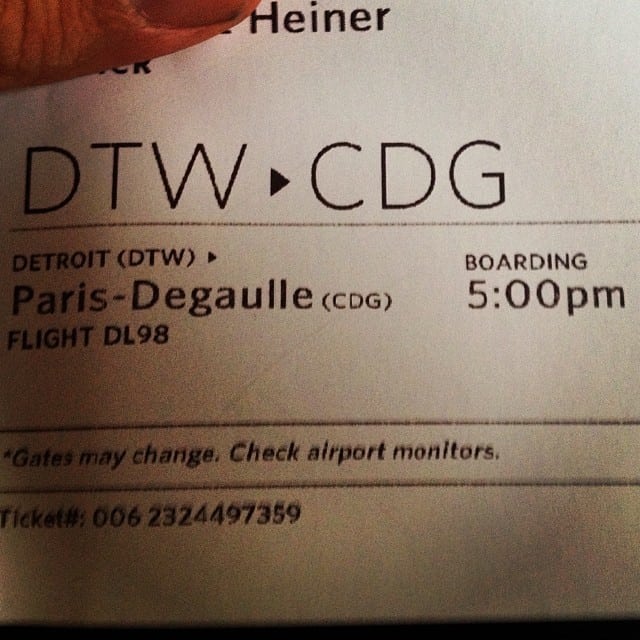
The photo is from my own Instagram feed, from the day I officially moved out of America, December 10, 2013.

Did you enjoy this article? TAIP is 100% reader-supported through tipping. If you want to leave us a tip of any amount it would be highly appreciated. These tips help support our efforts to keep TAIP an ad-free environment. Just as at a cafe, the tips are split evenly among the team.

Three Years On from Moving to France, Part II: Big Changes

Next month I begin my fourth year in Paris.  I wanted to use the milestone to share some reflections on how I have changed and ongoing tips on how to make the move yourself.  This is the second in a series of four.  You can find the first one here.

When people ask me “Why France?” I usually answer the question in Russian-doll format answering “why Europe,” then “why France,” then “why Paris.”  So too, when I reflect on how three years of living in Europe have changed me, I think in these categories.

Paris

Cars: more than ever I am anti-car.  Paris has an outstanding and extensive network of buses, trams, metros, and bikes, all overlaid across a city which is eminently walkable.  I support the current Mayor’s ongoing legislative push to exclude cars from the city center.  Cars are not a divine right.  They are an innovation, and they need to be put in their place side-by-side with pedestrians, bikes, scooters, etc., not accommodated as the sine qua non of modern life.

Neighborhood-focused: in my first year in Paris I went all over the city to visit restaurants and bars to know the city better, until I fell into the familiar routine of most Parisians: staying within a 15-minute walk of my apartment.  There is a deep comfort and familiarity that comes from knowing your streets and block by heart.  Sixty-five percent of my Paris life is located inside 8 streets near my house in the 2nd.  I love that, and I love knowing all the nooks and crannies that make up that little world.

France

Language: with classes and study it’s not difficult to obtain a conversational level of French quite quickly but beyond that you will have to study diligently, because if you don’t have to speak a lot of French every day, your progress will be slower than those who do.  I’ve learned to be patient with my progress.

Scale change: France is roughly “.8 Texas” in size, I often tell people.  I’ve gotten used to the idea that France is a “big country” and that Belgium is a “small country” and that Liechtenstein is a “tiny country.”  When I contemplate it now I realize just how enormous the US seems to most of the rest of the world.  And yet, as a believer in smaller countries (I believe they are more easily governed) I am ever more convinced that the US is simply too large of a country to be governed well.  It’s breaking into 3-5 nations would do the entire world much good, as the instant effects would be to end dollar hegemony and US military overreach.  It’s also the only circumstance under which I would ever contemplate a return to the US, because then there would be real hope for real change.

Bureaucracy: I understand the French completely in this regard now.  They want all their paperwork just so, and every time I’ve had it thus, the process, whatever it has been, has been expeditious.  Fill out the forms and wait.

Dairy Snob: In America it is the cereal and snack aisles that present you with almost limitless choices, though it’s all highly processed and generally not good for you.  In France you are confronted with that same panoply of choice when you get to the cheese, yogurt, and dairy sections.  The French truly love their dairy products, and most French cows are kept in the grazing conditions they have enjoyed for centuries.  You get to really love good butter, cheese, yogurt, and milk.

Europe

Guns: I have come to realize that America’s gun culture is a weird substitute religion.  I served in the US military and as such have, in the past, owned and used guns for range practice, to keep up my marksmanship.  But this whole “right to bear arms” is an irrelevancy in the age of drones.  Stockpiling weapons only makes sense if you’re:

a) paranoid enough to think that the government is going to come to take them or
b) stupid enough to think you have training, skills, or firepower to resist if they do or
c) you are willing to die for the abstract “right to bear arms” (whatever that means) which would make you a martyr for your gun religion.

Guns, in their proper context, can be an enjoyable hobby, like archery.  But in America, it’s a religion, and that’s unfortunate, because it’s pretty poor fare, as religions go.

The EU: I came to Europe as a hardcore Euroskeptic and lover of small government and nation-state sovereignty.  I was in Glasgow for the Scottish Referendum in 2014, cheering for Yes, I was in London for Brexit, cheering for Leave, and yet I live in France, a nation that was a founding member of what is now known as the EU.

I would say that I am still a lover of small government and would happily support Scottish departure from the UK and Catalonian separation from Spain.  Let them try it on their own.  The worst that can happen is failure but at least it’s something ventured.

And yet, I see that the EU does do good.  I accept that it has played a role in keeping the peace, but it must share credit at least equally with NATO, which has more than words to back itself up.  If the EU is to succeed (and I’m not opposed to its success) its future might lie in a two-tier approach one in which there is tighter, deeper cooperation for example with France, Benelux, Germany, Denmark, Sweden, and Finland, in which there is an integrated government, executive, and judiciary, and a second tier which is the greater EU, which would lie outside a currency union but exist in a free trade zone with some limitations on freedom of movement.  This would allow countries to sign up for more Europe or less Europe, and it would be better than the current “one size fits all” absurdity that puts Greece in a currency union with Germany.  The world is changing and the EU too must change if it wants to not just survive, but thrive.  Hence I remain a Euroskeptic…of the current iteration of the EU.  Hopefully it can change, especially as Brexit negotiations will lead to existential questions.

Pace of Travel: When I was a tourist visiting Europe from the States, and even in my first year here, I was in a frantic “see all the things” mode.  Who knew when I would be in Europe again, I thought to myself, so why not go at a breakneck pace?  But when you live here you realize it’s all within reach, be it a 10 € bus ticket, 25 € train ride, or 50 € flight.  And, should you keep your health and wits about you, it will continue to endure and be there for you.  So, when my friends come to visit, I try to slow them down too.

Pace of Life: This is perhaps the most wonderful thing about my life in Europe.  I’m a business owner and have been for many years.  As such I’ve been able to take off for short and long trips at almost any time of the year.  But I could only do so with fellow independents.  In Europe, all my friends with jobs have plenty of vacation time, and as such we can take short trips together all throughout the year.  We partition life and work and leave the office in its place when it’s time for life, and vice versa.  Americans throw around the phrase “work hard play hard” but, in Europe, it’s just called life: there’s work, there’s life, and time to enjoy both.  No need to binge or “go hard” on either.

Through all these changes I observe that there is no “right” way to do things in various countries and cultures.  There are just different ways to do things.  But, some of those ways are better than others, and I happen to think that Europe does a lot of things well.

Did you enjoy this article? TAIP is 100% reader-supported through tipping. If you want to leave us a tip of any amount it would be highly appreciated. These tips help support our efforts to keep TAIP an ad-free environment. Just as at a cafe, the tips are split evenly among the team.
Three Years On, Part I: Penseés for Those Planning to Move to France

Next month I begin my fourth year in Paris.  I wanted to use the milestone to share some reflections on how I have changed and ongoing tips on how to make the move yourself.  This is the first in a series of four.

I’ve successfully obtained two different classes of visa, long-term visitor (part one and two, and renewal) and indépendant, also known as profession libérale (part one and two).  It’s been really gratifying to get mail from readers who simply printed out those articles, followed them to the letter, and got visas. Indeed, I spent so much time researching and documenting the process that I now offer paid consulting services (in person and via Skype) to those seeking these visas, and refer those seeking other types of visas to professionals I have grown to know and trust.  Today I want to share, in broad strokes, just a few of the points I touch on when speaking to readers who use my consulting services.

What is a Scouting Trip?

This is the chance for you to take off your tourist hat and visit Paris as a possible resident.  You go to visit apartments that are in your price range to rent, even if you aren’t going to be in town for a while.  You meet with people who work in your industry (if you have a job) or meet with business owners in your field (if you’re an entrepreneur).  You go to Meetups and Coworking spaces to build a network and get to know the city a bit.  If you need a bit of assistance here, use Shapr.  And yeah, take a day trip and/or a trip to a nearby country to remind yourself of what’s at your doorstep when you live in this gem of a city.

What Is the Number One Mistake Made by Those Coming to Paris For the First Time?

Not having your housing situation locked down.  In fact a friend of an acquaintance showed up and was living in hostels and Airbnbs, and was completely clueless as to just how tight this market was (and is), and after 45 days of searching and applying to over 2 dozen places, gave up and went back to her country.  To be fair, I think she came for a job, not for the city, so she wasn’t committed to persevering, financially or emotionally, but I’m shocked to see even graduate students not take a very serious stance on this.  I recently coached a friend through this process who is enrolled in a two-year graduate program but only had arranged for a four-month Airbnb stay with no backup plan.  An agency found her a great place but witnessing her anxiety reminded me of my heady early days when I was in an Airbnb for 90 days before moving to my first apartment in Paris, a little shoebox in the sky, on the 8th floor of a centuries-old building in the 17th.

What is One Ongoing Nuisance?

Bank accounts.  I’ve written about it here and here and it seems at the moment that unless you are a fiscal resident of France, US citizens are being granted French bank accounts only with a lot of difficulty and documentation.  (Two readers of this blog who are not fiscal residents did manage to get an account at Crédit Agricole, after being turned down at Société Générale and BNP Paribas, among other places.)

There are a few workarounds.  You could, like my friend Patty, use your American credit card to pay for everything (maybe even earning points and miles), and then settle that bill every month from your American bank account, withdrawing petty cash as needed from that account.  This is not a solution for those who wish to live here long-term, however.

Alternatively, if your only major French-focused transaction each month is your rent payment, Wise will also allow you to pay a French bank account directly from your US bank account, with a bare minimum of fees, which is a lot more fun than withdrawing hundreds of euros from an ATM and then handing that to your landlord.

If you want a complement to the Transferwise solution you can use Revolut, which issues you a chip and pin card which you can load up in the currency of your choice from the bank account of your choice, all manageable from an app.  Did I mention it’s all totally free? 🙂

What is One Thing You Cannot Do Too Much of Before Arriving?

Conversational French.  You can take all the classes you want and know 6 different tenses and a lot of vocabulary, but if you haven’t practiced speaking French, you will be in for a rude awakening when you arrive.  In a way, I parse it as the difference between “studying” French and “learning” it.  You can “study” all you want, but your “learning” will commence when you arrive and get to speak this lovely language every day, and hear the pace, cadence, and the distinct Parisian pronunciation.  Get a private tutor, join a local meetup language group, use an app, and maybe, as a last resort, take classes (they are time-consuming and move only as quickly as the slowest person in the class).  As I post this article I am spending a month in the States and to keep my French up I’m attending a local French conversational meetup.

What Did You Fail to Do Adequately?

Budget.  There’s always “one more expense” I could not have foreseen.  If I could go back and do it again I would have taken my planned-down-to-the-centime budget and multiplied it by 1.5, thereby giving myself just an extra bit of fat.  As it turned out, the squeeze on my budget in the 11th month of my stay caused me to start another small business to generate more cash flow.  So, in my case the squeeze created a great new thing, but that doesn’t mean I couldn’t have benefited from the “1.5” strategy myself.

Last Thing…

Find and develop French friends.  Severely limit your reliance and/or attendance at “expat” bars or events, which ironically use English as the linguafranca.  I’ve found there is no faster way to the heart, stomach, and soul of France than my French friends.  They will help you with your French, ask for help with their English, and give you genuine local reactions to news, politics, and new places you want to try.

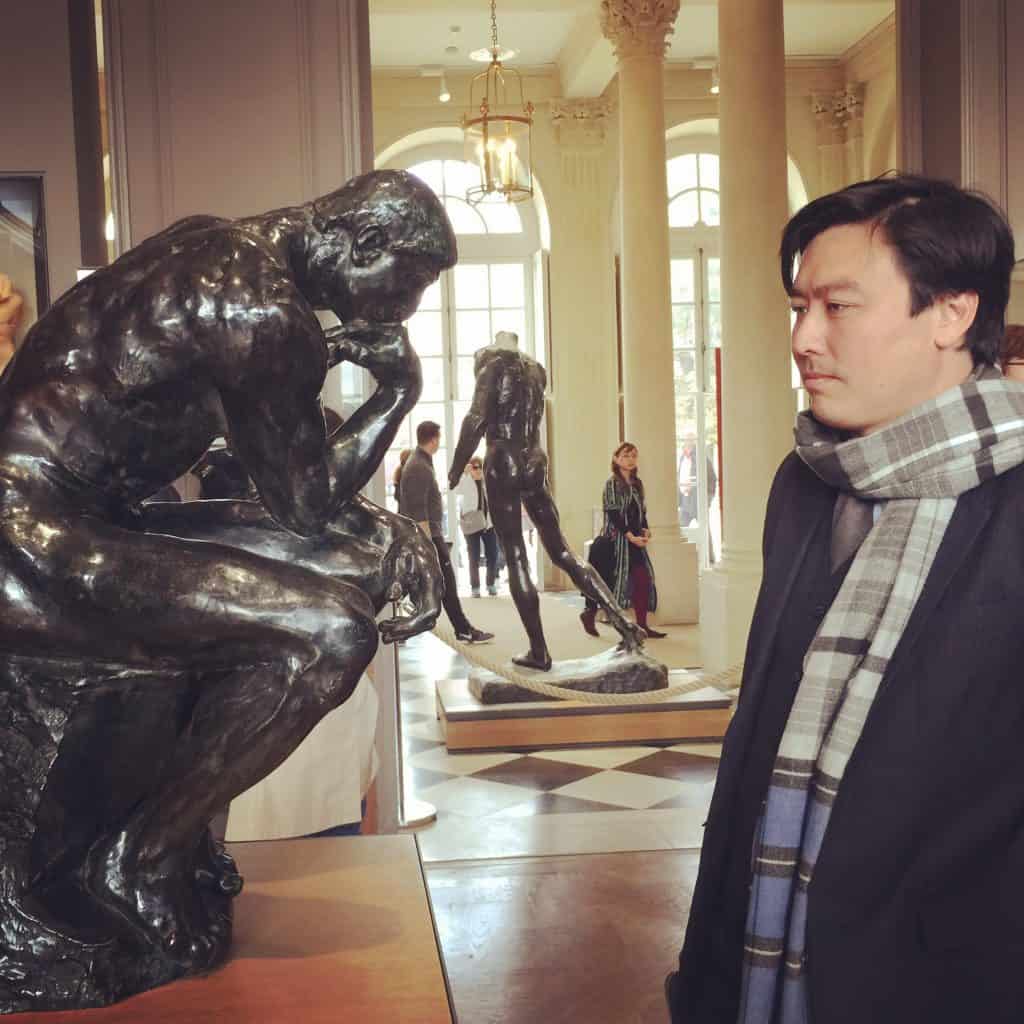
The photo was taken by my friend Domo on a recent visit to the Rodin Museum.  On almost every first Sunday when many museums are free, a group of us go out for brunch and a museum visit.  To date we have seen 22 museums together.

Did you enjoy this article? TAIP is 100% reader-supported through tipping. If you want to leave us a tip of any amount it would be highly appreciated. These tips help support our efforts to keep TAIP an ad-free environment. Just as at a cafe, the tips are split evenly among the team.

The Expat Visits “Home”

If you’ve built a full and rich life someplace before coming to Paris, visiting that place is much less a “vacation” than a carefully and meticulously planned series of meetings, appointments, coffees, and meals.  Throw in the occasional doctor/dentist visit and you’re pretty full up (for those wondering, I still visit my US doctor/dentist.  I have almost a decade of experience with them that I treasure and I maintain my health well enough for now to not have to find their equivalents in France.  As I move into the French health care system this summer I will finally at least meet these specialists).

The Good News

  • It is great to catch up with friends and family.  They are anxious to hear about your life, and are truly happy to see you, knowing how impacted your schedule is.
  • You get a better sense of what’s going on there.  Before I left I authored a piece on Trump, then went on to follow it up with the research of asking Americans who actually lived in America about some of my conclusions.

The Bad News

  • There’s a reason you’re in Paris.  You love it here and you don’t really like to be away for any period of time much less the 3-4 weeks you are gone to make an intercontinental flight worthwhile.  I don’t like being away from Paris, but…
  • It’s a necessary evil.  Having the first world luxury of emigrating to a country of your choice far away from these smiling faces means that you simply have to accept the division in your life that you have created by moving to a foreign land.
  • I’ll return to the US later this year for my youngest sister’s wedding.  I won’t bring books to read, as I won’t have time.  I’ll bring my smile and my energy to see as many people as I can during my visit.  Those conversations will linger with me long after I return to my new home.

Where is “home” anyway for people like me?  Start by watching Pico Ayer’s TED talk on the issue.

Did you enjoy this article? TAIP is 100% reader-supported through tipping. If you want to leave us a tip of any amount it would be highly appreciated. These tips help support our efforts to keep TAIP an ad-free environment. Just as at a cafe, the tips are split evenly among the team.
The US Visit: Tips & Tricks

I’m just returning from my fourth visit to America after relocating to France, and I thought I might share some tips and strategies to help you when you make your flights back.

Consider Flying Out of London

The fares are simply much more aggressively priced out of there and I got a $600 roundtrip ticket from London to Los Angeles on just 120 days’ notice.  Outside of the ultra-low-cost carrier market, prices are always higher when you fly to a country that doesn’t speak the language of the country you’re flying from.  For example, Paris to Martinique (French-speaking to French-speaking): $450 when I was scouting those fares a couple of months back.  Paris to Grand Cayman (French-speaking to English-speaking), just minutes further away?  $800.  It would make sense to fly to Martinique and then hop a small flight to the Caymans if that was your destination (but why not just try Martinique?  Grand Cayman, Little Cayman, and Cayman Brac will be there for you next time 🙂 ).  The airlines are guessing (rightly) that you’re probably a tourist, not just visiting family, and hence feel they can charge you more.

The same applies here in Europe.  If you book far enough ahead you can get 60€ roundtrip tickets on Eurostar (no I’m not kidding) for Paris-London and then fly from London.  Or you can make a side trip to London out of it.  You’ll still be ahead based on your savings from not flying out of Paris.  The exact same flight I took from London had a connecting leg from Paris…for $300 more.

Realize That Three Flights Are More Expensive than Four (But Are Also Easier)

I’ve visited America as a leg of a visit to South America.  I’ve also done the additional internal roundtrip route.  The latter is definitely cheaper.  My parents live in California so my inbound and outbound flights were out of Los Angeles but I also spent a week in Kansas, which I flew to directly using Spirit Airlines, the only ultra-low-cost carrier (read: charges for water and carry-ons) in North America.  The $200 for that flight (Los Angeles-Kansas City-Los Angeles) plus the original $600 for the London-Los Angeles segment added up to $800, or roughly $400 cheaper than the London-Los Angeles-Kansas City-London route I had priced out at $1225.  Of course the “savings” cost me 6 hours as I had to fly “back” to LA, away from Europe, and as I landed in LA to spend a few more days with my parents after visiting friends and family in Kansas I decided to do the easier 3 flight journey for my sister’s upcoming wedding in October.  After this most recent trip, I think the extra cost will definitely be worth it.

Consider Flying Air New Zealand if They Are on Your Route

I was so pleased with my experience in coach of all places that I wrote about it the day after I landed!

Use Priceline for Rental Cars

Name Your Price is still alive and well and I used it to get a car for $20/day USD in Los Angeles, with Avis.  If you want to know the hack, send me an email.

Keep Some Loose Cash with Your Electrical Adapters

You won’t have to go to an ATM right away when you deplane, and you also won’t forget the adapters you need.

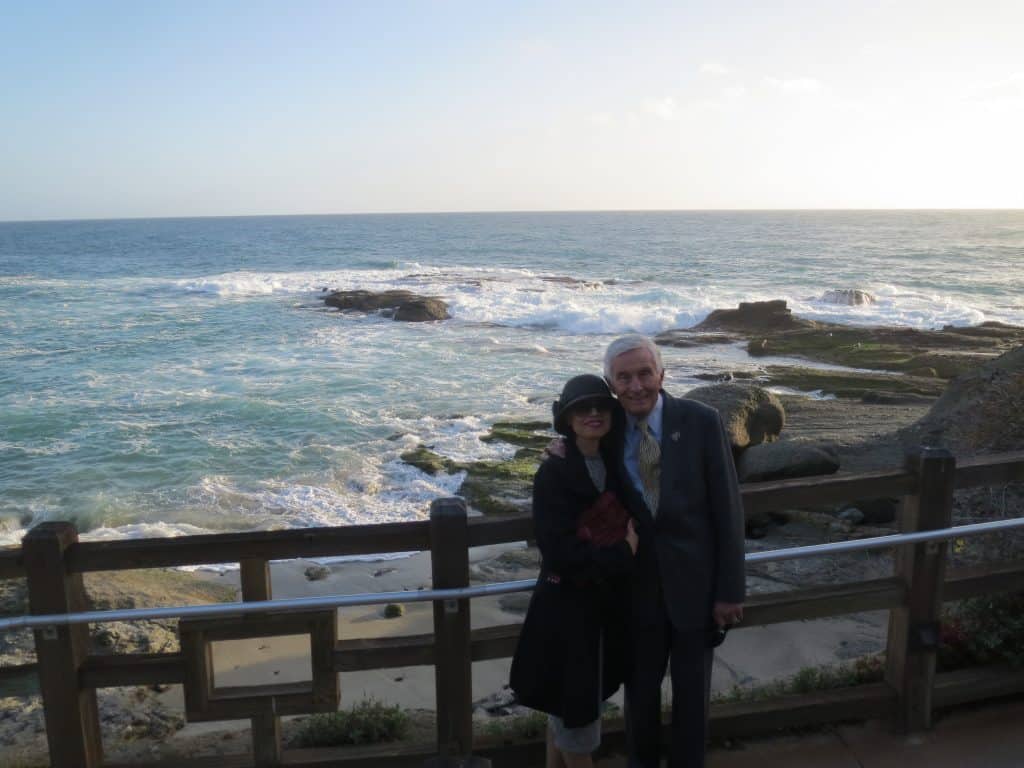
Photo was taken by me this month on the rocky Laguna Beach shoreline.  My amazing parents, celebrating 40 years of marriage this year.

Did you enjoy this article? TAIP is 100% reader-supported through tipping. If you want to leave us a tip of any amount it would be highly appreciated. These tips help support our efforts to keep TAIP an ad-free environment. Just as at a cafe, the tips are split evenly among the team.

How to Get a Same Day US Passport (in Los Angeles)

One of the challenges of living in Europe is that you may get your passport stamped a lot.  I say may because there are times I’ve traveled through four countries and never been asked for ID, much less a passport.  But if you do leave Schengen (most notably, to go to the UK, or to the newer Eastern European members of the EU, i.e. Poland/Hungary/Croatia, etc.) you will probably be asked for your passport.  If you have your French carte de sejour (the card version, not the sticker in your passport one) you can sometimes use this in the EU passport line.  I’ve tried it more than once with success, and always had the backup plan of playing “dumb American” if it didn’t work. 🙂

This is all to say that my 26-page US passport was coming to the end of its useful life last November.  Though it was still 3 years to go until renewal (American passports are good for 10 years these days), I was out of pages for stamps.  Yes, I know, tough life for Stephen.  My problem was compounded by the fact that the US Embassy in France was directed to stop adding extra pages to passports on December 31, 2015, a fact I found out in late November when looking through their website.  Given that I would need my passport all throughout December for travel, I couldn’t spare it for the 2-3 weeks the embassy would need to make the extra pages.

By the time I had a moment to go to the US Embassy in Paris in late January of this year, I had figured out that I had to renew in person: foreign residents aren’t permitted to mail their passports back to the US for extra pages service (which still exists there, anyway).  The instructions stated this in bold and the embassy employee confirmed it.  Again, due to travel, I couldn’t surrender the passport for 2-3 weeks or even the 2-3 business day expedited service.  My “I’m out of pages” reason didn’t qualify for any higher level of expediting.  And given how customs officials don’t seem to care about stamping over previous stamps, perhaps it wasn’t that big of a deal anyway.  But I didn’t want to chance it.

“So I should do rush processing when I’m in America next month?” I asked.  He shrugged, then nodded as he realized that would be easy.  I told him I would be in Los Angeles for a segment of my trip and he said they did same-day processing.

As I got ready to leave France I called 1-877-487-2778, which is the number to make an appointment for passport services in the USA.  Since I wasn’t 14 days from leaving the US (I hadn’t even technically arrived), they said I couldn’t make an appointment yet (I found out later this wasn’t true).  She then told me to call back 14 days prior to my leaving with the date I wanted the appointment.  Alas, the next available time was while I would be in Kansas City for a week visiting friends and family and there was no regional consulate there.

After perusing the interwebs, I gleaned that I might be able to get in with no appointment IF I showed up at some terrible hour in the morning (note: terrible is generally anything prior to 10am), but in this case it would be compounded by waking up even earlier to drive there.  I left north Orange County at around 5am to arrive at 11000 Wilshire Blvd at 6:30am, 30 minutes before the opening time on a Wednesday (normal hours are 7am-3pm).  The line was 30 deep already, but of the 20 only 5 were without appointments, including a couple who had their suitcases with them!

When I got to the window around 7:15am I got the skinny which the interwebs didn’t provide: no-appointment folks (like myself) would only be seen if they had proof of travel within 48 hours.  I was 12 days out, timely by appointment standards, but not by standby standards, which was only for the most desperate.  “Make an appointment for 2 days before you leave,” he told me in response to my stating I was going to be in KC shortly.  Trusting in the “we see everyone in line on Fridays” rule (my flight to Europe would be on a Sunday) I called the 800 number again and this time used the automated system to get an appointment for a date and time of my choosing, which would be the 18th of March at 7am.

* * *

This time, I left at 5:30am, with the confidence of someone who had an appointment in hand and who understood how the system worked.  Even better, I was a veteran of the French immigration system.  Did these Americans, with their simple and easy five requirements, think they could intimidate me? 🙂

Everyone lined up in the same place as before, but the line was longer as I arrived right at 7, not at 6:30 as I did the time before.  After a few minutes, the guard left the main lobby and walked over to that side of the building and that line and directed those who had appointments to go to the lobby and everyone else (non-appointment peeps) to stay there.

Anticipating this, I had loitered in sort of a neutral in-between spot, pretending to look at something important on my phone.  As the line started moving my way I slowly ambled towards the main lobby to the line outside to enter the security check.  I was third in line to enter.  The French “lines are for other people” attitude was engrained, I guess!

I had my paperwork ready to go after I passed the security check, and 20 minutes and $200 USD later, I had a claim check and a 2:00pm pick-up time.  The costs included a passport book (the super size 52-page edition, no extra charge), a passport card (used for travel in North America and the Caribbean: I figured why not pick one up since I was there anyway), and the expedite fee.

I got breakfast, went to the beach, about 10 minutes away, then whiled away 2 hours at the amazing Getty Center, just a few miles up the road, and one of my favorite places in Southern California, and returned at 2pm thinking I would simply go back into the building and high five myself after getting my new stuff.  The guard pointed me in the direction of a line that was three times longer than the morning line.

“But I’m here to pick up,” I said, thinking I was special.  “So are they,” he must have said for the thousandth time.  And coming back earlier wouldn’t have helped a couple who came at 8 got into the line at 1 so they would get to the window at 2.  No luck theirs wasn’t ready yet.

So I plopped down at the end of the line and read for about 90 minutes as the line slowly snaked forward.  As it got closer to 3pm some nervous nellies asked the guard if they would close the window at 3pm.  “We’ll see everyone in line,” he said patiently.  And it made sense.  It was a 120-second interaction for the slowest, as far as we could tell, and about 30 seconds for the fastest.  You or a designated agent hand over a claim check, show ID, sign, and get the passport.

So around 3:30pm I finally pulled onto the 405 to go back to Orange County, which most people know is precisely the wrong time to get on that freeway, and the carpool lane didn’t have it any better.

So, I “lost” almost a full day bringing you this information, and you will likely lose the same executing this, but bring a book, some snacks, a friend, and a fully-charged phone, and you’ll be fine.  To say nothing of the fact that you’ll have a brand new passport in your hand that same day.  That will make it all worthwhile.  Even the 4am wake-up part.

Featured passport photo taken by Lena LeRay and used by Creative Commons copyright.  

Did you enjoy this article? TAIP is 100% reader-supported through tipping. If you want to leave us a tip of any amount it would be highly appreciated. These tips help support our efforts to keep TAIP an ad-free environment. Just as at a cafe, the tips are split evenly among the team.
Mailbag: Passport Pages, Transferring Your Visa, and Taxes

It’s been a while since I’ve done one of these, but it’s often helpful for me to share some of these answers to questions I get in email so that others who are also wondering might have their questions answered as well.

How does adding passport pages to my (US) passport or renewal of it affect my visa?

Well, this is a two-parter.  As of December 31st, 2015, the US Embassy in France is no longer adding pages to your passport.  What that means (and I confirmed this in person at the Embassy) is that you will have to apply for an early renewal of your passport, as US citizens living abroad are not permitted to mail their passport back to the US for pages to be added there.  For my battle-worn blue book, that renewal ends up being roughly 3 years early.  But given that I’m down to room for exactly 5 more stamps, it’ll have to do, especially since I have a lot of travel later this year.

As to how it affects your visa: it doesn’t.  If you’re in the first year of your long-term stay visa, your carte de séjour exists in the form of the sticker that OFII put in your passport roughly 90 days after you arrived during your follow-up visit.  If you add pages/renew your passport you will get your cancelled passport back and still show that sticker, if you need to.

If you’re in your second year and beyond, you will be issued an actual carte de séjour after your renewal, which effectively functions both as your ID and your visa.  Those stickers in your passport from years ago are then like the rest of the stamps in your passport memories but nothing legally important.

You said recently that you had to file taxes?  How did that go?

Great question!  Funnily enough, despite sending them a properly filled-out French tax return appropriate for a foreign filer, in which I indicated that my income had not been derived from French companies, they still sent me a bill for 1781 euros.  After some laughter with my accountant and attorney, an email was dispatched to the relevant department:

réf de l’avis:15 75 XXXXXXX XX
Nº fiscal déclarant: 30 25 XXX XXX XXX X

Messieurs,

Je reçois cet avis d’imposition dont je conteste le fondement. En effet, l’assiette de la CSG et de la CRDS est l’ensemble des revenus français quelque soit leur nature et montant.

La totalité des revenus composant l’assiette de cette imposition a été d’origine américaine, perçue et imposée aux USA conformément au traité fiscal franco-américain.

En conséquence, de par la définition même de cette double imposition CSG – CRDS, l’assiette de cette imposition ici présente est non conforme. Je demande donc son annulation immédiate et sans condition.  

Cordialement,

Stephen HEINER

The next day, which is essentially light speed by French standards, had this response in my inbox:

Monsieur,

Votre demande a bien été prise en compte. Vous allez bientôt recevoir un avis de dégrèvement.

Salutations.

Translation: You’re right.  You don’t owe any money.

Stephen: Gee, thanks. 🙂

Did you enjoy this article? TAIP is 100% reader-supported through tipping. If you want to leave us a tip of any amount it would be highly appreciated. These tips help support our efforts to keep TAIP an ad-free environment. Just as at a cafe, the tips are split evenly among the team.